
Sand Blasting Machine Market Size, Share & Demand by 2034
Coverage: by Blasting Type (Dry, Wet); Product Type (Portable, Stationary); End-user (Automotive, Construction, Marine, Oil and Gas, Others) , and Geography (North America, Europe, Asia Pacific, and South and Central America)
- Status : Data Released
- Report Code : TIPRE00008865
- Category : Manufacturing and Construction
- No. of Pages : 150
- Available Report Formats :


- Last update date : September 18, 2026


2025 Market Size
US$ 601.77 Mn
Base year value
2034 Forecast
US$ 909.33 Mn
Projected by 2034
CAGR 2026-2034
4.69 %
Growth rate
Addressable Market
US$ 6,858.60 Mn
(2026-2034)
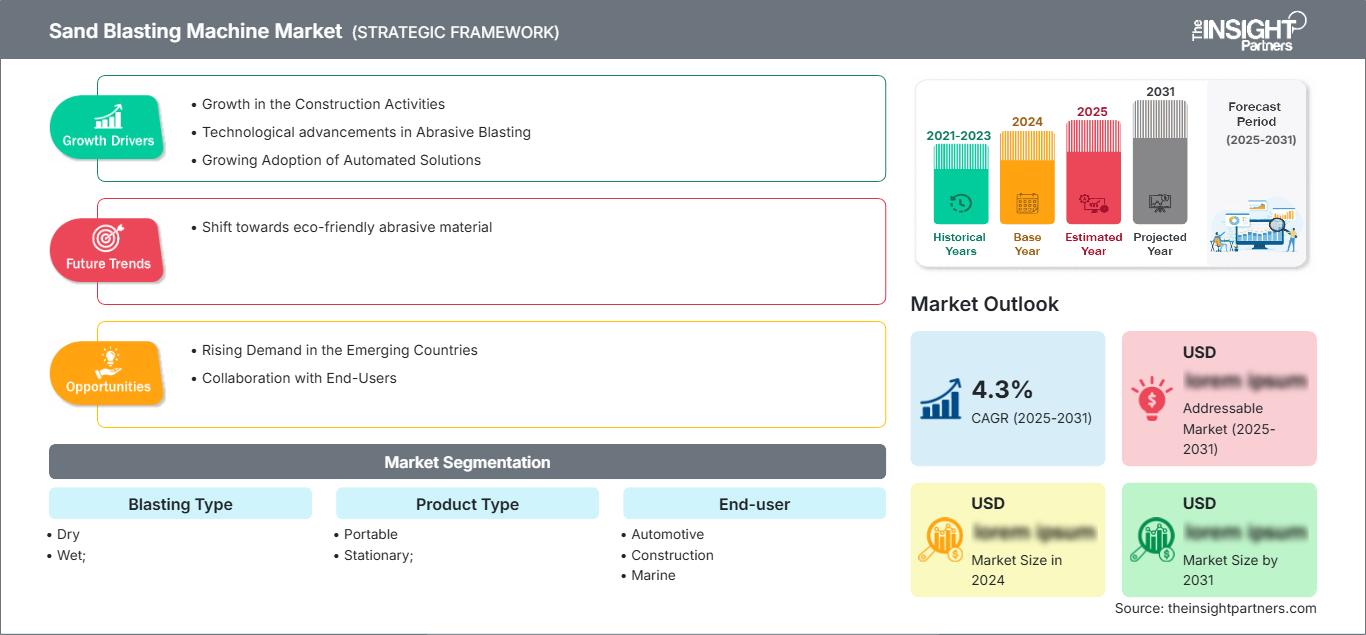
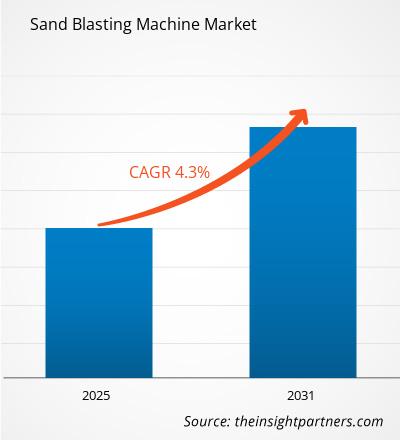
The sand blasting machine market was valued at US$ 601.77 Million in 2025 and is projected to reach US$ 909.33 Million by 2034, expanding at a CAGR of 4.69% during 2026–2034. Demand is supported by surface preparation requirements across automotive, construction, marine, and oil and gas applications, while equipment development increasingly emphasizes controlled abrasive delivery, dust management, portability, operator protection, and compatibility with diverse surface-treatment processes.
The sand blasting machine market size in North America is positioned for steady expansion, with a modeled CAGR of 3.9–4.4% through 2034. Structural demand is supported by bridge and infrastructure rehabilitation, industrial maintenance, automotive refinishing, and protective-coating preparation. Replacement of aging equipment and tighter workplace controls are also encouraging contractors to adopt systems offering improved abrasive metering, containment, recovery, and wet-blasting capabilities.
Sand Blasting Machine Market Assessment and Insights
- North America: Mature industrial maintenance activity supports a 17–20% share in 2025, with the region growing at a 3.9–4.4% CAGR between 2026–2034. Infrastructure rehabilitation and coating preparation remain important demand anchors.
- US: The US represents 72–78% of North America's 2025 market, with growth of 3.8–4.3% CAGR between 2026–2034, supported by industrial maintenance, automotive restoration, and infrastructure spending.
- Europe: Europe accounts for a 20–24% share in 2025 and is expected to grow at a 4.3–4.8% CAGR between 2026–2034, led by Germany, the UK, France, Italy, and Spain, where industrial refurbishment and coating compliance sustain demand.
- Asia Pacific: Asia Pacific holds a 28–32% share in 2025 and is forecast to expand at a 5.2–5.8% CAGR between 2026–2034, led by China, Japan, South Korea, and India as manufacturing and infrastructure capacity expands.
- Largest Segment: Dry blasting represents a 68–72% market share in 2025, with a 4.3–4.7% CAGR from 2026–2034, reflecting broad industrial applicability and established contractor practices.
- High Growth Segment: Portable equipment holds a 43–47% market share in 2025 and is projected to grow at a 5.3–5.8% CAGR from 2026–2034, benefiting mobile maintenance requirements.
- Key companies analyzed in detail: Airblast B.V.; Burwell Technologies Pty Limited; C.B. Sabbiatrici S.R.L.; Clemco Industries Corp.; Empire Abrasive Equipment; Mod-U-Blast; Norton Sandblasting Equipment; PAUL AUER GmbH; Quill Falcon; TP Tools & Equipment.
Source: The Insight Partners' analysis based on proprietary research, government publications, company annual reports, investor presentations, industry databases, and expert interviews.
The sand blasting machine market has evolved from basic pressure-pot configurations toward equipment incorporating controlled abrasive metering, improved moisture separation, dust suppression, recovery systems, ergonomic controls, and application-specific configurations. Portable systems have gained relevance where contractors move between infrastructure, marine, and maintenance sites, while stationary installations remain important for repeatable production environments. Equipment suppliers increasingly combine blast machines with extraction, air treatment, media recovery, and safety controls.
Looking ahead, the sand blasting machine market is expected to benefit from refurbishment activity in emerging industrial economies, modernization of fabrication facilities, and investments in transportation and energy infrastructure. Regulatory attention to worker exposure, particulate emissions, and surface-preparation practices should favor better-contained systems. Demand is also likely to diversify toward wet and dust-suppressed configurations where work occurs in populated areas, enclosed environments, or facilities requiring tighter contamination control.
Sand Blasting Machine Market Report Scope
| Report Attribute | Details |
|---|---|
| Market size in 2025 | US$ 601.77 Million |
| Market Size by 2034 | US$ 909.33 Million |
| Global CAGR (2026 - 2034) | 4.69% |
| Historical Data | 2021-2024 |
| Forecast period | 2026-2034 |
Sand Blasting Machine Market Analysis
The sand blasting machine market growth is closely linked to the surface-preparation ecosystem, which includes equipment manufacturers, abrasive suppliers, compressor providers, protective-coating companies, contractors, maintenance specialists, and distributors. Demand occurs because there is a need to clean, restore, or prepare for coating any substrate that may be made of steel, concrete, or aluminum, among others. The value of the equipment is determined not only by machine performance but also by compressor compatibility, nozzle choice, abrasives consumption, recovery rate, and safety.
There are different factors that play out in the supply of both portable and engineered blast equipment. For the portable machines, there will always be competition based on mobility, reliability, pressure regulation, and maintainability, while large machines have to distinguish themselves through blast room capability, automation, dust collection, abrasive recovery, and customizing their layout. Rising emphasis on total operating cost is also shifting purchasing decisions from equipment price toward abrasive efficiency, downtime, maintenance requirements, and lifecycle performance, as highlighted in the Sand Blasting Machine Market report.
The competitive positioning of these companies is increasingly relying on their engineering capability rather than just the mere availability of machines. Airblast B.V. integrates machinery and anticorrosion products on a global scale, whereas Burwell Technologies Pty Limited concentrates on production, distribution, and custom-designed surface preparation systems in Australia. On the other hand, C.B. Sabbiatrici S.R.L. is concerned with blasting and shot peening machinery, while Clemco Industries Corp. offers a wide range of products.
There is a tendency to opt for specialized products. The company Empire Abrasive Equipment prides itself on customized finishing systems as well as domestic production, while Mod-U-Blast specializes in portable air treatment systems, safety and blasting equipment. Norton Sandblasting Equipment and TP Tools & Equipment take care of needs that pertain to contractors and automobiles, whereas PAUL AUER GmbH specializes in engineered blasting equipment. Quill Falcon is increasingly concentrating on dustless and portable equipment in restricted workspaces.
● REPORT CUSTOMIZATION
Tailor This Report To Align With Your Specific Business Requirements
This report can be customized to align precisely with your business objectives, scope, and target markets. Customization options include tailored segmentation, geography, competitive analysis, and strategic insights to support informed decision-making.
Customize This Report →WHAT YOU CAN ADJUST
- ● Segmentations
- ● Geography
- ● Competitive Analysis
- ● Language Preferences
Sand Blasting Machine Market: Strategic Insights
Regional Insights
North America Sand Blasting Machine Market
North America represented a 17–20% of the Sand Blasting Machine Market share in 2025 and is projected to expand at a 3.9–4.4% CAGR through 2034. The United States dominates regional demand due to industrial maintenance, bridge refurbishment, automotive restoration, shipbuilding, and coating pretreatment requirements. Canada makes its contribution due to energy, infrastructure, mining, and marine projects, whereas Mexico is enjoying growing manufacturing output and cross-border industrialization efforts. Replacement demand is significant, since contractors need machines that will allow them to be productive regardless of operating conditions.
Regional demand increasingly stresses the importance of containment, abrasives recovery, air quality control, and operator safety. Wet systems become increasingly application-oriented where dust suppression is needed, whereas portable systems stay popular among field maintenance. North American manufacturers have after-market, rental, and spare parts opportunities available. The regional competitive situation is favorable for suppliers who are not only selling machines but also offering equipment, service, and application engineering support.
U.S. Sand Blasting Machine Market
The US accounts for 72–78% of North America's 2025 Sand Blasting Machine Market and is expected to grow at a 3.8–4.3% CAGR through 2034. Demand is distributed across automotive, construction, marine, oil and gas, and industrial maintenance. Contractors increasingly require mobile equipment for bridges, structures, machinery, and localized coating-removal work. The presence of Clemco Industries Corp., Empire Abrasive Equipment, Mod-U-Blast, Norton Sandblasting Equipment, and TP Tools & Equipment strengthens domestic product availability and aftermarket support.
Application trends are moving toward improved dust control, abrasive recovery, remote controls, and more efficient air management. Infrastructure maintenance remains strategically important because surface preparation directly affects coating adhesion and asset life. Automotive restoration supports a separate contractor and workshop customer base, where cabinet and compact blasting solutions are particularly relevant. Energy and industrial facilities create additional demand for robust equipment capable of operating across maintenance cycles and demanding environmental conditions.
Europe Sand Blasting Machine Market
Europe represented a 20–24% share in 2025 and is projected to grow at a 4.3–4.8% CAGR through 2034. Germany leads the region through its extensive machinery, automotive, metalworking, and industrial manufacturing base. The UK has significant demand from infrastructure rehabilitation, marine maintenance, construction restoration, and specialist contractors. France, Italy, and Spain contribute through industrial fabrication, transportation infrastructure, shipbuilding, automotive production, and renovation activity.
European purchasing decisions increasingly incorporate dust management, operator safety, energy efficiency, and environmental performance. Wet and dust-suppressed solutions are gaining relevance for urban projects and enclosed worksites. PAUL AUER GmbH and C.B. Sabbiatrici S.R.L. provide strong regional engineering capabilities, while Airblast B.V. serves anticorrosion and industrial users. The UK also supports specialist demand for mobile and dustless systems, while Germany remains the leading country because of its broad manufacturing and engineered-equipment base.
APAC Sand Blasting Machine Market
APAC holds a 28–32% share in 2025 and is forecast to grow at a 5.2–5.8% CAGR through 2034, making it the leading regional growth engine. China leads, followed by Japan, South Korea, India, and Australia. Manufacturing expansion, shipbuilding, infrastructure development, automotive production, and energy projects create recurring surface-preparation requirements. Industrial localization and modernization of production facilities should sustain equipment investment.
China's large manufacturing base provides scale, while Japan and South Korea support technologically demanding automotive and marine applications. India is benefiting from infrastructure and industrial capacity additions, while Australia maintains strong demand from mining, energy, marine, and maintenance operations. Local distribution and service capabilities will remain important because equipment utilization depends heavily on compressor support, abrasive availability, replacement components, and technician access.
Middle East & Africa Sand Blasting Machine Market
Middle East and Africa Sand Blasting Machine Market demand is supported by energy infrastructure, construction, marine assets, and industrial maintenance. Saudi Arabia and the UAE remain leading markets because of large-scale infrastructure and energy investment, while South Africa contributes through mining, manufacturing, and transportation maintenance. The regional market is expected to expand at a 3.8–4.3% CAGR through 2034.
Saudi Arabia is the leading country, with oil and gas maintenance providing recurring requirements for corrosion and coating preparation. The UAE benefits from marine, construction, and industrial projects, while South Africa supports mining and heavy-industry applications. Rest-of-MEA demand is more project-driven and sensitive to capital expenditure cycles. Portable systems are particularly relevant where contractors must move equipment between dispersed industrial sites.
Segmentation Analysis
Blasting Type
Dry and wet systems address different operating requirements, with dry blasting remaining the dominant configuration. The main segment is expected to expand at a 4.3–4.7% CAGR from 2026–2034. Dry equipment benefits from established contractor practices, broad substrate compatibility, and high productivity, while wet systems are increasingly selected where dust suppression, heat reduction, or contamination control is important. The Sand Blasting Machine Market forecast indicates continued demand across both configurations as end users balance productivity, environmental requirements, worker safety, and surface preparation performance.
- Dry: The dominant configuration, supported by established contractor workflows, high material-removal capability, broad industrial compatibility, and strong use in automotive, construction, marine, and maintenance applications.
- Wet: Increasingly important where airborne dust, heat, or contamination must be controlled. Adoption is supported by urban restoration, enclosed worksites, marine maintenance, and sensitive industrial environments.
Product Type
Product configuration is divided between equipment designed for mobile field operations and systems installed within dedicated production or blasting facilities. Portable equipment is expected to register a 5.3–5.8% CAGR from 2026–2034, reflecting demand for flexible deployment, while stationary systems remain important for high-volume and repeatable processing.
- Portable: Strong demand comes from contractors serving bridges, vehicles, pipelines, marine assets, construction sites, and industrial maintenance locations where equipment must be transported between projects.
- Stationary: Preferred for controlled production environments requiring repeatable blasting, integrated extraction, abrasive recovery, larger capacity, and consistent processing of recurring workpieces.
End-user
End-user demand is diversified across industries where corrosion removal, coating preparation, restoration, cleaning, and substrate conditioning influence asset performance. The segment is expected to maintain steady expansion as infrastructure and industrial assets require periodic refurbishment. Automotive and construction provide broad demand, while marine and oil and gas applications tend to require specialized equipment and operating controls.
- Automotive: Demand centers on restoration, component cleaning, coating removal, body preparation, and workshop applications, with compact cabinets and controlled blasting systems supporting repeatable operations.
- Construction: Infrastructure rehabilitation, structural steel preparation, concrete restoration, and coating removal create recurring demand, particularly for portable equipment suitable for field-based work.
- Marine: Shipyards and maintenance contractors use blasting for corrosion removal and coating preparation on hulls, decks, structures, and equipment exposed to aggressive environments.
- Oil and Gas: Pipelines, storage tanks, processing facilities, and production equipment require surface preparation during maintenance and recoating cycles, supporting robust and controlled blasting systems.
Opportunity Snapshot
| End-User | Revenue Contribution (High/Medium/Low) | Trend Tag (MAX 2 words) | Adoption Stage (Emerging/Scaling/Mature) |
| Automotive | High | Restoration Work | Mature |
| Construction | High | Infrastructure Rehab | Scaling |
| Marine | Medium | Corrosion Control | Mature |
| Oil and Gas | High | Asset Recoating | Mature |
Sand Blasting Machine Market Growth Drivers and Impact Analysis
Infrastructure rehabilitation and protective-coating renewal
One important source of demand for blasting equipment stems from the ongoing need to repair bridges, industrial structures, pipelines, tanks, machinery, and other pieces of equipment whose lifetimes rely on proper surface treatment. Blasting is the process of eliminating corrosion, degraded coating, scale, and other contaminants prior to applying protection. The economic effect is not limited to the purchase of equipment since the contractors must acquire other items such as compressors, dust collectors, abrasives, recovery systems, protective gear, and replacements. Infrastructure projects thus generate a multi-step demand chain within the larger surface preparation ecosystem. Mobile equipment is more useful in cases where there are several locations, while stationary units are better suited where fabrication and maintenance take place in enclosed areas.
Expansion of industrial manufacturing and refurbishment capacity
As there is an expansion in manufacturing, there will be greater opportunities for the use of surface preparation on fabricated metals, auto parts, machinery, building materials, and industrial equipment. The blasting process can help in improving the adherence of the coating and cleaning the parts before further processing. This makes the performance of the equipment very significant with respect to the manufacturing process. This would be particularly true where there is increased capacity in the factory or where new product lines have been added that require repeated surface preparation. Fixed systems could have advantages in these situations since extraction, recycling, and automation of the process can lead to reduced labor requirements. On the other hand, small workshops and subcontractors will have advantages with portable and compact systems due to budgetary and space constraints.
Greater emphasis on worker protection and dust management
The effects of workplace exposure considerations are affecting equipment purchasing decisions where blasting is done in proximity to other personnel, in enclosed areas, or on occupied structures. Buyers are starting to consider containment capabilities, dust suppression, remote control, compatibility with respiratory protection, abrasive recovery, and visibility in addition to pressures and capacities. Wet blasting may be able to take a larger share in applications that require airborne particulate control, while dry blasting will remain dominant where removal efficiency is most important. The effect is increasing the need for equipment packages rather than individual blast pots. Manufacturers can compete by offering features such as deadman switches, moisture separation, filtration, abrasive recovery, and safety systems. This creates stronger incentives for contractors to minimize cleaning and disruption times.
Sand Blasting Machine Market Future Trends
Increasing integration of automated and digitally controlled blasting
The sand blasting machine market trends are expected to increasingly incorporate automated pressure regulation, programmable abrasive metering, remote controls, sensor-based monitoring, and production-line integration. Automation can also help in increasing repeatability through the consistency in the blasting parameters for each workpiece and less reliance on the skills of the operator. For large setups, automation may become more common with machines communicating with extraction, recovery, conveyor, and inspection systems to enable automated surface treatment processes. The collection of data can be used to plan for maintenance of abnormal pressure, usage of abrasives, and machine usage. Automation adoption will primarily be limited to high-production companies due to higher costs for integrating and engineering the processes compared to simple contractor machines.
Growth of low-dust and application-specific blasting configurations
The sand blasting machine market is likely to see broader adoption of application-specific wet, dustless, vapor-reduced, and confined-space configurations. These systems are designed around operating constraints rather than simply maximum abrasive velocity. Urban maintenance, heritage restoration, hazardous coating removal, enclosed industrial areas, and work near sensitive equipment can benefit from reduced airborne dust and improved operator visibility. Equipment manufacturers are likely to respond with lighter mobile systems, water-management accessories, improved mist control, and specialized containment solutions. Electric or alternative power configurations may also become more relevant where emissions, access, or indoor operation restrict conventional compressor arrangements. The resulting product landscape should become more segmented, with buyers selecting equipment according to substrate, coating, worksite restrictions, recovery requirements, and environmental controls rather than using one machine configuration for every application.
Sand Blasting Machine Market Opportunities
Expansion of mobile equipment rental and contractor service models
The sand blasting machine market presents an opportunity for suppliers to expand rental, leasing, demonstration, and equipment-as-a-service models aimed at contractors with irregular project workloads. The use of mobile equipment can prove particularly well-suited to such situations because the demand for such equipment is often driven by the schedule for the infrastructure, marine, construction, or industrial shutdowns. Renting allows for reducing initial capital investment and choosing the capacity depending on the size of the project. Service companies can improve their revenue flow from abrasive supply, compressor rental, maintenance services, replacement of nozzles, protective equipment and technical assistance. Setting up regional centers to provide fast repairs and part availability will increase the speed of operations even further. Such an approach can be highly appropriate for developing countries where contractors are growing and at the same time are cautious about making investments.
Specialized solutions for energy and complex industrial assets
Infrastructure for energy represents a great opportunity for suppliers that can design equipment considering hard-to-reach locations, hazardous environments, and tough maintenance schedules. Oil refineries, pipelines, tanks, power plants, and new hydrogen infrastructures need surface preparation while maintaining low operational disruptions. Equipment can help in such issues as confined spaces, dust control, hazardous-area compliance, remote control, and fast mobilization. Suppliers can distinguish themselves by creating specific solutions based on trailer designs, compact equipment, better water handling, explosive risk compliance, and integrated extraction technologies. Cooperation with contractors providing industrial maintenance services and coating providers can generate demand through projects while showing off equipment performance in a challenging environment. This opportunity does not rely much on large volume sales but on valuable equipment and repeatable maintenance contracts.
Frequently Asked Questions

- Comprehensive Market Sizing and Forecast Analysis
- Detailed Segmentation Analysis
- In-Depth Market Dynamics Assessment
- Regional and Country-Level Insights
- Competitive Landscape and Company Benchmarking
- Strategic Business Intelligence
Recent Reports
Testimonials

The Insight Partners' SCADA System Market report is comprehensive, with valuable insights on current trends and future forecasts. The team was highly professional, responsive, and supportive throughout. We are very satisfied and highly recommend their services.
RAN KEDEM Partner, Reali Technologies LTDs
I requested a report on a very specific software market and the team produced the report in a few days. The information was very relevant and well presented. I then requested some changes and additions to the report. The team was again very responsive and I got the final report in less than a week.
JEAN-HERVE JENN Chairman, Future Analytica
We worked with The Insight Partners for an important market study and forecast. They gave us clear insights into opportunities and risks, which helped shape our plans. Their research was easy to use and based on solid data. It helped us make smart, confident decisions. We highly recommend them.
PIYUSH NAGPAL Sr. Vice President, High Beam Global
The Insight Partners delivered insightful, well-structured market research with strong domain expertise. Their team was professional and responsive throughout. The user-friendly website made accessing industry reports seamless. We highly recommend them for reliable, high-quality research services
YUKIHIKO ADACHI CEO, Deep Blue, LLC.
This is the first time I have purchased a market report from The Insight Partners.While I was unsure at first, I visited their web site and felt more comfortable to take the risk and purchase a market report.I am completely satisfied with the quality of the report and customer service. I had several questions and comments with the initial report, but after a couple of dialogs over email with their analyst I believe I have a report that I can use as input to our strategic planning process.Thank you so much for taking the extra time and making this a positive experience.I will definitely recommend your service to others and you will be my first call when we need further market data.
JOHN SUZUKI President and Chief Executive Officer, Board Director, BK Technologies
I wish to appreciate your support and the professionalism you displayed in the course of attending to my request for information regarding to infectious disease IVD market in Nigeria. I appreciate your patience, your guidance, and the fact that you were willing to offer a discount, which eventually made it possible for us to close a deal. I look forward to engaging The Insight Partners in the future, all thanks to the impression you have created in me as a result of this first encounter.
DR CHIJIOKE ONYIA MANAGING DIRECTOR, PineCrest Healthcare Ltd.Reason to Buy
- Informed Decision-Making
- Understanding Market Dynamics
- Competitive Analysis
- Identifying Emerging Markets
- Customer Insights
- Market Forecasts
- Risk Mitigation
- Boosting Operational Efficiency
- Strategic Planning
- Investment Justification
- Tracking Industry Innovations
- Aligning with Regulatory Trends





 Get Free Sample for