
Scissor Lift Market Share, Size & Demand by 2034
Coverage: by Product Type (Hydraulic, Mechanical, and Pneumatic); Movement Type (Mobile and Fixed); Industry (Construction, Manufacturing and Warehouse, and Others), and Geography (North America, Europe, Asia Pacific, and South and Central America)
- Status : Data Released
- Report Code : TIPAT100001348
- Category : Manufacturing and Construction
- No. of Pages : 224
- Available Report Formats :


- Last update date : September 21, 2026


2025 Market Size
US$ 3.84 Bn
Base year value
2034 Forecast
US$ 6.86 Bn
Projected by 2034
CAGR 2026-2034
6.65 %
Growth rate
Addressable Market
US$ 48.35 Bn
(2026-2034)
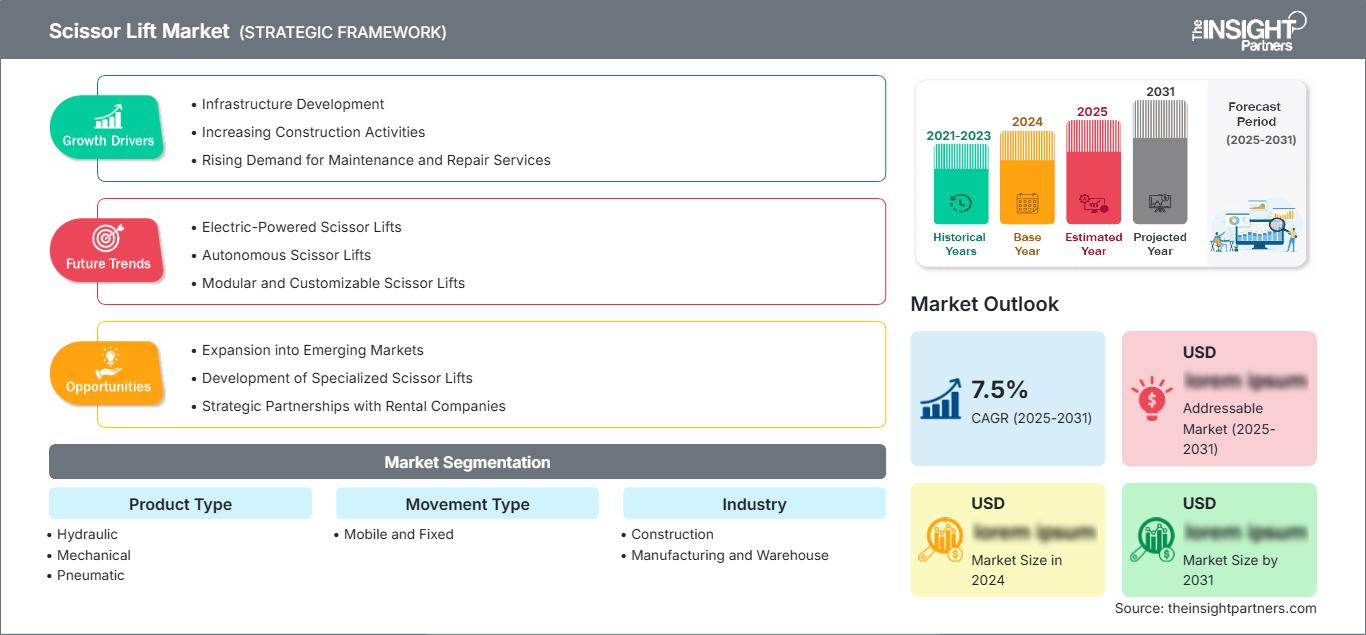
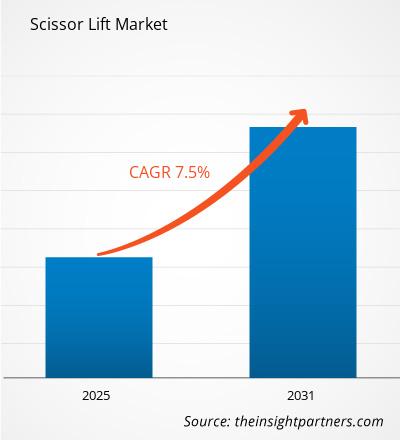
The scissor lift market is projected to grow from US$ 3.84 Billion in 2025 to US$ 6.86 Billion by 2034, registering a CAGR of 6.65% during 2026–2034. Demand is strengthening as construction contractors, manufacturers, facility managers, and warehouse operators prioritize safer vertical access, compact work platforms, and productive equipment for maintenance, installation, inspection, and material handling tasks.
North America remains a mature but active demand center as rental fleets, commercial construction, data centers, logistics facilities, and industrial maintenance programs support the scissor lift market size outlook. The region is expected to grow at a CAGR of 6.1–6.7% during 2026–2034, supported by safety compliance, equipment electrification, replacement cycles, and strong access-equipment rental penetration.
Scissor Lift Market Assessment and Insights
- North America held 34–37% share in 2025 and is expected to grow at a CAGR of 6.1–6.7% during 2026–2034, supported by construction activity, rental fleet renewal, data center projects, and warehouse maintenance.
- US represented 78–82% of North America share in 2025 and is projected to grow at a CAGR of 6.0–6.6% through 2034, driven by rental penetration and industrial facility upgrades.
- Europe accounted for 24–27% share in 2025 and is expected to grow at a CAGR of 5.7–6.3%, led by Germany, the UK, France, Italy, and Spain through construction safety and industrial maintenance demand.
- Asia Pacific captured 27–30% share in 2025 and is projected to grow at a CAGR of 7.2–7.9%, led by China, Japan, South Korea, India, and Australia through logistics, urban construction, and manufacturing expansion.
- Largest Segment: Hydraulic held 46–49% market share in 2025 and is expected to grow at a CAGR of 6.0–6.5%, reflecting established use in construction, warehouses, and industrial maintenance.
- High Growth Segment: Mobile held 72–76% share in 2025 and is projected to grow at a CAGR of 6.8–7.4%, supported by rental demand, flexible worksite movement, and indoor-outdoor application versatility.
- Key companies analyzed in detail: Terex Corporation, JLG Industries, Inc., Aichi Corporation, Haulotte Group, Linamar Corporation, MEC Aerial Work Platforms, Galmon (S) Pte Ltd., Wiese USA, EdmoLift AB, and Advance Lifts, Inc.
Source: The Insight Partners' analysis based on proprietary research, government publications, company annual reports, investor presentations, industry databases, and expert interviews.
The access machinery industry has transitioned from manual positioning to electric, connected, and specific-use equipment built to fit tight worksites. Some improvements in the industry include compact slab designs, leak containment, better guardrails, intelligent controllers, telematics, and reduced maintenance requirements for powertrains. In addition, manufacturers have been improving the weight, maneuverability, stability, and duty cycle of the equipment as contractors require machines capable of passing through standard doors and operating on delicate floors.
Future growth in demand will be driven by urban redevelopment, e-commerce warehousing, airport and hospital maintenance, automated production plants, and data centers. Safety regulations have an impact on the demand side of replacement as the operators assess guardrails, inspections, training, and worksite risk management practices. In the future, electric and hybrid equipment will play a larger role in indoor or low-emission sites, whereas rough terrain machines will be useful outdoors.
Scissor Lift Market Report Scope
| Report Attribute | Details |
|---|---|
| Market size in 2025 | US$ 3.84 Billion |
| Market Size by 2034 | US$ 6.86 Billion |
| Global CAGR (2026 - 2034) | 6.65% |
| Historical Data | 2021-2024 |
| Forecast period | 2026-2034 |
Scissor Lift Market Analysis
The growth in the market is driven by the necessity of lowering the risks of falling as well as increasing the efficiency of access. The scissor lifts provide a stable vertical lift for electrical installations, HVAC systems, façade maintenance, picking goods, production lines maintenance, and facility inspections. They are used in cases when ladders and scaffolding slow down the working process or make it more risky.
The value chain includes equipment manufacturers, components producers, equipment rentals, dealers, services and the final users. The market analysis indicates that the presence of a rental fleet greatly affects the cycles of purchases since many contractors use access equipment on a rental basis without any ownership expenses.
The competition is centered on global access-equipment brands and specialist lift makers. Terex Corporation’s Genie, JLG Industries Inc., Haulotte Group, Aichi Corporation, Linamar Corporation’s Skyjack, and MEC Aerial Work Platforms offer mobile elevating work platforms, whereas EdmoLift AB and Advance Lifts, Inc. excel in industrial and stationary lift usage.
Investment directions focus on miniaturized electric slab lifts, micro scissor lifts, fleet connectivity solutions, and ease of maintenance. Procurement decisions are increasingly based on operational statistics, operator comfort, commonality of components, and serviceability. The key to strategy is being able to satisfy both rental needs and actual application requirements.
● REPORT CUSTOMIZATION
Tailor This Report To Align With Your Specific Business Requirements
This report can be customized to align precisely with your business objectives, scope, and target markets. Customization options include tailored segmentation, geography, competitive analysis, and strategic insights to support informed decision-making.
Customize This Report →WHAT YOU CAN ADJUST
- ● Segmentations
- ● Geography
- ● Competitive Analysis
- ● Language Preferences
Scissor Lift Market: Strategic Insights
Regional Insights
North America scissor lift market
North America accounted for 34–37% scissor lift market share in 2025, supported by commercial construction, logistics expansion, industrial maintenance, retail refurbishment, and data center development. Rental fleets remain central to demand because contractors need flexible access equipment for short-duration projects and multi-site work schedules.
The region is projected to grow at a CAGR of 6.1–6.7% during 2026–2034. OSHA guidance requires safe use, inspection, maintenance, training, and fall protection for scissor lift operations, reinforcing demand for compliant equipment and documented operator programs across construction and general industry environments.
U.S. scissor lift Market
The US represented 78–82% of North America share in 2025 due to large rental fleets, broad construction activity, industrial facility maintenance, and strong equipment dealer networks. Demand is concentrated in slab electric lifts, rough-terrain units, compact models, and warehouse maintenance platforms.
The country is expected to grow at a CAGR of 6.0–6.6% through 2034. JLG Industries, Inc., Terex Corporation, MEC Aerial Work Platforms, Wiese USA, and Advance Lifts, Inc. support domestic availability, while contractors increasingly value onboard diagnostics, low-maintenance electric drive systems, and safer access in congested projects.
Europe scissor lift Market
Europe held 24–27% share in 2025 and is expected to grow at a CAGR of 5.7–6.3% during 2026–2034. Germany leads regional demand through manufacturing plants, logistics centers, and industrial maintenance, while the UK supports high rental adoption in construction and facility management.
France, Italy, and Spain add demand through infrastructure renovation, retail refurbishment, warehousing, and equipment rental modernization. European customers emphasize emissions reduction, indoor suitability, compact dimensions, and compliance with mobile elevating work platform safety standards. Electric models are gaining preference in sensitive indoor worksites.
APAC scissor lift Market
APAC captured 27–30% share in 2025 and is projected to grow at a CAGR of 7.2–7.9% through 2034. China is the leading country because of its broad construction activity, manufacturing scale, warehousing investment, and domestic equipment supply.
Japan and South Korea support demand through factories and logistics facilities, while India is expanding through urban infrastructure and organized warehousing. Australia contributes through rental fleets, mining support facilities, and commercial maintenance. Regional growth is tied to safer access practices and rising mechanization of work at height.
Middle East & Africa scissor lift Market
The Middle East & Africa market is expected to grow at a CAGR of 5.6–6.2% during 2026–2034. Saudi Arabia leads demand through large infrastructure, tourism, industrial, and logistics projects that require safe elevated access during construction and maintenance.
The UAE contributes through commercial real estate, airports, warehouses, and facility management, while South Africa adds manufacturing and retail maintenance demand. The rest of MEA remains project-led, with adoption improving as contractors shift from ladders and scaffolding toward certified access platforms.
Segmentation Analysis
Product Type
Product Type is expected to grow at a CAGR of 6.3–6.9% during 2026–2034 as buyers select lift systems based on height, load, maintenance cost, power source, and worksite conditions. This market scope reflects balanced demand across established hydraulic systems and specialized mechanical or pneumatic designs.
- Hydraulic remains the leading product type because it delivers reliable lifting force, broad availability, familiar maintenance practices, and strong suitability for construction, warehouses, loading areas, and industrial maintenance.
- Mechanical systems are used where controlled elevation, durability, and application-specific lifting are required, particularly in fixed industrial workstations, production support, and customized material access platforms.
- Pneumatic lifts serve niche environments where clean operation, reduced hydraulic fluid risk, and simpler power requirements are valued in sensitive facilities or specialized maintenance spaces.
Movement Type
Movement Type is expected to grow at a CAGR of 6.6–7.2% during 2026–2034 as contractors and facility operators prioritize flexible access. Mobile units dominate because rental fleets and multi-task jobsite workflows need machines that can reposition quickly across interiors, slabs, warehouses, and outdoor work zones.
- Mobile lifts dominate usage because they support flexible movement, jobsite repositioning, rental utilization, and varied maintenance tasks across construction, logistics, commercial buildings, and industrial facilities.
- Fixed lifts remain important for production lines, loading bays, mezzanine access, warehouse stations, and maintenance platforms where repeated vertical movement occurs at a defined location.
Industry
Industry is expected to grow at a CAGR of 6.4–7.0% during 2026–2034 as access needs expand across construction, manufacturing, and warehouse operations. Construction remains the leading end-use area because elevated installation, finishing, inspection, and maintenance activities occur across most building projects.
- Construction leads demand because scissor lifts improve worker safety and productivity during electrical, HVAC, ceiling, façade, painting, inspection, and fit-out work at commercial and infrastructure sites.
- Manufacturing adoption is supported by maintenance of production equipment, overhead utilities, machinery access, facility upgrades, and safe movement of workers within controlled industrial environments.
- Warehouse demand is increasing as logistics operators use lifts for racking maintenance, lighting work, inventory infrastructure, conveyor servicing, and facility safety inspections in large distribution centers.
Opportunity Snapshot
| Industry | Revenue Contribution | Trend Tag | Adoption Stage |
| Construction | High | Safe Access | Mature |
| Manufacturing | Medium | Plant Maintenance | Scaling |
| Warehouse | High | Rack Service | Scaling |
Scissor Lift Market Growth Drivers and Impact Analysis
Shift Toward Safer Work-at-Height Practices
The safety compliance requirement is one of the key factors due to the fact that scissor lifts have less dependence on ladders and temporary scaffolding for vertical transportation. The scissor lift is regarded as a mobile scaffold work platform by OSHA, and the agency stresses the importance of training, guardrails, stabilization, inspections, and proper operation. It results in the constant need to replace and upgrade this equipment from construction companies, warehouses, manufacturing enterprises, and property managers. It is especially important for those enterprises that have high insurance rates, strict safety project requirements, and possible losses during downtime.
Expansion of Warehousing and Facility Maintenance
Growth in the use of distribution centers, e-commerce logistics, data centers, airports, hospitals, and large shopping centers drives the need for vertical access solutions that are compact in nature. Scissor lifts can be used in the process of setting up lighting fixtures, racking, sprinklers, signs, cable trays, HVAC equipment, and even during inspection activities. This driver benefits the sales of electric slab scissor lifts because the use of such facilities demands silence, no pollution, and flooring protection.
Electrification and Lower Total Cost of Ownership
Scissor lifts are being redesigned on the basis of electric drives, lightweight designs, onboard diagnostics, a low number of serviceable parts, and increased part commonality. This makes maintenance less costly and improves availability, which is especially important in cases where rentals are involved and where a lot of equipment needs to be managed. Electric drives make it possible to use the lifts indoors where emissions regulations apply and where there is a need for protection of delicate floors. The effect is a cycle of product substitution based on comparing cost-effectiveness throughout the life of the product.
Scissor Lift Market Future Trends
Micro and Compact Electric Models
The scissor lift market trends show rising demand for micro-sized and compact electric units that can move through standard doorways, work in narrow corridors, and operate on finished floors. These machines support data centers, universities, hospitals, museums, retail stores, and indoor construction projects where large equipment is impractical. Future models will likely combine narrower widths, better turning radius, low-noise drive systems, and improved platform stability. This trend widens adoption among facility teams that need safe access without disrupting occupied buildings.
Fleet Telematics and Predictive Service
Fleet management connectivity will be a more effective differentiator as rentals and contractors look for improved utilization, preventative maintenance, and machine location tracking. Telemetry systems will help measure battery life, error codes, machine hours, impacts, and service intervals, which can help fleet managers avoid downtime and plan assets effectively. With integration into rental management systems, dispatch and billing processes will be easier and more accurate. As rental fleets get larger, diagnostic capability and open data availability from manufacturers will help retain customers.
Scissor Lift Market Opportunities
Rental Fleet Renewal in Mature Markets
The scissor lift market forecasts indicate a strong opportunity in rental fleet renewal across North America and Europe. Rental providers must replace aging machines while meeting customer expectations for electric drive, lower maintenance, telematics, and higher platform stability. Manufacturers can win volume orders by offering parts commonality, robust warranties, financing flexibility, and service support. The opportunity is attractive because rental companies influence equipment availability for thousands of contractors. Models that deliver low downtime and strong residual value will be preferred in renewal programs.
Industrial Fixed Lift Systems for Warehouses
Fixed scissor lift systems offer an opportunity in warehouses, manufacturing plants, and loading areas where repeated vertical movement occurs at the same workstation. These units can improve ergonomic handling, mezzanine access, loading support, and maintenance safety. Demand is supported by automation, higher racking density, and facility upgrades that require safe movement of personnel or materials. Suppliers that offer customization, safety interlocks, durable platforms, and integration with production layouts can capture projects beyond standard mobile lift sales.
Frequently Asked Questions

- Comprehensive Market Sizing and Forecast Analysis
- Detailed Segmentation Analysis
- In-Depth Market Dynamics Assessment
- Regional and Country-Level Insights
- Competitive Landscape and Company Benchmarking
- Strategic Business Intelligence
Recent Reports
Testimonials

The Insight Partners' SCADA System Market report is comprehensive, with valuable insights on current trends and future forecasts. The team was highly professional, responsive, and supportive throughout. We are very satisfied and highly recommend their services.
RAN KEDEM Partner, Reali Technologies LTDs
I requested a report on a very specific software market and the team produced the report in a few days. The information was very relevant and well presented. I then requested some changes and additions to the report. The team was again very responsive and I got the final report in less than a week.
JEAN-HERVE JENN Chairman, Future Analytica
We worked with The Insight Partners for an important market study and forecast. They gave us clear insights into opportunities and risks, which helped shape our plans. Their research was easy to use and based on solid data. It helped us make smart, confident decisions. We highly recommend them.
PIYUSH NAGPAL Sr. Vice President, High Beam Global
The Insight Partners delivered insightful, well-structured market research with strong domain expertise. Their team was professional and responsive throughout. The user-friendly website made accessing industry reports seamless. We highly recommend them for reliable, high-quality research services
YUKIHIKO ADACHI CEO, Deep Blue, LLC.
This is the first time I have purchased a market report from The Insight Partners.While I was unsure at first, I visited their web site and felt more comfortable to take the risk and purchase a market report.I am completely satisfied with the quality of the report and customer service. I had several questions and comments with the initial report, but after a couple of dialogs over email with their analyst I believe I have a report that I can use as input to our strategic planning process.Thank you so much for taking the extra time and making this a positive experience.I will definitely recommend your service to others and you will be my first call when we need further market data.
JOHN SUZUKI President and Chief Executive Officer, Board Director, BK Technologies
I wish to appreciate your support and the professionalism you displayed in the course of attending to my request for information regarding to infectious disease IVD market in Nigeria. I appreciate your patience, your guidance, and the fact that you were willing to offer a discount, which eventually made it possible for us to close a deal. I look forward to engaging The Insight Partners in the future, all thanks to the impression you have created in me as a result of this first encounter.
DR CHIJIOKE ONYIA MANAGING DIRECTOR, PineCrest Healthcare Ltd.Reason to Buy
- Informed Decision-Making
- Understanding Market Dynamics
- Competitive Analysis
- Identifying Emerging Markets
- Customer Insights
- Market Forecasts
- Risk Mitigation
- Boosting Operational Efficiency
- Strategic Planning
- Investment Justification
- Tracking Industry Innovations
- Aligning with Regulatory Trends





 Get Free Sample for