
Screw Conveyor Market Trends, Size & Growth by 2034
Coverage: by Type (Shafted Screw Conveyor, Shaftless Screw Conveyor, Vertical Screw Conveyor, Horizontal Screw Conveyor, Inclined Screw Conveyor); End-user (Food and Beverage, Metals and Mining, Cement, Paper and Pulp, Plastics, Pharmaceuticals, Others) , and Geography (North America, Europe, Asia Pacific, and South and Central America)
- Status : Data Released
- Report Code : TIPRE00010634
- Category : Manufacturing and Construction
- No. of Pages : 150
- Available Report Formats :


- Last update date : September 21, 2026


2025 Market Size
US$ 5.06 Bn
Base year value
2034 Forecast
US$ 7.38 Bn
Projected by 2034
CAGR 2026-2034
4.29 %
Growth rate
Addressable Market
US$ 56.51 Bn
(2026-2034)
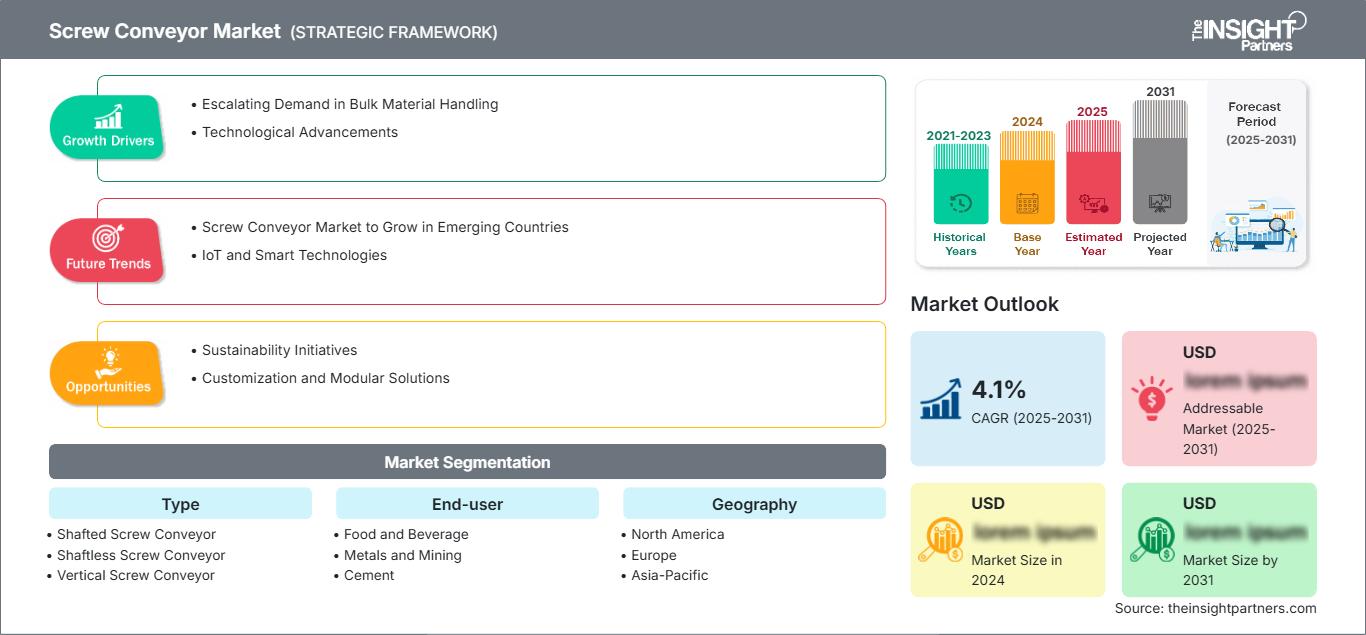
The screw conveyor market is positioned for steady expansion as bulk-material handling systems become more automated, hygienic, and application-specific. The market is valued at US$ 5.06 Billion in 2025 and is projected to reach US$ 7.38 Billion by 2034, registering a CAGR of 4.29% during 2026–2034. Demand is supported by continuous material transfer requirements across food processing, cement, mining, pharmaceuticals, plastics, and paper manufacturing operations.
Across North America, screw conveyor size is influenced by replacement demand, food-processing modernization, mining activity, and investment in automated bulk handling. The regional market is expected to expand at approximately 4.0–4.4% CAGR during 2026–2034, supported by hygienic conveying requirements, warehouse modernization, and upgrades to aging industrial equipment. Adoption increasingly favors enclosed, low-maintenance configurations, contributing to the growth of the Screw Conveyor Market size.
Screw Conveyor Market Assessment and Insights
- North America: North America is estimated to account for 29–33% share in 2025, growing at a 4.0–4.4% CAGR between 2026–2034. Food processing, mining, agriculture, and industrial modernization sustain replacement and expansion demand.
- US: The US represents approximately 68–73% of North American share in 2025, with a 4.0–4.4% CAGR between 2026–2034, supported by food manufacturing, agriculture, and automated bulk-material handling.
- Europe: Europe is estimated at 24–28% share in 2025, expanding at 3.6–4.0% CAGR between 2026–2034. Germany, the UK, France, Italy, and Spain benefit from mature processing industries and stringent hygiene requirements.
- Asia Pacific: Asia Pacific represents approximately 33–37% share in 2025, advancing at 4.8–5.2% CAGR between 2026–2034. China, India, Japan, and South Korea lead demand through manufacturing, cement, mining, food processing, and infrastructure investment.
- Largest Segment: Shafted Screw Conveyor holds an estimated 50–55% market share in 2025, with a 4.0–4.4% CAGR during 2026–2034, reflecting broad industrial applicability and established engineering practices.
- High Growth Segment: Inclined Screw Conveyor represents approximately 15–20% market share in 2025, with a 4.8–5.3% CAGR during 2026–2034, benefiting from space-efficient vertical elevation and flexible plant layouts.
- Key companies analyzed in detail: Continental Conveyor, Flexicon Corporation, FMC Technologies, Inc., Kase Custom Conveyors, KWS Manufacturing Company, Ltd., Orthman Manufacturing, Inc., Screw Conveyor Corporation, SPIRAC, Tsubakimoto Chain Co., and WAMGROUP S.p.A.
Source: The Insight Partners' analysis based on proprietary research, government publications, company annual reports, investor presentations, industry databases, and expert interviews.
The screw conveyor market has evolved from standardized mechanical conveying equipment toward engineered systems optimized for material characteristics, throughput, sanitation, and installation geometry. Shafted designs remain prevalent because of established fabrication methods and suitability for granular materials, while shaftless and inclined configurations address sticky products, constrained layouts, and elevation requirements. Manufacturers increasingly combine robust flights, improved sealing, variable-speed drives, and monitoring components to reduce maintenance exposure.
Over the forecast period, investment is expected to move toward application-specific equipment in emerging manufacturing centers, particularly across the Asia Pacific and Latin America. Food-safety requirements, dust-control expectations, wastewater management, and industrial energy-efficiency objectives should encourage enclosed and lower-maintenance designs. Infrastructure programs and expanding processing capacity are also expected to increase demand for conveying systems capable of continuous operation under variable material loads, as highlighted in the Screw Conveyor Market report.
Screw Conveyor Market Report Scope
| Report Attribute | Details |
|---|---|
| Market size in 2025 | US$ 5.06 Billion |
| Market Size by 2034 | US$ 7.38 Billion |
| Global CAGR (2026 - 2034) | 4.29% |
| Historical Data | 2021-2024 |
| Forecast period | 2026-2034 |
Screw Conveyor Market Analysis
The screw conveyor market growth is closely linked with the expansion of automated material movement in process industries. Equipment demand originates from manufacturers requiring controlled transfer, feeding, metering, mixing, or discharge of powders, granules, sludges, and semi-solid materials. OEMs source carbon steel, stainless steel, motors, gearboxes, bearings, seals, controls, and fabricated flights, while integrators connect conveyors with feeders, silos, hoppers, mixers, packaging equipment, and production lines.
In terms of supply chain structure, there is a combination of standard parts and engineered-to-order manufacturing. In many cases, buyers assess the total cost of ownership of an asset rather than the purchase price alone, especially when there is potential for wear caused by abrasives, sanitary needs, and the need for continuous operation that may entail additional maintenance costs. Fabrication firms compete on customization and faster delivery, while experienced providers differentiate themselves through engineering, testing, material knowledge, and integration capabilities.
Screw conveyor analysis indicates a fragmented competitive environment in which international equipment manufacturers compete with specialized regional fabricators. Continental Conveyor, KWS Manufacturing Company, Ltd., Screw Conveyor Corporation, and WAMGROUP S.p.A. maintain positions through engineered bulk-handling solutions, while Flexicon Corporation emphasizes flexible conveying and integrated feeding systems. Tsubakimoto Chain Co. combines conveying technologies with broader power-transmission capabilities, strengthening its ability to serve industrial customers seeking integrated equipment portfolios, consistent with the outlook presented in the Screw Conveyor Market forecast.
Investment strategy has now started shifting towards product customization, digital tracking, hygienic construction, and speedy delivery. The focus of Flexicon Corporation has been modular flexible-screw systems and speedy delivery, whereas that of Tsubakimoto Chain Co. has been shaftless conveying and sensor-based technology for handling powders. Application engineering is the area where Kase Custom Conveyors and Orthman Manufacturing, Inc. have been competing with each other, whereas SPIRAC’s main focus has been specialized conveying.
● REPORT CUSTOMIZATION
Tailor This Report To Align With Your Specific Business Requirements
This report can be customized to align precisely with your business objectives, scope, and target markets. Customization options include tailored segmentation, geography, competitive analysis, and strategic insights to support informed decision-making.
Customize This Report →WHAT YOU CAN ADJUST
- ● Segmentations
- ● Geography
- ● Competitive Analysis
- ● Language Preferences
Screw Conveyor Market: Strategic Insights
Regional Insights
North America screw conveyor market
North America is estimated to represent 29–33% share of the Screw Conveyor Market in 2025, with regional demand expanding at a 4.0–4.4% CAGR during 2026–2034. The US represents the majority of regional demand due to its vast network of food processing, agricultural, mining, wastewater treatment, and manufacturing operations. Canada is a contributor due to its mining, food processing, and resource-related industries, while Mexico is aided by the growth in its manufacturing capability and nearshoring investments.
Replacement of old conveyor equipment is one of the key demand drivers, especially when manufacturers want to gain better sanitation, dust control, variable speed, and low maintenance. There are growing demands among food processors for stainless steel and wash-down capable conveyors, while miners and cement plants look for durable and wear-resistant systems. Local manufacturers will capitalize on the need for customization and short lead times, while international ones will focus on engineering and product portfolio.
U.S. screw conveyor Market
The United States represents approximately 68–73% of the North American Screw Conveyor Market share in 2025, with demand expected to expand at a 4.0–4.4% CAGR during 2026–2034. There is a well-diversified industrial structure ranging from food and beverages, pharmaceuticals, agriculture, plastics, metal, mining, and cement. This leads to a continuous need for material handling. Machine replacement is made easier due to the upgrading of plant facilities and automation.
Increasingly, applications are involving enclosed conveying, hygienic conveying, metering, and connection with automated batching systems. Flexicon Corporation, KWS Manufacturing Company, Ltd., Continental Conveyor, Screw Conveyor Corporation, and Orthman Manufacturing, Inc. have found themselves relevant in the United States equipment market environment. The demand for their services is further boosted by activities geared at boosting efficiency. Those who can engineer systems with sensors, variable speed control, and unique screw geometry benefit more.
Europe screw conveyor Market
Europe holds approximately 24–28% share of the Screw Conveyor Market in 2025, with a 3.6–4.0% CAGR during 2026–2034. The leader in demand comes from Germany, facilitated by machinery production and process industries. The UK ensures its demand in terms of food, pharmaceutical, and environmental segments, whereas France, Italy, and Spain participate in terms of food processing, cement, chemical, and manufacturing industries.
The German market depends on automation in production processes, engineering-intensive manufacturing, and an existing installed base requiring equipment updates. The buyers from the UK are concerned about hygienic and efficient processing in the food and pharmaceutical sectors. France and Italy are helped by food and chemical production, along with machinery production, while Spain depends on cement, food, and infrastructure activities to convey needs.
APAC screw conveyor Market
APAC is estimated at 33–37% of the Screw Conveyor Market share in 2025, with a 4.8–5.2% CAGR during 2026–2034. China remains the leading market, followed by Japan, South Korea, India, and Australia. Industrial expansion, cement production, mining, food processing, and infrastructure development create broad equipment demand.
China and India provide the strongest volume opportunities, while Japan and South Korea favor technologically advanced and automated systems. Australia contributes through mining and mineral processing. Industrial automation programs and manufacturing investment support conveyor modernization, while food-processing expansion increases demand for hygienic systems. Regional manufacturers also benefit from localized fabrication and cost-sensitive procurement.
Middle East & Africa screw conveyor Market
The Middle East and Africa Screw Conveyor Market demand is supported by energy-related processing, cement, mining, agriculture, wastewater, and infrastructure projects. Saudi Arabia and the UAE are leading Gulf markets, while South Africa provides an important mining and mineral-processing base. The broader region increasingly requires robust equipment suited to high temperatures, dust, abrasive materials, and demanding operating environments.
The regional market is expected to expand at a 4.5–4.9% CAGR during 2026–2034. Saudi Arabia benefits from industrial diversification and infrastructure investment, while the UAE supports demand through manufacturing, logistics, and food processing. South Africa remains anchored by mining. Rest-of-MEA markets provide project-driven opportunities where reliable, low-maintenance conveying is prioritized.
Segmentation Analysis
Type
The Type segment is expected to expand at approximately 4.1–4.5% CAGR during 2026–2034. Selection depends on material characteristics, conveying distance, elevation, throughput, sanitation, and available floor space. Shafted configurations remain widely deployed, while shaftless, vertical, horizontal, and inclined designs address specialized installation and handling requirements. The Screw Conveyor Market trends indicate broadening demand as manufacturers develop configurations for difficult-flowing and contamination-sensitive materials.
- Shafted Screw Conveyor: Shafted Screw Conveyor remains the established configuration for granular and bulk materials, offering proven mechanical design, broad fabrication availability, and suitability for feeding, transferring, mixing, and discharge operations.
- Shaftless Screw Conveyor: Shaftless Screw Conveyor is strategically important for sticky, viscous, and sludge-like materials because its open internal geometry reduces interference from central shafts and supports challenging wastewater and process applications.
- Vertical Screw Conveyor: Vertical Screw Conveyor addresses applications requiring compact elevation of bulk solids where floor space is constrained, supporting efficient integration between lower-level storage, feeders, and elevated processing equipment.
- Horizontal Screw Conveyor: Horizontal Screw Conveyor serves continuous transfer over relatively level routes and remains important across manufacturing, food processing, cement, plastics, and bulk-material handling facilities.
- Inclined Screw Conveyor: Inclined Screw Conveyor supports elevation and transfer within a single conveying route, making it valuable where plants require space-efficient movement between process stages or storage levels.
End-user
The End-user segment is projected to grow at approximately 4.3–4.7% CAGR during 2026–2034. Food and beverage and metals and mining generate substantial requirements because of continuous bulk-material movement, while cement, paper and pulp, plastics, and pharmaceuticals demand application-specific configurations. Material properties, hygiene standards, abrasion exposure, and production continuity strongly influence purchasing decisions across the end-user segment is projected to grow at approximately 4.3–4.7% CAGR during 2026–2034. Food and beverage and metals and mining generate substantial requirements because of continuous bulk-material movement, while cement, paper and pulp, plastics, and pharmaceuticals demand application-specific configurations. Material properties, hygiene standards, abrasion exposure, and production continuity strongly influence purchasing decisions across the Screw Conveyor Market.
Food and Beverage: Food and Beverage users prioritize enclosed, cleanable, stainless-steel conveying systems for ingredients, powders, grains, and blended products, with sanitation and contamination control shaping equipment specifications.
- Metals and Mining: Metals and Mining operations require rugged conveyors capable of handling abrasive ores, concentrates, mineral products, and process residues while maintaining structural reliability under demanding conditions.
- Cement: Cement plants depend on durable conveying systems for powders and bulk materials, with equipment selection emphasizing wear resistance, dust control, throughput, and continuous operation.
- Paper and Pulp: Paper and Pulp facilities use screw conveyors for chips, fibers, sludge, additives, and process residues, creating demand for corrosion-resistant and application-specific designs.
- Plastics: Plastics manufacturers require controlled movement of pellets, regrind, additives, and powders, encouraging compact systems compatible with extrusion, compounding, blending, and packaging operations.
- Pharmaceuticals: Pharmaceuticals applications emphasize hygienic construction, cleanability, controlled material handling, and contamination prevention, supporting specialized stainless-steel and sanitary configurations.
Opportunity Snapshot
| End-user | Revenue Contribution | Trend Tag | Adoption Stage |
| Food and Beverage | High | Sanitary Handling | Mature |
| Metals and Mining | High | Abrasive Handling | Mature |
| Cement | High | Dust Control | Mature |
| Paper and Pulp | Medium | Sludge Transfer | Scaling |
| Plastics | Medium | Pellet Feeding | Scaling |
| Pharmaceuticals | Medium | Clean Conveying | Scaling |
| Others | Low | Waste Handling | Emerging |
Screw Conveyor Market Growth Drivers and Impact Analysis
Automation and continuous-process modernization
There is an increased automation of material handling in industrial facilities with the aim of minimizing manual effort, balancing throughput, and ensuring consistency in manufacturing processes. Screw conveyors fit into such systems since the rotational speed of the screw can be controlled and the discharge end can be linked with other equipment such as feeding, mixing, siloing, packaging machines, and process vessels. In plants dealing with food, cement, plastics, and drugs, such a connection facilitates the synchronized movement of materials from one operation to another. It is not only about the installation of screw conveyors but also the replacement of manual operations by mechanical controls. Such problems as overloading, clogging, or malfunction of motors may be detected by sensors in time and prevent the stoppage of production.
Expansion of food, pharmaceutical, and hygienic processing
As food and pharmaceutical companies look to incorporate equipment that minimizes contamination while ensuring a reliable flow of material, enclosed screw conveyors can help them move powders, granules, raw ingredients, and semi-solid substances while minimizing contamination from the environment. With this in mind, the use of stainless steel construction and surfaces, removable parts, and easy-to-clean design are important for such equipment. This is translating into the adoption of higher-value solutions compared to purely cost-based purchasing. Companies that can provide sanitized finishes, validated design, fast cleaning methods, and seamless integration with batching or dispensing systems are in a good position to meet these demands. Growth in the manufacture of packaged food, nutraceuticals, pharmaceutical products, and specialty ingredients across developing markets is extending the customer base.
Mining, cement, and infrastructure investment
Screw conveyor systems have been used in mining and cementing facilities to ensure efficient transportation of abrasive powders, minerals, aggregates and process waste in continuously running systems. Increasing infrastructure will require more cement manufacturing and mineral processing capabilities, especially in the Asia-Pacific region, the Middle East and some parts of Latin America. Screw conveyors offer compact designs of systems where materials can be conveyed, fed and discharged under a controlled environment and at the same time minimize the exposure to dust by using an enclosed handling system. Screw conveyors have maximum impact in applications where the equipment operates in highly abrasive conditions and variable loading. End users are now more concerned about flight thickness, liner selection, drive capacity, bearing protection and maintenance access.
Screw Conveyor Market Future Trends
Digital monitoring and condition-based maintenance
Monitoring through digital technology is expected to become more commonplace within conveying machinery as industrial operators seek early detection of machinery status. Digital technology may be used to monitor motor operation, vibrations, temperatures, loadings, and cycles, thus making it possible for maintenance personnel to determine any abnormalities that are present before equipment stops operating. Future monitoring systems will involve the connection between conveyors and control systems at the plant level, whereby the performance of conveyors across several production lines will be monitored centrally. There will also be the capability of carrying out predictive maintenance based on the severity of operation. The technology is expected to be very useful in industries such as mining, cement, and continuous food processing industries due to the severe impact of unexpected downtime. Vendors will distinguish themselves through standard communication interfaces, remote diagnostics, and control systems capable of performing analysis.
Modular and application-specific conveyor architectures
Future development of equipment will probably focus on modular design that enables the length of the belt, geometry of the screw, hopper design, drive capability, discharge options, and monitoring modules to be customized without changing the entire system. Such a design can reduce engineering cycles and enable producers to cater to various types of material and facilities through standard modules. Modular design will also promote easy replacement and expansion since parts of the system can be improved as the production demand changes. Users in the food industry and pharmaceutical companies will probably prefer easily detachable sanitary modules, while mining companies and cement producers will need replaceable wear parts and flight protection. Installation flexibility will also be an important factor in the future since facilities will have limited space and other processing equipment installed at the same time.
Screw Conveyor Market Opportunities
Localized manufacturing and aftermarket service networks
The screw conveyor market presents investment opportunities for manufacturers that establish localized fabrication, spare-parts inventories, and engineering support close to industrial customers. Regional production can reduce transportation time for large fabricated equipment while enabling faster modification of screw flights, troughs, shafts, hoppers, and discharge assemblies. Aftermarket capabilities are equally important because conveyors operate in environments where wear, corrosion, contamination, and mechanical loading require periodic component replacement. Investors and equipment suppliers can strengthen customer retention by combining installation services with inspection programs, refurbishment, and predictive maintenance. Emerging manufacturing centers in India, Southeast Asia, Latin America, and the Middle East offer opportunities for regional assembly and service hubs. A localized model can also improve responsiveness for mining, cement, food processing, and wastewater projects where delivery schedules are closely linked to plant commissioning.
Application engineering for difficult materials
screw conveyor Forecasts indicate that application-specific engineering can create attractive opportunities where standard conveying equipment cannot reliably manage difficult materials. Sticky powders, abrasive minerals, cohesive sludges, fragile ingredients, and products with variable bulk density require careful selection of screw geometry, speed, inclination, material construction, and drive capacity. Suppliers can build higher-value offerings by combining material testing with customized equipment design before installation. This approach reduces the risk of underperforming systems and gives customers greater confidence when handling new formulations or feedstocks. Opportunities are particularly relevant in pharmaceuticals, specialty chemicals, food ingredients, mining, and environmental treatment. Engineering firms and equipment manufacturers can also develop application libraries and simulation capabilities that accelerate configuration. Such expertise creates differentiation based on process outcomes rather than equipment specifications alone.
Frequently Asked Questions

- Comprehensive Market Sizing and Forecast Analysis
- Detailed Segmentation Analysis
- In-Depth Market Dynamics Assessment
- Regional and Country-Level Insights
- Competitive Landscape and Company Benchmarking
- Strategic Business Intelligence
Recent Reports
Testimonials

The Insight Partners provided valuable market intelligence that supported our global go-to-market strategy. Their team was professional, responsive, and attentive to our feedback, providing thoughtful analysis and helpful methodological clarifications throughout the project.
Junmo Kim Chief Financial Officer (CFO), Enertech Co., Ltd.
The Insight Partners' SCADA System Market report is comprehensive, with valuable insights on current trends and future forecasts. The team was highly professional, responsive, and supportive throughout. We are very satisfied and highly recommend their services.
RAN KEDEM Partner, Reali Technologies LTDs
I requested a report on a very specific software market and the team produced the report in a few days. The information was very relevant and well presented. I then requested some changes and additions to the report. The team was again very responsive and I got the final report in less than a week.
JEAN-HERVE JENN Chairman, Future Analytica
We worked with The Insight Partners for an important market study and forecast. They gave us clear insights into opportunities and risks, which helped shape our plans. Their research was easy to use and based on solid data. It helped us make smart, confident decisions. We highly recommend them.
PIYUSH NAGPAL Sr. Vice President, High Beam Global
The Insight Partners delivered insightful, well-structured market research with strong domain expertise. Their team was professional and responsive throughout. The user-friendly website made accessing industry reports seamless. We highly recommend them for reliable, high-quality research services
YUKIHIKO ADACHI CEO, Deep Blue, LLC.
This is the first time I have purchased a market report from The Insight Partners.While I was unsure at first, I visited their web site and felt more comfortable to take the risk and purchase a market report.I am completely satisfied with the quality of the report and customer service. I had several questions and comments with the initial report, but after a couple of dialogs over email with their analyst I believe I have a report that I can use as input to our strategic planning process.Thank you so much for taking the extra time and making this a positive experience.I will definitely recommend your service to others and you will be my first call when we need further market data.
JOHN SUZUKI President and Chief Executive Officer, Board Director, BK Technologies
I wish to appreciate your support and the professionalism you displayed in the course of attending to my request for information regarding to infectious disease IVD market in Nigeria. I appreciate your patience, your guidance, and the fact that you were willing to offer a discount, which eventually made it possible for us to close a deal. I look forward to engaging The Insight Partners in the future, all thanks to the impression you have created in me as a result of this first encounter.
DR CHIJIOKE ONYIA MANAGING DIRECTOR, PineCrest Healthcare Ltd.Reason to Buy
- Informed Decision-Making
- Understanding Market Dynamics
- Competitive Analysis
- Identifying Emerging Markets
- Customer Insights
- Market Forecasts
- Risk Mitigation
- Boosting Operational Efficiency
- Strategic Planning
- Investment Justification
- Tracking Industry Innovations
- Aligning with Regulatory Trends





 Get Free Sample for