
Security Orchestration Market Size, Share & Growth by 2034
Coverage: By Component (Software and Services); Deployment Type ( On-Premise and Cloud); Function (Network Security, Threat Intelligence, Compliance Management, Ticketing Solutions, End-Point Security and Others); Type of Enterprise (Small & Medium Scale and Large Scale); and End User (BFSI, Government, IT & Telecom, Manufacturing, Healthcare & Pharmaceuticals, and Others)
- Status : Data Released
- Report Code : TIPTE100001073
- Category : Technology, Media and Telecommunications
- No. of Pages : 150
- Available Report Formats :


- Last update date : March 23, 2026


2025 Market Size
US$ 2.2 Bn
Base year value
2034 Forecast
US$ 8.8 Bn
Projected by 2034
CAGR 2026-2034
15.12 %
Growth rate
Addressable Market
US$ 42.73 Bn
(2026-2034)
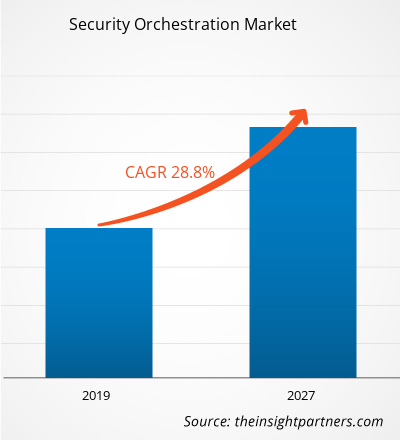
The global Security Orchestration Market size is projected to reach US$ 8.8 billion by 2034 from US$ 2.2 billion in 2025. The market is anticipated to register a CAGR of 15.12% during the forecast period 2026–2034
Key market dynamics include a heightening global focus on automated incident response, rising enterprise awareness regarding the efficiency gains of centralized security management, and a significant shift toward integrated cyber defense platforms. Additionally, the market is expected to benefit from the growing popularity of cloud-native security architectures, expansion in digital infrastructure across emerging economies, and the increasing inclusion of orchestration in high-value protection segments like threat intelligence and compliance management.
Security Orchestration Market Analysis
The security orchestration market analysis shows a shift toward high-value automated operations as organizations prioritize rapid response and operational density. The market is shifting into traditional on-premise for regulated industries and high-growth cloud-native markets. Strategic opportunities are emerging in specialty small and medium-scale enterprise solutions, where simplified orchestration offers a clear competitive advantage over complex legacy systems. The analysis also notes that market expansion depends on API ecosystem integrity for seamless tool connections and processing efficiency for high-volume alert data. Competitive differentiation now stands out depending on platforms that offer low-code playbooks and highlight ease of use, rapid deployment, and being able to track every step of an incident response. This approach helps software providers maintain higher margins in a market with diverse security needs.
Security Orchestration Market Overview
Security solutions have advanced from niche defensive tools to mainstream operational requirements. The security orchestration includes automated network security, real-time threat intelligence, and integrated compliance management. Both global technology leaders and specialized startups compete in this market, using advanced capabilities such as machine learning and automated workflows. Growing demand for streamlined security operations among digital businesses in North America and Europe has increased the popularity of orchestration as a core resilience solution. North America leads in revenue due to its established cybersecurity culture, while Asia-Pacific is advancing in platform innovation and rapid digital adoption. The US market is the most developed, driven by technology-focused enterprises and the broad availability of advanced security talent. Competition among brands is fueling greater integration, variety, and the inclusion of advanced features like automated ticketing and endpoint protection.
Market Research Highlights
- Global market for Security Orchestration was valued at US$ 2.20 Billion in 2025
- Annual market size is expected to reach US$ 8.80 Billion by 2034
- Total addressable market (TAM) during 2026-2034 is projected to reach approximately US$ 42.73 Billion
- Market is anticipated to register a CAGR of 15.12% during the forecast period
- The United States represents a key market, supported by Increasing cyber threats, Rising need for automated security solutions, as well as evolving industry dynamics
- Market analysis covers North America, Europe, Asia-Pacific, South and Central America, Middle East and Africa, with growth evaluated across the forecast period
- Market opportunities such as Adoption of AI-driven security solutions, Growing need for integrated security systems are expected to influence market dynamics and addressable market
- Report profiles industry participants, including CyberSponse, Inc., DFLabs S.p.A., FireEye, Inc., Microsoft Corporation (Hexadite), Tufin, Phantom Cyber Corporation (Splunk Inc.), Swimlane LLC, Demisto, Inc., Siemplify Ltd., Cyberbit Ltd., while analyzing competitive strategies and innovation developments
-
Source: The Insight Partners' analysis based on proprietary research, government publications, company annual reports, investor presentations, industry databases, and expert interviews.
● REPORT CUSTOMIZATION
Tailor This Report To Align With Your Specific Business Requirements
This report can be customized to align precisely with your business objectives, scope, and target markets. Customization options include tailored segmentation, geography, competitive analysis, and strategic insights to support informed decision-making.
Customize This Report →WHAT YOU CAN ADJUST
- ● Segmentations
- ● Geography
- ● Competitive Analysis
- ● Language Preferences
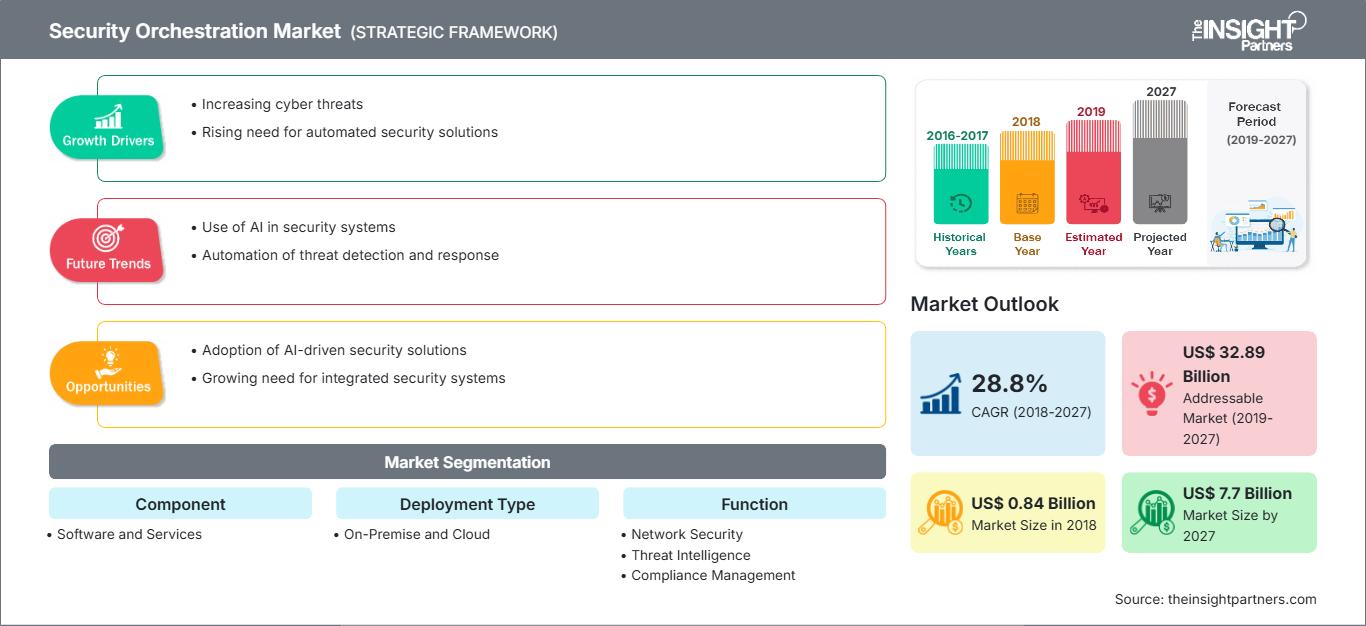
Security Orchestration Market: Strategic Insights
-
Get Top Key Market Trends of this report.This FREE sample will include data analysis, ranging from market trends to estimates and forecasts.
Security Orchestration Market Drivers and Opportunities
Market Drivers:
- Increasing Complexity of Cyber Threats and Alert Fatigue: Security teams are overwhelmed by thousands of daily alerts. Orchestration provides automated filtering and response, which makes it easier to manage defense for teams with limited staff. This operational benefit is driving its popularity.
- Consolidation of Security Toolstacks: The expansion of enterprise security portfolios has sustained high demand for orchestration inputs. As organizations trade up to integrated experiences, platforms that unify various tools continue to see stable adoption gains.
- Rapid Expansion of Digital and Cloud Infrastructure: Shift to remote and hybrid work has removed traditional geographic boundaries for security. This is particularly evident in the rapid adoption of cloud-based orchestration and managed services in regions like Asia-Pacific and North America.
Market Opportunities:
- Expansion into Small and Medium Scale Enterprises: Beyond large-scale corporations, orchestration offers significant opportunities in simplified, cost-effective security bundles for smaller businesses.
- Growth in Emerging APAC Corridors: Forming strategic partnerships between global software suppliers and regional distributors may facilitate access to high-margin market segments in China and India, where demand for premium, automated security products is increasing.
- Diversification into Compliance Automation: There is a growing opportunity for providers to target specific industries through automated compliance reporting and auditing features, as seen in recent successful expansions in the European market.
Security Orchestration Market Report Segmentation Analysis
The Security Orchestration Market share is analyzed across various segments to provide a clearer understanding of its structure, growth potential, and emerging trends. Below is the standard segmentation approach used in most industry reports:
By Component:
- Software: The dominant volume driver, particularly within the traditional enterprise, due to established security frameworks and the need for core orchestration engines.
- Services: A fast-growing niche that aligns with global outsourcing trends. It is increasingly preferred by organizations that prioritize expert deployment and ongoing management.
By Deployment Type:
- Cloud: The fastest-rising delivery model, especially for agile businesses and distributed workforces, enabling rapid scaling and cross-border security management.
- On-Premise: Remains a primary choice for high-security environments like government and finance, benefiting from direct control over sensitive security data.
By Function:
- Network Security: Focused on automating defenses across the perimeter and internal traffic.
- Threat Intelligence: Automating the collection and application of global threat data.
- Compliance Management: Ensuring automated adherence to regional and industry regulations.
- Ticketing Solutions: Integrating security actions with operational workflow tools.
- End-Point Security: Coordinating response actions across distributed devices and workstations.
By Type of Enterprise:
- Large Scale: Represents the majority of market spend due to complex infrastructures and significant security budgets.
- Small & Medium Scale: A high-growth segment adopting orchestration to maximize limited human resources through automation.
By Geography:
- North America
- Europe
- Asia Pacific
- South & Central America
- Middle East & Africa
Security Orchestration Market Report Scope
| Report Attribute | Details |
|---|---|
| Market size in 2025 | US$ 2.2 Billion |
| Market Size by 2034 | US$ 8.8 Billion |
| Global CAGR (2026 - 2034) | 15.12% |
| Historical Data | 2021-2024 |
| Forecast period | 2026-2034 |
| Segments Covered |
By Component
|
| Regions and Countries Covered |
North America
|
| Market leaders and key company profiles |
|
Security Orchestration Market Players Density: Understanding Its Impact on Business Dynamics
The Security Orchestration Market is growing rapidly, driven by increasing end-user demand due to factors such as evolving consumer preferences, technological advancements, and greater awareness of the product's benefits. As demand rises, businesses are expanding their offerings, innovating to meet consumer needs, and capitalizing on emerging trends, which further fuels market growth.
Security Orchestration Market Share Analysis by Geography
Asia-Pacific is expected to grow fastest in the coming years. Emerging markets in South & Central America, the Middle East, and Africa also have many untapped opportunities for security software providers and managed service firms to expand.
The security orchestration market is undergoing a significant transformation, moving from a specialized tool for mature operations centers to a global high-value defensive standard. Growth is driven by the rising prevalence of sophisticated ransomware, a surge in demand for automated incident response, and the expansion of the digital transformation. Below is a summary of market share and trends by region:
1. North America
- Market Share: Holds the largest share globally, anchored by a mature cybersecurity ecosystem and the presence of industry leaders like Palo Alto Networks and Splunk.
- Key Drivers:
- High domestic adoption of advanced automated threat hunting and zero-trust architectures
- Established processing infrastructure and strict regulatory frameworks for data protection
- Robust government investment in defense-grade cybersecurity and public-sector automation
- Trends: A strategic shift toward prioritizing cloud-native platforms over legacy on-premise tools. There is also an increasing focus on integrating generative AI to meet the demands of enterprises facing severe security talent shortages.
2. Europe
- Market Share: A major regional segment driven by strict compliance mandates such as GDPR and the NIS2 directive.
- Key Drivers:
- High demand for automated compliance reporting and sovereign cloud security solutions
- Established industrial (Manufacturing, BFSI) requiring specialized orchestration for critical infrastructure
- Increasing adoption of managed security services to address regional skill gaps
- Trends: Growth of privacy-first orchestration platforms and a strategic focus on local data processing to ensure high-margin regulatory alignment for multi-national corporations.
3. Asia-Pacific
- Market Share: The fastest-growing region, with major economies acting as the primary drivers for high-volume software adoption and managed service growth.
- Key Drivers:
- Massive consumer and enterprise base in China and India seeking premium, automated threat protection
- Government-supported digital initiatives and the rapid expansion of 5G and IoT networks
- Rising urbanization leading to a preference for westernized smart security operations
- Trends: Heavy reliance on e-commerce platforms and cloud-based orchestration used in the finance and telecommunications industries to defend against large-scale automated attacks.
4. South and Central America
- Market Share: Emerging market with a growing cybersecurity industry in countries like Brazil and Argentina.
- Key Drivers:
- Increasing awareness of the financial superiority of automated defense for reducing breach dwell times
- Modernization of small-scale IT environments into commercial-grade SOCs to supply urban centers
- Rising interest in integrated security platforms among middle-to-high income business segments
- Trends: Growth of boutique farm-to-table style managed security providers and the introduction of localized orchestration playbooks to differentiate from the dominant global market.
5. Middle East and Africa
- Market Share: Developing market with deep strategic roots in protecting national infrastructure, transitioning toward formalized commercial production of digital assets.
- Key Drivers:
- Traditional focus on energy and utility security
- High demand for shelf-stable, reliable security platforms in rapidly developing digital climates
- Strategic investments in smart governance to improve local data security and reduce reliance on external talent
- Trends: Implementation of modern AI-driven milking and refrigeration technologies, conceptually applied as automated threat detection and rapid response, to formalize the informal security market.
High Market Density and Competition
Competition is intensifying due to the presence of established leaders such as Palo Alto Networks, Splunk Inc., and IBM Corporation. Regional experts and niche players like Swimlane, Tines, and Rapid7, alongside innovators such as ServiceNow and Fortinet, also contribute to a diverse and rapidly expanding market landscape. This competitive environment pushes vendors to differentiate through:
- Hyperautomation and AI Integration: Platforms now position themselves as superior alternatives by emphasizing higher efficiency, automated playbook generation, and AI-driven insights for health-conscious security analysts.
- Specialized Application Modules: Security orchestration products now include more than just alert handling. Companies offer automated compliance management, real-time threat intelligence feeds, and high-end ticketing integrations.
- Next-Gen Processing Tech: New technologies, like low-code automation and API-first designs, help create high-quality security ecosystems used in government and corporate sectors worldwide.
Opportunities and Strategic Moves
- Partner with high-end retail and financial channels to tap into the surging demand for automated compliance and artisanal-level threat response in Asia-Pacific and North American markets.
- Incorporate sustainable operational practices and regenerative zero-trust certifications to appeal to security-conscious millennials and Gen Z IT leaders seeking ethical and reliable defense alternatives.
Major Companies operating in the Security Orchestration Market are:
- CyberSponse, Inc.
- DFLabs S.p.A.
- FireEye, Inc.
- Microsoft Corporation (Hexadite)
- Tufin
- Phantom Cyber Corporation (Splunk Inc.)
- Swimlane LLC
- Demisto, Inc.
- Siemplify Ltd.
- Cyberbit Ltd.
Disclaimer: The companies listed above are not ranked in any particular order.
Security Orchestration Market News and Recent Developments
- In February 2026, Swimlane, the leader in agentic AI automation for every security function, announced the next chapter of its AI SOC journey, a revolutionary product that redefines the security analyst role by delivering a transparent AI workforce built on the Swimlane Turbine platform. Available now, Swimlane AI SOC marks a fundamental shift from AI assistants to autonomous deep agents that handle the cognitive load, while maintaining the transparency and control enterprises and global MSSPs demand.
- In November 2025, Tufin, the leader in network security policy management, announced the availability of Tufin Orchestration Suite (TOS) R25-2. The R25-2 release delivers expanded visibility, deeper automation, and stronger security controls, enabling organizations to strengthen their security posture while simplifying operations across their increasingly complex hybrid environments.
Security Orchestration Market Report Coverage and Deliverables
The Security Orchestration Market Size and Forecast (2021–2034) report provides a detailed analysis of the market covering below areas:
- Security Orchestration Market size and forecast at global, regional, and country levels for all the key market segments covered under the scope
- Security Orchestration Market trends, as well as market dynamics such as drivers, restraints, and key opportunities
- Detailed PEST and SWOT analysis
- Security Orchestration Market analysis covering key market trends, global and regional framework, major players, regulations, and recent market developments
- Industry landscape and competition analysis covering market concentration, heat map analysis, prominent players, and recent developments in the Security Orchestration Market.
- Detailed company profiles
Frequently Asked Questions

- Comprehensive Market Sizing and Forecast Analysis
- Detailed Segmentation Analysis
- In-Depth Market Dynamics Assessment
- Regional and Country-Level Insights
- Competitive Landscape and Company Benchmarking
- Strategic Business Intelligence
Recent Reports
Testimonials

The Insight Partners' SCADA System Market report is comprehensive, with valuable insights on current trends and future forecasts. The team was highly professional, responsive, and supportive throughout. We are very satisfied and highly recommend their services.
RAN KEDEM Partner, Reali Technologies LTDs
I requested a report on a very specific software market and the team produced the report in a few days. The information was very relevant and well presented. I then requested some changes and additions to the report. The team was again very responsive and I got the final report in less than a week.
JEAN-HERVE JENN Chairman, Future Analytica
We worked with The Insight Partners for an important market study and forecast. They gave us clear insights into opportunities and risks, which helped shape our plans. Their research was easy to use and based on solid data. It helped us make smart, confident decisions. We highly recommend them.
PIYUSH NAGPAL Sr. Vice President, High Beam Global
The Insight Partners delivered insightful, well-structured market research with strong domain expertise. Their team was professional and responsive throughout. The user-friendly website made accessing industry reports seamless. We highly recommend them for reliable, high-quality research services
YUKIHIKO ADACHI CEO, Deep Blue, LLC.
This is the first time I have purchased a market report from The Insight Partners.While I was unsure at first, I visited their web site and felt more comfortable to take the risk and purchase a market report.I am completely satisfied with the quality of the report and customer service. I had several questions and comments with the initial report, but after a couple of dialogs over email with their analyst I believe I have a report that I can use as input to our strategic planning process.Thank you so much for taking the extra time and making this a positive experience.I will definitely recommend your service to others and you will be my first call when we need further market data.
JOHN SUZUKI President and Chief Executive Officer, Board Director, BK Technologies
I wish to appreciate your support and the professionalism you displayed in the course of attending to my request for information regarding to infectious disease IVD market in Nigeria. I appreciate your patience, your guidance, and the fact that you were willing to offer a discount, which eventually made it possible for us to close a deal. I look forward to engaging The Insight Partners in the future, all thanks to the impression you have created in me as a result of this first encounter.
DR CHIJIOKE ONYIA MANAGING DIRECTOR, PineCrest Healthcare Ltd.Reason to Buy
- Informed Decision-Making
- Understanding Market Dynamics
- Competitive Analysis
- Identifying Emerging Markets
- Customer Insights
- Market Forecasts
- Risk Mitigation
- Boosting Operational Efficiency
- Strategic Planning
- Investment Justification
- Tracking Industry Innovations
- Aligning with Regulatory Trends





 Get Free Sample for