
Security Automation Market Size, Share & Demand by 2034
Security Automation Market Size and Forecasts (2021 - 2034), Global and Regional Share, Trends, and Growth Opportunity Analysis Report Coverage : By Offering (Solutions, Services), Technology (AI and ML, Predictive Analytics, RPA, User behaviour and entity behaviour analytics, Others), Application (Network Security, IAM, End Point Security, Incident Response Management, Others), Vertical (BFSI, Manufacturing, Media & Entertainment, Energy and Utilities, Retail and Ecommerce, Others)
- Status : Data Released
- Report Code : TIPRE00039616
- Category : Technology, Media and Telecommunications
- No. of Pages : 150
- Available Report Formats :


- Last update date : August 06, 2026


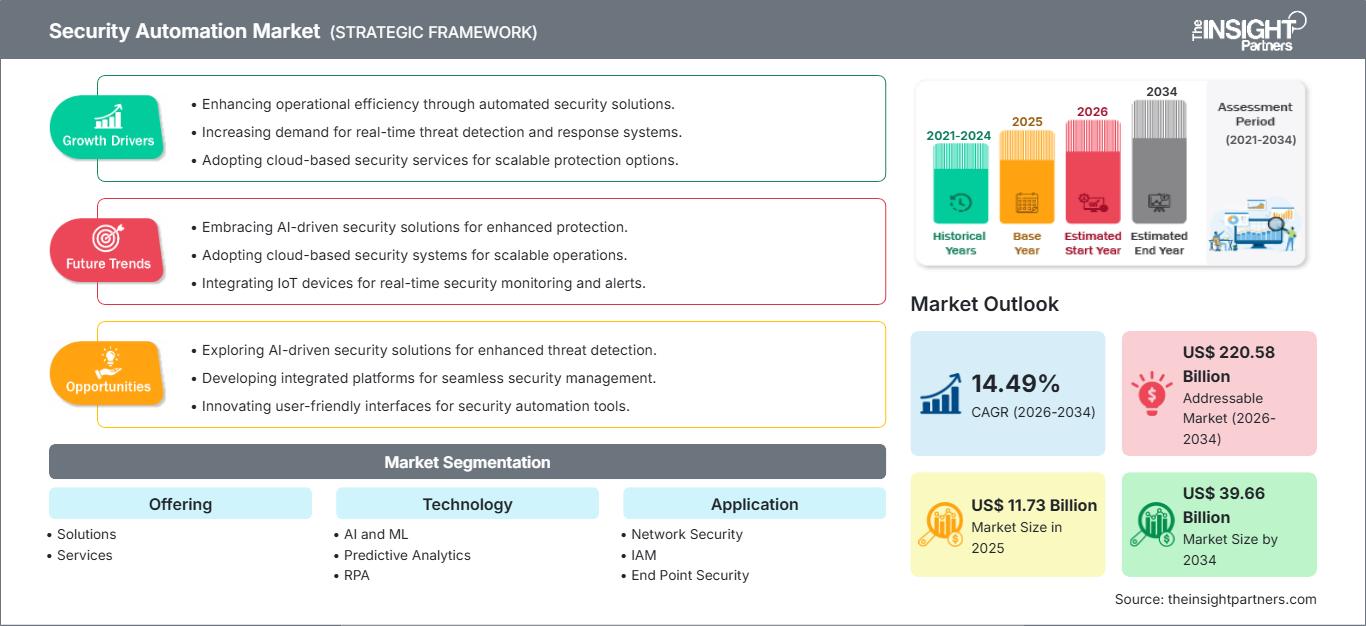
2025 Market Size
US$ 11.73 Bn
Base year value
2034 Forecast
US$ 39.66 Bn
Projected by 2034
CAGR 2026-2034
14.49 %
Growth rate
Addressable Market
US$ 220.58 Bn
(2026-2034)
The Security automation market was valued at US$ 11.73 Billion in 2025 and is projected to reach US$ 39.66 Billion by 2034, expanding at a CAGR of 14.49% during 2026–2034. Increasing cyberattack sophistication, growing enterprise adoption of cloud-native security architectures, and the need to reduce response times are driving sustained demand for automated cybersecurity solutions across industries. Organizations are increasingly integrating artificial intelligence, orchestration platforms, and automated workflows to strengthen security operations while improving operational efficiency.
Across North America, enterprises continue to prioritize cybersecurity modernization as digital transformation, hybrid work environments, and expanding regulatory obligations reshape enterprise risk strategies. The security automation market size in the region is supported by strong investments in security operations centers, cloud security, and zero-trust implementation. North America is expected to expand at an estimated CAGR of 13.5%–14.5% during 2026–2034, supported by mature technology adoption and continuous innovation from leading cybersecurity vendors.
Security Automation Market Assessment and Insights
- North America: The region maintains market leadership owing to high cybersecurity spending, widespread cloud adoption, and strong enterprise digitalization. Share in 2025: 37%–40%. CAGR between 2026–2034: 13.5%–14.5%.
- US: The country remains the largest national market due to significant enterprise security investments, federal cybersecurity initiatives, and extensive vendor presence. Share in 2025: 82%–85% of North America. CAGR between 2026–2034: 13.4%–14.4%.
- Europe: Strong regulatory frameworks including GDPR and NIS2 continue to encourage automation investments across Germany, the UK, France, Italy, and Spain. Share in 2025: 26%–29%. CAGR between 2026–2034: 13.8%–14.8%.
- Asia Pacific: Accelerating cloud migration, expanding digital economies, and rising cybersecurity awareness across China, Japan, India, South Korea, and Australia support robust expansion. Share in 2025: 23%–26%. CAGR between 2026–2034: 15.8%–16.8%.
- Largest Segment: Solutions account for the largest revenue contribution as enterprises prioritize integrated security orchestration, automated threat detection, and response platforms. Market share in 2025: 67%–70%. CAGR between 2026–2034: 14.1%–15.0%.
- High Growth Segment: AI and ML is projected to record the fastest expansion because organizations increasingly deploy intelligent threat detection, predictive analytics, and automated decision support. Market share in 2025: 30%–34%. CAGR between 2026–2034: 17.0%–18.5%.
- Key companies analyzed in detail: Palo Alto Networks, Splunk Inc., CyberArk Software Ltd., Check Point Software Technologies Ltd., CrowdStrike Holdings, Inc., Red Hat, Inc., Cisco Systems, Inc., VMware Carbon Black, Trellix, IBM Corporation, Secureworks Corp., Tenable Holdings, Inc., Microsoft Corporation, Swimlane Inc., Tufin Software Technologies Ltd., Sumo Logic, Inc., Google LLC.
Source: The Insight Partners' analysis based on proprietary research, government publications, company annual reports, investor presentations, industry databases, and expert interviews.
Enterprise cybersecurity strategies have evolved from isolated security tools toward integrated automation ecosystems that combine artificial intelligence, orchestration, analytics, and continuous monitoring. Security operations centers increasingly depend on automated workflows to prioritize alerts, investigate threats, and execute predefined response actions with minimal human intervention. Growing cloud adoption, expanding attack surfaces, and persistent cybersecurity workforce shortages continue to accelerate implementation across both large enterprises and mid-sized organizations. These developments have strengthened demand for interoperable platforms capable of integrating endpoint, identity, network, and cloud security environments while improving operational resilience and reducing response complexity, driving growth in the Security Automation Market.
Future growth is likely to be fueled by growing investments in the Asia Pacific, the Middle East, and select economies of Latin America, owing to organizations' need to enhance their digital infrastructure and build cyber resiliency. With government cybersecurity frameworks, compliance requirements, and the adoption of zero-trust architecture, organizations are being incentivized to automate security processes that involve repetition. Innovation in generative AI, behavioral analysis, and cloud native security platforms is anticipated to provide new avenues for deployment and scalability.
Security Automation Market Report Scope
| Report Attribute | Details |
|---|---|
| Market size in 2025 | US$ 11.73 Billion |
| Market Size by 2034 | US$ 39.66 Billion |
| Global CAGR (2026 - 2034) | 14.49% |
| Historical Data | 2021-2024 |
| Forecast period | 2026-2034 |
Security Automation Market Analysis
Increasing digital transformation initiatives, expanding hybrid cloud deployments, and growing cybersecurity risks continue to strengthen security automation market growth across enterprise environments. Organizations increasingly deploy automation platforms to improve threat detection, accelerate incident response, and reduce manual intervention within security operations centers. At the same time, expanding ransomware activity and increasingly sophisticated attack techniques are encouraging enterprises to integrate artificial intelligence, security orchestration, and behavioral analytics into existing cybersecurity architectures for greater operational efficiency.
The broader ecosystem of the Security Automation Market continues to evolve through collaboration among cloud providers, cybersecurity vendors, managed security service providers, and systems integrators. Cloud-native deployment models enable organizations to scale automation capabilities rapidly while reducing infrastructure complexity. Demand is also supported by increasing adoption among regulated industries where compliance requirements require continuous monitoring, automated reporting, and faster incident remediation across distributed digital environments.
Competitive intensity continues to increase as global cybersecurity vendors strengthen portfolios through platform integration, artificial intelligence capabilities, strategic acquisitions, and ecosystem partnerships. This security automation market analysis indicates that leading companies are increasingly focusing on unified security platforms capable of integrating endpoint protection, identity governance, network security, cloud security, and threat intelligence within a centralized automation framework. Such integrated approaches improve visibility while reducing operational complexity for enterprise security teams.
These include Palo Alto Networks, CrowdStrike Holdings, Inc., Microsoft Corporation, Cisco Systems, Inc., IBM Corporation, and Google LLC, who continue growing in their AI-powered security and cloud native security offerings. CyberArk Software Ltd. builds its privileged access automation solutions, and Splunk Inc. improves its security operations through advanced data platforms that use analytical techniques. These include Check Point Software Technologies Ltd., Trellix, VMware Carbon Black, Secureworks Corp., Swimlane Inc., Tufin Software Technologies Ltd., Sumo Logic, Inc., Red Hat, Inc., and Tenable Holdings, Inc.
● REPORT CUSTOMIZATION
Tailor This Report To Align With Your Specific Business Requirements
This report can be customized to align precisely with your business objectives, scope, and target markets. Customization options include tailored segmentation, geography, competitive analysis, and strategic insights to support informed decision-making.
Customize This Report →WHAT YOU CAN ADJUST
- ● Segmentations
- ● Geography
- ● Competitive Analysis
- ● Language Preferences
Security Automation Market: Strategic Insights
Regional Insights
North America Security Automation Market
North America accounted for approximately 37%–40% security automation market share in 2025, making it the largest regional contributor. The region benefits from mature cybersecurity infrastructure, high cloud adoption rates, and significant spending on security operations modernization. Large enterprises across BFSI, healthcare, government, retail, and technology sectors continue to deploy automated threat detection and response platforms to address increasingly sophisticated cyberattacks. Regulatory initiatives from federal agencies and critical infrastructure protection programs further support long-term demand. The region is projected to expand at a CAGR of 13.5%–14.5% during 2026–2034.
The US and Canada are still the forerunners when it comes to the implementation of security systems driven by artificial intelligence, security orchestration tools, and automated compliance monitoring systems. The rise in ransomware attacks, growth in remote workspaces, and the need to protect cloud workloads are making businesses automate security processes that are repetitive in nature. There is a high degree of vendor consolidation, with the major players in the cybersecurity industry continually innovating and integrating platforms.
U.S. Security Automation Market
The United States represented approximately 82%–85% of the North American market in 2025, supported by the presence of major cybersecurity technology providers, advanced digital infrastructure, and strong enterprise cybersecurity spending. The country is expected to register a CAGR of 13.4%–14.4% during 2026–2034 as organizations increasingly prioritize automated security operations and proactive threat management. Adoption remains particularly strong within financial services, government agencies, healthcare institutions, and technology companies that require continuous monitoring and rapid incident response capabilities, reinforcing U.S. leadership in the Security Automation Market.
Demand for application services is growing in various sectors like network security, identity & access management, endpoint protection, and incident response management. Companies are increasingly using automation technologies in their security operations centers in order to eliminate alert fatigue and speed up the process of remediation. Some of the leading companies with presence in the country include Microsoft Corporation, Palo Alto Networks, Cisco Systems, Inc., CrowdStrike Holdings, Inc., IBM Corporation, and Google LLC.
Europe Security Automation Market
Europe accounted for approximately 26%–29% of the global market in 2025 and is expected to grow at a CAGR of 13.8%–14.8% during 2026–2034. Strong regulatory requirements, increasing cybersecurity awareness, and rising investment in digital infrastructure continue to support market expansion. Germany remains the leading country within the region due to its large industrial base, advanced manufacturing sector, and growing emphasis on securing Industry 4.0 environments through automated cybersecurity frameworks, supporting growth in the Security Automation Market.
The UK is one of the region’s most developed cybersecurity markets. Banks, governments, and digital service providers continue to invest in security orchestration, automation of compliance, and AI-based threat detection. Thanks to the highly developed cybersecurity environment and regulation in the UK, technology adoption can be expected to remain strong in both the public and private sectors.
In Germany, the development is driven by the implementation of industrial cybersecurity solutions and automated monitoring tools. In France, Italy, and Spain, the increased demand for automation in security operations is seen amid growing cloud migrations and digital transformations of businesses. The development of cybersecurity initiatives on the government level and new compliance requirements create good opportunities for market growth in those countries.
APAC Security Automation Market
Asia Pacific accounted for approximately 23%–26% of the global market in 2025 and is projected to record the fastest regional expansion with a CAGR of 15.8%–16.8% during 2026–2034. Rapid digitalization, increasing internet penetration, and growing cybersecurity investments are driving adoption across both developed and emerging economies. China remains the largest contributor, supported by extensive enterprise digital transformation and expanding cloud infrastructure deployment, strengthening the growth outlook for the Security Automation Market.
Japan, South Korea, India, and Australia keep up their regional growth momentum with their investments in cyber resiliency, smart infrastructure, and cloud security upgrades. The cybersecurity measures of the government, data protection policies, and growing awareness about cybersecurity threats drive enterprises to adopt security automation. India emerges as one of the major growth markets for its fast digital economy development and cybersecurity spending of enterprises.
Middle East & Africa Security Automation Market
The Middle East & Africa region is expected to expand at a CAGR of 14.8%–15.8% during 2026–2034, supported by digital transformation initiatives and increasing cybersecurity investments. Saudi Arabia remains the leading market, benefiting from large-scale digital infrastructure projects and national cybersecurity programs. Organizations are increasingly deploying automated security solutions to protect critical infrastructure and government systems from evolving cyber threats, contributing to the growth of the Security Automation Market.
In the UAE, there is a high-level of focus on smart cities, cloud computing, and digitized governments, thereby making room for cybersecurity automation solutions. On the African continent, South Africa is one of the important markets, while Africa as a whole is seeing increasing use of cybersecurity automation platforms in the banking, telecommunications, and energy verticals. Growth opportunities will be sustained by expanding the digital ecosystem and infrastructure upgrade projects through the forecast period.
Segmentation Analysis
Offering
The Offering segment is projected to expand at a CAGR of 14.2%–15.1% during 2026–2034. Growing enterprise demand for integrated cybersecurity platforms and managed security expertise continues to support adoption across organizations of all sizes. As cyber threats become increasingly sophisticated, enterprises seek comprehensive offerings that combine automation, orchestration, analytics, and professional services. The security automation market scope continues to broaden as organizations integrate automation into cloud, hybrid, and on-premises security environments while improving operational efficiency and compliance readiness.
- Solutions: Solutions represent the largest revenue contributor owing to widespread deployment of security orchestration, automated threat detection, compliance management, and incident response platforms that improve operational visibility while reducing manual workloads across enterprise security operations.
- Services: Services continue gaining strategic importance as organizations require consulting, deployment, integration, managed security, and ongoing support to maximize automation performance while addressing evolving regulatory and cybersecurity requirements.
Technology
The Technology segment is anticipated to register a CAGR of 15.3%–16.2% during 2026–2034 as enterprises increasingly adopt intelligent automation to strengthen cyber resilience. Continuous advancements in artificial intelligence, behavioral analytics, robotic process automation, and predictive security intelligence enable organizations to automate repetitive security operations while improving detection accuracy and response effectiveness. Vendors continue integrating multiple technologies into unified security platforms to enhance enterprise-wide protection.
- AI and ML: Artificial intelligence and machine learning technologies enable continuous threat detection, automated prioritization, anomaly identification, and adaptive response capabilities, making them central to next-generation security operations and enterprise cyber resilience strategies.
- Predictive Analytics: Predictive analytics helps organizations identify emerging attack patterns by analyzing historical and real-time security data, enabling proactive risk mitigation, improved threat forecasting, and stronger decision-making across security operations centers.
- RPA: Robotic process automation streamlines repetitive cybersecurity activities including ticket creation, log collection, compliance reporting, and workflow execution, allowing security teams to focus on higher-value investigation and strategic risk management activities.
- User behaviour and entity behavior analytics: User behavior and entity behavior analytics strengthen insider threat detection by continuously monitoring behavioral deviations, improving visibility into compromised accounts and suspicious activities across enterprise networks and cloud environments.
Application
The Application segment is expected to grow at a CAGR of 14.8%–15.7% during 2026–2034, driven by expanding enterprise cybersecurity requirements and increasingly complex digital infrastructures. Organizations are deploying automation across multiple security functions to improve incident response, strengthen access controls, secure distributed endpoints, and reduce operational burdens. Application-specific automation continues to enhance organizational resilience against sophisticated cyber threats while supporting regulatory compliance.
- Network Security: Network security remains a foundational application area where automation continuously monitors traffic, identifies anomalies, and coordinates rapid containment actions to minimize operational disruption across enterprise digital infrastructure.
- IAM: Identity and access management solutions increasingly incorporate automation to streamline user provisioning, privileged access controls, authentication workflows, and policy enforcement while reducing identity-related cybersecurity risks.
- End Point Security: Endpoint security automation enables continuous monitoring, rapid malware containment, vulnerability assessment, and policy enforcement across laptops, servers, mobile devices, and distributed enterprise computing environments.
- Incident Response Management: Incident response management solutions automate investigation workflows, evidence collection, prioritization, containment, and remediation activities, significantly reducing response times while improving consistency across security operations.
Vertical
The Vertical segment is projected to expand at a CAGR of 14.4%–15.3% during 2026–2034 as industry-specific cybersecurity requirements become increasingly sophisticated. Organizations across regulated and digitally intensive industries continue investing in automation to protect sensitive information, maintain business continuity, and satisfy evolving compliance obligations. Industry adoption patterns vary according to regulatory exposure, digital maturity, and cyber risk profiles.
- BFSI: Financial institutions continue leading adoption because automated security operations strengthen fraud prevention, identity protection, transaction monitoring, regulatory compliance, and rapid response to increasingly sophisticated cyberattacks targeting financial ecosystems.
- Manufacturing: Manufacturing organizations increasingly deploy automation to secure industrial control systems, connected production assets, operational technology networks, and Industry 4.0 environments against ransomware and operational disruptions.
- Media & Entertainment: Media and entertainment companies implement automated cybersecurity to protect digital content, cloud production workflows, streaming platforms, intellectual property, and consumer information from evolving cyber threats.
- Energy and Utilities: Energy and utility providers adopt automation to secure critical infrastructure, industrial networks, smart grid operations, and connected assets while maintaining service continuity and regulatory compliance requirements.
- Retail and Ecommerce: Retail and e-commerce enterprises increasingly automate cybersecurity operations to protect payment systems, customer information, omnichannel platforms, and digital commerce environments while minimizing fraud and operational risk.
Opportunity Snapshot
| Application | Revenue Contribution | Trend Tag | Adoption Stage |
| Network Security | High | Zero Trust | Mature |
| IAM | High | Identity Fabric | Scaling |
| End Point Security | High | XDR Adoption | Scaling |
| Incident Response Management | High | SOAR Expansion | Scaling |
Security Automation Market Growth Drivers and Impact Analysis
Escalating cyber threats accelerate enterprise security automation investments
The increase in ransomware attacks, phishing attacks, attacks via supply chain, and APTs is compelling organizations to adopt automated cybersecurity practices. Nowadays, modern businesses have to face several thousand cybersecurity alerts on a daily basis, and it is getting increasingly difficult to handle them manually. Automated cybersecurity can help in the speedy detection of attacks, consistent and effective responses to them and better prioritization of critical incidents. These are some industries like BFSI, health care, manufacturing, and government, which are highly worried about enhancing cyber-resilience through the adoption of automation of threat intelligence, endpoint protection, identity and access management, and cloud security platforms.
Artificial intelligence transforms security operations center performance
The implementation of artificial intelligence and machine learning technologies will transform the way in which security operations centers conduct their monitoring, investigations, and response activities concerning cyber incidents. Intelligently designed algorithms constantly examine the telemetry gathered from endpoints, cloud workload, applications, and infrastructure to recognize abnormalities with more precision than the current rule-based methods. With the help of the automation powered by AI, alert fatigue will be minimized due to prioritization of high-risk events and suggestions of the right mitigation activities. In addition, security personnel will have improved investigative activities to handle the rising volume of attacks without corresponding growth in staffing.
Cloud-native digital transformation expands automation deployment
Organizations shifting their applications and workload onto hybrid or multi-cloud environments require a scalable architecture that will offer protection for their ever-evolving digital world. Cloud-based automation systems will be useful for managing policies, monitoring the workloads, handling vulnerabilities and providing compliance reporting of the distributed infrastructure. Automation has become common in organizations when it comes to implementing DevSecOps since it allows them to identify vulnerabilities within the SDLC and deploy applications in a more secure way. However, automation is also critical in ensuring continuous verification and management of access controls in zero-trust security models.
Security Automation Market Future Trends
Generative AI reshapes autonomous cyber defense capabilities
According to industry experts, generative AI will substantially increase the capabilities of security automation platforms to conduct context-based threat analysis, create incident summaries, provide response suggestions, and automate the investigation process. While this kind of technology will not replace security personnel, it will assist analysts to become more productive and make decisions faster by eliminating the repetitive elements of their work. Future security platforms will rely on large language models that will be combined with threat intelligence and behavior analysis for generating responsive actions against emerging cyber threats. This trend is likely to lead to rapid investments in intelligent cybersecurity solutions by organizations.
Unified security platforms gain enterprise-wide adoption
Organizations increasingly prefer consolidated cybersecurity platforms instead of managing numerous standalone security products. Future security automation deployments are expected to integrate endpoint security, identity governance, cloud protection, network monitoring, compliance management, and threat intelligence into unified operational environments. This convergence enables centralized visibility, simplified policy management, and coordinated incident response across increasingly complex digital ecosystems. Vendors are expected to prioritize open architectures, interoperability, and API-driven integration to improve compatibility with existing enterprise infrastructure. These developments will strengthen operational efficiency while reducing technology fragmentation, administrative complexity, and total cost of ownership for organizations pursuing long-term cybersecurity modernization.
Security Automation Market Opportunities
Expanding adoption among small and medium-sized enterprises
Small and medium-sized enterprises represent one of the most attractive investment areas for the security automation market Forecasts over the coming decade. Many SMEs continue facing increasing cyber risks while operating with limited cybersecurity personnel and constrained IT budgets. Cloud-delivered automation platforms, subscription-based security services, and managed detection and response offerings enable these organizations to access enterprise-grade security capabilities without substantial infrastructure investments. Vendors developing cost-effective, scalable, and simplified automation solutions are well-positioned to capture this expanding customer segment. Strategic partnerships with managed service providers and regional channel partners are expected to further accelerate adoption while improving cybersecurity maturity across smaller enterprises globally.
Critical infrastructure modernization creates long-term investment potential
Governments and infrastructure operators are significantly increasing investments in cybersecurity as utilities, transportation systems, healthcare facilities, telecommunications networks, and manufacturing environments become increasingly connected. Security automation platforms capable of protecting operational technology environments, industrial control systems, and critical infrastructure assets are expected to experience sustained demand throughout the forecast period. Vendors offering integrated monitoring, automated incident response, asset visibility, and regulatory compliance capabilities can benefit from expanding public and private sector investments. Long-term opportunities are also expected to emerge through national cyber resilience initiatives, smart city programs, and industrial digital transformation projects requiring advanced automated cybersecurity capabilities across mission-critical environments.
Frequently Asked Questions

- Comprehensive Market Sizing and Forecast Analysis
- Detailed Segmentation Analysis
- In-Depth Market Dynamics Assessment
- Regional and Country-Level Insights
- Competitive Landscape and Company Benchmarking
- Strategic Business Intelligence
Recent Reports
Testimonials

The Insight Partners' SCADA System Market report is comprehensive, with valuable insights on current trends and future forecasts. The team was highly professional, responsive, and supportive throughout. We are very satisfied and highly recommend their services.
RAN KEDEM Partner, Reali Technologies LTDs
I requested a report on a very specific software market and the team produced the report in a few days. The information was very relevant and well presented. I then requested some changes and additions to the report. The team was again very responsive and I got the final report in less than a week.
JEAN-HERVE JENN Chairman, Future Analytica
We worked with The Insight Partners for an important market study and forecast. They gave us clear insights into opportunities and risks, which helped shape our plans. Their research was easy to use and based on solid data. It helped us make smart, confident decisions. We highly recommend them.
PIYUSH NAGPAL Sr. Vice President, High Beam Global
The Insight Partners delivered insightful, well-structured market research with strong domain expertise. Their team was professional and responsive throughout. The user-friendly website made accessing industry reports seamless. We highly recommend them for reliable, high-quality research services
YUKIHIKO ADACHI CEO, Deep Blue, LLC.
This is the first time I have purchased a market report from The Insight Partners.While I was unsure at first, I visited their web site and felt more comfortable to take the risk and purchase a market report.I am completely satisfied with the quality of the report and customer service. I had several questions and comments with the initial report, but after a couple of dialogs over email with their analyst I believe I have a report that I can use as input to our strategic planning process.Thank you so much for taking the extra time and making this a positive experience.I will definitely recommend your service to others and you will be my first call when we need further market data.
JOHN SUZUKI President and Chief Executive Officer, Board Director, BK Technologies
I wish to appreciate your support and the professionalism you displayed in the course of attending to my request for information regarding to infectious disease IVD market in Nigeria. I appreciate your patience, your guidance, and the fact that you were willing to offer a discount, which eventually made it possible for us to close a deal. I look forward to engaging The Insight Partners in the future, all thanks to the impression you have created in me as a result of this first encounter.
DR CHIJIOKE ONYIA MANAGING DIRECTOR, PineCrest Healthcare Ltd.Reason to Buy
- Informed Decision-Making
- Understanding Market Dynamics
- Competitive Analysis
- Identifying Emerging Markets
- Customer Insights
- Market Forecasts
- Risk Mitigation
- Boosting Operational Efficiency
- Strategic Planning
- Investment Justification
- Tracking Industry Innovations
- Aligning with Regulatory Trends





 Get Free Sample for