
Shot Peening Machine and Peen Forming Market Forecast to 2034
Coverage: By Technology (Shot Peening, Peen Forming, and Corundum (Aluminium Oxide)), Application (Commercial Aviation, Military Aviation, MedTech, and Space), End User (Manufacturing and MRO), and Geography
- Status : Published
- Report Code : TIPRE00044099
- Category : Manufacturing and Construction
- No. of Pages : 250
- Available Report Formats :


- Last update date : November 05, 2026


2025 Market Size
US$ 319.85 Mn
Base year value
2034 Forecast
US$ 545.65 Mn
Projected by 2034
CAGR 2026-2034
6.11 %
Growth rate
Addressable Market
US$ 3,917.87 Mn
(2026-2034)
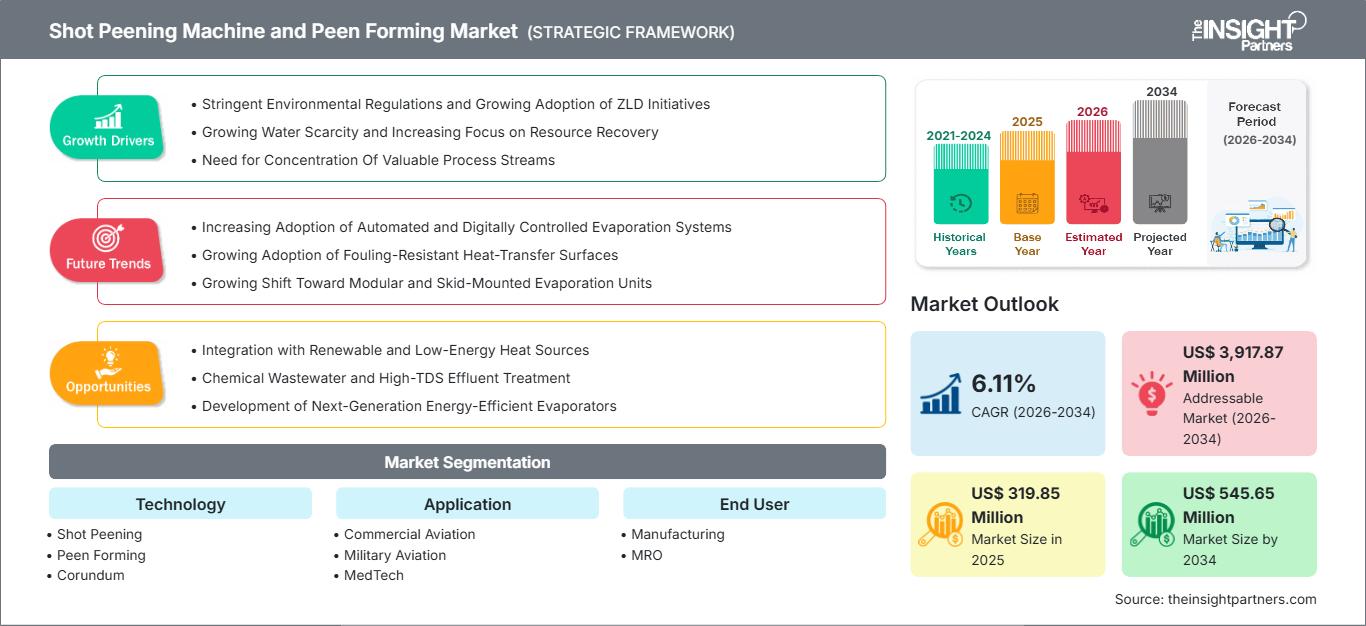
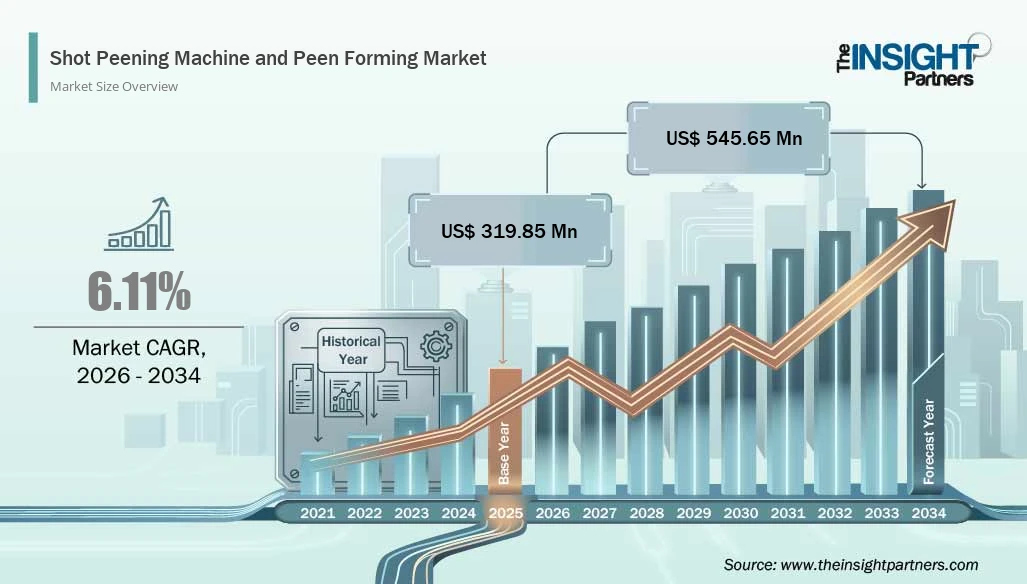
The Global Shot Peening Machine and Peen Forming Market was valued at US$ 319.85 million in 2025 and is projected to reach US$ 545.65 million by 2034, registering a CAGR of 6.11% during 2026–2034. Demand is supported by aerospace component manufacturing, fatigue-resistance requirements, aircraft maintenance activities, and industrial investment in controlled surface treatment. Equipment modernization, automated processing, and the need for repeatable component quality also influence purchasing decisions. Market development will depend on aerospace production, manufacturing capacity expansion, and the commercial viability of advanced peening and forming technologies.
North America remains an important market because of its established aerospace supply chain, defense manufacturing base, and maintenance, repair, and overhaul infrastructure. The region's modelled CAGR is ~5% through 2034, supported by replacement demand, specialized component processing, and investments in production equipment. Manufacturers and maintenance providers require reliable systems that can meet application-specific process specifications.
Shot Peening Machine and Peen Forming Market Assessment and Insights
Regional Outlook
- North America: 26.18% of the global market in 2025 | 6.04% CAGR through 2034. Market position: North America benefits from established aerospace manufacturing, defense procurement, specialist surface-engineering providers, and extensive maintenance, repair, and overhaul activity. Its mature industrial base supports recurring equipment demand and upgrades.
- US: 71.23% of North American market revenue in 2025 | 6.26% CAGR through 2034. Market position: The United States anchors regional demand through commercial aircraft production, military aviation programs, engine maintenance, and precision component manufacturing. Its established aerospace supply chain supports advanced process control and equipment replacement.
- Europe: 28.18% of the global market in 2025 | 5.81% CAGR through 2034. Market position: Europe combines established aerospace manufacturing, industrial machinery expertise, and specialist equipment suppliers. Germany is the leading country in Europe, supported by engineering capabilities, while the UK, France, Italy, and Spain contribute through aerospace and industrial production.
- Asia Pacific: 37.85% of the global market in 2025 | 6.50% CAGR through 2034. Market position: Asia Pacific is the fastest-growing region, supported by expanding aerospace capabilities, industrial modernization, and manufacturing investment. China leads the regional market, while Japan and South Korea contribute advanced engineering expertise and India expands its aerospace and maintenance infrastructure.
Segment Outlook
- Application: 6.11% CAGR through 2034. Market position: Application demand is led by commercial aviation, where fatigue resistance, component reliability, and maintenance requirements sustain equipment utilization. Military aviation and space applications support specialized systems requiring tighter process control.
- End User: 6.11% CAGR through 2034. Market position: Manufacturing represents the larger end-user category because production facilities integrate peening into repeatable component-processing workflows. MRO demand benefits from aircraft maintenance, component refurbishment, and the need to extend the service life of high-value parts.
Competitive Coverage
KSA Kugelstrahlzentrum Aachen GmbH, NGDAO QINGGONG MACHINERY CO., LTD., Curtiss-Wright Corporation, Wheelabrator Group, Aerosphere Inc., Pangborn, Guyson Corporation, Empire Abrasive Equipment, Peening Technologies Equipment, LLC, Innovative Peening Systems, OSK-Kiefer GmbH, COGEIM EUROPE SRL, Norblast S.r.l., JX Shot Blasting Machine Co., Ltd., Progressive Surface, Inc., Sintokogio Ltd., Rösler Oberflächentechnik GmbH.
Methodology
The Insight Partners follows Data Collection & Secondary Research, Primary Research, Data Analysis, and Data Triangulation & Final Review to validate market estimates and insights.
Source: The Insight Partners' analysis based on proprietary research, government publications, company annual reports, investor presentations, industry databases, and expert interviews.
The Global Shot Peening Machine and Peen Forming Market is shaped by changes in aircraft manufacturing, component engineering, and industrial surface treatment. Shot peening introduces beneficial compressive residual stresses through controlled impact, while peen forming uses the process to produce specified curvature in metal structures. Equipment development has progressed toward programmable motion, automated media delivery, process monitoring, and repeatable treatment parameters. These capabilities help manufacturers handle complex geometries and reduce variation between components. Production requirements increasingly favor systems that combine process consistency with documented quality controls.
Looking ahead, the market's development will depend on aircraft production schedules, defense modernization, maintenance capacity, and the expansion of aerospace supply chains in Asia Pacific. Investment opportunities extend beyond new machine installations to upgrades, inspection systems, replacement parts, and specialist service capabilities. Qualification requirements in aviation and other critical applications can lengthen purchasing cycles, but they also create incentives for reliable, traceable equipment. Manufacturers entering emerging industrial markets may benefit from local technical support and training. At the same time, buyers will continue balancing automation and precision against capital expenditure, floor space, operating costs, and production throughput.
Shot Peening Machine and Peen Forming Market Report Scope
| Report Attribute | Details |
|---|---|
| Market size in 2025 | US$ 319.85 Million |
| Market Size by 2034 | US$ 545.65 Million |
| Global CAGR (2026 - 2034) | 6.11% |
| Historical Data | 2021-2024 |
| Forecast period | 2026-2034 |
Shot Peening Machine and Peen Forming Market Analysis
The principal mechanism behind Global Shot Peening Machine and Peen Forming Market growth is the need to improve fatigue performance in components exposed to repeated loading. Aerospace manufacturers use controlled surface treatment to support component durability, while engine and structural maintenance operations require dependable processes for eligible parts. Industrial buyers also consider peening when evaluating component life-cycle costs, production quality, and reliability. Demand therefore reflects both original equipment manufacturing and recurring aftermarket requirements. Investment decisions depend on the component mix, process specifications, throughput targets, and the cost of integrating new equipment into existing production lines.
The chain encompasses equipment engineering, abrasive-media supply, system integration, process qualification, operator training, inspection, and maintenance. Equipment manufacturers compete on blast coverage automation media recovery, programmable control, and ability to handle complex geometries of parts. Customers consider not only machine prices but also media costs, downtime for maintenance, energy use, and repeatability of the process. Suppliers compete with the ability to put together a system based on the part, volume, and quality needed, opening a path for providers of specialized equipment for aerospace and other regulated manufacturing environments as well as for suppliers of industrial blasting equipment more generally.
Global shot peening machine and peen forming market analysis indicated competitors includes established equipment manufacturers, specialist process-engineering firms, and companies offering related surface-treatment services. Curtiss-Wright Corporation brings surface-engineering expertise, while Wheelabrator Group, Pangborn, and Rösler Oberflächentechnik GmbH participate in industrial blasting and peening equipment supply. Guyson Corporation and Empire Abrasive Equipment address equipment configurations suited to specific customer requirements. Other specialists, including KSA Kugelstrahlzentrum Aachen GmbH, OSK-Kiefer GmbH, COGEIM EUROPE SRL, and Norblast S.r.l., contribute to a diverse supplier landscape.
Strategic positioning increasingly depends on investment priorities include programmable automation, process monitoring, media management, and technical service capabilities. Suppliers can strengthen customer relationships by reducing setup complexity, improving documentation, and supporting repeatable treatment across multiple production batches. Still, aerospace qualification requirements, integration costs, and customer-specific engineering can constrain rapid supplier substitution. Companies that combine application expertise with dependable service networks may be better positioned to secure long-term industrial accounts.
● REPORT CUSTOMIZATION
Tailor This Report To Align With Your Specific Business Requirements
This report can be customized to align precisely with your business objectives, scope, and target markets. Customization options include tailored segmentation, geography, competitive analysis, and strategic insights to support informed decision-making.
Customize This Report →WHAT YOU CAN ADJUST
- ● Segmentations
- ● Geography
- ● Competitive Analysis
- ● Language Preferences
Shot Peening Machine and Peen Forming Market: Strategic Insights
Regional Insights
North America shot peening machine and peen forming Market
North America accounts for an estimated 26.18% of the global shot peening machine and peen forming market share in 2025, with a projected CAGR of 6.04% through 2034. Regional demand reflects an established aerospace ecosystem, defense-related manufacturing, and a large base of maintenance providers. The United States contributes most of the regional activity, supported by aircraft engines, structural components, landing systems, and other precision-engineered parts. Canada contributes through aerospace manufacturing and specialized industrial production, while Mexico participates through manufacturing supply chains and export-oriented industrial activity.
Operating in the mature industrial market, there is demand for new equipment as well as replacement purchases. As older equipment is modernized, end-users are in particular scrutinizing automated handling, process control, and repeatability. MRO facilities need trustworthy systems and trained procedures to operate qualifiable units. Procurement can be affected by lengthy approval processes and process repeatability demonstrations. These conditions tend to favor suppliers with the ability to offer commissioning maintenance application engineering, and training. While growth in the regional aerospace market is less than in emerging manufacturing centers, the large presence of high-value aerospace manufacturing activity offers a reliable level of demand for advanced equipment.
US shot peening machine and peen forming Market
The United States represents an estimated 71.23% of North American market revenue in 2025 and is projected to grow at a CAGR of 6.26% through 2034. Its position reflects the breadth of commercial aviation, military aerospace, aircraft engine manufacturing, and component repair activity. Domestic suppliers and service providers support applications involving fatigue-sensitive components, while specialist equipment makers address process requirements that vary by geometry, material, and production volume.
The US market is a mix of equipment purchase and maintenance demand. Buyers are interested in part automation, programmable blast coverage and process settings, documented where variations in component specifications require identical treatment. Guyson supplies engineered shot peening equipment for niche applications; Curtiss-Wright Corporation is part of the wider surface-engineering sector. The commercial perspective will be affected by aircraft utilisation, defense expenditure, industrial capacity utilisation and manufacturers' willingness to upgrade installation equipment. Equipment qualification costs are high, which can inhibit purchase, but component reliability supports the need for investment in controlled processes.
Europe shot peening machine and peen forming Market
Europe represents an estimated 28.18% of global revenue in 2025 and is projected to expand at a CAGR of 5.81% through 2034. Germany is the leading country in Europe, reflecting its engineering base, industrial equipment expertise, and extensive precision-manufacturing capabilities. The UK and France contribute through aerospace production, engine programs, defense-related engineering, and aircraft maintenance. Italy adds demand through aerospace suppliers and advanced manufacturing, while Spain contributes through aircraft structures, component production, and industrial supply chains.
Equipment reliability, process documentation, and compatibility with existing production systems are key factors in European purchasing decisions. The German ecosystem of specialist machinery supplies the system for putting together custom solutions. Aerospace and maintenance activity in the UK spurs demand for controlled processing of qualifying parts. France's aircraft and propulsion supply chains are an advantage to the country, while Italy's suppliers focus on niche industrial and aerospace applications. Spain's position is to be found through it Europe-wide participation in aircraft production and part manufacture.
Asia Pacific shot peening machine and peen forming Market
Asia Pacific accounts for an estimated 37.85% of global market revenue in 2025 and is projected to register a CAGR of 6.50% through 2034, making it the fastest-growing region. China is the leading country in Asia Pacific, supported by its industrial manufacturing base, machinery production, and expanding aerospace capabilities. Japan contributes advanced manufacturing expertise, while South Korea supports aerospace, defense, and precision component industries. India benefits from aerospace production and maintenance investment, and Australia contributes through aerospace maintenance and defense-related activity.
Growth in the region will be a combination of manufacturing capacity growth, local sourcing of supply-chain components, and industrial equipment updating. With more rigorous quality standards, customers' requirements may favor more automated (e.g. manufacturing) equipment with repeatable operating parameters. China already sources a combination of locally manufactured equipment and from industrial and aerospace end-users. Japan/South Korea could take at least some share of a precision centric end-user specification. India's domestic manufacturing and MRO ecosystem creates an opportunity for supply of equipment and technical services. Australia is a smaller market, with a smaller number of applications to consider, but where specific applications and maintenance requirements play a part.
Middle East and Africa shot peening machine and peen forming Market
The Middle East and Africa market is expected to expand at a modelled CAGR of 5.97% through 2034. Saudi Arabia and the United Arab Emirates benefit from aviation infrastructure, defense-related activity, and investment in industrial capabilities. South Africa contributes through aerospace-related engineering and specialized manufacturing. The remaining Middle East and Africa markets are diverse, with demand influenced by aviation service development, industrial investment, and access to qualified processing facilities.
Equipment, infrastructure, and diversification of industrial sectors in the energy space may also bolster demand for surface-treatment systems beyond the aerospace industry. The Saudi industrial investment plan has great potential for local manufacturing and after-market support, as well as the UAE's aviation industrial ecosystem.
Segmentation Analysis
Technology Type
Technology selection influences process consistency, component coverage, operating costs, and the range of geometries that can be treated. The technology segment under global shot peening machine and peen forming market scope serves both high-volume industrial operations and specialized aerospace applications, with purchasing decisions shaped by surface requirements and production workflows. Adoption is increasingly influenced by automation compatibility, process repeatability, and the ability to manage complex parts. Investment in advanced peening methods may accelerate as manufacturers seek more localized treatment and improved control over component performance.
- Shot Peening: Shot peening remains an established approach for inducing compressive residual stresses on metal surfaces. Its flexibility across industrial and aerospace components supports demand for systems that deliver consistent media flow, coverage, and treatment intensity.
- Steel Shots: Steel shots are used in applications requiring durable, reusable metallic media and controlled impact. Their suitability depends on component material, specified surface condition, media integrity, and the need to maintain consistent processing parameters.
- Ceramic Shots: Ceramic shots support specialized applications where media characteristics and surface-finish requirements differ from those of conventional metallic media. Selection depends on component sensitivity, contamination considerations, and the required balance between treatment effectiveness and surface quality.
- Glass Beads: Glass beads are used where a comparatively gentle abrasive treatment or particular surface appearance is required. Their relevance depends on the specified process, component material, and whether the application calls for peening or another controlled surface-finishing operation.
- Cut Wire Shots: Cut wire shots provide a manufactured media option with controlled dimensions and composition. They are relevant to processes where consistency in media geometry and durability helps maintain predictable impact behavior and treatment repeatability.
- Peen Forming: Peen forming supports the controlled shaping of metal structures through the introduction of residual stresses. Demand is linked to aerospace structures and applications requiring specified curvature without relying exclusively on conventional mechanical forming methods.
- Shot: Shot-based peen forming applies repeated impacts across a defined surface to generate curvature. The approach is relevant to large metal panels and structures where forming accuracy, controlled coverage, and compatibility with component specifications are important.
- Laser: Laser peen forming uses controlled laser-induced effects to modify residual stress and support precision forming requirements. Its adoption is influenced by capital cost, process complexity, engineering requirements, and the value of non-contact treatment in specialized applications.
- Corundum: Corundum is associated with abrasive surface-treatment applications and should be distinguished from shot peening media used specifically to establish controlled compressive stresses. Equipment selection depends on the intended surface preparation, material compatibility, and required finish.
Application
Application requirements determine the process specifications, equipment configuration, qualification burden, and service expectations associated with peening and forming systems. This category is influenced by the need to maintain component reliability under demanding operating conditions and by the cost of component failure or premature replacement. Buyers assess equipment according to geometry, material, treatment accessibility, and production frequency. The commercial aviation application is expected to represent the largest individual application, while specialized aerospace programs may create opportunities for higher-precision systems.
- Commercial Aviation: Commercial aviation supports demand through aircraft production, engine component manufacturing, and maintenance requirements. Buyers emphasize repeatable treatment, documented process parameters, and reliable equipment support for eligible fatigue-sensitive components.
- Military Aviation: Military aviation applications require dependable component performance across demanding operating conditions. Procurement can involve specialized specifications, longer qualification processes, and requirements for controlled treatment of selected structural and propulsion components.
- MedTech: MedTech applications may require carefully controlled surface processing for selected metal components and devices. Adoption depends on material compatibility, surface specifications, contamination control, and the validation requirements applicable to each product and manufacturing process.
- Space: Space applications involve specialized components for which reliability, material performance, and traceable manufacturing processes are important. Demand is project-driven and depends on spacecraft production schedules, propulsion engineering, and the technical suitability of peening or forming for individual components.
End User
End-user demand reflects the difference between integrating surface treatment into component production and using it to support maintenance or refurbishment. Manufacturing buyers generally assess throughput, automation, repeatability, and production-line integration, while maintenance providers prioritize flexibility, component eligibility, turnaround time, and process documentation. Both groups evaluate lifecycle costs and the availability of technical support. Manufacturing is expected to remain the larger end-user category, while MRO offers opportunities tied to installed aircraft fleets and the continued need to maintain high-value components.
- Manufacturing: Manufacturing users integrate peening and forming into component production workflows. Equipment decisions depend on throughput, part geometry, automation, process control, and the cost of maintaining consistent quality across repeated production batches.
- MRO: MRO users apply approved surface-treatment processes within maintenance and component-repair workflows. Demand depends on fleet utilization, component eligibility, repair procedures, turnaround requirements, and the availability of trained personnel and qualified equipment.
Opportunity Snapshot
| Application | Revenue Contribution | Trend Tag | Adoption Stage |
| Commercial Aviation | High | Fleet Maintenance | Mature |
| Military Aviation | Medium | Defense Modernization | Mature |
| MedTech | Low | Precision Processing | Emerging |
| Space | Medium | Spacecraft Engineering | Scaling |
Shot Peening Machine and Peen Forming Market Growth Drivers and Impact Analysis
Aircraft Component Reliability and Fatigue Management
Aircraft part components are subject to high cycles of repeated loading, vibration, and extreme operating conditions and that means fatigue control considerations are high on the list of manufacturing and maintenance concerns. Controlled shot peening can introduce a layer of compressive residual stress that could slow the onset of fatigue-crack growth according to the application. This lead to a demand for equipment and systems that can deliver on the threeTs of consistency, coverage, and repeatable treatment parameters. The process must be matched to the component material and geometry, as well as engineering design, instead of following a prescriptive approach to the benefits of peening; that means, for equipment suppliers this adds to the responsibilities of application engineering commissioning operator training and process documentation.
Industrial Modernization and Automated Production Workflows
Impacts of automation modernization at User Facility by production needs, investment cost, and return on investment. An upgrade to a modern automated system can justify the cost of equipment that can increase throughput, repeatability, and achieve better integration with other parts of the production system. Manual or older equipment installations may limit the ability to generate less process variation, reduce manpower requirements, and accommodate complex component shapes. Automated peening equipment may provide programmable-motion capabilities, media control, and operational uniformity. All of these are important considerations where manufacturers are working with a defined family of component parts.
Expansion of Aerospace Manufacturing and Maintenance Capacity
Growth in aircraft production and the development of regional maintenance capacity can expand the addressable customer base for peening equipment. New production facilities require suitable processing capabilities, while maintenance providers need equipment and procedures aligned with the components they are authorized to service. Expansion in Asia Pacific is most of all relevant because local manufacturing and MRO ecosystems can create demand for equipment, training, and technical support. These investments do not convert immediately into machine purchases: construction schedules, qualification requirements, workforce availability, and customer approvals can affect procurement timing.
Shot Peening Machine and Peen Forming Market Future Trends
Greater Integration of Digital Process Monitoring
Future equipment development is likely to place greater emphasis on connecting process settings with production records and quality-control workflows. Monitoring media flow, pressure, nozzle movement, and cycle conditions can help operators identify deviations and improve repeatability. Data capture may also support troubleshooting, maintenance planning, and documentation for demanding applications. The commercial value depends on whether monitoring systems provide actionable information rather than simply collecting additional data. Manufacturers will need to consider cybersecurity, compatibility with existing controls, and the cost of maintaining digital systems over their operating life. Suppliers that combine accessible interfaces with application-specific monitoring may be better positioned to serve facilities seeking stronger process control. Adoption will remain dependent on customer requirements, regulatory context, and the economic case for improved visibility.
Increasing Use of Specialized and Application-Specific Processes
The market is likely to develop through a more differentiated equipment mix rather than a uniform shift toward one technology. Conventional shot peening will remain relevant for established applications, while laser-based approaches may attract interest where precise treatment, specialized geometries, or non-contact processing justify higher investment. Peen forming systems will continue to serve structural applications that require controlled curvature and component-specific engineering. Buyers will compare technical suitability, process maturity, capital cost, qualification burden, and service availability before selecting equipment. These considerations favor suppliers that can demonstrate application competence and provide engineering support throughout installation and validation. Greater specialization may also increase the value of partnerships among equipment manufacturers, component producers, research organizations, and process-service providers.
Shot Peening Machine and Peen Forming Market Opportunities
Developing Regional Service and Qualification Capabilities
Growth can also be achieved by tapping service networks near industries with growth potential. Locally available technical support can minimize response time, enable operator training, and reduce procurement lead times for spare parts; all essential when customers operate complex, specialised systems and cannot take the risk of replacing installed equipment without impacting qualification and production schedules. An optimal investment would target locations with visible aircraft programs, manufacturing facilities, and growth in MRO dollars that appear to support a viable customer base. Suppliers should also consider local engineers, import restrictions, customer approval procedures, and the costs related to supporting spare parts inventories before making a capital expenditure. Partnering with existing providers of industrial services may provide a lower-risk means of entry into a location than developing a fully-fledged local branch. Commercial viability will depend on demonstrated technical solutions and viable service economics.
Expanding Lifecycle Services and Equipment Modernization
Another source of growth is a focus on bringing installed equipment through the entire lifecycle of operations. Carried as part of a modernization project, offerings can include control-system upgrades, media handling improvements, automation retrofits, reconditioned parts, and better monitoring of process conditions. Such enhancements may be attractive to a customer who does not want to replace the entire machine but simply needs a higher level of repeatability. Supplier services can also include training, maintenance, and application-engineering packages to suit customer needs. Before proceeding with maintenance or upgrades, the appropriate mix of cost-effective upgrades versus entirely new mechanical equipment must be determined, as well as the ability of a mechanical equipment or process limitation to be replaced. Cost-effective retrofit projects involve compatibility testing, validation, and integration with production schedules.
Recent Developments
- September 2026: Curtiss-Wright Corporation - Curtiss-Wright announced an expansion of its Bangalore shot peening facility with additional thermal spray services, materials testing, analysis, and engineering support. The investment broadens the facility's surface-engineering capabilities for aerospace, defense, power generation, automotive, and industrial customers in India. It also reflects the role of regional service capacity in supporting specialized manufacturing and maintenance requirements.
- November 2025: Wheelabrator - The company announced that its aerospace shot peening facility in Charleville-Mézières, France, had received Nadcap accreditation in May 2025. The facility uses robotic shot peening equipment and includes an on-site laboratory, expanding the company's qualified processing capacity for European aerospace manufacturers and MRO providers. The development demonstrates how regional processing infrastructure and specialized automation can support customer qualification requirements and reduce logistical dependence on a single service location.
Frequently Asked Questions

- Comprehensive Market Sizing and Forecast Analysis
- Detailed Segmentation Analysis
- In-Depth Market Dynamics Assessment
- Regional and Country-Level Insights
- Competitive Landscape and Company Benchmarking
- Strategic Business Intelligence
Recent Reports
Testimonials

The Insight Partners provided valuable market intelligence that supported our global go-to-market strategy. Their team was professional, responsive, and attentive to our feedback, providing thoughtful analysis and helpful methodological clarifications throughout the project.
Junmo Kim Chief Financial Officer (CFO), Enertech Co., Ltd.
The Insight Partners' SCADA System Market report is comprehensive, with valuable insights on current trends and future forecasts. The team was highly professional, responsive, and supportive throughout. We are very satisfied and highly recommend their services.
RAN KEDEM Partner, Reali Technologies LTDs
I requested a report on a very specific software market and the team produced the report in a few days. The information was very relevant and well presented. I then requested some changes and additions to the report. The team was again very responsive and I got the final report in less than a week.
JEAN-HERVE JENN Chairman, Future Analytica
We worked with The Insight Partners for an important market study and forecast. They gave us clear insights into opportunities and risks, which helped shape our plans. Their research was easy to use and based on solid data. It helped us make smart, confident decisions. We highly recommend them.
PIYUSH NAGPAL Sr. Vice President, High Beam Global
The Insight Partners delivered insightful, well-structured market research with strong domain expertise. Their team was professional and responsive throughout. The user-friendly website made accessing industry reports seamless. We highly recommend them for reliable, high-quality research services
YUKIHIKO ADACHI CEO, Deep Blue, LLC.
This is the first time I have purchased a market report from The Insight Partners.While I was unsure at first, I visited their web site and felt more comfortable to take the risk and purchase a market report.I am completely satisfied with the quality of the report and customer service. I had several questions and comments with the initial report, but after a couple of dialogs over email with their analyst I believe I have a report that I can use as input to our strategic planning process.Thank you so much for taking the extra time and making this a positive experience.I will definitely recommend your service to others and you will be my first call when we need further market data.
JOHN SUZUKI President and Chief Executive Officer, Board Director, BK Technologies
I wish to appreciate your support and the professionalism you displayed in the course of attending to my request for information regarding to infectious disease IVD market in Nigeria. I appreciate your patience, your guidance, and the fact that you were willing to offer a discount, which eventually made it possible for us to close a deal. I look forward to engaging The Insight Partners in the future, all thanks to the impression you have created in me as a result of this first encounter.
DR CHIJIOKE ONYIA MANAGING DIRECTOR, PineCrest Healthcare Ltd.Reason to Buy
- Informed Decision-Making
- Understanding Market Dynamics
- Competitive Analysis
- Identifying Emerging Markets
- Customer Insights
- Market Forecasts
- Risk Mitigation
- Boosting Operational Efficiency
- Strategic Planning
- Investment Justification
- Tracking Industry Innovations
- Aligning with Regulatory Trends





 Get Free Sample for