
Shower Valves Market Size, Growth & Trends by 2034
Coverage: By Material (Brass, Stainless Steel); Application (Residential, Commercial) , and Geography (North America, Europe, Asia Pacific, and South and Central America)
- Status : Data Released
- Report Code : TIPRE00018404
- Category : Manufacturing and Construction
- No. of Pages : 150
- Available Report Formats :


- Last update date : July 17, 2026


2025 Market Size
US$ 1.29 Bn
Base year value
2034 Forecast
US$ 1.85 Bn
Projected by 2034
CAGR 2026-2034
4.15 %
Growth rate
Addressable Market
US$ 14.31 Bn
(2026-2034)
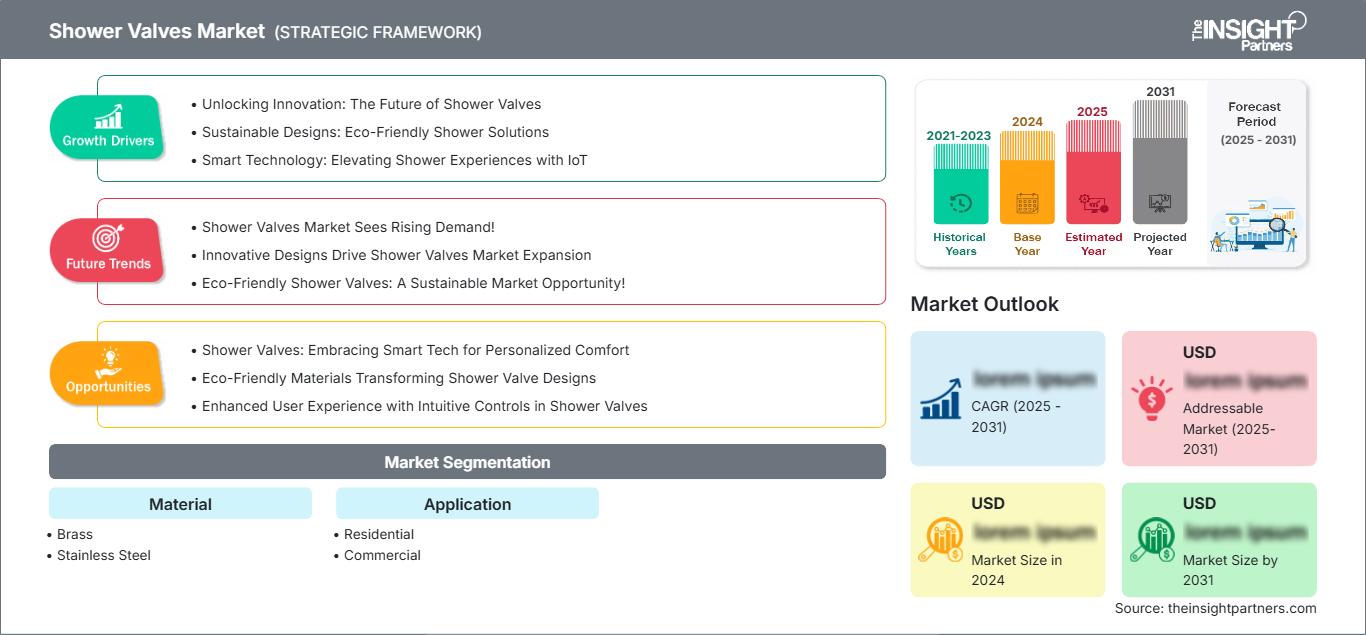
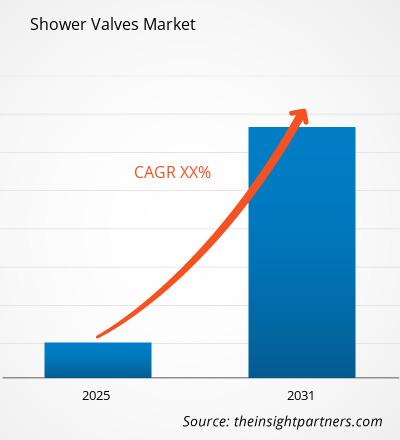
The Shower Valves Market is projected to increase from US$ 1.29 Billion in 2025 to US$ 1.85 Billion by 2034, registering a CAGR of 4.15% during 2026–2034. Demand is shaped by replacement plumbing cycles, residential bathroom upgrades, hospitality construction, and the shift toward safer temperature control. The market remains closely tied to brass and stainless steel valve adoption across residential and commercial applications.
Across North America, the Shower Valves Market size is supported by remodeling activity, stricter water-efficiency expectations, and higher specification of pressure-balancing and thermostatic controls. The region is estimated to grow at a CAGR range of 3.8–4.4% during 2026–2034, with demand reinforced by aging housing stock, multifamily renovations, and commercial restroom modernization.
Shower Valves Market Assessment and Insights
- North America accounted for 31–34% share in 2025 and is expected to grow at a CAGR between 2026–2034 of 3.8–4.4%, supported by remodeling, water-efficiency codes, and premium shower controls.
- US represented 78–82% of North America in 2025 and is projected to expand at a CAGR between 2026–2034 of 3.9–4.5%.
- Europe held 24–27% share in 2025 and is forecast to grow at 3.4–4.0%, led by Germany, the UK, France, Italy, and Spain.
- Asia Pacific captured 28–31% share in 2025 and is set to grow at 4.7–5.3%, led by China, India, Japan, South Korea, and Australia.
- Largest Segment Brass held 62–66% market share in 2025, with a 3.9–4.5% CAGR range through 2034 due to machinability, durability, and installer familiarity.
- High Growth Segment Commercial applications held 27–30% market share in 2025 and are projected to grow at 4.6–5.2% through 2034.
- Key companies analyzed in detail: ApolloDelta, DANCOW, JAG PLUMBING PRODUCTS, Kohler Co., Korky, Oatey Co., Jones Stephens, Sloan Valve Company, KEENEY, and Zurn Elkay Water Solutions Corporation.
Source: The Insight Partners' analysis based on proprietary research, government publications, company annual reports, investor presentations, industry databases, and expert interviews.
The product development path is trending towards pressure-balancing, thermostatic, concealed and smart-friendly valves providing stability in temperatures, safety and water wastage. Valve manufacturers are focusing on the improvement of the cartridge reliability, corrosion-resistance and surface finish compatibility, while coping with fluctuations in brass prices. The production process is evolving more towards modular valve construction, rough-in standardization and SKU optimization, thereby making it possible for distributors and installers to simplify their inventory process while servicing the renovation and new constructions market segments.
In future, the demand is expected to expand in the rapidly developing urban areas where there is a need for apartment construction, hotels pipeline infrastructure and health care facility infrastructures which would need robust plumbing system. With regulatory focus on water conservation, lead-free and safe bathing environment, there would be opportunities for investing in the high-end valves.
Shower Valves Market Report Scope
| Report Attribute | Details |
|---|---|
| Market size in 2025 | US$ 1.29 Billion |
| Market Size by 2034 | US$ 1.85 Billion |
| Global CAGR (2026 - 2034) | 4.15% |
| Historical Data | 2021-2024 |
| Forecast period | 2026-2034 |
Shower Valves Market Analysis
Residential renovation still provides the greatest strength in terms of demand, since people continue updating their old systems with something safer and more efficient. The Shower Valves Market development is driven by the combination of stylish bathrooms designs and needs for protection from burns, consistent water pressure, and leakage avoidance. Brass remains the most common material used in mass production, while stainless steel becomes more popular in certain applications.
The supply chain consists of alloy producers, cartridge manufacturers, casting and machining services, brand owners, distributors, plumbers, builders, and facility managers. Supply factors include metal prices, testing for safety standards compliance, and familiarity of installers with rough-in platform. More and more commercial buyers start considering valves along with installation cost, warranty, and compatibility with low-flow showerheads.
Examples of competitive positioning elements comprise brand credibility, channel presence, and product assortment. Specification presence through design centers, sustainability and business partnerships is what Kohler Co. and Sloan Valve Company concentrate on. Competition for Oatey Co., Jones Stephens, KEENEY, and Zurn Elkay Water Solutions Corporation includes availability of contractors and system repairs. ApolloDelta, DANCOW, JAG PLUMBING PRODUCTS, and Korky provide specialized and value-range products.
Based on the Shower Valves Market Analysis, funds would be allocated to connectivity technology, anti-scald compliance and installation speed. Big companies would focus on configurators, sustainability claims and platformed shower valves. Small firms may secure their market position by using replacement parts and private labels, especially when in regions where plumbers require easily accessible cartridge valves.
● REPORT CUSTOMIZATION
Tailor This Report To Align With Your Specific Business Requirements
This report can be customized to align precisely with your business objectives, scope, and target markets. Customization options include tailored segmentation, geography, competitive analysis, and strategic insights to support informed decision-making.
Customize This Report →WHAT YOU CAN ADJUST
- ● Segmentations
- ● Geography
- ● Competitive Analysis
- ● Language Preferences
Shower Valves Market: Strategic Insights
Regional Insights
North America Shower Valves Market
North America represented 31–34% of global revenue in 2025 and is expected to grow at a 3.8–4.4% CAGR through 2034. The Shower Valves Market share in the region is supported by bathroom remodeling, aging plumbing infrastructure, and higher penetration of pressure-balancing and thermostatic valves in residential renovations.
Commercial demand is driven by hospitality refurbishments, multifamily construction, healthcare upgrades, and code-aligned fixture replacement. Contractors prioritize valves that reduce call-backs, withstand hard-water conditions, and fit common rough-in dimensions. Distribution through wholesalers and home-improvement retailers keeps replacement cycles active across both premium and mid-market product tiers.
U.S. Shower Valves Market
The United States contributed 78%–82% of the total demand in North America in 2025, with forecast growth expected in a CAGR of 3.9%–4.5% during 2026–2034. The largest market demands occur in renovation-rich states, urban multi-family construction, senior living facilities, and hospitality renovation projects where safety and water usage control are key specification parameters.
Kohler Co., Oatey Co., Jones Stephens, Sloan Valve Company, KEENEY, and Zurn Elkay Water Solutions Corporation enjoy good channel presence in terms of wholesaler, retailer, and commercial specification channels. Pressure balancing valves are favored by residential consumers whereas commercial consumers are becoming increasingly concerned about serviceability, accessibility, and compatibility with facility water management programs.
Europe Shower Valves Market
The share of Europe was 24-27% in 2025 and it is expected to register a CAGR growth rate of 3.4-4.0% from 2026-2034. Germany is the leading country in the region in terms of consumption owing to high standards of sanitaryware, building renovations, and preference for long-lasting brass and thermostatic showering systems.
Following Germany is the United Kingdom, driven by rental buildings renovations and water efficiency. France, Italy, and Spain contribute to the demand by means of hotel renovations in the context of tourism, renovations of apartments, and bathrooms. European consumers have a higher willingness to use concealed systems and thermostatic valves.
APAC Shower Valves Market
The share of APAC stood at 28-31% in 2025 and is forecasted to increase at 4.7-5.3% till 2034, which will be the fastest among all regions. China dominates in terms of construction volume, while India drives growth due to increased demand for urban housing, hotel infrastructure, and organized sanitaryware retailing.
The preference for more expensive products in Japan, South Korea, and Australia is associated with compact bathrooms and saving water, premium fixtures being popular there. The industrial policy that promotes domestic production, construction of residential skyscrapers, and increasing consumption of middle-class people boosts demand in the region.
Middle East & Africa Shower Valves Market
The Middle East & Africa region is expected to exhibit a CAGR of 4.0%-4.6% during the forecast period of 2026-2034, due to growth in hotel building constructions, residential complexes, and luxury properties that will drive demand for valves meant to handle high pressure variation and minerals-laden water.
Renovations, institution buildings, and infrastructural improvements in South Africa and the Rest of MEA drive demand for these products. Water and energy conservation needs drive demand for showers and the extreme operating environment drives demand for corrosion-resistant valves and cartridge valves.
Segmentation Analysis
Material
Material segmentation is expected to grow at a CAGR range of 4.0–4.6% during 2026–2034. The Shower Valves Market scope across material choices is shaped by cost, corrosion resistance, machining requirements, and installer confidence. Brass remains the default for many concealed and exposed valves, while stainless steel addresses applications needing hygiene, strength, and long-term resistance in demanding water conditions.
- Brass remains the leading material due to its durability, machinability, and established plumbing acceptance, supporting wide use across residential replacement, new construction, and mainstream commercial shower installations.
- Stainless Steel serves projects requiring higher corrosion resistance, cleaner aesthetics, and lifecycle durability, making it strategically important in premium bathrooms, coastal buildings, healthcare facilities, and hospitality environments.
Application
Application segmentation is projected to grow at a CAGR range of 4.1–4.7% during 2026–2034. Residential use remains the revenue anchor because shower valves are replaced during remodeling, plumbing repair, and bathroom upgrades. Commercial adoption is more specification-driven, with hotels, hospitals, gyms, schools, and multifamily properties prioritizing safety, maintenance access, and durability under repeated daily use.
- Residential demand is supported by renovation cycles, aging bathrooms, and consumer preference for reliable temperature control, making this sub-segment central to replacement sales and brand-led retail channels.
- Commercial demand is tied to hospitality, healthcare, education, and multifamily assets, where facility managers value standardized valves, serviceable cartridges, and reduced operational disruption.
Opportunity Snapshot
| Application | Revenue Contribution | Trend Tag | Adoption Stage |
| Residential | High | Bathroom Retrofit | Mature |
| Commercial | Medium | Facility Upgrade | Scaling |
Shower Valves Market Growth Drivers and Impact Analysis
Bathroom Renovation and Aging Plumbing Replacement
Bathroom renovation leads to sustained replacement demand as the shower valves are usually out of sight until there is leaking, temperature fluctuations, or decorative renovations, leading to system replacement. The aging homes in North America and Europe offer constant retrofit opportunities while the apartments and urban homes in APAC ensure consistent installation opportunities. The effect is a stronger demand foundation compared to discretionary decorative product segments. Plumbers usually advise their customers on valve replacement when walls have to be opened up. This trend favors those brands that have sturdy rough-ins, plenty of cartridges and good wholesaler ties as plumbers always want to minimize risks and service calls.
Water Efficiency and Safety-Oriented Building Codes
Regulations and voluntary building standards increasingly emphasize water efficiency, scald prevention, and safe bathing environments. Valves that maintain stable temperature and support low-flow showerheads help buildings manage water and energy consumption without compromising user comfort. In commercial settings, the impact is strongest in hotels, healthcare facilities, schools, and senior living assets, where safety exposure and maintenance responsibility are high. Manufacturers that document compliance, publish clear specifications, and offer durable cartridges gain preference during project selection. This driver also raises the value of technical support, because architects, engineers, and contractors need confidence that selected valves will satisfy code, pressure, and lifecycle expectations.
Commercial Restroom and Hospitality Modernization
Commercial buildings require valves that can withstand frequent use, variable pressure, and scheduled maintenance constraints. Hotel refurbishments, gym expansions, healthcare upgrades, and multifamily amenity improvements support higher-value products with better service access and standardized components. The market impact is a shift from lowest-cost replacement toward lifecycle-based procurement. Facility owners increasingly consider downtime, parts availability, and installer familiarity when selecting valves. This supports suppliers with national distribution, commercial specification teams, and product families that can be deployed across multiple properties. Demand also extends to stainless steel and premium brass assemblies where corrosion, hard water, or durability concerns affect long-term operating cost.
Shower Valves Market Future Trends
Digital Shower Controls Moving into Mainstream Renovation
Shower Valves Market trends point toward gradual adoption of digital controls that combine temperature memory, flow personalization, and system diagnostics. While full smart showers remain premium, modular digital interfaces are becoming more relevant as homeowners connect bathroom experiences with broader smart-home expectations. Over the forecast period, suppliers will likely focus on easier installation, retrofit compatibility, and simplified user controls rather than complex luxury-only systems. The strategic implication is that valve makers must treat software, sensors, and serviceability as part of the product architecture. Partnerships with shower system brands and app ecosystems may become a stronger differentiator.
Material Optimization for Durability and Compliance
Future product development will increasingly balance brass availability, stainless steel performance, lead-free compliance, and recyclability. Buyers are expected to ask for clearer material disclosures, corrosion data, and lifecycle evidence, especially in institutional and hospitality projects. Manufacturers may respond with hybrid assemblies that use brass where machinability matters and stainless steel where water exposure is harsher. This trend can reduce failure risk while protecting margins during metal price volatility. It also supports design-for-service approaches, where replaceable cartridges and standardized bodies extend product life and reduce waste from full valve replacement.
Shower Valves Market Opportunities
Retrofit Kits for Contractor-Led Replacement Programs
Contractor-led retrofit programs offer a practical route to scale because plumbers influence product choice at the point of replacement. Suppliers can package rough-in compatibility, cartridge kits, installation guides, and warranty clarity into programs targeted at remodeling contractors, property managers, and maintenance firms. Shower Valves Market Forecasts indicate that replacement demand will remain less cyclical than premium new construction, making retrofit kits attractive for recurring revenue. Companies that reduce wall-opening complexity, support common legacy dimensions, and provide fast parts access can capture share in residential and light commercial repair channels. Distributor training and jobsite availability will be central to execution.
Commercial Specifications for Water-Stressed Urban Markets
Water-stressed cities create opportunities for valves that support efficient showering, stable temperature control, and facility-level maintenance planning. Hotels, student housing, hospitals, and large apartment complexes need products that reduce waste while preserving occupant comfort. Suppliers can target these projects with documented performance, anti-scald features, and compatibility with low-flow fixtures. Investment should focus on specification support, regional approvals, and corrosion-resistant materials suited to local water chemistry. This opportunity is especially relevant in the Middle East, India, Australia, and parts of the western U.S., where water stewardship increasingly shapes building design and operating budgets.
Recent Developments
- June 2026: SR SUN RISE officially launches its new all-round rain shower faucet collection, tailored for families who prioritize home wellness and quality living. SR SUN RISE has unveiled two premium multi-functional shower faucet sets. The first option is SR SUN RISE’s classic shower set. This system adopts a solid brass pressure-balancing valve cartridge with ceramic discs. The cartridge stabilizes hot and cold water pressure to prevent abrupt temperature swings caused by household water pressure fluctuations. Even when other faucets or water outlets are in use, the shower maintains a consistent water temperature and provides reliable anti-scald protection for daily use.
- April 2026: GROHE has introduced the Rainshower Aqua wall-mounted head showers as part of its premium showering portfolio, expanding its product range in the bathroom fittings segment. The new range is designed for integration into modern bathroom layouts, with a wall-mounted format that supports a clean, and space-efficient setup. The Rainshower Aqua head shower is designed to cover the user fully and can be adjusted up to a 30-degree angle. It is available in two formats, a round version with a diameter of 360 mm and a rectangular version measuring 400 mm × 230 mm. The product offers two spray modes, Rain and ActiveRain, designed for different use cases such as rinsing and massage.
- February 2026: Kohler, a global leader of innovative sustainable solutions, proudly debuts Anthem EvoCycle smart shower, a recirculating dual-mode system that delivers up to 80% water savings, while maintaining full flow rate. Anthem EvoCycle is designed to "conserve without compromise." It demonstrates Kohler's mission to help people live gracious, healthy, and sustainable lives by putting wellness and sustainability at the center of daily showering rituals with real-time water savings and insights.
Frequently Asked Questions

- Comprehensive Market Sizing and Forecast Analysis
- Detailed Segmentation Analysis
- In-Depth Market Dynamics Assessment
- Regional and Country-Level Insights
- Competitive Landscape and Company Benchmarking
- Strategic Business Intelligence
Recent Reports
Testimonials

The Insight Partners provided valuable market intelligence that supported our global go-to-market strategy. Their team was professional, responsive, and attentive to our feedback, providing thoughtful analysis and helpful methodological clarifications throughout the project.
Junmo Kim Chief Financial Officer (CFO), Enertech Co., Ltd.
The Insight Partners' SCADA System Market report is comprehensive, with valuable insights on current trends and future forecasts. The team was highly professional, responsive, and supportive throughout. We are very satisfied and highly recommend their services.
RAN KEDEM Partner, Reali Technologies LTDs
I requested a report on a very specific software market and the team produced the report in a few days. The information was very relevant and well presented. I then requested some changes and additions to the report. The team was again very responsive and I got the final report in less than a week.
JEAN-HERVE JENN Chairman, Future Analytica
We worked with The Insight Partners for an important market study and forecast. They gave us clear insights into opportunities and risks, which helped shape our plans. Their research was easy to use and based on solid data. It helped us make smart, confident decisions. We highly recommend them.
PIYUSH NAGPAL Sr. Vice President, High Beam Global
The Insight Partners delivered insightful, well-structured market research with strong domain expertise. Their team was professional and responsive throughout. The user-friendly website made accessing industry reports seamless. We highly recommend them for reliable, high-quality research services
YUKIHIKO ADACHI CEO, Deep Blue, LLC.
This is the first time I have purchased a market report from The Insight Partners.While I was unsure at first, I visited their web site and felt more comfortable to take the risk and purchase a market report.I am completely satisfied with the quality of the report and customer service. I had several questions and comments with the initial report, but after a couple of dialogs over email with their analyst I believe I have a report that I can use as input to our strategic planning process.Thank you so much for taking the extra time and making this a positive experience.I will definitely recommend your service to others and you will be my first call when we need further market data.
JOHN SUZUKI President and Chief Executive Officer, Board Director, BK Technologies
I wish to appreciate your support and the professionalism you displayed in the course of attending to my request for information regarding to infectious disease IVD market in Nigeria. I appreciate your patience, your guidance, and the fact that you were willing to offer a discount, which eventually made it possible for us to close a deal. I look forward to engaging The Insight Partners in the future, all thanks to the impression you have created in me as a result of this first encounter.
DR CHIJIOKE ONYIA MANAGING DIRECTOR, PineCrest Healthcare Ltd.Reason to Buy
- Informed Decision-Making
- Understanding Market Dynamics
- Competitive Analysis
- Identifying Emerging Markets
- Customer Insights
- Market Forecasts
- Risk Mitigation
- Boosting Operational Efficiency
- Strategic Planning
- Investment Justification
- Tracking Industry Innovations
- Aligning with Regulatory Trends





 Get Free Sample for