
Slurry Tankers Market Growth, Trends & Demand by 2034
Coverage: By Type (Single-Axle, 2 Axles, 3 Axles, Others); Application (Agriculture, Industry) , and Geography (North America, Europe, Asia Pacific, and South and Central America)
- Status : Data Released
- Report Code : TIPRE00022407
- Category : Manufacturing and Construction
- No. of Pages : 150
- Available Report Formats :


- Last update date : July 28, 2026


2025 Market Size
US$ 924.61 Mn
Base year value
2034 Forecast
US$ 1,862.32 Mn
Projected by 2034
CAGR 2026-2034
9.15 %
Growth rate
Addressable Market
US$ 13,223.89 Mn
(2026-2034)
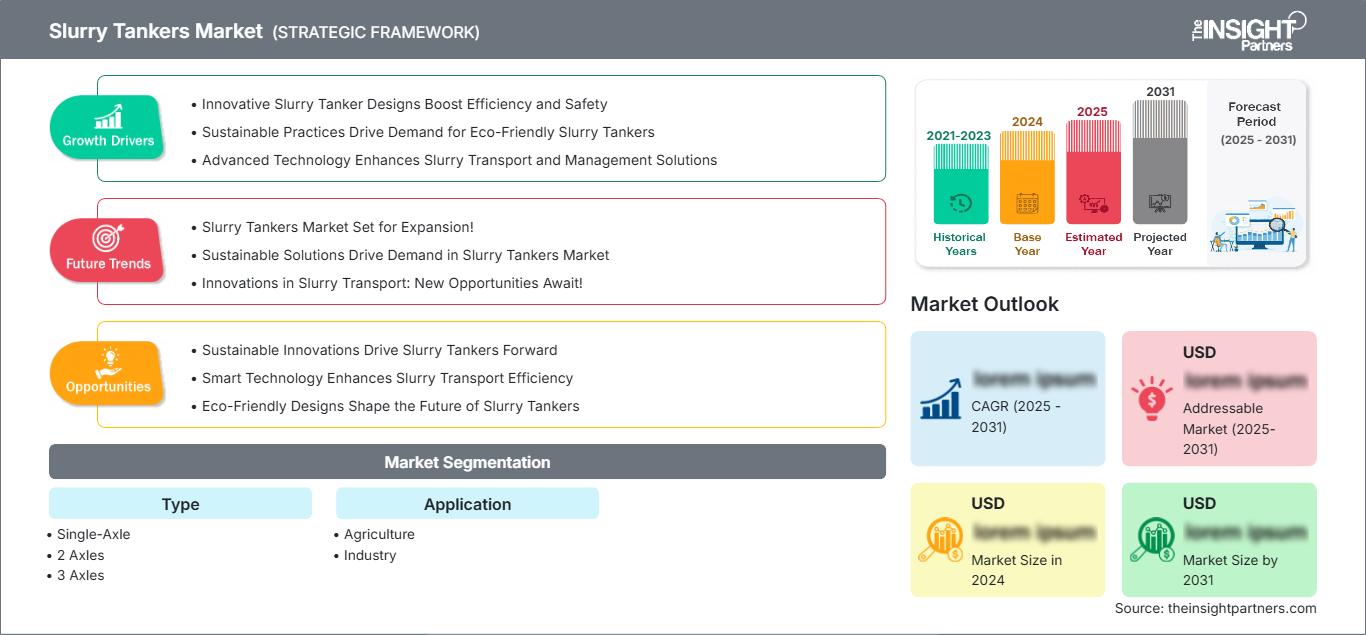
The Slurry Tankers Market size held a value of US$ 924.61 Million in 2025 and is anticipated to reach US$ 1,862.32 Million in 2034, growing at a CAGR of 9.15% during 2026 and 2034. Growth will be driven by manure transport, liquid organic fertilizers delivery, and on-farm nutrient management due to investments in tankers that offer better spreading efficiency, reduced downtime for fields, and help adhere to changing environmental policies.
The Slurry Tankers Market is expected to grow at a CAGR of 8.5% - 9.5% in North America owing to changing dynamics such as dairy consolidation, runoff nutrient regulation, and precision spreading. The market size in North America will be driven by large herd farms, manure management initiatives of states, and growing demand for low emission spreading system that enhances nitrogen utilization.
Slurry Tankers Market Assessment and Insights
- North America accounted for 30–34% Slurry Tankers Market share in 2025 and is expected to grow at an 8.5–9.5% CAGR between 2026–2034, supported by dairy scale-up, manure relocation programs, and precision nutrient application.
- US represented 76–80% of North America in 2025 and is projected to expand at an 8.7–9.6% CAGR between 2026–2034, led by CAFO compliance and dairy modernization.
- Europe held 31–35% share in 2025 and is forecast to grow at an 8.0–9.0% CAGR between 2026–2034, with Germany, France, the UK, Italy, and Spain leading regulated adoption.
- Asia Pacific captured 22–26% share in 2025 and is expected to post a 10.0–11.2% CAGR between 2026–2034, driven by China, India, Japan, South Korea, and Australia.
- Largest Segment Agriculture held 78–82% market share in 2025 and is projected to grow at an 8.8–9.7% CAGR between 2026–2034 as manure becomes a strategic fertilizer input.
- High Growth Segment Industry accounted for 18–22% market share in 2025 and is forecast to grow at a 9.6–10.8% CAGR between 2026–2034 with wastewater and process-slurry use cases.
- Key companies analyzed in detail: BAUER GmbH, Bossini S.r.l., Enoagricola Rossi S.r.l. Unipersonale, Farmchief, JEANTIL, JOSKIN, Kotte Landtechnik GmbH and Co. KG, SAMSON AGRO, SlurryKat Ltd, Vredo Dodewaard B.V.
Source: The Insight Partners' analysis based on proprietary research, government publications, company annual reports, investor presentations, industry databases, and expert interviews.
Machine design has transitioned from simple vacuum tankers towards advanced nutrient application machines. Equipment companies are integrating lobe pumps, macerators, dribble bars, trailing shoes, GPS systems and nutrient sensors in an effort to make their application more even and cut down losses. Manufacturing has shifted away from customized designs for big operations towards modular tanker platforms that can easily cater to small family farms, contractors and large-scale livestock farms.
According to the Slurry Tankers Market forecast, demand will extend far beyond the conventional dairy regions due to the convergence of livestock intensification, economic viability of organic fertilizers and the need for protecting watersheds. The new geographies are likely to go for more durable 2 axle and 3 axle designs which can cover more acreage per run. Nutrient recycling public initiatives along with private manure logistics investments are bound to influence purchasing decisions in markets which face fluctuating mineral fertilizer prices and farm labor shortage issues.
Slurry Tankers Market Report Scope
| Report Attribute | Details |
|---|---|
| Market size in 2025 | US$ 924.61 Million |
| Market Size by 2034 | US$ 1,862.32 Million |
| Global CAGR (2026 - 2034) | 9.15% |
| Historical Data | 2021-2024 |
| Forecast period | 2026-2034 |
Slurry Tankers Market Analysis
Factors driving the market include the need to make livestock waste a useful nutrient source rather than a disposal problem. Dairy and swine farms have an increasing demand for tankers which can process larger liquid volumes, distribute the manure at agronomic rate and minimize ammonia emissions. Guidance from the USDA and EPA regarding manure management connects proper handling with water quality.
The supply chain for the product consists of tanker construction, axle and chassis producers, pumps, manure spreaders, dealers, contractors, livestock farms and industrial farms. Dynamics of supply include steel prices, hydraulic components and local dealer services capacity. Customers consider total cost of ownership which involves time of filling, compaction from tires, servicing frequency and ability to work with low emission equipment.
The Slurry Tankers Market analysis reveals a competitive market environment characterized by specialist European manufacturers and regional distributors with effective service coverage networks. Companies like JOSKIN, SAMSON AGRO, Kotte Landtechnik GmbH and Co. KG, BAUER GmbH, Vredo Dodewaard B.V. are competitors based on capacity, pumping capacity, and application accuracy, whereas Bossini S.r.l. and Enoagricola Rossi S.r.l. Unipersonale are catering to cost-conscious farmers.
Current investment trends favor bigger slurry tankers, heavy-duty trucks for contractors, and electronic rate control systems rather than replacement. Farmchief, JEANTIL, SlurryKat Ltd, and others are positioning themselves on factors such as robustness, after-sales support, and flexibility of design. Increasingly, market differentiation is being achieved through nutrient placement verification, reduced soil compaction, and compliance help among others.
● REPORT CUSTOMIZATION
Tailor This Report To Align With Your Specific Business Requirements
This report can be customized to align precisely with your business objectives, scope, and target markets. Customization options include tailored segmentation, geography, competitive analysis, and strategic insights to support informed decision-making.
Customize This Report →WHAT YOU CAN ADJUST
- ● Segmentations
- ● Geography
- ● Competitive Analysis
- ● Language Preferences
Slurry Tankers Market: Strategic Insights
Regional Insights
North America Slurry Tankers Market
North America had a share of 30–34% of Slurry Tankers Market in 2025 and is forecast to grow at a CAGR of 8.5–9.5%. The demand for the product is driven by demand for large-scale operations in dairy, swine, and mixed livestock farms in connection with developing nutrient management programs.
The regulations continue to play a role due to the pressure on US and Canadian farmers in terms of nitrogen, phosphorous, and groundwater protection. Examples of EPA state programs and USDA manure guidelines foster controlled land application. Slurry tankers are gaining popularity with those farmers that try to minimize risk associated with using purchased fertilizers.
U.S. Slurry Tankers Market
The United States accounted for 76–80% of the North American market in 2025 and is projected to grow at a CAGR of 8.7–9.6%. CAFO regulation, manure transport practices, and dairy farms concentration are influencing the purchasing decision. Strongest demand is expected from Wisconsin, California, New York, Idaho, and Pennsylvania states where liquid manure management is essential part of farming operations.
Market players operate via dealers and include European manufacturers' products and domestic distributors/service providers. In terms of application, popular configurations are 2 axles and 3 axles equipment featuring low emission toolbars, high volume pump, and flotation tires. Tankers suitable for digestate management due to increased use of anaerobic digestion technology among dairy and swine farms are also gaining popularity.
Europe Slurry Tankers Market
Europe’s share was estimated at 31-35%, growing at a CAGR of 8.0%-9.0% on account of livestock population density, the availability of contractors, and the use of application standards mandated by regulations. The UK’s market focus is on increased farm efficiency and contractor usage, whereas Germany emphasizes precision spreading, large-scale equipment, and adherence to nutrient management requirements.
The demand from France, Italy, and Spain is derived from dairy concentrations, mixed farming operations, and upgrading the logistics of organic fertilizers. The regulations related to nitrate restrictions in the EU and the Farm to Fork Strategy for reducing nutrient loss contribute to equipment upgrades in the vulnerable areas of Europe.
APAC Slurry Tankers Market
APAC captured 22-26% market share in 2025 and is anticipated to grow at a CAGR of 10.0-11.2%, which is the highest amongst the other regions. APAC is led by China owing to large-scale farming operations and use of waste recycling technologies in environmental policies. India, Japan, South Korea, and Australia drive additional demand for mechanization, dairy farming operations, and crop fertilization.
The major applications in the industrial segment involve wastewater treatment and transport of biomass resources whereas, policy initiatives promote manure application instead of its discharge into water bodies. Being price sensitive, there is a trend towards using tankers with 2 axles even amongst the contractors and larger farming operations.
Middle East & Africa Slurry Tankers Market
Middle East & Africa remains smaller but is forecast to grow at a 7.2–8.4% CAGR. Saudi Arabia and the UAE lead demand linked to controlled-environment agriculture, dairy investment, and wastewater reuse. South Africa anchors broader regional adoption through commercial farming, livestock production, and contractor services.
Rest of MEA markets are influenced by infrastructure spending, irrigation expansion, and organic waste handling needs. Adoption is constrained by financing and service coverage, yet demand improves when tankers support both agricultural slurry and industrial sludge transport. Durability, corrosion protection, and simple maintenance remain decisive purchase criteria.
Segmentation Analysis
Type
Type is projected to grow at an 8.9–9.8% CAGR between 2026–2034 as buyers match axle configuration with farm scale, soil conditions, road rules, and hauling distance. The Slurry Tankers Market scope within type segmentation is shaped by the trade-off between maneuverability, payload, compaction control, and contractor productivity.
- Single-Axle models remain important for smaller farms, narrow lanes, and lighter soils where maneuverability and lower purchase cost matter more than maximum payload or contractor-grade utilization.
- 2 Axles tankers hold broad appeal among medium and large farms because they balance capacity, stability, road transport, and compatibility with dribble bars or trailing shoe equipment.
- 3 Axles models serve high-volume livestock operations and contractors that prioritize fewer trips, larger working widths, better weight distribution, and efficient slurry logistics over higher upfront cost.
Application
Application is forecast to expand at an 8.8–10.8% CAGR between 2026–2034 as agricultural nutrient recycling remains dominant and industrial slurry handling gains relevance. Demand reflects wider recognition that liquid organic streams can be transported, stored, and applied more efficiently when tankers integrate pumping, metering, and spreading technologies.
- Agriculture is the core application because livestock farms rely on slurry movement from storage pits or lagoons to fields, turning manure into a managed fertilizer input.
- Industry includes process slurry, digestate, and wastewater-related transport where tankers need robust pumps, corrosion resistance, and flexible loading systems for non-field use cases.
Opportunity Snapshot
| Application | Revenue Contribution | Trend Tag | Adoption Stage |
| Agriculture | High | Precision Nutrients | Mature |
| Industry | Medium | Waste Reuse | Scaling |
Slurry Tankers Market Growth Drivers and Impact Analysis
Nutrient Management Compliance Is Forcing Equipment Upgrades
Water protection rules are changing the economics of manure handling because farms must demonstrate that nitrogen and phosphorus are applied at suitable rates and times. The EU Nitrates Directive limits livestock manure application to 170 kg nitrogen per hectare in vulnerable contexts, while U.S. state programs promote nutrient planning and manure transfer controls. These policies increase demand for tankers with accurate metering, low-emission spreading bars, and better recordkeeping compatibility. The market impact is strongest among dairy and swine farms that operate near sensitive watersheds, where compliance risk can justify replacement of older broadcast systems.
Livestock Consolidation Is Raising Capacity Requirements
Larger livestock farms generate more liquid manure at fewer sites, which increases hauling distance, storage coordination, and seasonal spreading pressure. Operators therefore need tankers that can move higher volumes while protecting soil structure and maintaining field productivity. This driver favors 2 axles and 3 axles configurations, flotation tires, high-flow pumps, and contractor-grade frames. Commercial contractors also benefit because farms without sufficient capital can outsource slurry transport during narrow application windows. The result is a shift from low-cost ownership decisions toward lifecycle productivity, with filling speed and fewer field passes becoming measurable purchasing criteria.
Fertilizer Volatility Is Increasing Manure’s Strategic Value
Mineral fertilizer price volatility has made manure a more valuable nutrient asset rather than a farm by-product. When slurry is applied with better timing and placement, farms can reduce purchased nutrient dependency while improving soil organic matter. Tankers equipped with macerators, section control, and trailing shoe systems help capture this value by lowering overlap, improving crop uptake, and limiting volatilization. This driver is especially relevant in mixed crop-livestock regions where manure can substitute a portion of nitrogen and potassium demand. Equipment suppliers that quantify nutrient-use benefits will strengthen sales conversations with cost-conscious farmers.
Slurry Tankers Market Future Trends
Sensor-Enabled Nutrient Application
Slurry Tankers Market trends will increasingly center on real-time nutrient sensing, variable-rate spreading, and digital job documentation. Near-infrared sensors can estimate nutrient concentration during filling or spreading, allowing operators to apply slurry based on nutrient value rather than tank volume alone. This will support more accurate fertilizer substitution, stronger compliance records, and improved crop response. Adoption will initially be concentrated among contractors, large dairy farms, and European buyers facing tighter nutrient accounting, but sensor costs should decline as integration becomes standardized across premium tanker platforms.
Low-Emission Spreading Becomes a Default Specification
Future procurement will shift from tank capacity alone toward integrated application systems that limit ammonia losses and odor. Trailing shoe, dribble bar, and injection-compatible tankers are likely to become standard in regulated livestock regions because they place slurry closer to the soil or crop canopy. Research indexed by FAO AGRIS has shown subsurface injection can reduce ammonia emissions significantly compared with surface spreading. This trend will influence product design, dealer inventories, and financing because buyers will increasingly evaluate environmental performance alongside pumping speed and durability.
Slurry Tankers Market Opportunities
Contractor Fleet Modernization
Contractor fleets represent a high-value opportunity because they operate equipment intensively and influence technology diffusion among farms. Manufacturers can target this channel with durable 2 axles and 3 axles tankers, rapid filling systems, service contracts, and financing packages based on seasonal utilization. Contractors also need flexible toolbars that allow the same tanker to serve grassland, arable fields, and digestate customers. A strong contractor proposition can accelerate adoption in regions where individual farms hesitate to purchase premium equipment, turning service providers into practical demonstration platforms for efficient slurry logistics.
Digestate and Circular Nutrient Logistics
Anaerobic digestion creates a related opportunity because digestate requires transport and field application similar to livestock slurry, but often at larger centralized sites. Equipment suppliers can serve biogas operators, dairy clusters, and cooperative nutrient hubs with corrosion-resistant tanks, high-output pumps, and application systems suitable for variable dry matter content. This opportunity is investment-oriented because it links farm equipment with renewable energy, waste management, and fertilizer substitution. As circular nutrient markets mature, tankers that handle both raw slurry and digestate will command stronger utilization and resale value.
Recent Developments
- July 2026: SlurryKat introduced SlurryKat Farmline range developed to make premium SlurryKat engineering accessible to more farmers without compromising on the quality, durability and reliability that define every machine. Designed for part-time farmers, weekend farmers and smaller livestock enterprises, the Farmline tanker has been created for those with lower slurry volumes who still demand a premium slurry tanker built to perform for years to come. Available from 1,350 to 2,500 gallons to suit any farm.
- August 2025: Following the TG18, TG20 and most recently the TG24 models, SAMSON is expanding its range with the new TG15. In a context of rapid technological development, the TG15 provides users with a machine adapted to market evolutions, suitable both for pumping and for the application of slurry and digestates. The new TG15 model is approved for road use (maximum speed 40 km/h) and complies with European Regulation EU167/2013. Its development responds to the growing demand for slurry tankers capable of operating on roads under increasingly strict weight restrictions. In many countries, these requirements have been strengthened and enforced, pushing manufacturers to design machines that are both compliant and secure.
- October 2024: Newterra announced the addition of two additional slurry tankers to its fleet, further enhancing its service capabilities for customers on the East Coast. This investment strengthens Newterra’s position in the municipal drinking water and beverage bottling industries, significantly boosting its ability to support vital customer needs.
Frequently Asked Questions

- Comprehensive Market Sizing and Forecast Analysis
- Detailed Segmentation Analysis
- In-Depth Market Dynamics Assessment
- Regional and Country-Level Insights
- Competitive Landscape and Company Benchmarking
- Strategic Business Intelligence
Recent Reports
Testimonials

The Insight Partners' SCADA System Market report is comprehensive, with valuable insights on current trends and future forecasts. The team was highly professional, responsive, and supportive throughout. We are very satisfied and highly recommend their services.
RAN KEDEM Partner, Reali Technologies LTDs
I requested a report on a very specific software market and the team produced the report in a few days. The information was very relevant and well presented. I then requested some changes and additions to the report. The team was again very responsive and I got the final report in less than a week.
JEAN-HERVE JENN Chairman, Future Analytica
We worked with The Insight Partners for an important market study and forecast. They gave us clear insights into opportunities and risks, which helped shape our plans. Their research was easy to use and based on solid data. It helped us make smart, confident decisions. We highly recommend them.
PIYUSH NAGPAL Sr. Vice President, High Beam Global
The Insight Partners delivered insightful, well-structured market research with strong domain expertise. Their team was professional and responsive throughout. The user-friendly website made accessing industry reports seamless. We highly recommend them for reliable, high-quality research services
YUKIHIKO ADACHI CEO, Deep Blue, LLC.
This is the first time I have purchased a market report from The Insight Partners.While I was unsure at first, I visited their web site and felt more comfortable to take the risk and purchase a market report.I am completely satisfied with the quality of the report and customer service. I had several questions and comments with the initial report, but after a couple of dialogs over email with their analyst I believe I have a report that I can use as input to our strategic planning process.Thank you so much for taking the extra time and making this a positive experience.I will definitely recommend your service to others and you will be my first call when we need further market data.
JOHN SUZUKI President and Chief Executive Officer, Board Director, BK Technologies
I wish to appreciate your support and the professionalism you displayed in the course of attending to my request for information regarding to infectious disease IVD market in Nigeria. I appreciate your patience, your guidance, and the fact that you were willing to offer a discount, which eventually made it possible for us to close a deal. I look forward to engaging The Insight Partners in the future, all thanks to the impression you have created in me as a result of this first encounter.
DR CHIJIOKE ONYIA MANAGING DIRECTOR, PineCrest Healthcare Ltd.Reason to Buy
- Informed Decision-Making
- Understanding Market Dynamics
- Competitive Analysis
- Identifying Emerging Markets
- Customer Insights
- Market Forecasts
- Risk Mitigation
- Boosting Operational Efficiency
- Strategic Planning
- Investment Justification
- Tracking Industry Innovations
- Aligning with Regulatory Trends





 Get Free Sample for