
Smart Agriculture Market Share, Size & Demand by 2034
Coverage: By Product Type (Hardware, Software, and Services) and Application (Precision Farming, Livestock Monitoring, Yield Monitoring, Soil Heath Monitoring, Irrigation System, Variable Rate Application, Asset Management, and Smart Greenhouse), and Geography
- Status : Data Released
- Report Code : TIPTE100000318
- Category : Electronics and Semiconductor
- No. of Pages : 224
- Available Report Formats :


- Last update date : July 28, 2026


2025 Market Size
US$ 15.63 Bn
Base year value
2034 Forecast
US$ 38.91 Bn
Projected by 2034
CAGR 2026-2034
10.67 %
Growth rate
Addressable Market
US$ 241.62 Bn
(2026-2034)
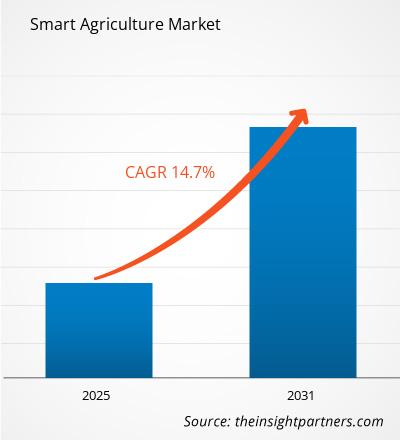
The Smart Agriculture market size is expected to increase from US$ 15.63 Billion in 2025 to US$ 38.91 Billion in 2034, at a CAGR of 10.67% between 2026 and 2034. Growth is driven by adoption which is going beyond pilot projects as farmers integrate connected equipment, farm management solutions, livestock monitors, and greenhouse automation systems to optimize yield visibility, resource optimization, worker productivity, and tolerance to weather uncertainty.
The North American region is the most advanced adoption region, with a CAGR range of 9.8 to 10.4% driven by connected row crop farming and rural broadband initiatives. North America's Smart Agriculture Market is defined by high equipment mechanization, data-enabled agronomy solutions, and robust distribution channel network to support precision agriculture, variable rate applications, livestock monitoring, and farm software subscriptions.
Smart Agriculture Market Assessment and Insights
- North America accounted for 34–36% Smart Agriculture market share in 2025 and is projected to grow at a CAGR of 9.8–10.4% between 2026–2034, driven by GNSS guidance, farm telematics, and stronger agricultural connectivity.
- US represented 78–82% of North America in 2025 and is expected to grow at 9.9–10.5% CAGR between 2026–2034, led by large-acre crop operations.
- Europe held 25–27% share in 2025 and is forecast to grow at 9.2–9.8% CAGR between 2026–2034, with Germany, France, the UK, Italy, and Spain leading digital farm uptake.
- Asia Pacific captured 22–24% share in 2025 and is expected to expand at 12.1–12.8% CAGR between 2026–2034, supported by China, India, Japan, South Korea, and Australia.
- Largest Segment Hardware held 48–52% market share in 2025 and is projected to grow at 9.4–10.1% CAGR between 2026–2034 as sensors, controllers, drones, and guidance systems scale.
- High Growth Segment Software held 27–31% market share in 2025 and is projected to grow at 12.4–13.1% CAGR between 2026–2034 as analytics and subscription platforms mature.
- Key companies analyzed in detail: AGCO Corporation, AgJunction LLC, Ag Leader Technology, Deere & Company, Raven Industries, Inc., SemiosBio Technologies Inc., SST Development Group, Inc., TeeJet Technologies, Topcon Precision Agriculture, and Trimble Inc.
Source: The Insight Partners' analysis based on proprietary research, government publications, company annual reports, investor presentations, industry databases, and expert interviews.
Farm digitization has progressed from individualized guidance tools to integrated operating systems encompassing machinery, soil information, weather forecasting, irrigation management, and pest and disease mitigation. Dynamics within farm production operations have undergone change as sensor-equipped and connective capabilities have been incorporated by equipment manufacturers into their products, as well as being retrofitted by specialized providers to provide digital solutions for mixed fleets. This makes the solution available beyond big farms and supports the economics of Smart Agriculture Market investments within different agricultural sectors.
In the next five years, the importance of new geographies will be driven by government policies that tie food security, water optimization, and climate adaptation to investments in farm technology. Capital investments will gravitate towards AI agronomy, autonomous farming activities, and interoperable data platforms. Government tailwinds related to traceability, lower inputs, and sustainability will drive increased measurability, financial viability, and scalability of connected farm operations.
Smart Agriculture Market Report Scope
| Report Attribute | Details |
|---|---|
| Market size in 2025 | US$ 15.63 Billion |
| Market Size by 2034 | US$ 38.91 Billion |
| Global CAGR (2026 - 2034) | 10.67% |
| Historical Data | 2021-2024 |
| Forecast period | 2026-2034 |
Smart Agriculture Market Analysis
The demand is increasing due to labor shortage, fluctuating input prices, water scarcity, and stricter sustainability reporting. The adoption rate of Smart Agriculture Market will be highest among those who are capable of integrating field-level information with variable application rates of planting, spraying, irrigation, and harvesting. Hardware is still very important, but value will increasingly come from software that transforms data from sensors, machines, satellites, and weather into practical actions.
There are a lot of participants in the ecosystem ranging from OEMs, sensor makers, connectivity solutions, agronomists, platform providers, dealers, and service integrators. Supply-side dynamics have become better as retrofitted systems ease the process of replacing existing technology and cloud-based platforms facilitate remote troubleshooting. The FAO focuses on digital agriculture and artificial intelligence as enablers of efficient and resilient agrifood systems, along with rural broadband programs.
Market Analysis for Smart Agriculture identifies a trend toward competition in ecosystems rather than individual devices. Deere & Company, AGCO Corporation, Trimble Inc., Topcon Precision Agriculture, and Raven Industries, Inc. enhance platforms with capabilities related to steering, application control, autonomy, and data services. Specialists such as Ag Leader Technology, SemiosBio Technologies Inc., TeeJet Technologies, AgJunction LLC, and SST Development Group, Inc. retain relevance in specialized roles.
Current areas of investment interest include AI-based weed detection, autonomous implements, fleet management, soil analysis, and subscriptions to decision platforms. Success is based on interoperability, dealer relations, agronomic legitimacy, and data management. Those who operate in mixed fleets and demonstrate measurable reductions in fertilizer use, pesticide usage, irrigation, and labor have an advantage over vendors with specialized products that lack integration options.
● REPORT CUSTOMIZATION
Tailor This Report To Align With Your Specific Business Requirements
This report can be customized to align precisely with your business objectives, scope, and target markets. Customization options include tailored segmentation, geography, competitive analysis, and strategic insights to support informed decision-making.
Customize This Report →WHAT YOU CAN ADJUST
- ● Segmentations
- ● Geography
- ● Competitive Analysis
- ● Language Preferences
Smart Agriculture Market: Strategic Insights
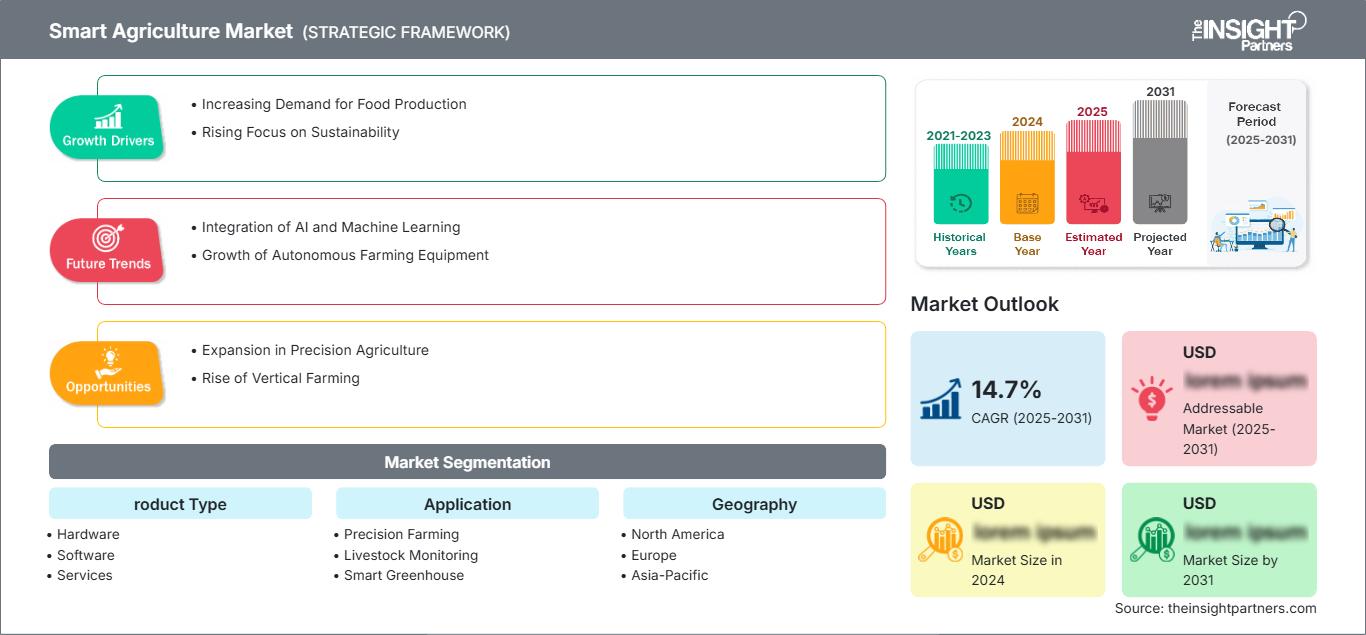
Regional Insights
North America Smart Agriculture Market
In 2025, North America accounted for 34-36% share of Smart Agriculture market and is anticipated to grow at a CAGR of 9.8-10.4% during 2026-2034 owing to wide availability of fields, high levels of mechanization, and necessity of optimizing fertilizers, seeds, irrigation, and chemicals in corn, soybeans, wheat, cotton, and specialty crops.
Additionally, the regional market dynamics will be driven by connectivity initiatives and services-equipment partnerships. For instance, FCC Precision Ag Connectivity Task Force correlates development of broadband and adoption of precision agriculture technologies, whereas USDA rural connectivity initiatives are focused on enabling real-time operations on farms. Such trends foster the demand for telematics, fleet management systems, autonomy-ready equipment, livestock wearables, and agronomics services.
U.S. Smart Agriculture Market
In 2025, the U.S. represented 78-82% of the North American region, while it is expected to experience a CAGR of 9.9-10.5% from 2026 to 2034. The large-acre row crop production practices, high cost of labor, and regular replacement cycles of machinery makes automated steering, yield mapping, variable rate application, and on-farm management solutions profitable businesses.
There is an abundant presence of companies here with Deere & Company, AGCO Corporation, Trimble Inc., Raven Industries, Inc., Ag Leader Technology, and TeeJet Technologies catering to equipment and software requirements. Trends in application of technology include high usage in precision agriculture, livestock monitoring in dairy and beef farms, and smart greenhouse systems near cities' food markets.
Europe Smart Agriculture Market
The share of Europe was 25-27% in 2025 and it is estimated that it will grow at a CAGR of 9.2-9.8% during 2026-2034. Adoption in Germany is driven by machinery intensity, while France and the UK benefit from digital agronomy in crop protection, compliance, and increased productivity against growing sustainability requirements.
Italian and Spanish contribution includes vineyards, orchards, protected cultivation, and water-saving irrigation use cases. The European Commission’s digital agriculture policy focuses on IoT, sensors, data analytics, and decision support systems for sustainable production. With maturation of CAP-advisory services and data space initiatives, farm software, smart spraying, and greenhouse automation will also see increasing adoption.
APAC Smart Agriculture Market
The Asia Pacific region has a market share of 22-24% in 2025 and is forecasted to generate 12.1-12.8% CAGR from 2026 to 2034, thereby being the fastest-growing regional market segment. China dominates by virtue of its initiatives in mechanization and digital villages, while Japan and South Korea rely on robotics, greenhouse, and labor-saving solutions.
Growth dynamics of India and Australia include various growth drivers. India will benefit from small farmer services, irrigation analysis, and advisory systems, whereas Australia will benefit from broadacre solutions and water solutions. Favorable policies in relation to food security and climate adaptation contribute to the growth of the Smart Agriculture Market.
Middle East & Africa Smart Agriculture Market
MEA region is forecast to experience growth at a CAGR of 10.7%–11.4% during 2026–2034 driven by advanced implementation of controlled environment agriculture, desalination of water, and food security initiatives in Saudi Arabia and the UAE on one hand and by commercial farming, irrigation management, and livestock monitoring in South Africa on the other.
Infrastructure-related challenges continue affecting rollouts beyond leading economies but solar-powered sensors, satellite connectivity, and services-based models can help overcome entry hurdles. RoMEA demand will be most pronounced where governments emphasize water efficiency, greenhouses, and climate-smart agriculture for lowering dependence on imports.
Segmentation Analysis
Product Type
Product Type is projected to expand at a CAGR of 10.1–10.8% between 2026 and 2034 as buyers combine field hardware, recurring software, and implementation services. The Smart Agriculture Market scope within this segment is broad because farm operators need interoperable tools that can collect data, automate tasks, and translate insights into measurable operating savings across mixed assets.
- Hardware remains the largest revenue contributor as farms invest in sensors, guidance systems, drones, controllers, gateways, and connected machinery that provide the data foundation for automated operations.
- Software is scaling faster as farm management systems, analytics engines, weather platforms, and decision-support tools convert raw field information into planning, compliance, and profitability insights.
- Services are strategically important because installation, calibration, training, agronomic advisory, connectivity support, and maintenance reduce adoption risk and improve return on digital agriculture investments.
Application
Application is projected to grow at a CAGR of 10.6–11.3% from 2026 to 2034 as precision farming, livestock monitoring, and smart greenhouse systems address different farm productivity constraints. Demand is moving from monitoring toward action, including automated feeding, irrigation scheduling, targeted spraying, climate control, and yield optimization across varied operating environments.
- Precision Farming holds the strongest position because broadacre farms use guidance, mapping, variable-rate application, and yield analytics to reduce overlaps, protect margins, and improve input discipline.
- Livestock Monitoring gains demand as producers use wearables, cameras, feeding analytics, and health alerts to manage herd productivity, welfare, disease risk, and labor constraints more effectively.
- Smart Greenhouse is strategically important for controlled production, using climate sensors, fertigation control, lighting automation, and crop analytics to support year-round yields and resource efficiency.
Opportunity Snapshot
| Application | Revenue Contribution | Trend Tag | Adoption Stage |
| Precision Farming | High | Variable Rate | Mature |
| Livestock Monitoring | Medium | Herd Analytics | Scaling |
| Smart Greenhouse | Medium | Climate Control | Scaling |
| Others | Low | Farm Automation | Emerging |
Smart Agriculture Market Growth Drivers and Impact Analysis
Rising Pressure to Reduce Input Waste
The cost of fertilizer, pesticides, seeds, animal feeds, and irrigation play a significant role in profitability on the farm, which is why innovations that help in optimizing placement affect the bottom line. Precision placement helps farmers avoid overlaps, pinpoint poorly performing areas, and apply varying rates according to information about soil conditions, crops, and weather conditions. The greatest market influence can be seen in situations where margins are low and savings can be proved year after year. In light of increased focus on sustainability reporting, the technology also helps with quantifying savings in terms of runoff, irrigation, and pesticide usage.
Labor Shortages Accelerating Farm Automation
Seasonal labor availability has become less predictable for planting, spraying, harvesting, feeding, and greenhouse management. Smart systems reduce dependence on manual supervision by automating guidance, application control, herd alerts, irrigation scheduling, and greenhouse climate decisions. The commercial effect is not limited to replacing labor; it also enables fewer workers to manage larger areas with fewer mistakes. Autonomous and semi-autonomous equipment improves operating windows during weather-sensitive periods, while remote diagnostics reduce downtime. These gains are especially valuable in North America, Europe, Japan, Australia, and high-value horticulture regions.
Connectivity and Data Platforms Improving Decision Quality
Connected farms generate high-volume data from machinery, drones, livestock devices, soil probes, weather stations, and irrigation systems. When this information is integrated into farm platforms, decisions shift from seasonal estimates to near-real-time management. Broadband and satellite connectivity expand the addressable base by supporting remote monitoring, cloud analytics, and equipment updates. The impact is visible in faster response to crop stress, lower service costs, and better coordination between growers, dealers, agronomists, and input suppliers. Data interoperability will increasingly determine vendor selection and long-term customer retention.
Smart Agriculture Market Future Trends
AI-Enabled Autonomy Across the Crop Cycle
Smart Agriculture Market trends are moving toward autonomy that covers planning, planting, crop protection, nutrient management, and harvest logistics. AI vision systems will distinguish weeds, crop rows, pests, and plant stress with increasing accuracy, allowing machines to apply inputs only where needed. The next stage is coordinated autonomy, where tractors, implements, drones, and advisory software share field context. Commercialization will depend on safety validation, connectivity, service support, and farmer trust. As systems prove payback through reduced chemical use and better labor productivity, adoption should expand from premium fleets to retrofit-enabled mixed operations.
Farm Data Governance Becoming a Purchase Criterion
Farmers are becoming more selective about who controls equipment, agronomic, livestock, and compliance data. Future procurement decisions will include data portability, privacy, cybersecurity, and the ability to share information with trusted advisors without vendor lock-in. Europe’s agricultural data-space direction and wider IoT data rules signal how regulation may influence platform design. Vendors that make data rights clear and provide secure integration with finance, insurance, food processors, and sustainability reporting systems will gain trust. This trend turns governance into a competitive differentiator, not only a legal requirement.
Smart Agriculture Market Opportunities
Service-Led Models for Small and Mid-Sized Farms
Many growers cannot justify full ownership of drones, sensors, analytics platforms, or autonomous equipment. This creates an opportunity for dealers, cooperatives, agronomy firms, and technology providers to offer subscription, leasing, and service-bundled models. Smart Agriculture Market Forecasts point to stronger adoption where upfront costs are converted into seasonal operating expenses linked to measurable savings. Service-led models can include scouting, prescription maps, irrigation scheduling, equipment calibration, and compliance reporting. They are particularly relevant in APAC, Latin America, and fragmented European farm structures, where aggregation can make advanced technology economically viable.
Controlled-Environment Agriculture for Water-Stressed Regions
Greenhouse automation, fertigation control, climate sensors, and lighting optimization offer a clear pathway for food security strategies in water-stressed and import-dependent markets. The opportunity is strongest in the Middle East, North Africa, and dense urban regions where year-round vegetable production can reduce logistics exposure. Investors can target modular greenhouse systems paired with software, energy management, and crop advisory services. Commercial success will depend on crop economics, power availability, water treatment, and operator training. Vendors that integrate agronomy with automation will be better positioned than equipment-only suppliers.
Recent Developments
- July 2026: The Zimbabwe Emergency Food Production Project, funded by the African Development Bank with $25 million from its Transitional Support Facility, provided quality agricultural inputs, improved farming technologies and extension services while promoting climate-smart agriculture across 153,000 hectares. The project also increased production of drought-tolerant maize and sunflower seeds and contributed to average wheat yields of five tonnes per hectare. The Government of Zimbabwe, the African Development Bank and implementing partner, the Food and Agriculture Organisation of the United Nations (FAO), marked the successful completion of the initiative, which turned an emergency response to global food shocks into a long-term investment in agricultural resilience and food sovereignty.
- April 2026: Uganda has entered a strategic partnership with the United Nations Health Industry Foundation and the Prince Kimbugwe Foundation to accelerate artificial intelligence adoption, youth skills development, and smart agriculture. The agreement, signed by the Ministry of ICT and National Guidance, marks a significant step toward integrating advanced technologies into the country’s economic transformation agenda. Under the partnership, stakeholders will establish AI laboratories, roll out joint research initiatives, and deliver specialised training programmes for Ugandan youth and ICT professionals. The collaboration is also expected to facilitate international student exchange programmes, enabling participants to gain exposure to global best practices in artificial intelligence and smart agriculture.
- March 2026: In the heart of Guyana’s rice belt at the Guyana Rice Development Board (GRDB) Research Centre in Burma, regional and international partners gathered to launch a new initiative aimed at transforming how the Caribbean manages one of its most critical resources – soil. Initiated on March 02, 2026, the ADOPT Caribbean – Soil Health for Climate-Resilient Agriculture Project, officially began its journey to strengthen soil health, reduce agricultural emissions, and accelerate the adoption of climate-smart farming practices in Guyana, Jamaica, and Saint Vincent and the Grenadines.
Frequently Asked Questions

- Comprehensive Market Sizing and Forecast Analysis
- Detailed Segmentation Analysis
- In-Depth Market Dynamics Assessment
- Regional and Country-Level Insights
- Competitive Landscape and Company Benchmarking
- Strategic Business Intelligence
Recent Reports
Testimonials

The Insight Partners' SCADA System Market report is comprehensive, with valuable insights on current trends and future forecasts. The team was highly professional, responsive, and supportive throughout. We are very satisfied and highly recommend their services.
RAN KEDEM Partner, Reali Technologies LTDs
I requested a report on a very specific software market and the team produced the report in a few days. The information was very relevant and well presented. I then requested some changes and additions to the report. The team was again very responsive and I got the final report in less than a week.
JEAN-HERVE JENN Chairman, Future Analytica
We worked with The Insight Partners for an important market study and forecast. They gave us clear insights into opportunities and risks, which helped shape our plans. Their research was easy to use and based on solid data. It helped us make smart, confident decisions. We highly recommend them.
PIYUSH NAGPAL Sr. Vice President, High Beam Global
The Insight Partners delivered insightful, well-structured market research with strong domain expertise. Their team was professional and responsive throughout. The user-friendly website made accessing industry reports seamless. We highly recommend them for reliable, high-quality research services
YUKIHIKO ADACHI CEO, Deep Blue, LLC.
This is the first time I have purchased a market report from The Insight Partners.While I was unsure at first, I visited their web site and felt more comfortable to take the risk and purchase a market report.I am completely satisfied with the quality of the report and customer service. I had several questions and comments with the initial report, but after a couple of dialogs over email with their analyst I believe I have a report that I can use as input to our strategic planning process.Thank you so much for taking the extra time and making this a positive experience.I will definitely recommend your service to others and you will be my first call when we need further market data.
JOHN SUZUKI President and Chief Executive Officer, Board Director, BK Technologies
I wish to appreciate your support and the professionalism you displayed in the course of attending to my request for information regarding to infectious disease IVD market in Nigeria. I appreciate your patience, your guidance, and the fact that you were willing to offer a discount, which eventually made it possible for us to close a deal. I look forward to engaging The Insight Partners in the future, all thanks to the impression you have created in me as a result of this first encounter.
DR CHIJIOKE ONYIA MANAGING DIRECTOR, PineCrest Healthcare Ltd.Reason to Buy
- Informed Decision-Making
- Understanding Market Dynamics
- Competitive Analysis
- Identifying Emerging Markets
- Customer Insights
- Market Forecasts
- Risk Mitigation
- Boosting Operational Efficiency
- Strategic Planning
- Investment Justification
- Tracking Industry Innovations
- Aligning with Regulatory Trends





 Get Free Sample for