
Smart Card IC Market Size, Share & Growth by 2034
Smart Card IC Market Size and Forecasts (2021 - 2034), Global and Regional Share, Trends, and Growth Opportunity Analysis Report Coverage : By Interface (Contact, Contactless, Dual Interface); Application (SIM Cards, ID Cards, Employee ID, ePassport, loT Devices, Others); End-User (Telecommunications, BFSI, Government and Healthcare, Transportation, Others)
- Status : Data Released
- Report Code : TIPRE00039628
- Category : Electronics and Semiconductor
- No. of Pages : 150
- Available Report Formats :


- Last update date : July 31, 2026


2025 Market Size
US$ 3.71 Bn
Base year value
2034 Forecast
US$ 6.33 Bn
Projected by 2034
CAGR 2026-2034
6.10 %
Growth rate
Addressable Market
US$ 45.42 Bn
(2026-2034)
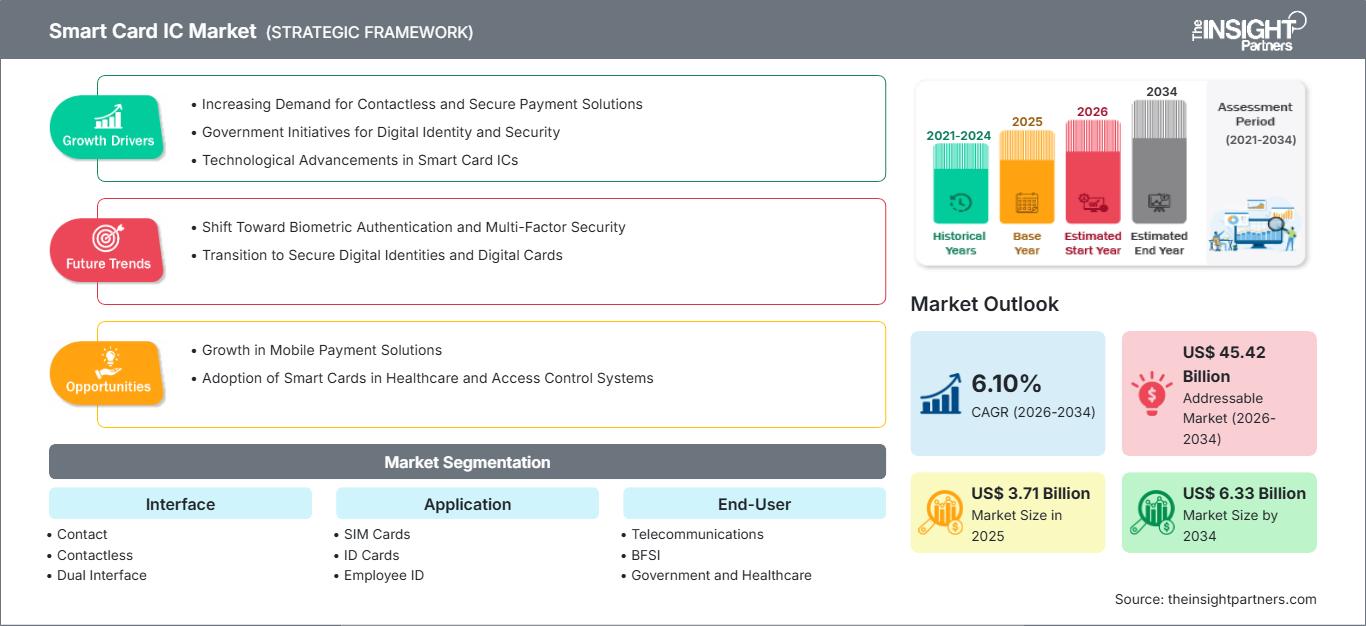
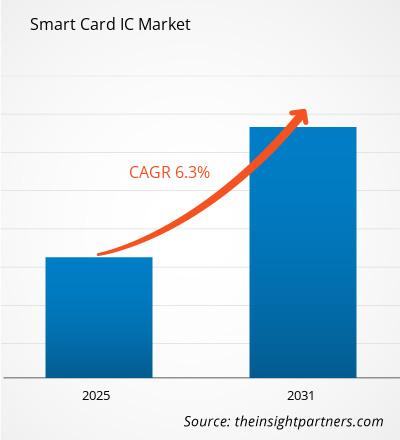
The Smart Card IC Market reached US$ 3.71 billion in 2025 and is predicted to reach US$ 6.33 billion by 2034, with a projected CAGR of 6.10% during 2026 to 2034. Key drivers behind the need for smart cards include secure payment authentication, SIMs, government ID, and device provisioning where the role of integrated circuits in tamper resistance, crypto processing, and data storage is essential.
North America still stands out as a region that has been adopting smart cards steadily, with the regional market demand growing at a rate of 5.4-5.9% CAGR through 2034 due to bank and transit authority card systems' renewals and government IDs issuance. Regional market demand will be driven by the readiness of the EMV migration, the development of healthcare identity management systems, and enterprise access control upgrades, along with secure IoT onboarding.
Smart Card IC Market Assessment and Insights
- North America accounted for 21–24% share in 2025 and is growing at a CAGR between 5.4–5.9% during 2026–2034, supported by EMV security, healthcare identity, and transit fare modernization.
- US represented 78–82% of North America in 2025 and is growing at a CAGR between 5.5–6.0% during 2026–2034, led by banking, access, and healthcare credentials.
- Europe held 25–28% share in 2025 and is growing at a CAGR between 5.7–6.2% during 2026–2034, with Germany, France, the UK, Italy, and Spain advancing eID, banking, and transport deployments.
- Asia Pacific contributed 38–42% share in 2025 and is growing at a CAGR between 6.8–7.4% during 2026–2034, led by China, Japan, South Korea, India, and Australia across telecom, payments, and public identity.
- Largest Segment Contactless held 48–52% market share in 2025 and is growing at a CAGR between 6.7–7.2% during 2026–2034 due to faster authentication and payment convenience.
- High Growth Segment IoT Devices held 9–12% market share in 2025 and is growing at a CAGR between 8.4–9.1% during 2026–2034 as secure provisioning expands.
- Key companies analyzed in detail: Microchip Technology Inc., Broadcom Inc., NXP Semiconductors N.V., onsemi, HID Global Corporation, Bombardier Inc., Microelectronics Technology Inc., STMicroelectronics N.V., Kartek, Sunrise Technologies.
Source: The Insight Partners' analysis based on proprietary research, government publications, company annual reports, investor presentations, industry databases, and expert interviews.
The chip type has migrated from memory-oriented cards to secure microcontrollers that integrate cryptography, nonvolatile memory, and secure operating systems. The contactless architecture received the production priority due to issuers' focus on faster transaction processing and hygiene-driven frictionless user experience. Wafer manufacturing capabilities, packaging volume, and embedded security certifications now influence choice of suppliers, and demand increasingly goes towards chips that can be used for identity, payment, mobility, and device authentication services in power-efficient packages.
In the forecast period, shipments in emerging Asia, Gulf digital identity projects, and Europe will be boosted by new cycles of public credential issuance. Security-focused public procurements and life-cycle management, personalized and interoperable offerings by private issuers are among priorities now. Investments may go to high-memory controllers, secure element certification, and manufacturing resilience; this would make the Smart Card IC Market more diverse from its revenue sources beyond SIM and bank cards.
Smart Card IC Market Report Scope
| Report Attribute | Details |
|---|---|
| Market size in 2025 | US$ 3.71 Billion |
| Market Size by 2034 | US$ 6.33 Billion |
| Global CAGR (2026 - 2034) | 6.10% |
| Historical Data | 2021-2024 |
| Forecast period | 2026-2034 |
Smart Card IC Market Analysis
The growth in the demand for smart card IC market is supported by three interconnected drivers: secure digital payments, identity management, and authentication of embedded devices. According to EMVCo, 97% of global card-based transactions have been made through EMV chip transactions as of Q4 2025, confirming the extent of chip-based payment infrastructure development. Telecoms continue to drive the base demand through SIM and eSIM replacement, while government bodies continue using chip-based credentials for passports, national identities, health cards, and driver’s licenses.
This value chain includes silicon design, secure operating system embedding, wafer fabrication, module assembly, card personalization, and issuer fulfillment. There are foundry, secure memory, certification period, and regional packaging redundancy on the supply side. Contactless modules receive more engineering attention, as antenna tuning, low-power RF properties, and security all have to be taken into account without affecting transaction speed and form factors.
Competitive positioning within the Smart Card IC Market report is based on the depth of security certification, customer qualification track record, and capability to provide solutions for both high volume cards and more costly secure elements. Security controllers for ePassports, IDs, payment cards and transport applications are offered by NXP Semiconductors N.V. Secure mobile and NFC applications are covered by STMicroelectronics N.V. through provision of secure element platforms. Authentication is taken care of by Microchip Technology Inc. via secure ICs and provision services.
Current focus within the Smart Card IC Market analysis of investments is moving from simple memory cost reduction to security differentiation, lifecycle services and supply continuity. Broadcom Inc., onsemi, HID Global Corporation, Bombardier Inc., Microelectronics Technology Inc., Kartek, and Sunrise Technologies contribute through participation around components, systems or specific deployment channels. The importance of cryptographic agility, compliance readiness, manufacturing control and multi-application credential support is growing among buyers.
● REPORT CUSTOMIZATION
Tailor This Report To Align With Your Specific Business Requirements
This report can be customized to align precisely with your business objectives, scope, and target markets. Customization options include tailored segmentation, geography, competitive analysis, and strategic insights to support informed decision-making.
Customize This Report →WHAT YOU CAN ADJUST
- ● Segmentations
- ● Geography
- ● Competitive Analysis
- ● Language Preferences
Smart Card IC Market: Strategic Insights
Regional Insights
North America Smart Card IC Market
North America held 21–24% of revenue in 2025, with a 5.4–5.9% CAGR expected during 2026–2034. The Smart Card IC Market share in the region is supported by mature EMV banking infrastructure, healthcare identity requirements, airport credentialing, and transit systems that are replacing magnetic or barcode media with contactless secure credentials.
The focus on structural demand will not be on initial adoption but on lifecycle refreshing, heightened security needs, and converging multiple applications. Financial institutions will be replacing their contactless cards, corporations will be refreshing their employee ID cards, and government departments will be assessing their needs to enhance credential assurance. There is also some demand for secure elements for IoT provisioning as well.
U.S. Smart Card IC Market
US comprised of 78–82% of North American region in 2025 and estimated to exhibit a 5.5–6.0% CAGR during 2026–2034. Applications such as bank cards' replacement, identification of healthcare providers, government credentialing programs, and enterprise access systems provide an opportunity for a consistent demand for contactless and dual-interface chips.
Market presence includes major companies like Microchip Technology Inc., Broadcom Inc., HID Global Corporation, and onsemi, along with other international secure controller vendors catering to US issuers. Applications have high preference towards payment cards, employee ID cards, transport card, and authentication of connected devices. Government and state initiatives further involve prolonged qualification processes, although they do improve revenue visibility for approved IC vendors.
Europe Smart Card IC Market
Europe held a 25-28% share in 2025 and is expected to witness a CAGR of 5.7-6.2% from 2026 to 2034. Germany dominates in Europe owing to high eID, health card, transport cards, and financial services cards applications in the country, along with a well-developed semiconductor and secure personalization ecosystem in the region.
The UK is playing its part through contactless payments, transit fare media, and access control modernization. The need for public credentials and industrial authentication is high in Germany. France, Italy, and Spain make contributions in Europe through ePassport renewals, bank cards replacement, healthcare ID cards, and mobility cards in municipalities. European buyers usually emphasize on certification, compliance, and interoperability.
APAC Smart Card IC Market
APAC had a 38–42% share in 2025, and the market is forecast to grow at a 6.8–7.4% CAGR between 2026 and 2034, with China being the dominant country. High telecom subscribers, financial inclusion, eID deployments, and transport tickets support volume demand in China, Japan, South Korea, India, and Australia.
Moreover, the industrial policies support indigenous secure semiconductors in particular in China, Japan, and South Korea. India sees digital infrastructure and bank card issuance as factors driving volume, while Australia sees transit and enterprise security as use case drivers. The growth story in Asia Pacific is built around the volume of SIM cards and payments combined with government and IoT security solutions.
Middle East & Africa Smart Card IC Market
Middle East & Africa is expected to grow at a 6.1–6.7% CAGR from 2026 to 2034, with the UAE leading adoption intensity. Saudi Arabia, the UAE, South Africa, and the Rest of MEA are investing in digital IDs, payment acceptance, telecom subscriber security, and smart-city mobility platforms.
Energy-sector access control, airport expansion, and infrastructure modernization provide durable demand for secure credentials. Gulf markets prioritize high-assurance identity and contactless service delivery, while African growth is linked to mobile connectivity, financial inclusion, and government digitization. Supply continuity and cost sensitivity remain important procurement considerations across the region.
Segmentation Analysis
Interface
Interface is expected to grow at a 6.2–6.8% CAGR during 2026–2034 as issuers balance installed reader infrastructure with demand for faster tap-based authentication. The Smart Card IC Market scope within interface design is expanding toward dual-use chips that combine contact reliability with contactless convenience, especially in banking, transit, public identity, and enterprise access programs requiring interoperability.
- Contact remains relevant where physical insertion, controlled access, and legacy readers dominate, especially in banking, enterprise security, and government systems requiring predictable communication and lower transition risk.
- Contactless is the largest interface, reflecting strong preference for rapid authentication in payments, transport, and identity checks where speed, convenience, and user acceptance drive issuer decisions.
- Dual Interface supports migration strategies by enabling one credential to work across older contact readers and newer tap-based infrastructure, making it strategically important for phased modernization.
Application
Application is projected to grow at a 6.4–7.0% CAGR from 2026 to 2034 as chips move beyond conventional card issuance into connected identity and device security. SIM Cards continue to provide scale, while ID Cards, Employee ID, ePassport, and IoT Devices increase demand for higher memory, stronger encryption, and trusted credential lifecycle management.
- SIM Cards retain large-volume demand through mobile subscriber growth, operator replacement cycles, and eSIM coexistence, making telecom security a steady baseline for IC shipments.
- ID Cards are strategically important in public-service digitization because they combine citizen authentication, benefits access, travel support, and fraud reduction in a single secure credential.
- Employee ID demand is rising as enterprises replace basic badges with secure cards supporting access control, time attendance, logical login, and facility compliance requirements.
- ePassport applications require high-assurance chips with secure memory and anti-tamper functions, making certification, durability, and international interoperability decisive procurement criteria.
- IoT Devices represent the highest-growth application as manufacturers embed secure elements for device identity, encrypted onboarding, firmware validation, and protection against counterfeiting.
End-User
End-User demand is forecast to expand at a 6.0–6.6% CAGR during 2026–2034 as regulated sectors increase hardware-based authentication. Telecommunications provides shipment stability, BFSI supports value through payment security, Government and Healthcare drive credential assurance, and Transportation creates recurring demand from fare media and mobility-account integration.
- Telecommunications remains a core end-user because subscriber authentication, roaming security, and eSIM transition management require reliable, certified chips across consumer and machine-to-machine connections.
- BFSI prioritizes fraud reduction, contactless payment enablement, and customer trust, making secure chip performance central to card replacement, premium issuance, and digital credential strategies.
- Government and Healthcare use smart credentials to improve citizen services, patient identification, entitlement verification, and secure access to sensitive data across distributed institutions.
- Transportation adopts contactless cards and secure modules for fare collection, account-based ticketing, and multimodal mobility systems that need fast throughput and dependable authentication.
Opportunity Snapshot
| Application | Revenue Contribution | Trend Tag | Adoption Stage |
| SIM Cards | High | eSIM Coexistence | Mature |
| ID Cards | High | Digital Identity | Scaling |
| Employee ID | Medium | Secure Access | Scaling |
| ePassport | Medium | Border Security | Mature |
| IoT Devices | Medium | Device Trust | Emerging |
Smart Card IC Market Growth Drivers and Impact Analysis
Chip-Based Payment Security Becomes a Baseline Requirement
Payment issuers have been approaching secure chips as a fundamental building block and not an optional fraud prevention technology. According to EMVCo’s fourth quarter statistics for 2025, 97% of all worldwide card transactions are EMV chip. This implies that the future room for expansion will mainly be in refresh, contactless migration, and upgrading premium credentials. It explains why there will still be demand for ICs even in developed economies since banks will always need to replace expiring cards and enhance their cryptography and interoperability capabilities. The effect can be seen in procurement practices where issuers prefer certified controllers due to performance and durability.
Digital Identity Programs Expand High-Assurance Credential Volumes
Chips are being increasingly incorporated into identity systems by governments to deliver better services, manage borders, access healthcare facilities, and prevent fraud. Government demand for ICAO-based ePassport solutions, ID modernization projects, and healthcare credentialing involves needs for secure controllers with certified memory, encryption, and tamper protection functions. As opposed to consumer products, government credentials tend to have a more stringent testing process, longer time to procurement, and high personalization needs, creating barriers to entry for vendors. The implication of the market is a shift towards value over price, since reliability and compliance are of great importance for governments.
Connected Devices Require Hardware Roots of Trust
The security for the IoT is being upgraded from software-based security to hardware-based security since there will be connected devices in the sectors of healthcare, utility, manufacturing, building automation, and even consumers. The secure elements allow manufacturers to have secure keys, authenticate devices, perform secure firmware updates, and minimize counterfeiting threats. In the case of NXP Semiconductors, EdgeLock range of products demonstrates EAL6+ Common Criteria security. Microchip Technology Inc. offers secure key storage, hardware crypto acceleration, and provisioning services. The effects on the Smart Card IC Market Demand are both qualitative and quantitative.
Smart Card IC Market Future Trends
Multi-Application Credentials Become Standard
Smart Card IC Market trends are moving toward credentials that support payment, identity, transport, and access functions on a single secure platform. Issuers want fewer physical tokens, easier lifecycle management, and stronger user convenience without compromising separation between applications. Higher nonvolatile memory, applet isolation, and secure over-the-air personalization will become more important as enterprises and governments consolidate credential portfolios. This trend favors suppliers with mature secure operating systems, flexible memory architectures, and partnerships across card manufacturers, mobile wallet providers, and personalization bureaus. It also raises switching costs because certified multi-application deployments require extensive testing and ecosystem coordination.
Regionalized Secure Semiconductor Supply Gains Priority
Buyers are expected to place greater weight on supply-chain transparency, packaging redundancy, and regional production options after earlier semiconductor shortages exposed dependency risks. Smart card IC procurement already involves long qualification cycles, so disruptions can delay bank card issuance, public credential programs, and telecom provisioning. Over the next decade, vendors with diversified assembly, secure personalization support, and controlled manufacturing flows will be better positioned in tenders. Governments may also favor suppliers that align with domestic semiconductor strategies, especially where identity credentials are considered critical infrastructure. This trend could reshape pricing, inventory policy, and supplier concentration.
Smart Card IC Market Opportunities
Secure IoT Provisioning Services
Vendors can create differentiated value by combining secure ICs with provisioning, certificate management, and firmware authentication services for connected-device manufacturers. Smart Card IC Market Forecasts point to stronger demand for hardware roots of trust in industrial, healthcare, utility, and smart-building devices as compliance expectations increase. Semiconductor suppliers should target design-in partnerships early, because device makers often lock security architecture before commercial launch. The opportunity is not limited to chip sales; recurring revenue can emerge from lifecycle credential management, secure personalization, and managed update services. This favors companies able to provide both silicon and trusted operational infrastructure.
Government Credential Modernization in Emerging Markets
Emerging markets present an attractive opportunity as governments digitize identity, healthcare, social benefits, and travel documents. Many programs need scalable, cost-conscious, but high-assurance chips that can meet international security requirements while supporting local personalization. Suppliers can improve win rates by partnering with domestic system integrators, card bureaus, and reader infrastructure providers. The investment case is strongest where national ID programs are connected to financial inclusion, mobile services, and public-benefit delivery. Successful vendors will position themselves as compliance partners, not component sellers, and support ministries across pilot, certification, rollout, and renewal phases.
Recent Developments
- July 2026: The Smart Payment Association (SPA) announced that its members and Advisory Council members shipped 2.47 billion payment cards and chip modules in 2025, marking a year of consolidation after the chip shortages and corrective years that preceded it.
- December 2025: LG Innotek announced that the company has successfully developed a 'Next-Generation Smart IC (integrated circuit) Substrate' featuring enhanced performance and reducing carbon emissions generated in its production by half. The smart IC substrate is an essential component for mounting IC chips that store information on smart cards, such as those in credit cards, electronic passports, and USIMs. When users place a smart card in an ATM or on a passport reader, the IC chip's information is transmitted to the device via electronic signals.
- June 2024: STMicroelectronics has revealed the STeID Java Card smartcard platform that meets state-of-the-art requirements for electronic identity (eID) and eGovernment use cases. As eID documents using secure microcontrollers continue gaining importance in the fight against identity fraud, the STeID platform now accelerates the deployment of advanced solutions. Targeting common criteria EAL 6+ certification, the platform comprises a secure operating system, STeID JC Open OS, and a portfolio of proprietary applets.
Frequently Asked Questions

- Comprehensive Market Sizing and Forecast Analysis
- Detailed Segmentation Analysis
- In-Depth Market Dynamics Assessment
- Regional and Country-Level Insights
- Competitive Landscape and Company Benchmarking
- Strategic Business Intelligence
Recent Reports
Testimonials

The Insight Partners' SCADA System Market report is comprehensive, with valuable insights on current trends and future forecasts. The team was highly professional, responsive, and supportive throughout. We are very satisfied and highly recommend their services.
RAN KEDEM Partner, Reali Technologies LTDs
I requested a report on a very specific software market and the team produced the report in a few days. The information was very relevant and well presented. I then requested some changes and additions to the report. The team was again very responsive and I got the final report in less than a week.
JEAN-HERVE JENN Chairman, Future Analytica
We worked with The Insight Partners for an important market study and forecast. They gave us clear insights into opportunities and risks, which helped shape our plans. Their research was easy to use and based on solid data. It helped us make smart, confident decisions. We highly recommend them.
PIYUSH NAGPAL Sr. Vice President, High Beam Global
The Insight Partners delivered insightful, well-structured market research with strong domain expertise. Their team was professional and responsive throughout. The user-friendly website made accessing industry reports seamless. We highly recommend them for reliable, high-quality research services
YUKIHIKO ADACHI CEO, Deep Blue, LLC.
This is the first time I have purchased a market report from The Insight Partners.While I was unsure at first, I visited their web site and felt more comfortable to take the risk and purchase a market report.I am completely satisfied with the quality of the report and customer service. I had several questions and comments with the initial report, but after a couple of dialogs over email with their analyst I believe I have a report that I can use as input to our strategic planning process.Thank you so much for taking the extra time and making this a positive experience.I will definitely recommend your service to others and you will be my first call when we need further market data.
JOHN SUZUKI President and Chief Executive Officer, Board Director, BK Technologies
I wish to appreciate your support and the professionalism you displayed in the course of attending to my request for information regarding to infectious disease IVD market in Nigeria. I appreciate your patience, your guidance, and the fact that you were willing to offer a discount, which eventually made it possible for us to close a deal. I look forward to engaging The Insight Partners in the future, all thanks to the impression you have created in me as a result of this first encounter.
DR CHIJIOKE ONYIA MANAGING DIRECTOR, PineCrest Healthcare Ltd.Reason to Buy
- Informed Decision-Making
- Understanding Market Dynamics
- Competitive Analysis
- Identifying Emerging Markets
- Customer Insights
- Market Forecasts
- Risk Mitigation
- Boosting Operational Efficiency
- Strategic Planning
- Investment Justification
- Tracking Industry Innovations
- Aligning with Regulatory Trends





 Get Free Sample for