
Spin on Carbon Market Growth, Size & Forecast by 2034
Spin on Carbon Market Size and Forecasts (2021 - 2034), Global and Regional Share, Trends, and Growth Opportunity Analysis Report Coverage : By Carbon Credit Type (Verified Carbon Standard, Gold Standard, Climate Action Reserve, American Carbon Registry), Market Participant (Regulatory Bodies, Corporations, Non-Governmental Organizations, Brokers), Carbon Offset Activity (Afforestation, Renewable Energy, Energy Efficiency, Methane Capture), Compliance Framework (Cap and Trade, Voluntary Market, Carbon Tax)
- Status : Data Released
- Report Code : TIPRE00039640
- Category : Electronics and Semiconductor
- No. of Pages : 150
- Available Report Formats :


- Last update date : October 30, 2026


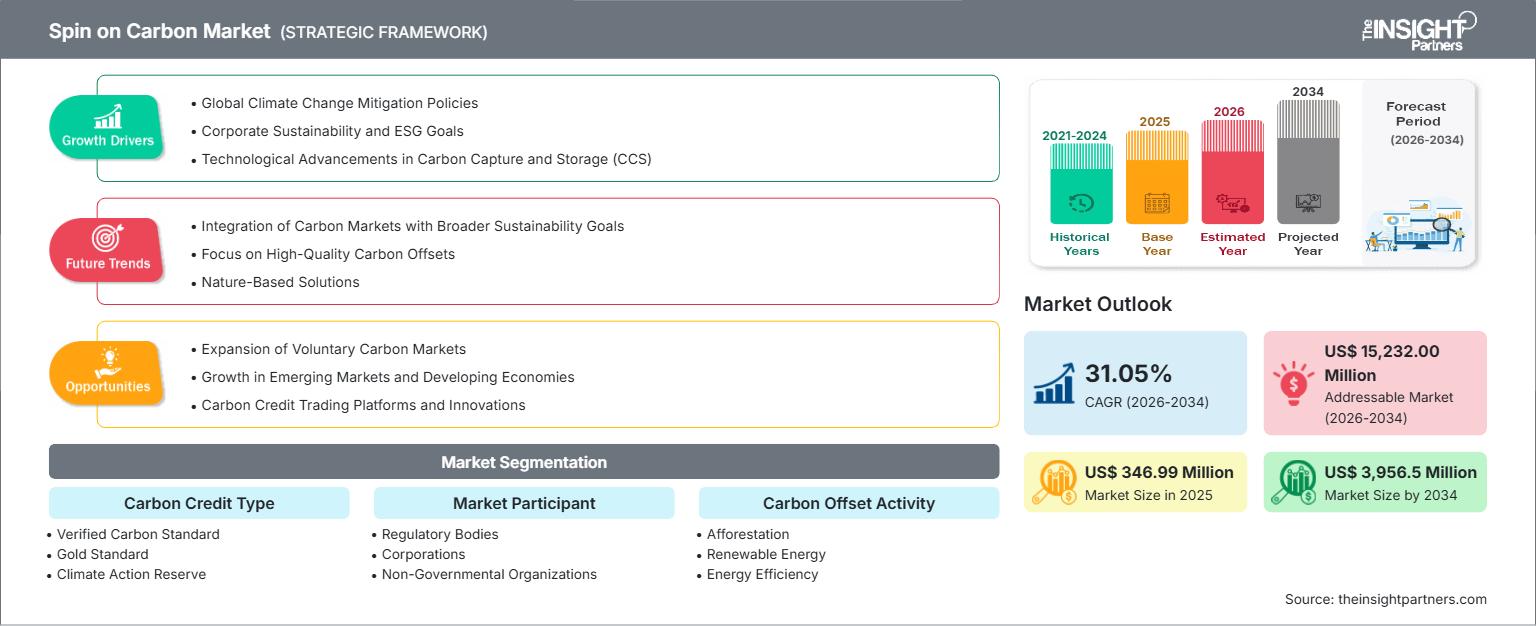
2025 Market Size
US$ 346.99 Mn
Base year value
2034 Forecast
US$ 3,956.5 Mn
Projected by 2034
CAGR 2026-2034
31.05 %
Growth rate
Addressable Market
US$ 15,232.00 Mn
(2026-2034)
The Spin on Carbon Market is expanding as carbon crediting, emissions trading, and carbon-pricing mechanisms become increasingly integrated into corporate decarbonization strategies and national climate policies. The market is valued at US$ 346.99 Million in 2025 and is projected to reach US$ 3,956.5 Million by 2034, registering a CAGR of 31.05% during 2026–2034. Increasing participation by corporations, development of regulated carbon-pricing systems, and greater attention to credit quality are reshaping demand, supply, and transaction structures across the market.
North America remains a structurally important market because established compliance mechanisms coexist with voluntary carbon-credit activity, corporate climate commitments, and established verification infrastructure. The region is projected to register a CAGR of ~29% through 2034. The Spin on Carbon Market size is supported by mature trading ecosystems, regulatory development, project investment, and increasing demand for traceable carbon instruments.
Spin on Carbon Market Assessment and Insights
Regional Outlook
- North America: ~34% of the global Spin on Carbon Market share in 2025 | ~29% CAGR through 2034. Market position: North America holds the largest regional position, supported by established emissions trading infrastructure, corporate procurement, project developers, verification organizations, and active compliance programs in major US and Canadian jurisdictions.
- US: ~72% of North American market revenue in 2025 | ~29% CAGR through 2034. Market position: The US represents the largest country market within North America, supported by California's cap-and-invest framework, corporate carbon procurement, renewable-energy projects, and expanding demand for independently verified credits.
- Europe: ~29% of the global market in 2025 | ~30% CAGR through 2034. Market position: Europe has a mature carbon-pricing ecosystem led by Germany within the region, with the UK, France, Italy, and Spain contributing through emissions trading, corporate climate programs, and project-based carbon activity.
- Asia Pacific: ~24% of the global market in 2025 | ~35% CAGR through 2034. Market position: Asia Pacific is the fastest-growing region, driven by expanding national carbon markets, industrial decarbonization, renewable-energy investment, and increasing participation from China, Japan, South Korea, India, and Australia.
Segment Outlook
- Market Participant: ~46% Share in 2025 | ~31% CAGR through 2034. Market position: Corporations account for a substantial portion of market activity because emissions-management obligations, voluntary climate commitments, and supply-chain requirements increasingly require access to carbon credits and carbon-pricing instruments.
- Carbon Offset Activity: ~24% Share in 2025 | ~34% CAGR through 2034. Market position: Carbon offset activity is expanding rapidly as project developers diversify portfolios across renewable energy, afforestation, methane capture, and efficiency projects while buyers increasingly prioritize measurable and independently verified climate outcomes.
Competitive Coverage
NextEra Energy, Inc., Vattenfall AB, Enel SpA, Duke Energy Corporation, Chevron Corporation, TotalEnergies SE, bp p.l.c., Iberdrola, S.A., ENGIE SA, Shell plc
Methodology
The Insight Partners follows Data Collection & Secondary Research, Primary Research, Data Analysis, and Data Triangulation & Final Review to validate market estimates and insights.
Source: The Insight Partners' analysis based on proprietary research, government publications, company annual reports, investor presentations, industry databases, and expert interviews.
The carbon market has moved from relatively fragmented and voluntary offset transactions to a more comprehensive ecosystem that includes registries, verification organizations, exchanges, brokers, companies, governments, and project developers. Carbon credit standards are getting stricter, requiring more emphasis on additionality, permanence, monitoring, reporting, verification, and non-double counting. On the other hand, compliance markets are getting increasingly complex with the growth of emission trading systems and carbon taxation by governments. All those changes lead to the improvement of market structure and growing importance of credit quality and transaction documentation. As a result, Spin on Carbon Market operations are now increasingly based not only on regulatory frameworks but also on integrity of projects as well.
In the future, international cooperation within the carbon market is likely to create more options for cross-border transactions. This will be caused by Article 6 mechanisms, expanded emission trading systems, and carbon pricing policies at the domestic level. Besides, the emerging economies are setting up their own institutions, which can enable linking of domestic projects with international purchasers. Hence, the investments will flow to projects that are capable of proving their measurements and verifications, especially nature removals, methane reductions, and standard-compliant projects.
Spin on Carbon Market Report Scope
| Report Attribute | Details |
|---|---|
| Market size in 2025 | US$ 346.99 Million |
| Market Size by 2034 | US$ 3,956.5 Million |
| Global CAGR (2026 - 2034) | 31.05% |
| Historical Data | 2021-2024 |
| Forecast period | 2026-2034 |
Spin on Carbon Market Analysis
The Growth Engine of the Carbon Market is directly related to the growth of carbon pricing regimes and business emission management needs. The demand comes from regulatory compliance mechanisms and corporations who buy voluntary credits for residual emissions. Credits are produced by project developers via renewable energy projects, afforestation, methane capture and energy efficiency. The project is checked by verification agencies, credits are issued by the registry, trade of credits is organized by brokers and exchanges, and finally credits are retired by the buyers. This system creates constant demand for the services of project development, verification, trading and portfolio management.
Supply is increasingly becoming driven not only by volumes but also by the quality of credits. According to the World Bank report of 2026, total carbon credit issuance grew up by ~8% from 2024 to 2025 while prices declined in general and some high-quality project types remained premium priced. This is the market where supply becomes increasingly segmented by the level of environmental integrity, methodology, permanence and the buyer's eligibility.
The competitive environment comprises integrated energy companies, utilities, environmental products providers, project investors, brokers, and carbon market services providers. Firms like Shell, TotalEnergies, ENGIE, Iberdrola, and Enel compete in various areas of the ecosystem, including investment into projects, carbon purchasing, environmental products provision, and emissions reduction. Utilities like NextEra Energy, Vattenfall, and Duke Energy may compete via their renewable energy projects and decarbonization efforts. Such complex competitive environment creates the following competitive advantages: portfolio quality, market access, project origination, and regulation expertise.
Increasingly, investments are made in scalable projects with verifiable climate impacts. For instance, TotalEnergies increased its portfolio of nature-based carbon credits, and Shell is still working to build up its carbon credits procurement and environmental products business. Hence, the analysis of Spin on Carbon Market demonstrates that vertical integration will be a future trend in the industry, as major energy companies will integrate project financing, credit procurement, trading, and customer-oriented carbon products.
● REPORT CUSTOMIZATION
Tailor This Report To Align With Your Specific Business Requirements
This report can be customized to align precisely with your business objectives, scope, and target markets. Customization options include tailored segmentation, geography, competitive analysis, and strategic insights to support informed decision-making.
Customize This Report →WHAT YOU CAN ADJUST
- ● Segmentations
- ● Geography
- ● Competitive Analysis
- ● Language Preferences
Spin on Carbon Market: Strategic Insights
Regional Insights
North America Spin on Carbon Market
North America represents ~34% of the global market in 2025 and is projected to grow at ~29% CAGR through 2034. The region benefits from established carbon-market infrastructure, corporate sustainability programs, project developers, and regulatory mechanisms. California's cap-and-invest program covers approximately 80% of state greenhouse gas emissions and establishes a declining emissions cap, creating a continuing demand signal for compliance instruments.
The US accounts for ~72% of North American revenue, reflecting the depth of corporate participation and established carbon-market infrastructure. Credits can be sourced from various activities such as renewable-energy generation, forest-based activities, methane reduction, and energy efficiency. The provincial trading systems in Canada also offer other avenues for trading. The regulatory improvements coupled with the need for good carbon credits and credible residual emission solutions on the part of the corporations will enable further growth.
U.S. Spin on Carbon Market
The US represents ~72% of North American revenue in 2025 and is expected to expand at ~29% CAGR through 2034. California’s cap-and-invest program still functions as an important compliance tool, and voluntary participation by corporations adds another channel of demand. In the US, there is also considerable project development potential in forestry, renewable energy, methane capture, and energy efficiency.
Energy corporations, utilities, and corporations participate through project financing, credit purchases, emissions management, and environmental commodities. Companies such as NextEra Energy and Duke Energy have their place in the utilities sector, and Chevron and Shell take part in carbon management and carbon markets. There is growing emphasis on credit integrity, which is prompting buyers to consider issues of verification, additionality, and retirement of credits before purchase.
Europe Spin on Carbon Market
Europe represents ~29% of the global market in 2025 and is projected to expand at ~30% CAGR through 2034. Germany is the largest economy in Europe because of its strong industrial base and high exposure to carbon-pricing policies across Europe. The UK has a distinct emissions trading regime, whereas France, Italy, and Spain contribute to demand creation through decarbonization of industry, investments in renewable energy projects, and business-led sustainability projects.
The European market is highly influenced by the EU Emissions Trading Scheme, which helps create a demand structure for allowances. Carbon pricing is getting increasingly tied up with the industrial policy, energy transition investments, and competitiveness considerations. Moreover, voluntary credits are becoming increasingly important to corporate buyers, resulting in higher demand for carbon projects with good verification and transparent results.
There is industrial activity in Germany that creates exposure to carbon prices. In addition, the French electricity sector and the business community supports carbon project demand. Meanwhile, the Italian and Spanish economies benefit from investments in renewable energy projects and increased corporate sustainability activities. The UK's distinct compliance regime is yet another compliance market in Europe.
APAC Spin on Carbon Market
APAC represents ~24% of the global market in 2025 and is expected to register ~35% CAGR through 2034, making it the fastest-growing region. China is the leading country in Asia Pacific, supported by its national emissions trading system and large industrial and power sectors. Japan, South Korea, India, and Australia are developing or strengthening mechanisms that expand the region's carbon-market ecosystem.
Industrial decarbonization, renewable-energy deployment, methane reduction, and carbon-pricing policy development are major growth mechanisms. India's emerging carbon-credit framework, China's expanding emissions trading architecture, Japan's GX policies, South Korea's established ETS, and Australia's carbon-market mechanisms create multiple demand channels. The diversity of regulatory systems also encourages intermediaries and project developers to develop jurisdiction-specific market expertise.
Middle East & Africa Spin on Carbon Market
Middle East & Africa is projected to grow at ~31% CAGR through 2034. Saudi Arabia is the leading country in the Middle East & Africa region where evidence supports a strong market position, supported by large-scale energy transition initiatives, carbon-management programs, and investment in lower-carbon technologies. The UAE is also strengthening carbon-market capabilities through climate-policy initiatives and international engagement.
South Africa's carbon tax framework provides an additional compliance mechanism, while renewable-energy development and methane-reduction opportunities create potential project supply. Saudi Arabia and the UAE benefit from substantial energy-sector investment and growing interest in carbon-management technologies. Across the rest of MEA, market development is more closely connected with international climate finance, nature-based projects, renewable-energy deployment, and infrastructure modernization.
Segmentation Analysis
Carbon Credit Type
The Carbon Credit Type segment is projected to grow at ~31% CAGR through 2034. Credit standards remain central to market credibility because buyers increasingly assess verification, additionality, permanence, monitoring, and registry transparency. Verified Carbon Standard has broad project coverage, while Gold Standard emphasizes sustainable-development outcomes. Climate Action Reserve and American Carbon Registry provide established methodologies and registries for specific project categories and jurisdictions.
- Verified Carbon Standard: Provides a widely recognized framework for verifying emission-reduction and removal projects. Its broad methodology coverage supports diverse project development and makes it strategically important for buyers seeking standardized carbon-credit issuance and registry-based traceability.
- Gold Standard: Emphasizes climate mitigation alongside sustainable-development outcomes. Its positioning supports projects where buyers consider community benefits, environmental safeguards, and transparent verification important elements of procurement decisions.
- Climate Action Reserve: Provides project protocols and registry infrastructure with strong relevance to North American carbon-market activity. Its methodologies support project developers and buyers seeking standardized approaches to quantifying and verifying emissions reductions.
- American Carbon Registry: Offers established methodologies, validation, verification, and registry services across multiple project categories. Its role is particularly relevant to US-based project development and buyers seeking independently documented carbon reductions and removals.
Market Participant
The Market Participant segment is the largest main segment, with ~46% share in 2025 and a projected ~31% CAGR through 2034. Corporations generate substantial demand through compliance exposure, voluntary climate programs, supply-chain requirements, and residual-emissions management. Regulatory bodies shape market rules, NGOs contribute project and integrity expertise, and brokers facilitate liquidity and market access.
- Regulatory Bodies: Establish emissions caps, carbon taxes, eligibility rules, reporting requirements, and crediting frameworks. Their decisions directly influence market liquidity, compliance demand, eligible project categories, and the development of domestic carbon-market infrastructure.
- Corporations: Represent a major demand center because companies procure credits for regulatory obligations and residual emissions. Corporate procurement increasingly emphasizes project quality, traceability, retirement records, and alignment with internal climate strategies.
- Non-Governmental Organizations: Contribute expertise in environmental integrity, community outcomes, project governance, and climate-program implementation. Their involvement can influence buyer confidence and the development of higher-quality project standards.
- Brokers: Connect buyers with project developers and market participants while supporting price discovery, portfolio construction, transaction execution, and risk management. Their importance rises as markets become more fragmented across standards and jurisdictions.
Carbon Offset Activity
Carbon Offset Activity is the high-growth main segment, accounting for ~24% share in 2025 and expected to grow at ~34% CAGR through 2034. The Spin on Carbon Market scope increasingly encompasses diversified project activities as buyers seek measurable emissions reductions and removals. Nature-based and methane projects are receiving greater attention because of their potential environmental and climate co-benefits.
- Afforestation: Generates carbon-removal opportunities through forest establishment and restoration. Demand is influenced by interest in nature-based removals, biodiversity benefits, permanence, land-management practices, and transparent measurement of stored carbon.
- Renewable Energy: Supports emissions reductions by displacing higher-emission electricity generation. Projects remain relevant in emerging economies where renewable capacity additions can combine energy-access objectives with carbon-market financing.
- Energy Efficiency: Reduces emissions through lower energy consumption in buildings, industry, transport, and other applications. Projects can provide measurable reductions while supporting operating-cost savings and technology modernization.
- Methane Capture: Targets methane emissions from landfills, agriculture, wastewater, and energy operations. The high warming impact of methane makes capture and destruction projects strategically important where monitoring and verification can demonstrate measurable reductions.
Compliance Framework
The Compliance Framework segment is projected to grow at ~32% CAGR through 2034. Framework selection determines how allowances, credits, taxes, reporting obligations, and eligible reductions interact. Compliance mechanisms tend to create more predictable demand, while voluntary systems provide flexibility for corporate climate strategies. Carbon taxes can establish direct price signals without requiring tradable allowance markets.
- Cap and Trade: Establishes a declining emissions limit and enables regulated entities to trade allowances. It creates a market-based compliance signal and can encourage investment in lower-emission technologies.
- Voluntary Market: Enables companies and organizations to purchase and retire credits outside mandatory obligations. Demand is increasingly influenced by claims guidance, credit quality, project transparency, and corporate climate strategies.
- Carbon Tax: Places a direct monetary cost on covered emissions. Tax systems can encourage efficiency improvements and fuel switching while generating public revenues that may support climate or infrastructure programs.
Opportunity Snapshot
| Carbon Offset Activity | Revenue Contribution | Trend Tag | Adoption Stage |
|---|---|---|---|
| Afforestation | High | Nature Removals | Scaling |
| Renewable Energy | High | Clean Power | Mature |
| Energy Efficiency | Medium | Efficiency Retrofits | Scaling |
| Methane Capture | Medium | Methane Abatement | Scaling |
Spin on Carbon Market Growth Drivers and Impact Analysis
Expansion of Direct Carbon Pricing Mechanisms
The expansion of emissions trading systems and carbon taxes is creating a stronger structural demand base for carbon-market instruments. The World Bank reported in 2026 that direct carbon pricing covered just over 29% of global greenhouse gas emissions across 87 implemented policies. This expansion increases the number of companies exposed to carbon costs and strengthens the role of compliance markets in investment decisions. Cap-and-trade programs can also create recurring demand for allowances and eligible credits as emissions limits become progressively tighter. For the Spin on Carbon Market, wider carbon-price coverage expands the addressable participant base, encourages development of market infrastructure, and increases demand for specialized services covering compliance strategy, trading, verification, and portfolio management.
Increasing Corporate Demand for High-Integrity Carbon Credits
Corporate climate strategies are increasingly moving beyond broad offset purchasing toward more structured procurement frameworks. Buyers are evaluating additionality, permanence, verification, project governance, biodiversity impacts, community outcomes, and retirement documentation. This shift benefits projects that can provide detailed monitoring and transparent evidence of emissions reductions or removals. It also creates opportunities for brokers, verification organizations, project developers, and environmental-product providers to differentiate through quality assurance and due diligence. As corporations face greater scrutiny over environmental claims, procurement decisions are increasingly connected with internal governance and disclosure processes. This dynamic can increase the value of credible credits while reducing the attractiveness of poorly documented projects.
Growth of Carbon-Financed Climate Projects
Carbon-market finance is becoming an additional funding mechanism for projects that can generate verified emissions reductions or removals. Renewable energy, methane capture, forestry restoration, and efficiency projects can combine carbon revenue with conventional project finance, improving the range of available financing structures. The World Bank reported that carbon pricing generated more than US$107 billion in public revenues in 2025, demonstrating the increasing economic importance of carbon-pricing mechanisms. For project developers, access to carbon finance can help support project development and monitoring costs. For investors, it creates opportunities to participate in climate projects through direct investment, offtake agreements, credit portfolios, or specialized environmental-market platforms.
Spin on Carbon Market Future Trends
Higher-Integrity Credits and Greater Quality Differentiation
The Spin on Carbon Market trends landscape is expected to shift toward stronger differentiation based on project quality, methodology, permanence, additionality, and claims eligibility. Buyers are increasingly likely to distinguish between credits according to measurable environmental outcomes rather than treating all carbon credits as interchangeable units. Nature-based removals, methane-reduction projects, and credits supported by robust monitoring systems can benefit from this differentiation. Digital registries, improved project data, satellite monitoring, and automated verification tools may further improve traceability. This trend could produce more transparent pricing structures in which credit value reflects project characteristics, buyer eligibility, durability, and environmental integrity rather than simply the volume of credits available.
Integration of International and Domestic Carbon Frameworks
International cooperation under Article 6 is expected to increasingly interact with domestic emissions trading systems and national carbon-credit programs. Greater alignment of accounting, authorization, tracking, and corresponding-adjustment requirements can make cross-border transactions easier to structure while reducing double-counting risks. Domestic registries may increasingly connect with international systems, enabling project developers to reach broader pools of buyers where regulatory eligibility permits. This evolution can encourage investment in projects designed from inception to meet multiple compliance and verification requirements. Market participants will therefore need stronger capabilities in regulatory monitoring, documentation, transaction structuring, and cross-border carbon accounting as frameworks become more interconnected.
Spin on Carbon Market Opportunities
Developing High-Integrity Nature and Methane Credit Portfolios
Project developers and investors can expand portfolios around nature-based removals and methane-abatement activities where measurable climate outcomes can be demonstrated. Afforestation, forest restoration, landfill methane capture, agricultural methane reduction, and related activities can generate credits while supporting biodiversity, waste management, and local economic outcomes. The opportunity extends beyond project ownership to long-term offtake agreements, portfolio aggregation, monitoring services, and verification infrastructure. Buyers increasingly require credible evidence before committing capital, creating opportunities for providers that combine project development with transparent measurement systems. Companies entering these activities can also diversify exposure across geographies and methodologies rather than relying on a single project type.
Carbon-Market Services for Emerging Compliance Systems
The expansion of carbon-pricing frameworks in emerging economies creates opportunities for brokers, exchanges, consultants, verification providers, and technology companies. New markets require participant registration, emissions measurement, credit eligibility rules, trading infrastructure, reporting systems, and compliance-management services. Providers with established experience can adapt these capabilities to jurisdictions developing their own systems. The Spin on Carbon Market Forecasts therefore indicate commercial opportunities beyond credit generation itself, particularly in market infrastructure and transaction services. Local partnerships can help international providers understand regulatory requirements, while domestic companies can build specialized platforms around project development, verification, registry management, and corporate carbon procurement.
Recent Developments
- April 2026: ENGIE International Supply & Energy Management published an assessment of the voluntary carbon market emphasizing the increasing importance of high-integrity credits, project due diligence, additionality, permanence, governance, and buyer confidence. The company highlighted the market's professionalization and growing differentiation between credits based on quality and claims readiness. —
- March 2026: Shell updated its carbon-credit offering, describing a portfolio of independently verified projects spanning nature-based and technology-based activities. The company outlined its approach of avoiding and reducing emissions first, followed by using carbon credits for remaining emissions, while emphasizing standards, due diligence, and project integrity.
- September 2026: ASM has introduced XP8 Vertos Flowable Carbon, a plasma-enhanced chemical vapor deposition (PECVD) flowable carbon film designed to support advanced semiconductor manufacturing. The technology combines gap filling and planarization within a single PECVD process, helping reduce process complexity and improve topography control. The solution is intended to support three-dimensional semiconductor scaling and address emerging patterning requirements for increasingly complex device architectures. ASM has begun deploying the technology in high-volume manufacturing, with potential applications across both logic and memory devices.
Frequently Asked Questions

- Comprehensive Market Sizing and Forecast Analysis
- Detailed Segmentation Analysis
- In-Depth Market Dynamics Assessment
- Regional and Country-Level Insights
- Competitive Landscape and Company Benchmarking
- Strategic Business Intelligence
Recent Reports
Testimonials

The Insight Partners provided valuable market intelligence that supported our global go-to-market strategy. Their team was professional, responsive, and attentive to our feedback, providing thoughtful analysis and helpful methodological clarifications throughout the project.
Junmo Kim Chief Financial Officer (CFO), Enertech Co., Ltd.
The Insight Partners' SCADA System Market report is comprehensive, with valuable insights on current trends and future forecasts. The team was highly professional, responsive, and supportive throughout. We are very satisfied and highly recommend their services.
RAN KEDEM Partner, Reali Technologies LTDs
I requested a report on a very specific software market and the team produced the report in a few days. The information was very relevant and well presented. I then requested some changes and additions to the report. The team was again very responsive and I got the final report in less than a week.
JEAN-HERVE JENN Chairman, Future Analytica
We worked with The Insight Partners for an important market study and forecast. They gave us clear insights into opportunities and risks, which helped shape our plans. Their research was easy to use and based on solid data. It helped us make smart, confident decisions. We highly recommend them.
PIYUSH NAGPAL Sr. Vice President, High Beam Global
The Insight Partners delivered insightful, well-structured market research with strong domain expertise. Their team was professional and responsive throughout. The user-friendly website made accessing industry reports seamless. We highly recommend them for reliable, high-quality research services
YUKIHIKO ADACHI CEO, Deep Blue, LLC.
This is the first time I have purchased a market report from The Insight Partners.While I was unsure at first, I visited their web site and felt more comfortable to take the risk and purchase a market report.I am completely satisfied with the quality of the report and customer service. I had several questions and comments with the initial report, but after a couple of dialogs over email with their analyst I believe I have a report that I can use as input to our strategic planning process.Thank you so much for taking the extra time and making this a positive experience.I will definitely recommend your service to others and you will be my first call when we need further market data.
JOHN SUZUKI President and Chief Executive Officer, Board Director, BK Technologies
I wish to appreciate your support and the professionalism you displayed in the course of attending to my request for information regarding to infectious disease IVD market in Nigeria. I appreciate your patience, your guidance, and the fact that you were willing to offer a discount, which eventually made it possible for us to close a deal. I look forward to engaging The Insight Partners in the future, all thanks to the impression you have created in me as a result of this first encounter.
DR CHIJIOKE ONYIA MANAGING DIRECTOR, PineCrest Healthcare Ltd.Reason to Buy
- Informed Decision-Making
- Understanding Market Dynamics
- Competitive Analysis
- Identifying Emerging Markets
- Customer Insights
- Market Forecasts
- Risk Mitigation
- Boosting Operational Efficiency
- Strategic Planning
- Investment Justification
- Tracking Industry Innovations
- Aligning with Regulatory Trends





 Get Free Sample for