
LED Driver IC Market Size, Demand & Growth by 2034
LED Driver IC Market Size and Forecasts (2021 - 2034), Global and Regional Share, Trends, and Growth Opportunity Analysis Report Coverage : By Type (Buck-Boost Led Driver IC, Current Sink Led Driver IC, Inductor less (Charge Pump) Led Driver IC, Step-Down (Buck) Led Driver IC, and Others), Application (Consumer Electronics, Healthcare, IT & ITES, Automotive, Telecommunication, Government, and Others)
- Status : Data Released
- Report Code : TIPRE00039502
- Category : Electronics and Semiconductor
- No. of Pages : 150
- Available Report Formats :


- Last update date : October 26, 2026


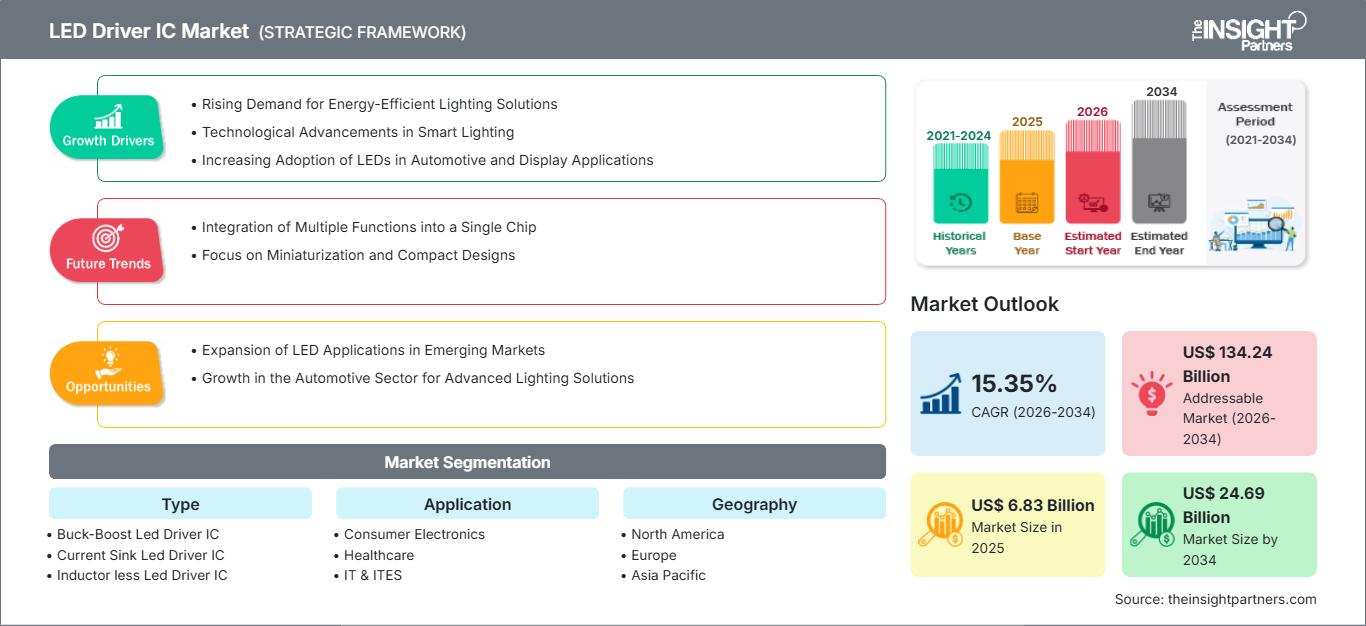
2025 Market Size
US$ 6.83 Bn
Base year value
2034 Forecast
US$ 24.69 Bn
Projected by 2034
CAGR 2026-2034
15.35 %
Growth rate
Addressable Market
US$ 134.24 Bn
(2026-2034)
The LED Driver IC Market size was valued at US$ 6.83 Billion in 2025 and is projected to reach US$ 24.69 Billion by 2034, registering a CAGR of 15.35% during 2026–2034. The assessment examines technology evolution, application demand, regional development, competitive positioning, and strategic opportunities across Buck-Boost Led Driver IC, Current Sink Led Driver IC, Inductor less Led Driver IC, Step-Down Led Driver IC, and the specified applications.
North America is expected to expand at an estimated CAGR of 8.1–9.0% during 2026–2034, supported by advanced automotive electronics and established semiconductor design capabilities. Increasing adoption of connected devices, adaptive vehicle lighting, and energy-efficient commercial infrastructure should sustain replacement and upgrade activity across major application industries.
LED Driver IC Market Assessment and Insights
- North America represented a 2025 LED Driver IC Market share of 35–37% and is projected to grow at a CAGR of 8.1–9.0% between 2026–2034, supported by automotive electronics, semiconductor capabilities, and efficient infrastructure.
- US accounted for 74–78% of North American demand in 2025 and is expected to grow at a CAGR of 8.0–8.9% during 2026–2034, led by automotive and consumer electronics.
- Europe held a 23–26% share in 2025 and is forecast to register a CAGR of 9.0–10.0% during 2026–2034, with Germany, the UK, France, Italy, and Spain supporting demand through automotive and efficiency initiatives.
- Asia Pacific represented 29–32% share in 2025 and is expected to expand at a CAGR of 17.0–18.5% through 2034, led by China, Japan, South Korea, and India.
- Largest Segment is Consumer Electronics, with a 2025 market share of 34–38% and a CAGR of 14.2–15.0% during 2026–2034, reflecting broad device penetration and replacement demand.
- High Growth Segment is Automotive, representing 15–18% share in 2025 and a CAGR of 17.0–18.5% during 2026–2034, supported by intelligent vehicle lighting.
- Key companies analyzed in detail: Samsung Electronics Co., Ltd.; Toshiba Corporation; General Electric Company; Philips Lighting Holding B.V.; ams-OSRAM AG; Texas Instruments Incorporated; Mitsubishi Electric Corporation; Renesas Electronics Corporation; Analog Devices, Inc.; Infineon Technologies AG.
Source: The Insight Partners' analysis based on proprietary research, government publications, company annual reports, investor presentations, industry databases, and expert interviews.
Technological development is making LED drivers more integrated, better in terms of current regulation, compact and functional when it comes to diagnostics. Semiconductors are becoming more integrated in terms of their conversion, control, protection, dimming and communication capabilities. Therefore, manufacturing processes become more oriented towards developing application specific platforms and scalable devices. Automotive lighting, display lighting, networking equipment and professional lighting have an increasing need for precise current regulation under different voltages and temperatures, making integrated architectures preferable to discrete ones.
The LED Driver IC Market report suggests that any future growth will be associated more with Asia Pacific production sites and selective electronics ecosystems of emerging countries. Investments in semiconductor capacities, electrification of automobiles, connected infrastructure and efficient lighting bring new applications. Regulation focus on energy efficiency makes replacement cycles even more important. According to IEA, in 2024, lighting in buildings and outdoors was responsible for 8% of world's electricity consumption.
LED Driver IC Market Report Scope
| Report Attribute | Details |
|---|---|
| Market size in 2025 | US$ 6.83 Billion |
| Market Size by 2034 | US$ 24.69 Billion |
| Global CAGR (2026 - 2034) | 15.35% |
| Historical Data | 2021-2024 |
| Forecast period | 2026-2034 |
LED Driver IC Market Analysis
Market drivers are the increase in electronic content in lighting, display, automotive, and connectivity applications. Demand drivers in the LED Driver IC market are the requirement of stable current, low power loss, small form factor, accurate dimming, thermal management, and electromagnetic compatibility. The supply chain comprises design, silicon wafer manufacture, packaging, module assembly, and end-product assembly. The automotive and consumer electronics sectors are two key demand sectors since they require advanced lighting control.
The supply factors in the LED Driver IC Market are associated with analog design expertise, semiconductor fabrication, packaging expertise, and application qualification process. The automotive segment is characterized by long qualification periods and reliable supplies, which favor established suppliers. Consumer electronics provides short cycles and more price-sensitive supply, which creates room for differentiation in terms of integration and cost. The supply base, therefore, consists of suppliers that rely on economies of scale and specialized suppliers.
Portfolio coverage and customer support become increasingly important aspects for the competitive positioning in the LED Driver IC Market Analysis. In this respect, Texas Instruments Incorporated and Analog Devices, Inc. boast the capacity in terms of analogs and power management, while Renesas Electronics Corporation has expertise in embedded processing, power and displays. Moreover, Infineon Technologies AG offers automotive LED driver technology based on linear, buck, boost and buck-boost architectures.
Samsung Electronics Co., Ltd. and Toshiba Corporation bring in semiconductor know-how, while General Electric Company and Philips Lighting Holding B.V. continue having system-level lighting solutions exposure. ams-OSRAM AG is associated with optics and illumination solutions. Mitsubishi Electric Corporation contributes automotive and power electronics technologies. The investment trends tend to be in favor of solutions integration, regional manufacturing resilience, application-oriented reference design, and platforms that save customers' time while allowing long product lifecycles.
● REPORT CUSTOMIZATION
Tailor This Report To Align With Your Specific Business Requirements
This report can be customized to align precisely with your business objectives, scope, and target markets. Customization options include tailored segmentation, geography, competitive analysis, and strategic insights to support informed decision-making.
Customize This Report →WHAT YOU CAN ADJUST
- ● Segmentations
- ● Geography
- ● Competitive Analysis
- ● Language Preferences
LED Driver IC Market: Strategic Insights
Regional Insights
North America LED Driver IC Market
North America is estimated to hold a 35–37% LED Driver IC Market share in 2025 and is forecast to grow at a CAGR of 8.1–9.0% during 2026–2034. The region is blessed with proven semiconductor designs, state-of-the-art automotive electronics, widespread consumer device deployment, and developed commercial infrastructure. While the United States is the leading demand hub, Canada makes its presence felt in applications involving automotive, industrial, and technology that need robust electronic controls.
Demand from structural applications is supported by stringent procurement policies and application-specific requirements. Diagnostics, thermal management, EMC capability, and tolerance to fluctuating electrical conditions are some of the key criteria that automobile manufacturers are looking at. The consumer and IT applications contribute to compact architecture requirements. The United States accounts for 74–78% of North American demand in 2025 and is projected to grow at a CAGR of 8.0–8.9% through 2034.
U.S. LED Driver IC Market
The U.S. represents 74–78% of North American demand in 2025 and is projected to grow at a CAGR of 8.0–8.9% during 2026–2034. A well-developed semiconductor environment, automotive environment, consumer electronics market, and telecommunications infrastructure in the country offer several demand paths. Companies like Texas Instruments Incorporated and Analog Devices, Inc. help in developing applications for industrial and automotive systems.
Current trends in application development are geared towards programmable current control, temperature monitoring, high resolution dimming and miniaturization. Trends in automotive lighting are geared towards adaptation and multi-channel control, whereas display devices need efficient backlighting. IT and telecommunications devices, in addition to these, need high power density and availability of components. All these trends favor suppliers who have the capability to integrate analog performance and application support.
Europe LED Driver IC Market
Europe is estimated to account for 23–26% share in 2025 and is forecast to register a CAGR of 9.0–10.0% through 2034. Germany leads this market because of the automotive sector and industrial electronics, while the United Kingdom, France, Italy, and Spain offer further demand for connected infrastructures, transportation, consumer electronics, and efficient lighting. Energy efficiency considerations from regulatory bodies also drive demand for replacement of components.
Modernization of commercial infrastructure and connectivity solutions drives demand in the UK, while Germany still holds leadership in terms of automotive electronics. France offers applications related to automotive electronics, industrial electronics, and public infrastructure, while Italy gets driven by industrial equipment and transportation demands. Spain gets driven by modernization of its infrastructure, commercial facilities, and energy-efficiency projects. All of the markets in question have increasing demands for thermal stability, safety, electromagnetic compatibility, and reliable operation cycles.
APAC LED Driver IC Market
Asia Pacific is estimated to represent 29–32% share in 2025 and is forecast to expand at a CAGR of 17.0–18.5% through 2034. The market leader is China, then come Japan, South Korea, India, and Australia. The electronics manufacturing scale, car manufacturing, telecommunications spending, and localization of semiconductors drive the demand in the region.
China enjoys manufacturing scale coupled with vehicle and connected device ecosystem growth. Japan and South Korea focus on reliability components while India builds up the local electronics manufacturing capabilities. Australia also contributes in terms of infrastructure and industry. The ITU estimates that 70% of the 5G population coverage in the Asia Pacific region occurred in 2025.
Middle East & Africa LED Driver IC Market
Middle East and Africa are projected to register a CAGR of 10.0–11.5% during 2026–2034. The leading demand comes from Saudi Arabia and UAE by means of intelligent infrastructures, transportation, commercial building, and digitalization initiatives. South Africa is an industrial economy, whereas the Rest of MEA is project-based and fragmented.
Energy efficiency and infrastructure upgrades are among the key regional factors affecting the segment. Saudi Arabia development projects and UAE connected buildings' investments help in promoting efficient lighting and electronics. In addition, the needs of industrial and mining sectors are met in South Africa. Telecommunications sector growth serves as another avenue for demand growth due to the growth of the network infrastructure.
Segmentation Analysis
Type
Type is projected to grow at a CAGR of 14.8–16.0% during 2026–2034. Topology selection depends on voltage conversion requirements, thermal conditions, efficiency targets, board space, and control complexity. Integrated architectures are increasingly preferred where customers seek fewer external components, simplified design, and reliable current regulation across variable operating conditions.
- Buck-Boost Led Driver IC: Supports applications where supply voltage can move above or below LED-string requirements. Its strategic importance is increasing in automotive and battery-powered systems requiring stable current across variable electrical conditions.
- Current Sink Led Driver IC: Provides controlled current across multiple LED channels and supports accurate brightness regulation. Demand is concentrated in applications requiring predictable illumination, diagnostics, and straightforward multi-channel control.
- Inductor less Led Driver IC: Reduces magnetic components and can simplify compact designs. Its strategic position is strongest where board area and component count are more important than the highest switching efficiency.
- Step-Down Led Driver IC: Uses buck conversion where source voltage exceeds LED-string requirements. It remains important for automotive, display, industrial, and consumer applications seeking efficient current regulation and manageable thermal performance.
Application
Application segment in the LED Driver IC Market is projected to expand at a CAGR of 15.2–16.3% during 2026–2034. Demand differs substantially by operating environment, safety requirements, thermal conditions, voltage range, and product lifecycle. Automotive applications increasingly require diagnostics and programmable control, while consumer electronics provides high-volume demand. Healthcare and telecommunications emphasize reliability, and government projects emphasize lifecycle economics.
- Consumer Electronics: Provides a broad demand base across displays, appliances, portable products, and connected devices. Compact packaging, efficient operation, brightness control, and cost optimization remain key selection criteria.
- Healthcare: Requires stable illumination, predictable thermal behavior, and high reliability. Equipment designers generally prioritize component longevity, consistent performance, and qualification characteristics because failures can affect equipment usability.
- IT & ITES: Uses driver technologies in displays, indicators, equipment, and facility lighting. Energy management, thermal optimization, compact design, and reliable operation are increasingly important in dense equipment environments.
- Automotive: Requires high reliability, thermal tolerance, diagnostics, functional safety, and advanced dimming. Adaptive headlights, rear lamps, displays, and cabin lighting increase demand for multi-channel and programmable architectures.
- Telecommunication: Supports infrastructure indicators, displays, electronic equipment, and facility systems. Compactness, thermal behavior, efficiency, and long product availability influence component procurement and system design.
- Government: Covers public infrastructure, transportation, facilities, and efficiency programs. Procurement emphasizes standards compliance, lifecycle cost, serviceability, predictable supply, and long-term operating reliability.
Opportunity Snapshot
| Application | Revenue Contribution | Trend Tag | Adoption Stage |
|---|---|---|---|
| Consumer Electronics | High | Display Backlight | Mature |
| Healthcare | Medium | Clinical Lighting | Scaling |
| IT & ITES | Medium | Efficient Displays | Scaling |
| Automotive | High | Adaptive Lighting | Scaling |
| Telecommunication | Medium | Network Hardware | Scaling |
| Government | Low | Smart Facilities | Emerging |
LED Driver IC Market Growth Drivers and Impact Analysis
Vehicle electrification is increasing lighting-control complexity
Electrification is causing an increased demand for effective electronic control in relation to headlamps, tail lamps, displays, ambiance lights, and signaling solutions. Electrified vehicles work in a challenging environment as far as both power and thermal aspects are concerned, which results in the ever-increasing importance of precise current control. Furthermore, adaptive lighting brings about a new aspect in terms of independently controlled channels, diagnostics, and configurable modes of operation. It contributes to the increased use of semiconductor components within lighting modules, as well as to the procurement of integrated solutions that will be able to perform several functions at once. It impacts all stakeholders, including lighting solution suppliers, Tier 1 lighting solution manufacturers, and automobile manufacturers, since the criteria for qualification are such that robust and durable component families are favored. As vehicles become software-based, the driver electronics start requiring interoperability with the diagnostic and communications layers.
Energy-efficiency requirements are supporting advanced lighting replacement
Energy-efficiency needs also continue to drive adoption and evolution of LEDs towards advanced power management solutions. Buildings and outdoor lighting are estimated to make up to 8% of global electricity consumption in 2024, accounting for about 2,200 TWh. In its turn, the next wave of lighting replacement is becoming less about LEDs themselves, and more about improved efficacy, increased lifetime, smart control capabilities, and decreased electrical losses. This is where the influence of drivers comes in through the parameters of current management, energy conversion, dimming, heat dissipation, and electrical quality. As a result, there are commercial and industrial incentives to upgrade old driver designs when doing so results in lower expenses on lighting operation. The market consequence of this situation is ongoing transition from simple lighting into systems where driver properties play an important role in overall system economics.
Connected infrastructure is expanding electronic control requirements
Expansion of digital infrastructure is increasing the number of connected devices, network systems, displays, indicators, and supporting equipment requiring dependable power management. The ITU reported that 5G reached 55% of the global population in 2025, while Asia Pacific reached about 70%. Increased network density will lead to an increased need for small electronic devices that can perform well in terms of energy and thermal efficiency. Driver parts may find utility in cases where there is status lighting, display, intelligent lighting in buildings, and monitoring systems used in the equipment. Reliability and long-term viability of parts have been prioritized by telecom operators since maintenance issues can be very costly. This works favorably for parts that come with built-in protection, diagnostic features, current limiting and smaller packages.
LED Driver IC Market Future Trends
Software-configurable architectures will reshape product differentiation
Driver solutions whose operation is configurable through software seem to gain in importance with respect to programmable current profile, dimming, diagnostic capabilities and faults management for lighting systems. Automotive sector provides a good example due to the possibility for a manufacturer to use identical hardware in different types of cars and vary operation parameters through software only. In the case of industrial machinery and smart home products, the same approach may be used for different product variations sharing identical electronic platform. Microcontroller and communication interface integration will help eliminate duplicate hardware and implement more sophisticated system control. Product differentiation will therefore increasingly be dependent on development tools, diagnostic capabilities, configuration solutions and software compatibility apart from electrical specifications. Such companies as suppliers of re-usable platforms will make customers' development process faster and uniform.
Higher integration will improve power density and system compactness
The LED Driver IC Market trends show that higher integration is expected to reduce external component requirements while improving power density and thermal control. Advanced packaging, integrated switching elements, improved control algorithms, and higher-frequency operation can enable smaller lighting modules without sacrificing regulation accuracy. The trend is particularly relevant to electric vehicles, portable electronics, compact displays, and telecommunications equipment where physical space is limited. Designers will nevertheless need to balance switching efficiency with electromagnetic emissions, heat dissipation, and reliability. Future products are therefore likely to emphasize efficiency across broad load ranges rather than at a single operating point. Integrated protection and diagnostics should also reduce system-level component counts and simplify qualification. Over time, suppliers with strong packaging expertise and mixed-signal capabilities should be better positioned to address applications where size, thermal performance, reliability, and control intelligence must be optimized simultaneously.
LED Driver IC Market Opportunities
Regional semiconductor ecosystems can improve supply resilience
Regional semiconductor ecosystem development creates opportunities for suppliers to establish closer relationships among chip design, manufacturing, packaging, and system integration. Automotive and industrial customers increasingly value traceability, supply continuity, long product availability, and diversified manufacturing. India and Southeast Asia are strengthening electronics ecosystems, while North America and Europe continue emphasizing semiconductor resilience. Suppliers can respond through regional application centers, qualification capabilities, packaging partnerships, and strategic inventory arrangements. Product portfolios should prioritize architectures serving multiple applications because common platforms can improve manufacturing utilization and reduce portfolio complexity. Local engineering support can further accelerate design wins by helping customers adapt common devices to regional requirements. The opportunity extends beyond fabrication: companies can strengthen their competitive position by linking localized technical support with globally consistent quality systems, enabling them to participate earlier in customer design decisions and longer-duration supply programs.
Automotive intelligent lighting offers higher-value design opportunities
Automotive intelligent lighting offers a strong opportunity because modern vehicles increasingly incorporate individually controlled light sources across exterior and interior systems. Adaptive beams, dynamic signaling, ambient lighting, illuminated displays, and advanced rear lamps require accurate current control, diagnostics, thermal protection, and communication. Suppliers can capture higher-value positions by developing scalable reference architectures combining driver ICs with controllers, sensors, interfaces, and protection functions. Partnerships with lighting Tier 1 suppliers can accelerate qualification and improve access to vehicle platforms. Product strategies should emphasize multi-channel capability, high-resolution dimming, low electromagnetic emissions, thermal robustness, and software configurability. LED Driver IC Market Forecasts indicate substantial expansion through 2034, making automotive design wins strategically important for suppliers seeking stronger exposure to premium applications and longer product lifecycles.
Recent Developments
- August 2025: Diodes Incorporated launched the automotive-compliant AL5958Q 48-channel matrix LED driver, designed to enable dynamic lighting and animated displays in next-generation vehicles. Supporting up to 32 scans, 16 integrated NMOS scan switches and 16-bit dimming with RGB support, the device is suited for mini- and micro-LED applications including central information and cluster displays, head-up displays, grille and emblem lighting, interior lights and rear lights.
- November 2025: NOVOSENSE launched a new portfolio of automotive LED driver ICs for vehicle exterior and interior lighting, including the NSUC1500 ambient-lighting IC with an integrated ARM Cortex-M3 core and four-channel high-precision current-mode LED drivers. The device supports 16-bit independent PWM dimming and 6-bit analog dimming for precise brightness and colour-mixing control, while helping compensate for LED lumen depreciation.
Frequently Asked Questions

- Comprehensive Market Sizing and Forecast Analysis
- Detailed Segmentation Analysis
- In-Depth Market Dynamics Assessment
- Regional and Country-Level Insights
- Competitive Landscape and Company Benchmarking
- Strategic Business Intelligence
Recent Reports
Testimonials

The Insight Partners provided valuable market intelligence that supported our global go-to-market strategy. Their team was professional, responsive, and attentive to our feedback, providing thoughtful analysis and helpful methodological clarifications throughout the project.
Junmo Kim Chief Financial Officer (CFO), Enertech Co., Ltd.
The Insight Partners' SCADA System Market report is comprehensive, with valuable insights on current trends and future forecasts. The team was highly professional, responsive, and supportive throughout. We are very satisfied and highly recommend their services.
RAN KEDEM Partner, Reali Technologies LTDs
I requested a report on a very specific software market and the team produced the report in a few days. The information was very relevant and well presented. I then requested some changes and additions to the report. The team was again very responsive and I got the final report in less than a week.
JEAN-HERVE JENN Chairman, Future Analytica
We worked with The Insight Partners for an important market study and forecast. They gave us clear insights into opportunities and risks, which helped shape our plans. Their research was easy to use and based on solid data. It helped us make smart, confident decisions. We highly recommend them.
PIYUSH NAGPAL Sr. Vice President, High Beam Global
The Insight Partners delivered insightful, well-structured market research with strong domain expertise. Their team was professional and responsive throughout. The user-friendly website made accessing industry reports seamless. We highly recommend them for reliable, high-quality research services
YUKIHIKO ADACHI CEO, Deep Blue, LLC.
This is the first time I have purchased a market report from The Insight Partners.While I was unsure at first, I visited their web site and felt more comfortable to take the risk and purchase a market report.I am completely satisfied with the quality of the report and customer service. I had several questions and comments with the initial report, but after a couple of dialogs over email with their analyst I believe I have a report that I can use as input to our strategic planning process.Thank you so much for taking the extra time and making this a positive experience.I will definitely recommend your service to others and you will be my first call when we need further market data.
JOHN SUZUKI President and Chief Executive Officer, Board Director, BK Technologies
I wish to appreciate your support and the professionalism you displayed in the course of attending to my request for information regarding to infectious disease IVD market in Nigeria. I appreciate your patience, your guidance, and the fact that you were willing to offer a discount, which eventually made it possible for us to close a deal. I look forward to engaging The Insight Partners in the future, all thanks to the impression you have created in me as a result of this first encounter.
DR CHIJIOKE ONYIA MANAGING DIRECTOR, PineCrest Healthcare Ltd.Reason to Buy
- Informed Decision-Making
- Understanding Market Dynamics
- Competitive Analysis
- Identifying Emerging Markets
- Customer Insights
- Market Forecasts
- Risk Mitigation
- Boosting Operational Efficiency
- Strategic Planning
- Investment Justification
- Tracking Industry Innovations
- Aligning with Regulatory Trends





 Get Free Sample for