
Smart Exoskeleton Market Size, Share & Trends by 2034
Coverage: by Component (Sensors, Actuators, Power Source, Control System, Others); Type (Soft Exoskeleton, Rigid Exoskeleton); Body Part (Upper Body, Lower Body, Full body); Application (Industrial, Healthcare, Military, Others) , and Geography (North America, Europe, Asia Pacific, and South and Central America)
- Status : Data Released
- Report Code : TIPRE00008330
- Category : Electronics and Semiconductor
- No. of Pages : 150
- Available Report Formats :


- Last update date : August 12, 2026


2025 Market Size
US$ 835.49 Mn
Base year value
2034 Forecast
US$ 2,879.99 Mn
Projected by 2034
CAGR 2026-2034
14.74 %
Growth rate
Addressable Market
US$ 15,914.09 Mn
(2026-2034)
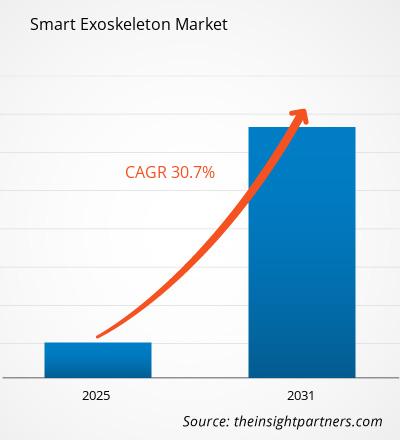
The Smart Exoskeleton Market was valued at US$ 835.49 million in 2025 and is projected to reach US$ 2,879.99 million by 2034, registering a CAGR of 14.74% from 2026 to 2034. The future success of such devices will be supported by growing demand for assistive technologies in the healthcare industry, improvements in industrial safety, and performance enhancement among soldiers. Artificial intelligence combined with small size sensors and improved actuators technology have made possible that exoskeleton devices become intelligent systems, able to adapt their functions according to changes in biomechanics.
North America takes the biggest portion of the Smart Exoskeleton Market Size. This region is led by the United States with regard to adoption and innovations. This region is expected to have CAGR between 12-14% during the forecasted period. Such growth is supported by well-developed healthcare industry, large budgets of the defense sector used to support soldiers, and presence of the major players in the industry. Moreover, OSHA regulations concerning the requirement of safety measures at work contribute to the popularity of industrial exoskeletons.
Smart Exoskeleton Market Assessment and Insights
- North America: North America leads the global Market, holding a market share range of 32-36% in 2025, driven by advanced healthcare infrastructure and military investments. The region is growing at a CAGR range of 12-14% from 2026 to 2034 .
- US: The US dominates the North American Market with an estimated share of 75-80% in 2025. Strong defense contracts, presence of key players, and favorable reimbursement policies support a CAGR range of 11-13% from 2026 to 2034 .
- Europe: Europe holds a market share range of 26-30% in 2025, with Germany, the UK, and France as leading countries. The region is growing at a CAGR range of 13-15% from 2026 to 2034, driven by strong manufacturing automation and aging population support .
- Asia Pacific: APAC is the fastest-growing region, with a market share range of 22-26% in 2025, led by China, Japan, and South Korea. Growing at a CAGR range of 16-18% from 2026 to 2034, the region benefits from industrial automation and government initiatives for elderly care .
- Largest Segment: The Industrial application segment holds the largest market share, estimated at 38-42% in 2025. Growing at a CAGR range of 14-16% from 2026 to 2034, this segment is driven by workplace safety regulations and labor productivity demands .
- High Growth Segment: The Healthcare application segment is projected as the high-growth segment, with a CAGR range of 16-18% from 2026 to 2034. This growth is fueled by rising stroke incidences, spinal cord injuries, and the aging global population .
- Key companies analyzed in detail: ATOUN Inc., Bionik, Inc, CYBERDYNE, INC., Ekso Bionics, Gogoa.eu, ReWalk Robotics, Rex Bionics Ltd, Technaid. S.L., US Bionics, Inc., Wearable Robotics srl
Source: The Insight Partners' analysis based on proprietary research, government publications, company annual reports, investor presentations, industry databases, and expert interviews.
The Smart Exoskeleton Market has come a long way, from specialized rehabilitation systems to multi-purpose platforms that serve industries, medicine, and defense markets. The move from bulky to light exoskeletons has increased the range of use of these systems in various environments. The change in the production model from individual to flexible assembly lines has decreased costs and made exoskeletons more accessible. The edge computing features allow achieving quick and instant responses without being tied to the cloud latency issues, thus increasing the utility of such devices in dynamic industrial environments.
Looking into the future, the Smart Exoskeleton Market has immense potential for continued growth as developing countries are looking to update their healthcare infrastructure and automate processes in the industrial sector. Incentives for rehabilitation devices in developing countries such as China and India are generating revenues through government initiatives. Investment in robotics firms along with higher reimbursements for rehabilitation devices is contributing towards faster commercialization of smart exoskeletons. Policy regulations that have an emphasis on occupational safety and growing older populations are generating positive regulatory environments.
Smart Exoskeleton Market Report Scope
| Report Attribute | Details |
|---|---|
| Market size in 2025 | US$ 835.49 Million |
| Market Size by 2034 | US$ 2,879.99 Million |
| Global CAGR (2026 - 2034) | 14.74% |
| Historical Data | 2021-2024 |
| Forecast period | 2026-2034 |
Smart Exoskeleton Market Analysis
The factors behind the demand for exoskeletons include demographical changes, increased safety concerns at work places, and new technologies. For instance, the world's aging population creates high demand for exoskeletons because elderly people require solutions that would help them keep their independence and avoid accidents caused by falls. Moreover, companies operating in the industry should focus on reducing injuries and musculoskeletal disorders among workers. According to the World Health Organization, musculoskeletal problems are the main reasons for disabilities in the world today. Meanwhile, supply side improvements include development of special components manufacturing companies producing tiny sensors, high torque actuators, and compact batteries. The structure of the value chain includes cooperation of robotics companies with hospitals and defense industries.
The competitive structure of the Smart Exoskeleton Market Report consists of well-known competitors and rising specialists. Firms such as Ekso Bionics, ReWalk Robotics, and CYBERDYNE, INC. rule the healthcare and rehabilitation category by providing their clinically tested and approved products. The industrial application has drawn such participants as ATOUN Inc. and Wearable Robotics srl that pay much attention to the ergonomic aspect for use in manufacturing and logistics. Investment dynamics show a preference to the development of soft exoskeletons, which are more comfortable and convenient, therefore, attracting venture investment. Strategic orientation is increasingly focused on artificial intelligence and cloud integration that ensure performance optimization based on data processing. Technology companies and research organizations establish partnerships that speed up the process of developing the interface and adaptive control systems.
● REPORT CUSTOMIZATION
Tailor This Report To Align With Your Specific Business Requirements
This report can be customized to align precisely with your business objectives, scope, and target markets. Customization options include tailored segmentation, geography, competitive analysis, and strategic insights to support informed decision-making.
Customize This Report →WHAT YOU CAN ADJUST
- ● Segmentations
- ● Geography
- ● Competitive Analysis
- ● Language Preferences
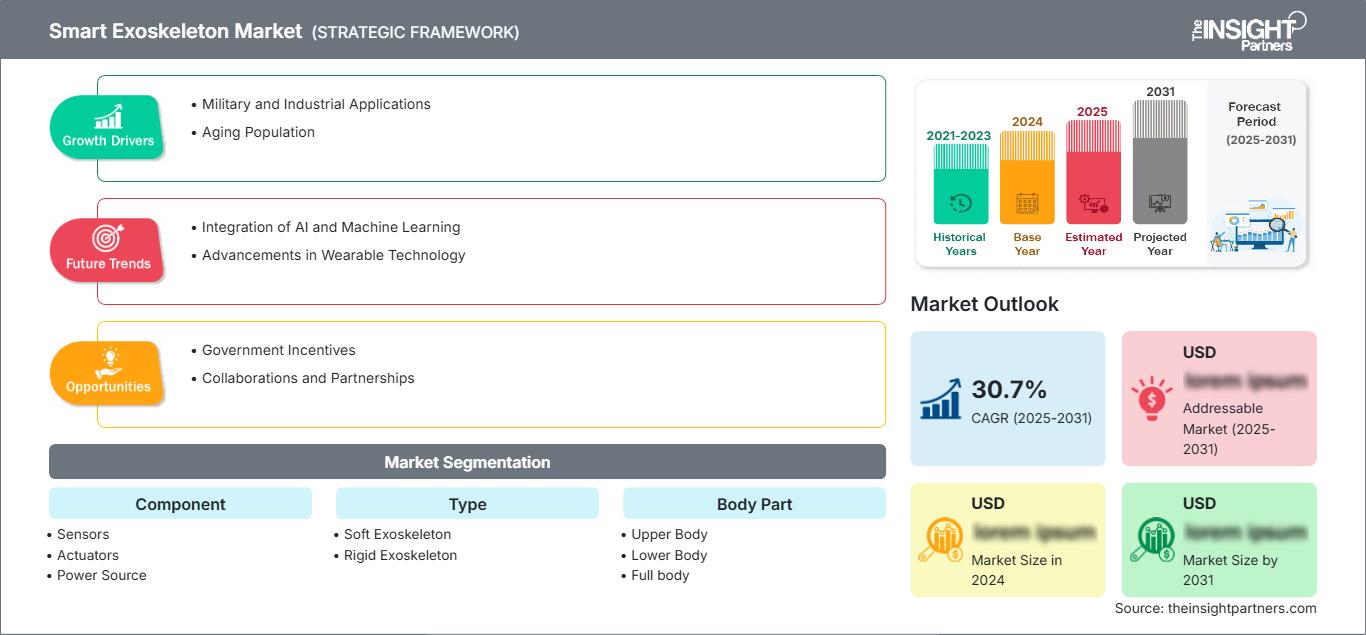
Smart Exoskeleton Market: Strategic Insights
Regional Insights
North America Smart Exoskeleton Market
North America enjoys an overwhelming dominance in the Smart Exoskeleton Market across the globe, commanding an estimated market share of 32-36% in 2025. Such regional dominance can be attributed to considerable expenditure on healthcare, well-equipped rehabilitation facilities, and military-based research initiatives. The US Department of Defense has made considerable investment in exoskeleton technology for enhancing the performance of soldiers and for logistical assistance. Rising industrialization, owing to strict occupational safety regulations and labor shortage in manufacturing and logistics, is expected to drive the growth of the market. Major vendors like Ekso Bionics and ReWalk Robotics, along with reimbursement policies for medical exoskeletons, are driving the growth of this region in the market. The region is expected to grow at a CAGR of 12-14% during 2026-2034.
U.S. Smart Exoskeleton Market
US constitutes around 75-80% of the North American Smart Exoskeleton Market in 2025, estimated to be the largest individual country-level market. Growth in the market is due to the rehabilitation programs of the Department of Veterans Affairs and commercial healthcare organizations opting for exoskeleton therapy programs. Industrial uses are gaining traction in the automobile manufacturing, warehousing, and construction industries, due to the demand for labor productivity. Development of exoskeleton technologies for purposes of loading and endurance improvement is being funded by the US military. Research and development are taking place mainly in California, Texas, and the Northeast corridor.
Europe Smart Exoskeleton Market
The market share of Europe in the global Smart Exoskeleton Market will be 26-30% in 2025 with Germany, the United Kingdom, France, Italy, and Spain being the major countries contributing. Germany will lead European adoption due to its established manufacturing industry and stringent occupational safety laws and will experience a CAGR of about 14-15%. The United Kingdom will show strong demand for exoskeletons in the healthcare and rehabilitation industry with the help of innovations by the National Health Service with a CAGR of 13-14%. France and Italy will increase adoption of industrial exoskeletons in the automotive and aerospace industries. Spain will witness strong adoption in healthcare and logistics with the help of research funded by the EU. The region will have strong partnerships in research between academic and industry players with workplace safety regulations. The CAGR of Europe will be 13-15% between 2026 and 2034.
APAC Smart Exoskeleton Market
APAC accounts for 22-26% of the global Smart Exoskeleton market in 2025 and is the fastest growing region. China dominates owing to strong backing from the government for automation and elderly care technologies, which have been expanding at a CAGR of 17-19%. Japan's advanced robotics ecosystem and its aging population are responsible for increased adoption at a CAGR of 16-18%. South Korea shows high growth in applications related to healthcare and defense. India and Australia are emerging regions, where India emphasizes affordable exoskeletons for use in labor-intensive sectors and Australia expands in rehabilitation technology. The APAC region is estimated to grow at a CAGR of 16-18% between 2026 and 2034.
Middle East & Africa Smart Exoskeleton Market
The Middle East & Africa region, while currently representing a smaller market share of 5-8%, is showing promising growth potential. Saudi Arabia and the UAE are investing in healthcare modernization and industrial diversification, creating opportunities for exoskeleton adoption in rehabilitation and oil & gas sectors. South Africa demonstrates growing interest in mining safety applications. The region's CAGR is estimated at 11-13% from 2026 to 2034, with energy sector investments and infrastructure development driving demand. Government healthcare initiatives in the Gulf Cooperation Council countries are supporting rehabilitation technology adoption.
Segmentation Analysis
Component
The Component segment of the Smart Exoskeleton Market encompasses Sensors, Actuators, Power Source, Control System, and Others. Sensors are critical for real-time motion detection and force feedback, enabling adaptive responses to user movements. Actuators provide the mechanical force for movement assistance, with advancements in lightweight, high-torque designs improving device efficiency. Power sources, primarily advanced batteries, are a focus of R&D efforts to extend operational timeframes. Control systems integrate AI algorithms for personalized movement assistance, representing the "brain" of smart exoskeletons. The Component segment is projected to grow at a CAGR of 13-15% from 2026 to 2034.
- Sensors: Sensors detect user movements, muscle activity, and environmental conditions, enabling real-time adaptive responses. Advanced inertial measurement units and electromyography sensors are enhancing device precision and usability .
- Actuators: Actuators convert electrical energy into mechanical force, providing movement assistance. Innovations in brushless DC motors and pneumatic systems are improving power-to-weight ratios and device responsiveness .
- Power Source: Power sources, primarily lithium-ion and emerging solid-state batteries, determine operational duration. Extended battery life is a key priority for industrial and military applications .
- Control System: Control systems integrate AI and machine learning algorithms for personalized movement assistance. Edge computing capabilities enable faster processing, improving real-time responsiveness .
Type
The Type segment includes Soft Exoskeleton and Rigid Exoskeleton. Rigid exoskeletons, using metal or composite frames, offer maximum support for heavy-load applications in industrial and military settings. Soft exoskeletons, employing textile-based structures and flexible actuators, provide superior comfort and wearability, gaining traction in healthcare and light industrial applications. The shift toward soft exoskeletons reflects growing demand for user-friendly devices suitable for extended wear. The Type segment is projected to grow at a CAGR of 13-15% from 2026 to 2034.
- Soft Exoskeleton: Soft exoskeletons use flexible materials and textile-based actuators, offering superior comfort and discretion. They are increasingly preferred for healthcare and light industrial applications due to their lightweight design and wearability .
- Rigid Exoskeleton: Rigid exoskeletons provide robust support through metal or composite frames, suitable for heavy-load applications. They dominate military and industrial sectors where maximum force augmentation is required .
Body Part
The Body Part segment covers Upper Body, Lower Body, and Full Body exoskeletons. Lower body exoskeletons are widely used for gait rehabilitation and mobility assistance in healthcare. Upper body exoskeletons support arm and shoulder movements in industrial assembly and rehabilitation. Full body exoskeletons offer comprehensive support for military applications and severe mobility impairments. The Body Part segment is projected to grow at a CAGR of 14-16% from 2026 to 2034.
- Upper Body: Upper body exoskeletons support arm and shoulder movements, primarily used in industrial assembly, overhead tasks, and upper limb rehabilitation .
- Lower Body: Lower body exoskeletons are widely adopted for gait rehabilitation, mobility assistance, and load-bearing support in healthcare and industrial settings .
- Full Body: Full body exoskeletons provide comprehensive support for severe mobility impairments and military applications. They represent the most complex and highest-cost segment .
Application
The Application segment includes Industrial, Healthcare, Military, and Others. Industrial applications focus on workplace safety, injury prevention, and productivity enhancement in manufacturing, logistics, and construction. Healthcare applications encompass rehabilitation, mobility assistance, and elderly care. Military applications involve soldier enhancement, load-bearing support, and endurance augmentation. The Industrial segment holds the largest share, driven by workplace safety regulations and labor productivity demands. The Application segment is projected to grow at a CAGR of 14-16% from 2026 to 2034.
- Industrial: Industrial applications dominate the market, driven by workplace safety regulations and productivity demands. Exoskeletons reduce musculoskeletal injuries and enhance worker efficiency in manufacturing and logistics .
- Healthcare: Healthcare applications are the fastest-growing segment, driven by rising stroke incidences, spinal cord injuries, and the aging population. Rehabilitation and mobility assistance are key sub-applications .
- Military: Military applications focus on soldier enhancement, load-bearing support, and endurance augmentation. Defense investments and ongoing conflicts are driving demand .
Opportunity Snapshot
| Application | Revenue Contribution | Trend Tag | Adoption Stage |
|---|---|---|---|
| Industrial | High | Workplace Safety | Scaling |
| Healthcare | High | Rehab Robotics | Scaling |
| Military | Medium | Soldier Augmentation | Emerging |
| Others | Low | Consumer Wearables | Emerging |
Smart Exoskeleton Market Growth Drivers and Impact Analysis
Rising Aging Population and Mobility Impairments
The global demographic shift toward an older population is a primary driver of the Smart Exoskeleton Market. According to the World Health Organization, the proportion of the global population aged 60 years and older is projected to nearly double from 12% to 22% between 2015 and 2050. This demographic transition correlates with increased prevalence of mobility impairments, stroke incidents, and musculoskeletal disorders, creating substantial demand for assistive technologies. Smart exoskeletons offer a solution that enables elderly individuals to maintain independence and quality of life, reducing the burden on healthcare systems. In developed economies, government initiatives promoting "aging in place" are supporting adoption of rehabilitation and mobility assistance devices. The healthcare application segment is projected to experience the highest growth rate, reflecting the critical role of exoskeletons in addressing aging-related mobility challenges.
Workplace Safety Regulations and Labor Productivity Demands
Stringent occupational safety regulations and labor shortages in manufacturing, logistics, and construction sectors are accelerating industrial exoskeleton adoption. The International Labour Organization estimates that musculoskeletal disorders account for a significant portion of work-related injuries, costing economies billions annually. Employers are increasingly adopting smart exoskeletons as proactive solutions to reduce workplace injuries, compensate for aging workforces, and enhance employee well-being. In countries such as the US and Germany, regulatory frameworks mandating workplace safety measures are creating a favorable environment for exoskeleton deployment. Industrial exoskeletons reduce physical strain during repetitive tasks, improve posture, and enhance lifting capabilities, directly addressing productivity and safety imperatives.
Technological Advancements in Robotics and AI
Continuous innovations in robotics, artificial intelligence, and sensor technologies are expanding the capabilities and affordability of smart exoskeletons. Advancements in lightweight materials such as carbon fiber composites have drastically reduced device weight, while improved power management systems have extended operational timeframes. Machine learning algorithms enable real-time adaptation to user movements, providing personalized assistance. These technological breakthroughs have made smart exoskeletons practical for real-world applications, transitioning from research prototypes to commercially viable products. Investment in R&D by both established players and startups is fostering innovation and reducing costs, making devices more accessible across sectors.
Smart Exoskeleton Market Future Trends
Integration of AI and Machine Learning for Adaptive Control
Artificial intelligence and machine learning are fundamentally transforming smart exoskeleton functionality, enabling devices to adapt in real-time to individual user movements and environmental conditions. AI algorithms analyze user behavior patterns, predicting movement intentions and adjusting torque, support levels, and gait patterns accordingly. This adaptive capability enhances the intuitiveness and effectiveness of exoskeletons, improving user experience and clinical outcomes. In rehabilitation settings, AI-powered exoskeletons can track patient progress and dynamically adjust therapy protocols, accelerating recovery timelines. In industrial applications, AI enables exoskeletons to anticipate and prevent injury risks by analyzing movement patterns and providing corrective feedback. The integration of AI with cloud computing also facilitates remote monitoring and data analytics, enabling continuous performance optimization and predictive maintenance.
Expansion of Soft and Ultra-Soft Exoskeleton Technologies
The shift toward soft and ultra-soft exoskeleton designs represents a significant Smart Exoskeleton Market Trend. These devices utilize flexible materials, textile-based actuators, and lightweight frames, offering superior comfort, wearability, and discretion compared to traditional rigid exoskeletons. Soft exoskeletons are particularly suited for healthcare applications where patient comfort is paramount, and for industrial settings requiring extended wear periods. Advances in soft robotics, including pneumatic artificial muscles and electroactive polymers, are enabling improved force output without sacrificing flexibility. The trend toward softer designs is expanding the addressable market, making exoskeletons accessible for applications such as elderly care, consumer fitness, and even everyday mobility assistance.
Smart Exoskeleton Market Opportunities
Rehabilitation and Home Healthcare Expansion
The growing emphasis on remote rehabilitation and home healthcare presents significant opportunities for smart exoskeleton manufacturers. With healthcare systems under pressure to reduce costs and improve patient outcomes, there is increasing demand for decentralized, cost-effective rehabilitation solutions. Lightweight, user-friendly exoskeletons suitable for home use are gaining traction, enabling patients to continue therapy outside clinical settings. The development of tele-rehabilitation platforms integrated with smart exoskeletons enables remote monitoring and virtual therapy sessions, expanding access to care. Companies that develop affordable, easy-to-use home rehabilitation exoskeletons with robust remote monitoring capabilities are well-positioned to capture significant market share in this expanding segment.
Industrial Automation and Workforce Augmentation
The convergence of industrial automation and workforce augmentation technologies creates substantial opportunities in the Smart Exoskeleton Market Forecast. As industries face labor shortages and aging workforces, smart exoskeletons offer a means of extending the working life of experienced personnel while enhancing productivity and safety. Opportunities exist in developing task-specific exoskeletons for industries such as automotive manufacturing, logistics, and construction, where repetitive lifting and overhead tasks are common. Customization for specific workplace environments, integration with IoT platforms for performance monitoring, and development of exoskeletons compatible with existing safety equipment are key areas of innovation.
Recent Developments
- July 2026: Dutch cargo gateway Maastricht Aachen Airport has become the first airport in the country to see its handlers use an AI-powered exoskeleton in their everyday cargo handling operations. The EXIA exoskeleton system from German Bionic, which can be worn by handlers on both the apron and in the cargo warehouse, employs AI-powered sensors to analyse lifting movements and provide active back support when required. It provides adaptive lifting assistance of up to 38kg, the airport said, reducing strain on lower backs while allowing employees to move around naturally.
- July 2026: Founded in 2010, Onyx Healthcare – a leading medical device manufacturer based in Taiwan – collaborated with Intel and FREE Bionics to design an AI-powered exoskeleton robot that aims to boost the clinical rehabilitation experience. FREE Walk is a robotics-based AI solution that leverages two unique Intel-based hardware and software components – the Intel Core Ultra series family of CPUs and the Intel OpenVINO software stack – into a lightweight, wearable exoskeleton worn by patients.
- May 2026: Hypershell, the world's leading consumer exoskeleton brand, launched the New Hypershell X Series, introducing the world's most intuitive exoskeleton and its latest lineup of AI-powered exoskeletons, now available for sale. Powered by HyperIntuition, Hypershell's AI-driven motion control algorithm, the New Hypershell X Series is designed to deliver support that feels more natural, immediate and closely aligned with the wearer. As the world's first TÜV Rheinland-verified end-to-end AI exoskeleton, the range brings together intelligent motion control, an upgraded wearing system and a new-generation motor to deliver fully synchronized, fast assistance.
Frequently Asked Questions

- Comprehensive Market Sizing and Forecast Analysis
- Detailed Segmentation Analysis
- In-Depth Market Dynamics Assessment
- Regional and Country-Level Insights
- Competitive Landscape and Company Benchmarking
- Strategic Business Intelligence
Recent Reports
Testimonials

The Insight Partners' SCADA System Market report is comprehensive, with valuable insights on current trends and future forecasts. The team was highly professional, responsive, and supportive throughout. We are very satisfied and highly recommend their services.
RAN KEDEM Partner, Reali Technologies LTDs
I requested a report on a very specific software market and the team produced the report in a few days. The information was very relevant and well presented. I then requested some changes and additions to the report. The team was again very responsive and I got the final report in less than a week.
JEAN-HERVE JENN Chairman, Future Analytica
We worked with The Insight Partners for an important market study and forecast. They gave us clear insights into opportunities and risks, which helped shape our plans. Their research was easy to use and based on solid data. It helped us make smart, confident decisions. We highly recommend them.
PIYUSH NAGPAL Sr. Vice President, High Beam Global
The Insight Partners delivered insightful, well-structured market research with strong domain expertise. Their team was professional and responsive throughout. The user-friendly website made accessing industry reports seamless. We highly recommend them for reliable, high-quality research services
YUKIHIKO ADACHI CEO, Deep Blue, LLC.
This is the first time I have purchased a market report from The Insight Partners.While I was unsure at first, I visited their web site and felt more comfortable to take the risk and purchase a market report.I am completely satisfied with the quality of the report and customer service. I had several questions and comments with the initial report, but after a couple of dialogs over email with their analyst I believe I have a report that I can use as input to our strategic planning process.Thank you so much for taking the extra time and making this a positive experience.I will definitely recommend your service to others and you will be my first call when we need further market data.
JOHN SUZUKI President and Chief Executive Officer, Board Director, BK Technologies
I wish to appreciate your support and the professionalism you displayed in the course of attending to my request for information regarding to infectious disease IVD market in Nigeria. I appreciate your patience, your guidance, and the fact that you were willing to offer a discount, which eventually made it possible for us to close a deal. I look forward to engaging The Insight Partners in the future, all thanks to the impression you have created in me as a result of this first encounter.
DR CHIJIOKE ONYIA MANAGING DIRECTOR, PineCrest Healthcare Ltd.Reason to Buy
- Informed Decision-Making
- Understanding Market Dynamics
- Competitive Analysis
- Identifying Emerging Markets
- Customer Insights
- Market Forecasts
- Risk Mitigation
- Boosting Operational Efficiency
- Strategic Planning
- Investment Justification
- Tracking Industry Innovations
- Aligning with Regulatory Trends





 Get Free Sample for