
Smart Food Logistics Market Growth, Demand & Size by 2034
Coverage: By Component (Hardware, Software and Services); Technology (Fleet Management, Asset Tracking, Cold Chain Monitoring and Others) , and Geography (North America, Europe, Asia Pacific, and South and Central America)
- Status : Data Released
- Report Code : TIPRE00017563
- Category : Electronics and Semiconductor
- No. of Pages : 150
- Available Report Formats :


- Last update date : August 12, 2026


2025 Market Size
US$ 15.58 Bn
Base year value
2034 Forecast
US$ 55.31 Bn
Projected by 2034
CAGR 2026-2034
15.12 %
Growth rate
Addressable Market
US$ 302.61 Bn
(2026-2034)
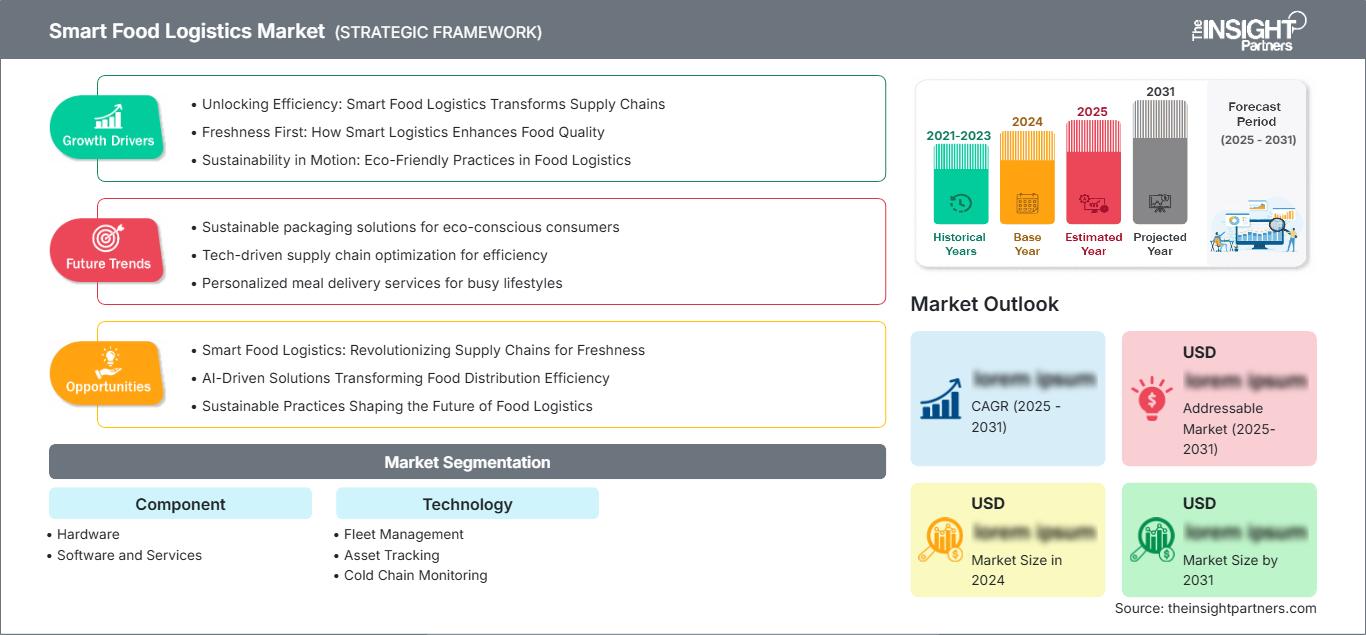
The Smart Food Logistics Market was valued at US$ 15.58 billion in 2025 and is projected to reach US$ 55.31 billion by 2034, registering a CAGR of 15.12% from 2026 to 2034. Such a strong growth is due to the increasing application of advanced technologies like IoT, artificial intelligence, and real-time monitoring in food logistics processes. The combination of digitalization and the need for food safety is transforming the industry and influencing the transportation, storage, and distribution of perishables all over the world.
North America can be considered an important market for the size of the Smart Food Logistics Market SIze, with the US taking the lead among other countries in terms of technological adoption and development. It is expected that North America will register a CAGR of 13-15% during the forecast period. Some structural drivers for the growth in the region are the presence of major technology providers, food safety regulations, and growing consumer demands for the transparency of food logistics.
Smart Food Logistics Market Assessment and Insights
- North America: North America holds a substantial share of 30-34% in the global Market in 2025. The region is growing at a CAGR of 13-15% from 2026 to 2034, driven by strong technology adoption and regulatory support for food safety.
- US: The US dominates North America, accounting for approximately 85-90% of the regional market in 2025. Growth is supported by advanced cold chain infrastructure and food safety regulations, with a CAGR range of 13-15% from 2026 to 2034.
- Europe: Europe accounts for 26-30% of the global Market in 2025, with Germany, the UK, and France as leading countries. The region is growing at a CAGR of 14-16% from 2026 to 2034, supported by EU sustainability policies and food traceability regulations.
- Asia Pacific: APAC is the fastest-growing regional market, holding 28-32% share in 2025, led by China, Japan, and India. Growing at a CAGR of 16-18% from 2026 to 2034, the region benefits from expanding cold chain infrastructure and rising food safety awareness.
- Largest Segment: The Cold Chain Monitoring technology segment holds the largest share, estimated at 45-50% in 2025. Growing at a CAGR of 15-17% from 2026 to 2034, this segment is driven by demand for temperature-controlled food transportation.
- High Growth Segment: The Asset Tracking technology segment is projected as the high-growth segment, with a CAGR of 16-18% from 2026 to 2034. This growth is fueled by demand for end-to-end supply chain visibility and traceability.
- Key companies analyzed in detail: BT9 Ltd., Controlant, FoodlogiQ, Geotab Inc., Huawei Technologies Co., Ltd., ORBCOMM, Penske, Semtech Corporation, Sensitech Inc., Tech Mahindra Limited
Source: The Insight Partners' analysis based on proprietary research, government publications, company annual reports, investor presentations, industry databases, and expert interviews.
In Smart Food Logistics Market, there is a transformation from rudimentary monitoring methods to more sophisticated and data-driven solutions, which provide visibility and predictability. With a move from manual temperature monitoring to IoT-based sensors, food companies can monitor the quality of their products all along the supply chain. Modern production dynamics include the use of AI analytics and cloud collaborative solutions to ensure optimal transportation. Such technological developments make smart food logistics available to wider segments of food industry players.
For the future, the development of Market is expected to gain momentum due to investments in cold chain technologies in developing countries. Favorable government policies aimed at food traceability and minimizing waste make conditions good for adoption. 5G and edge computing solutions will help introduce new use cases in real-time monitoring and automated delivery services. In addition, small and medium food producers use more affordable modular solutions.
Smart Food Logistics Market Report Scope
| Report Attribute | Details |
|---|---|
| Market size in 2025 | US$ 15.58 Billion |
| Market Size by 2034 | US$ 55.31 Billion |
| Global CAGR (2026 - 2034) | 15.12% |
| Historical Data | 2021-2024 |
| Forecast period | 2026-2034 |
Smart Food Logistics Market Analysis
The demand for intelligent logistics solutions in the food sector is motivated by the need for improved food safety, visibility, and waste management. The pressure on food manufacturers and retailers to deliver high-quality and compliant products with the expectations of consumers regarding freshness and traceability is driving the demand for intelligent logistics solutions.
There are several key players in the value chain including hardware vendors, software vendors, telematics firms, and logistics firms. Improvement in the supply dynamics has been experienced through the introduction of standardization of data communication protocols and service-oriented architecture which make integration and implementation easier. The growing popularity of the e-commerce market has increased demand for intelligent logistics solutions.
The competition environment in the Smart Food Logistics Market Report is characterized by an eclectic combination of companies offering logistics technology solutions and vendors of food safety solutions. Firms like Geotab Inc., ORBCOMM, and Semtech Corporation occupy the market share in the hardware and connectivity solutions space, while Controlant and Sensitech Inc. are strong in temperature solutions. FoodlogiQ and Tech Mahindra Limited are strong in food safety and visibility software platforms.
In the investments made, there has been a Smart Food Logistics Market trend towards investments in AI-driven analysis and blockchain-driven traceability. Ecosystem collaborations have emerged as key strategic considerations where companies work together to offer end-to-end solutions which specifically cater to the needs of the food industry.
● REPORT CUSTOMIZATION
Tailor This Report To Align With Your Specific Business Requirements
This report can be customized to align precisely with your business objectives, scope, and target markets. Customization options include tailored segmentation, geography, competitive analysis, and strategic insights to support informed decision-making.
Customize This Report →WHAT YOU CAN ADJUST
- ● Segmentations
- ● Geography
- ● Competitive Analysis
- ● Language Preferences
Smart Food Logistics Market: Strategic Insights
Regional Insights
North America Smart Food Logistics Market
The North American continent stands out to be one of the most crucial markets for smart food logistics systems, contributing 30-34% share in 2025. There has been notable digitization of the food logistics value chain in this region owing to the need to cut down on waste and increase efficiency. The United States leads in terms of developed cold chains, food safety laws, and availability of key technology companies. Canada also enjoys gradual growth due to efforts taken by the government to promote food traceability.
U.S. Smart Food Logistics Market
The US dominates around 85-90% of the North American Smart Food Logistics Market Share by 2025. This growth is attributed to the increased penetration of IoT-based temperature monitoring solutions. Leading food retail companies are implementing such solutions for ensuring safety of food during transit and preventing spoilage. Also, the availability of key players like Geotab Inc., ORBCOMM, and Sensitech Inc. is aiding market development. In the US market, the compound annual growth rate stands between 13-15% from 2026 to 2034.
Europe Smart Food Logistics Market
Europe constitutes around 26-30% of the worldwide market for Smart Food Logistics in 2025 with significant contributions from Germany, the United Kingdom, and France. Germany ranks first in Europe, due to the prominence of food processing industries in the country along with the sustainability rules. UK is increasingly adopting smart logistics solutions for food delivery from retailers. France concentrates on cold chain logistics and traceability. Italy and Spain are progressing through digital transformation programs under the aegis of EU.
APAC Smart Food Logistics Market
APAC is the fastest-growing regional market, representing 28-32% of global share in 2025. China leads with government initiatives promoting cold chain infrastructure development and food safety. Japan and South Korea are leaders in IoT and automation adoption for food logistics. India is accelerating through investments in cold storage and transportation. Australia is applying smart technologies in fresh produce export logistics. APAC is projected to grow at a CAGR of 16-18% from 2026 to 2034.
Middle East & Africa Smart Food Logistics Market
Although the Middle East & Africa region does not currently constitute a large market share, it has a promising future. Vision 2030 of Saudi Arabia and food security measures of UAE have led to investments in smart logistics solutions for food. South Africa is building cold chain facilities for exporting fresh produce. CAGR of this region is expected to be between 13% and 15% between 2026 and 2034.
Segmentation Analysis
Component
The Component segment of the Smart Food Logistics Market encompasses Hardware and Software and Services. Hardware includes IoT sensors, RFID tags, telematics devices, and temperature monitoring equipment. Software and Services include cloud-based platforms, data analytics, fleet management software, and integration services. The growing demand for real-time monitoring and data-driven decision-making is driving the adoption of both hardware and software solutions. The Component segment is projected to grow at a CAGR of 14-16% from 2026 to 2034.
- Hardware: Hardware includes IoT sensors, RFID tags, telematics devices, and temperature monitoring equipment. These devices enable real-time tracking and monitoring of food shipments throughout the supply chain.
- Software and Services: Software and Services include cloud-based platforms, data analytics, fleet management software, and integration services. These solutions enable data-driven decision-making and supply chain optimization.
Technology
The Technology segment covers Fleet Management, Asset Tracking, and Cold Chain Monitoring. Cold Chain Monitoring is the largest technology segment, driven by the need for temperature-controlled food transportation. Fleet Management solutions are gaining importance as logistics providers seek to optimize routes and reduce costs. Asset Tracking is the fastest-growing segment, driven by demand for end-to-end supply chain visibility. The Technology segment is projected to grow at a CAGR of 15-17% from 2026 to 2034.
- Fleet Management: Fleet Management solutions optimize routing, reduce fuel consumption, and improve delivery efficiency. They are essential for logistics providers managing temperature-controlled food distribution.
- Asset Tracking: Asset Tracking solutions provide real-time visibility of food shipments throughout the supply chain. They enable traceability, reduce losses, and ensure regulatory compliance.
- Cold Chain Monitoring: Cold Chain Monitoring ensures temperature control during food transportation and storage. Real-time temperature monitoring prevents spoilage and ensures food safety.
Opportunity Snapshot
| Technology | Revenue Contribution | Trend Tag | Adoption Stage |
|---|---|---|---|
| Fleet Management | Medium | Route Optimization | Scaling |
| Asset Tracking | High | Visibility | Emerging |
| Cold Chain Monitoring | High | Temperature Control | Scaling |
Smart Food Logistics Market Growth Drivers and Impact Analysis
Rising Demand for Food Safety and Traceability
Increasing food safety concerns and regulatory requirements are driving the adoption of smart food logistics solutions. Governments worldwide are implementing stringent regulations for food traceability and temperature monitoring, creating a favorable environment for technology adoption. The Food Safety Modernization Act in the US and similar regulations in Europe mandate comprehensive traceability systems, accelerating investments in IoT sensors, real-time monitoring, and blockchain-based tracking solutions. Consumer demand for transparency and food quality information is further pressuring food companies to implement smart logistics solutions that provide end-to-end visibility.
Growing E-commerce and Online Grocery Platforms
The rapid growth of e-commerce and online grocery platforms is a significant driver of the Smart Food Logistics Market. These platforms require efficient storage, delivery routing, and cold-chain management to enable faster, safer delivery of fresh products. According to the U.S. Census Bureau, e-commerce sales rose by 5.3% in the second quarter of 2025 compared to the same quarter in 2024. This growth is driving demand for smart logistics solutions that optimize last-mile delivery, reduce spoilage, and ensure product quality throughout the distribution process.
Technological Advancements in IoT and AI
Continuous innovations in IoT sensors, artificial intelligence, and data analytics are expanding smart food logistics capabilities and accessibility. IoT-enabled sensors provide real-time information on temperature conditions, asset location, and fleet mobility speed. AI-powered analytics enable predictive maintenance, route optimization, and demand forecasting. Cloud-based collaborative solutions extend through the entire supply chain, enabling tight integration of warehouse, transport, and end-consumer information. These technological breakthroughs have made smart logistics solutions practical for food industry applications.
Smart Food Logistics Market Future Trends
AI-Powered Predictive Analytics and Demand Forecasting
Artificial intelligence is transforming smart food logistics through predictive analytics and demand forecasting. AI algorithms analyze historical data, weather patterns, and market trends to optimize inventory levels, reduce waste, and improve delivery accuracy. Machine learning models help logistics providers predict demand variability, identify potential disruptions, and optimize resource allocation. The integration of AI with IoT data enables real-time decision-making and automated responses to changing conditions. As AI models mature, prescriptive analytics will recommend optimal actions, further enhancing operational efficiency and reducing food waste.
Expansion of IoT-Enabled Cold Chain Systems
The expansion of IoT-enabled cold chain systems is transforming food logistics, enabling real-time temperature monitoring and quality control across the entire supply chain. Connected sensors provide continuous visibility of temperature conditions, ensuring compliance with food safety regulations and reducing spoilage. The deployment of Bluetooth Low Energy beacons with temperature sensors enables tracking of goods at relevant checkpoints and continuous temperature data collection during shipment. The growing focus on food waste reduction and regulatory compliance is accelerating the adoption of IoT-enabled cold chain solutions.
Smart Food Logistics Market Opportunities
Autonomous Delivery and Last-Mile Solutions
The growing demand for autonomous delivery robots and drones presents significant opportunities for Smart Food Logistics Market Forecast. Major companies are developing autonomous food delivery robots to accelerate last-mile delivery, reduce labor costs, and minimize food spoilage through temperature-controlled routing. These self-navigating vehicles equipped with sensors, navigation software, and insulated storage can deliver meals or groceries without human drivers. Companies that develop cost-effective, reliable autonomous delivery solutions with robust temperature control capabilities will capture significant market share in the expanding e-commerce and online grocery segments.
Cold Chain Infrastructure Expansion in Emerging Markets
The expansion of cold chain infrastructure in emerging markets creates substantial opportunities for smart food logistics providers. Countries such as China, India, and Southeast Asian nations are investing heavily in cold storage and transportation infrastructure to reduce food waste and support growing populations. The Indian cold chain industry is estimated to have reached 420 billion rupees (USD 5.08 billion) in 2022, with significant cold chain storage capacity expansion. Companies that develop affordable, scalable cold chain monitoring solutions tailored to emerging market needs are well-positioned to capture market share in these rapidly growing regions.
Recent Developments
- July 2026: NoTip has launched public beta testing of its robotic food delivery platform in Mason, Ohio, giving residents early access to an autonomous delivery service that combines electric vehicles with delivery robots. The company says its patent-pending dual-stage delivery system uses an electric road vehicle to transport orders before a robot completes the final doorstep delivery.
- June 2026: In a major step towards modernising India's foodgrain storage ecosystem, the Department of Food and Public Distribution (DFPD), Ministry of Consumer Affairs, Food and Public Distribution, today launched the Smart Warehousing System for foodgrain storage at a ceremony held at Bharat Mandapam, New Delhi. The system represents the world's largest deployment of Artificial Intelligence (AI) and Internet of Things (IoT) based technologies in public sector foodgrain warehousing. This initiative has been implemented across 215 bag-based foodgrain warehouses of the Central Warehousing Corporation (CWC), while the Food Corporation of India (FCI) is deploying the system in an additional 150 warehouses.
- May 2026: Marks & Spencer (M&S) has started building a GBP 340 million automated distribution centre in Northamptonshire to support plans to double the size of its food business. The retailer’s new 1.3 million sq ft National Distribution Centre (NDC) in Daventry will serve more than 200 M&S Food stores. M&S said the investment, the largest supply chain project in its history, will increase capacity, reduce long-term operating costs and improve product availability across its network.
Frequently Asked Questions

- Comprehensive Market Sizing and Forecast Analysis
- Detailed Segmentation Analysis
- In-Depth Market Dynamics Assessment
- Regional and Country-Level Insights
- Competitive Landscape and Company Benchmarking
- Strategic Business Intelligence
Recent Reports
Testimonials

The Insight Partners' SCADA System Market report is comprehensive, with valuable insights on current trends and future forecasts. The team was highly professional, responsive, and supportive throughout. We are very satisfied and highly recommend their services.
RAN KEDEM Partner, Reali Technologies LTDs
I requested a report on a very specific software market and the team produced the report in a few days. The information was very relevant and well presented. I then requested some changes and additions to the report. The team was again very responsive and I got the final report in less than a week.
JEAN-HERVE JENN Chairman, Future Analytica
We worked with The Insight Partners for an important market study and forecast. They gave us clear insights into opportunities and risks, which helped shape our plans. Their research was easy to use and based on solid data. It helped us make smart, confident decisions. We highly recommend them.
PIYUSH NAGPAL Sr. Vice President, High Beam Global
The Insight Partners delivered insightful, well-structured market research with strong domain expertise. Their team was professional and responsive throughout. The user-friendly website made accessing industry reports seamless. We highly recommend them for reliable, high-quality research services
YUKIHIKO ADACHI CEO, Deep Blue, LLC.
This is the first time I have purchased a market report from The Insight Partners.While I was unsure at first, I visited their web site and felt more comfortable to take the risk and purchase a market report.I am completely satisfied with the quality of the report and customer service. I had several questions and comments with the initial report, but after a couple of dialogs over email with their analyst I believe I have a report that I can use as input to our strategic planning process.Thank you so much for taking the extra time and making this a positive experience.I will definitely recommend your service to others and you will be my first call when we need further market data.
JOHN SUZUKI President and Chief Executive Officer, Board Director, BK Technologies
I wish to appreciate your support and the professionalism you displayed in the course of attending to my request for information regarding to infectious disease IVD market in Nigeria. I appreciate your patience, your guidance, and the fact that you were willing to offer a discount, which eventually made it possible for us to close a deal. I look forward to engaging The Insight Partners in the future, all thanks to the impression you have created in me as a result of this first encounter.
DR CHIJIOKE ONYIA MANAGING DIRECTOR, PineCrest Healthcare Ltd.Reason to Buy
- Informed Decision-Making
- Understanding Market Dynamics
- Competitive Analysis
- Identifying Emerging Markets
- Customer Insights
- Market Forecasts
- Risk Mitigation
- Boosting Operational Efficiency
- Strategic Planning
- Investment Justification
- Tracking Industry Innovations
- Aligning with Regulatory Trends





 Get Free Sample for