
Warehousing and Logistics Robot Market Demand, Share & Growth by 2034
Coverage: by Type (Handling Robots, Palletizing Robots, Delivery Robots, Supporting Robots, Depalletizing Robots, Manufacturing Robots, Others); Application (Food and Beverage, Pharmaceutical, Consumer Electronics, Textile, Others), and Geography (North America, Europe, Asia Pacific, and South and Central America)
- Status : Data Released
- Report Code : TIPRE00013260
- Category : Electronics and Semiconductor
- No. of Pages : 150
- Available Report Formats :


- Last update date : September 28, 2026


2025 Market Size
US$ 7.91 Bn
Base year value
2034 Forecast
US$ 16.64 Bn
Projected by 2034
CAGR 2026-2034
8.61 %
Growth rate
Addressable Market
US$ 110.05 Bn
(2026-2034)
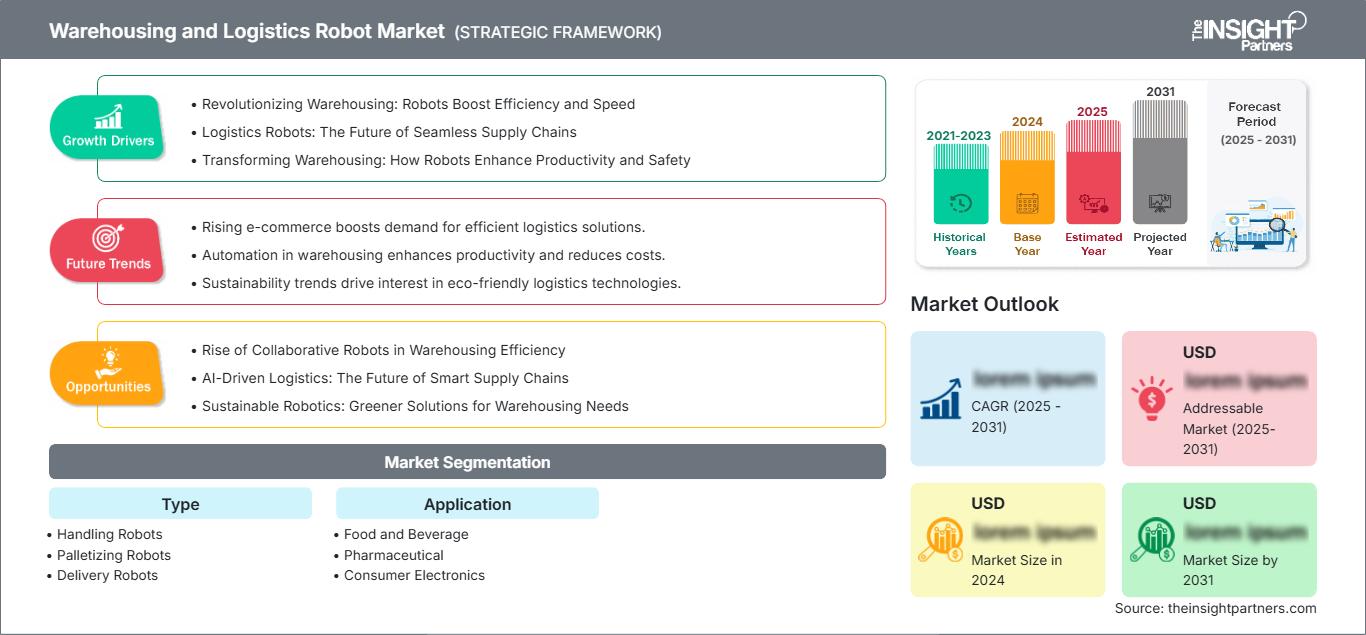
The warehousing and logistics robot market is projected to grow from US$ 7.91 Billion in 2025 to US$ 16.64 Billion by 2034, registering a CAGR of 8.61% during 2026–2034. Adoption is moving beyond early automation pilots as distribution centers deploy mobile robots, palletizing systems, depalletizing cells, and handling robots to improve throughput, inventory accuracy, and resilience across labor-constrained fulfillment networks.
North America remains a core demand center, supported by e-commerce fulfillment, the modernization of third-party logistics, and rising warehouse labor costs. The warehousing and logistics robot market size in the region is being shaped by scalable robotics-as-a-service models, pressure from omnichannel retail, and investment in AI-enabled warehouse execution systems that coordinate robots with existing warehouse management platforms.
Warehousing and Logistics Robot Market Assessment and Insights
- North America: The region accounted for an estimated 29–33% share in 2025 and is expected to expand at a CAGR of 9.0–10.2% during 2026–2034, driven by automation in retail, e-commerce, pharmaceuticals, and food logistics.
- U.S.: The U.S. represented around 72–76% of North America in 2025 and is forecast to grow at a CAGR of 9.2–10.5%, supported by fulfillment automation and labor productivity initiatives.
- Europe: Europe held an estimated 24–28% share in 2025 and is expected to grow at a CAGR of 7.8–8.8%, led by Germany, the UK, France, Italy, and Spain.
- Asia Pacific: Asia Pacific accounted for 32–36% share in 2025 and is projected to grow at a CAGR of 9.5–10.9%, with China, Japan, South Korea, and India leading deployments.
- Largest Segment: Handling robots represented the largest segment with an estimated 31–35% market share in 2025 and a CAGR of 8.2–9.1% during 2026–2034.
- High Growth Segment: Delivery robots held an estimated 12–16% share in 2025 and are forecast to grow at a CAGR of 10.4–11.8% as facilities automate internal transport.
- Key companies analyzed in detail: ABB Ltd., Zebra Technologies Corporation, FANUC CORPORATION, GreyOrange, Hitachi, Ltd., KUKA AG, Mitsubishi Electric Corporation, SSI Schaefer Group, Vecna Robotics, and Yaskawa Electric Corporation.
Source: The Insight Partners' analysis based on proprietary research, government publications, company annual reports, investor presentations, industry databases, and expert interviews.
Automation in warehousing has shifted from fixed conveyor-heavy designs toward modular fleets that can be added in phases. The market growth is being reinforced by AMRs, vision-guided robotic arms, intelligent palletizing systems, and software orchestration that reduces bottlenecks between picking, packing, replenishment, and dispatch operations.
The Warehousing and Logistics Robot Market report indicates that, over the forecast period, adoption is likely to broaden across mid-sized warehouses as leasing models and cloud-based fleet management reduce upfront barriers. Investment will also move toward emerging logistics corridors in Asia Pacific and the Middle East, where modern fulfillment infrastructure is being built with robotics-ready layouts from the outset.
Warehousing and Logistics Robot Market Report Scope
| Report Attribute | Details |
|---|---|
| Market size in 2025 | US$ 7.91 Billion |
| Market Size by 2034 | US$ 16.64 Billion |
| Global CAGR (2026 - 2034) | 8.61% |
| Historical Data | 2021-2024 |
| Forecast period | 2026-2034 |
Warehousing and Logistics Robot Market Analysis
Demand for warehousing and logistics robotics is inherently connected to the rapid development of fulfillment processes, shorter order cycle times, more diverse SKUs, and ongoing labor shortages. In light of ever-increasing e-commerce traffic, omnichannel retailing, and customers’ demands for faster shipping, the need to improve efficiency without sacrificing performance is becoming increasingly urgent for warehouses. More often than not, robotic solutions are used to provide consistent throughput during peak periods, reduce order errors, improve inventory accuracy, and operate 24/7. Moreover, robotics solutions help increase employee safety by automating repetitive and physically demanding processes such as travel, lifting, sorting, and transporting materials in large warehouses.
The market ecosystem encompasses robot manufacturers, gripper and sensor suppliers, warehouse execution software developers, systems integrators, automation consultants, and logistics service providers. Warehousing and logistics robot market analysis indicates that value creation is increasingly shifting toward integrated automation platforms that combine robotic hardware with advanced software capabilities, simulation tools, predictive maintenance analytics, and seamless interfaces with warehouse management systems (WMS) and enterprise resource planning (ERP) platforms. Customers want a solution that provides real-time visibility, operational intelligence, and coordination across warehouse processes. The shift towards this approach motivates vendors to design comprehensive automation solutions that increase productivity, reduce implementation complexity, and ensure operational scalability.
The competitive landscape is shaped by a mix of global industrial robotics manufacturers and specialized providers of warehouse automation solutions. ABB Ltd., FANUC CORPORATION, KUKA AG, Mitsubishi Electric Corporation, and Yaskawa Electric Corporation draw on their vast experience in robotics and automation, significant customer bases, and extensive automation portfolios to solve warehouse challenges. On the other hand, GreyOrange, Zebra Technologies Corporation, SSI Schaefer Group, and Vecna Robotics focus on technologies and solutions for fulfillment, autonomous mobile robots, orchestration software, and intelligent workflow automation for picking, transport, and inventory management processes.
In modern times, strategic positioning increasingly relies on the speed of deployment, lifecycle support, and a clear demonstration of economic value to the customer. The customer is showing a preference for vendors that can offer cost savings per pick, shorter ROI times, easy integration with existing facilities, safety compliance, and flexibility in scalability across multiple sites. Increasing attention to scalable automation architectures is also driving the adoption of technologies such as artificial intelligence, machine vision, autonomous navigation, digital twins, and advanced analytics, which continuously enhance system performance. Warehouse managers' ongoing search for increased productivity, workforce optimization, and supply chain resilience will continue to drive demand for intelligent robotic solutions.
● REPORT CUSTOMIZATION
Tailor This Report To Align With Your Specific Business Requirements
This report can be customized to align precisely with your business objectives, scope, and target markets. Customization options include tailored segmentation, geography, competitive analysis, and strategic insights to support informed decision-making.
Customize This Report →WHAT YOU CAN ADJUST
- ● Segmentations
- ● Geography
- ● Competitive Analysis
- ● Language Preferences
Warehousing and Logistics Robot Market: Strategic Insights
Regional Insights
North America warehousing and logistics robot market
North America accounted for an estimated 29–33% warehousing and logistics robot market share in 2025 and is projected to grow at a CAGR of 9.0–10.2% during 2026–2034. Adoption is strongest in high-throughput fulfillment, parcel handling, grocery distribution, and pharmaceutical logistics.
Operators are using AMRs, robotic picking, palletizing, and automated transport to manage labor constraints and accelerate order-cycle reliability. Demand is also supported by robotics-as-a-service contracts that allow retailers and 3PLs to scale capacity without redesigning entire warehouse networks.
U.S. warehousing and logistics robot Market
The U.S. represented approximately 72–76% of North America in 2025 and is expected to grow at a CAGR of 9.2–10.5%. The focus on e-commerce consolidation, regional logistics facilities, and the presence of sophisticated system integrators make the country one of the key deployment hubs.
Robots have already been employed to facilitate tote transport, de-palletizing, order consolidation, and inspection. The list of companies involved includes FANUC America, ABB Robotics, Zebra Technologies Corporation, GreyOrange, Vecna Robotics, and SSI Schaefer Group.
Europe warehousing and logistics robot Market
Europe held an estimated 24–28% share in 2025 and is forecast to grow at a CAGR of 7.8–8.8%. Germany is the top country due to its expertise in automated factories, logistics infrastructure, and adoption in automotive, electronics, and industrial logistics.
In the UK, automation in e-commerce and grocery logistics is focused on, whereas in France, Italy, and Spain, robots are being used to boost warehouse efficiency. Sustainability regulations are helping to create compact logistics centers.
APAC warehousing and logistics robot Market
Asia Pacific accounted for an estimated 32–36% share in 2025 and is projected to grow at a CAGR of 9.5–10.9%. Regional robotics deployment is driven mainly by China, thanks to its capacity in manufacturing, e-commerce, and local robotics development.
Japan and South Korea provide expertise in the engineering of robotic solutions, while India and Australia expand automation in retail, electronics, and logistics. The region enjoys advantages in terms of new warehouses, urban delivery infrastructure, and industrial automation policies.
Middle East & Africa warehousing and logistics robot Market
The Middle East & Africa is expected to grow at a CAGR of 7.4–8.6% during 2026–2034. Leadership by the two countries is exercised through logistics facilities, port-linked distribution centers, and diversification strategies geared towards national-level transport infrastructure.
South Africa is the most advanced African country due to its logistics related to retail and food products. Within the region, adoption of robotics is limited but increasing in new automated warehouses.
Segmentation Analysis
Type
The type segment is forecast to grow at a CAGR of 8.4–9.4% during 2026–2034. The warehousing and logistics robot market scope includes robots that handle material handling, storage, pallet flows, internal delivery, and manufacturing-related warehouse tasks.
- Handling Robots: Handling robots are the largest type segment, used for picking, placing, lifting, and moving goods across storage and fulfillment workflows where speed, repeatability, and safety are critical.
- Palletizing Robots: Palletizing robots support end-of-line packaging and warehouse dispatch, helping operators manage heavy loads, mixed pallets, and repetitive stacking with improved consistency.
- Delivery Robots: Delivery robots facilitate automated movement of materials within zones, minimizing associate movement time and increasing predictability of replenishment, picking, and packing procedures.
- Supporting Robots: Supporting robots support activities such as inspections, inventory scans, cleaning, and additional movement, helping with greater visibility and minimizing downtime in large operations.
- Depalletizing Robots: Depalletizing robots facilitate unloading of cases or layers from incoming pallets, increasing efficiency and reducing manual labor in food and beverage, retail, and consumer goods warehouses.
- Manufacturing Robots: Manufacturing robots help link plant floor production with warehouse flow, assisting in packaging, transportation, staging, and manufacturing-related logistics at warehouses.
Application
The application segment is expected to expand at a CAGR of 8.0–9.2% during 2026–2034 as warehouse operators automate sector-specific handling requirements. Food and beverage, pharmaceuticals, consumer electronics, and textile logistics each require different capabilities for payload, hygiene, traceability, and accuracy.
- Food and Beverages: Robots are used in food and beverages warehouse operations for activities such as palletization, cold chain management, and high volume of cases where hygiene, efficiency, and reduced damage are vital considerations.
- Pharmaceuticals: Robotic automation is used in pharmaceutical logistics operations for traceable transportation, secure storage, and order fulfillment, particularly when product integrity and temperature sensitive handling are crucial.
- Consumer Electronics: Robots play a strategic role in consumer electronics warehousing where the handling of high value SKU’s and serialization and replenishment are essential.
- Textiles: Robotic automation plays an important role in textile logistics operations by managing SKU variation, peak seasons and reverse logistics.
Opportunity Snapshot
| Application | Revenue Contribution | Trend Tag | Adoption Stage |
| Food and Beverage | High | Cold Chain | Scaling |
| Pharmaceutical | Medium | Traceable Fulfillment | Scaling |
| Consumer Electronics | High | Precision Picking | Mature |
| Textile | Medium | Returns Automation | Emerging |
Warehousing and Logistics Robot Market Growth Drivers and Impact Analysis
Rising Fulfillment Speed Requirements
The continued reduction of delivery time windows by e-commerce and omnichannel operations has rendered manual warehouse operations increasingly vulnerable during peak demand. Robotic technology helps speed up movement in a warehouse, minimize unnecessary travel by workers, and ensure consistent facility operations. It is most effective in high-SKU warehouses, where order variability makes standard fixed automation less efficient.
Labor Availability and Productivity Pressures
This job typically requires repetitive walking, lifting, scanning, and bending, which poses challenges for recruiting and retaining employees. The use of robots is increasing to take on physically challenging jobs, allowing employees to handle exceptions, quality control, and process monitoring. This ensures greater safety and greater productivity per employee. This approach makes the most sense when wages, turnover, and seasonal labor create operational risk.
AI-Enabled Warehouse Orchestration
Adoption of robotics is increasing with AI-based execution systems integrating robots, inventory, workforce, and equipment in real time. Such systems help with task assignment, path planning, maintenance needs prediction, and performance monitoring. Thus, a flexible warehouse setting is achieved in which the robots adapt to changing order patterns rather than following fixed paths.
Warehousing and Logistics Robot Market Future Trends
Multi-Robot Fleet Interoperability
The warehousing and logistics robot market trends will increasingly center on interoperability between different robot types, vendors, and software layers. Facilities will not rely on a single type of robot; rather, they will integrate AMRs, robotic arms, palletizers, scanning robots, and automated storage solutions. Open interfaces and fleet management software will be important criteria in purchases, as companies need to avoid supplier lock-in and manage a mixed fleet.
Robotics-as-a-Service Expansion
The adoption of subscription-based automation deployment models is set to grow as medium-sized warehouses seek to automate their processes without large upfront investments. The robotics-as-a-service approach enables the facility owner to match costs to throughput, seasonal peak capacity, or the productivity goal for that specific location. The service-oriented approach also holds vendors more accountable regarding uptime and performance metrics.
Warehousing and Logistics Robot Market Opportunities
Automation in Brownfield Warehouses
Many warehouses were not designed for full automation, creating opportunities for modular robots that can operate within existing aisles, docks, and storage layouts. Vendors that can deploy systems with minimal building changes can address a large installed base of distribution facilities. Warehousing and logistics robot market forecasts indicate that retrofitting will remain important because many operators need productivity gains faster than new warehouse construction cycles allow.
Sector-Specific Robotic Solutions
Food, pharmaceuticals, electronic devices, and textiles have their own logistics requirements. Vendors specializing in gripper solutions, software processes, and analysis customized for individual industries' logistics would be able to achieve greater differentiation. Pharmaceutical logistics require traceability and careful handling; food logistics require cleanliness and temperature control; electronics require proper SKU management; textile logistics benefit from returns automation.
Frequently Asked Questions

- Comprehensive Market Sizing and Forecast Analysis
- Detailed Segmentation Analysis
- In-Depth Market Dynamics Assessment
- Regional and Country-Level Insights
- Competitive Landscape and Company Benchmarking
- Strategic Business Intelligence
Recent Reports
Testimonials

The Insight Partners provided valuable market intelligence that supported our global go-to-market strategy. Their team was professional, responsive, and attentive to our feedback, providing thoughtful analysis and helpful methodological clarifications throughout the project.
Junmo Kim Chief Financial Officer (CFO), Enertech Co., Ltd.
The Insight Partners' SCADA System Market report is comprehensive, with valuable insights on current trends and future forecasts. The team was highly professional, responsive, and supportive throughout. We are very satisfied and highly recommend their services.
RAN KEDEM Partner, Reali Technologies LTDs
I requested a report on a very specific software market and the team produced the report in a few days. The information was very relevant and well presented. I then requested some changes and additions to the report. The team was again very responsive and I got the final report in less than a week.
JEAN-HERVE JENN Chairman, Future Analytica
We worked with The Insight Partners for an important market study and forecast. They gave us clear insights into opportunities and risks, which helped shape our plans. Their research was easy to use and based on solid data. It helped us make smart, confident decisions. We highly recommend them.
PIYUSH NAGPAL Sr. Vice President, High Beam Global
The Insight Partners delivered insightful, well-structured market research with strong domain expertise. Their team was professional and responsive throughout. The user-friendly website made accessing industry reports seamless. We highly recommend them for reliable, high-quality research services
YUKIHIKO ADACHI CEO, Deep Blue, LLC.
This is the first time I have purchased a market report from The Insight Partners.While I was unsure at first, I visited their web site and felt more comfortable to take the risk and purchase a market report.I am completely satisfied with the quality of the report and customer service. I had several questions and comments with the initial report, but after a couple of dialogs over email with their analyst I believe I have a report that I can use as input to our strategic planning process.Thank you so much for taking the extra time and making this a positive experience.I will definitely recommend your service to others and you will be my first call when we need further market data.
JOHN SUZUKI President and Chief Executive Officer, Board Director, BK Technologies
I wish to appreciate your support and the professionalism you displayed in the course of attending to my request for information regarding to infectious disease IVD market in Nigeria. I appreciate your patience, your guidance, and the fact that you were willing to offer a discount, which eventually made it possible for us to close a deal. I look forward to engaging The Insight Partners in the future, all thanks to the impression you have created in me as a result of this first encounter.
DR CHIJIOKE ONYIA MANAGING DIRECTOR, PineCrest Healthcare Ltd.Reason to Buy
- Informed Decision-Making
- Understanding Market Dynamics
- Competitive Analysis
- Identifying Emerging Markets
- Customer Insights
- Market Forecasts
- Risk Mitigation
- Boosting Operational Efficiency
- Strategic Planning
- Investment Justification
- Tracking Industry Innovations
- Aligning with Regulatory Trends





 Get Free Sample for