
Smart Machines Market Growth, Trends & Demand by 2034
Coverage: by Component (Software, Hardware, Services); Machine Type (Robots, Autonomous Cars, Drones, Wearable Devices, Others); Technology (Cloud Computing Technology, Big Data, Internet of Thing, Robotics, Cognitive Technology, Affective Technology); Application (Manufacturing, Automotive, Transportation and Logistics, Healthcare, Consumer Electronics, Aerospace and Defense, Others); and Geography (North America, Europe, Asia Pacific, and South and Central America)
- Status : Data Released
- Report Code : TIPTE100000245
- Category : Electronics and Semiconductor
- No. of Pages : 150
- Available Report Formats :


- Last update date : August 26, 2026


2025 Market Size
US$ 305.97 Bn
Base year value
2034 Forecast
US$ 1,058.92 Bn
Projected by 2034
CAGR 2026-2034
14.79 %
Growth rate
Addressable Market
US$ 5,842.99 Bn
(2026-2034)
The Smart Machines Market size was valued at US$ 305.97 billion in 2025 and is projected to reach US$ 1058.92 billion by 2034, registering a CAGR of 14.79% over the forecast period from 2026 to 2034. The market is experiencing robust growth driven by rapid advancements in artificial intelligence (AI), machine learning (ML), and the Internet of Things (IoT), which are revolutionizing industries by enhancing automation, decision-making, and operational efficiency.
North America holds a substantial share of 28-32% of the global Smart Machines Market in 2025, with a projected CAGR of 13-15% through 2034. The region's market is propelled by high adoption of autonomous systems, early integration of AI and ML in industrial processes, and significant investments in smart infrastructure and autonomous vehicle technology.
Smart Machines Market Assessment and Insights
- North America – Estimated to hold 28-32% of the global Smart Machines Market share in 2025, growing at a CAGR of 13-15% from 2026 to 2034. Dominated by the U.S., the region is driven by early adoption of AI, autonomous vehicles, and industrial automation, supported by strong technological infrastructure.
- US – Represents approximately 85-90% of the North American market in 2025, with a CAGR of 13-15% projected through 2034. Market leadership is reinforced by the presence of tech giants, robust R&D investments, and a high demand for automation across manufacturing and logistics.
- Europe – Accounts for 22-26% of the global market in 2025, growing at an estimated CAGR of 14-16% during the forecast period. Germany, the UK, and France are leading countries, driven by strong automotive and manufacturing industries and a focus on Industry 4.0 technologies.
- Asia Pacific – Captures 30-34% of global market share in 2025 and is projected to grow at the fastest CAGR of 16-18% through 2034. China leads the region with massive investments in AI, robotics, and smart manufacturing, followed by Japan, South Korea, and India.
- Largest Segment – The hardware component segment represented the largest share with 55-60% of the market in 2025, growing at a CAGR of 14-16% through 2034, driven by the essential need for sensors, processors, and mechanical components.
- High Growth Segment – The software component segment is projected as the fastest-growing with a CAGR of 17-19% from 2026 to 2034, due to the increasing need for AI algorithms, machine learning models, and data analytics platforms that power smart machine intelligence.
- Key companies analyzed in detail – IBM Corp., Google Inc., Apple Inc., Digital Reasoning Inc., Alchemy API Inc., Narrative Science Inc., LG Electronics, BAE Systems, ABB Ltd., and Microsoft Corporation.
Source: The Insight Partners' analysis based on proprietary research, government publications, company annual reports, investor presentations, industry databases, and expert interviews.
From primitive automated devices to highly intelligent autonomous machines that can adapt to changing environments, Smart Machines Market has seen a major paradigm shift over the years. With the integration of AI, IoT, and big data, machines can now carry out complicated operations, make autonomous decisions, and increase efficiency. The market has seen a paradigm shift towards hardware-software integration with heavy investments in cognitive technology and affective computing to improve the human-machine interface.
Emerging markets, especially in Asia-Pacific, represent huge growth opportunities owing to the investments made by governments and industrial sectors in areas like smart manufacturing and digital transformation. The increasing usage of autonomous vehicles, drones, and wearables opens up new revenue streams. Favorable regulatory winds include government initiatives to promote R&D in AI.
Smart Machines Market Report Scope
| Report Attribute | Details |
|---|---|
| Market size in 2025 | US$ 305.97 Billion |
| Market Size by 2034 | US$ 1,058.92 Billion |
| Global CAGR (2026 - 2034) | 14.79% |
| Historical Data | 2021-2024 |
| Forecast period | 2026-2034 |
Smart Machines Market Analysis
In terms of application, Smart Machines Market trends include automation, efficiencies, and better decision-making capabilities. The inclusion of AI and machine learning capabilities in hardware creates a foundation for real-time data processing, predictive maintenance, and process control in manufacturing, healthcare, logistics, and other industries.
The value chain involves component suppliers, technology vendors, systems integrators, and end users, where ecosystem integration is now becoming an important component for offering comprehensive solutions. Another key driving force behind the market development is the increasing demand for greater data access in various industries because smart machines rely a lot on having access to quality data.
The main competitors in this industry include large technology vendors, such as IBM Corp., Google Inc., Apple Inc., Microsoft Corporation, and large industrial firms, including ABB Ltd., and BAE Systems. Companies' investments are directed towards developing innovative software and platforms for AI and cognitive technology.
Strategic positioning is increasingly relying on creating a compatible ecosystem, improving interoperability, and developing open platforms.
● REPORT CUSTOMIZATION
Tailor This Report To Align With Your Specific Business Requirements
This report can be customized to align precisely with your business objectives, scope, and target markets. Customization options include tailored segmentation, geography, competitive analysis, and strategic insights to support informed decision-making.
Customize This Report →WHAT YOU CAN ADJUST
- ● Segmentations
- ● Geography
- ● Competitive Analysis
- ● Language Preferences
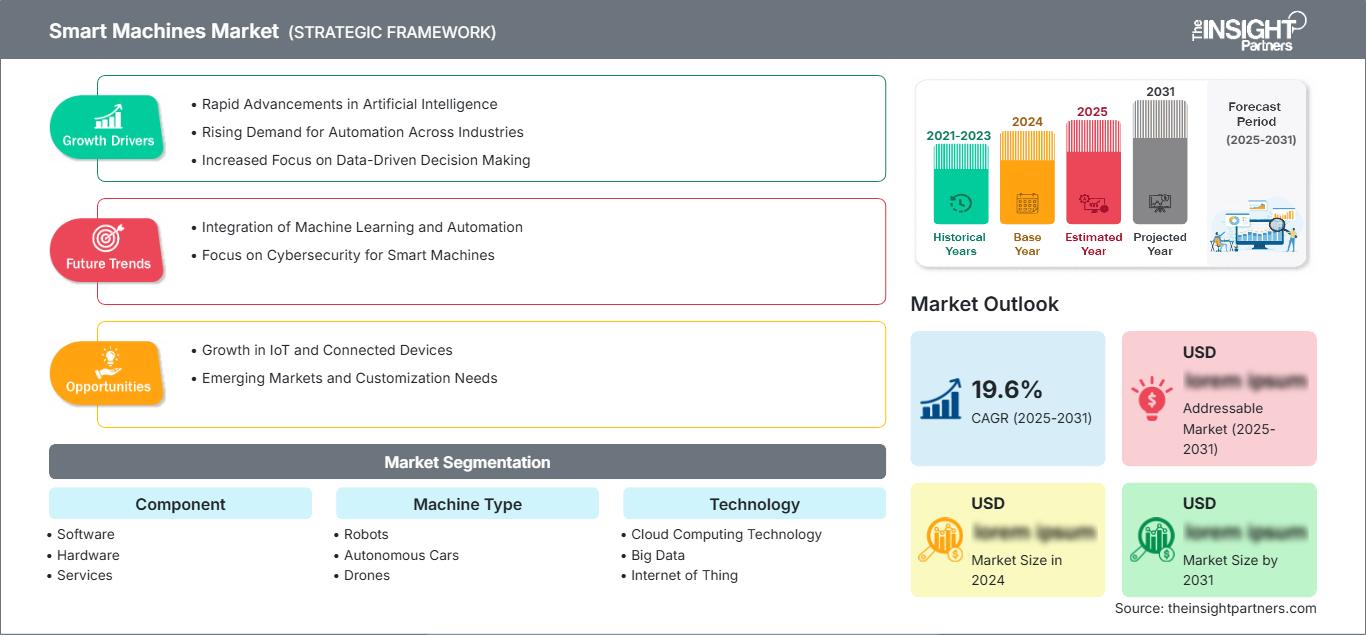
Smart Machines Market: Strategic Insights
Regional Insights
North America Smart Machines Market
North America is estimated to hold 28-32% of the global market in 2025, with a projected CAGR of 13-15% through 2034. The US is the principal driver for growth, facilitated by high deployment of autonomous technologies and high levels of investments in artificial intelligence and machine learning technologies. Government initiatives to develop smart infrastructure and autonomous vehicles create an enabling environment. Major players such as Google, IBM, and Microsoft are increasing their offerings in the smart machines segment through innovative products and acquisitions. Canada and Mexico are rising as the growth markets due to automation in manufacturing and logistics processes.
U.S. Smart Machines Market
The U.S. market accounts for approximately 85-90% of North American revenue, with a CAGR of 13-15% projected through 2034. The growing use of AI-based technologies and rising need for automation in industries such as manufacturing and logistics are some of the main factors contributing to the development of this market. Investment in technology used for self-driving vehicles and smart cities also drives market growth. The dominance of major technology companies such as Google, Apple, and IBM contributes to the strong position of this market in the U.S.
Europe Smart Machines Market
Europe is estimated to capture 22-26% of the global market in 2025, growing at a CAGR of 14-16% through 2034. The German region has taken up leadership in terms of implementation, owing to its industrial strength and the government’s emphasis on Industry 4.0 technologies. The UK region can attribute the success to the high uptake of AI in the healthcare and finance sector, mainly centered on cognitive AI and autonomous technologies. France, Italy, and Spain are also becoming regions of interest due to the EU push towards digital transformation and AI research. Leading companies such as ABB Ltd and BAE Systems are making investments in automation and autonomous systems.
APAC Smart Machines Market
According to the Smart Machines Market report, Asia Pacific accounted for 30-34% of global market share in 2025 and is projected to grow at the fastest CAGR of 16-18% through 2034. China remains at the forefront of the region's adoption trends with large investments in artificial intelligence, robotics, and intelligent manufacturing. The nation's "Made in China 2025" policy focuses on intelligent technology such as industrial robots and self-driving cars. Japan and South Korea show significant growth thanks to their highly developed robotics and automation in manufacturing. India shows rapid adoption through the "Digital India" policy that supports AI and smart technology adoption. Another reason for the rapid growth in the region is decreasing costs of smart machines and increased government investments in AI.
Middle East & Africa Smart Machines Market
The MEA region exhibits emerging adoption of smart machine technologies, with a projected CAGR of 12-14% through 2034. Saudi Arabia leads regional investment through Vision 2030, with smart city projects in Riyadh and NEOM driving demand for automation and AI technologies. UAE adoption is accelerated by Dubai's Smart City initiative and the rapid expansion of smart infrastructure. South Africa represents the largest African market, with growing industrial automation adoption. Infrastructure development and smart city investments create additional application opportunities across the region.
Segmentation Analysis
Component
The component segment comprises Hardware, Software, and Services. Hardware dominates the segment, accounting for 55-60% of the market in 2025, driven by essential components like sensors, processors, and mechanical components. The segment is growing at a CAGR of 14-16%. Software, however, represents the fastest-growing sub-segment with a CAGR of 17-19%, reflecting the shift toward AI algorithms, machine learning models, and cloud-based analytics platforms. Services, including consulting, installation, maintenance, and support, are also seeing increased demand as businesses seek comprehensive solutions for integrating smart machines into their operations.
- Hardware – Forms the physical foundation of smart machines, including sensors, processors, actuators, and mechanical components. Innovation in miniaturization, energy efficiency, and processing power drives the market.
- Software – Enables machine learning, data processing, and autonomous decision-making. Fastest-growing segment due to the increasing importance of AI and analytics in delivering intelligence and adaptability to machines.
- Services – Encompasses consulting, installation, maintenance, and support services. Critical for ensuring the optimal performance and integration of smart machines into existing systems.
Machine Type
The machine type segment in the Smart Machines Market includes Robots, Autonomous Cars, Drones, Wearable Devices, and Others. Robots dominate the segment, accounting for 35-40% of the market in 2025, driven by their versatility and proven ROI in manufacturing, logistics, and healthcare. The segment is growing at a CAGR of 14-16%. Autonomous Cars represent a high-growth segment with a CAGR of 16-18%, fueled by advancements in sensor technology, AI, and the push for safer transportation. Drones are increasingly adopted for surveillance, mapping, and delivery, while Wearable Devices are seeing growth in healthcare and fitness applications.
- Robots – Versatile automated systems designed for precision and efficiency. Widely preferred across industries for streamlining operations and reducing human intervention.
- Autonomous Cars – Self-driving vehicles powered by AI and sensors. High-growth segment driven by the pursuit of safer, more efficient transportation solutions.
- Drones – Unmanned aerial vehicles used for surveillance, mapping, and delivery. Growth is fueled by advances in aerodynamics, battery life, and autonomous navigation.
- Wearable Devices – Smart devices worn on the body providing data and functionalities. Growth is driven by innovation in sensor miniaturization and wireless connectivity.
Technology
The technology segment in the Smart Machines Market includes Cloud Computing Technology, Big Data, Internet of Things (IoT), Robotics, Cognitive Technology, and Affective Technology. Cloud Computing Technology dominates the segment, accounting for 25-30% of the market in 2025, driven by its scalability, cost-efficiency, and ability to provide remote computing power and storage. The segment is growing at a CAGR of 15-17%. Affective Technology is projected as a high-growth segment with a CAGR of 17-19%, as it enables machines to recognize and respond to human emotions, enhancing human-machine interaction. Cognitive Technology, which encompasses AI systems capable of learning and reasoning, is also seeing significant growth.
- Cloud Computing Technology – Enables scalable, remote computing and storage. Dominates due to the growing need for flexible, cost-effective IT infrastructure.
- Big Data – Processes and analyzes massive datasets for valuable insights. Crucial for data-driven decision-making and predictive analytics.
- Internet of Things – Interconnects devices, people, and data through the internet. Facilitates seamless communication and data exchange.
- Robotics – Develops intelligent machines capable of autonomous or semi-autonomous tasks. Catalyzed by the pursuit of automation and efficiency.
- Cognitive Technology – Encompasses AI systems that learn, reason, and solve problems. Driven by the need for intelligent systems that automate decision-making.
- Affective Technology – Recognizes and responds to human emotions. High-growth segment drives by the desire for empathetic and responsive technology interfaces.
Application
The application segment includes Manufacturing, Automotive, Transportation and Logistics, Healthcare, Consumer Electronics, Aerospace and Defense, and Others. Manufacturing dominates the application segment, accounting for 25-30% of the market in 2025, driven by decades of automation investment and proven KPIs. The segment is growing at a CAGR of 14-16%. Healthcare is projected as a high-growth segment with a CAGR of 17-19%, driven by the need for AI-assisted diagnostics, robotic surgeries, and patient care optimization. Transportation and Logistics are also seeing significant growth due to the adoption of autonomous vehicles and drones.
- Manufacturing – Largest application, leveraging automation for production line optimization. Benefits from reduced errors, higher output, and lower labor costs.
- Automotive – Integrates smart machines in assembly and autonomous vehicle development. Focus on precision, efficiency, and safety.
- Transportation and Logistics – Adopts autonomous vehicles and drones for route optimization and delivery. Enhances efficiency and reduces costs.
- Healthcare – High-growth application, using AI for diagnostics, robotic surgeries, and patient monitoring. Improves patient outcomes and operational efficiency.
- Consumer Electronics – Integrates AI into devices for smart functionalities. Focus on user experience and connectivity.
- Aerospace and Defense – Employs smart machines for surveillance, autonomous systems, and precision operations. Key area for innovation and advanced automation.
Opportunity Snapshot
| Application | Revenue Contribution | Trend Tag | Adoption Stage |
|---|---|---|---|
| Manufacturing | High | Industry 4.0 | Mature |
| Automotive | High | Autonomous Driving | Scaling |
| Transportation and Logistics | Medium | Autonomous Delivery | Scaling |
| Healthcare | Medium | AI Diagnostics | Emerging |
| Consumer Electronics | Medium | Smart Devices | Mature |
| Aerospace and Defense | Low | Unmanned Systems | Scaling |
Smart Machines Market Growth Drivers and Impact Analysis
Advancements in Artificial Intelligence and Machine Learning
The Smart Machines Market forecast indicates that rapid progress in AI and ML technologies is a primary driver. Smart machines leverage these capabilities to analyze vast amounts of data, make autonomous decisions, and perform tasks with unparalleled efficiency and accuracy . In healthcare, AI assists in diagnosing diseases and optimizing treatment plans, while in finance, AI-driven algorithms enhance fraud detection and trading strategies. As AI continues to evolve, its impact on productivity, innovation, and competitiveness is reshaping industries worldwide . Additionally, AI-driven predictive analytics is transforming businesses by providing valuable insights for better decision-making and resource allocation.
Increasing Demand for Automation and Operational Efficiency
The rising need for automation and improved operational efficiency is a major driver across industries such as manufacturing, logistics, and healthcare. Smart machines offer the capability to streamline complex processes, reduce human intervention, and enhance overall productivity . In manufacturing, automation systems optimize production lines, resulting in higher output and reduced errors. In logistics, AI-powered solutions enhance route optimization and inventory management, leading to significant cost savings. This growing demand is accelerating the adoption of smart machines, enabling organizations to stay competitive in an increasingly fast-paced business environment .
Proliferation of IoT and Connectivity Technologies
The expansion of the Internet of Things (IoT) and 5G networks is driving the adoption in the smart machines market by enabling real-time data collection and analysis. IoT facilitates seamless communication and data exchange between devices and applications, enhancing the capabilities of smart systems . With the growing penetration of connected devices, the demand for smart machines that can process and act on data in real-time is increasing. The availability of 5G networks further accelerates this trend by providing the low-latency, high-bandwidth connectivity required for complex autonomous systems .
Smart Machines Market Future Trends
Emphasis on Affective and Cognitive Technologies
The Smart Machines Market is witnessing an increased focus on affective and cognitive technologies that enable machines to understand and respond to human emotions and cognitive processes. Affective computing is reshaping human-machine interaction norms, with emotion-sensing algorithms fine-tuning responses in healthcare and customer service applications . Concurrently, cognitive technology merges symbolic reasoning with deep learning, allowing smart machines to justify decisions to regulators, an emerging compliance advantage in sectors such as aviation maintenance. This trend is driving the development of more intuitive, empathetic, and trustworthy smart machines.
Expansion of Agentic AI and Self-Healing Systems
The emergence of agentic AI and self-healing systems is a key trend shaping the future of the smart machines market. Agentic AI refers to autonomous AI systems capable of achieving complex goals with minimal human intervention, while self-healing systems can detect and repair issues autonomously . These technologies are enabling smart machines to become more resilient, adaptable, and independent, reducing downtime and maintenance costs. The rise of specialized large language models (LLMs) and edge AI is further accelerating this trend, as machines gain the ability to process and act on data in real-time .
Smart Machines Market Opportunities
Healthcare Diagnostics and Robotic Surgeries
The healthcare sector presents a substantial opportunity for smart machines market, particularly in diagnostics and robotic surgeries. AI-assisted diagnostic tools can flag anomalies on imaging scans with high accuracy, while surgical suites adopt robotic arms delivering sub-millimeter precision . The integration of smart machines in patient data management, appointment scheduling, and remote monitoring is also improving patient care and operational efficiency . As the demand for precision medicine and minimally invasive procedures grows, the adoption of smart machines in healthcare is expected to accelerate, creating significant opportunities for technology providers and healthcare institutions.
Autonomous Vehicles and Drone Logistics
The autonomous vehicles and drone logistics market presents a significant growth opportunity, driven by the push for safer transportation and efficient delivery systems. Autonomous cars are headlining the growth chart with a 17-19% CAGR outlook, while warehouse drones and autonomous mobile robots (AMRs) are serving retail and logistics operators pushing same-day delivery promises . Companies developing autonomous vehicles and drone delivery systems are capitalizing on the need for efficient, cost-effective, and scalable logistics solutions. The integration of 5G connectivity and AI-driven navigation systems is further expanding the capabilities of autonomous vehicles and drones, making them viable for a broader range of applications.
Recent Developments
- August 2026: Solomon Technology Corp is expanding its artificial intelligence (AI)-powered systems for humanoid robots, with chairman saying that the company aims to address one of the biggest hurdles to wider adoption — machine perception. Rather than manufacturing humanoid robots, Solomon develops AI-powered 3D vision modules and machine vision software that enable robots to perceive, understand and interact with their surroundings. The company is also applying technology to drones, autonomous mobile robots (AMRs) and industrial inspection systems.
- February 2025: Robotics Growth Partnership publishes Smart Machines Strategy 2035. The Smart Machines 2035 Strategy provides a roadmap to position the UK as a global leader in robotics and Smart Machines. It highlights their transformative potential to address pressing societal challenges, enhance economic productivity, and establish national leadership in a rapidly evolving technological landscape. This 10-year plan builds on the UK’s strengths in research, innovation, and entrepreneurship, laying out strategic goals and actionable steps to unlock the full potential of robotics and Smart Machines.
- August 2024: Figure AI introduced Figure 02, an advanced humanoid robot for industrial and commercial applications. The robot includes six RGB cameras, an onboard vision-language model, integrated audio capabilities for natural speech interaction, and highly dexterous hands, enabling real-time reasoning, vision processing, and task control .
- July 2025: Comau announced that it has completed its acquisition of Automha S.p.A. through which Comau has acquired full ownership of the company and its global subsidiaries. The strategic investment by Comau marks a further step in building a forward-focused Italian automation Hub and will leverage the strong synergies between the two brands to create value for customers and shareholders in different markets around the world.
Frequently Asked Questions

- Comprehensive Market Sizing and Forecast Analysis
- Detailed Segmentation Analysis
- In-Depth Market Dynamics Assessment
- Regional and Country-Level Insights
- Competitive Landscape and Company Benchmarking
- Strategic Business Intelligence
Recent Reports
Testimonials

The Insight Partners' SCADA System Market report is comprehensive, with valuable insights on current trends and future forecasts. The team was highly professional, responsive, and supportive throughout. We are very satisfied and highly recommend their services.
RAN KEDEM Partner, Reali Technologies LTDs
I requested a report on a very specific software market and the team produced the report in a few days. The information was very relevant and well presented. I then requested some changes and additions to the report. The team was again very responsive and I got the final report in less than a week.
JEAN-HERVE JENN Chairman, Future Analytica
We worked with The Insight Partners for an important market study and forecast. They gave us clear insights into opportunities and risks, which helped shape our plans. Their research was easy to use and based on solid data. It helped us make smart, confident decisions. We highly recommend them.
PIYUSH NAGPAL Sr. Vice President, High Beam Global
The Insight Partners delivered insightful, well-structured market research with strong domain expertise. Their team was professional and responsive throughout. The user-friendly website made accessing industry reports seamless. We highly recommend them for reliable, high-quality research services
YUKIHIKO ADACHI CEO, Deep Blue, LLC.
This is the first time I have purchased a market report from The Insight Partners.While I was unsure at first, I visited their web site and felt more comfortable to take the risk and purchase a market report.I am completely satisfied with the quality of the report and customer service. I had several questions and comments with the initial report, but after a couple of dialogs over email with their analyst I believe I have a report that I can use as input to our strategic planning process.Thank you so much for taking the extra time and making this a positive experience.I will definitely recommend your service to others and you will be my first call when we need further market data.
JOHN SUZUKI President and Chief Executive Officer, Board Director, BK Technologies
I wish to appreciate your support and the professionalism you displayed in the course of attending to my request for information regarding to infectious disease IVD market in Nigeria. I appreciate your patience, your guidance, and the fact that you were willing to offer a discount, which eventually made it possible for us to close a deal. I look forward to engaging The Insight Partners in the future, all thanks to the impression you have created in me as a result of this first encounter.
DR CHIJIOKE ONYIA MANAGING DIRECTOR, PineCrest Healthcare Ltd.Reason to Buy
- Informed Decision-Making
- Understanding Market Dynamics
- Competitive Analysis
- Identifying Emerging Markets
- Customer Insights
- Market Forecasts
- Risk Mitigation
- Boosting Operational Efficiency
- Strategic Planning
- Investment Justification
- Tracking Industry Innovations
- Aligning with Regulatory Trends





 Get Free Sample for