
Micro-LED Display Market Growth, Trends & Demand by 2034
Coverage: By Product (Large scale Display, Small and Medium sized Display, Micro Display); Application (Smartphone and Tablet, TV, PC and laptop, Smartwatch, Others); Industry (Consumer Electronics, Entertainment and Sports, Automotive, Retail, Government and Defense, Others) , and Geography (North America, Europe, Asia Pacific, and South and Central America)
- Status : Published
- Report Code : TIPRE00020762
- Category : Electronics and Semiconductor
- No. of Pages : 321
- Available Report Formats :


- Last update date : August 14, 2026


2025 Market Size
US$ 16.95 Bn
Base year value
2034 Forecast
US$ 29.64 Bn
Projected by 2034
CAGR 2026-2034
6.4 %
Growth rate
Addressable Market
US$ 210.71 Bn
(2026-2034)
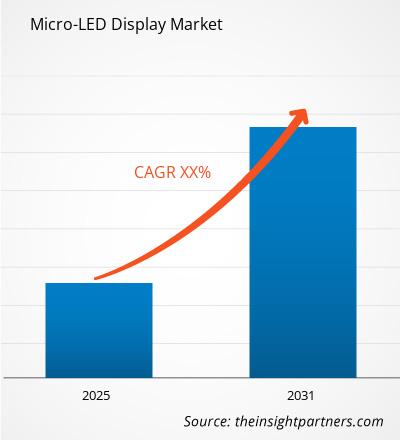
Micro LED Display Market was valued at US$16.95 billion in 2025 and is projected to reach US$29.64 billion by 2034, expanding at a CAGR of 6.4% during 2026–2034. Demand is supported by high-brightness, self-emissive display architectures that improve contrast, durability, transparency, and energy efficiency across premium televisions, automotive interfaces, commercial signage, wearables, and emerging near-eye devices.
Asia Pacific remains a priority commercialization region, with an estimated 7.9% CAGR through 2034 as premium consumer electronics, automotive cockpit digitization, defense visualization, and enterprise signage budgets support early adoption. Micro LED Display Market size in the region is strengthened by demand for durable displays, high ambient-light readability, and local partnerships that shorten qualification cycles for automotive, aerospace, retail, and command-center applications.
Micro-LED Display Market Assessment and Insights
- North America held 28.89% share in 2025 and is growing at a CAGR of 5.6% between 2026–2034, supported by premium TV launches, automotive display pilots, defense-grade visualization, and retail signage upgrades.
- US represented 86% of North America in 2025 and is growing at a CAGR of 5.8% between 2026–2034, led by enterprise displays, AR development, and automotive programs.
- Europe accounted for 22.22% share in 2025 and is growing at a CAGR of 5.1% between 2026–2034, with Germany, the UK, France, Italy, and Spain leading adoption.
- Asia Pacific captured 40.00% share in 2025 and is growing at a CAGR of 7.9% between 2026–2034, with China, South Korea, Japan, Taiwan, and India leading capacity and demand.
- Largest Segment Television Sets held 14.8% market share in 2025 and is growing at a CAGR of 7.6% between 2026–2034.
- High Growth Segment Flexible Displays held 18.4% market share in 2025 and is growing at a CAGR of 7.5% between 2026–2034.
- Key companies analyzed in detail: Samsung Electronics Co., Ltd.; BOE Technology Group Co., Ltd.; LG Electronics Inc.; Sharp Corporation; Sony Group Corporation; AUO Corporation; Panasonic Holdings Corporation; Innolux Corporation; Truly International Holdings Limited; and TCL Technology Group Corporation.
Source: The Insight Partners' analysis based on proprietary research, government publications, company annual reports, investor presentations, industry databases, and expert interviews.
Technological progress within manufacturing is bringing the Micro-LED Display Market commercialization from demonstration walls into scalable product roadmaps. The improvements in epitaxy, chip sorting, mass transfer, bonding, repair, and color conversion are decreasing the yield loss and enhancing panel uniformity. The backplanes' segment will stay capital intensive; however, the glass backplanes, tiling techniques, and modular cabinets are supporting suppliers in addressing the large format displays needs while getting ready for small-sized panels in automotive, wearables, and near-eye segments.
Within the forecasted period, commercialization of the technology will require cooperation between suppliers, regional subsidies and premium pricing tolerance from the customers. China, South Korea, Japan, Taiwan, and US will continue playing an important role in investments due to the presence of panels' knowledge, semiconductor equipment, and device's ecosystem. The regulatory wind at the back of energy efficiency and cockpit safety will be positive for durable high-brightness displays.
Micro-LED Display Market Report Scope
| Report Attribute | Details |
|---|---|
| Market size in 2025 | US$ 16.95 Billion |
| Market Size by 2034 | US$ 29.64 Billion |
| Global CAGR (2026 - 2034) | 6.4% |
| Historical Data | 2021-2024 |
| Forecast period | 2026-2034 |
Micro-LED Display Market Analysis
The demand is growing for displays that are bright, have long lifetimes, are resistant to burn-in, have low latency, and have wide color performance. Micro-LED Display Market is seeing the greatest growth in situations where there is clear value for visual performance such as in premium home theaters, retail experience centers, automotive cockpits, control rooms, and AR microdisplays. Value chain involves substrates like sapphire and silicon, epitaxy, driver ICs, mass transfer systems, inspection systems, backplane and set assembly.
Supply capacity is limited by transfer yield, repair rates, miniaturization, and cost per pixel. However, tiled displays are becoming popular since defective modules are easier to replace than a monolithic display. Automotive and wearable application need more stringent qualification due to reliability issues, but they do present great margins since brightness, transparency, and robustness solve problems that neither LCD nor OLED are able to address.
Competitive positioning is shaped by panel manufacturing depth and end-device access. Samsung Electronics Co., Ltd. and Sony Group Corporation support premium large-format positioning, BOE Technology Group Co., Ltd. and TCL Technology Group Corporation emphasize scale, while AUO Corporation and Innolux Corporation are advancing automotive and transparent display applications. This Micro-LED Display Market analysis shows that leadership depends on yield learning, customer co-development, and defensible process know-how.
Investment is shifting from concept prototypes toward pilot lines, application-specific modules, and system-level validation. LG Electronics Inc., Sharp Corporation, Panasonic Holdings Corporation, and Truly International Holdings Limited add product integration, consumer electronics, and module experience that broadens addressable channels. Strategic advantage will come from lowering repair cost, securing driver IC capacity, qualifying automotive-grade components, and aligning display roadmaps with premium device replacement cycles.
● REPORT CUSTOMIZATION
Tailor This Report To Align With Your Specific Business Requirements
This report can be customized to align precisely with your business objectives, scope, and target markets. Customization options include tailored segmentation, geography, competitive analysis, and strategic insights to support informed decision-making.
Customize This Report →WHAT YOU CAN ADJUST
- ● Segmentations
- ● Geography
- ● Competitive Analysis
- ● Language Preferences
Micro-LED Display Market: Strategic Insights

Regional Insights
North America Micro LED Display Market
North America held 28.89% share in 2025 and is expected to grow at a CAGR of 5.6% during 2026–2034. Micro LED Display Market share is supported by premium residential displays, enterprise signage, aerospace visualization, and automotive cockpit programs that require high luminance, fast response, and durability under variable temperature and ambient-light conditions.
This area can also benefit from semiconductor design capabilities, system integration partners, and budgets allocated for the construction of command centers, studios, flagship stores, and defense training facilities. Volume adoption has not yet taken place in this area, but some early deployments will act as reference cases that enable suppliers to validate the performance of their products regarding lifetime, serviceability, and calibration.
U.S. Micro LED Display Market Market
The US accounted for 86% of North America in 2025 and is projected to grow at a CAGR of 5.8% from 2026–2034. Demand is concentrated in premium televisions, virtual production walls, automotive cockpit pilots, aviation visualization, and AR development programs. Procurement favors suppliers able to combine performance validation with long-term service support.
Samsung Electronics Co., Ltd., Sony Group Corporation, LG Electronics Inc., and Panasonic Holdings Corporation maintain visible channels through displays, imaging, and professional systems, while AUO Corporation supports mobility-focused technology showcases. Application trends include ultra-premium home cinema, transparent retail installations, simulation environments, and automotive displays where sunlight readability and design flexibility strengthen the commercial case.
Europe Micro LED Display Market Market
Europe represented 22.22% share in 2025 and is forecast to grow at a CAGR of 5.1% through 2034. Germany is the leading country because premium automotive engineering, industrial visualization, and professional display procurement align with high-reliability use cases. The UK supports studio production, control rooms, and retail flagships.
France, Italy, and Spain make their contributions through luxury retail, venues for the public, transport facilities, and business communications networks. European customers usually need rigorous performance on energy efficiency, safety, and lifespan, and therefore companies with reliable quality systems have an upper hand. Automotive applications continue to be relevant due to transparent, curved, and pillar-to-pillar concepts.
APAC Micro LED Display Market Market
APAC held 40.00% share in 2025 and is expected to grow at a CAGR of 7.9% during 2026–2034. China leads through panel scale, equipment investment, and digital signage deployment, while Japan and South Korea contribute premium devices, imaging brands, and advanced materials expertise.
The Taiwanese companies continue to be crucial for technological development for both AUO Corporation and Innolux Corporation, while the markets of India and Australia increase the need for products through their retail upgrade, business displays, and automotive components. The supportive policies for semiconductor and display manufacturing chains within the countries strengthen the resilience of the ecosystem.
Middle East & Africa Micro LED Display Market Market
Middle East and Africa is projected to grow at a CAGR of 4.9% during 2026–2034, led by the UAE and Saudi Arabia. Demand is linked to premium retail districts, airports, smart-city command centers, stadiums, and hospitality venues where high brightness and long operating life support outdoor-facing installations.
South Africa and other MEA regions introduce selective adoption via the broadcast studio, enterprise lobby, and infrastructure control room. Display walls that are energy efficient and effective will be able to cater to the region's requirements for a durable public interface. Selective adoption is still project-driven, although some flagships may set benchmarks for related programs.
Segmentation Analysis
Display Panel Size
Display Panel Size is projected to grow at a CAGR of 5.4–8.7% during 2026–2034. Micro LED Display Market scope across panel sizes is broadening as large panels support premium signage and televisions, while microdisplays target AR and optical engines. Small and medium-sized panels remain strategically important for automotive, tablets, monitors, and wearables where brightness and durability justify early adoption.
- Microdisplays are strategically important for AR glasses, viewfinders, defense optics, and compact projection engines where high brightness, low power, and small pixel pitch are critical.
- Small & Medium-sized Panels address automotive interfaces, tablets, laptops, wearables, and monitors where durability, color quality, and thin form factors support premium device differentiation.
- Large Panels lead visible commercialization through televisions, digital signage, control rooms, and experience centers that can absorb premium pricing and benefit from modular serviceability.
Panel Type
Panel Type is expected to grow at a CAGR of 6.0–7.5% from 2026–2034. Flat formats dominate commercial readiness, but flexible, foldable, and curved concepts are shaping premium design pipelines. Transparent and freeform architectures strengthen automotive, retail, and exhibition opportunities where displays must merge information with physical environments without compromising brightness or contrast.
- Flat Panel Display remains the most commercially mature format, serving televisions, signage, monitors, and control rooms where manufacturing repeatability and serviceable modules matter.
- Flexible Display supports cockpit surfaces, wearable interfaces, and curved retail installations where conformability adds design value beyond conventional rigid panels.
- Foldable Display remains early stage but is relevant for premium mobile devices, automotive concepts, and compact professional screens requiring mechanical durability.
- Curved Display fits immersive monitors, vehicle dashboards, simulation environments, and luxury signage where field-of-view and design continuity improve user engagement.
Product Type
Product Type is forecast to grow at a CAGR of 6.3–7.0% during 2026–2034. Television sets and large-format displays provide the strongest revenue base, while automotive displays and wearables create faster design-led adoption. Smartphones, tablets, monitors, and laptops require sharper cost reduction before wider penetration, but they remain important long-term targets for high-performance panels.
- Smartphones and Tablets remain longer-term opportunities because cost, repair yield, and battery integration must improve before high-volume consumer adoption becomes practical.
- Television Sets anchor premium commercialization as modular large screens, high contrast, and long operating life support luxury home cinema and professional viewing applications.
- Monitors and Laptops offer selective demand in gaming, creative workstations, and professional environments where brightness, refresh performance, and durability justify premium pricing.
- Digital Signage and Large Format Displays benefit from modularity, serviceability, outdoor-facing brightness, and continuous-operation requirements across retail, venues, transport, and control centers.
- Automotive Displays are gaining strategic weight as cockpit digitization, transparent surfaces, and exterior communication displays require sunlight-readable, durable visual interfaces.
- Wearables need compact, efficient, and bright screens for watches, AR devices, and health-focused interfaces where power efficiency and readability are decisive.
Industry Vertical
Industry Vertical is projected to grow at a CAGR of 6.4–7.6% during 2026–2034. Consumer electronics remains the largest demand pool, while automotive, sports and entertainment, retail, healthcare, and aerospace and defense create higher-value use cases. Adoption depends on brightness, operating life, reliability, and the ability to justify premium costs through immersive, mission-critical, or brand-enhancing applications.
- Consumer Electronics leads commercialization through televisions, premium monitors, tablets, and wearables where visual performance, durability, and brand differentiation influence purchasing decisions.
- Automotive uses technology for cockpits, transparent windows, exterior communication, and high-brightness safety interfaces that withstand demanding operating environments.
- Sports and Entertainment adopts large immersive walls, scoreboards, broadcast studios, and venue displays where brightness and seamless scaling improve audience engagement.
- Retail deploys transparent showcases, flagship signage, and luxury product storytelling where high contrast and long uptime support premium brand presentation.
- BFSI uses secure command centers, trading floors, customer lounges, and digital branches where clarity, reliability, and continuous operation support information-intensive environments.
- Education applies high-resolution walls and interactive lecture displays in advanced classrooms, labs, and simulation centers where durability supports shared-use environments.
- Healthcare considers surgical visualization, training rooms, diagnostic review spaces, and patient communication displays where brightness, hygiene, and long service life matter.
- Aerospace and Defense requires rugged visualization for simulators, command rooms, avionics concepts, and field systems where readability and reliability outweigh initial display cost.
Opportunity Snapshot
| Industry Vertical | Revenue Contribution | Trend Tag | Adoption Stage |
| Consumer Electronics | High | Premium TVs | Scaling |
| Automotive | Medium | Smart Cockpit | Emerging |
| Sports and Entertainment | Medium | Venue Walls | Scaling |
| Retail | Medium | Transparent Signage | Scaling |
| BFSI | Low | Control Rooms | Emerging |
| Education | Low | Immersive Labs | Emerging |
| Healthcare | Low | Surgical Display | Emerging |
| Aerospace and Defense | Medium | Mission Visuals | Scaling |
Micro-LED Display Market Growth Drivers and Impact Analysis
Premium display performance becomes a purchasing differentiator
As buyers seek criteria for assessing display technology in luxury homes, commercial spaces, studios, and branding settings, brightness, contrast, lifespan, and maintainability of the display have become more important than mere display size. Since micro-LED technology is a self-emitting technology that provides high dynamic range, fast response, and image retention immunity, micro-LED technology has gained appeal in cases where there is fear of burn-in problems associated with OLED technology or issues associated with LCD backlighting.
Automotive cockpit digitization expands qualified use cases
Vehicle interiors are becoming digital interfaces that merge instrument panels, passenger displays, head-up displays, side-window displays, and exterior communication interfaces. Micro-LED may be able to serve automotive industry needs in terms of brightness, transparency, durability against vibrations, and resistance to heat, especially when used in smart cockpits and advanced mobility platforms. The impact on the market will be an extended qualification process, but increased strategic value due to automotive projects establishing long-term supply arrangements. Suppliers that have passed their reliability tests may leverage automotive platforms to qualify flexible, curved, and transparent designs before applying those learnings to other markets.
Manufacturing learning lowers cost barriers gradually
Commercial growth hinges on better mass transfer efficiency, quality control, repair procedures, and backplane integration. Pilot production lines in Asia are aiding suppliers in identifying defect trends, minimizing rework, and enhancing modular manufacturing, while equipment manufacturers perfect their laser transfer, bonding, and testing processes. The cost reductions are not expected to be even across the board, considering that small displays, car displays, and tiled walls have distinct yields economics. Nonetheless, each successful production run contributes to better process understanding and helps customers gain confidence while enabling suppliers to provide more stable quotes.
Micro-LED Display Market Future Trends
Transparent and embedded display surfaces
Micro-LED trends in the market will be towards displays that merge seamlessly with physical surroundings only when information is required. Displays like transparent displays, mirror displays, smart windows, and retail displays may create mixed reality experiences without hindering visibility. Side window display ideas, sunroof display ideas, and signal display ideas may find application in automobiles. Transparency and product story creation may find application in luxury retail through transparent showcase display.
Microdisplay adoption in AR optical engines
The near-eye device industry will drive Micro-LEDs to use pixel pitches, brightness, and full-color capabilities. Since AR glasses need to operate outside but with minimal battery consumption, LED-on-silicon and other microdisplay technologies offer an excellent match. Ecosystem readiness and waveguide efficiency will determine if microdisplays take hold. In the case that consumer and enterprise AR devices develop, microdisplays can become a profitable niche before television reaches mainstream adoption.
Micro-LED Display Market Opportunities
Automotive platform co-development
Suppliers of automobiles and panel manufacturers can derive value from jointly developing displays with automakers at an early stage of the development of their cockpits. The qualification needs may be challenging, but they help build strong competitive advantages once the platform is won. Areas of opportunity may include displays embedded within windows, curved instrument panels, passenger entertainment screens, and exterior communication modules for electric and autonomous vehicles. Businesses that offer optical design, thermal design, reliability testing, and manufacturing capabilities can transform initial prototype engagement into sustainable revenue streams. Collaboration with Tier 1 cockpit manufacturers would be critical since the display performance would have to meet the safety and software criteria.
Premium signage and experiential retail rollouts
Opportunities for the near term include luxury retail, museum, airport, sports, and corporate experience center applications, where visual impact can be linked to brand experience, visitor engagement, and operational sustainability. The modular nature of Micro-LED walls provides advantages in terms of size customization, visual coherence, and ease of maintenance compared to many traditional display solutions. Service contracts can be created based on calibration services, module replacements, and content management. Opportunities that require high brightness levels, long operational hours, and architectural flexibility will enable suppliers to justify their premium prices and create references for further commercialization.
Recent Developments
- January 2026 Samsung Display announced that it has begun the mass production of the world’s first 34-inch 360Hz QD-OLED panel, featuring a “V (Vertical)-Stripe” pixel structure. The company has been supplying panels to seven global monitor manufacturers, including ASUS, MSI, and Gigabyte, since December 2025.
- May 2026: BOE, a global leader in the display industry, marked its twelfth consecutive participation at the prestigious event, showcasing more than 30 world-first or industry-first innovations driven by its three technology brands. Notably, 65% of the exhibits made their industry debut, establishing new benchmarks in the industrialization maturity and industry leadership of pioneering technologies. BOE presented the complete range of display technologies, including LCD, OLED, MLED, and AI-integrated solutions.
- June 2026: Sharp Display Solutions showcased its latest professional display portfolio at InfoComm 2026. The company introduced integrated digital signage solutions combining its PN-M and PN-P professional displays with BrightSign Built-In SDM technology, simplifying installation by eliminating external media players and cables for commercial signage applications.
Frequently Asked Questions

- Comprehensive Market Sizing and Forecast Analysis
- Detailed Segmentation Analysis
- In-Depth Market Dynamics Assessment
- Regional and Country-Level Insights
- Competitive Landscape and Company Benchmarking
- Strategic Business Intelligence
Recent Reports
Testimonials

The Insight Partners provided valuable market intelligence that supported our global go-to-market strategy. Their team was professional, responsive, and attentive to our feedback, providing thoughtful analysis and helpful methodological clarifications throughout the project.
Junmo Kim Chief Financial Officer (CFO), Enertech Co., Ltd.
The Insight Partners' SCADA System Market report is comprehensive, with valuable insights on current trends and future forecasts. The team was highly professional, responsive, and supportive throughout. We are very satisfied and highly recommend their services.
RAN KEDEM Partner, Reali Technologies LTDs
I requested a report on a very specific software market and the team produced the report in a few days. The information was very relevant and well presented. I then requested some changes and additions to the report. The team was again very responsive and I got the final report in less than a week.
JEAN-HERVE JENN Chairman, Future Analytica
We worked with The Insight Partners for an important market study and forecast. They gave us clear insights into opportunities and risks, which helped shape our plans. Their research was easy to use and based on solid data. It helped us make smart, confident decisions. We highly recommend them.
PIYUSH NAGPAL Sr. Vice President, High Beam Global
The Insight Partners delivered insightful, well-structured market research with strong domain expertise. Their team was professional and responsive throughout. The user-friendly website made accessing industry reports seamless. We highly recommend them for reliable, high-quality research services
YUKIHIKO ADACHI CEO, Deep Blue, LLC.
This is the first time I have purchased a market report from The Insight Partners.While I was unsure at first, I visited their web site and felt more comfortable to take the risk and purchase a market report.I am completely satisfied with the quality of the report and customer service. I had several questions and comments with the initial report, but after a couple of dialogs over email with their analyst I believe I have a report that I can use as input to our strategic planning process.Thank you so much for taking the extra time and making this a positive experience.I will definitely recommend your service to others and you will be my first call when we need further market data.
JOHN SUZUKI President and Chief Executive Officer, Board Director, BK Technologies
I wish to appreciate your support and the professionalism you displayed in the course of attending to my request for information regarding to infectious disease IVD market in Nigeria. I appreciate your patience, your guidance, and the fact that you were willing to offer a discount, which eventually made it possible for us to close a deal. I look forward to engaging The Insight Partners in the future, all thanks to the impression you have created in me as a result of this first encounter.
DR CHIJIOKE ONYIA MANAGING DIRECTOR, PineCrest Healthcare Ltd.Reason to Buy
- Informed Decision-Making
- Understanding Market Dynamics
- Competitive Analysis
- Identifying Emerging Markets
- Customer Insights
- Market Forecasts
- Risk Mitigation
- Boosting Operational Efficiency
- Strategic Planning
- Investment Justification
- Tracking Industry Innovations
- Aligning with Regulatory Trends





 Get Free Sample for