
Smart Textile Market Growth and Forecast by 2034
Coverage: By Type (Active, Passive, Ultra-Smart), Function (Sensing, Energy harvesting, Luminescence & Aesthetics, Thermo-Electricity), Industry Vertical (Healthcare, Sports & Fitness, Fashion, Military, Automotive), and Geography
- Status : Data Released
- Report Code : TIPEL00002272
- Category : Electronics and Semiconductor
- No. of Pages : 150
- Available Report Formats :


- Last update date : August 28, 2026


2025 Market Size
US$ 5.53 Bn
Base year value
2034 Forecast
US$ 35.90 Bn
Projected by 2034
CAGR 2026-2034
23.1 %
Growth rate
Addressable Market
US$ 161.82 Bn
(2026-2034)
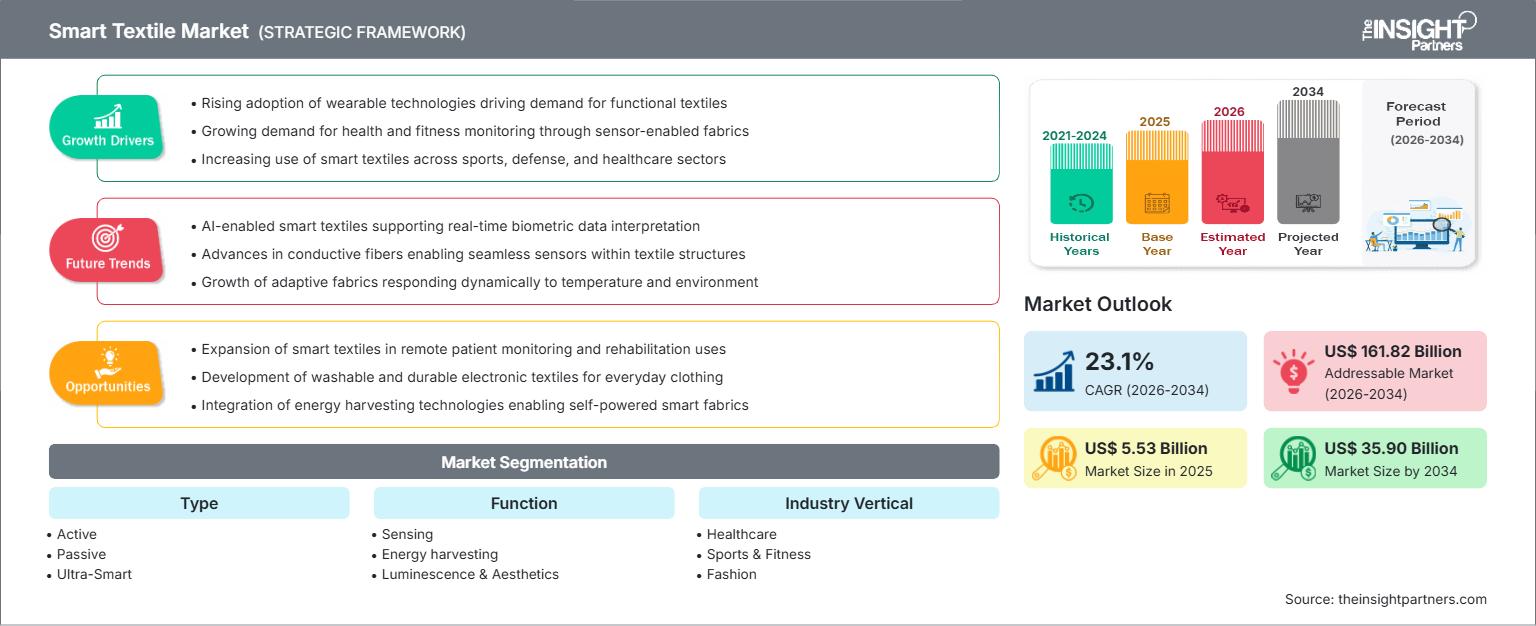
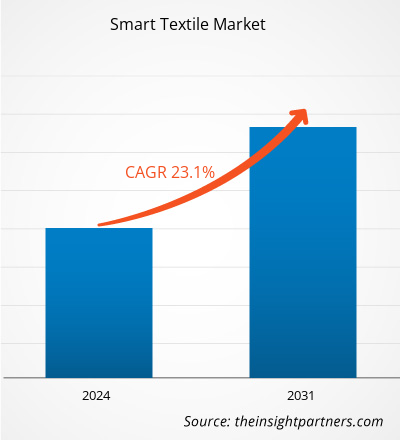
The Smart Textile Market size was valued at US$ 5.53 Billion in 2025 and is projected to reach US$ 35.90 Billion by 2034, registering a CAGR of 23.1% from 2026 to 2034. This substantial growth trajectory reflects the accelerating integration of electronics and connectivity into traditional textile platforms, creating multifunctional fabrics for diverse end-use sectors.
North America is estimated to account for approximately 34-38% of the global Smart Textile Market in 2025, growing at a CAGR of 21-24% over the forecast period. Structural growth drivers in the region include robust defense expenditure on soldier modernization programs and an advanced healthcare infrastructure prioritizing remote patient monitoring solutions and wearable diagnostic devices.
Smart Textile Market Assessment and Insights
- North America: Held approximately 34-38% Smart Textile Market share in 2025, growing at a CAGR of 21-24% during 2026-2034. The region's dominance is supported by strong defense budgets and advanced healthcare sector adoption of wearable monitoring technologies.
- U.S.: Accounted for approximately 82-86% of North America's Smart Textile Market in 2025, growing at a CAGR of 22-25% through 2034. High R&D expenditure and a mature consumer electronics ecosystem drive innovation in smart fabrics across military and fitness applications.
- Europe: Represented around 26-30% market share in 2025, expanding at a CAGR of 22-25% during 2026-2034. Leading countries include Germany, the UK, and France, where automotive and healthcare sectors are key adopters of smart textile solutions.
- Asia Pacific: Held approximately 28-32% market share in 2025, growing at the highest regional CAGR of 25-28% through 2034. China, Japan, and South Korea lead the region, supported by strong textile manufacturing bases and government initiatives promoting technical textiles.
- Largest Segment: The Healthcare vertical accounted for approximately 32-36% market share in 2025, growing at a CAGR of 24-27% during 2026-2034. Remote patient monitoring and continuous health tracking applications are primary growth catalysts in this segment.
- High Growth Segment: Sports & Fitness vertical, capturing approximately 24-28% market share in 2025, projected to grow at a CAGR of 25-28% through 2034. Growing fitness consciousness and demand for performance-enhancing wearables drive adoption.
- Key companies analyzed in detail: DuPont de Nemours, Inc., Jabil Inc., Sensoria Inc., Interactive Wear AG, Adidas AG, Hexoskin (Carré Technologies Inc.), Schoeller Textiles AG, Clim8, Nike, Inc., Thermosoft International Corporation.
Source: The Insight Partners' analysis based on proprietary research, government publications, company annual reports, investor presentations, industry databases, and expert interviews.
The Smart Textile Market report indicates that evolution of smart textiles has witnessed a great shift from simple conductive fabrics to more complex and advanced platforms that integrate flexible electronics and micro-sensors. Developments in the field of materials science have facilitated the creation of textiles that can sense, communicate, and harvest energy by themselves. The mode of production for these smart textiles is gradually moving from costly small-scale production to more advanced and scalable ways like the use of printed electronics and automated assembly systems.
In the future, the development of new geographies, especially those of the Asia Pacific region, will be very important for market expansion due to rising industrialization in such geographies and favorable government policies regarding technical textiles. The R&D efforts being made for sustainable smart textiles are on the rise and the regulations in place in Europe and North America are promoting eco-friendly production methods.
Smart Textile Market Report Scope
| Report Attribute | Details |
|---|---|
| Market size in 2025 | US$ 5.53 Billion |
| Market Size by 2034 | US$ 35.90 Billion |
| Global CAGR (2026 - 2034) | 23.1% |
| Historical Data | 2021-2024 |
| Forecast period | 2026-2034 |
Smart Textile Market Analysis
The market demand depends significantly on the increasing cases of chronic illnesses among the population and the search for affordable solutions that enable continuous health monitoring. Smart Textiles are used in the healthcare industry for remote health monitoring in order to minimize re-admissions to hospitals and facilitate health anomaly detection based on the collection of the real-time physiological data. The value chain includes the following participants: raw materials producers, component providers, textile providers, and integrators. Companies from the electronics and textile industries collaborate in order to combine their expertise.
Supply is determined by the availability of the conductive fibers and miniaturized electronic components. Manufacturers expand their capacities due to the increased demand coming from different industries. Competitors include both well-established chemical and materials companies and wearable technologies players. DuPont de Nemours, Inc. still develops advanced conductive materials and protective textiles intended for industrial and military purposes. Jabil Inc. uses its electronics manufacturing experience in order to create integrated solutions in the field of smart textiles. The main products of Sensoria Inc. include wearables and other sensors for sports and healthcare purposes. Interactive Wear AG produces heated apparels for outdoor and industrial use.
Venture capital investment into sports and healthcare segments is growing, and companies are implementing vertical integration and strategic partnerships in order to strengthen their positions in the market.
● REPORT CUSTOMIZATION
Tailor This Report To Align With Your Specific Business Requirements
This report can be customized to align precisely with your business objectives, scope, and target markets. Customization options include tailored segmentation, geography, competitive analysis, and strategic insights to support informed decision-making.
Customize This Report →WHAT YOU CAN ADJUST
- ● Segmentations
- ● Geography
- ● Competitive Analysis
- ● Language Preferences
Smart Textile Market: Strategic Insights
Regional Insights
North America Smart Textile Market
North America is estimated to hold the largest market share of 34-38% in 2025, growing at a CAGR of 21-24% through 2034. Leadership in the region is supported by various defense-related research projects and highly evolved healthcare systems that utilize cutting-edge technology. The Department of Defense in the United States has been investing heavily in smart textile technologies for soldier protection and performance monitoring, which has created high demand for such products. Health care systems are beginning to use smart fabrics for purposes of monitoring patients and rehabilitation. The knowledge and experience in wearables of Canada along with favorable government policies in this respect help fuel growth in the region.
U.S. Smart Textile Market
The U.S. accounts for approximately 82-86% of the North American Smart Textile Market in 2025, growing at a CAGR of 22-25% during the forecast period. Government investments in military smart textiles that aim at developing sensors-based uniforms, which will help with situational awareness and health tracking, fuel growth in the market. Commercialization is on the rise as well since major sportswear brands and sports technology firms are developing their smart clothing lines. Venture capital market in the USA is highly developed and supports ventures in wearable health technology. Companies like DuPont de Nemours, Inc., Sensoria Inc., and Jabil Inc. have well-developed activities within the country and participate in innovation in the field.
Europe Smart Textile Market
Europe accounted for approximately 26-30% of the global Smart Textile Market in 2025, expanding at a CAGR of 22-25% from 2026 to 2034. It has a great deal of experience in technical textiles and advanced materials technology, which makes Germany a dominant player in the sector due to its automotive and engineering industries. The contribution of the United Kingdom is in scientific research in material science and military applications with universities such as the University of Cambridge being engaged in development of advanced smart textiles technology. France and Italy are increasingly becoming important in the area of fashion and healthcare applications for their textile products. Spain is working on advanced textiles for use in industrial safety applications.
APAC Smart Textile Market
The Asia Pacific region is estimated to hold approximately 28-32% market share in 2025, expanding at a regional CAGR of 25-28%. The Smart Textiles market is dominated by China, which is followed by Japan and South Korea, while there is a lot of growth happening in India and Australia. The reason for China’s leading position is the vast textile manufacturing industry in the country along with government investment in the technical textiles sector under various programs for advanced manufacturing. The expertise in electronics and fiber technologies held by Japan is making a contribution to the growth in smart textiles. South Korea is witnessing growth in the field of smart textiles because of applications in defense and consumer electronics.
Middle East & Africa Smart Textile Market
The Middle East and Africa region is growing at a CAGR of 20-23% during 2026-2034, driven by investments in healthcare modernization and defense modernization programs. Saudi Arabia has established itself as an important player in the global Smart Textile Market with investments in projects such as smart cities and healthcare to create a need for climate-smart and medical smart textiles. In the UAE, healthcare facilities and sports facilities are being developed to encourage the use of technology to track fitness. South Africa is developing its skills in safety and industrial smart textiles. Growth in the region is encouraged by efforts toward economic diversification as well as increased awareness about the benefits of wearables in healthcare and sports.
Segmentation Analysis
Type
The global Smart Textile Market by type is segmented into Active, Passive, and Ultra-Smart textiles. The Active segment is anticipated to exhibit a CAGR of 25-28% during 2026-2034, driven by the growing demand for textiles capable of responding to environmental stimuli, including temperature regulation and moisture management. Passive textiles, incorporating basic sensing functionality without response mechanisms, currently dominate the market due to their cost-effectiveness and established applications in wearable monitoring. Ultra-Smart textiles represent an advanced category combining sensing, actuation, and communication capabilities.
- Passive: Incorporates sensors and conductive fibers without active response mechanisms, widely used in health monitoring and fitness applications due to lower cost and established manufacturing processes.
- Active: Features responsive capabilities including temperature regulation, moisture management, and lighting functions, with significant applications in defense and automotive sectors.
- Ultra-Smart: Combines sensing, actuation, and communication capabilities, enabling adaptive functionality and complex data processing for advanced healthcare and military applications.
Function
The Smart Textile Market by function includes Sensing, Energy harvesting, Luminescence & Aesthetics, and Thermo-Electricity segments. The sensing function segment is projected to grow at a CAGR of 24-27% during 2026-2034, driven by increasing demand for health monitoring and safety applications requiring continuous biometric data collection. Energy harvesting functionality is gaining traction in sustainability-focused applications.
- Sensing: Most established segment, enabling continuous monitoring of physiological parameters including heart rate, respiration, and temperature for healthcare and fitness applications.
- Energy harvesting: Converts mechanical, thermal, or solar energy into electrical power, gaining traction in applications requiring sustainable power sources for embedded electronics.
- Luminescence & Aesthetics: Provides lighting, display, and color-changing capabilities, serving fashion and entertainment sectors seeking innovative design solutions.
- Thermo-Electricity: Enables temperature regulation and energy generation from temperature gradients, particularly relevant for automotive and outdoor apparel applications.
Industry Vertical
Industry verticals in the Smart Textile Market encompass Healthcare, Sports & Fitness, Fashion, Military, and Automotive applications. The Healthcare segment, holding the largest share, is anticipated to grow at a CAGR of 24-27% over the forecast period, driven by increasing adoption of wearable monitoring devices for chronic disease management.
- Healthcare: Dominant segment driven by chronic disease management needs, enabling continuous monitoring, fall detection, and therapeutic applications.
- Sports & Fitness: High-growth segment serving performance monitoring, injury prevention, and biometric tracking for athletes and fitness enthusiasts.
- Fashion: Style-integrated applications including interactive clothing and light-emitting garments, driven by designer innovation and consumer interest in technology-enhanced apparel.
- Military: Strategic segment for soldier protection, performance monitoring, and communication systems, supported by government defense programs globally.
- Automotive: Advanced interior textiles for heating, sensing, and comfort functions, integrating with vehicle electronic systems.
Opportunity Snapshot
| Industry Vertical | Revenue Contribution | Trend Tag | Adoption Stage |
|---|---|---|---|
| Healthcare | High | Remote Monitoring | Scaling |
| Sports & Fitness | High | Performance Tracking | Scaling |
| Military | Medium | Soldier Systems | Scaling |
| Fashion | Medium | Interactive Apparel | Emerging |
| Automotive | Medium | Integrated Interiors | Emerging |
Smart Textile Market Growth Drivers and Impact Analysis
Integration with IoT and Connected Health Platforms
The convergence of smart textiles with Internet of Things (IoT) infrastructure has created a paradigm shift in healthcare monitoring and chronic disease management. Smart textiles embedded with sensors enable continuous, non-invasive collection of vital signs including ECG, heart rate, respiration rate, and blood oxygen saturation. The collected data, when sent to the cloud platforms, allows health care professionals to remotely monitor their patients and take preemptive action. The worldwide adoption of telemedicine and remote patient monitoring initiatives as a result of the digitalization of the health care system continues to create consistent demand for smart textile-based monitoring systems. It is worth noting that regulatory authorities have recognized smart textiles' data as clinically significant.
Rising Defense Expenditure on Soldier Modernization
Military institutions across the world are investing heavily in smart textiles to improve the safety of soldiers, their situational awareness, and effectiveness on the battlefield. Military projects geared towards intelligent uniforms incorporate sensor technology, communication equipment, and environmental protection features. The American military, as well as those of Europe and Asian nations such as China and India, have budgeted money for the development and acquisition of smart textiles. These textiles are used for health monitoring of soldiers, detecting chemical and biological attacks, and gathering battlefield information.
Preventive Healthcare and Wellness Trends
The growing global emphasis on preventive healthcare and fitness is driving consumer adoption of smart textile products for wellness monitoring and performance optimization. Fitness enthusiasts and health-conscious individuals increasingly use smart garments for tracking physical activity, sleep quality, and stress levels. The integration of advanced sensors and AI-powered analytics into clothing products eliminates the need for separate wearable devices, offering seamless user experiences. Sports brands are investing in smart textile development for both professional athlete applications and consumer fitness products. Healthcare systems are incorporating smart textiles into wellness and rehabilitation programs to reduce healthcare costs through early intervention.
Smart Textile Market Future Trends
Eco-Friendly and Biodegradable Smart Textiles
The Smart Textile Market trends will be shaped by sustainability imperatives driving the development of biodegradable and eco-friendly smart fabrics. Manufacturers are focusing on integrating electronics into textiles using environmentally benign materials and processes, addressing concerns about electronic waste and environmental impact. Innovations include biodegradable conductive inks, compostable fibers, and energy-harvesting materials derived from renewable sources. Regulatory pressure and consumer preferences for sustainable products are accelerating R&D investments in this direction. The development of recyclable smart textiles with minimal environmental footprint during production and disposal represents a key strategic priority for forward-looking companies.
Human-Machine Interface and Haptic Feedback Integration
Advancements in haptic feedback and human-machine interface technologies are emerging as transformative trends in smart textiles, enabling garments to communicate with users through touch, vibration, and thermal signals. These capabilities are creating new possibilities in virtual reality gaming, rehabilitation therapy, and assistive technologies for visually impaired individuals. Smart textiles equipped with haptic systems provide directional cues, environmental feedback, and communication capabilities without visual or audio interfaces. Integration with augmented reality applications and mobile platforms is expanding the addressable scope into consumer and enterprise applications.
Smart Textile Market Opportunities
Automotive Smart Interior Applications
Significant opportunities exist for smart textile adoption in automotive interiors, where manufacturers seek to differentiate through enhanced comfort, safety, and user experience. Smart fabrics capable of detecting occupant presence, monitoring driver alertness, and providing localized heating and cooling can improve vehicle functionality and passenger satisfaction. The shift toward electric and autonomous vehicles emphasizes interior ambience, creating demand for interactive surfaces with lighting and display capabilities. Automotive OEMs are actively exploring partnerships with smart textile developers to integrate these capabilities into next-generation vehicle designs. This emerging application segment presents substantial growth prospects beyond traditional automotive textile applications.
Architectural and Building Integration
Smart textiles present an emerging opportunity in architecture and building design, where dynamic surfaces and integrated functionality can improve energy efficiency, occupant comfort, and building aesthetics. Applications include responsive window treatments that adjust light transmission, architectural membranes with active heating and cooling, and building-integrated smart lighting systems. The Smart Textile Market forecasts indicate that building and architecture applications, though currently nascent, offer significant growth potential in developed markets. Sustainable building certification requirements and energy efficiency mandates are creating demand for smart textile building solutions. Collaboration between textile manufacturers, building material suppliers, and architectural firms will be crucial to capture this emerging opportunity.
Recent Developments
- August 2026: OSHIMA CO., LTD. has introduced PlySight, a defect-to-piece production simulation in the OSHIMA Smart Factory Platform. PlySight matches roll defect data from the EagleAi AI fabric inspection machine against the production marker and lay plan and shows which pieces and layers have detected defects before any fabric is spread.
- November 2025: India has approved the Textiles Focused Research, Assessment, Monitoring, Planning and Start-up (Tex-RAMPS) Scheme, aimed at strengthening innovation, competitiveness, and data-driven policymaking in the country’s textiles and apparel sector. The scheme carries an outlay of INR 305 crore (~US$ 34.14 million) for fiscal 2025-26 to fiscal 2030-31 and will be fully funded as a Central Sector initiative under the Ministry of Textiles.
- August 2024: To advance the technical textiles sector, the Government has approved grants for four start-ups and five educational institutions. This decision was made during the 8th Empowered Programme Committee (EPC) meeting of the National Technical Textiles Mission, chaired by the Secretary of the Ministry of Textiles at Udyog Bhawan. Under the ‘Grant for Research & Entrepreneurship across Aspiring Innovators in Technical Textiles (GREAT) scheme, four innovative start-ups have been selected to receive grants of approximately INR 50 lakhs each. These start-ups are focusing on strategic areas such as Composites, Sustainable Textiles, and Smart Textiles.
Frequently Asked Questions

- Comprehensive Market Sizing and Forecast Analysis
- Detailed Segmentation Analysis
- In-Depth Market Dynamics Assessment
- Regional and Country-Level Insights
- Competitive Landscape and Company Benchmarking
- Strategic Business Intelligence
Recent Reports
Testimonials

The Insight Partners' SCADA System Market report is comprehensive, with valuable insights on current trends and future forecasts. The team was highly professional, responsive, and supportive throughout. We are very satisfied and highly recommend their services.
RAN KEDEM Partner, Reali Technologies LTDs
I requested a report on a very specific software market and the team produced the report in a few days. The information was very relevant and well presented. I then requested some changes and additions to the report. The team was again very responsive and I got the final report in less than a week.
JEAN-HERVE JENN Chairman, Future Analytica
We worked with The Insight Partners for an important market study and forecast. They gave us clear insights into opportunities and risks, which helped shape our plans. Their research was easy to use and based on solid data. It helped us make smart, confident decisions. We highly recommend them.
PIYUSH NAGPAL Sr. Vice President, High Beam Global
The Insight Partners delivered insightful, well-structured market research with strong domain expertise. Their team was professional and responsive throughout. The user-friendly website made accessing industry reports seamless. We highly recommend them for reliable, high-quality research services
YUKIHIKO ADACHI CEO, Deep Blue, LLC.
This is the first time I have purchased a market report from The Insight Partners.While I was unsure at first, I visited their web site and felt more comfortable to take the risk and purchase a market report.I am completely satisfied with the quality of the report and customer service. I had several questions and comments with the initial report, but after a couple of dialogs over email with their analyst I believe I have a report that I can use as input to our strategic planning process.Thank you so much for taking the extra time and making this a positive experience.I will definitely recommend your service to others and you will be my first call when we need further market data.
JOHN SUZUKI President and Chief Executive Officer, Board Director, BK Technologies
I wish to appreciate your support and the professionalism you displayed in the course of attending to my request for information regarding to infectious disease IVD market in Nigeria. I appreciate your patience, your guidance, and the fact that you were willing to offer a discount, which eventually made it possible for us to close a deal. I look forward to engaging The Insight Partners in the future, all thanks to the impression you have created in me as a result of this first encounter.
DR CHIJIOKE ONYIA MANAGING DIRECTOR, PineCrest Healthcare Ltd.Reason to Buy
- Informed Decision-Making
- Understanding Market Dynamics
- Competitive Analysis
- Identifying Emerging Markets
- Customer Insights
- Market Forecasts
- Risk Mitigation
- Boosting Operational Efficiency
- Strategic Planning
- Investment Justification
- Tracking Industry Innovations
- Aligning with Regulatory Trends





 Get Free Sample for