
Solar Silicon Wafer Market Demand, Share & Growth by 2034
Coverage: By Type (Monocrystalline Wafer, Polycrystalline Wafer); Application (PV Modules, Inverter, Solar Cell, Solar Racking System, Solar Battery) , and Geography (North America, Europe, Asia Pacific, and South and Central America)
- Status : Data Released
- Report Code : TIPRE00020284
- Category : Electronics and Semiconductor
- No. of Pages : 150
- Available Report Formats :


- Last update date : October 26, 2026


2025 Market Size
US$ 14.74 Bn
Base year value
2034 Forecast
US$ 26.6 Bn
Projected by 2034
CAGR 2026-2034
6.78 %
Growth rate
Addressable Market
US$ 186.81 Bn
(2026-2034)
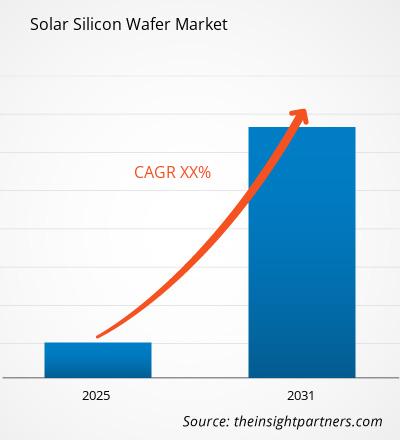
The Solar Silicon Wafer Market is valued at US$ 14.74 Billion in 2025 and is projected to reach US$ 26.6 Billion by 2034, expanding at a 6.78% CAGR from 2026 to 2034. The market covers silicon wafer manufacturing and supply across monocrystalline and polycrystalline wafer technologies and their use across PV modules, inverters, solar cells, solar racking systems, and solar batteries. Demand is closely linked to photovoltaic manufacturing capacity, wafer efficiency improvements, technology transitions, and expansion of solar generation infrastructure.
North America is supported by domestic clean-energy manufacturing initiatives, utility-scale solar deployment, and efforts to strengthen upstream photovoltaic supply chains. The Solar Silicon Wafer Market size is influenced by the region's need to reduce dependence on concentrated overseas manufacturing while improving access to high-efficiency wafers. A defensible modeled outlook indicates a ~7% CAGR through 2034, supported by localized supply-chain investment and continued demand for higher-efficiency crystalline silicon technologies.
Solar Silicon Wafer Market Assessment and Insights
Regional Outlook
- North America: ~8% of the global Solar Silicon Wafer Market share in 2025 | ~7% CAGR through 2034. Market position: North America represents a strategically important but comparatively smaller production base, with growth supported by domestic photovoltaic manufacturing incentives, utility-scale deployment, supply-chain localization, and demand for secure access to advanced wafer technologies.
- US: ~85% of North American market revenue in 2025 | ~7% CAGR through 2034. Market position: The US accounts for most regional demand and manufacturing investment, supported by utility-scale solar projects, domestic clean-energy policy, module localization, and increasing attention to upstream wafer and cell supply resilience.
- Europe: ~10% of the global market in 2025 | ~6% CAGR through 2034. Market position: Europe remains a mature downstream photovoltaic market while rebuilding selected upstream capabilities. Germany is the leading country in Europe, supported by established solar manufacturing expertise, industrial demand, and policy-driven supply-chain diversification.
- Asia Pacific: ~77% of the global market in 2025 | ~7% CAGR through 2034. Market position: Asia Pacific is the largest regional market and the principal manufacturing hub, with China as the leading country in Asia Pacific. Large PV manufacturing ecosystems, extensive capacity, technology development, and strong solar deployment underpin its position.
Segment Outlook
- Monocrystalline Wafer: ~92% Share in 2025 | ~7% CAGR through 2034. Market position: Monocrystalline wafers lead because their higher efficiency, compatibility with advanced N-type cell architectures, and suitability for high-power modules support broad adoption across utility-scale, commercial, and distributed solar applications.
- Solar Battery: ~10% Share in 2025 | ~9% CAGR through 2034. Market position: Solar battery applications represent a high-growth opportunity within the supplied application taxonomy as solar-plus-storage systems expand and manufacturers seek efficient photovoltaic components that support integrated generation and storage architectures.
Competitive Coverage
CETC Solar Energy Holdings Co., Ltd., Changzhou Xusheng Energy Co., Ltd., Comtec Solar Systems Group Limited, Electronics and Materials Corporation, GCL Technology Holdings Limited, Jiangxi LDK Solar High-Tech Co., Ltd., JinkoSolar Holding Co., Ltd., LONGi Green Energy Technology Co., Ltd., Shanxi Luan Solar Energy Technology Co., Ltd., Sino-American Silicon Products Inc.
Methodology
The Insight Partners follows Data Collection & Secondary Research, Primary Research, Data Analysis, and Data Triangulation & Final Review to validate market estimates and insights.
Source: The Insight Partners' analysis based on proprietary research, government publications, company annual reports, investor presentations, industry databases, and expert interviews.
The Solar Silicon Wafer Market is progressing from traditional silicon wafer manufacturing towards next-generation larger size and thin silicon wafers, which can be utilized to make advanced crystalline silicon cells. The economics of manufacturing will continue to depend on efficient growth, slicing, silicon usage, automation, and defectivity control. With the emergence of N-type technologies, the demand for such silicon wafers that can help increase the efficiency of cell has increased. The larger sizes of wafers have also affected the equipment design and the module design. The strategic importance of integration into the supply chain will remain significant as the wafer fabrication is located in-between polysilicon and cell manufacturing.
In the future, the Solar Silicon Wafer Market will gain from the expansion of photovoltaic manufacturing beyond traditional production regions, especially in the regions where government wants to increase its energy security. The development of policies and strategies to manufacture more photovoltaics domestically will take place in India, the US, and some European economies. Nevertheless, the Asian manufacturers are expected to remain competitive in terms of their manufacturing capabilities due to integrated supply chains, equipment maturity, and existing experience in wafer manufacturing.
Solar Silicon Wafer Market Report Scope
| Report Attribute | Details |
|---|---|
| Market size in 2025 | US$ 14.74 Billion |
| Market Size by 2034 | US$ 26.6 Billion |
| Global CAGR (2026 - 2034) | 6.78% |
| Historical Data | 2021-2024 |
| Forecast period | 2026-2034 |
Solar Silicon Wafer Market Analysis
Market growth is linked with the development of solar cell manufacturing and with the constant rise in the number of installations of photovoltaics. Besides, the need for wafers is not driven by module output; other factors include the wafer thickness, size, structure of the cell, efficiency of the process, and silicon consumption per watt. Manufacturers aim at increasing power density, and wafer producers must cut down on material used in the process without impairing mechanical and electrical properties. Technology drives demand, thus providing revenue opportunities for innovations.
Value creation involves polysilicon refining, ingot manufacturing, slicing of wafers, cleaning and inspecting, cell manufacturing and modules assembly. Thus, cost competitiveness requires integration across multiple stages of production. In China, upstream PV manufacturing is very concentrated, and according to the International Energy Agency, it accounts for about 95% of the world's PV wafer manufacturing capacity.
Market Competitiveness in the Solar Silicon Wafer Market is defined by economies of scale, technology roadmaps, cost per watt, yield management, silicon management, customer management, and the integration of wafer production with cell and module manufacturing processes. LONGi has focused on its monocrystalline wafers while JinkoSolar continues to advance its wafer pulling, slicing, automation, and large format technologies. GCL Technology plays a vital role in the upstream supply of silicon materials as well as wafer technology.
The emphasis on investment is increasingly moving from adding capacities towards lowering costs, improving yield rates, automation, product differentiation, and supply chain management. There is also a rationalization process underway after capacity expansion in the industry. This places an advantage in favor of manufacturers that have strong balance sheets, superior process technologies, diverse customer base, and access to inexpensive power and material supplies.
● REPORT CUSTOMIZATION
Tailor This Report To Align With Your Specific Business Requirements
This report can be customized to align precisely with your business objectives, scope, and target markets. Customization options include tailored segmentation, geography, competitive analysis, and strategic insights to support informed decision-making.
Customize This Report →WHAT YOU CAN ADJUST
- ● Segmentations
- ● Geography
- ● Competitive Analysis
- ● Language Preferences
Solar Silicon Wafer Market: Strategic Insights

Regional Insights
North America Solar Silicon Wafer Market
North America represented ~8% of the global Solar Silicon Wafer Market in 2025 and is projected to expand at a ~7% CAGR through 2034. The regional opportunity is connected with plans to improve domestic PV manufacturing capabilities and to decrease vulnerability to highly concentrated international supply chains. The US stands out as the largest regional market for demand in terms of utility-scale PV capacity, commercial applications, and investment in domestic clean-energy manufacturing.
Local manufacturing is becoming a vital component in strategy due to the relatively high concentration levels that upstream PV components exhibit compared with the downstream deployment of solar capacity. For these reasons, there are incentives on the part of US manufacturers and solar project developers to build long-term procurement relationships. Canada contributes with its utility-scale and distributed solar deployment, whereas Mexico acts as a manufacturing and supply chain bridge for North American production networks. The North America Solar Silicon Wafer Market share is lower than the Asia-Pacific one, yet its strategic value is growing.
U.S. Solar Silicon Wafer Market
The US accounted for ~85% of North American Solar Silicon Wafer Market revenue in 2025 and is expected to record a ~7% CAGR through 2034. This stance for the country is bolstered by the use of large-scale photovoltaics, local manufacturing efforts, and a regulatory regime that promotes more localization within the solar energy value chain. The demand aspect is especially important in case of high-efficiency crystalline silicon technology applications in utility and commercial-scale projects.
US solar market development is additionally impacted by the requirement to enhance supply chain security. Downstream manufacturing expansion in the country results in the demand for local or regional procurement of wafers, cells, and modules, even though upstream capacity is less developed than the downstream demand. This leads to foreign firms and domestic manufacturers evaluating integrated manufacturing, long-term supply contracts, joint ventures, and advanced manufacturing techniques. The demand profile includes high-quality wafers that provide for increased module production considering that land, labor, and balance-of-systems costs are critical to the project economics.
Europe Solar Silicon Wafer Market
Europe accounted for ~10% of the global Solar Silicon Wafer Market in 2025 and is projected to grow at a ~6% CAGR through 2034. Germany represents the top country in Europe, based on its industrial strength, existing photovoltaic ecosystem, engineering know-how, and significant solar deployments. The dominance of Germany is complemented by France, Italy, Spain, and the UK, with varying strengths in terms of utility-scale solar, distributed generation, manufacturing, and energy transition policies.
Germany remains particularly relevant for technology development and industrial equipment, while France and Italy gain from growing solar deployment and initiatives to secure domestic clean-energy supply chains. Spain has become a key utility-scale solar market due to good solar resources and robust project development, driving downstream demand for high-performance photovoltaic components. The UK provides additional demand from utility-scale and distributed solar expansion, despite having a smaller wafer manufacturing capacity.
With regard to the Solar Silicon Wafer Market, opportunity in Europe becomes linked to supply chain diversification rather than manufacturing scale alone. European manufacturers have more expensive production costs than the well-established Asian suppliers, increasing the significance of automation, premium products, recycling, low-carbon manufacturing, and product differentiation. Policies designed to strengthen clean-technology manufacturing could be used to facilitate selective investments, especially in cases where supply security and life cycle emissions become important in procurement processes.
APAC Solar Silicon Wafer Market
APAC represented ~77% of the global Solar Silicon Wafer Market in 2025 and is expected to expand at a ~7% CAGR through 2034, making it the largest regional market. China is the dominant country in Asia Pacific because of its well-integrated photovoltaic manufacturing ecosystem that includes polysilicon, ingots, wafers, cells, and modules. Japan and South Korea contribute through their technology-driven manufacturing capabilities while India and Australia provide downstream demand.
China's dominance in the region comes from scale, manufacturing capacity, equipment, and downstream demand. India is moving towards building its own PV manufacturing to minimize its import dependency whereas Japan focuses on efficiency-driven technologies and solar applications. South Korea continues to be an important player in advanced photovoltaic manufacturing and Australia provides downstream solar demand. Industrial strength and supportive policies in the region will ensure that APAC remains the core ecosystem for manufacturing and consumption.
Middle East & Africa Solar Silicon Wafer Market
The Middle East and Africa region is expected to record a ~6% CAGR through 2034. Saudi Arabia represents the leading country in the Middle East & Africa region where evidence supports a differentiated market position, supported by large renewable-energy ambitions, utility-scale solar projects, industrial diversification, and efforts to develop domestic clean-energy value chains. The UAE also contributes through large solar projects and clean-energy investment.
South Africa remains an important African market because of utility-scale renewable deployment and electricity-system requirements. Other Middle Eastern and African economies are increasingly evaluating solar manufacturing, project development, and energy-storage integration. For wafer suppliers, regional opportunity is more closely associated with downstream solar capacity expansion and potential localization than with a mature domestic wafer-manufacturing ecosystem. Long-term prospects therefore depend on project pipelines, industrial policy, infrastructure availability, financing, and access to competitively priced electricity.
Segmentation Analysis
Type
The Type segment of the Solar Silicon Wafer Market comprises Monocrystalline Wafer and Polycrystalline Wafer. The segment is expected to expand at a ~7% CAGR from 2026 to 2034, supported by increasing demand for high-efficiency photovoltaic technologies. Monocrystalline products benefit from compatibility with advanced cell architectures, while polycrystalline products retain relevance in selected cost-sensitive and legacy applications.
- Monocrystalline Wafer: Monocrystalline wafers occupy the central position in advanced photovoltaic manufacturing because they support higher-efficiency cell architectures and greater power density. Their strategic importance is reinforced by ongoing improvements in crystal growth, wafer thinning, slicing precision, and compatibility with N-type technologies.
- Polycrystalline Wafer: Polycrystalline wafers remain relevant where cost considerations, existing manufacturing assets, or specific application requirements influence procurement decisions. Their role is narrower than monocrystalline products in newer high-efficiency architectures, but established installed manufacturing capabilities continue to support selected demand.
Application
The Application segment of the Solar Silicon Wafer Market is expected to register a ~8% CAGR through 2034 across PV Modules, Inverter, Solar Cell, Solar Racking System, and Solar Battery applications. The demand environment is increasingly connected to integrated solar systems, higher-efficiency cells, and the expansion of solar-plus-storage architectures.
- PV Modules: PV modules remain a core downstream destination because wafers form the fundamental semiconductor substrate for crystalline silicon solar cells. Demand is driven by module production, efficiency upgrades, larger-format architectures, and utility-scale solar deployment.
- Inverter: Inverter-related applications connect photovoltaic generation with grid and electrical-system requirements. Although wafer demand is indirectly linked to this application, increasing system efficiency and power density support continued technological integration across the solar equipment ecosystem.
- Solar Cell: Solar cells represent the most direct wafer-consuming application. Advances in N-type TOPCon, back-contact, HJT, and emerging tandem architectures encourage wafer manufacturers to improve purity, thickness control, surface quality, and dimensional consistency.
- Solar Racking System: Solar racking systems support the physical installation of PV modules across utility-scale, commercial, and distributed projects. Their relationship with wafer demand is indirect, but larger module formats and higher power densities influence system-level design and installation requirements.
- Solar Battery: Solar battery applications are gaining strategic importance as photovoltaic systems increasingly integrate energy storage. Higher solar generation capacity, storage deployment, and integrated solar-storage architectures can strengthen demand for efficient PV components across the broader renewable-energy system.
Opportunity Snapshot
| Application | Revenue Contribution | Trend Tag | Adoption Stage |
|---|---|---|---|
| PV Modules | High | Utility Solar | Mature |
| Inverter | Medium | Smart Conversion | Scaling |
| Solar Cell | High | High Efficiency | Mature |
| Solar Racking System | Medium | System Integration | Mature |
| Solar Battery | Low | Solar Storage | Scaling |
Solar Silicon Wafer Market Growth Drivers and Impact Analysis
Expansion of Global Solar PV Manufacturing
Solar deployment remains the fundamental demand engine for silicon wafers because each expansion in crystalline silicon cell and module production creates corresponding requirements for wafer substrates. The IEA reported that China alone commissioned nearly 370 GW of solar PV capacity in 2025, illustrating the scale of downstream demand supporting the upstream photovoltaic manufacturing ecosystem. Beyond China, national manufacturing strategies in the US, India, and Europe are encouraging additional production capacity and supply-chain diversification. This creates opportunities for wafer manufacturers with competitive costs, reliable quality, and localized customer relationships. The impact extends beyond wafer volumes because higher-efficiency cells can increase the value of advanced wafer specifications. As manufacturers prioritize energy yield and power density, suppliers capable of consistent quality and lower silicon consumption can strengthen their position within the value chain.
Transition Toward Higher-Efficiency Silicon Technologies
The shift toward N-type architectures, back-contact technologies, larger wafer formats, and thinner wafer designs is increasing the technical requirements placed on wafer manufacturers. Modern production increasingly depends on precise crystal growth, low defect density, automated slicing, thickness control, and efficient material utilization. JinkoSolar's disclosed development history shows continued optimization of crystal pulling, slicing, automation, and tungsten-wire cutting technologies, demonstrating how wafer manufacturing is moving toward process-level efficiency rather than simple capacity expansion. This transition can improve the economic value of wafers when higher conversion efficiency lowers downstream balance-of-system costs. It also raises entry requirements because manufacturers must invest in process engineering, equipment optimization, quality control, and technology development. Consequently, technological capability is becoming a stronger differentiator across the competitive landscape.
Supply-Chain Localization and Manufacturing Resilience
The high geographic concentration of wafer manufacturing is encouraging governments and solar companies to evaluate alternative supply chains. The IEA estimates that China accounts for about 95% of global PV wafer production capacity, making wafer supply particularly concentrated within the solar value chain. This structure provides cost and scale advantages but creates exposure to trade policy, logistics disruptions, energy costs, and changes in domestic industrial policy. North America, Europe, and India therefore represent important potential locations for selective upstream investment, although achieving competitive economics remains challenging. The market impact is a gradual shift toward multi-region sourcing, strategic inventory management, technology partnerships, and integrated manufacturing. Suppliers that can combine competitive production economics with dependable delivery and compliance with regional sourcing requirements may gain greater access to customers seeking supply-chain resilience.
Solar Silicon Wafer Market Future Trends
Greater Adoption of Ultra-Thin and High-Efficiency Wafer Designs
Solar Silicon Wafer Market trends are increasingly centered on reducing silicon consumption while preserving mechanical reliability and electrical performance. Wafer thinning can reduce material use per watt, but thinner substrates require tighter control over crystal quality, handling, cutting, transport, and cell processing. Larger wafer formats also influence equipment utilization and downstream module design. The next phase of development is therefore likely to emphasize coordinated optimization rather than isolated wafer-thickness reductions. Manufacturers will increasingly evaluate wafer performance according to its contribution to cell efficiency, module power, yield, and lifecycle economics. Back-contact and other advanced cell architectures can further increase the importance of surface quality and defect control. This creates a technology pathway in which wafer producers compete through integrated process engineering, automated inspection, low-loss slicing, and improved material utilization.
Integration of Solar Manufacturing With Storage and Digital Systems
The Solar Silicon Wafer Market is likely to become increasingly connected to broader solar-plus-storage ecosystems. As solar projects add batteries, smart inverters, energy-management platforms, and grid-support capabilities, module manufacturers are placing greater emphasis on lifetime energy yield and system-level performance. This encourages upstream suppliers to support cell and module architectures optimized for higher output per unit of area. LONGi's recent strategy illustrates this direction by integrating PV and energy-storage technologies while continuing to develop advanced crystalline silicon technologies. Over time, procurement decisions may increasingly consider how wafer characteristics influence module efficiency, degradation, temperature performance, and compatibility with integrated energy systems. The trend creates opportunities for suppliers that can connect wafer innovation with downstream performance requirements rather than competing solely on nominal wafer price.
Solar Silicon Wafer Market Opportunities
Localized Upstream Manufacturing in Emerging Production Hubs
The Solar Silicon Wafer Market Forecasts indicate an opportunity for manufacturers to establish selective upstream capacity in regions seeking greater photovoltaic supply-chain independence. India is particularly relevant because policy initiatives are supporting domestic solar manufacturing while the country remains highly dependent on international upstream supply. The US and Europe also offer opportunities for specialized wafer production where customers place a premium on localized sourcing, traceability, and supply security. However, successful projects require more than announced capacity. Competitive electricity prices, access to polysilicon, equipment availability, skilled labor, customer offtake, and utilization rates are critical to achieving sustainable economics. Investors can therefore focus on integrated or strategically partnered facilities rather than isolated capacity additions. Manufacturing platforms designed around automation, high-efficiency wafers, and long-term customer contracts can improve resilience against cyclical price pressure.
Advanced Wafer Technologies for Premium PV Applications
Another opportunity lies in differentiated wafers designed for advanced cell architectures and premium photovoltaic applications. Back-contact, HJT, TOPCon, and future tandem technologies place greater emphasis on substrate quality, thickness consistency, defect control, and compatibility with specialized cell processes. Suppliers can capture additional value by developing proprietary wafer specifications, improving slicing yields, reducing material losses, and collaborating directly with cell manufacturers during technology qualification. This approach can reduce exposure to commodity-style price competition because product differentiation becomes linked to downstream efficiency and manufacturing yield. Strategic partnerships with leading cell and module producers can also shorten qualification cycles and improve visibility into future product requirements. Over the medium term, specialized wafer products may therefore become an important route for manufacturers seeking to protect margins while the broader industry works through excess capacity and periodic pricing pressure.
Recent Developments
- August 2026: LONGi Green Energy Technology Co., Ltd. reported that first-half 2026 BC module sales reached 19.55 GW, up 125% year on year, while wafer shipments reached 48.91 GW. The company also highlighted continued overseas expansion and advanced wafer technologies as part of its response to industry-wide supply-demand imbalances.
- May 2026: GCL Technology Holdings Limited announced a comprehensive strategic transformation toward a global multi-product new-energy materials platform. The company said the strategy would combine silicon-based, lithium-based, and carbon-based materials while expanding global capacity and market coverage. The move reflects the photovoltaic industry's ongoing adjustment and the need for diversified technology and supply-chain strategies.
- April 2026: JinkoSolar Holding Co., Ltd. reported its 2025 financial results and highlighted continued development of monocrystalline wafer technology, including improvements in crystal pulling, wafer slicing, automation, and tungsten-wire slicing. The company reported 86 GW of full-year module shipments and continued investment in N-type manufacturing technologies.
Frequently Asked Questions

- Comprehensive Market Sizing and Forecast Analysis
- Detailed Segmentation Analysis
- In-Depth Market Dynamics Assessment
- Regional and Country-Level Insights
- Competitive Landscape and Company Benchmarking
- Strategic Business Intelligence
Recent Reports
Testimonials

The Insight Partners provided valuable market intelligence that supported our global go-to-market strategy. Their team was professional, responsive, and attentive to our feedback, providing thoughtful analysis and helpful methodological clarifications throughout the project.
Junmo Kim Chief Financial Officer (CFO), Enertech Co., Ltd.
The Insight Partners' SCADA System Market report is comprehensive, with valuable insights on current trends and future forecasts. The team was highly professional, responsive, and supportive throughout. We are very satisfied and highly recommend their services.
RAN KEDEM Partner, Reali Technologies LTDs
I requested a report on a very specific software market and the team produced the report in a few days. The information was very relevant and well presented. I then requested some changes and additions to the report. The team was again very responsive and I got the final report in less than a week.
JEAN-HERVE JENN Chairman, Future Analytica
We worked with The Insight Partners for an important market study and forecast. They gave us clear insights into opportunities and risks, which helped shape our plans. Their research was easy to use and based on solid data. It helped us make smart, confident decisions. We highly recommend them.
PIYUSH NAGPAL Sr. Vice President, High Beam Global
The Insight Partners delivered insightful, well-structured market research with strong domain expertise. Their team was professional and responsive throughout. The user-friendly website made accessing industry reports seamless. We highly recommend them for reliable, high-quality research services
YUKIHIKO ADACHI CEO, Deep Blue, LLC.
This is the first time I have purchased a market report from The Insight Partners.While I was unsure at first, I visited their web site and felt more comfortable to take the risk and purchase a market report.I am completely satisfied with the quality of the report and customer service. I had several questions and comments with the initial report, but after a couple of dialogs over email with their analyst I believe I have a report that I can use as input to our strategic planning process.Thank you so much for taking the extra time and making this a positive experience.I will definitely recommend your service to others and you will be my first call when we need further market data.
JOHN SUZUKI President and Chief Executive Officer, Board Director, BK Technologies
I wish to appreciate your support and the professionalism you displayed in the course of attending to my request for information regarding to infectious disease IVD market in Nigeria. I appreciate your patience, your guidance, and the fact that you were willing to offer a discount, which eventually made it possible for us to close a deal. I look forward to engaging The Insight Partners in the future, all thanks to the impression you have created in me as a result of this first encounter.
DR CHIJIOKE ONYIA MANAGING DIRECTOR, PineCrest Healthcare Ltd.Reason to Buy
- Informed Decision-Making
- Understanding Market Dynamics
- Competitive Analysis
- Identifying Emerging Markets
- Customer Insights
- Market Forecasts
- Risk Mitigation
- Boosting Operational Efficiency
- Strategic Planning
- Investment Justification
- Tracking Industry Innovations
- Aligning with Regulatory Trends





 Get Free Sample for