
Solid Control Equipment Market Growth, Size & Forecast by 2034
Coverage: By Type (Shale Shakers, Mud Centrifuges, Desander and Desilter, Mud Cleaners, Others); Application (Onshore, Offshore) , and Geography (North America, Europe, Asia Pacific, and South and Central America)
- Status : Data Released
- Report Code : TIPRE00021738
- Category : Manufacturing and Construction
- No. of Pages : 150
- Available Report Formats :


- Last update date : October 30, 2026


2025 Market Size
US$ 7.23 Bn
Base year value
2034 Forecast
US$ 10.99 Bn
Projected by 2034
CAGR 2026-2034
4.77 %
Growth rate
Addressable Market
US$ 82.74 Bn
(2026-2034)
The Solid Control Equipment Market revenue is projected to rise from US$ 7.23 Billion in 2025 to US$ 10.99 Billion by 2034, representing a CAGR of 4.77% during 2026–2034. The market covers equipment used to separate drilled solids, recover drilling fluids, manage fluid properties, and reduce waste across onshore and offshore operations. Core products include shale shakers, mud centrifuges, desanders and desilters, and mud cleaners.
North America remains the principal commercial base, with an estimated CAGR of ~4% through 2034. The Solid Control Equipment Market size in the region is supported by long-lateral drilling, high-specification rig upgrades, and the need to sustain record output with fewer active rigs. Greater automation, tighter control of low-gravity solids, and lower fluid-replacement costs are shifting procurement from stand-alone machinery toward integrated, sensor-enabled systems.
Solid Control Equipment Market Assessment and Insights
Regional Outlook
- North America: ~38% of the global market in 2025 | ~4% CAGR through 2034. Market position: The region ranks first, supported by a large high-specification rig base, shale drilling intensity, established rental channels, and continuous replacement of separation assets.
- US: ~82% of North American market revenue in 2025 | ~4% CAGR through 2034. Market position: The country leads North America because Permian-focused drilling, longer laterals, and operator emphasis on fluid recovery reward high-throughput, automated solids-control packages.
- Europe: ~21% of the global market in 2025 | ~3% CAGR through 2034. Market position: A mature offshore and industrial base sustains replacement demand, with Norway and the UK leading Europe and Germany, France, Italy, and Spain supporting specialized applications.
- Asia Pacific: ~25% of the global market in 2025 | ~6% CAGR through 2034. Market position: Asia Pacific is the fastest-growing region as China, India, Australia, Japan, and South Korea expand energy, trenchless, mining, and infrastructure programs.
Segment Outlook
- Onshore: ~72% Share in 2025 | ~4% CAGR through 2034. Market position: Onshore leads because land rigs are more numerous, equipment cycles are shorter, and modular packages can be redeployed economically across basins and civil projects.
- Offshore: ~28% Share in 2025 | ~6% CAGR through 2034. Market position: Offshore grows faster as deepwater programs require compact, high-capacity systems, certified electrical components, lower-discharge operations, and dependable remote monitoring.
Competitive Coverage
Baker Hughes Company, Clean Harbors, Inc., Derrick Corporation, Elgin Power and Separation Solutions, GN Solids Control, KOSUN Machinery Co., Ltd., NOV Inc., SLB, Weatherford International plc, Halliburton Energy Services, Inc.
Methodology
The Insight Partners follows Data Collection & Secondary Research, Primary Research, Data Analysis, and Data Triangulation & Final Review to validate market estimates and insights.
Source: The Insight Partners' analysis based on proprietary research, government publications, company annual reports, investor presentations, industry databases, and expert interviews.
Separation techniques have evolved from independent shakers and hydrocyclones to integrated systems. Advances such as variable frequency drives, advanced screens, abrasion resistant materials, and bigger bowl centrifuges permit cut-point control at increased flow-rates. Changes in production discipline have driven down the number of rigs that can produce footage and output. Therefore, efficiency and durability of operations as well as speed of service and automation are priorities for operators and not just capacity additions. Rentals and services drive replacement since contractors can achieve economies of scale in fleet and performance.
Through 2034, the focus for the industry will change towards Asia Pacific and certain parts of the Middle East, where there is an overlap between drilling, pipeline building, and slurry applications. Offshore applications will be characterized by smaller skid-mounted equipment, hazardous area certifications, and closed-loop disposal of waste fluids. Regulations regarding the discharge of cuttings and transportation will favor fluid recovery and local manufacture and services will reduce delivery time.
Solid Control Equipment Market Report Scope
| Report Attribute | Details |
|---|---|
| Market size in 2025 | US$ 7.23 Billion |
| Market Size by 2034 | US$ 10.99 Billion |
| Global CAGR (2026 - 2034) | 4.77% |
| Historical Data | 2021-2024 |
| Forecast period | 2026-2034 |
Solid Control Equipment Market Analysis
Growth of the Solid Control Equipment Market is driven by cost savings. Cleaner drilling fluid lowers costs of dilution, additives, pump damage, and waste disposal, whereas better rheology facilitates quick penetration and well integrity. Long laterals and complicated fluid systems increase the cost of poor separation, thus driving demand for high-capacity shakers and multistage centrifugation.
The ecosystem involves suppliers of screens and equipment, fluid service, drilling rigs, rentals, waste services, and end users. Material such as steel, motors, bearings, rubber products, screens, controls, and electrical sub-assemblies define the lead times and reliability. The supply chain is becoming increasingly localized; however, specialty screens, wear parts, and control devices continue to be a significant source of risk. Manufacturers of equipment, consumables, and performance data through field services create barriers to competition.
The Solid Control Equipment Market report describes a competitive market environment divided into diverse oilfield service providers and solid separation specialists. Baker Hughes Company, NOV Inc., SLB, Weatherford International plc, and Halliburton Energy Services, Inc. can combine solids control services with drilling fluids, rig technology, and worldwide services. Derrick Corporation, GN Solids Control, KOSUN Machinery Co., Ltd., and Elgin Power and Separation Solutions compete using the depth of their products and application engineering services, while Clean Harbors, Inc. connects equipment requirements with waste management.
The investments are being directed to modular skid systems, remote monitoring systems, variable speed centrifuges, and platform technologies that minimize rig-up time. Positioning involves proving the ability to minimize total fluid loss, produce dry cuttings, reduce maintenance, and ensure safety. The suppliers who have inventory and technicians are well-positioned to work offshore and in remote locations because downtime is costlier than the price difference in equipment.
● REPORT CUSTOMIZATION
Tailor This Report To Align With Your Specific Business Requirements
This report can be customized to align precisely with your business objectives, scope, and target markets. Customization options include tailored segmentation, geography, competitive analysis, and strategic insights to support informed decision-making.
Customize This Report →WHAT YOU CAN ADJUST
- ● Segmentations
- ● Geography
- ● Competitive Analysis
- ● Language Preferences
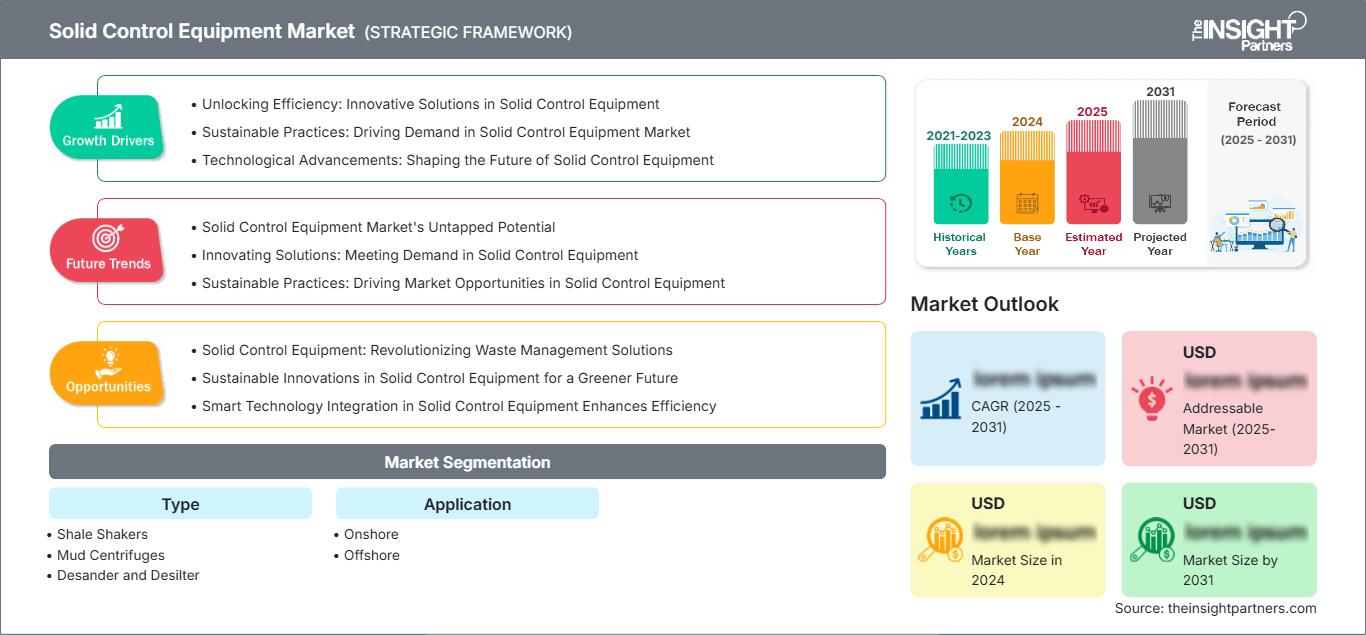
Solid Control Equipment Market: Strategic Insights
Regional Insights
North America Solid Control Equipment Market
North America is expected to expand at a CAGR of ~4% through 2034. The region combines a large installed base with demanding shale operations, where long laterals and high circulation rates make shaker capacity, centrifuge reliability, and screen performance commercially important. The Solid Control Equipment Market share is concentrated in the region because contractors can support rapid field deployment through mature rental, repair, and consumables networks.
Growth is driven more by replacement needs than increasing rig counts. Companies are achieving higher production using less rigs, increasing the worth of equipment that helps with the protection of the mud and reduces nonproductive time. Canada provides an additional demand for oil sand, conventional drilling, and remote services while Mexico adds its demand in the form of offshore and onshore drilling.
U.S. Solid Control Equipment Market
The U.S. represents ~82% of North American revenue in 2025 and is projected to record a CAGR of ~4% through 2034. Its placement is determined by the size of Permian, Eagle Ford, Bakken, Haynesville, and Appalachian basins in conjunction with activities in the Gulf of Mexico. Increased lateral lengths result in higher drilled-solids content, thereby necessitating staged treatment and proper screening, regardless of any decline in overall rig count.
Some examples of firms with appropriate technologies or service offerings are Baker Hughes Company, NOV Inc., SLB, Weatherford International plc, Halliburton Energy Services, Inc., Derrick Corporation, and Elgin Power and Separation Solutions. The market demand is moving towards wider treatment windows, automation, and fast-mobilization equipment. In the United States, there is a growing preference for demonstrated savings in terms of dilution, transportation, and wear, thus combining machine, consumable, analytics, and field service providers.
Europe Solid Control Equipment Market
Europe accounts for ~21% of global revenue in 2025 and is expected to grow at a CAGR of ~3% through 2034. Maturity exists within the region, but North Sea asset operations require continual small-sized equipment certification, replacements, screens, centrifuge improvements, and closed loop processing. In addition to Norway, with its offshore facilities, the UK stands out in Europe due to its need for reliable equipment and waste handling processes.
Germany participates by way of equipment engineering and trenchless construction, and with industrial processing demands. France does not have as many drilling platforms as the UK or Norway, but provides environmental services and specialty processing. Italy combines energy from the Mediterranean along with civil works, and Spain provides possibilities in horizontal directional drilling, water works, and industrial processing of sludges.
Demand is not limited to oil and gas drilling in the region; this leads to lower dependence on drilling cycles. European procurement involves considerations for emissions, transport reduction, and exposure of workers. Ageing of offshore equipment provides chances for retrofitting using technologies like variable speed drives and monitoring but not for changing of the mud systems. Companies that can demonstrate compliance, have spares in proximity of port operations, and help other equipment producers will succeed.
APAC Solid Control Equipment Market
Asia Pacific holds ~25% of global revenue in 2025 and is forecast to grow at a CAGR of ~6% through 2034, making it the fastest-growing region. China is the top player in the Asia Pacific region because of its local fabrication of equipment, drilling activities, and large trenchless and industrial separation applications. The exploration plans and development of infrastructure of India provide the additional scalable demand.
The mining sector, coal seam gas, HDD, and offshore applications come from Australia. Japan and South Korea are not significant upstream markets but are important for engineering products, shipbuilding facilities, and offshore project supply chain. The emphasis in policy making on energy security, localization, and urban utility construction will be on modular mud reclamation systems. Competition will be strong in this region.
Middle East & Africa Solid Control Equipment Market
The Middle East & Africa region is projected to expand at a CAGR of ~5% through 2034. Saudi Arabia is the dominant nation in Middle East & Africa based on continuous upstream investments, strong drilling services cluster, and national localization policies. The UAE brings offshore and sour service business segments where hazardous area certifications and smaller footprint are significant.
South Africa brings mining, infrastructure and industrial slurry applications, whereas rest of the MEA brings oilfield applications from North & West Africa. Buyers in the region prefer equipment that is robust enough to handle heat, abrasives and logistics issues of remote locations. Local assembly, maintenance and training can add significant value in bidding.
Segmentation Analysis
Type
The Type main segment is modeled to grow at a CAGR of ~5% during 2026–2034. The Solid Control Equipment Market scope spans sequential separation stages, from primary screening to fine-solids removal and combined cleaning. Procurement depends on flow rate, particle-cut requirements, fluid density, available deck space, and maintenance capability. Integrated packages gain preference where contractors want one control architecture, standardized spares, and measurable fluid recovery across changing formations.
- Shale Shakers: Primary separation keeps shakers central to every active mud system. Demand favors greater screen area, stable vibration, rapid panel changes, and designs that process higher flow without increasing footprint.
- Mud Centrifuges: Centrifuges address fine and low-gravity solids that screening cannot remove. Variable-speed operation, wear protection, and automated torque control strengthen their strategic role in fluid recovery and density management.
- Desander and Desilter: Hydrocyclone-based units offer robust intermediate separation for sand- and silt-sized particles. They remain important in lower-cost rigs, HDD systems, and projects where simple maintenance and high throughput outweigh precise cut control.
- Mud Cleaners: Combined hydrocyclone and fine-screen systems conserve valuable drilling fluid while rejecting concentrated solids. Their compact configuration supports space-constrained rigs and operators seeking fewer transfer steps and simpler process integration.
Application
The Application main segment is modeled to advance at a CAGR of ~5% during 2026–2034. Onshore demand is broader and more repetitive, while offshore projects command higher specification and service intensity. Selection criteria differ by installation: land operators prioritize mobility and rapid maintenance, whereas offshore buyers emphasize footprint, certification, containment, and reliability. Across both settings, lifecycle economics increasingly outweigh acquisition price.
- Onshore: Onshore contributes the largest revenue pool because land rigs, workover units, HDD projects, and industrial sites require redeployable separation packages. Rental availability and faster replacement cycles reinforce recurring equipment and consumables demand.
- Offshore: Offshore is the higher-growth application as deepwater and shelf projects require compact, high-throughput systems. Closed-loop handling, remote monitoring, corrosion resistance, and hazardous-area compliance raise equipment value per installation.
Opportunity Snapshot
| Application | Revenue Contribution | Trend Tag | Adoption Stage |
| Onshore | High | Pad Efficiency | Mature |
| Offshore | Medium | Closed Loop | Scaling |
Solid Control Equipment Market Growth Drivers and Impact Analysis
Longer Laterals Increase Solids-Processing Intensity
Drilling productivity increasingly depends on longer horizontal sections and faster penetration through variable formations. These operating conditions raise total cuttings volume and can overload conventional mud systems even when rig counts remain flat. Higher solids loading increases viscosity, pump pressure, dilution requirements, and wear if separation is inconsistent. Operators therefore invest in larger screen area, parallel shaker configurations, and high-speed centrifuges that maintain fluid properties at elevated circulation rates. The impact extends beyond equipment sales: screens, wear parts, rentals, and field optimization services generate recurring demand. Vendors that quantify avoided mud replacement and reduced nonproductive time can support stronger value-based pricing.
Waste Reduction Becomes a Direct Operating-Cost Lever
Transporting and disposing of wet cuttings is expensive, particularly offshore and at remote land sites. Efficient solids control removes more recoverable fluid before waste leaves the active system, lowering both fresh-fluid purchases and disposal volume. Cuttings dryers, fine-screen shakers, and centrifuges therefore influence logistics, environmental exposure, and well economics simultaneously. In regulated basins, closed-loop systems also reduce pit use and simplify waste traceability. This mechanism supports upgrades even during cautious drilling cycles because savings arise from each well drilled rather than from fleet expansion. Suppliers that integrate separation equipment with containment, dewatering, and monitoring can address a larger share of operator spending.
High-Specification Rig Upgrades Sustain Replacement Demand
Aging rigs and separation assets create a replacement opportunity as contractors high-grade fleets instead of adding large numbers of new units. Modern drilling programs require equipment that handles fluctuating flow, abrasive solids, denser fluids, and tighter deck layouts. Variable-frequency drives, improved bearings, wear-resistant internals, and automation extend operating windows while reducing manual intervention. Standardized modular skids can also move between rigs and simplify technician training. The commercial impact is a shift from commodity purchases toward engineered packages with service agreements, spare-parts plans, and performance guarantees. This benefits suppliers with installed-base knowledge, local workshops, and cross-brand maintenance capability.
Solid Control Equipment Market Future Trends
Adaptive Separation Through Connected Controls
Solid Control Equipment Market trends increasingly point to closed-loop control rather than fixed machine settings. Sensors that track vibration, torque, flow, temperature, and screen condition can help operators adjust centrifuge speed or shaker loading before process instability becomes downtime. Through 2034, connected platforms are likely to combine condition monitoring with maintenance history and fluid data, enabling remote specialists to support multiple rigs. Adoption will be fastest where offshore access is costly or drilling programs are standardized across pads. Equipment makers will need interoperable interfaces and cybersecurity discipline, while service providers will differentiate through actionable recommendations rather than raw dashboards.
Separation Platforms Extend Beyond Oilfield Drilling
Technology developed for drilling mud is moving into horizontal directional drilling, tunneling, mining, industrial wastewater, and sludge recovery. This broadening changes product design: customers outside upstream energy often need quieter packages, containerized layouts, simpler controls, and flexible feed handling rather than oilfield-specific rig integration. Manufacturers can reuse centrifuge, hydrocyclone, and screening expertise while diversifying cyclic exposure. The transition will favor configurable platforms and application laboratories that validate performance on customer material. It may also expand distributor networks into infrastructure and environmental services, creating demand less directly correlated with crude-price cycles.
Solid Control Equipment Market Opportunities
Localized Service Hubs in High-Activity Basins
Equipment suppliers can convert regional growth into recurring revenue by placing rental fleets, screens, wear parts, and trained technicians near drilling clusters. Solid Control Equipment Market Forecasts indicate that Asia Pacific and the Middle East will create attractive expansion points, but imported equipment alone may not satisfy uptime, localization, or certification requirements. A hub strategy can combine final assembly, rapid repair, operator training, and application testing. Partnerships with rig contractors or waste-management companies reduce entry risk and provide installed-base visibility. Priority locations should be screened for project pipelines, customs friction, technician availability, and the concentration of compatible equipment.
Performance-Based Fluid Recovery Services
Suppliers can move beyond equipment rental by contracting around measurable outcomes such as fluid recovered, cuttings moisture reduction, dilution avoided, or uptime achieved. This model aligns vendor compensation with operator economics and can accelerate adoption of premium shakers, centrifuges, and controls. It requires reliable baseline data, calibrated sensors, clear fluid accounting, and shared responsibility for operating conditions. Early programs are best suited to repeatable pad campaigns and multiwell offshore projects where savings can be compared consistently. Providers that combine hardware, consumables, field engineering, and analytics can capture a larger service wallet while creating evidence for future bids.
Recent Developments
- April 2026: GN Solids Control established GN Solids MENA in the UAE as a regional headquarters to strengthen its presence across the Middle East and North Africa. The new operation provides localized sales, technical support, equipment supply, and after-sales services for oil and gas drilling, HDD, mining, and environmental applications.
- September 2026: SLB was awarded a contract by OQ Exploration & Production (OQEP) to deliver the Bisat-B Expansion Production Facility in Oman. SLB will provide engineering, procurement, construction, commissioning, and four years of operations and maintenance support, with the expansion expected to raise gross fluids handling capacity to 548,000 barrels per day.
Frequently Asked Questions

- Comprehensive Market Sizing and Forecast Analysis
- Detailed Segmentation Analysis
- In-Depth Market Dynamics Assessment
- Regional and Country-Level Insights
- Competitive Landscape and Company Benchmarking
- Strategic Business Intelligence
Recent Reports
Testimonials

The Insight Partners provided valuable market intelligence that supported our global go-to-market strategy. Their team was professional, responsive, and attentive to our feedback, providing thoughtful analysis and helpful methodological clarifications throughout the project.
Junmo Kim Chief Financial Officer (CFO), Enertech Co., Ltd.
The Insight Partners' SCADA System Market report is comprehensive, with valuable insights on current trends and future forecasts. The team was highly professional, responsive, and supportive throughout. We are very satisfied and highly recommend their services.
RAN KEDEM Partner, Reali Technologies LTDs
I requested a report on a very specific software market and the team produced the report in a few days. The information was very relevant and well presented. I then requested some changes and additions to the report. The team was again very responsive and I got the final report in less than a week.
JEAN-HERVE JENN Chairman, Future Analytica
We worked with The Insight Partners for an important market study and forecast. They gave us clear insights into opportunities and risks, which helped shape our plans. Their research was easy to use and based on solid data. It helped us make smart, confident decisions. We highly recommend them.
PIYUSH NAGPAL Sr. Vice President, High Beam Global
The Insight Partners delivered insightful, well-structured market research with strong domain expertise. Their team was professional and responsive throughout. The user-friendly website made accessing industry reports seamless. We highly recommend them for reliable, high-quality research services
YUKIHIKO ADACHI CEO, Deep Blue, LLC.
This is the first time I have purchased a market report from The Insight Partners.While I was unsure at first, I visited their web site and felt more comfortable to take the risk and purchase a market report.I am completely satisfied with the quality of the report and customer service. I had several questions and comments with the initial report, but after a couple of dialogs over email with their analyst I believe I have a report that I can use as input to our strategic planning process.Thank you so much for taking the extra time and making this a positive experience.I will definitely recommend your service to others and you will be my first call when we need further market data.
JOHN SUZUKI President and Chief Executive Officer, Board Director, BK Technologies
I wish to appreciate your support and the professionalism you displayed in the course of attending to my request for information regarding to infectious disease IVD market in Nigeria. I appreciate your patience, your guidance, and the fact that you were willing to offer a discount, which eventually made it possible for us to close a deal. I look forward to engaging The Insight Partners in the future, all thanks to the impression you have created in me as a result of this first encounter.
DR CHIJIOKE ONYIA MANAGING DIRECTOR, PineCrest Healthcare Ltd.Reason to Buy
- Informed Decision-Making
- Understanding Market Dynamics
- Competitive Analysis
- Identifying Emerging Markets
- Customer Insights
- Market Forecasts
- Risk Mitigation
- Boosting Operational Efficiency
- Strategic Planning
- Investment Justification
- Tracking Industry Innovations
- Aligning with Regulatory Trends





 Get Free Sample for