
Solid State Transformers Market Trends, Demand & Growth by 2034
Coverage: by Product Type (Distribution Solid State Transformer, Power Solid State Transformer, Traction Solid State Transformer); Application (Alternative Power Generation, Electric Vehicle Charging Stations, Power Distribution, Traction Locomotives, Others); End-User (Energy, Transportation, Others) , and Geography (North America, Europe, Asia Pacific, and South and Central America)
- Status : Data Released
- Report Code : TIPRE00004349
- Category : Electronics and Semiconductor
- No. of Pages : 150
- Available Report Formats :


- Last update date : October 30, 2026


2025 Market Size
US$ 221.85 Mn
Base year value
2034 Forecast
US$ 2,997.46 Mn
Projected by 2034
CAGR 2026-2034
33.55 %
Growth rate
Addressable Market
US$ 11,051.44 Mn
(2026-2034)
The Solid State Transformers Market was valued at US$ 221.85 Million in 2025 and is projected to reach US$ 2,997.46 Million by 2034, registering a CAGR of 33.55% during 2026–2034. The market encompasses power-conversion technologies that use semiconductor-based switching and high-frequency magnetic components to provide controllable voltage transformation, bidirectional power flow, and enhanced integration with digital power systems. Growth is being shaped by grid modernization, electrification, distributed energy resources, and the increasing need for compact, flexible power infrastructure.
North America represents a technology-intensive market, with the Solid State Transformers Market size supported by utility modernization, data-center power requirements, electric vehicle charging infrastructure, and investment in advanced power electronics. The region is expected to register a CAGR of ~31% through 2034, supported by demand for higher power density, grid-edge control, and direct integration between medium-voltage networks, storage, renewable generation, and digitally managed loads.
Solid State Transformers Market Assessment and Insights
Regional Outlook
- North America: ~34% of the global Solid State Transformers Market share in 2025 | ~31% CAGR through 2034. Market position: North America holds a leading regional position, supported by advanced utility infrastructure, power-electronics development, data-center expansion, EV charging deployment, and demand for controllable medium-voltage conversion technologies.
- US: ~88% of North American market revenue in 2025 | ~31% CAGR through 2034. Market position: The US accounts for most North American demand, with adoption supported by grid modernization, distributed energy resources, high-density digital infrastructure, EV charging, and development of digitally controlled power-conversion architectures.
- Europe: ~29% of the global market in 2025 | ~32% CAGR through 2034. Market position: Europe combines mature grid infrastructure with strong electrification and decarbonization requirements. Germany leads the regional opportunity, while the UK, France, Italy, and Spain contribute through grid modernization, rail electrification, renewable integration, and industrial power conversion.
- Asia Pacific: ~29% of the global market in 2025 | ~39% CAGR through 2034. Market position: Asia Pacific is the fastest-growing region, driven by industrial electrification, renewable capacity additions, EV infrastructure, and advanced manufacturing. China leads the regional market, while Japan, South Korea, India, and Australia provide additional technology and infrastructure demand.
Segment Outlook
- Distribution Solid State Transformer: ~48% Share in 2025 | ~32% CAGR through 2034. Market position: Distribution applications lead because they address voltage conversion and power-quality requirements close to end users while supporting distributed generation, storage, EV charging, and digitally managed distribution networks.
- Electric Vehicle Charging Stations: ~22% Share in 2025 | ~40% CAGR through 2034. Market position: This application records the highest growth outlook as charging networks require compact medium-voltage interfaces, high power density, flexible DC architectures, and faster deployment without extensive conventional conversion equipment.
Competitive Coverage
ABB Ltd., Alstom SA, Amantys Power Electronics Ltd., Eaton Corporation plc, GE Vernova Inc., GridBridge, Mitsubishi Electric Corporation, Schneider Electric SE, Siemens AG, Varentec, Inc.
Methodology
The Insight Partners follows Data Collection & Secondary Research, Primary Research, Data Analysis, and Data Triangulation & Final Review to validate market estimates and insights.
Source: The Insight Partners' analysis based on proprietary research, government publications, company annual reports, investor presentations, industry databases, and expert interviews.
Technology advancements in Solid State Transformers Market signify the shift from traditional voltage transformation techniques based on passivity to power-electronic systems that are capable of switching, controlling, monitoring, and digital management of electrical power. Progress in semiconductor technology, high-frequency magnetics, thermal management, and digital controls has increased the practicality of medium-voltage power conversion systems. Manufacturing approaches are becoming oriented towards the production of modular solutions that will be standardizable and flexible for the applications in utilities, transport, charging, and renewable energy.
Future adoption will probably widen beyond the pilot and unique cases due to the lowering cost of the components and improvement in their reliability and integration into the system. Future deployment will probably take place mostly in Asia Pacific and North America, with European markets continuing to focus on grid flexibility and electrification. Investment in charging infrastructure, renewable power generation, energy storage, digital substations, and high-power densities might help increase the size of the market opportunity.
Solid State Transformers Market Report Scope
| Report Attribute | Details |
|---|---|
| Market size in 2025 | US$ 221.85 Million |
| Market Size by 2034 | US$ 2,997.46 Million |
| Global CAGR (2026 - 2034) | 33.55% |
| Historical Data | 2021-2024 |
| Forecast period | 2026-2034 |
Solid State Transformers Market Analysis
Factors driving growth in the market for Solid State Transformers include the integration of electrification and digitalization in power networks. The trend is towards devices which can handle fluctuations in power flow in relation to renewable energy generation, storage, charging and flexible loads. Value chain participants include power semiconductors, converters, high frequency transformers, controls, thermal systems, protective devices, systems integration, and installation services. Thus, supply in the Solid State Transformers Market is based on availability of advanced power semiconductors, magnetic material, engineering skills and manufacturing abilities.
Furthermore, demand for products in the Solid State Transformers Market is increasingly application specific. Distribution networks need flexible voltage regulation and grid edge control, while charging systems need medium voltage conversion and small size. Renewable energy sources need bidirectional power handling as well as compatibility with storage. Such demands provide opportunities for suppliers able to combine transformer design and manufacture with semiconductor switching, control, protection, and systems integration.
According to Solid State Transformers Market analysis, the market presents a competitive landscape of large electrical equipment companies, power electronics companies and technology-oriented new entrants. The companies in this category include ABB, Siemens, Schneider Electric, Eaton, Mitsubishi Electric, and GE Vernova that provide existing solutions for the grid and power conversion, whereas Alstom brings its relevance in traction and rail industry applications. In turn, Amantys, Varentec, and GridBridge stand for more technology-specific players. The competitiveness in the industry is growing through such factors as efficiency, power density, controllability, reliability, integrability and scalability of manufacturing.
For this reason, the strategy of investments is becoming application-driven commercialization. The suppliers will focus on commercializing their solutions through such applications as data centers, EV charging stations, renewable energy systems and smart grids where the compact and controllable nature of the power conversion will justify the complexity of the technology.
● REPORT CUSTOMIZATION
Tailor This Report To Align With Your Specific Business Requirements
This report can be customized to align precisely with your business objectives, scope, and target markets. Customization options include tailored segmentation, geography, competitive analysis, and strategic insights to support informed decision-making.
Customize This Report →WHAT YOU CAN ADJUST
- ● Segmentations
- ● Geography
- ● Competitive Analysis
- ● Language Preferences
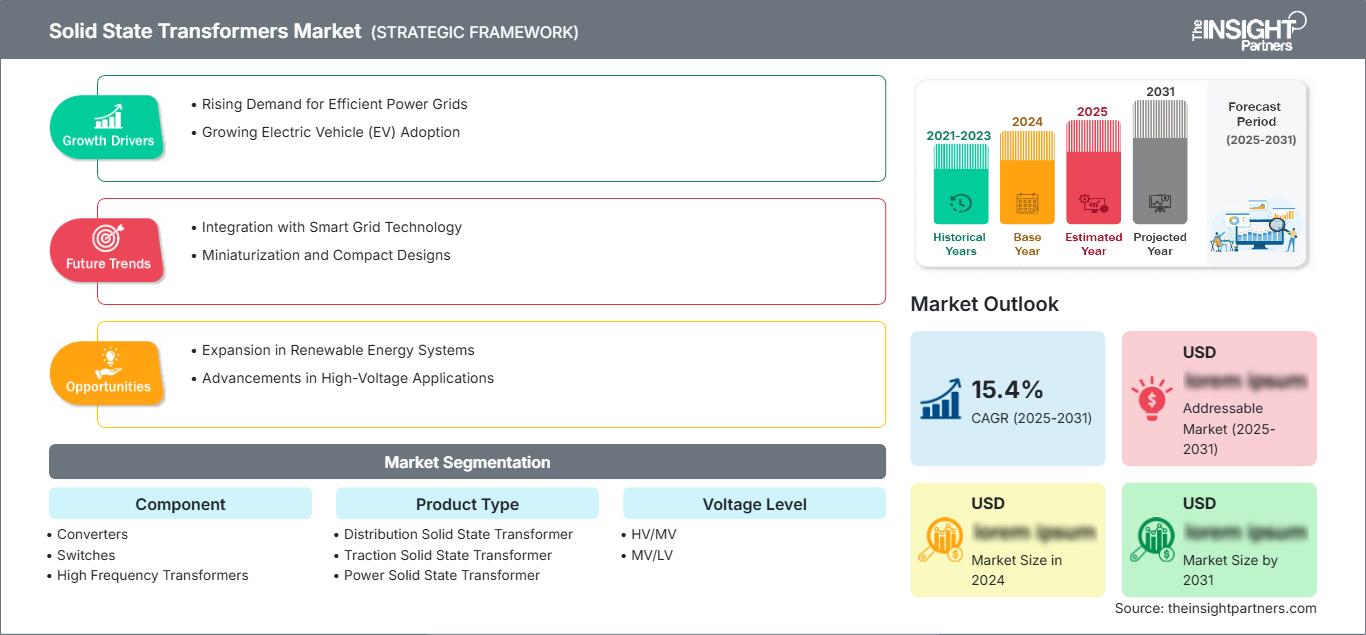
Solid State Transformers Market: Strategic Insights
Regional Insights
North America Solid State Transformers Market
North America accounted for ~34% of the global market in 2025 and is projected to expand at ~31% CAGR through 2034. The regional opportunity is anchored in the US, where utilities and infrastructure developers are addressing aging distribution assets, growing electricity demand, distributed generation, storage, and new high-power loads. Solid-state architectures provide an avenue for integrating voltage conversion, monitoring, power-quality management, and bidirectional operation within increasingly digital distribution environments.
US accounts for about 88% of North American revenue in the market. Demand is driven by the presence of data centers with high density, EV charging stations, renewable microgrids, and industrial electrification. Canada adds value through the integration of renewables, grid modernization, and electrification programs, whereas the wider regional environment profits due to existing power electronics manufacturing and engineering expertise. The key issue in adoption is the trade-off between functionality and economics vs. traditional transformers.
U.S. Solid State Transformers Market
The US generated ~88% of North American market revenue in 2025 and is expected to register ~31% CAGR through 2034. Its market development is supported by utility modernization programs, distributed energy resources, EV charging, energy storage, and rapidly expanding digital infrastructure. The combination of large electricity loads and constrained physical space increases the relevance of compact, high-power-density conversion technologies.
Company operations range from existing electrical equipment manufacturers to niche power electronics providers. Areas of application include distribution systems, microgrids, EV charging, and power architecture for data centers. It will probably be driven by project applications in the early stages, where utilities and infrastructure providers will look at reliability, interoperability, cybersecurity, maintenance, and economic factors for the full life cycle.
Europe Solid State Transformers Market
According to the Solid State Transformers Market forecast, Europe represented ~29% of the global market in 2025 and is expected to expand at ~32% CAGR through 2034. Germany is the leading country in Europe, supported by industrial electrification, renewable integration, advanced manufacturing, and grid modernization. The UK provides opportunities through offshore wind integration, network flexibility, and electrification of transport, while France benefits from rail, industrial, and low-carbon power infrastructure. Italy and Spain add demand through renewable generation, distribution modernization, and electrification projects.
European adoption is closely linked to the need to accommodate increasingly decentralized generation and variable electricity flows without proportionally expanding conventional infrastructure. France and Germany also provide strong engineering and industrial ecosystems for power conversion and transportation applications. Across the region, solid-state systems can gain relevance where controllability, compactness, bidirectional operation, and power-quality management offer operational advantages that justify higher initial technology complexity.
APAC Solid State Transformers Market
The Solid State Transformers Market report shows that Asia Pacific accounted for ~29% of the global market in 2025 and is forecast to grow at ~39% CAGR through 2034, making it the fastest-growing regional market. China is the leading country in Asia Pacific, supported by industrial scale, electrification, renewable deployment, EV infrastructure, and domestic power-electronics capabilities. Japan and South Korea contribute advanced semiconductor and electrical-equipment expertise, while India and Australia provide expanding grid and renewable applications.
Industrial modernization is a key regional demand driver. China and India require scalable infrastructure for renewable integration and electric mobility, while Japan and South Korea emphasize advanced power conversion and resilient electrical systems. Australia adds opportunities linked to renewable generation, storage, and geographically dispersed electricity infrastructure.
Middle East & Africa Solid State Transformers Market
The Solid State Transformers Market in Middle East & Africa is developing from a smaller base, with adoption supported by grid expansion, renewable-energy investment, industrial diversification, and electrification of infrastructure. The region is expected to register ~28% CAGR through 2034. Saudi Arabia represents a significant regional opportunity because of large-scale infrastructure development, renewable-energy programs, and efforts to modernize electricity networks supporting new industrial and urban loads.
The UAE provides additional demand through smart-grid initiatives, renewable projects, and digitally enabled infrastructure, while South Africa presents opportunities associated with grid modernization and distributed generation. Rest of MEA remains more heterogeneous, with adoption dependent on project economics, grid maturity, local technical capabilities, and access to financing. Solid-state systems are therefore expected to enter through targeted applications before broader utility deployment.

Segmentation Analysis
Component
Component is expected to register a CAGR of ~34% through 2034 as converters, switches, and high-frequency transformers become increasingly optimized for higher efficiency, power density, and controllability. The segment reflects the shift toward integrated power-electronic architectures and creates opportunities for component suppliers capable of meeting demanding thermal, switching, reliability, and voltage requirements.
- Converters: Converters provide the power-electronic interface required for controlled voltage and frequency transformation. Their importance increases as SST architectures incorporate bidirectional energy flows, DC outputs, renewable generation, storage, and charging systems requiring flexible power management.
- Switches: Switches determine switching performance, controllability, efficiency, and protection characteristics. Their strategic importance is increasing with advances in wide-bandgap semiconductor technologies and the need to operate power-conversion systems at higher frequencies and power densities.
- High Frequency Transformers: High Frequency Transformers provide galvanic isolation while enabling compact magnetic architectures. Their design directly affects system efficiency, thermal behavior, size, and reliability, making materials, winding structures, insulation, and manufacturing precision important competitive considerations.
Product Type
Product Type is projected to expand at a CAGR of ~33% through 2034. Distribution, traction, and power solid state transformers address different operating environments and customer requirements. Product differentiation is increasingly determined by voltage class, power rating, bidirectional capability, thermal architecture, controls, installation environment, and compatibility with digital grid systems.
- Distribution Solid State Transformer: Distribution SSTs address grid-edge voltage conversion and power-quality requirements. They can support distributed generation, storage, EV charging, and flexible loads while providing greater controllability than conventional distribution transformers.
- Traction Solid State Transformer: Traction SSTs are relevant to rail electrification because they can reduce equipment volume and provide advanced power conversion. Adoption is influenced by rolling-stock requirements, railway voltage standards, weight constraints, efficiency, and reliability expectations.
- Power Solid State Transformer: Power SSTs target higher-power applications where controllable conversion and integration with modern electrical infrastructure are important. They can support industrial facilities, renewable systems, storage, and specialized grid applications requiring flexible power-flow management.
Voltage Level
Voltage Level is expected to register a CAGR of ~33% through 2034. The segment reflects different points of electrical conversion, with HV/MV systems serving upstream or medium-voltage interfaces and MV/LV architectures addressing distribution and end-use applications. Deployment depends on insulation, semiconductor ratings, thermal performance, protection, and grid-interconnection requirements.
- HV/MV: HV/MV applications focus on higher-voltage interfaces where solid-state conversion can provide controllable power flow and advanced grid functions. Adoption requires robust insulation, semiconductor technology, protection coordination, and high-reliability architectures suitable for utility environments.
- MV/LV: MV/LV applications provide a direct opportunity for compact conversion closer to loads. Demand is linked to distribution modernization, EV charging, renewable integration, storage, industrial facilities, and applications where reduced conversion stages can improve system efficiency.
Application
Application is forecast to expand at a CAGR of ~36%, reflecting increasing demand for flexible power conversion across transportation, utilities, charging infrastructure, and renewable generation. The Solid State Transformers Market scope is broadening as end users evaluate SSTs not only for voltage conversion but also for power-quality control, bidirectional flows, digital monitoring, and integration of DC loads.
- Automotive: Automotive applications are associated with electrified mobility and vehicle-related power infrastructure. SST adoption can support compact conversion architectures and high-power electrical systems, particularly where charging, energy management, and grid interaction require flexible voltage transformation.
- Power Grid: Power grid applications focus on modernization, controllability, distributed energy integration, and power-quality management. SSTs can provide functionality that conventional transformers do not inherently offer, supporting more flexible distribution architectures and digitally managed grid-edge infrastructure.
- Electric Vehicle Charging Stations: EV charging stations represent a high-growth application because charging depots require high-power conversion, compact equipment, and scalable grid connections. SSTs can directly connect medium-voltage networks with charging systems while reducing conversion stages and supporting future high-power charging architectures.
- Renewable Power Generation: Renewable applications benefit from bidirectional conversion and flexible coupling between generation, storage, and electrical networks. SSTs can support variable generation profiles and improve controllability where renewable assets increasingly interact with storage and digitally managed distribution infrastructure.
Opportunity Snapshot
| Application | Revenue Contribution | Trend Tag | Adoption Stage |
| Automotive | Medium | Electrified Mobility | Scaling |
| Power Grid | High | Grid Modernization | Scaling |
| Electric Vehicle Charging Stations | High | Fast Charging | Scaling |
| Renewable Power Generation | Medium | Renewable Integration | Scaling |
Solid State Transformers Market Growth Drivers and Impact Analysis
Expansion of Electrification and Distributed Energy Resources
The expansion of electrification is increasing the complexity of electricity networks by adding EV charging, battery storage, renewable generation, heat-related electrical loads, and digitally controlled industrial equipment. Conventional distribution architectures were designed primarily for predictable, one-directional power flows, whereas modern systems increasingly require bidirectional operation and dynamic voltage management. Solid-state transformers can address this requirement by combining transformation with power-electronic control. Their ability to interface AC and DC systems also supports architectures where generation, storage, and loads operate at different electrical characteristics. The resulting value proposition is strongest in applications where controllability and system integration are more important than the lowest upfront equipment cost. As electrification progresses, project developers and utilities are likely to evaluate SSTs as part of broader grid modernization rather than as direct replacements for every conventional transformer.
Rising Demand for Compact High-Power Conversion
High-density electrical loads are creating stronger requirements for compact equipment with high efficiency and controllable power delivery. EV charging depots, industrial facilities, renewable plants, storage systems, and large digital infrastructure projects can require substantial power within constrained physical footprints. Solid-state transformers can reduce the number of conversion stages and enable more direct interfaces between medium-voltage supplies and downstream DC or AC loads. This can reduce equipment footprint and simplify certain power architectures while creating opportunities for integrated monitoring and control. The commercial impact depends on achieving sufficient reliability, thermal performance, serviceability, and cost competitiveness. As equipment suppliers standardize modular designs and customers gain operating experience, the technology can become more attractive for projects where physical space, installation time, and power density materially affect total project economics.
Solid State Transformers Market Future Trends
Integration with Digital and DC Power Architectures
Solid State Transformers Market trends are increasingly connected with the development of digitally managed and DC-oriented power architectures. Modern electrical systems are incorporating more DC-native equipment, including batteries, renewable generation interfaces, EV charging systems, and high-density electronic loads. SSTs can serve as an intelligent conversion layer between medium-voltage AC networks and these downstream systems. Future architectures are therefore likely to combine SSTs with monitoring, software controls, protection, energy-management systems, and distributed storage. The trend could shift the competitive basis from transformer hardware alone toward integrated power platforms. Suppliers that can coordinate conversion, protection, control, and communications may address broader system requirements, while customers will increasingly evaluate interoperability, cybersecurity, maintainability, and lifecycle performance alongside conversion efficiency.
Higher Adoption of Wide-Bandgap Semiconductor Technologies
The development of silicon carbide and other advanced semiconductor technologies is expected to influence SST architecture by enabling higher switching frequencies, improved efficiency, and potentially smaller conversion systems. Higher-frequency operation can reduce the size of magnetic components, although thermal management, insulation, electromagnetic compatibility, reliability, and semiconductor cost remain important engineering considerations. As component technologies mature, manufacturers can optimize converters and high-frequency transformers for different voltage and power requirements rather than relying on a single architecture. This creates opportunities for modular SST platforms that can be adapted across distribution, charging, renewable, and industrial applications. Commercial adoption will depend on whether improvements in performance and footprint compensate for the additional complexity associated with advanced power electronics.
Solid State Transformers Market Opportunities
AI Infrastructure and High-Density Power Distribution
Solid State Transformers Market Forecasts point to an opportunity in high-density power infrastructure where electricity demand is increasing rapidly and physical space is constrained. AI-oriented data centers are particularly relevant because their electrical architectures increasingly require efficient conversion, high power density, rapid response, and direct integration with DC loads. SST-based architectures can potentially reduce intermediate conversion stages and support higher-voltage DC distribution. The opportunity extends beyond hyperscale facilities to industrial computing, advanced manufacturing, and other power-intensive digital infrastructure. For suppliers, commercial entry can involve modular systems, demonstration projects, utility partnerships, and integrated offerings that combine transformation with switching, protection, monitoring, and energy management.
EV Charging and Renewable-Energy Integration
A second opportunity lies in combining EV charging infrastructure with renewable generation and energy storage. Charging depots can create concentrated medium-voltage loads, while renewable generation and batteries introduce bidirectional power flows that conventional architectures may handle through multiple conversion stages. SSTs can provide a common power-electronic interface capable of connecting these resources and managing electrical flows dynamically. Commercial opportunities can therefore emerge in fleet depots, logistics hubs, public charging corridors, renewable-powered charging sites, and distributed energy hubs. Suppliers that develop standardized, modular systems can address repeated deployment requirements while adapting controls and power ratings to individual project configurations.
Recent Developments
- September 2026: ABB Ltd. launched its Infinitus direct-current portfolio for AI data centers, with solid-state transformer technology at its core. The architecture is designed to convert medium-voltage AC directly to 800 VDC and support higher power density, energy efficiency, and reduced infrastructure footprint. ABB positioned the technology for AI data centers and identified broader applicability across industrial buildings, manufacturing, renewables, and marine operations.
- August 2026: Siemens AG and Maschinenfabrik Reinhausen announced a strategic partnership to develop and industrialize a solid-state transformer for AI-ready data centers. The modular SST is designed for grid voltages up to 36 kV and an 800 VDC output, targeting reduced conversion stages, improved availability, and lower infrastructure footprint for high-density computing environments.
- May 2026: Eaton Corporation plc expanded its collaboration with the National University of Singapore-led Sustainable Tropical Data Centre Testbed and planned to showcase a 2.5 MW medium-voltage solid-state transformer container for market feedback and subsequent live trials at Jurong Island. The initiative is intended to generate operating data for high-density, AI-ready power architectures in tropical conditions.
Frequently Asked Questions

- Comprehensive Market Sizing and Forecast Analysis
- Detailed Segmentation Analysis
- In-Depth Market Dynamics Assessment
- Regional and Country-Level Insights
- Competitive Landscape and Company Benchmarking
- Strategic Business Intelligence
Recent Reports
Testimonials

The Insight Partners provided valuable market intelligence that supported our global go-to-market strategy. Their team was professional, responsive, and attentive to our feedback, providing thoughtful analysis and helpful methodological clarifications throughout the project.
Junmo Kim Chief Financial Officer (CFO), Enertech Co., Ltd.
The Insight Partners' SCADA System Market report is comprehensive, with valuable insights on current trends and future forecasts. The team was highly professional, responsive, and supportive throughout. We are very satisfied and highly recommend their services.
RAN KEDEM Partner, Reali Technologies LTDs
I requested a report on a very specific software market and the team produced the report in a few days. The information was very relevant and well presented. I then requested some changes and additions to the report. The team was again very responsive and I got the final report in less than a week.
JEAN-HERVE JENN Chairman, Future Analytica
We worked with The Insight Partners for an important market study and forecast. They gave us clear insights into opportunities and risks, which helped shape our plans. Their research was easy to use and based on solid data. It helped us make smart, confident decisions. We highly recommend them.
PIYUSH NAGPAL Sr. Vice President, High Beam Global
The Insight Partners delivered insightful, well-structured market research with strong domain expertise. Their team was professional and responsive throughout. The user-friendly website made accessing industry reports seamless. We highly recommend them for reliable, high-quality research services
YUKIHIKO ADACHI CEO, Deep Blue, LLC.
This is the first time I have purchased a market report from The Insight Partners.While I was unsure at first, I visited their web site and felt more comfortable to take the risk and purchase a market report.I am completely satisfied with the quality of the report and customer service. I had several questions and comments with the initial report, but after a couple of dialogs over email with their analyst I believe I have a report that I can use as input to our strategic planning process.Thank you so much for taking the extra time and making this a positive experience.I will definitely recommend your service to others and you will be my first call when we need further market data.
JOHN SUZUKI President and Chief Executive Officer, Board Director, BK Technologies
I wish to appreciate your support and the professionalism you displayed in the course of attending to my request for information regarding to infectious disease IVD market in Nigeria. I appreciate your patience, your guidance, and the fact that you were willing to offer a discount, which eventually made it possible for us to close a deal. I look forward to engaging The Insight Partners in the future, all thanks to the impression you have created in me as a result of this first encounter.
DR CHIJIOKE ONYIA MANAGING DIRECTOR, PineCrest Healthcare Ltd.Reason to Buy
- Informed Decision-Making
- Understanding Market Dynamics
- Competitive Analysis
- Identifying Emerging Markets
- Customer Insights
- Market Forecasts
- Risk Mitigation
- Boosting Operational Efficiency
- Strategic Planning
- Investment Justification
- Tracking Industry Innovations
- Aligning with Regulatory Trends





 Get Free Sample for