
Stacker Market Share, Growth & Demand by 2034
Coverage: By Type (Electric, Hydraulic); End-User (Retail, Logistics, Automobile, Food and Beverages, Others) , and Geography (North America, Europe, Asia Pacific, and South and Central America)
- Status : Data Released
- Report Code : TIPRE00008448
- Category : Manufacturing and Construction
- No. of Pages : 150
- Available Report Formats :


- Last update date : October 30, 2026


2025 Market Size
US$ 39.86 Bn
Base year value
2034 Forecast
US$ 82.22 Bn
Projected by 2034
CAGR 2026-2034
8.38 %
Growth rate
Addressable Market
US$ 548.10 Bn
(2026-2034)
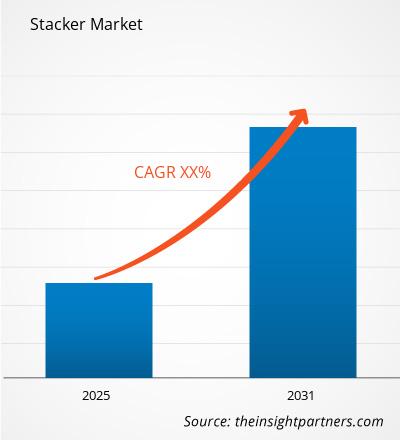
The Stacker Market was valued at US$ 39.86 Billion in 2025 and is projected to reach US$ 82.22 Billion by 2034, expanding at a 8.38% CAGR from 2026 to 2034. Demand is supported by the need for efficient pallet movement, vertical storage, narrower aisles, improved operator ergonomics, and flexible equipment suited to retail, logistics, automobile, and food and beverage facilities. The market is increasingly shaped by warehouse modernization, compact material handling requirements, and the transition toward lower-emission equipment.
North America is supported by established warehouse infrastructure, replacement demand, and increasing deployment of electric material handling equipment. The Stacker Market size is also influenced by investments in distribution centers, cold-chain facilities, and manufacturing operations requiring compact lifting solutions. Electric equipment is gaining relevance as operators seek lower maintenance requirements, quieter operation, and improved energy efficiency across multi-shift warehouse environments.
Stacker Market Assessment and Insights
Regional Outlook
- North America: ~27% of the global market in 2025 | ~7% CAGR through 2034. Market position: North America represents a mature demand center supported by extensive warehousing, distribution, manufacturing, and retail infrastructure. Fleet replacement, labor optimization, narrow-aisle storage, and electrification support sustained equipment investment.
- US: ~82% of North American market revenue in 2025 | ~7% CAGR through 2034. Market position: The US represents the principal North American demand base, supported by large distribution networks, e-commerce fulfillment, food logistics, manufacturing, and established material handling fleets. Automation and operator-assistance technologies increasingly influence purchasing decisions.
- Europe: ~24% of the global market in 2025 | ~7% CAGR through 2034. Market position: Europe is a mature market characterized by warehouse automation, stringent workplace requirements, energy-efficiency priorities, and established industrial manufacturing. Germany is the leading country in Europe, followed by substantial demand from the UK, France, Italy, and Spain.
- Asia Pacific: ~40% of the global market in 2025 | ~10% CAGR through 2034. Market position: Asia Pacific is the largest and fastest-growing regional market, supported by manufacturing expansion, logistics infrastructure, e-commerce, and warehouse modernization. China is the leading country in Asia Pacific, while India and Southeast Asian economies provide additional expansion opportunities.
Segment Outlook
- Electric: ~65% Share in 2025 | ~9% CAGR through 2034. Market position: Electric stackers lead because they combine compact dimensions, controlled lifting, lower operating emissions, and suitability for indoor applications. Their relevance is increasing in warehouses, retail distribution, food facilities, and manufacturing sites pursuing electrification.
- Logistics: ~38% Share in 2025 | ~10% CAGR through 2034. Market position: Logistics is the high-growth end-user segment because distribution centers require frequent pallet movement, rapid put-away, vertical storage, and efficient use of floor space. E-commerce fulfillment and warehouse modernization further strengthen equipment utilization.
Competitive Coverage
CLARK Material Handling Company, Crown Equipment Corporation, Doosan Corporation Industrial Vehicle, Godrej and Boyce Manufacturing Company Limited, Hangcha Group Co., Ltd., Jungheinrich AG, Mitsubishi Logisnext Co., Ltd., Nido Machineries Pvt. Ltd., PUMA LIFT, Toyota Industries Corporation
Methodology
The Insight Partners follows Data Collection & Secondary Research, Primary Research, Data Analysis, and Data Triangulation & Final Review to validate market estimates and insights.
Source: The Insight Partners' analysis based on proprietary research, government publications, company annual reports, investor presentations, industry databases, and expert interviews.
Stacker Market products have changed from manual operation to electrical and ergonomically friendly designs that can be interconnected. Advances in batteries, powertrain, hydraulic controls, operator interface, and compact chassis have made the role of stackers in warehouses and industrial production areas grow. Manufacturers are competing in terms of maneuverability, lift ability, energy efficiency, safety assistance, and compatibility with digitally controlled material flow. The trend is especially significant where the operator needs to move the pallet vertically and horizontally without occupying the floor area by bigger trucks.
In the future, the Stacker Market will see increased integration of equipment into the automated warehousing systems and energy control system. Industrial countries will develop new warehouses as part of organized manufacturing and logistics networks. Investment in lithium-ion machinery, warehousing software, operator assistance, and automated material handling can become an influential criterion in the procurement decision making process. Workplace safety regulations may also contribute to equipment replacements.
Stacker Market Report Scope
| Report Attribute | Details |
|---|---|
| Market size in 2025 | US$ 39.86 Billion |
| Market Size by 2034 | US$ 82.22 Billion |
| Global CAGR (2026 - 2034) | 8.38% |
| Historical Data | 2021-2024 |
| Forecast period | 2026-2034 |
Stacker Market Analysis
Demand is highly related to throughput, pallet density, storage height, aisle width, and labor. Stackers represent an ideal middle way between basic pallet trucks and forklifts due to the ability to stack goods vertically without increasing footprint size significantly. The value chain is represented by equipment manufacturers, component makers, battery and charging systems suppliers, dealers, rental companies, warehouse systems integrators, and after-sales service providers. Supply trends become more favorable towards platforms which allow installing different batteries, masts, capacities, control systems, and attachments specific to applications.
As per the Stacker Market Report, the industry is made up of global material handling conglomerates and regional players addressing the needs of price and application-specific markets. Toyota Industries Corporation, Jungheinrich AG, Crown Equipment Corporation, Mitsubishi Logisnext Co., Ltd., CLARK Material Handling Company, Doosan Corporation Industrial Vehicle, and Hangcha Group Co., Ltd. operate on the competitive scene with product range, network of dealers, engineering capabilities, and service support. Regional and application-focused participation in competition is provided by Godrej and Boyce Manufacturing Company Limited, Nido Machineries Pvt. Ltd., and PUMA LIFT.
● REPORT CUSTOMIZATION
Tailor This Report To Align With Your Specific Business Requirements
This report can be customized to align precisely with your business objectives, scope, and target markets. Customization options include tailored segmentation, geography, competitive analysis, and strategic insights to support informed decision-making.
Customize This Report →WHAT YOU CAN ADJUST
- ● Segmentations
- ● Geography
- ● Competitive Analysis
- ● Language Preferences
Stacker Market: Strategic Insights

Regional Insights
North America Stacker Market
North America held ~27% share of Global Stacker Market in 2025 and will continue to grow at ~7% CAGR from 2024 to 2034. Distribution network, retail network, manufacturing capabilities, and third-party logistics services are well developed in the region. Application that require frequent movement of pallets, stacking of products vertically, and mobility in small spaces are some factors contributing to the regional demand. Aging fleet is another structural factor in terms of replacement demand due to increasing trend of considering total operational cost, energy consumption, safety, and services while purchasing new equipment.
US accounts for ~82% of market revenue in North America and will remain the key demand center in the region. Warehouse construction, fulfillment center building, food distribution and industrial reshoring will continue to drive the equipment needs. Canada and Mexico will offer complimentary demand in terms of manufacturing, logistics, food processing and cross-border logistics. Electric stackers will find relevance in regions where indoor air quality, noise, operational cost and energy management have significance while buying.
U.S. Stacker Market
North American Stacker Market Revenue in the United States accounts for ~82% of revenue share in 2025 and is anticipated to register a growth rate of ~7% CAGR till 2034. There will be an increasing need for compact and efficient material handling equipment for large-scale distribution centers, retail storage warehouses, manufacturing centers and food logistics due to the presence of existing dealer and service network for replacement and maintenance purposes. Toyota Industries Corporation, Crown Equipment Corporation, CLARK Material Handling Company, Jungheinrich AG and other foreign vendors are engaged in US material handling applications.
Electric walkie and straddle variants find themselves suitable for short distance material handling and rack stacking as well as operating in confined spaces. Growth in this market is also driven by facilities that want to increase their storage capacity without investing in infrastructure changes. In addition, safety features and connected machines, along with adjustable performance parameters become essential for productivity improvements amidst labor restrictions and high operating costs.
Europe Stacker Market
The European region accounted for ~24% share of the Stacker Market in 2025 and is anticipated to grow at a ~7% CAGR during 2025-2034. Germany is the leading country in the region, driven by the country's well-established manufacturing industry, logistics network, engineering sector, and a large number of material handling companies. The UK gets its edge from the retail distribution and e-commerce business, whereas France is driven by manufacturing, food distribution, and logistics sectors. In addition, the growth from industrial, automotive, food, and warehousing applications from Italy and Spain is observed.
Germany has a unique ecosystem in terms of electric material handling and warehouse automation, the UK has an emphasis on the productivity and space optimization at distribution centers, and France continues to gain an advantage from the modernization of the logistics infrastructure. In Italy, the industrial and automotive cluster drives the application-specific demand for stackers, and in Spain, the growing logistics facilities along with its regional distribution networks play their roles. Several factors that affect the choice of the equipment across Europe are energy efficiency, safety in the workplace, warehouse density, and automation compatibility.
APAC Stacker Market
Asia Pacific accounted for ~40% of the Stacker Market share in the year 2025 and is forecasted to register ~10% CAGR during the period 2026-2034, making it the fastest growing regional market. China leads the Asia Pacific market, backed by extensive manufacturing, logistics, e-commerce, and local equipment manufacturing. Japan makes contributions through its advanced automation and efficient industrial activities. South Korea, on the other hand, receives backing owing to applications in electronics, automobiles, and logistics sector.
The Indian market is backed by organized warehousing, manufacturing growth, modernization of retailing, and logistics infrastructure. The Australian market is receiving support due to its contribution in distribution, food logistics, and industrial warehousing. In the region, investments in modern storage facilities along with a transition from manual handling to mechanization drives the usage of stackers. Electric equipment holds value due to reduction in operational costs and clean environment inside the facility.
Middle East & Africa Stacker Market
The Middle East and Africa market is projected to expand at ~8% CAGR through 2034. Saudi Arabia is the leading country in the Middle East & Africa market where evidence supports the position, driven by logistics infrastructure, industrial diversification, retail development, and investment in modern warehousing. The UAE also represents a significant regional demand center because of its logistics hubs, distribution facilities, ports, and re-export activity.
South Africa provides an important African base through manufacturing, retail distribution, food processing, and logistics operations. Rest of MEA demand is associated with industrial projects, distribution infrastructure, food supply chains, and warehouse modernization. Energy management and operating reliability are important considerations in the region, while infrastructure development creates opportunities for compact material handling equipment. As organized logistics networks expand, stackers can provide flexible pallet movement and vertical storage without requiring the larger footprint associated with heavier industrial equipment.
Segmentation Analysis
Type
The type segment is divided into Electric and Hydraulic. The segment is expected to expand at ~9% CAGR from 2026 to 2034. Electric equipment is increasingly preferred for indoor warehouse applications because of controlled operation, lower direct emissions, reduced noise, and compatibility with modern battery systems. Hydraulic stackers remain relevant where buyers prioritize straightforward lifting mechanisms, lower equipment complexity, or specific application requirements.
- Electric: Electric stackers are positioned strongly in warehouses, distribution centers, retail facilities, food operations, and manufacturing plants. Demand is associated with indoor operation, energy efficiency, maneuverability, and increasing acceptance of lithium-ion battery systems.
- Hydraulic: Hydraulic stackers remain relevant for applications requiring dependable lifting with comparatively straightforward mechanical architecture. They can serve smaller warehouses, workshops, production areas, and operations where purchase economics and simple maintenance remain important procurement considerations.
End-User
The end-user segment is divided into Retail, Logistics, Automobile, and Food and Beverages and is projected to grow at ~9% CAGR from 2026 to 2034. Logistics represents the largest demand center because high-volume distribution facilities require repeated pallet movement and vertical storage. Retail, automobile, and food and beverage applications provide diversified demand based on inventory characteristics, facility layouts, and handling requirements.
- Retail: Retail warehouses and distribution facilities use stackers for pallet put-away, replenishment, order preparation, and short-distance movement. Space utilization and equipment maneuverability are strategically important as retailers expand fulfillment capabilities.
- Logistics: Logistics operations require frequent pallet handling, loading, unloading, storage, and retrieval. Stackers support distribution-center productivity and space optimization, making this application strategically important as supply chains become more responsive and warehouse networks expand.
- Automobile: Automotive plants and component warehouses use stackers to move parts, packaging, assemblies, and production materials. Demand is influenced by manufacturing-line logistics, organized storage, and the need for reliable movement across constrained production environments.
- Food and Beverages: Food and beverage facilities require dependable pallet movement across warehouses, production areas, and distribution centers. Electric equipment is particularly relevant for indoor environments where emissions, hygiene considerations, maneuverability, and operating noise influence equipment selection.
Opportunity Snapshot
| End-User | Revenue Contribution | Trend Tag | Adoption Stage |
| Retail | Medium | Fulfillment Density | Scaling |
| Logistics | High | Warehouse Automation | Mature |
| Automobile | Medium | Line-Side Handling | Scaling |
| Food and Beverages | Medium | Cold-Chain Handling | Scaling |
Stacker Market Growth Drivers and Impact Analysis
Expansion of Warehousing and Distribution Infrastructure
The expansion of distribution centers is increasing the requirement for compact equipment capable of moving pallets while maximizing storage capacity. Modern warehouses increasingly emphasize vertical utilization because land and facility costs can constrain expansion. Stackers support this requirement by combining lifting functionality with maneuverability in relatively narrow operating areas. The impact extends beyond equipment purchases because higher warehouse density can encourage investment in compatible racking, charging systems, fleet-management tools, and service contracts. Logistics operators also benefit from equipment that can perform multiple short-distance handling tasks without deploying larger forklifts for every movement. As organized retail and fulfillment networks become more extensive, equipment utilization can rise across receiving, put-away, replenishment, and dispatch activities, strengthening replacement and fleet-expansion demand.
Electrification of Material Handling Equipment
Electrification is changing equipment selection across warehouses and industrial facilities. Electric stackers can support indoor operations where lower noise, reduced direct emissions, and controlled maneuverability are valued. Improvements in lithium-ion batteries, charging systems, and energy management are also reducing some of the operational limitations associated with conventional battery-powered equipment. The impact is particularly relevant for facilities operating multiple shifts because charging strategy, opportunity charging, battery life, and equipment availability directly influence productivity. Electrification can also encourage fleet standardization because the same energy infrastructure can support multiple categories of electric material handling equipment. As companies evaluate total cost of ownership, lower maintenance requirements and energy efficiency can become important alongside purchase price.
Labor Optimization and Demand for Safer Material Movement
Labor availability and workplace safety considerations are encouraging companies to mechanize repetitive pallet-handling tasks. Stackers can reduce the physical effort associated with lifting and positioning palletized goods while allowing operators to manage loads more consistently. The market impact is strongest in facilities with high movement frequency, constrained aisles, or repetitive put-away operations. Manufacturers are therefore incorporating ergonomic controls, improved visibility, stability systems, programmable performance settings, and operator-assistance features into equipment platforms. These developments can increase acceptance among users that previously relied on manual handling or basic equipment. For fleet operators, improved ergonomics can complement broader workforce strategies by helping employees perform material movement tasks with greater consistency and reducing dependence on purely manual lifting activities.
Stacker Market Future Trends
Integration of Connected and Semi-Autonomous Functions
Connected stackers are expected to become more closely integrated with warehouse-management and fleet-management systems. Equipment can increasingly serve as a data source for utilization monitoring, battery management, maintenance planning, and operator-performance analysis. The longer-term direction is toward semi-autonomous functions that assist positioning, speed control, route execution, and repetitive handling activities while retaining human oversight where application complexity requires it. This transition can change the purchasing process because buyers may evaluate software compatibility and data visibility alongside mechanical specifications. Manufacturers with established digital platforms can therefore differentiate through the ability to connect equipment with wider warehouse workflows. The trend is likely to be most relevant in high-throughput logistics facilities where utilization data can support measurable operational improvements.
Lithium-Ion Platforms and Energy-Optimized Fleet Design
Battery architecture is expected to become an increasingly important differentiator across the Stacker Market Trends. Lithium-ion systems can support compact equipment designs, opportunity charging, and multi-shift utilization while reducing some maintenance requirements associated with traditional battery technologies. Future product development is likely to focus on integrating batteries, chargers, thermal management, and energy monitoring into complete fleet solutions rather than treating them as separate components. This trend can influence equipment geometry, operating availability, and charging infrastructure requirements. Facilities may increasingly assess energy consumption at the fleet level, encouraging standardized electric platforms and charging strategies. The result is a gradual shift from equipment selection based only on capacity and lift height toward broader evaluation of productivity, energy utilization, uptime, and lifecycle economics.
Stacker Market Opportunities
Localized Production and Distribution in Emerging Manufacturing Economies
Manufacturers can capture opportunities by expanding localized production, component sourcing, dealer networks, and after-sales service in emerging manufacturing economies. India and other Asia Pacific markets offer potential because warehouse infrastructure, organized retail, automotive production, and logistics networks are expanding simultaneously. Localized platforms can address application requirements and price sensitivity more effectively while reducing delivery lead times. Regional service capabilities are equally important because fleet downtime can directly affect warehouse throughput. Companies that combine locally adapted equipment with financing, leasing, maintenance, operator training, and replacement programs can address a broader portion of the equipment lifecycle. Such approaches can also strengthen customer retention and improve access to smaller warehouses that may not justify highly customized automation projects.
Integrated Equipment, Software, and Lifecycle Service Models
An additional opportunity in the Stacker Market Forecast lies in combining stackers with fleet-management software, energy systems, maintenance services, training, and financing. Customers increasingly evaluate material handling as an operational system rather than an isolated equipment purchase. Suppliers can therefore expand revenue opportunities through monitoring, preventive maintenance, battery management, rental, refurbishment, and lifecycle replacement programs. Integration with warehouse software can further improve fleet visibility and allow operators to match equipment deployment with workload patterns. This model is particularly relevant to logistics companies managing large fleets across multiple facilities. A service-oriented approach can create recurring customer engagement while allowing manufacturers and dealers to differentiate in markets where equipment specifications are becoming increasingly comparable.
Recent Developments
- February 2026: Jungheinrich announced a comprehensive redesign of its 1i series pallet and double-deck trucks, introducing a shorter vehicle front, scalable lithium-ion energy concepts with integrated chargers, ergonomic operating improvements, and additional safety and assistance functions. The development reflects increasing emphasis on compact equipment, reduced downtime, and safer warehouse handling.
- August 2025: Toyota Material Handling introduced three electric heavy-duty stacker solutions in North America, comprising counterbalanced, walkie reach, and walkie straddle configurations. The launch targeted diverse warehouse environments and emphasized versatility, durability, operator comfort, and productivity. The development expands Toyota's electric stacker offering for demanding warehouse applications.
- February 2026: STAKON showcased its Metal Handling Battery Operated Stacker at LogiMAT India, introducing a heavy-duty material handling solution designed for industrial and warehouse applications. The stacker features a robust metal body and heavy-duty mast assembly, making it suitable for handling metal components, fabricated goods, industrial pallets, and medium-to-heavy loads.
Frequently Asked Questions

- Comprehensive Market Sizing and Forecast Analysis
- Detailed Segmentation Analysis
- In-Depth Market Dynamics Assessment
- Regional and Country-Level Insights
- Competitive Landscape and Company Benchmarking
- Strategic Business Intelligence
Recent Reports
Testimonials

The Insight Partners provided valuable market intelligence that supported our global go-to-market strategy. Their team was professional, responsive, and attentive to our feedback, providing thoughtful analysis and helpful methodological clarifications throughout the project.
Junmo Kim Chief Financial Officer (CFO), Enertech Co., Ltd.
The Insight Partners' SCADA System Market report is comprehensive, with valuable insights on current trends and future forecasts. The team was highly professional, responsive, and supportive throughout. We are very satisfied and highly recommend their services.
RAN KEDEM Partner, Reali Technologies LTDs
I requested a report on a very specific software market and the team produced the report in a few days. The information was very relevant and well presented. I then requested some changes and additions to the report. The team was again very responsive and I got the final report in less than a week.
JEAN-HERVE JENN Chairman, Future Analytica
We worked with The Insight Partners for an important market study and forecast. They gave us clear insights into opportunities and risks, which helped shape our plans. Their research was easy to use and based on solid data. It helped us make smart, confident decisions. We highly recommend them.
PIYUSH NAGPAL Sr. Vice President, High Beam Global
The Insight Partners delivered insightful, well-structured market research with strong domain expertise. Their team was professional and responsive throughout. The user-friendly website made accessing industry reports seamless. We highly recommend them for reliable, high-quality research services
YUKIHIKO ADACHI CEO, Deep Blue, LLC.
This is the first time I have purchased a market report from The Insight Partners.While I was unsure at first, I visited their web site and felt more comfortable to take the risk and purchase a market report.I am completely satisfied with the quality of the report and customer service. I had several questions and comments with the initial report, but after a couple of dialogs over email with their analyst I believe I have a report that I can use as input to our strategic planning process.Thank you so much for taking the extra time and making this a positive experience.I will definitely recommend your service to others and you will be my first call when we need further market data.
JOHN SUZUKI President and Chief Executive Officer, Board Director, BK Technologies
I wish to appreciate your support and the professionalism you displayed in the course of attending to my request for information regarding to infectious disease IVD market in Nigeria. I appreciate your patience, your guidance, and the fact that you were willing to offer a discount, which eventually made it possible for us to close a deal. I look forward to engaging The Insight Partners in the future, all thanks to the impression you have created in me as a result of this first encounter.
DR CHIJIOKE ONYIA MANAGING DIRECTOR, PineCrest Healthcare Ltd.Reason to Buy
- Informed Decision-Making
- Understanding Market Dynamics
- Competitive Analysis
- Identifying Emerging Markets
- Customer Insights
- Market Forecasts
- Risk Mitigation
- Boosting Operational Efficiency
- Strategic Planning
- Investment Justification
- Tracking Industry Innovations
- Aligning with Regulatory Trends





 Get Free Sample for