
Stone Crushing Equipment Market Demand, Share & Growth by 2034
Coverage: by Product Type (Cone crusher, Jaw crusher, Impact crusher, Others); End-Use (Mining, Quarrying, Recycling, Others) , and Geography (North America, Europe, Asia Pacific, and South and Central America)
- Status : Data Released
- Report Code : TIPRE00005447
- Category : Manufacturing and Construction
- No. of Pages : 150
- Available Report Formats :


- Last update date : October 30, 2026


2025 Market Size
US$ 2.34 Bn
Base year value
2034 Forecast
US$ 4.2 Bn
Projected by 2034
CAGR 2026-2034
6.71 %
Growth rate
Addressable Market
US$ 29.55 Bn
(2026-2034)
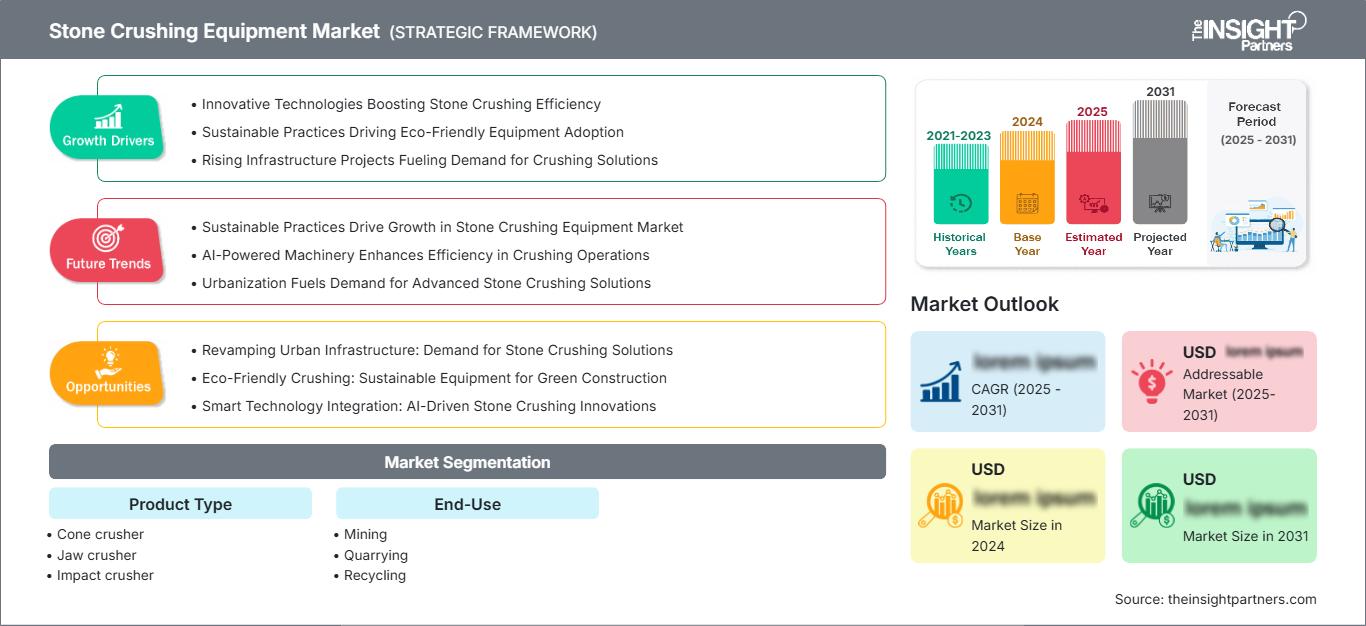
The Stone Crushing Equipment Market was valued at US$ 2.34 Billion in 2025 and is projected to reach US$ 4.2 Billion by 2034, expanding at a CAGR of 6.71% during 2026–2034. Equipment reduces quarried, mined, and recovered stone into specified particle sizes for downstream processing. Demand is shaped by aggregate production, mineral processing, infrastructure construction, and construction waste recovery.
North America remains an important Stone Crushing Equipment Market Size focus because established quarrying operations, replacement demand, and investment in recycling equipment support continued equipment purchases. The region is expected to register a ~5% CAGR through 2034. Mobile processing, automation, and demand for higher equipment utilization are strengthening replacement cycles, while environmental requirements encourage more efficient material recovery and processing configurations.
Stone Crushing Equipment Market Assessment and Insights
Regional Outlook
- North America: ~26% of the global Stone Crushing Equipment Market in 2025 | ~5% CAGR through 2034. Market position: North America represents a mature equipment base supported by aggregates production, infrastructure maintenance, and recycling. Established contractors and quarry operators increasingly prioritize mobile systems, automation, fuel efficiency, and aftermarket support.
- US: ~72% of North American market revenue in 2025 | ~5% CAGR through 2034. Market position: The US accounts for most North American demand because of its extensive aggregate production, construction activity, and established crushing fleet. Replacement purchases increasingly emphasize transportability, productivity, safety, and recycling capability.
- Europe: ~23% of the global market in 2025 | ~5% CAGR through 2034. Market position: Europe is a mature market with strong equipment replacement and recycling demand. Germany is the leading country in Europe, supported by engineering capabilities and established quarrying, construction, and materials-processing ecosystems.
- Asia Pacific: ~38% of the global market in 2025 | ~8% CAGR through 2034. Market position: Asia Pacific is the fastest-growing region, supported by infrastructure expansion, urbanization, mining output, and aggregate consumption. China is the leading country in Asia Pacific, while India and Southeast Asia add equipment demand.
Segment Outlook
- Jaw crusher: ~44% Share in 2025 | ~6% CAGR through 2034. Market position: Jaw crushers lead the product landscape because primary crushing requires robust reduction of large feed sizes. Their broad use in quarrying and mining and suitability for mobile plants sustain demand.
- Recycling: ~29% Share in 2025 | ~9% CAGR through 2034. Market position: Recycling is the high-growth end-use because urban redevelopment and construction waste recovery are increasing the need to process concrete, asphalt, and mixed demolition materials close to project sites.
Competitive Coverage
Astec Industries, Inc., Eagle Crusher Company, Inc., IROCK Crushers, Komatsu Ltd., McLanahan Corporation, Metso Corporation, Sandvik AB, Terex Corporation, thyssenkrupp AG, Zhengzhou YiFan Machinery Co., Ltd.
Methodology
The Insight Partners follows Data Collection & Secondary Research, Primary Research, Data Analysis, and Data Triangulation & Final Review to validate market estimates and insights.
Source: The Insight Partners' analysis based on proprietary research, government publications, company annual reports, investor presentations, industry databases, and expert interviews.
The industry has moved from fixed crushing units towards units where mobile units, automation, optimized chambers, and condition monitoring have been integrated. More and more frequently, jaw, cone, and impact units have been chosen in crushing circuits rather than as stand-alone units. The industry is improving its performance regarding fuel consumption, wear handling, installation times, and portability. Currently available product lines reflect increasing focus on mobile crushing for aggregates and recycling, while mining still requires high-capacity primary and secondary reduction systems.
Urban redevelopment, efficiency, and expansion of aggregate processing capacity are factors influencing the future of the industry. Policies relating to construction waste promote recycling and processing close to the source, while monitoring and remote diagnostics increase equipment availability. The industry is designing flexible units capable of operating in quarrying, demolition, and recycled aggregate production projects.
Stone Crushing Equipment Market Report Scope
| Report Attribute | Details |
|---|---|
| Market size in 2025 | US$ 2.34 Billion |
| Market Size by 2034 | US$ 4.2 Billion |
| Global CAGR (2026 - 2034) | 6.71% |
| Historical Data | 2021-2024 |
| Forecast period | 2026-2034 |
Stone Crushing Equipment Market Analysis
The Stone Crushing Equipment Market growth driver is a combination of downstream demand for aggregates and minerals along with the need for equipment replacement and increase in recycling capacity. While the quarry segment has a need for reduction from larger stones to specification-defined aggregates, the mining segment is reliant on the crushing step prior to downstream processing of minerals. In recent years, there is a preference for mobility on part of the contracting community as long as processing can take place on-site at the quarry/mining or construction site.
The value chain includes equipment manufacturers, component makers and wear parts suppliers, distributors, EPCs, quarries and mines, recycling facilities and after market providers. The supply side is evolving towards modular equipment, intelligent controls, and custom crushing circuits. Instead of competing based on machine capacity, manufacturers compete on performance metrics such as throughput, energy efficiency, wear life, serviceability, and support services. Recycled aggregates add to the customer base for this market.
In this Stone Crushing Equipment Market report, we see competition involving diverse heavy equipment suppliers along with specialized stone-crushing firms. In addition to Metso and Sandvik's wide mineral processing capabilities, Komatsu adds mining equipment along with crushing equipment. Terex, Astec Industries, Eagle Crusher, IROCK Crushers, and McLanahan provide stiff competition in mobile and portable stone crushing and recycling applications. thyssenkrupp AG and Zhengzhou YiFan Machinery have rounded off the supplier offerings in large-scale mineral processing and equipment cost considerations.
Technology that reduces total cost of ownership and ensures higher up-time has become an investment priority. The manufacturers are enhancing their product line and after-sales, monitoring, and application engineering capabilities. Positioning depends upon equipment capability, dealer network, parts availability, financing, and complete processing lines.
● REPORT CUSTOMIZATION
Tailor This Report To Align With Your Specific Business Requirements
This report can be customized to align precisely with your business objectives, scope, and target markets. Customization options include tailored segmentation, geography, competitive analysis, and strategic insights to support informed decision-making.
Customize This Report →WHAT YOU CAN ADJUST
- ● Segmentations
- ● Geography
- ● Competitive Analysis
- ● Language Preferences
Stone Crushing Equipment Market: Strategic Insights
Regional Insights
North America Stone Crushing Equipment Market
The Stone Crushing Equipment Market share for North America was ~26% in 2025 and is expected to expand at ~5% CAGR through 2034. The region benefits from a large installed equipment base, replacement requirements, and spending on roads, commercial development, and site preparation. The US dominates regional demand, while Canada supports demand through mining and aggregates activity.
The choice of machinery is now more dependent on labor, running costs, transportation, and even environmental factors. Mobile jaw and impact crushers will suit the needs of contractors that have demolition waste and recycled aggregates as their primary material source, whereas large, stationary and semi-mobile machines will be more suitable for mining quarries. Remote monitoring of digital controls is becoming significant for achieving better performance.
U.S. Stone Crushing Equipment Market
In 2025, the US accounted for around 72% of the North American market revenue and is expected to register growth at a CAGR of ~5% from 2026 to 2034. The presence of a diversified range of construction materials drives the requirement of crushing equipment, where quarries have needs for grading of aggregates and contractors need equipment that can be used on an occasional basis.
Competitors in the market are Astec Industries, Eagle Crusher, IROCK Crushers, Komatsu, McLanahan, Metso, Sandvik, and Terex. The growing importance of recycling in the market stems from the fact that contractors need to recycle concrete, asphalt, and demolition materials near their project sites.
Europe Stone Crushing Equipment Market
Europe accounted for ~23% of the worldwide market share in 2025 and will likely see ~5% CAGR up to 2034. In Europe, Germany accounts for the major country driven by its well-developed machinery manufacturing and aggregate processing industry. UK demands are seen for its quarrying, construction, and recycling operations; France enjoys infrastructure and aggregate needs, and Italy has a varied construction materials and machinery industry. There is demand from Spain due to its quarrying and infrastructure needs.
More European demands include those related to material recovery and resource efficiency goals. Mobile crushers are helpful when operators want to process material close to demolition and quarries in order to reduce hauling needs. Recycling needs are seen to boost use of impact and jaw designs for concrete and asphalt. The Europeans typically look at emissions performance, mobility of equipment, safety of operation, maintenance access, and integration with screening and conveying solutions.
UK and France offer good markets for aggregate and recycling equipment. Construction materials production, quarrying, and infrastructure renewal drive the demand from Italy and Spain. The equipment availability is not the main source of competitive advantage anymore in the region.
APAC Stone Crushing Equipment Market
Asia Pacific held ~38% of the global market in 2025 and is forecast to expand at ~8% CAGR through 2034, making it the fastest-growing region. China is the leading country in Asia Pacific, with extensive mining, aggregate production, and infrastructure requirements. India is also expanding its equipment base as road construction, urban development, and quarrying activity increase.
Japan and South Korea contribute via state-of-the-art equipment, technology, and industrial use, whereas Australia offers the demand from mining and resource processing industries. Policies on infrastructure development, processing minerals locally, and construction waste disposal in the region ensure investments in equipment. Increasing attention is paid by manufacturers to high throughput, mobility, automation, and low operating costs to accommodate the varied geography and higher use demands.
Middle East & Africa Stone Crushing Equipment Market
Middle East & Africa is projected to grow at ~6% CAGR through 2034. Saudi Arabia is the leading country in the Middle East & Africa region where evidence supports a clear equipment demand base, supported by large infrastructure programs, quarrying requirements, and construction activity. The UAE adds demand through infrastructure development and aggregate processing for construction projects.
It continues to be an important market for mining and quarrying activities, but the other MEA regions have diverse end users related to roads construction, housing, industry projects, and mining. Mobile and modular crushing plants may prove useful in such situations where there is little infrastructural setup to support fixed plants.
Segmentation Analysis
Product Type
The Stone Crushing Equipment Market scope across product types is shaped by feed size, rock hardness, required reduction ratio, final product specifications, and circuit configuration. Product selection also depends on whether the installation is fixed, semi-mobile, or fully mobile. Jaw crushers remain central to primary reduction, while cone and impact configurations address secondary, tertiary, shaping, and recycling requirements.
- Cone crusher: Cone crushers are widely used for secondary and tertiary reduction where consistent particle sizing and high-throughput processing are required. Their importance is strongest in hard-rock quarrying and mining circuits, where controlled reduction and wear management influence plant economics.
- Jaw crusher: Jaw crushers handle large feed sizes and provide robust primary reduction. Their straightforward configuration supports fixed and mobile applications, making them important for quarrying, mining, construction materials, and initial processing of demolition feed.
- Impact crusher: Impact crushers use impact energy to achieve reduction and particle shaping, making them particularly useful for aggregates and recycling. Their ability to process concrete, asphalt, and selected softer rock supports flexible contractor and recycling applications.
End-Use
End-use segment in the Stone Crushing Equipment Market demand differs according to material characteristics, operating scale, and required product quality. Mining operations generally prioritize capacity, reliability, and wear resistance, while quarrying emphasizes consistent aggregate production. Recycling has a distinct equipment requirement because feed can vary substantially and may contain contaminants, increasing the value of flexible, mobile, and easily adjustable systems.
- Mining: Mining applications require heavy-duty crushing systems capable of processing large volumes of ore or mineral-bearing rock. Reliability, automation, wear resistance, and integration with downstream material handling are strategically important because crusher availability directly affects broader processing continuity.
- Quarrying: Quarrying remains a core application because crushed stone and aggregates are essential inputs for construction. Equipment is selected around feed characteristics, desired grading, plant configuration, and production continuity, with mobile systems gaining relevance for flexible site operations.
- Recycling: Recycling demand centers on recovering usable material from concrete, asphalt, and demolition waste. Compact and mobile crushers support on-site processing, while adjustable settings and integrated screening help operators manage variable feed and produce marketable recycled aggregates.
Opportunity Snapshot
| End-Use | Revenue Contribution | Trend Tag | Adoption Stage |
| Mining | High | High Throughput | Mature |
| Quarrying | High | Aggregate Output | Mature |
| Recycling | Medium | C&D Recovery | Scaling |
Stone Crushing Equipment Market Growth Drivers and Impact Analysis
Expansion of Infrastructure and Aggregate Consumption
Infrastructure construction directly increases demand for crushed stone, manufactured aggregates, and processed mineral materials used in roads, bridges, buildings, rail systems, and industrial facilities. Large construction programs require dependable local sources of aggregate, which supports investment in primary and secondary crushing capacity. Quarry operators can respond to higher production requirements by expanding fixed plants, adding mobile units, or replacing equipment with higher-capacity models. Contractors also use portable crushers to shorten material-hauling distances and process suitable feed closer to the point of use. The impact extends across crushers, screens, conveyors, wear parts, and service contracts. Demand is therefore linked not only to construction activity but also to the operational need for reliable, specification-controlled aggregate production.
Growth of Construction and Demolition Material Recycling
Construction and demolition recycling is broadening the application base for crushing equipment. Concrete, asphalt, masonry, and mixed demolition materials can contain recoverable aggregates that reduce dependence on virgin materials when processed to suitable specifications. This creates demand for impact and jaw crushers that can operate close to demolition and redevelopment sites. Operators increasingly value compact transportable systems, adjustable crushing chambers, integrated prescreening, and rapid setup because feed characteristics can change from one project to another. This shifts crushing toward a wider circular-materials ecosystem and increases the value of suppliers combining crushing with screening, conveying, separation, and material recovery.
Mining Output and Mineral Processing Capacity Expansion
Mining remains a major source of demand for robust crushing systems because ore and rock must commonly be reduced before downstream handling, grinding, separation, or beneficiation. New mines, brownfield expansions, and debottlenecking programs can require additional primary or secondary crushing capacity, while existing operations replace equipment to improve availability and control operating costs. High-throughput systems are particularly important where a crusher bottleneck can constrain the capacity of an entire processing circuit. Manufacturers therefore compete on chamber design, wear life, automation, maintenance access, and service response. Increasing use of digital monitoring also allows operators to track operating conditions and identify maintenance needs earlier, supporting more predictable production and reinforcing the role of aftermarket services in long-term equipment economics.
Stone Crushing Equipment Market Future Trends
Digitalized Crushing and Condition-Based Maintenance
Future equipment platforms are expected to place greater emphasis on connected controls, remote monitoring, diagnostics, and condition-based maintenance. Sensors can capture information on operating loads, temperature, vibration, power consumption, and equipment status, allowing operators to identify abnormal conditions before failures disrupt production. The Stone Crushing Equipment Market trends therefore point toward equipment being managed as part of a connected processing system rather than as an isolated mechanical asset. Digital interfaces can also support production optimization by helping operators adjust feed rates, chamber settings, and operating parameters. Over time, these capabilities may strengthen aftermarket relationships because software, service agreements, data interpretation, and wear management become increasingly integrated with the physical machine.
Electrification, Mobility, and Lower-Impact Processing
Equipment development is increasingly balancing mobility with lower energy use and reduced site impact. Hybrid and electric power options, efficient drive systems, lighter transport configurations, and improved process control can reduce fuel consumption or enable alternative power arrangements where site infrastructure permits. Mobile crushing can also reduce the need to transport raw material over long distances, particularly in quarrying and recycling applications. Future platforms are likely to emphasize rapid deployment, reconfiguration, and integration with screens and conveyors. Customers increasingly evaluate lifecycle economics, including energy, maintenance, transport, emissions requirements, and utilization.
Stone Crushing Equipment Market Opportunities
Integrated Recycling and Material Recovery Systems
The expansion of demolition and redevelopment activity creates opportunities for suppliers to provide complete recycling lines rather than standalone crushers. Integrated configurations can combine primary crushing, screening, separation, conveying, and stockpiling to improve recovery and reduce repeated material handling. The Stone Crushing Equipment Market Forecasts increasingly depends on how effectively suppliers address variable feed, contamination, product quality, and space limitations at recycling sites. Manufacturers can pursue this opportunity through compact modular plants, application-specific chamber configurations, rental-oriented equipment, and service packages. Partnerships with demolition contractors, waste processors, and aggregate producers can broaden distribution while creating recurring demand for wear parts, maintenance, and process optimization.
High-Efficiency Equipment and Aftermarket Service Expansion
A second opportunity lies in upgrading existing crushing fleets with higher-efficiency equipment, retrofit packages, digital monitoring, and optimized wear components. Many operators can improve production without completely redesigning their processing sites by replacing selected machines or upgrading control and crushing technologies. Suppliers with established installed bases can use this pathway to strengthen aftermarket revenue through inspections, rebuilds, replacement chambers, wear parts, remote diagnostics, and performance services. Application engineering is also important because crusher performance depends on feed characteristics and circuit design. Vendors that combine equipment with lifecycle support can address customers seeking predictable operating costs and improved availability while creating longer commercial relationships beyond the initial machine sale.
Recent Developments
- June 2026: Metso is strengthening its prominent position as a crushing solutions supplier with the launch of three new primary crushers – Metso Primarok, Metso Optirok and Metso Durarok. Engineered to address the diverse needs of modern mining operations, these high-performance crushers offer superior capacity, safer maintenance, as well as the lowest capital expenditure and total cost of ownership across a wide range of primary crushing applications and ore types.
- September 2025: Weir, a global provider in mining technology, has launched a new range of ENDURON jaw and cone crushers, developed in close collaboration with customers to address their most pressing operational challenges. This customer-first approach has resulted in equipment that enhances safety, boosts productivity, simplifies maintenance, and supports sustainability goals.
- July 2025: Athos Crushing & Screening launched the fully electric Powertrack range of mobile crushers and screens in Southern Africa following an extensive testing program. Manufactured by SRHeavy (SRH), the range initially includes the Powertrack PT Pro J-11E mobile jaw crusher, PT Pro C-20E mobile cone crusher, PT Pro ST-08E mobile triple-deck screen, and PT Pro SP-08E scalping screen. The equipment is targeted at aggregates, mining, recycling, and contract operations, particularly sites with access to grid electricity or renewable energy.
Frequently Asked Questions

- Comprehensive Market Sizing and Forecast Analysis
- Detailed Segmentation Analysis
- In-Depth Market Dynamics Assessment
- Regional and Country-Level Insights
- Competitive Landscape and Company Benchmarking
- Strategic Business Intelligence
Recent Reports
Testimonials

The Insight Partners provided valuable market intelligence that supported our global go-to-market strategy. Their team was professional, responsive, and attentive to our feedback, providing thoughtful analysis and helpful methodological clarifications throughout the project.
Junmo Kim Chief Financial Officer (CFO), Enertech Co., Ltd.
The Insight Partners' SCADA System Market report is comprehensive, with valuable insights on current trends and future forecasts. The team was highly professional, responsive, and supportive throughout. We are very satisfied and highly recommend their services.
RAN KEDEM Partner, Reali Technologies LTDs
I requested a report on a very specific software market and the team produced the report in a few days. The information was very relevant and well presented. I then requested some changes and additions to the report. The team was again very responsive and I got the final report in less than a week.
JEAN-HERVE JENN Chairman, Future Analytica
We worked with The Insight Partners for an important market study and forecast. They gave us clear insights into opportunities and risks, which helped shape our plans. Their research was easy to use and based on solid data. It helped us make smart, confident decisions. We highly recommend them.
PIYUSH NAGPAL Sr. Vice President, High Beam Global
The Insight Partners delivered insightful, well-structured market research with strong domain expertise. Their team was professional and responsive throughout. The user-friendly website made accessing industry reports seamless. We highly recommend them for reliable, high-quality research services
YUKIHIKO ADACHI CEO, Deep Blue, LLC.
This is the first time I have purchased a market report from The Insight Partners.While I was unsure at first, I visited their web site and felt more comfortable to take the risk and purchase a market report.I am completely satisfied with the quality of the report and customer service. I had several questions and comments with the initial report, but after a couple of dialogs over email with their analyst I believe I have a report that I can use as input to our strategic planning process.Thank you so much for taking the extra time and making this a positive experience.I will definitely recommend your service to others and you will be my first call when we need further market data.
JOHN SUZUKI President and Chief Executive Officer, Board Director, BK Technologies
I wish to appreciate your support and the professionalism you displayed in the course of attending to my request for information regarding to infectious disease IVD market in Nigeria. I appreciate your patience, your guidance, and the fact that you were willing to offer a discount, which eventually made it possible for us to close a deal. I look forward to engaging The Insight Partners in the future, all thanks to the impression you have created in me as a result of this first encounter.
DR CHIJIOKE ONYIA MANAGING DIRECTOR, PineCrest Healthcare Ltd.Reason to Buy
- Informed Decision-Making
- Understanding Market Dynamics
- Competitive Analysis
- Identifying Emerging Markets
- Customer Insights
- Market Forecasts
- Risk Mitigation
- Boosting Operational Efficiency
- Strategic Planning
- Investment Justification
- Tracking Industry Innovations
- Aligning with Regulatory Trends





 Get Free Sample for