
Subsea Manifolds Market Growth, Trends & Forecast by 2034
Coverage: by Type (Template Manifold, Cluster Manifold, Pipeline End Manifold (PLEM)); Application (Onshore, Offshore) , and Geography (North America, Europe, Asia Pacific, and South and Central America)
- Status : Data Released
- Report Code : TIPRE00008418
- Category : Manufacturing and Construction
- No. of Pages : 150
- Available Report Formats :


- Last update date : October 13, 2026


2025 Market Size
US$ 7.19 Bn
Base year value
2034 Forecast
US$ 13.1 Bn
Projected by 2034
CAGR 2026-2034
6.89 %
Growth rate
Addressable Market
US$ 91.64 Bn
(2026-2034)
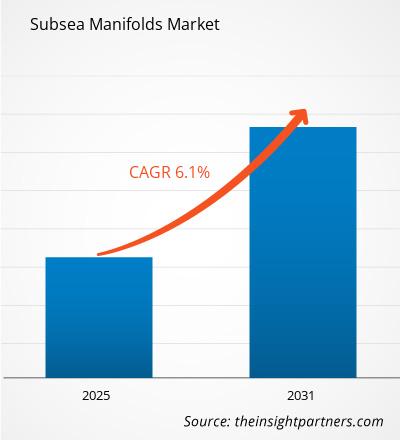
The Subsea Manifolds Market was valued at US$ 7.19 Billion in 2025 and is projected to reach US$ 13.1 Billion by 2034, expanding at a CAGR of 6.89% during 2026–2034. The market encompasses subsea flow-distribution and gathering equipment used to connect multiple wells, route production and injection fluids, and integrate subsea production systems with pipelines and host facilities. Demand is shaped by deepwater developments, brownfield tiebacks, field-life extension, and increasing standardization of subsea architectures.
In North America, subsea development activity remains closely associated with deepwater oil and gas production, particularly in the US Gulf of Mexico. The region is supported by established offshore infrastructure, experienced engineering and installation capabilities, and continued investment in brownfield expansions and tieback developments. Standardized subsea equipment, existing host infrastructure, and pressure to improve project economics are supporting replacement and new-installation demand.
Subsea Manifolds Market Assessment and Insights
Regional Outlook
- North America: ~31% of the global Subsea Manifolds Market share in 2025 | ~6% CAGR through 2034. Market position: North America remains a major subsea equipment market because of deepwater activity in the US Gulf of Mexico. Existing production infrastructure, brownfield developments, and tieback projects support recurring demand for manifolds and associated controls.
- US: ~82% of the North American market revenue in 2025 | ~6% CAGR through 2034. Market position: The US accounts for most regional demand, supported by Gulf of Mexico developments, established offshore service capabilities, and projects that connect new wells to existing floating or fixed production infrastructure.
- Europe: ~29% of the global market in 2025 | ~6% CAGR through 2034. Market position: Europe is a mature subsea market led by Norway, with the UK, Germany, France, Italy, and Spain contributing through offshore engineering, energy infrastructure, and specialized supply-chain capabilities. Tiebacks and brownfield projects support demand.
- Asia Pacific: ~25% of the global market in 2025 | ~8% CAGR through 2034. Market position: Asia Pacific is the fastest-growing region as offshore developments expand across China, Australia, Indonesia, Malaysia, India, and other producing countries. Deepwater investment and increasing localization are broadening the regional equipment base.
Segment Outlook
- Template Manifold: ~42% share in 2025 | ~6% CAGR through 2034. Market position: Template manifolds benefit from their compatibility with multiwell subsea architectures and established field-development concepts. Their use remains significant where operators require centralized gathering, controlled well connections, and repeatable subsea layouts.
- Cluster Manifold: ~33% share in 2025 | ~8% CAGR through 2034. Market position: Cluster manifolds are positioned for comparatively faster growth as operators seek flexible well tiebacks, standardized subsea configurations, and compact gathering arrangements for deepwater and satellite-field developments.
Competitive Coverage
ABB Limited, Aker Solutions ASA, Baker Hughes, a GE Company LLC, Dril-Quip, Inc., Halliburton Company, McDermott, Schlumberger Limited, Subsea 7 S.A., TechnipFMC plc, Trendsetter Engineering
Methodology
The Insight Partners follows Data Collection & Secondary Research, Primary Research, Data Analysis, and Data Triangulation & Final Review to validate market estimates and insights.
Source: The Insight Partners' analysis based on proprietary research, government publications, company annual reports, investor presentations, industry databases, and expert interviews.
The market for subsea manifolds has evolved from relatively standardized gathering configurations to more complex production systems that have the ability to accommodate increased well complexity, high pressures, tiebacks, and water depths. Advancements in subsea controls, flow assurance, materials engineering, and installation techniques have increased the operating window for manifold systems. Increasingly, operators are looking at manifolds as part of a larger subsea production system and not as individual pieces of equipment, which ties in design decisions to other subsea trees, flowlines, umbilicals, jumpers, controls, and host facilities.
Also, there is a move towards greater standardization and repeatability in the development model. Configure-to-order equipment, modular construction, and engineering and installation integration have the ability to decrease engineering interfaces and enhance schedule predictability. This is in favor of Subsea Manifolds Market growth since operators are increasingly looking at shortened project cycles and equipment commonality. Brownfield tiebacks are especially applicable in this regard because manifolds can integrate additional wells to existing production facilities without needing a new host facility.
Subsea Manifolds Market Report Scope
| Report Attribute | Details |
|---|---|
| Market size in 2025 | US$ 7.19 Billion |
| Market Size by 2034 | US$ 13.1 Billion |
| Global CAGR (2026 - 2034) | 6.89% |
| Historical Data | 2021-2024 |
| Forecast period | 2026-2034 |
Subsea Manifolds Market Analysis
Demand and economics of offshore fields development are strongly linked to each other. A usual subsea production system might consist of subsea trees, manifolds, jumpers, flowlines, risers, umbilicals, control systems, and connecting systems. The manifold is an interface for production fluids gathering from several wells and distribution of fluids for injection into certain wells. Therefore, design of the manifold impacts flow assurance, installation, well spacing, intervention, and future expandability. In case of deep-water development, special attention should be paid to such features as pressure resistance, reliability, remote intervention, and compact installation scheme.
A supply chain involves specialized equipment vendors, subsea engineering companies, fabrication facilities, installation companies, and integrated subsea field solutions providers. ABB Limited supplies automation and electrical solutions, Aker Solutions ASA works in offshore engineering and subsea development area. Baker Hughes, a GE Company LLC, Halliburton Company, and Schlumberger Limited work in oilfield technologies. Specialized subsea equipment is provided by Dril-Quip, Inc. and Trendsetter Engineering. Engineering, fabrication, installation, and integrated subsea services are provided by McDermott, Subsea 7 S.A., and TechnipFMC plc.
The competition is no longer driven purely by hardware characteristics, but is increasingly revolving around the issues of equipment standardization, engineering integration, manufacturing capability, installation capabilities, and life-cycle support. TechnipFMC has been focusing on standardized subsea production systems and delivery solutions in several recent projects. Subsea 7 S.A. merges offshore installation capabilities with subsea engineering and project execution capabilities, whereas Aker Solutions ASA remains engaged in tieback and life cycle projects in the mature offshore areas. All of these trends demonstrate that supplier positioning is becoming more related to capability to integrate manifold systems within project scope.
Another area of investment involves projects that use existing infrastructure. The tie-back project will help minimize the need for construction of new host facilities and enhance the use of already installed processing facilities. In such a situation, suppliers with capability to design compact and interoperable subsea systems will be in an advantageous position. Simultaneously, the exploration of the deep water fields in Brazil, Guyana, Africa, Australia, and Southeast Asia will create demand for high specification subsea production systems.
● REPORT CUSTOMIZATION
Tailor This Report To Align With Your Specific Business Requirements
This report can be customized to align precisely with your business objectives, scope, and target markets. Customization options include tailored segmentation, geography, competitive analysis, and strategic insights to support informed decision-making.
Customize This Report →WHAT YOU CAN ADJUST
- ● Segmentations
- ● Geography
- ● Competitive Analysis
- ● Language Preferences
Subsea Manifolds Market: Strategic Insights

Regional Insights
North America Subsea Manifolds Market
North America represented ~31% of the global market in 2025 and is expected to expand at a ~6% CAGR through 2034. The US is the principal regional demand center, with the Gulf of Mexico providing a mature ecosystem for subsea production, installation, inspection, maintenance, and lifecycle services. Deepwater developments increasingly use tiebacks and existing host infrastructure to improve project economics. This creates recurring requirements for manifolds, controls, flowlines, and related subsea equipment.
The US market benefits from a combination of established offshore infrastructure and continued development of technically complex reservoirs. New projects are increasingly connected to existing facilities, reducing surface infrastructure requirements while increasing the importance of subsea integration. Subsea equipment suppliers and installation contractors also benefit from the concentration of engineering expertise along the US Gulf Coast. Recent US Gulf awards demonstrate continued activity in deepwater development and subsea infrastructure, reinforcing the region's role as an important demand center.
U.S. Subsea Manifolds Market
The US accounted for ~82% of North American revenue in 2025 and is projected to grow at a ~6% CAGR through 2034. The Gulf of Mexico remains the central application environment, supported by deepwater fields, existing floating production systems, and an extensive network of offshore service providers. Operators are increasingly using subsea tiebacks to connect additional wells to established infrastructure, supporting demand for compact gathering and distribution systems.
The competitive ecosystem includes global subsea equipment suppliers and specialized engineering companies with established Gulf Coast operations. Project requirements increasingly emphasize reliability, standardized equipment, installation efficiency, and compatibility with existing production systems. The combination of mature infrastructure and new deepwater resources creates a dual demand profile: replacement and optimization within established fields alongside new equipment for incremental developments.
Europe Subsea Manifolds Market
Europe accounted for ~29% of the global market in 2025 and is expected to grow at a ~6% CAGR through 2034. Norway is the leading country in Europe for subsea development activity, supported by a sophisticated offshore supply chain, mature continental shelf infrastructure, and continued development of satellite fields and brownfield tiebacks. The UK also maintains an important position through North Sea field redevelopment and infrastructure-led projects.
Norway's market is increasingly shaped by infrastructure reuse and field-life extension. Operators are pursuing subsea tiebacks that connect new discoveries to existing platforms, pipelines, and processing facilities. This approach increases the importance of standardized subsea systems that can be delivered within compressed schedules. Germany, France, Italy, and Spain contribute through engineering, energy-company operations, industrial manufacturing, and specialized offshore services, although their market roles differ from Norway and the UK.
European suppliers are also advancing integrated engineering models. Recent subsea awards in Norway demonstrate continued investment in brownfield developments and standardized subsea production systems. These projects support manifold demand because multiwell tiebacks require gathering and distribution interfaces capable of integrating new wells with existing infrastructure. The European market therefore combines mature replacement demand with technology-intensive new development.
APAC Subsea Manifolds Market
Asia Pacific represented ~25% of the global market in 2025 and is expected to grow at a ~8% CAGR through 2034, making it the fastest-growing major region. China is the leading country in Asia Pacific, supported by offshore exploration and production activity and investment in domestic energy resources. Australia, Indonesia, Malaysia, India, and South Korea also contribute through offshore development, engineering, fabrication, and supply-chain capabilities.
Regional growth is supported by new offshore discoveries, deepwater projects, brownfield expansions, and efforts to increase domestic production. Indonesia and Malaysia are particularly relevant for subsea tiebacks and deepwater developments, while Australia provides a technically advanced offshore project environment. Growing regional engineering and fabrication capabilities can also reduce reliance on imported equipment over time, although high-specification subsea systems remain dependent on specialized global suppliers.
Middle East & Africa Subsea Manifolds Market
Middle East & Africa is expected to expand at a ~7% CAGR through 2034. Offshore developments in West Africa are a major demand source, with Nigeria and Angola supported by deepwater resources and existing subsea infrastructure. In the Middle East, offshore oil and gas investment provides a stable application base, while new development programs can require additional subsea gathering and distribution systems.
The region also benefits from developments in Mozambique, Côte d'Ivoire, Guyana-adjacent Atlantic activity, and other emerging offshore provinces. Project economics favor modular equipment and infrastructure reuse where existing facilities can support new production. Local-content requirements, fabrication capability, logistics, and offshore installation capacity remain important considerations for suppliers entering or expanding in regional projects.
Segmentation Analysis
Type
Type
Template Manifold holds an estimated 2025 share of ~42% and is projected to grow at a ~6% CAGR through 2034. Template arrangements remain important because they provide a structured basis for connecting multiple subsea wells and organizing flow paths within established field-development concepts. Their relatively standardized configuration supports repeatability in engineering and installation, particularly for developments with predictable well layouts. Demand is also supported by brownfield extensions where new wells must integrate with existing subsea architecture.
- Template Manifold: Template manifolds are widely used for centralized gathering from multiple subsea wells. Their structured configuration supports predictable well placement, standardized connections, and organized flow distribution. They remain strategically important for developments requiring repeatable subsea layouts and integration with established production systems.
- Cluster Manifold: Cluster manifolds support flexible well grouping and are relevant for satellite developments and tieback architectures. Their configuration can accommodate changing well layouts and provide a practical interface between multiple wells and export infrastructure, supporting growing demand for flexible deepwater development concepts.
- Pipeline End Manifold: Pipeline end manifolds provide an interface between subsea pipelines and associated production or gathering infrastructure. They are particularly relevant where flowlines, pipelines, and well systems must be integrated at defined connection points, supporting efficient transportation and system organization.
Application
Application
Offshore applications account for an estimated 2025 share of ~76% and are projected to expand at a ~7% CAGR through 2034. Offshore production remains the core environment for subsea manifold deployment because subsea wells and gathering systems are directly linked to offshore field-development architectures. Increasing water depths, complex reservoirs, and infrastructure-led tiebacks support continued demand for robust and integrated manifold systems.
Onshore applications represent a smaller portion of the addressable market and are expected to grow at a ~4% CAGR through 2034. Their role is associated with specialized gathering and production arrangements where subsea-type manifold technologies or related architectures can support field requirements. Adoption is more constrained than offshore because conventional surface gathering infrastructure is generally available for onshore developments.
Opportunity Snapshot
| Application | Revenue Contribution | Trend Tag | Adoption Stage |
| Offshore | High | Deepwater Tiebacks | Scaling |
| Onshore | Low | Specialized Gathering | Mature |
Subsea Manifolds Market Growth Drivers and Impact Analysis
Expansion of Deepwater and Tieback Developments
The Subsea Manifolds Market forecast indicates that expansion of deepwater production is a direct demand driver because subsea wells require engineered gathering and distribution systems before production can reach floating or fixed host facilities. As operators prioritize capital efficiency, tiebacks have become an important development approach for satellite fields and incremental reservoirs. A manifold can consolidate several wells into a common production pathway, reducing the number of individual connections to downstream infrastructure. This can simplify installation and improve utilization of existing processing capacity. Deepwater projects also place greater emphasis on equipment reliability because intervention is more difficult and costly than in shallow-water environments. As offshore operators continue to balance new field development with infrastructure reuse, demand is shifting toward manifold systems that can accommodate multiple wells, standardized interfaces, and future field extensions. This supports sustained equipment requirements across greenfield and brownfield projects.
Standardization and Integrated Subsea Project Delivery
Standardized subsea architectures are increasingly important as operators seek to reduce engineering interfaces and improve project execution. Configure-to-order equipment and repeatable designs can shorten engineering cycles while allowing manufacturers to use established components across multiple developments. Integrated engineering, procurement, construction, and installation models further connect equipment design with installation planning and commissioning. For manifold suppliers, this trend increases the value of modular designs, standardized interfaces, digital engineering, and predictable manufacturing processes. It also changes competitive dynamics because operators may prefer suppliers capable of providing multiple elements of the subsea production system rather than a single isolated component. Recent projects by major subsea contractors demonstrate continued movement toward integrated delivery. Over the forecast period, this approach is expected to support investment in manufacturing capacity, digital configuration tools, and engineering capabilities that can reduce project complexity without compromising pressure, flow assurance, or reliability requirements.
Field-Life Extension and Brownfield Revitalization
Brownfield revitalization is an important source of manifold demand because mature offshore assets increasingly require incremental wells, replacement equipment, and new subsea connections to maintain production. Connecting additional reservoirs to existing platforms or floating production units can be more economical than developing entirely new host infrastructure. This development model creates requirements for manifolds capable of interfacing with existing flowlines, controls, pipelines, and production systems. Brownfield work can also involve more complex engineering than greenfield projects because suppliers must account for existing equipment, operating constraints, and installation windows. As mature offshore provinces pursue production optimization, subsea equipment providers with engineering, installation, and lifecycle capabilities can participate in multiple stages of asset development. The resulting opportunity extends beyond new manifold sales into replacement, modification, inspection, intervention, and system integration services.
Subsea Manifolds Market Future Trends
Configure-to-Order Subsea Architectures
The Subsea Manifolds Market trends show that configure-to-order architectures are likely to become increasingly important as operators seek shorter project schedules and greater consistency across subsea developments. Instead of engineering every production system from a completely unique design, suppliers can use standardized equipment platforms and adapt configurations to specific well counts, pressure conditions, field layouts, and host requirements. This approach can reduce repetitive engineering and support more predictable manufacturing. For manifolds, configuration flexibility can allow common structural and connection concepts to be adapted across multiple developments. The trend also supports closer integration between digital engineering and manufacturing, enabling design changes to be evaluated before fabrication. As subsea projects become increasingly schedule-sensitive, suppliers with established standard platforms can potentially reduce lead times and improve coordination between equipment production, installation, and commissioning. This trend is particularly relevant to brownfield tiebacks and repeat developments where operators seek consistent equipment across project portfolios.
Higher-Complexity Deepwater and Subsea Processing Architectures
Future subsea projects are expected to place greater technical demands on manifolds as fields move toward deeper waters, longer tiebacks, higher pressures, and more complex fluid characteristics. Manifolds may increasingly operate within architectures that include subsea boosting, compression, water injection, advanced flow assurance, and more sophisticated controls. These developments require equipment designs that maintain reliability while accommodating demanding pressure and temperature conditions. Subsea processing can also change how production is gathered and transported, creating additional interfaces between manifolds and subsea processing equipment. Suppliers will therefore need to combine structural integrity, flow management, control integration, and lifecycle considerations. The trend is likely to favor companies with multidisciplinary engineering capabilities and established subsea technology portfolios. Over time, the distinction between a standalone manifold supplier and an integrated subsea-system provider may become less pronounced as operators increasingly evaluate complete production architectures.
Subsea Manifolds Market Opportunities
Regional Manufacturing and Local Supply-Chain Development
The expansion of offshore projects in Asia Pacific, Africa, and other emerging producing regions creates opportunities for suppliers to establish regional manufacturing, assembly, engineering, and service capabilities. Local-content expectations can encourage operators and contractors to increase procurement from domestic or regional suppliers, particularly for fabrication, installation support, maintenance, and lifecycle services. Manifold manufacturing can benefit from regional hubs where demand is sufficient to justify specialized facilities and qualified personnel. Suppliers can also establish partnerships with local engineering and fabrication companies to improve logistics and shorten project lead times. The opportunity is not limited to complete manifold fabrication. Local machining, coating, pressure testing, assembly, inspection, and replacement-part capabilities can gradually expand the regional supply base. Companies that combine global design standards with regional execution may be positioned to participate in emerging offshore markets while meeting project-specific localization requirements.
Integrated Lifecycle and Brownfield Support Services
Lifecycle services represent another opportunity as operators extend the productive life of offshore assets. Existing manifolds may require inspection, repair, replacement, modification, or integration with additional wells and pipelines. Suppliers with engineering and field-service capabilities can support these requirements by providing equipment upgrades alongside installation and maintenance services. Brownfield projects can also generate demand for engineering studies, interface management, subsea intervention planning, and commissioning support. The commercial opportunity is therefore broader than the initial equipment sale. Long-term service relationships can provide suppliers with recurring involvement as offshore fields evolve. Digital monitoring and condition-based maintenance can further support this model by enabling operators to identify equipment issues before failures disrupt production. As mature offshore provinces emphasize asset optimization, lifecycle-oriented suppliers can increasingly participate in production enhancement programs, field extensions, and decommissioning preparation.
Recent Developments
- September 2026: Subsea 7 S.A. announced an extension from Turkish Petroleum Offshore Technology Center for the Sakarya Phase 3 development offshore Türkiye. The additional scope covers towing and mooring line installation and connection activities associated with the floating production unit, with project management and engineering led from Istanbul. The award extends Subsea 7's involvement in a major Black Sea gas development and demonstrates continued subsea infrastructure investment in a mature regional project.
- September 2026: TechnipFMC plc announced a significant iEPCI contract from PETRONAS Carigali for the Limbayong deepwater project offshore Malaysia. The project will use the Subsea 2.0 configure-to-order platform alongside integrated engineering, procurement, construction, and installation execution. The award highlights the increasing use of standardized subsea platforms and integrated delivery models for accelerating offshore development schedules.
- May 2026: Aker Solutions ASA received a FEED contract from Equinor for the Atlantis subsea tie-in in the northern North Sea. The work involves preparing the Kvitebjørn platform to receive production from the Atlantis gas condensate discovery and includes an option for subsequent engineering, procurement, construction, installation, and commissioning assistance. The project illustrates the continued role of infrastructure-led tiebacks in European offshore development.
Frequently Asked Questions

- Comprehensive Market Sizing and Forecast Analysis
- Detailed Segmentation Analysis
- In-Depth Market Dynamics Assessment
- Regional and Country-Level Insights
- Competitive Landscape and Company Benchmarking
- Strategic Business Intelligence
Recent Reports
Testimonials

The Insight Partners provided valuable market intelligence that supported our global go-to-market strategy. Their team was professional, responsive, and attentive to our feedback, providing thoughtful analysis and helpful methodological clarifications throughout the project.
Junmo Kim Chief Financial Officer (CFO), Enertech Co., Ltd.
The Insight Partners' SCADA System Market report is comprehensive, with valuable insights on current trends and future forecasts. The team was highly professional, responsive, and supportive throughout. We are very satisfied and highly recommend their services.
RAN KEDEM Partner, Reali Technologies LTDs
I requested a report on a very specific software market and the team produced the report in a few days. The information was very relevant and well presented. I then requested some changes and additions to the report. The team was again very responsive and I got the final report in less than a week.
JEAN-HERVE JENN Chairman, Future Analytica
We worked with The Insight Partners for an important market study and forecast. They gave us clear insights into opportunities and risks, which helped shape our plans. Their research was easy to use and based on solid data. It helped us make smart, confident decisions. We highly recommend them.
PIYUSH NAGPAL Sr. Vice President, High Beam Global
The Insight Partners delivered insightful, well-structured market research with strong domain expertise. Their team was professional and responsive throughout. The user-friendly website made accessing industry reports seamless. We highly recommend them for reliable, high-quality research services
YUKIHIKO ADACHI CEO, Deep Blue, LLC.
This is the first time I have purchased a market report from The Insight Partners.While I was unsure at first, I visited their web site and felt more comfortable to take the risk and purchase a market report.I am completely satisfied with the quality of the report and customer service. I had several questions and comments with the initial report, but after a couple of dialogs over email with their analyst I believe I have a report that I can use as input to our strategic planning process.Thank you so much for taking the extra time and making this a positive experience.I will definitely recommend your service to others and you will be my first call when we need further market data.
JOHN SUZUKI President and Chief Executive Officer, Board Director, BK Technologies
I wish to appreciate your support and the professionalism you displayed in the course of attending to my request for information regarding to infectious disease IVD market in Nigeria. I appreciate your patience, your guidance, and the fact that you were willing to offer a discount, which eventually made it possible for us to close a deal. I look forward to engaging The Insight Partners in the future, all thanks to the impression you have created in me as a result of this first encounter.
DR CHIJIOKE ONYIA MANAGING DIRECTOR, PineCrest Healthcare Ltd.Reason to Buy
- Informed Decision-Making
- Understanding Market Dynamics
- Competitive Analysis
- Identifying Emerging Markets
- Customer Insights
- Market Forecasts
- Risk Mitigation
- Boosting Operational Efficiency
- Strategic Planning
- Investment Justification
- Tracking Industry Innovations
- Aligning with Regulatory Trends





 Get Free Sample for