
Swiss Screw Machines Market Size, Share & Growth by 2034
Coverage: By Type (Automatic Swiss Machines, CNC Swiss Machines); Material (Aluminum, Stainless Steel, Plastic, Copper, Others); RPM (Below 1000 RPM, 1000 to 3000 RPM, 3000 to 5000 RPM, 5000 to 8000 RPM, 8000 to 10000 RPM, Above 10000 RPM); End User (Automotive and Transport, Pharmaceutical, Aerospace and Defense, Construction, Agriculture, Others) , and Geography (North America, Europe, Asia Pacific, and South and Central America)
- Status : Data Released
- Report Code : TIPRE00026927
- Category : Manufacturing and Construction
- No. of Pages : 150
- Available Report Formats :


- Last update date : November 03, 2026


2025 Market Size
US$ 885.73 Mn
Base year value
2034 Forecast
US$ 1,457.13 Mn
Projected by 2034
CAGR 2026-2034
5.69 %
Growth rate
Addressable Market
US$ 10,620.32 Mn
(2026-2034)
The Swiss Screw Machines Market was valued at US$ 885.73 Million in 2025 and is projected to reach US$ 1,457.13 Million by 2034, registering a CAGR of 5.69% during 2026–2034. The market covers automatic and CNC Swiss machines used for precision production of small and complex components across automotive and transport, pharmaceutical, aerospace and defense, construction, and agriculture applications. Demand is supported by the need for repeatable machining, tighter dimensional control, higher productivity, and efficient processing of diverse materials.
North America remains a significant precision-machining market, supported by advanced automotive production, aerospace and defense manufacturing, medical-component machining, and investment in automated production cells. The Swiss Screw Machines Market size is expected to expand at a modeled CAGR of ~5% through 2034 as manufacturers prioritize unattended production, labor efficiency, complex part capability, and integrated turning operations. The United States represents the principal demand center in the region, while Mexico and Canada add manufacturing opportunities through automotive, aerospace, and industrial supply chains.
Swiss Screw Machines Market Assessment and Insights
Regional Outlook
- North America: ~25% of the global Swiss Screw Machines Market share in 2025 | ~5% CAGR through 2034. Market position: North America maintains a major regional position because of established precision-machining ecosystems, aerospace and defense programs, automotive production, and demand for automated small-part manufacturing.
- US: ~82% of North American market revenue in 2025 | ~5% CAGR through 2034. Market position: The US is the principal North American market, supported by domestic aerospace, defense, automotive, medical, and industrial component production, with machine users emphasizing productivity and repeatable precision.
- Europe: ~30% of the global market in 2025 | ~5% CAGR through 2034. Market position: Europe has a mature precision-engineering base, with Germany representing the leading country in Europe and strong demand also originating from Switzerland, Italy, France, the UK, and Spain.
- Asia Pacific: ~34% of the global market in 2025 | ~7% CAGR through 2034. Market position: Asia Pacific is the largest and fastest-growing region, supported by manufacturing capacity, automotive production, electronics supply chains, medical-device manufacturing, and expanding automation investment led by China and Japan.
Segment Outlook
- Automatic Swiss Machines: ~68% Share in 2025 | ~6% CAGR through 2034. Market position: Automatic systems lead because they combine continuous bar feeding, repeatable production, and reduced operator intervention, making them suitable for recurring high-volume precision components.
- Pharmaceutical: ~18% Share in 2025 | ~7% CAGR through 2034. Market position: Pharmaceutical component production has a strong growth outlook because miniature precision parts, surgical components, and high-quality metal and polymer components require consistent dimensional control and repeatable processes.
Competitive Coverage
Ace Micromatic Group, Ardel Engineering and Manufacturing Inc., Batliboi, Cass Precision Machining, Hangzhou Datian CNC Machine Tool Co., H and R Screw Machine Products, Inc., Michael's Machine Company, Inc., Midwest Turned Products, Pacific West America, Inc., Thuro Metal Products, Inc.
Methodology
The Insight Partners follows Data Collection & Secondary Research, Primary Research, Data Analysis, and Data Triangulation & Final Review to validate market estimates and insights.
Source: The Insight Partners' analysis based on proprietary research, government publications, company annual reports, investor presentations, industry databases, and expert interviews.
Swiss screw machines have transitioned from specialty bar-machining machines into sophisticated precision production machines that can perform turning, drilling, milling, threading, among others in more integrated machine setups. Advancements in the CNC control, tool management, bar feed, live tooling, spindle technology, and automation capabilities have extended the range of components that can be machined. Increasingly, manufacturers opt for Swiss machines based on the geometry of parts, dimensional consistency requirements, production volume, and cost-effectiveness compared to traditional turning.
During the period through 2034, investments in the Swiss Screw Machines Market are forecast to focus on greater levels of automation, multi-axis capability, process monitoring, and machines that are able to machine complex components with minimal secondary operations. Rising manufacturing hubs in the Asia-Pacific region will facilitate equipment demand, whereas North American and European consumers will focus on productivity, reshoring, labor-saving, and flexible production. The demand for medical, aerospace, automotive, and precision industrial parts will drive long-term replacement and capacity expansion cycles in the market.
Swiss Screw Machines Market Report Scope
| Report Attribute | Details |
|---|---|
| Market size in 2025 | US$ 885.73 Million |
| Market Size by 2034 | US$ 1,457.13 Million |
| Global CAGR (2026 - 2034) | 5.69% |
| Historical Data | 2021-2024 |
| Forecast period | 2026-2034 |
Swiss Screw Machines Market Analysis
Swiss Screw Machines Market growth is highly dependent on the growing need for components that are small-diameter, intricate, and reproducible. The sliding headstock design could prove useful in automotive sensors, connectors, medical components, aerospace fittings, precision shafts, fasteners, and industrial parts due to the stability of the workpiece in the region of machining.
The value chain consists of machine manufacturers, CNC and control system suppliers, tooling manufacturers, bar stock suppliers, automation vendors, distributors, maintenance companies, and machining customers. As such, the demand is driven not just by the purchase of machines but also by the use of capacity, the cycle of replacement, intricacy of components, and availability of skilled laborers.
The competitive dynamics in Swiss Screw Machines Market are also characterized by the co-existence of specialized machine builders along with precision machining companies. The presence of Ace Micromatic Group and Batliboi adds to regional manufacturing accessibility, while Ardel Engineering & Manufacturing Inc., Cass Precision Machining, Midwest Turned Products, Pacific West America, Inc. and Thuro Metal Products are some of the players capable of performing down-stream machining operations. Competitive advantage in the market is now more dependent on cycle time minimization, automation, rigidity of machines, software, tooling and service.
Future investments are expected to focus on production cells which decrease handling and post machining activities. Multi axis and multi spindle capabilities have been noted with Cass Precision Machining, while automated precision production in case of Midwest Turned Products suggests a changing competitive dynamics towards integrated manufacturing systems where machine utilization, process reliability and production economics take precedence over mere specifications of the machine.
● REPORT CUSTOMIZATION
Tailor This Report To Align With Your Specific Business Requirements
This report can be customized to align precisely with your business objectives, scope, and target markets. Customization options include tailored segmentation, geography, competitive analysis, and strategic insights to support informed decision-making.
Customize This Report →WHAT YOU CAN ADJUST
- ● Segmentations
- ● Geography
- ● Competitive Analysis
- ● Language Preferences
Swiss Screw Machines Market: Strategic Insights
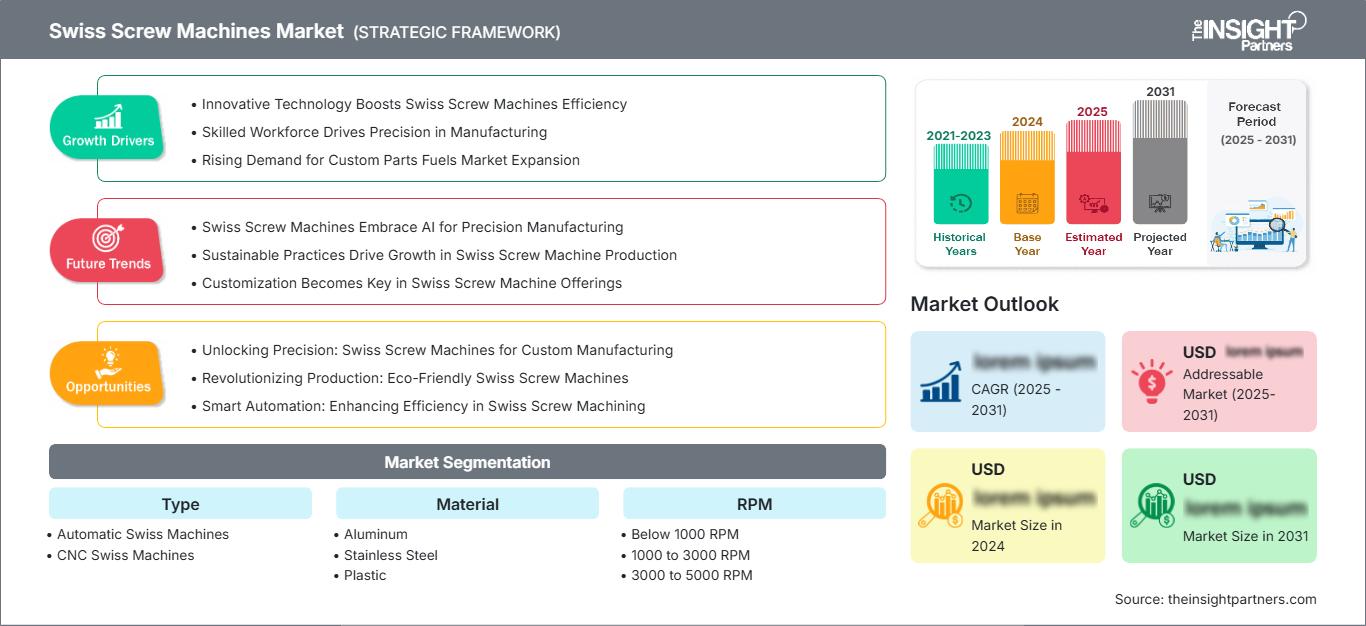
Regional Insights
North America Swiss Screw Machines Market
North America represented ~25% of the global market in 2025 and is expected to expand at ~5% CAGR through 2034. The region enjoys a proven aerospace, defense, automotive, medical, industrial, and precision engineering cluster base. The United States is responsible for ~82% of the North American revenue and represents the dominant customer, as well as the primary site of large-scale investments in automated precision machining.
Swiss Machining becomes popular among the US producers in the cases when small parts have to be machined with high degree of repeatability and labor productivity is critical. The requirements to stability and traceability are common in aerospace/defense sector, and throughput and consistency in automotive industry. The additional demand comes from the medical and instrumentation customers requiring miniature components.
U.S. Swiss Screw Machines Market
The U.S. accounted for ~82% of North American revenue in 2025 and is projected to grow at ~5% CAGR through 2034. The market is supported by a broad base of precision-machining companies and OEM supply chains. Aerospace and defense requirements are particularly relevant because complex fittings, pins, shafts, connectors, and other small components require controlled tolerances and repeatable production.
Additional demand comes from automotive and medical machining, while more industrial clients require automation due to labor shortages and better utilization of their equipment. Ardel Engineering and Manufacturing Inc., Cass Precision Machining, Midwest Turned Products, Pacific West America, Inc., and Thuro Metal Products, Inc. exemplify some of the downstream machining capabilities available. The focus of competition is moving towards comprehensive Swiss machining, live tooling, automated loading, inspection, and process control.
Europe Swiss Screw Machines Market
Europe held ~30% of the global market in 2025 and is expected to grow at ~5% CAGR through 2034. Germany is the leading country in Europe because of its large industrial manufacturing base, automotive ecosystem, machine-tool expertise, and concentration of precision component suppliers. Switzerland retains strategic importance because Swiss machining is closely associated with high-precision manufacturing, while Italy, France, the UK, and Spain provide additional demand across automotive, aerospace, medical, industrial, and precision-engineering applications.
Germany’s automotive and industrial machinery industries foster demand for high-speed precision machining, whereas Switzerland’s legacy of precision engineering fosters the adoption of specialized machining techniques for small components. Demand from France and the UK derives from aerospace, military, medical and industrial applications. Italy and Spain bring demand from automotive and general manufacturing.
The focus on production, flexibility, energy savings, process control and automation on the part of European users makes it possible to find opportunities in the replacement of older equipment by CNC-based equipment that can perform several operations at once. Hence, companies capable of providing application engineering and local technical support will be competitive even in an installed base that is relatively mature.
APAC Swiss Screw Machines Market
Asia Pacific accounted for ~34% of the global market in 2025 and is expected to register the fastest regional growth at ~7% CAGR through 2034. China is the leading country in Asia Pacific, supported by extensive automotive, electronics, industrial machinery, and component manufacturing. Japan remains strategically important because of its advanced machine-tool ecosystem and precision manufacturing capabilities.
South Korea contributes through automotive, electronics, and industrial manufacturing, while India is expanding its precision-machining base across automotive, aerospace, medical, and general engineering. Australia remains smaller but supports specialized industrial and mining-related component demand. Automation adoption, localization of manufacturing, rising component complexity, and capacity expansion are key factors supporting regional investment.
Middle East & Africa Swiss Screw Machines Market
Middle East & Africa represents a smaller portion of global demand but is expected to expand at ~6% CAGR through 2034. Saudi Arabia is the leading country in Middle East & Africa based on the region's industrial diversification, manufacturing investment, and expanding engineering ecosystem. The UAE adds demand through aerospace, industrial services, and advanced manufacturing initiatives.
South Africa provides an established base in automotive, mining equipment, industrial machinery, and precision engineering. Across the wider region, investments in manufacturing localization, energy infrastructure, transportation, and industrial diversification can create demand for precision machining equipment. Swiss machines are particularly relevant where manufacturers need compact, repeatable production of specialized components without extensive secondary processing.
Segmentation Analysis
Type
The Type segment is expected to expand at ~6% CAGR through 2034. Automatic Swiss Machines maintain a strong position because automated bar feeding and CNC-controlled machining support repeatable production while reducing manual intervention. CNC Swiss Machines provide the flexibility required for complex geometries, integrated milling and drilling, and short-to-medium production runs. The market increasingly favors systems that combine precision with unattended operation and faster changeovers.
- Automatic Swiss Machines: Automatic systems are suited to recurring component production where stable cycle times, automated bar handling, and repeatability improve production economics. Their value is strongest in automotive, industrial, medical, and precision component applications requiring sustained output.
- CNC Swiss Machines: CNC Swiss Machines provide programmable flexibility for complex components and support multiple operations in a single setup. Their adoption is supported by demand for intricate geometries, rapid product changes, tighter tolerances, and digitally controlled production.
Material
The Material segment is projected to grow at ~5% CAGR through 2034. Material selection directly affects tooling, cutting parameters, coolant requirements, spindle loading, and cycle economics. Stainless steel and aluminum remain important for precision components, while copper and plastics support electrical, fluid-handling, instrumentation, and specialized applications. Machine capability is increasingly assessed according to the range of materials and geometries that can be processed reliably.
- Aluminum: Aluminum is important where low weight, machinability, corrosion resistance, and efficient cycle times are required. Automotive, aerospace, electronics, and industrial applications use Swiss-machined aluminum components where dimensional consistency and reduced component mass are priorities.
- Stainless Steel: Stainless steel supports demanding medical, automotive, aerospace, and industrial applications. Its strength and corrosion resistance make it attractive for components exposed to fluids, heat, or mechanical stress, although tooling and cutting conditions require careful process control.
- Plastic: Engineering plastics are increasingly relevant for lightweight, electrically insulating, and chemically resistant components. Swiss machining enables precise small plastic parts for industrial, medical, electronics, and specialized applications where dimensional stability and clean production are important.
- Copper: Copper is valuable for electrical and thermal applications because of its conductivity. Precision Swiss machining supports terminals, connectors, pins, fittings, and other components where tight dimensions and reliable repeatability are necessary.
RPM
The RPM segment is expected to grow at ~6% CAGR through 2034 as machine users balance spindle speed with material characteristics, component geometry, tool life, and surface-finish requirements. Higher-speed configurations are increasingly relevant to miniature components and productivity-focused applications, while lower-speed ranges remain important for materials and parts requiring controlled cutting conditions.
- Below 1000 RPM: Lower spindle speeds support applications where material characteristics, larger component geometry, tooling requirements, or controlled cutting conditions limit the benefit of very high rotational speeds.
- 1000 to 3000 RPM: This range provides a balanced operating window for diverse precision components. It can support general-purpose production across automotive, industrial, agricultural, and construction-related machining requirements.
- 3000 to 5000 RPM: Mid-to-high spindle speeds support productivity improvements for smaller components and suitable materials. Manufacturers can use this range to improve cycle efficiency while maintaining appropriate surface finish and tool-life performance.
- 5000 to 8000 RPM: Higher-speed machining becomes increasingly valuable for miniature components and applications requiring efficient material removal. The segment benefits from improved spindle technology, tool balancing, coolant control, and automated process management.
- 8000 to 10000 RPM: This range addresses demanding high-speed production where small component diameters allow productivity gains from higher rotational speed. It is particularly relevant when manufacturers seek shorter cycles without sacrificing dimensional stability.
- Above 10000 RPM: Very high spindle speeds serve specialized miniature and precision applications. Adoption depends strongly on machine rigidity, spindle design, tooling balance, thermal control, and the economics of producing small complex components at high throughput.
End User
The End User segment is expected to register ~6% CAGR through 2034. Automotive and transport remain important because of high-volume precision component requirements, while pharmaceutical applications provide strong demand for small and highly controlled components. Aerospace and defense require tight tolerances and process consistency, while construction and agriculture contribute through machinery, hydraulic, fastening, and equipment components. Demand is therefore diversified across cyclical and specialized manufacturing industries.
- Automotive and Transport: Automotive and transport manufacturers require repeatable production of connectors, shafts, pins, fittings, sensors, fasteners, and other small components. Swiss machining supports high-volume manufacturing where cycle efficiency and dimensional consistency directly affect component economics.
- Pharmaceutical: Pharmaceutical-related component production benefits from precise machining of small parts used in medical and drug-delivery equipment. High quality requirements, repeatability, material compatibility, and controlled manufacturing processes support Swiss-machine adoption.
- Aerospace and Defense: Aerospace and defense applications prioritize dimensional accuracy, material performance, traceability, and reliable production of specialized components. Swiss machining is useful for fittings, pins, connectors, instrumentation parts, and other compact components requiring repeatable precision.
- Construction: Construction equipment uses precision-machined pins, fittings, hydraulic components, fasteners, and mechanical parts. Swiss machines are most relevant where component dimensions, repeatability, and production efficiency justify automated precision machining.
- Agriculture: Agricultural machinery creates demand for precision shafts, fittings, connectors, bushings, and other mechanical components. Swiss machining can improve consistency for recurring component families while supporting efficient production across diverse materials and part designs.
Opportunity Snapshot
| End User | Revenue Contribution | Trend Tag | Adoption Stage |
| Automotive and Transport | High | EV Components | Mature |
| Pharmaceutical | Medium | Precision Devices | Scaling |
| Aerospace and Defense | Medium | Lightweight Parts | Scaling |
| Construction | Low | Hydraulic Parts | Mature |
| Agriculture | Low | Equipment Parts | Mature |
Swiss Screw Machines Market Growth Drivers and Impact Analysis
Rising Demand for High-Precision Small Components
For example, manufacturers in automotive, medical, aerospace, electronics and industrial applications are constantly needing small components that require precise dimensions and complex shapes. This is where Swiss Machining is advantageous since the guiding system of the work piece will provide support near the cutting zone especially when it comes to slender work pieces. In addition, several processes can also be performed using only one production set-up process. This will decrease handling, increase consistency and minimize secondary machining. As work pieces become more compact and integrated into other components, there will be a greater need for manufacturers to utilize specialized machines as opposed to the traditional turning machines. This becomes very critical especially when it comes to suppliers providing components for repeatable production runs since small increases in cycle time or reductions in scrap will significantly impact costs.
Automation and Skilled-Labor Constraints
Companies in precision-machining are continuously faced with the need to enhance productivity while not adding labor in proportion to the increase in output. The Swiss machine is able to achieve this with automation of bar feeding, computer numerical controlled (CNC) control, live tooling, multi-axis machining, and increasingly integrated manufacturing cells. The advantages include extended periods of unmanned production along with reduced reliance on human assistance in repetitive tasks. The effects will be felt mostly by manufacturing companies that have large-scale production of standard parts using the same materials. At the same time, the ability to use digital controls means that skilled employees can dedicate themselves to programming, process optimization, inspection and machine maintenance. This way, investments in Swiss machines are justifiable even when capital costs are higher compared to simple turners because the benefits arise from the cost of production as a whole.
Growing Complexity of Machined Components
Component suppliers increasingly face designs that combine turning, drilling, threading, milling, grooving, and other operations in compact geometries. Producing these parts across multiple conventional machines can increase handling, setup requirements, work-in-process inventory, and opportunities for dimensional variation. Swiss machines with live tooling, multiple axes, and secondary-operation capability can consolidate more of these processes into a single platform. This improves process continuity and can shorten the route from raw bar stock to finished component. The trend is especially relevant in aerospace, medical, automotive, and specialized industrial applications, where components may be geometrically complex but produced repeatedly. Manufacturers are therefore evaluating machine investments according to the number of operations eliminated rather than simply spindle speed or nominal turning capacity. This supports demand for more capable Swiss platforms and encourages machine builders to integrate automation, tooling management, probing, and monitoring into the production environment.
Swiss Screw Machines Market Future Trends
Greater Integration of Automation and Digital Monitoring
Swiss Screw Machines Market trends are moving toward increasingly connected production cells that combine automatic loading, process monitoring, tool management, inspection, and machine-level data collection. Rather than treating the lathe as an isolated production asset, manufacturers are integrating equipment into broader digital workflows that track machine utilization, tool condition, cycle performance, and quality indicators. Automated bar feeders and robotic material handling can extend unattended production, while monitoring systems can identify process deviations before they create significant scrap. This direction is particularly important for manufacturers operating several machines across repeat production programs. The commercial implication is a gradual shift from purchasing standalone machine capacity toward purchasing production capability as an integrated system. Suppliers that can combine hardware, controls, software, automation, and application engineering are likely to gain an advantage as customers place greater emphasis on predictable output and measurable production efficiency.
Expansion of Multi-Operation and High-Speed Platforms
Swiss machining is increasingly moving toward platforms capable of completing more component features without removing the workpiece from the machine. Multi-axis control, live tooling, sub-spindle operations, higher-speed spindles, and improved coolant delivery allow manufacturers to address increasingly complex parts while limiting secondary operations. High-speed capabilities are particularly relevant for miniature components where productivity is strongly affected by spindle performance and tool-path optimization. At the same time, manufacturers must balance speed with thermal stability, tool life, material behavior, and surface-finish requirements. This means future equipment selection will increasingly focus on application-specific performance rather than maximum RPM alone. Machine builders that provide flexible configurations capable of serving several component families can improve asset utilization and reduce the risk associated with specialized capital equipment.
Swiss Screw Machines Market Opportunities
Precision Manufacturing Expansion in Asia Pacific
Asia Pacific provides a strong opportunity because its manufacturing ecosystem combines large automotive production, electronics manufacturing, industrial equipment capacity, and expanding medical and aerospace supply chains. China and Japan provide established precision-machining capabilities, while India and South Korea offer additional expansion opportunities as manufacturers increase automation and localize higher-value component production. For equipment suppliers, the opportunity is not limited to initial machine sales. Application engineering, tooling packages, automated loading, training, maintenance, and process optimization can create recurring value around installed equipment. Suppliers that adapt machine configurations to local component requirements and provide responsive service infrastructure can improve adoption. The region's relatively faster growth profile also creates opportunities to establish distribution and technical-support networks before customers become locked into competing machine platforms.
Automation-Led Replacement and Capacity Upgrades
The Swiss Screw Machines Market Forecasts point to an opportunity centered on replacement of older equipment with automated and more multifunctional systems. Manufacturers can justify capital upgrades when new machines reduce setup time, operator dependence, secondary operations, or material waste while improving repeatability. This opportunity is particularly relevant to mature manufacturing markets where installed equipment remains substantial but production requirements are becoming more complex. Machine suppliers can strengthen the replacement proposition by demonstrating measurable productivity gains through application testing, cycle-time analysis, tooling optimization, and automated material handling. Refurbishment and retrofit services can also address customers that are not ready for full replacement. The commercial opportunity therefore extends across new equipment, automation packages, controls, tooling, service contracts, and machine-life extension solutions.
Recent Developments
- May 2026: Reader Precision Solutions launched a $3.63 million expansion of its Swiss and CNC precision machining platforms to support scalable, high-volume contract manufacturing. The investment includes two Miyano BNX-51MSY2 machines, four Tsugami S206 Type II machines, two Tsugami B0205-VR Type V machines, and six Ventura SoftCam CNC machines. The expansion is intended to increase production capacity, throughput, flexibility, and redundancy while reducing setup times and supporting growing demand from mission-critical industries.
- September 2026: FZE Manufacturing bolstered its CNC Swiss machining capabilities for complex components, expanding its precision manufacturing capabilities for intricate, tight-tolerance parts. The company’s Swiss machining operations support multi-axis machining and materials including stainless steel, carbon and alloy steels, aluminum, brass, bronze, and plastics.
- April 2026: Axis Measurement expanded its manufacturing capabilities by adding high-volume Swiss-type CNC machines to support growing demand for small-diameter, tight-tolerance components used in natural-gas measurement products. The investment is aimed at increasing high-volume production capacity, reducing cycle times and work-in-process, improving lead times, and supporting LEAN manufacturing through automated, single-setup machining.
Frequently Asked Questions

- Comprehensive Market Sizing and Forecast Analysis
- Detailed Segmentation Analysis
- In-Depth Market Dynamics Assessment
- Regional and Country-Level Insights
- Competitive Landscape and Company Benchmarking
- Strategic Business Intelligence
Recent Reports
Testimonials

The Insight Partners provided valuable market intelligence that supported our global go-to-market strategy. Their team was professional, responsive, and attentive to our feedback, providing thoughtful analysis and helpful methodological clarifications throughout the project.
Junmo Kim Chief Financial Officer (CFO), Enertech Co., Ltd.
The Insight Partners' SCADA System Market report is comprehensive, with valuable insights on current trends and future forecasts. The team was highly professional, responsive, and supportive throughout. We are very satisfied and highly recommend their services.
RAN KEDEM Partner, Reali Technologies LTDs
I requested a report on a very specific software market and the team produced the report in a few days. The information was very relevant and well presented. I then requested some changes and additions to the report. The team was again very responsive and I got the final report in less than a week.
JEAN-HERVE JENN Chairman, Future Analytica
We worked with The Insight Partners for an important market study and forecast. They gave us clear insights into opportunities and risks, which helped shape our plans. Their research was easy to use and based on solid data. It helped us make smart, confident decisions. We highly recommend them.
PIYUSH NAGPAL Sr. Vice President, High Beam Global
The Insight Partners delivered insightful, well-structured market research with strong domain expertise. Their team was professional and responsive throughout. The user-friendly website made accessing industry reports seamless. We highly recommend them for reliable, high-quality research services
YUKIHIKO ADACHI CEO, Deep Blue, LLC.
This is the first time I have purchased a market report from The Insight Partners.While I was unsure at first, I visited their web site and felt more comfortable to take the risk and purchase a market report.I am completely satisfied with the quality of the report and customer service. I had several questions and comments with the initial report, but after a couple of dialogs over email with their analyst I believe I have a report that I can use as input to our strategic planning process.Thank you so much for taking the extra time and making this a positive experience.I will definitely recommend your service to others and you will be my first call when we need further market data.
JOHN SUZUKI President and Chief Executive Officer, Board Director, BK Technologies
I wish to appreciate your support and the professionalism you displayed in the course of attending to my request for information regarding to infectious disease IVD market in Nigeria. I appreciate your patience, your guidance, and the fact that you were willing to offer a discount, which eventually made it possible for us to close a deal. I look forward to engaging The Insight Partners in the future, all thanks to the impression you have created in me as a result of this first encounter.
DR CHIJIOKE ONYIA MANAGING DIRECTOR, PineCrest Healthcare Ltd.Reason to Buy
- Informed Decision-Making
- Understanding Market Dynamics
- Competitive Analysis
- Identifying Emerging Markets
- Customer Insights
- Market Forecasts
- Risk Mitigation
- Boosting Operational Efficiency
- Strategic Planning
- Investment Justification
- Tracking Industry Innovations
- Aligning with Regulatory Trends





 Get Free Sample for