
Tensioner Pump Market Trends, Demand & Growth by 2034
Coverage: by Type (Electric, Pneumatic, Hydraulic); Application (Power Industry, Oil and Gas Industry, General Industry, Others) , and Geography (North America, Europe, Asia Pacific, and South and Central America)
- Status : Data Released
- Report Code : TIPRE00007266
- Category : Manufacturing and Construction
- No. of Pages : 150
- Available Report Formats :


- Last update date : July 14, 2026


2025 Market Size
US$ 470.35 Mn
Base year value
2034 Forecast
US$ 718.23 Mn
Projected by 2034
CAGR 2026-2034
4.82 %
Growth rate
Addressable Market
US$ 5,396.19 Mn
(2026-2034)
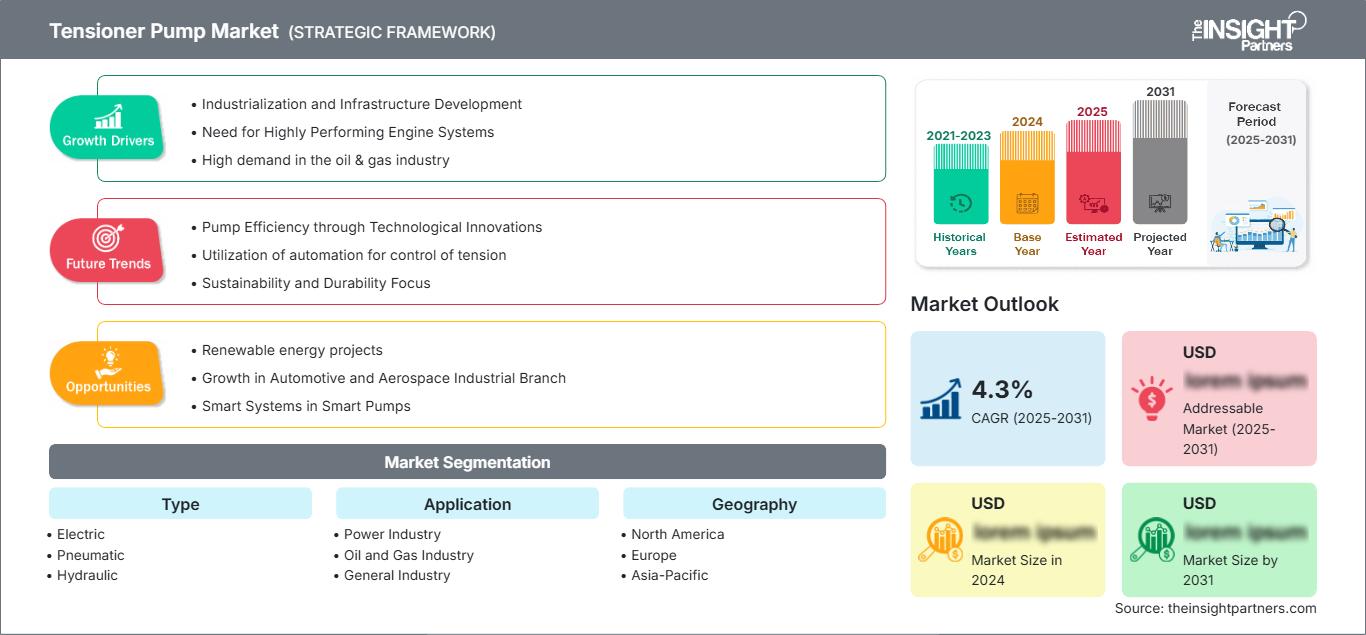
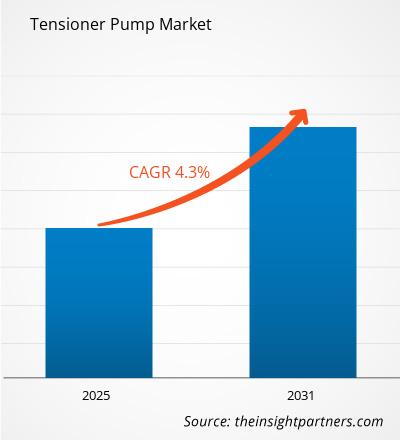
The Tensioner Pump Market size was valued at US$ 470.35 Million in 2025 and is projected to reach US$ 718.23 Million by 2034; it is expected to register a CAGR of 4.82% from 2026 to 2034. The demand is expected to be supported by the requirement for accurate bolt tightening in power generation plants, oil & gas facilities, and other industrial applications, wherein controlled pre-load reduces chances of leakage, down-time, and exposure.
North America is expected to grow at a CAGR of 4.4-4.8% during 2026 - 2034, thanks to refinery turn-arounds, liquefied natural gas plants, nuclear plant maintenance, and repowering wind farms. This region benefits from bolt services networks, use of electrical and hydraulic pumps, and stringent joint integrity requirements in critical facilities.
Tensioner Pump Market Assessment and Insights
- North America: The region accounted for 29–32% of the tensioner pump market share in 2025 and is expected to grow at a CAGR of 4.4–4.8% between 2026–2034, driven by power plant maintenance and oilfield bolting standards.
- US: The country represented 72–76% of North America share in 2025 and is projected to expand at a CAGR of 4.5–4.9% between 2026–2034, led by LNG, wind, and refinery activity.
- Europe: Europe held a 23–26% share in 2025 and is forecast to grow at a CAGR of 4.1–4.5% during 2026–2034, with Germany, the UK, France, Italy, and Spain leading adoption.
- Asia Pacific: APAC captured 31–34% share in 2025 and is expected to advance at a CAGR of 5.2–5.6% during 2026–2034, led by China, India, Japan, and South Korea.
- Largest Segment: Hydraulic held 58–62% share of the market in 2025 and is projected to grow at a CAGR of 4.6–5.0% during 2026–2034 due to high-pressure bolting reliability.
- High Growth Segment: Electric held 21–24% market share in 2025, and the Tensioner Pump Market forecast projects a CAGR of 5.5–5.9% during 2026–2034, as operators adopt control.
- Key companies analyzed in detail: Enerpac Tool Group Corp., HTL Group Ltd., Hydraulics Technology, Inc., HYTORC Division UNEX Corporation, ITH GmbH and Co. KG, Nord-Lock International AB, ORI MARTIN S.p.A., Powermaster Engineers Pvt. Ltd., SPX Flow, Inc., TorkWorx, Hydratight Limited, Boltight Limited.
Source: The Insight Partners' analysis based on proprietary research, government publications, company annual reports, investor presentations, industry databases, and expert interviews.
Tensioner Pump market trends include moving from manual pressure creation towards compact hydraulic pack, electric versions, and even digitally assisted operations. Demand is for tensioner pumps that enable multi-tensioner work, quick pressure buildup, and reliable preload records. The production of the equipment focuses on specialized manufacturers of bolting technology that have machining and seal design capability along with experience in handling high pressure safely. Market supply issues are still tied to precise components, pressure hoses, pressure gauges, and regional servicing for customers from oil and gas industry, wind energy, and power plants.
Future growth will come from the expanding need to construct new refineries, gas processing units, grid infrastructure, and manufacturing capabilities of growing developing industrial countries. Investments into renewable energy plants, liquefied natural gas terminal, and extending operational life of old thermal and nuclear plants increase the range of Tensioner Pumps' applications. Focus on workers' safety, secure flanges, and maintenance monitoring encourages the move from regular pumps to safer versions.
Tensioner Pump Market Report Scope
| Report Attribute | Details |
|---|---|
| Market size in 2025 | US$ 470.35 Million |
| Market Size by 2034 | US$ 718.23 Million |
| Global CAGR (2026 - 2034) | 4.82% |
| Historical Data | 2021-2024 |
| Forecast period | 2026-2034 |
Tensioner Pump Market Analysis
The demand in the tensioner Pump market is based on controlled bolt loading wherein variations in preload may result in flange leaks, loosening due to vibrations, or plant shutdowns. Power generation uses tensioner pumps for turbine applications, heat exchangers, and wind tower foundations, while Oil and Gas operators utilize them in turnarounds and subsea operations. Demand from general industry results from steel mills, cement works, mining operations, and large machines maintenance.
The ecosystem includes pump manufacturers, tensioner manufacturers, hose and fitting manufacturers, rental firms, calibration labs, and bolting companies. The supply chain is impacted by high pressure machining capability and availability of certified components. There is increasing emphasis by customers on serviceability, operator training, and compatibility with their existing bolting systems in the Tensioner Pump market.
Competitors include international manufacturers of industrial tools and bolting technologies. The Tensioner Pump market report highlights several key players, such as Enerpac Tool Group Corp., HYTORC Division UNEX Corporation, ITH GmbH & Co. KG, Hydraulics Technology, Inc., and SPX Flow, Inc., that compete based on capabilities in terms of pressure generation, portability, safety features, and application engineering. The regional suppliers like Powermaster Engineers Pvt. Ltd. improve pricing power and aftersales support.
Trends point to investment in electricity- and battery-powered pumps, pressure monitoring systems and compact designs. Strategic positioning should be in favor of those companies who can provide equipment sales together with rental, training and maintenance. The Tensioner Pump analysis proves that the buyers are willing to pay more for reliable products and not initial low prices, since failure of joint leads to serious negative effects.
● REPORT CUSTOMIZATION
Tailor This Report To Align With Your Specific Business Requirements
This report can be customized to align precisely with your business objectives, scope, and target markets. Customization options include tailored segmentation, geography, competitive analysis, and strategic insights to support informed decision-making.
Customize This Report →WHAT YOU CAN ADJUST
- ● Segmentations
- ● Geography
- ● Competitive Analysis
- ● Language Preferences
Tensioner Pump Market: Strategic Insights
Regional Insights
North America Tensioner Pump
North America had a 29-32% market share in 2025 and is expected to register a CAGR of 4.4-4.8% during 2034. Major applications include refinery turnarounds, petrochemical maintenance activities, development of LNG terminals, construction of wind farms, and outages at power plants. The region has efficient safety processes, rental equipment, and OEM services available.
Industrial customers opt for electric and hydraulic devices that allow quick multi-bolt tightening as well as precise pressure settings. The nature of energy-related investments by IEA and continued gas infrastructure activities along with aged power installations help justify regular replacement demands. Tensioner Pump market trends in this region also demonstrate the demand for portable pumps used in remote conditions.
U.S. Tensioner Pump Market
The U.S. accounted for 72–76% of the North American share in 2025 and is estimated to have a CAGR of 4.5–4.9% over 2026–2034. Bolting activities are generated by LNG export schemes, petrochemical complexes, offshore oil and gas maintenance operations, and nuclear plants’ life extension. Presence is well developed with companies such as Enerpac Tool Group Corp., HYTORC Division UNEX Corporation, and TorkWorx.
Applications are evolving from single pumps to systems that help optimize jobs and reduce involvement of workers. Wind turbine foundations, refineries' heat exchangers, pressure vessels, and pipeline flanges are among high value applications. Customers care about quick response time, calibration capability, and compatibility with tensioners currently being used.
Europe Tensioner Pump Market
Europe had 23-26% market share in 2025, with the growth expected to be 4.1-4.5% CAGR until 2034. The United Kingdom benefits from offshore wind, maintenance in the North Sea, and facilities for energy transit, in which controlled bolting plays a major role in wind turbines, substations, and subsea modules.
Germany is the largest country due to its production of machinery, power equipment, chemicals, and the wind industry chain. Often, customers demand high accuracy, documentation, and regulatory-ready tools that support hydraulic and electric devices.
France, Italy, and Spain contribute through refineries, shipyards, steel, cement, and grid modernization projects. Italy’s industrial equipment base and France’s nuclear maintenance cycle support recurring demand, while Spain’s renewable installations increase field service requirements for compact tensioning pumps.
APAC Tensioner Pump Market
APAC accounted for 31–34% share in 2025 and is projected to grow at a CAGR of 5.2–5.6% during 2026–2034. China is the leading country, supported by heavy manufacturing, petrochemicals, power generation, shipbuilding, and offshore wind installations.
Japan and South Korea create demand through shipyards, nuclear maintenance, turbines, and precision manufacturing. India is scaling refinery, gas pipeline, renewable, and infrastructure investment, increasing demand for reliable pumps with localized service and cost-efficient procurement.
Australia adds mining, LNG, and energy infrastructure opportunities. Policy support for clean power and industrial modernization strengthens Tensioner Pump growth across the region. Suppliers that combine rugged products with distributor training are positioned to capture expanding maintenance demand.
Middle East & Africa Tensioner Pump Market
Middle East and Africa is expected to grow at a CAGR of 4.9–5.3% during 2026–2034. Saudi Arabia is the leading country, driven by upstream investment, refining, petrochemicals, desalination, and power infrastructure where flange integrity is essential.
The UAE supports demand through oilfield services, LNG, ports, and industrial maintenance. Operators prioritize rugged pneumatic and hydraulic pumps suitable for remote sites, high ambient temperatures, and fast turnaround work in energy assets.
South Africa and the Rest of MEA contribute through mining, power rehabilitation, and infrastructure projects. Rental availability and technician training remain decisive adoption factors because many customers prefer service-based access over full equipment ownership.
Segmentation Analysis
Type
The Type segment in the tensioner pump market is projected to grow at a CAGR of 4.8–5.2% during 2026–2034. Product selection depends on site power availability, pressure requirements, portability, duty cycle, and safety procedures. Hydraulic systems remain dominant in high-pressure bolting, while electric systems are gaining ground where automation, repeatability, and lower operator fatigue are prioritized.
- Electric pumps are increasingly adopted in maintenance shops, wind assets, and plants with reliable power access because they offer consistent pressure delivery, easier controls, and better suitability for documented bolting workflows.
- Pneumatic pumps remain important in hazardous or remote operating environments where compressed air is preferred and electrical ignition risks must be minimized during oil and gas maintenance.
- Hydraulic pumps hold the strongest installed position because they deliver high pressure, robust field performance, and compatibility with large bolt tensioners used in turbines, flanges, and heavy equipment.
Application
The Application segment in the tensioner pump market is expected to grow at a CAGR of 4.7–5.1% during 2026–2034. Demand differs by asset criticality and maintenance frequency. Power applications require repeatable preload for turbines and wind structures, oil and gas users emphasize leak prevention and turnaround speed, and general industry prioritizes versatility for varied bolting tasks.
- Power Industry demand is supported by turbine maintenance, wind tower installation, nuclear outages, and grid equipment work where joint reliability directly affects availability and regulatory compliance.
- Oil and Gas Industry users deploy tensioner pumps in refineries, LNG facilities, offshore platforms, pipelines, and petrochemical plants where accurate bolt loading reduces leakage and shutdown exposure.
- General Industry includes steel, cement, mining, shipbuilding, machinery, and infrastructure maintenance, where customers value adaptable pumps that support multiple tools and rugged operating conditions.
Opportunity Snapshot
| Segment Name | Revenue Contribution | Trend Tag | Adoption Stage |
| Power Industry | High | Wind Bolting | Scaling |
| Oil and Gas Industry | High | Flange Integrity | Mature |
| General Industry | Medium | Plant Maintenance | Scaling |
Tensioner Pump Market Growth Drivers and Impact Analysis
Rising Criticality of Flange Integrity in Energy Assets
Controlled bolting gets more funding from energy operators because flange leakage, unequal preload, and bolt loosening due to vibration may lead to safety hazards and unplanned downtimes. The need for pumps capable of providing consistent high pressure performance over several bolts is critical in refineries, LNG plants, turbines, offshore platforms, and pressurized equipment. The effect is most pronounced in turnarounds, where faster cycle time bolting increases asset availability. This driver enables size increase in Tensioner Pump through associating purchases with risk mitigation, compliance, and availability needs.
Expansion of Wind, Grid, and Power Maintenance Programs
Power infrastructure is becoming more bolting intensive as wind farms, substations, turbines, generators, and grid equipment require repeatable joint integrity. Wind tower sections, foundation bolts, and nacelle assemblies depend on controlled preload, especially in high-vibration environments. Aging thermal and nuclear plants also need recurring outage maintenance. These conditions create recurring demand for portable hydraulic and electric pumps. The tensioner pump market impact is a wider customer base beyond oil and gas, improving resilience and supporting steady Tensioner Pump growth.
Shift Toward Safer and Faster Maintenance Workflows
There is an increasing pressure on the industrial maintenance workers to increase the efficiency of maintenance by minimizing the time spent on it and at the same time maintaining safety of the personnel along with good documentation. Tensioner pumps with remote control, gauges, quick coupling and compatibility with multiple tools help in reducing the effort and making the process consistent. Electrical systems help in controlled functioning in workshops and plants whereas pneumatic systems still find their importance in hazardous areas.
Tensioner Pump Market Future Trends
Digitally Documented Bolting Workflows
Pump usage in future will be more about documentation, traceability, and quality assurance than about the pressure alone. The customer is going to appreciate those pumps whose parameters are logged such as pressure setting, cycling count, calibration, and job-related information for maintenance history documentation. This will go well with digital asset management in refineries, power stations, and even offshore operations. Those who are able to interface their pumps with the cloud technology and handheld controllers will have the advantage.
Battery-Assisted High-Pressure Pumping
Battery-assisted pumps are likely to gain wider acceptance where power access is limited, including wind farms, pipelines, mining sites, offshore decks, and emergency maintenance locations. Improvements in battery density, motor efficiency, and rugged enclosure design will make cordless systems more practical for field bolting. This trend will not eliminate hydraulic or pneumatic pumps but will create a higher-value category for mobile maintenance. It also strengthens the Tensioner Pump Market trends by increasing average selling prices and service opportunities.
Tensioner Pump Market Opportunities
Rental and Service Models for Turnaround Contractors
Turnaround contractors require high-pressure pumps on a temporary basis due to the nature of the work that does not necessarily imply the ownership of the equipment. This is an area where suppliers have an opportunity to build their fleet of rental equipment as well as provide calibration, training, and fast maintenance services. This will help to give customers access to high-end pumps as well as ensure recurring revenue from their sale to manufacturers and distributors.
Localized Manufacturing and Distribution in APAC
The growth in the industrial sector in APAC is a chance for suppliers to set up local assembly, spare parts supply, and support services. The customers in India, China, Southeast Asia, and Australia want quicker deliveries, economical services, and designs suitable for the site locations. Cooperation with the distributors, bolting service companies, and training institutes will lower the barriers to adoption. This is a strategic chance since the suppliers can secure installed base loyalty and profits from the tensioner pump market.
Recent Developments
- March 2026: Enerpac Tool Group Corp. — Enerpac announced that it added Diesel Split Flow Pump capabilities through the acquisition of Hydra-Pac technology, expanding its heavy lifting and high-pressure hydraulic portfolio. The move strengthens field-oriented pumping solutions relevant to industrial maintenance and infrastructure applications.
- June 2025: HYTORC Division UNEX Corporation — HYTORC announced plans to showcase the LIGHTNING Pump Series at ADIPEC 2025, positioning the battery-operated pump family as a faster, smarter bolting solution with data collection, wireless connectivity, and automatic operations for oil and gas environments.
- January 2026: ITH GmbH and Co. KG — ITH updated product information for its Micro-MAX and Eco-MAX hydraulic power units, emphasizing compact high-pressure pump designs for bolt tensioning cylinders and industrial bolting work. These systems support service jobs, assembly tasks, and demanding energy-sector applications.
Frequently Asked Questions

- Comprehensive Market Sizing and Forecast Analysis
- Detailed Segmentation Analysis
- In-Depth Market Dynamics Assessment
- Regional and Country-Level Insights
- Competitive Landscape and Company Benchmarking
- Strategic Business Intelligence
Recent Reports
Testimonials

The Insight Partners' SCADA System Market report is comprehensive, with valuable insights on current trends and future forecasts. The team was highly professional, responsive, and supportive throughout. We are very satisfied and highly recommend their services.
RAN KEDEM Partner, Reali Technologies LTDs
I requested a report on a very specific software market and the team produced the report in a few days. The information was very relevant and well presented. I then requested some changes and additions to the report. The team was again very responsive and I got the final report in less than a week.
JEAN-HERVE JENN Chairman, Future Analytica
We worked with The Insight Partners for an important market study and forecast. They gave us clear insights into opportunities and risks, which helped shape our plans. Their research was easy to use and based on solid data. It helped us make smart, confident decisions. We highly recommend them.
PIYUSH NAGPAL Sr. Vice President, High Beam Global
The Insight Partners delivered insightful, well-structured market research with strong domain expertise. Their team was professional and responsive throughout. The user-friendly website made accessing industry reports seamless. We highly recommend them for reliable, high-quality research services
YUKIHIKO ADACHI CEO, Deep Blue, LLC.
This is the first time I have purchased a market report from The Insight Partners.While I was unsure at first, I visited their web site and felt more comfortable to take the risk and purchase a market report.I am completely satisfied with the quality of the report and customer service. I had several questions and comments with the initial report, but after a couple of dialogs over email with their analyst I believe I have a report that I can use as input to our strategic planning process.Thank you so much for taking the extra time and making this a positive experience.I will definitely recommend your service to others and you will be my first call when we need further market data.
JOHN SUZUKI President and Chief Executive Officer, Board Director, BK Technologies
I wish to appreciate your support and the professionalism you displayed in the course of attending to my request for information regarding to infectious disease IVD market in Nigeria. I appreciate your patience, your guidance, and the fact that you were willing to offer a discount, which eventually made it possible for us to close a deal. I look forward to engaging The Insight Partners in the future, all thanks to the impression you have created in me as a result of this first encounter.
DR CHIJIOKE ONYIA MANAGING DIRECTOR, PineCrest Healthcare Ltd.Reason to Buy
- Informed Decision-Making
- Understanding Market Dynamics
- Competitive Analysis
- Identifying Emerging Markets
- Customer Insights
- Market Forecasts
- Risk Mitigation
- Boosting Operational Efficiency
- Strategic Planning
- Investment Justification
- Tracking Industry Innovations
- Aligning with Regulatory Trends





 Get Free Sample for