
Thermoelectric Heat Pumps Market Share, Demand & Growth by 2034
Coverage: By Technology (Single Stage, Multi Stage); Type (Bulk (Standard), Micro, Thin-film); Application (Analytical Instrumentation, Automotive Electronics and Safety Systems, Refrigeration and Cryogenics, Thermal Cycling, Detectors, Others); End-use (Aerospace and Defense, Automotive, Consumer Electronics, Healthcare, Food and Beverages, Energy and Utility, Others), and Geography (North America, Europe, Asia Pacific, and South and Central America)
- Status : Data Released
- Report Code : TIPRE00015030
- Category : Electronics and Semiconductor
- No. of Pages : 150
- Available Report Formats :


- Last update date : July 15, 2026


2025 Market Size
US$ 1.49 Bn
Base year value
2034 Forecast
US$ 3.41 Bn
Projected by 2034
CAGR 2026-2034
9.68 %
Growth rate
Addressable Market
US$ 21.90 Bn
(2026-2034)
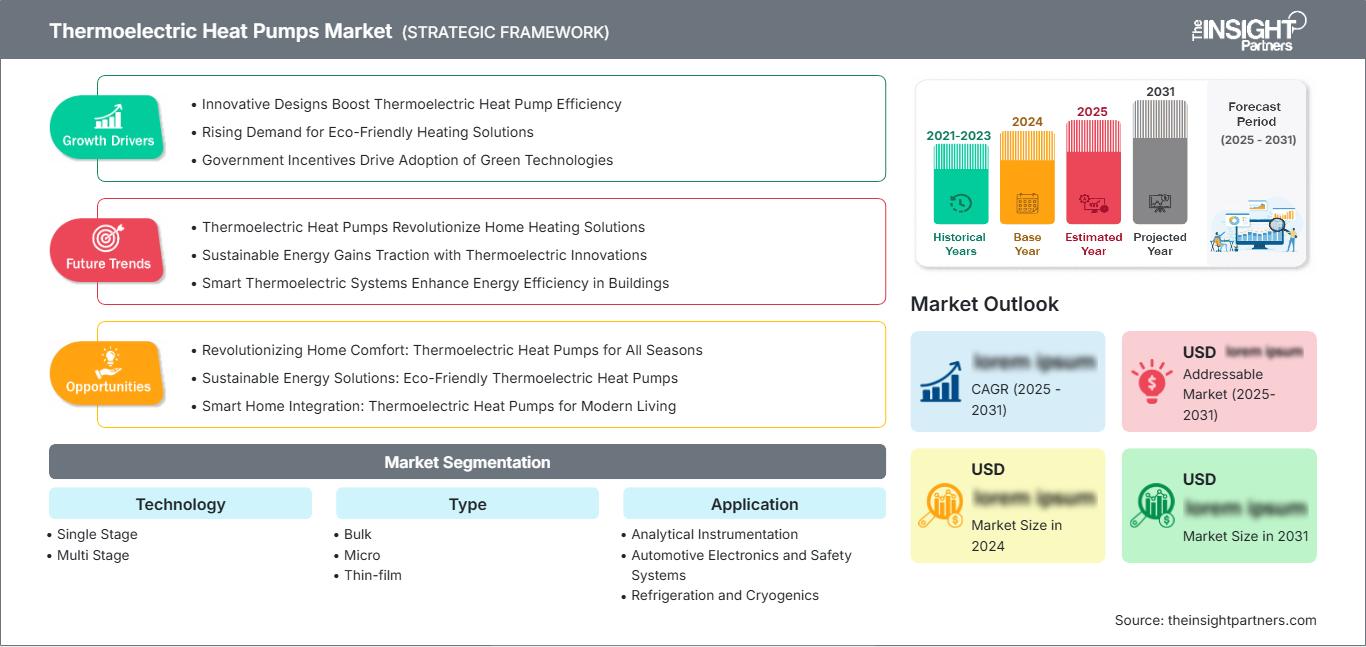
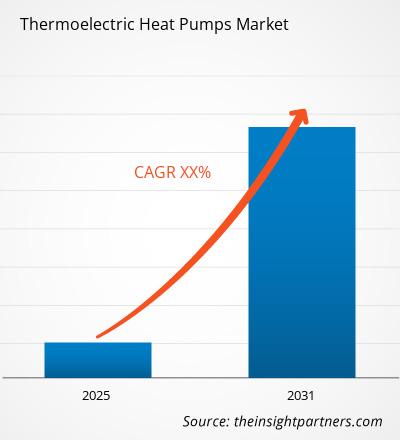
The Thermoelectric Heat Pumps Market projected to increase from US$ 1.49 Billion in 2025 to US$ 3.41 Billion by 2034, registering a CAGR of 9.68% during 2026–2034. The market reflects rising adoption of solid-state thermal control in compact systems where reliability, silent operation, rapid temperature switching, and refrigerant-free architecture are preferred over compressor-based alternatives across electronics, healthcare, automotive, aerospace, and laboratory applications.
Across North America, the Thermoelectric Heat Pumps size is supported by estimated regional expansion of 9.2–10.0% CAGR through 2034, as noted in the thermoelectric heat pumps market report, as medical diagnostics, defense electronics, optical communication, and EV subsystems demand precise localized heating and cooling. Supply-chain proximity to semiconductor, aerospace, and advanced instrumentation customers supports design-in activity, while refrigerant scrutiny and compact device engineering encourage solid-state alternatives for low-capacity, high-precision thermal loads.
Thermoelectric Heat Pumps Market Assessment and Insights
- North America accounted for 31–34% share in 2025 and is expected to grow at 9.2–10.0% CAGR between 2026–2034, driven by aerospace electronics, diagnostics equipment, optical modules, and defense-grade temperature stabilization.
- US represented 72–76% of North America in 2025 and is projected to expand at 9.3–10.1% CAGR between 2026–2034, led by medical, defense, and semiconductor thermal-control demand.
- Europe held 23–26% share in 2025 and is forecast to grow at 8.6–9.4% CAGR between 2026–2034, with Germany, the UK, and France leading precision instrumentation and automotive electronics adoption.
- Asia Pacific captured 34–38% share in 2025 and is likely to grow at 10.0–11.0% CAGR between 2026–2034, supported by China, Japan, South Korea, and India electronics manufacturing.
- Largest Segment Single Stage technology held 57–61% market share in 2025 and is expected to grow at 8.8–9.6% CAGR between 2026–2034 because of cost-effective deployment in compact cooling systems.
- High Growth Segment Thin-film type held 11–14% market share in 2025 and is projected to grow at 11.2–12.4% CAGR between 2026–2034 as microelectronics and photonics designs intensify.
- Key companies analyzed in detail: P.A. Hilton Limited, Coherent Corp., MAHLE GmbH, Ferrotec (USA) Corporation, Phononic, Inc., INHECO Industrial Heating and Cooling GmbH, Laird Thermal Systems GmbH, KRYOTHERM Ltd., TE Technology, Inc., and Armfield Limited.
Source: The Insight Partners' analysis based on proprietary research, government publications, company annual reports, investor presentations, industry databases, and expert interviews.
Evolution of products will be in the direction of engineered modules with more tolerance, high heat pumping density, and specific application packaging. There are developments in automation, bonding processes, ceramic substrates optimization, high temperature soldering, and integration of controllers for increased resistance to thermal cycling. The manufacturing process is highly specialized and performance depends on reliability of modules, contact resistance, and good thermal interface.
Future demand is expected to broaden as emerging Asian electronics clusters, European electrification programs, and North American defense modernization budgets increase demand for localized thermal management. The thermoelectric heat pumps market forecast indicates that regulatory pressure on refrigerants, healthcare decentralization, and AI-driven optical networking should support continued investment. However, wider use will depend on material availability, power efficiency improvements, and better integration with liquid cooling, heat sinks, and embedded control software.
Thermoelectric Heat Pumps Market Report Scope
| Report Attribute | Details |
|---|---|
| Market size in 2025 | US$ 1.49 Billion |
| Market Size by 2034 | US$ 3.41 Billion |
| Global CAGR (2026 - 2034) | 9.68% |
| Historical Data | 2021-2024 |
| Forecast period | 2026-2034 |
Thermoelectric Heat Pumps Market Analysis
The thermoelectric heat pump market size growth is being shaped by the shift toward precise, low-maintenance thermal control in equipment where vibration, noise, and refrigerant leakage are unacceptable. Strong demand exists for analytical instrumentation, PCR and laboratory systems, aerospace sensors, optical transceivers, and EV electronics. The value chain consists of semiconductors, ceramic substrates, interconnects, heat sinks, controllers, and systems integration, thereby making design collaboration vital during the qualification process.
For suppliers, the dynamics of supply are advantageous to those able to provide repeatable thermal cycling, custom geometry, and a reliable supply of tellurium-based materials. There is adequate capacity in global electronics assembly for volume, but mission-critical products continue to need lengthy validation cycles and engineering assistance. For customers demanding small packages with reliable temperature ranges, those suppliers who provide modules along with controllers and thermal design service will be more valuable than those providing only components.
The Thermoelectric Heat Pumps market analysis demonstrates a fragmented market environment with respect to global manufacturers of components, applied thermal systems, and specialized laboratory equipment. Coherent Corp., Ferrotec (USA) Corporation, Laird Thermal Systems GmbH, Phononic, Inc., and TE Technology, Inc. are competing on the basis of performance, miniaturization, lifecycle, and engineered solutions. P.A. Hilton Limited, INHECO Industrial Heating and Cooling GmbH, KRYOTHERM Ltd., MAHLE GmbH, and Armfield Limited increase the scope of applications within education, diagnostics, automotive, and instrumentation segments.
Investment is increasingly directed toward micro-TEC packaging, high-reliability thermal cycling, AI data center optics, and EV battery-adjacent electronics rather than broad residential heat-pump substitution. The Thermoelectric Heat Pumps market share is influenced by qualification history, the ability to support custom footprints, and strong links with OEM design teams. Companies with controller software, thermal modeling, and regional technical support are better placed to convert prototype interest into durable program revenue.
● REPORT CUSTOMIZATION
Tailor This Report To Align With Your Specific Business Requirements
This report can be customized to align precisely with your business objectives, scope, and target markets. Customization options include tailored segmentation, geography, competitive analysis, and strategic insights to support informed decision-making.
Customize This Report →WHAT YOU CAN ADJUST
- ● Segmentations
- ● Geography
- ● Competitive Analysis
- ● Language Preferences
Thermoelectric Heat Pumps Market: Strategic Insights
Regional Insights
North America Thermoelectric Heat Pumps
North America held 31–34% of global demand in 2025, with the Thermoelectric Heat Pumps share reflecting strong procurement from medical diagnostics, aerospace electronics, scientific instrumentation, and optical communication platforms. The region is expected to grow at 9.2–10.0% CAGR between 2026–2034 as defense modernization, semiconductor testing, and low-noise thermal control need support for new design wins.
There is a demand for the technology in applications that require small to medium thermal loads, wherein the compressor systems are oversized or impractical. The US plays an important role in regional commercialization, while Canada participates in the development process via photonics, lab, and cleantech research facilities. Designs are rigorous, but once a module is qualified, the chances of replacements are minimal.
U.S. Thermoelectric Heat Pumps Market
The US accounted for 72–76% of North American demand in 2025 and is forecast to expand at 9.3–10.1% CAGR between 2026–2034. Demand is linked to national laboratory programs, defense electronics, medical device manufacturing, and photonics supply chains serving AI networks, LiDAR, spectroscopy, and semiconductor test equipment. These thermoelectric heat pumps market trends highlight the growing importance of precision thermal management across advanced technology and mission-critical applications.
Company presence is widespread, and includes Ferrotec (USA) Corporation, Phononic, Inc., TE Technology, Inc., and Coherent Corp. Domestic customers receive assistance from these companies through engineering collaborations and customized modules. Trends in application focus on thermal cycling, infrared detectors, high-speed optics, and EV electronics. Adoption is highest where precise control enhances measurement, integrity, or critical component longevity.
Europe Thermoelectric Heat Pumps Market
Europe represented 23–26% of global demand in 2025 and is expected to grow at 8.6–9.4% CAGR between 2026–2034, with Germany as the leading country. Industrial automation, automotive electronics, aerospace sensing, and medical instrumentation drive uptake, while EU refrigerant policy indirectly supports solid-state solutions in compact cooling niches within the Thermoelectric Heat Pumps market.
The UK has the potential for growth via education, laboratory, and aerospace applications through suppliers like P.A. Hilton Limited and Armfield Limited, Germany, due to automotive, diagnostics, and laboratory automation needs associated with MAHLE GmbH and INHECO Industrial Heating and Cooling GmbH, and France, Italy, and Spain due to the demand from food safety testing, healthcare equipment, and defense electronics.
APAC Thermoelectric Heat Pumps Market
Asia Pacific held 34–38% share in 2025 and is projected to grow at 10.0–11.0% CAGR between 2026–2034, making it the fastest expanding region. China leads volume demand through electronics, optical modules, refrigeration components, and industrial equipment. At the same time, Japan and South Korea contribute high-reliability manufacturing and semiconductor-linked adoption in the Thermoelectric Heat Pumps market.
India and Australia add opportunities in diagnostics, defense electronics, research laboratories, and energy monitoring. Policy support for semiconductor localization, EV manufacturing, and advanced medical devices should increase design-in activity. Regional competitiveness is strengthened by assembly scale, component availability, and customer willingness to integrate compact cooling directly into electronics platforms.
Middle East & Africa Thermoelectric Heat Pumps Market
The Middle East and Africa demand is smaller but is expected to grow at 7.8–8.6% CAGR between 2026–2034. Saudi Arabia and the UAE lead regional adoption through energy infrastructure, defense electronics, laboratory equipment, and precision sensing used in harsh environments where compact, sealed thermal control is valuable in the Thermoelectric Heat Pumps market.
South Africa and the rest of MEA contribute demand through mining instrumentation, food safety, healthcare diagnostics, and distributed energy monitoring. High ambient temperature increases thermal-management complexity, but adoption remains selective because cost sensitivity favors compressor cooling unless precision, portability, or vibration-free operation is essential to system reliability.
Segmentation Analysis
Technology
Technology is expected to grow at 9.0–9.9% CAGR between 2026–2034 as customers select module architecture based on temperature differential, footprint, power budget, and reliability under cycling. The Thermoelectric Heat Pumps market is expanding across single-stage and multi-stage designs as equipment builders balance cost, depth of cooling, and package constraints. The scope of the Thermoelectric Heat Pumps continues to broaden with increasing adoption across diverse end-use applications.
- Single-stage modules dominate applications requiring moderate temperature lift, compact dimensions, and lower cost, making them preferred in analytical instruments, electronics spot cooling, and portable medical devices.
- Multi-stage modules serve deep-cooling and detector applications where larger temperature differentials are needed, creating strategic value in infrared sensing, cryogenic support, and advanced laboratory systems.
Type
Technology is expected to grow at 9.0–9.9% CAGR between 2026–2034 as customers select module architecture based on temperature differential, footprint, power budget, and reliability under cycling. The Thermoelectric Heat Pumps market is expanding across single-stage and multi-stage designs as equipment builders balance cost, depth of cooling, and package constraints. The Thermoelectric Heat Pumps scope continues to broaden with increasing adoption across diverse end-use applications.
- Bulk modules have the best market position because of their reliability and standard sizes, in addition to being widely available for refrigeration, instrumentation, thermal cycling, and industrial electronics use cases.
- Micro modules are needed for dense optical, sensing, and wearables applications in which thermal stabilization needs to be achieved near sensitive elements without any change in the overall size of the package.
- Thin film modules are vital for chip-level cooling and photonics applications due to their rapid responsiveness and packaging efficiency.
Application
Application is forecast to grow at 9.3–10.2% CAGR between 2026–2034 as adoption spreads across measurement, mobility, refrigeration, cycling, and detector platforms. Precision temperature control is the common purchase driver, but each use case differs in duty cycle, acceptable power draw, response time, and qualification requirements within the Thermoelectric Heat Pumps market.
- In Analytical Instrumentation, module-based temperature regulation is required for stabilizing samples, optics, and detectors for reliable measurements in chromatography, spectroscopy, molecular diagnosis, and lab automation.
- In Automotive Electronics & Safety Systems, thermal management is necessary for miniaturized applications of sensors, cameras, battery electronics, and cabin systems due to increased density and demands for reliability.
- In Refrigeration & Cryogenics, solid-state cooling technology is useful for small volume refrigeration systems, mobile cryogenics applications, and specialty containers due to concerns about maintenance, vibrations, and refrigerants.
- Thermal Cycles need robust modules that can withstand the process of repetitive heating and cooling cycles, hence material bonding, solder fatigue performance, and controller accuracy become important criteria during purchase.
- For Detectors, the need for thermal stability for reduced noise and drift is an essential criterion in infrared, scientific imaging, military sensors, and photonics applications.
End-use
End-use is expected to grow at 9.5–10.5% CAGR between 2026–2034, reflecting broad adoption in regulated, high-reliability, and space-constrained markets. Thermal-management decisions are increasingly made at the subsystem design stage, which favors suppliers that can support application engineering, rapid prototypes, and lifecycle documentation in the Thermoelectric Heat Pumps market.
- Aerospace and Defense values vibration-free, compact, and reliable temperature stabilization for sensors, avionics, detectors, and mission electronics operating across demanding environmental profiles.
- Automotive adoption is rising as electrified vehicles, ADAS sensors, and electronics-rich cabins need localized thermal control without adding bulky mechanical cooling components.
- Consumer Electronics uses modules selectively in premium devices, wearables, gaming systems, and compact appliances where quiet operation and small form factor improve user experience.
- Healthcare depends on accurate temperature control in diagnostics, laboratory automation, medicine storage, and portable medical systems that require reliability and regulatory traceability.
- Food and Beverages applications include portable refrigeration, dispensing systems, and quality-testing equipment where precise cooling supports safety, freshness, and distributed cold-chain operations.
- Energy and Utility demand comes from sensors, remote monitoring equipment, and power electronics, where sealed thermal control helps protect devices in outdoor or high-temperature sites.
Opportunity Snapshot
| Segment Name | Revenue Contribution | Trend Tag | Adoption Stage |
| Aerospace and Defense | High | Sensor Cooling | Mature |
| Automotive | High | EV Electronics | Scaling |
| Consumer Electronics | Medium | Wearable Cooling | Scaling |
| Healthcare | High | Diagnostic Control | Mature |
| Food and Beverages | Medium | Portable Cold | Scaling |
| Energy and Utility | Low | Remote Sensors | Emerging |
Thermoelectric Heat Pumps Market Growth Drivers and Impact Analysis
Miniaturized Electronics Require Localized Thermal Control
Electronic devices are getting smaller and more powerful, which requires thermal regulation closer to laser sources, processors, sensors, and battery systems. Thermoelectric Heat Pumps solve the problem since they provide cooling or heating with no moving parts, are fast-acting, and have a small size. The effect is most obvious in optical transceivers, LiDAR systems, medical tools, and EV electronics because a temperature change can affect precision, signal performance, and lifespan of a component. With OEMs designing compact modules instead of bulky systems, module vendors get an opportunity to participate in the design cycle and generate long-term demand due to custom geometry and control parameters.
Healthcare and Laboratory Automation Expand Precision Demand
Medical equipment is becoming increasingly dependent on controlled temperature ranges for molecular diagnosis, storage, heating/cooling cycles, imaging, and portable storage of samples. Solid-state coolers are an ideal choice as they have silent operation, provide precision bidirectional control, and can be incorporated into portable instruments used away from central labs. Market relevance is enhanced by the growing trend of decentralization and automation of processes, making cooling requirements smaller but with high expectations of reliability. Providers who can prove the performance of their products throughout the lifecycle, provide traceability, and ensure consistent temperature control can win more lucrative business.
Refrigerant and Maintenance Constraints Favor Solid-State Systems
Environmentally driven studies into the use of refrigerants, as well as the service requirements of mechanical coolers, push equipment manufacturers to explore solid state solutions for small-scale thermal loads. Thermoelectric coolers cannot be considered replacements for big HVAC solutions; however, their benefits include being sealed, portable, silent, and insensitive to vibrations, which makes their demand in practice inevitable in applications like food service, portable medical storage units, detectors, and other sensors and monitors. The effect on the market is selective yet sustainable since the customer always appreciates reliability and maintenance savings for low thermal loads.
Thermoelectric Heat Pumps Market Future Trends
Software-Defined Thermal Control Moves Toward the Edge
Thermoelectric Heat Pumps trends increasingly point toward software-defined cooling, where sensors, controllers, and algorithms adjust thermal output based on workload, ambient conditions, and component aging. This shift is important for AI optics, imaging systems, and portable diagnostics because thermal events can occur faster than mechanical systems can respond. Future products are likely to combine modules, firmware, telemetry, and predictive control to reduce energy use while preserving temperature stability. The result will be closer integration between thermal suppliers and electronics architects rather than transactional component sourcing.
Thin-Film and Micro Modules Enter More Photonic Platforms
Micro and thin-film designs are expected to gain design share as optical modules, sensors, and chip-adjacent electronics require cooling directly at the heat source in the Thermoelectric Heat Pumps market. Future adoption will depend on manufacturing repeatability, low electrical resistance, and compatibility with high-volume packaging. These formats will not replace bulk modules in standard equipment, but they can open premium use cases in data communication, defense detectors, and medical imaging. Suppliers that master miniaturized assembly and test validation can access faster-growing programs with high engineering barriers.
Thermoelectric Heat Pumps Market Opportunities
Design-In Partnerships with Medical and Photonics OEMs
Thermoelectric Heat Pumps market forecasts indicate attractive opportunities for suppliers that enter OEM programs early and co-develop application-specific modules. Medical diagnostics and photonics are especially compelling because thermal performance directly affects test accuracy, wavelength stability, and equipment uptime. Investors and manufacturers should prioritize engineering support, controller integration, and qualification services rather than competing solely on module price. A design-in strategy can create recurring revenue once the customer platform scales, especially when replacement requires requalification. Partnerships with instrument makers, optical component suppliers, and clinical automation firms can therefore convert technical differentiation into long-duration contracts.
Localized Manufacturing for Electronics and EV Supply Chains
Regional manufacturing investments can reduce lead times for customers integrating thermal modules into EV electronics, sensors, medical devices, and optical equipment in the Thermoelectric Heat Pumps market. Asia Pacific offers scale, while North America and Europe offer high-value engineering access and regulated-market proximity. Suppliers can improve resilience by qualifying alternate substrates, establishing regional test capacity, and offering configurable product families. The opportunity is not only production volume, but also faster prototype-to-qualification cycles. Companies that align module manufacturing, controller availability, and thermal validation near customer engineering teams should improve win rates in programs requiring rapid iteration.
Recent Developments
- November 2025: Phononic, a global leader in solid-state cooling technology, reveals the cooling solution for AI data centers that unthrottles AI performance while simultaneously delivering attractive returns on infrastructure investment. Today’s AI workloads exhibit unprecedented variability, driving throttling that can erode bandwidth and ultimately compute performance by as much as 30%. Cooling overprovisioning to address the resulting heat from these AI workload spikes is estimated at up to 78% at individual data centers, a notable drag on cost and performance efficiency.
- April 2025: Ferrotec Holdings Corporation marked a major milestone today with the groundbreaking of its second high-tech manufacturing facility at Kulim, Kedah, with an investment of RM1 billion (USD226 million). This reinforces its long-term commitment to Malaysia and its growing role in the global semiconductor industry. Set for completion within a year, the second facility will strengthen Ferrotec’s Southeast Asian footprint, enabling faster delivery, enhanced customer service, and greater innovation for global markets across Asia, Europe, and the Americas, bringing the company’s total Malaysian investment to RM1.9 billion.
Frequently Asked Questions

- Comprehensive Market Sizing and Forecast Analysis
- Detailed Segmentation Analysis
- In-Depth Market Dynamics Assessment
- Regional and Country-Level Insights
- Competitive Landscape and Company Benchmarking
- Strategic Business Intelligence
Recent Reports
Testimonials

The Insight Partners provided valuable market intelligence that supported our global go-to-market strategy. Their team was professional, responsive, and attentive to our feedback, providing thoughtful analysis and helpful methodological clarifications throughout the project.
Junmo Kim Chief Financial Officer (CFO), Enertech Co., Ltd.
The Insight Partners' SCADA System Market report is comprehensive, with valuable insights on current trends and future forecasts. The team was highly professional, responsive, and supportive throughout. We are very satisfied and highly recommend their services.
RAN KEDEM Partner, Reali Technologies LTDs
I requested a report on a very specific software market and the team produced the report in a few days. The information was very relevant and well presented. I then requested some changes and additions to the report. The team was again very responsive and I got the final report in less than a week.
JEAN-HERVE JENN Chairman, Future Analytica
We worked with The Insight Partners for an important market study and forecast. They gave us clear insights into opportunities and risks, which helped shape our plans. Their research was easy to use and based on solid data. It helped us make smart, confident decisions. We highly recommend them.
PIYUSH NAGPAL Sr. Vice President, High Beam Global
The Insight Partners delivered insightful, well-structured market research with strong domain expertise. Their team was professional and responsive throughout. The user-friendly website made accessing industry reports seamless. We highly recommend them for reliable, high-quality research services
YUKIHIKO ADACHI CEO, Deep Blue, LLC.
This is the first time I have purchased a market report from The Insight Partners.While I was unsure at first, I visited their web site and felt more comfortable to take the risk and purchase a market report.I am completely satisfied with the quality of the report and customer service. I had several questions and comments with the initial report, but after a couple of dialogs over email with their analyst I believe I have a report that I can use as input to our strategic planning process.Thank you so much for taking the extra time and making this a positive experience.I will definitely recommend your service to others and you will be my first call when we need further market data.
JOHN SUZUKI President and Chief Executive Officer, Board Director, BK Technologies
I wish to appreciate your support and the professionalism you displayed in the course of attending to my request for information regarding to infectious disease IVD market in Nigeria. I appreciate your patience, your guidance, and the fact that you were willing to offer a discount, which eventually made it possible for us to close a deal. I look forward to engaging The Insight Partners in the future, all thanks to the impression you have created in me as a result of this first encounter.
DR CHIJIOKE ONYIA MANAGING DIRECTOR, PineCrest Healthcare Ltd.Reason to Buy
- Informed Decision-Making
- Understanding Market Dynamics
- Competitive Analysis
- Identifying Emerging Markets
- Customer Insights
- Market Forecasts
- Risk Mitigation
- Boosting Operational Efficiency
- Strategic Planning
- Investment Justification
- Tracking Industry Innovations
- Aligning with Regulatory Trends





 Get Free Sample for