
Regenerative Turbine Pump Market Share, Growth & Forecast by 2034
Coverage: By Product (Single-stage, Multi-stage); Priming (Self-priming, Non self-priming); Capacity (Below 10 GPM, 10 - 30 GPM, 30 - 60 GPM, Above 60 GPM); Application (Agriculture, Chemicals, Building and Construction, Water and Wastewater, Industrial, Oil and Gas, Others) , and Geography (North America, Europe, Asia Pacific, and South and Central America)
- Status : Data Released
- Report Code : TIPRE00018581
- Category : Manufacturing and Construction
- No. of Pages : 150
- Available Report Formats :


- Last update date : September 16, 2026


2025 Market Size
US$ 502.41 Mn
Base year value
2034 Forecast
US$ 765.28 Mn
Projected by 2034
CAGR 2026-2034
4.79 %
Growth rate
Addressable Market
US$ 5,755.25 Mn
(2026-2034)
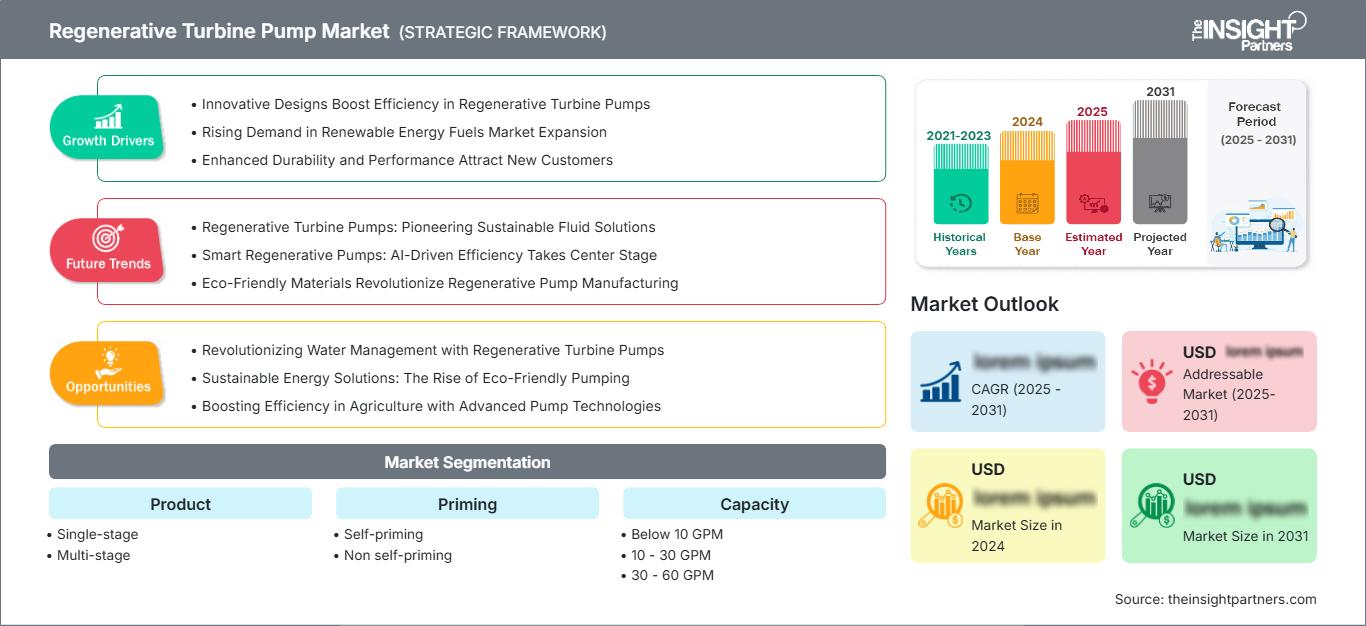
The regenerative turbine pump market is valued at US$ 502.41 Million in 2025 and is projected to reach US$ 765.28 Million by 2034, expanding at a CAGR of 4.79% during 2026–2034. The market encompasses specialized low-flow, high-head pumping equipment used across process industries, energy systems, water handling, and other applications where stable pressure delivery and compact hydraulic configurations are important.
North American demand is expected to expand at an estimated 4.3–4.9% CAGR through 2034, supported by the replacement of aging industrial pumping assets and continued investment in chemical processing, energy infrastructure, and water systems. The regenerative turbine pump market size is also influenced by manufacturers’ emphasis on application-specific materials, improved hydraulic efficiency, and equipment capable of maintaining stable performance under variable pressure conditions.
Regenerative Turbine Pump Market Assessment and Insights
- North America: The region is estimated to hold a 34–38% share in 2025 and expand at a 4.3–4.9% CAGR between 2026–2034, supported by mature process industries, replacement demand, and established pump distribution networks.
- US: The US represents approximately 78–82% of North America in 2025, with growth of 4.2–4.8% CAGR between 2026–2034, led by chemical, energy, industrial, and water applications.
- Europe: Europe accounts for 25–29% share in 2025 and is projected to grow at 4.1–4.7% CAGR between 2026–2034, with Germany, the UK, France, Italy, and Spain supporting demand through industrial modernization and efficiency requirements.
- Asia Pacific: Asia Pacific represents 27–31% share in 2025 and is expected to record 5.0–5.6% CAGR between 2026–2034, led by China, Japan, India, South Korea, and Australia amid manufacturing expansion and water infrastructure investment.
- Largest Segment: Multi-stage products hold an estimated 58–62% market share in 2025 and are expected to grow at 4.7–5.2% CAGR between 2026–2034, reflecting high-head, low-flow requirements.
- High Growth Segment: Self-priming products represent approximately 48–52% market share in 2025 and are forecast to grow at 5.1–5.7% CAGR between 2026–2034, supported by easier installation and operating flexibility.
- Key companies analyzed in detail: Corken, Inc.; IDEX Corporation; Magnatex Pumps, Inc.; MTH Pumps; Nikuni Co., Ltd.; Pentair plc; PSG, a Dover company; Roth Pump Co.; Speck Pumpen Walter Speck GmbH and Co. KG; TEIKOKU ELECTRIC MFG. CO., LTD.
Source: The Insight Partners' analysis based on proprietary research, government publications, company annual reports, investor presentations, industry databases, and expert interviews.
The technology base has evolved around compact hydraulic passages, precision-machined impellers, improved shaft and seal materials, and configurations capable of generating relatively high heads at low flow. Manufacturers increasingly differentiate products through corrosion-resistant construction, tighter manufacturing tolerances, self-priming capability, and application engineering. These changes allow regenerative units to address process duties where conventional centrifugal pumps can face cavitation or unstable low-flow operation. The regenerative turbine pump market therefore increasingly reflects engineering specialization rather than simple equipment replacement.
Development in the future will probably revolve around optimizing energy consumption, digital condition monitoring, modular pump systems, and geographically localized manufacturing. Up-and-coming economies of industry will be able to generate additional demand through the expansion of their chemical processing plants, food processing facilities, water treatment operations, and energy facilities. The importance of lifecycle costs in relation to industrial efficiency and water management issues is expected to become even more significant as companies make their purchases.
Regenerative Turbine Pump Market Report Scope
| Report Attribute | Details |
|---|---|
| Market size in 2025 | US$ 502.41 Million |
| Market Size by 2034 | US$ 765.28 Million |
| Global CAGR (2026 - 2034) | 4.79% |
| Historical Data | 2021-2024 |
| Forecast period | 2026-2034 |
Regenerative Turbine Pump Market Analysis
Demand is shaped by applications requiring controlled flow and comparatively high discharge pressure. The regenerative turbine pump market growth benefits from chemical transfer, boiler-related services, water treatment, refrigeration, process circulation, and specialized industrial duties where compact equipment can provide stable hydraulic performance. An ecosystem consists of manufacturers of pumps, providers of motors, seal makers and bearing suppliers, distributors, engineering firms, system integrators, and end users from the industrial sector. The supply chain continues to be affected by stainless steel, engineered metals, mechanical seals, electric motors, and machining capabilities.
Competition within the industry does not depend on volumes of production but on the hydraulic design, materials used, customization, and the level of services offered. Proper sizing of low-flow pumps is essential as operation beyond the designed hydraulic range results in increased energy use and wear and tear. As a result, engineering services have become a vital component in purchasing, especially in chemical and oil and gas facilities.
Competition is fragmented across specialist pump manufacturers and diversified industrial groups. IDEX Corporation benefits from Corken's established position in industrial and energy pumping, while Pentair plc maintains regenerative turbine offerings through its water and flow portfolio. Magnatex Pumps, Inc., MTH Pumps, Roth Pump Co., Nikuni Co., Ltd., and Speck Pumpen Walter Speck GmbH and Co. KG emphasize specialized hydraulic configurations and application engineering. TEIKOKU ELECTRIC MFG. CO., LTD. complements the competitive field with low-flow, high-head pumping expertise.
Investment preferences now revolve around precision in manufacture, anti-corrosion, product performance, and after-sales support. There is a move to improve technical literature and selection methods for the sake of eliminating sizing mistakes. Advanced Flow Solutions from IDEX Corporation involves the sale of Corken products, which include single-stage and multistage regenerative turbine pumps for oil and gas and industrial applications. Positioning thus requires the integration of application expertise with consistent supply, regional service presence, and unique pump designs.
● REPORT CUSTOMIZATION
Tailor This Report To Align With Your Specific Business Requirements
This report can be customized to align precisely with your business objectives, scope, and target markets. Customization options include tailored segmentation, geography, competitive analysis, and strategic insights to support informed decision-making.
Customize This Report →WHAT YOU CAN ADJUST
- ● Segmentations
- ● Geography
- ● Competitive Analysis
- ● Language Preferences
Regenerative Turbine Pump Market: Strategic Insights
Regional Insights
North America regenerative turbine pump market
North America is estimated to account for 34–38% of the regenerative turbine pump market share in 2025, with a growth of 4.3–4.9% CAGR through 2034. The United States dominates regional consumption because of its extensive chemical, refining, food processing, industrial manufacturing, and water infrastructure base. Demands are increased because the installed equipment is being replaced with an operator that favors dependable low-flow pumping with minimum downtime and compatibility with the already installed pipings and motors.
The Canadian market has been active in terms of energy, mining, chemical, and municipal water use, while the Mexican market has been demanding for manufacturing and processing purposes. Total cost of ownership, seal life, corrosion-resistant capabilities, and the availability of replacement parts are some of the things that regional buyers are now focusing on. North American users have also been specifying application-specific pump material due to certain environmental conditions.
U.S. regenerative turbine pump Market
The US represents approximately 78–82% of North America's regenerative turbine pump market 2025 share and is projected to grow at 4.2–4.8% CAGR through 2034. There is demand for the product in applications such as chemical processing, oil and gas, industrial manufacturing, water treatment, refrigeration, and process circulation. Suppliers who offer their services domestically can enjoy reduced lead time and existing relationships in engineering.
The manufacturers of importance to specialized pumping applications include Corken, MTH Pumps, Pentair plc, Magnatex Pumps, and Roth Pump Co. Low flow hydraulic stability, material compatibility, self-priming ability, and ease of maintenance are some of the considerations taken into account when making purchase decisions. Consumers of industrial pumps are beginning to judge their performance based on efficiency relative to that of the motor and the whole system, rather than pump cost only.
Europe regenerative turbine pump Market
Europe is estimated at 25–29% share of the regenerative turbine pump market in 2025, with 4.1–4.7% CAGR through 2034. Germany remains the leading country, supported by process engineering, machinery production, chemicals, and industrial automation. The UK retains demand from energy, water, and process industries, while France, Italy, and Spain contribute through manufacturing, food processing, utilities, and industrial modernization.
The UK market emphasizes reliability and replacement of installed pumping equipment across water, energy, and process facilities. Germany benefits from a strong engineering ecosystem and demand for precision equipment, while France has opportunities in water, chemicals, and industrial processing. Italy and Spain are supported by manufacturing, food processing, building services, and water infrastructure. European buyers increasingly consider efficiency, serviceability, material selection, and lifecycle performance when specifying specialized pumping systems.
APAC regenerative turbine pump market
APAC represents an estimated 27–31% share of the regenerative turbine pump market in 2025 and is expected to grow at 5.0–5.6% CAGR through 2034. China is the leading market, followed by Japan, India, South Korea, and Australia. Industrial manufacturing, chemical production, food processing, water treatment, and energy investment underpin regional demand.
China combines large manufacturing capacity with infrastructure expansion, while Japan emphasizes precision and reliability. India benefits from industrialization and water infrastructure programs, South Korea from advanced manufacturing and chemicals, and Australia from mining, energy, and water applications. Regional suppliers increasingly emphasize compact high-head designs, corrosion-resistant materials, and application-specific configurations as industrial projects become more technically demanding.
Middle East & Africa regenerative turbine pump Market
The Middle East and Africa regenerative turbine pump market demand is comparatively smaller but supported by energy, desalination, industrial processing, and infrastructure projects. Saudi Arabia and the UAE lead regional adoption, while South Africa represents an important market for mining, industrial processing, and water applications. The broader region is estimated to expand at 3.8–4.4% CAGR through 2034.
Saudi Arabia benefits from industrial diversification and energy investments, while the UAE combines water infrastructure with industrial and logistics development. South Africa requires reliable pumping equipment across mining and municipal systems. The rest of MEA presents selective opportunities where industrialization, water scarcity, and infrastructure investment create requirements for compact, high-head pumping systems. Service availability and corrosion resistance remain important procurement considerations.
Segmentation Analysis
Product
Product segmentation is divided into Single-stage and Multi-stage configurations. Multi-stage systems remain strategically important where higher pressure is required at controlled flow rates, while single-stage systems address less demanding duties. The main Product segment is expected to grow at 4.6–5.1% CAGR from 2026–2034. The regenerative turbine pump market scope expands as users select configurations according to pressure requirements, operating temperature, fluid characteristics, footprint, and maintenance strategy.
- Single-stage: Single-stage pumps serve applications requiring moderate pressure with relatively simple hydraulic arrangements. Their straightforward architecture can reduce installation complexity and remains relevant for compact industrial, building, water, and process applications.
- Multi-stage: Multi-stage pumps provide higher pressure generation through repeated hydraulic energy transfer. Their strong position reflects applications requiring high head at low flow, including specialized industrial, chemical, boiler, and process duties.
Priming
Priming comprises Self-priming and Non self-priming configurations in the Regenerative Turbine Pump Market Report. The segment is projected to expand at 4.8–5.3% CAGR from 2026–2034, with self-priming designs gaining strategic relevance where suction conditions vary or manual priming would increase operating intervention. Equipment selection depends on installation configuration, fluid properties, suction lift, and required restart reliability.
- Self-priming: Self-priming pumps reduce dependence on manual priming and can simplify installations where suction lines may contain air. They are relevant to intermittent process duties, water systems, and industrial applications requiring rapid restart.
- Non self-priming: Non self-priming designs remain suitable for controlled installations with stable liquid supply and predictable suction conditions. Their simpler operating environment can support applications where priming infrastructure is already available.
Capacity
Capacity includes Below 1 GPM, 1 - 3 GPM, 3 - 6 GPM, and Above 6 GPM in the Regenerative Turbine Pump Market Forecast. The Capacity segment is expected to grow at 4.4–5.0% CAGR from 2026–2034. Demand varies according to process requirements, pressure differential, equipment footprint, and the need for precise low-flow control.
- Below 1 GPM: These pumps address highly specialized low-volume duties where accurate fluid movement and compact equipment are priorities. They can serve laboratory, metering, cooling, chemical, and precision process requirements.
- 1 - 3 GPM: This range supports compact process systems requiring controlled flow and elevated pressure. Its relevance increases where equipment space is limited and conventional centrifugal configurations are inefficient.
- 3 - 6 GPM: This capacity range serves broader industrial and process applications requiring a balance between controlled flow and pressure. It can support water, chemical, refrigeration, and specialized circulation duties.
- Above 6 GPM: Larger-capacity configurations address applications requiring greater throughput while retaining regenerative hydraulic characteristics. Industrial processing, water systems, and energy-related duties can support demand for these units.
Application
Application segmentation comprises Agriculture, Chemicals, Building and Construction, Water and Wastewater, Industrial, and Oil and Gas in the Regenerative Turbine Pump Market Trends. The Application segment is projected to grow at 4.5–5.1% CAGR from 2026–2034 as specialized pumping requirements expand across process industries and infrastructure systems.
- Agriculture: Adoption is supported by irrigation, chemical dosing, water transfer, and controlled-pressure requirements where compact pumping equipment can complement existing water systems.
- Chemicals: Chemical processing values precise flow, material compatibility, pressure stability, and equipment reliability, creating opportunities for specialized configurations and corrosion-resistant construction.
- Building and Construction: Building applications include pressure boosting, water circulation, and specialized service systems where compact equipment and predictable operation support installation flexibility.
- Water and Wastewater: Water applications require dependable pumping for treatment, circulation, dosing, and pressure management, with material selection influenced by fluid quality and treatment chemistry.
- Industrial: Industrial users apply these pumps across process circulation, cooling, machinery systems, and fluid transfer, particularly where low-flow and high-head performance is required.
- Oil and Gas: Oil and gas applications emphasize reliability, fluid compatibility, pressure management, and equipment suitable for demanding process environments, supporting specialized pump configurations.
Opportunity Snapshot
| Application | Revenue Contribution (High/Medium/Low) | Trend Tag | Adoption Stage |
| Agriculture | Medium | Irrigation Pressure | Scaling |
| Chemicals | High | Corrosion Control | Mature |
| Building and Construction | Medium | Pressure Boosting | Scaling |
| Water and Wastewater | High | Treatment Flow | Mature |
| Industrial | High | Process Circulation | Mature |
| Oil and Gas | High | Fluid Transfer | Mature |
Regenerative Turbine Pump Market Growth Drivers and Impact Analysis
Industrial demand for low-flow, high-head pumping
Industrial processes frequently require pressure generation without the high flow rates associated with conventional centrifugal equipment in the Regenerative Turbine Pump Market. Regenerative turbine designs can address this operating window by repeatedly transferring energy to the fluid through the impeller periphery. Their suitability for compact systems supports use in chemical processing, cooling, boiler-related services, and specialized transfer applications. The market impact is strongest where plant operators need stable pressure while avoiding oversized equipment. Such requirements encourage suppliers to develop different materials, shaft arrangements, seals, and stage configurations. As industrial facilities modernize, pump selection increasingly considers hydraulic fit and lifecycle reliability rather than initial equipment price alone. This creates opportunities for manufacturers with application engineering capabilities and established aftermarket support.
Expansion of water treatment and industrial water infrastructure
Technical variety in pump systems is growing due to the greater need for water supplies and increased demands for water treatment. Pumps for specific processes such as dosing, circulation, pressure boosting, filtration assistance, and process water transportation are necessary. Turbine pumps can be considered if the system needs a small amount of flow but higher pressure and smaller equipment. Market opportunities include not only the sale of new systems but also the replacement of existing pumps, motors, seals, and other hydraulic devices since treatment plants regularly renew their equipment. Such opportunities are especially valuable in areas where industrial development is related to increased water management.
Demand for compact equipment and simplified system architecture
Space limitations and simplicity in systems are becoming more relevant in the purchase of industrial equipment. Regenerative turbine pumps have the ability to produce relatively high pressures through their small construction, thus enabling engineers to minimize the amount of space taken up by the equipment in selected low-flow applications. This feature may be useful in machinery skids, buildings, chemical plants, and process equipment where there is limited space available. It affects pipe fitting because the consistent flow characteristics will enable engineers to control pressure demands without necessarily making the pumps bulky. There are, therefore, many reasons why manufacturers have the drive to enhance dimensions, mounting, seals, and motors.
Regenerative Turbine Pump Market Future Trends
Digital selection and condition-based service
Digital tools are expected to become more important in pump selection, commissioning, and maintenance. Manufacturers can increasingly combine hydraulic curves, application parameters, material compatibility, and operating history into digital selection workflows. Condition monitoring can also support earlier identification of vibration, bearing, seal, temperature, or performance deviations. For users, the strategic value is not simply remote visibility but improved maintenance planning and reduced unplanned downtime. Over time, digital records can support more accurate replacement decisions by linking installed equipment with operating conditions and service histories. Suppliers that integrate selection software, technical documentation, monitoring capabilities, and aftermarket services can differentiate beyond hardware. This transition should gradually strengthen lifecycle-based procurement across industrial pumping applications.
Higher-efficiency materials and engineered configurations
Future product development is likely to emphasize hydraulic optimization, improved surface finishes, engineered alloys, advanced seals, and application-specific impeller geometry. These improvements can help pumps maintain performance under demanding temperature, pressure, or fluid conditions while reducing maintenance requirements. Manufacturers may also broaden modular configurations so users can select materials, seals, motors, and mounting arrangements according to process conditions. Such flexibility is especially relevant for chemical, oil and gas, and specialized industrial applications. Engineering development will increasingly focus on balancing efficiency with durability because the lowest energy consumption is not necessarily the best outcome when reliability is compromised. Product platforms that achieve both characteristics should gain preference among technically sophisticated users.
Regenerative Turbine Pump Market Opportunities
Localized manufacturing and aftermarket networks in Asia
Asia presents an opportunity for suppliers to establish localized manufacturing, assembly, distribution, and service capabilities around specialized pumping equipment. China, India, Japan, South Korea, and Australia have different industrial structures, meaning a single channel model may not adequately address procurement requirements. Local inventories of seals, bearings, motors, and complete pump assemblies can reduce downtime and improve customer confidence. Manufacturers can also partner with engineering contractors serving chemicals, food processing, water treatment, and industrial facilities. The regenerative turbine pump forecasts indicate that suppliers with regional technical support can capture demand beyond initial equipment sales by developing maintenance contracts and replacement programs. Localization can therefore strengthen both project access and recurring aftermarket revenue.
Engineered pump packages for process industries
An important opportunity lies in supplying complete engineered packages rather than standalone pumps. Integrating pumps with motors, controls, valves, instrumentation, bases, piping, and monitoring systems can reduce engineering workload for end users and system integrators. Chemical, industrial, water, and energy customers often require equipment configured around specific operating conditions, making packaged solutions commercially attractive. Suppliers can differentiate through testing, documentation, material certification, and commissioning assistance. This approach also creates opportunities to incorporate energy monitoring and predictive maintenance capabilities into new installations. Companies with established manufacturing and application-engineering capabilities can use packaged solutions to increase customer switching costs while addressing increasingly complex procurement requirements. The opportunity is particularly relevant for brownfield upgrades where installation disruption must be minimized.
Frequently Asked Questions

- Comprehensive Market Sizing and Forecast Analysis
- Detailed Segmentation Analysis
- In-Depth Market Dynamics Assessment
- Regional and Country-Level Insights
- Competitive Landscape and Company Benchmarking
- Strategic Business Intelligence
Recent Reports
Testimonials

The Insight Partners provided valuable market intelligence that supported our global go-to-market strategy. Their team was professional, responsive, and attentive to our feedback, providing thoughtful analysis and helpful methodological clarifications throughout the project.
Junmo Kim Chief Financial Officer (CFO), Enertech Co., Ltd.
The Insight Partners' SCADA System Market report is comprehensive, with valuable insights on current trends and future forecasts. The team was highly professional, responsive, and supportive throughout. We are very satisfied and highly recommend their services.
RAN KEDEM Partner, Reali Technologies LTDs
I requested a report on a very specific software market and the team produced the report in a few days. The information was very relevant and well presented. I then requested some changes and additions to the report. The team was again very responsive and I got the final report in less than a week.
JEAN-HERVE JENN Chairman, Future Analytica
We worked with The Insight Partners for an important market study and forecast. They gave us clear insights into opportunities and risks, which helped shape our plans. Their research was easy to use and based on solid data. It helped us make smart, confident decisions. We highly recommend them.
PIYUSH NAGPAL Sr. Vice President, High Beam Global
The Insight Partners delivered insightful, well-structured market research with strong domain expertise. Their team was professional and responsive throughout. The user-friendly website made accessing industry reports seamless. We highly recommend them for reliable, high-quality research services
YUKIHIKO ADACHI CEO, Deep Blue, LLC.
This is the first time I have purchased a market report from The Insight Partners.While I was unsure at first, I visited their web site and felt more comfortable to take the risk and purchase a market report.I am completely satisfied with the quality of the report and customer service. I had several questions and comments with the initial report, but after a couple of dialogs over email with their analyst I believe I have a report that I can use as input to our strategic planning process.Thank you so much for taking the extra time and making this a positive experience.I will definitely recommend your service to others and you will be my first call when we need further market data.
JOHN SUZUKI President and Chief Executive Officer, Board Director, BK Technologies
I wish to appreciate your support and the professionalism you displayed in the course of attending to my request for information regarding to infectious disease IVD market in Nigeria. I appreciate your patience, your guidance, and the fact that you were willing to offer a discount, which eventually made it possible for us to close a deal. I look forward to engaging The Insight Partners in the future, all thanks to the impression you have created in me as a result of this first encounter.
DR CHIJIOKE ONYIA MANAGING DIRECTOR, PineCrest Healthcare Ltd.Reason to Buy
- Informed Decision-Making
- Understanding Market Dynamics
- Competitive Analysis
- Identifying Emerging Markets
- Customer Insights
- Market Forecasts
- Risk Mitigation
- Boosting Operational Efficiency
- Strategic Planning
- Investment Justification
- Tracking Industry Innovations
- Aligning with Regulatory Trends





 Get Free Sample for