
Thermostatic Radiator Valves Market Trends, Demand & Growth by 2034
Coverage: By Type (Self-Operated, Electronic); End-users (Residential, Commercial) , and Geography (North America, Europe, Asia Pacific, and South and Central America)
- Status : Data Released
- Report Code : TIPRE00002814
- Category : Manufacturing and Construction
- No. of Pages : 150
- Available Report Formats :


- Last update date : July 15, 2026


2025 Market Size
US$ 222.04 Mn
Base year value
2034 Forecast
US$ 326.11 Mn
Projected by 2034
CAGR 2026-2034
4.36 %
Growth rate
Addressable Market
US$ 2,488.73 Mn
(2026-2034)
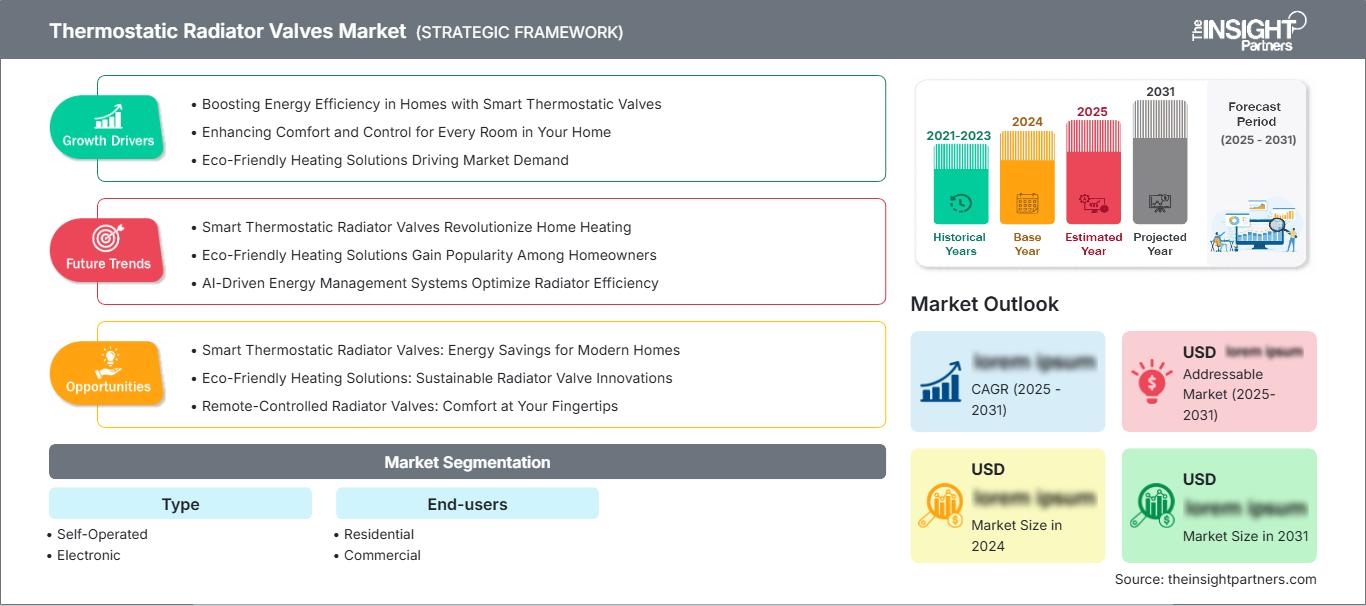
The global Thermostatic Radiator Valves Market will increase from US$ 222.04 Million in 2025 to US$ 326.11 Million in 2034, registering a compound annual growth rate of 4.36% during 2026–2034. The market encompasses both self-operated and electronically operated valves used in residential and commercial heating applications. Building efficiency regulations, temperature control requirements per room, hydronic retrofits, and increasing connectivity for heating management are the key drivers influencing the market growth.
In North America, the Thermostatic Radiator Valves Market size is driven by boiler replacements, retrofitting investments in multifamily housing and state-level energy performance standards for old buildings. The North American region is expected to have a compound annual growth rate of 3.9-4.4% from 2026-2034, with demand limited to colder urban areas. Thermostatic Radiator Valves are widely adopted where hydronic heating prevails, zoned comfort is recommended by contractors, and utilities incentivize controls to prevent overheating.
Thermostatic Radiator Valves Market Assessment and Insights
- North America represented 28–32% Thermostatic Radiator Valves market share in 2025 and is expected to grow at a CAGR of 3.9–4.4% between 2026–2034, supported by hydronic retrofits, multifamily upgrades, and energy-code compliance.
- US accounted for 72–76% of North America in 2025 and is forecast to expand at a 3.8–4.3% CAGR between 2026–2034, led by replacement demand.
- Europe held 34–38% share in 2025 and is projected to grow at a CAGR of 3.7–4.2% between 2026–2034, with Germany, the UK, France, Italy, and Spain leading adoption.
- Asia Pacific captured 22–26% share in 2025 and is estimated to grow at a CAGR of 5.0–5.6% between 2026–2034, led by China, Japan, South Korea, India, and Australia.
- Largest Segment Residential held 62–66% market share in 2025 and is expected to grow at a CAGR of 4.1–4.6% during 2026–2034, supported by room-by-room control.
- High Growth Segment Electronic held 29–33% market share in 2025 and is forecast to grow at a CAGR of 5.6–6.2% during 2026–2034, driven by smart heating platforms.
- Key companies analyzed in detail: Honeywell International Inc.; Caleffi S.p.A.; Ningbo Jiangbei Ysincere Commodity and Hardware Manufacturing Co., Ltd.; American Steam Control; Giacomini U.K. Ltd.; Drayton Controls; West Radiators Ltd.; Zhejiang Hualong Valves Co., Ltd.; Siemens Aktiengesellschaft; Myson.
Source: The Insight Partners' analysis based on proprietary research, government publications, company annual reports, investor presentations, industry databases, and expert interviews.
Product development is not limited to simple wax-element head systems but also includes pre-settable, pressure-stable, and digitally synchronized radiator control systems. Design advancements in brass bodies, sensors, anti-sticking springs, and actuator compatibilities are under discussion for reduction in call backs and flow variations in balancing of systems. The production process remains focused on European hydronics expertise and efficient machining centers in Asia, with the supply chain moving towards supplying valves in combination with retrofit kits, lockshields, adapters, and smart hubs.
For future growth, the focus will be on decarbonizing space heating, renovation projects, and low-cost controls that integrate well with boilers, heat pumps, and district heating. The opportunities lie in the eastern parts of Europe, some regions of China, and cold regions of India. The regulatory framework will favor room level control systems whereas the investors will be interested in electronic heads, installer training, and channel coordination.
Thermostatic Radiator Valves Market Report Scope
| Report Attribute | Details |
|---|---|
| Market size in 2025 | US$ 222.04 Million |
| Market Size by 2034 | US$ 326.11 Million |
| Global CAGR (2026 - 2034) | 4.36% |
| Historical Data | 2021-2024 |
| Forecast period | 2026-2034 |
Thermostatic Radiator Valves Market Analysis
Demand is driven by renovation cycles, rising energy costs, and contractors’ desire for better control to avoid overheating. The development of Thermostatic Radiator Valves market is more favorable in areas where hydronic heating is widely practiced, yet consumers do not want to replace their heaters and require room comfort. Value chain includes brass forging, machining, sensors, actuators, logistics, and training of installers; quality consistency is crucial procurement factor here.
Supply is rather favorable owing to dominance of technologically advanced and well-known European players and growing competition among Chinese producers offering lower cost of body and accessories of valves. Electronics adds dependency on sensors, wireless transmitters, batteries and ecosystems of apps. Commercial projects need systems that help balance and commission the system, especially in apartments, schools, healthcare and office buildings.
Competitive positioning in the Thermostatic Radiator Valves market is influenced by product reliability, valve body compatibility, digital connectivity, and installer expertise. According to the analysis of the Market of Thermostatic Radiator Valves, competition among Honeywell International Inc., Caleffi S.p.A., Siemens Aktiengesellschaft, Giacomini U.K. Ltd., Drayton Controls, and Myson is based on channel expertise, documentation, and product lines. American Steam Control, West Radiators Ltd., Ningbo Jiangbei Ysincere Commodity and Hardware Manufacturing Co., Ltd., and Zhejiang Hualong Valves Co., Ltd. are specialists for replacement products.
Increased investment in smart radiator heads, development of retrofit valve kits, compliance with certification standards, and inventory systems to prevent project delays were the key focus areas. Large firms leverage their certifications and integration capabilities as a defense against competition, while smaller firms compete on availability and flexible fitment. The strategy advantage is to cater to two kinds of customers: those who favor mechanical installations and those who require connectivity and energy management.
● REPORT CUSTOMIZATION
Tailor This Report To Align With Your Specific Business Requirements
This report can be customized to align precisely with your business objectives, scope, and target markets. Customization options include tailored segmentation, geography, competitive analysis, and strategic insights to support informed decision-making.
Customize This Report →WHAT YOU CAN ADJUST
- ● Segmentations
- ● Geography
- ● Competitive Analysis
- ● Language Preferences
Thermostatic Radiator Valves Market: Strategic Insights
Regional Insights
North America Thermostatic Radiator Valves
North America held 28-32% market share in 2025 and is predicted to grow at a 3.9-4.4% CAGR between 2026 and 2034. The market share dynamics of Thermostatic Radiator Valves are driven by the presence of hydronics in cold states and provinces, particularly in apartment buildings, institutions, and older housing units. Factors favoring replacement include boiler renovations and weatherization.
The Canadian market delivers a regular project pipeline through renovations of multifamily buildings and efficiency works in public-sector buildings, whereas the American market drives regional sales volumes. Manufacturers have to combine sophisticated connected control mechanisms with robust mechanical valves. Specified valves are to be suitable for existing radiator systems, provide steam/hot water service, and be easily installable during winter.
U.S. Thermostatic Radiator Valves Market
The US accounted for 72-76% of the North American market in 2025 and is expected to grow at a 3.8-4.3% CAGR through 2034. Demand in New York, New England, the Midwest, and old campus structures, which have radiators, is especially strong. Special replacement needs arise from steam applications, whereas hydronic systems generate sales opportunities for valve bodies and actuators.
Honeywell International Inc. and American Steam Control still have room to replace competitors, but Caleffi S.p.A. focuses on hydronic controls through contractor education. Ideal application opportunities include one-pipe steam apartments, retrofit projects in public housing and schools, health care additions, and luxury buildings. Low installation disruption, easy-to-maintain replacement parts, and controls that reduce resident complaints about excessive heat are crucial for building owners.
Europe Thermostatic Radiator Valves Market
The Europe segment had a market share of 34-38% in 2025 and is projected to exhibit a CAGR of 3.7-4.2% from 2026 to 2034. Germany is dominant due to the prevalence of district heating, apartment renovations, and hydronic balancing procedures. The UK remains relevant due to regulations on boilers and installer guidance that promote the use of room controllers in existing and social housing.
France, Italy, and Spain diversify demand, with France focusing on renovation plans, Italy offering radiator-based housing units, and Spain emphasizing selective use in the country's chilly northern regions. Customers in Europe care about EN 215 approval, KEYMARK certification, and low-temperature heating systems compatibility. Companies like Giacomini U.K. Ltd., Drayton Controls, Myson, Siemens Aktiengesellschaft, and Caleffi S.p.A. will have preference because of installer help and expertise.
APAC Thermostatic Radiator Valves Market
APAC accounted for 22–26% share in 2025 and is projected to expand at a 5.0–5.6% CAGR during 2026–2034. China is the leading country, supported by northern urban heating networks, manufacturing capacity, and building modernization.
Japan and South Korea emphasize efficient controls in compact residential and commercial spaces, while India and Australia create colder-climate niche opportunities. Policy drivers include energy conservation, cleaner heat planning, and utility interest in demand-side efficiency without expensive emitter replacement.
Middle East & Africa Thermostatic Radiator Valves Market
The Middle East and Africa market will register a growth rate of 4.4–5.0% CAGR during the forecast period of 2026-2034. Saudi Arabia and the UAE drive some demand for hydronic zoning solutions from the hospitality sector, the healthcare industry, and mixed-use buildings.
South Africa leads the region, as the country enjoys ongoing commercial retrofits and luxury residential building projects. The Rest of MEA segment continues to adopt hydronic zoning technology on a project basis driven by infrastructure investments, imports of HVAC systems and desire to cut operation costs.
Segmentation Analysis
Type
Type is projected to grow at a 4.4–4.9% CAGR during 2026–2034 as the Thermostatic Radiator Valves scope expands from conventional manual replacement toward connected radiator control. Mechanical products retain volume through affordability and durability, while electronic valves gain momentum where homeowners and facility managers require schedules, remote control, usage insights, and integration with broader building automation.
- Self-Operated valves remain the volume foundation because they offer simple room control, broad compatibility, and low maintenance for radiator-based homes, public housing, and commercial retrofits.
- Electronic valves are strategically important for smart heating ecosystems, enabling programmed zones, remote adjustment, and energy visibility for users seeking connected comfort without replacing radiators.
End-users
End-users in the Thermostatic Radiator Valves market are forecast to grow at a 4.2–4.7% CAGR during 2026–2034, with residential customers driving unit demand and commercial owners emphasizing lifecycle value. Residential uptake is tied to comfort, fuel savings, and convenience. Commercial adoption depends on maintenance access, tenant satisfaction, compliance documentation, and the ability to standardize controls across multiple buildings.
- Residential demand is mature but resilient, led by homeowners, landlords, and housing associations seeking room-by-room heat control, affordable retrofit options, and comfort improvements.
- Commercial users adopt valves in offices, schools, hotels, hospitals, and public buildings where system balancing, tenant comfort, and operating-cost visibility support stronger procurement justification.
Opportunity Snapshot
| End Users | Revenue Contribution | Trend Tag | Adoption Stage |
| Residential | High | Zoned Comfort | Mature |
| Commercial | Medium | Retrofit Control | Scaling |
Thermostatic Radiator Valves Market Growth Drivers and Impact Analysis
Energy Efficiency Codes Push Room-Level Heat Control
Radiator control technology is becoming more useful due to building efficiency policies, as room-by-room control will improve building comfort without changing their entire heating systems. In Europe, the legislation regarding building renovations, UK installation guidelines, and North American utility programs recommend using radiator control technologies that help avoid heat waste in seldom-used rooms. One may observe this in the example of retrofits, where the valves are combined with boiler replacements, balancing, and improving tenant comfort.
Hydronic Retrofits Favor Low-Disruption Controls
The owners of old apartments, school buildings, hospitals, and commercial establishments usually maintain their existing radiators because replacing them requires considerable effort and investment. The valves serve as an intermediate solution that links the old heating system to current standards. Room control may be updated along with boiler cleaning, radiator installation, and balancing works. This motivator works well for both mechanical and electronic valves, as different facilities have varying budgets, technical complexity, and maintenance capabilities.
Smart Heating Platforms Increase Electronic Valve Pull
The way in which people view their radiator controls has been altered by the adoption of connected homes. Rather than seeing valves as a piece of equipment, people will view the application scheduling, dashboard, and how well the system works alongside thermostats and building platforms. The connected heads provide business value to suppliers due to hub devices, sensors, software updates, and services. The effect that the connected home market will have on the broader market does not apply only to high-end homes; even multifamily owners can leverage this technology.
Thermostatic Radiator Valves Market Future Trends
Interoperable Smart Valve Ecosystems
Thermostatic Radiator Valves market trends will increasingly center on interoperable ecosystems rather than isolated devices. Buyers will expect radiator heads to work with room thermostats, boilers, heat pumps, occupancy sensors, and building-management platforms. Open connectivity can reduce vendor lock-in and simplify portfolio upgrades for landlords. Suppliers that provide robust pairing, stable firmware, and clear installer workflows will be better positioned than brands that focus only on hardware price. Over time, software reliability will become as important as valve mechanics.
Pressure-Independent Radiator Control
The future of product development will focus on pressure-insensitive and preset valves to maintain stable flow regardless of variations in building loads. This is because of problems in multifamily and institutional buildings where imbalanced radiators lead to discomfort, noise, and high return temperatures. Dynamic control improves the efficiency of the heat plant, especially when low-temperature systems and heat pumps are installed. Valves that offer hydraulic stability while using simple installation methods will help achieve energy targets and make advanced products more acceptable.
Thermostatic Radiator Valves Market Opportunities
Residential Retrofit Programs and Installer Bundles
The Thermostatic Radiator Valves Market forecast indicates significant opportunities within packaged retrofit solutions for residential properties. Valve heads, bodies, and adapters can be combined with commissioning instructions into standard packages for boiler installers, housing associations, and utility companies. In this way, uncertainty on behalf of contractors will be diminished, and more valves will be attached to the heating systems when they are upgraded. The best situation arises in places with dense clusters of houses, where minor efficiency improvements can be approved.
Commercial Portfolio Standardization
Property managers overseeing schools, nursing homes, office buildings, and public institutions can apply similar standards in their radiator valve installations to simplify maintenance. Valve manufacturers need to aim at schemes that incorporate selection, stocking, training, and documentation for compliance officials. The electronic valves work well in building applications with fluctuating occupancy, whereas mechanical valves work well with cash-strapped estates. Collaborating with energy service firms and facility management companies will help turn pilot projects into portfolio projects, particularly if there is concern about comfort and cost issues on boards.
Recent Developments
- November 2025: Aqara, a global leader and pioneer in IoT, today announces the availability of its Radiator Thermostat W600, first unveiled at IFA 2025. Boasting smart features like convenient temperature control, automated climate regulation, and seamless interoperability across Matter ecosystems via Thread/Zigbee protocol, the W600 transforms traditional radiators into intelligent, energy-efficient heating systems that not only enhance comfort but also help reduce energy bills.
- December 2025: Resideo Technologies (NYSE: REZI), a leading global provider of solutions for home comfort, security and safety, today launched a new style of smart comfort: the Honeywell Home X8S smart thermostat. From America’s No. 1 most trusted thermostat brand,1 the Honeywell Home X8S smart thermostat conveniently streams live video from compatible doorbells on the largest touchscreen in its class. It offers a combination of precision sensing and control, intuitive touchscreen interface and premium design, delivering the brand’s smartest thermostat yet.
Frequently Asked Questions

- Comprehensive Market Sizing and Forecast Analysis
- Detailed Segmentation Analysis
- In-Depth Market Dynamics Assessment
- Regional and Country-Level Insights
- Competitive Landscape and Company Benchmarking
- Strategic Business Intelligence
Recent Reports
Testimonials

The Insight Partners' SCADA System Market report is comprehensive, with valuable insights on current trends and future forecasts. The team was highly professional, responsive, and supportive throughout. We are very satisfied and highly recommend their services.
RAN KEDEM Partner, Reali Technologies LTDs
I requested a report on a very specific software market and the team produced the report in a few days. The information was very relevant and well presented. I then requested some changes and additions to the report. The team was again very responsive and I got the final report in less than a week.
JEAN-HERVE JENN Chairman, Future Analytica
We worked with The Insight Partners for an important market study and forecast. They gave us clear insights into opportunities and risks, which helped shape our plans. Their research was easy to use and based on solid data. It helped us make smart, confident decisions. We highly recommend them.
PIYUSH NAGPAL Sr. Vice President, High Beam Global
The Insight Partners delivered insightful, well-structured market research with strong domain expertise. Their team was professional and responsive throughout. The user-friendly website made accessing industry reports seamless. We highly recommend them for reliable, high-quality research services
YUKIHIKO ADACHI CEO, Deep Blue, LLC.
This is the first time I have purchased a market report from The Insight Partners.While I was unsure at first, I visited their web site and felt more comfortable to take the risk and purchase a market report.I am completely satisfied with the quality of the report and customer service. I had several questions and comments with the initial report, but after a couple of dialogs over email with their analyst I believe I have a report that I can use as input to our strategic planning process.Thank you so much for taking the extra time and making this a positive experience.I will definitely recommend your service to others and you will be my first call when we need further market data.
JOHN SUZUKI President and Chief Executive Officer, Board Director, BK Technologies
I wish to appreciate your support and the professionalism you displayed in the course of attending to my request for information regarding to infectious disease IVD market in Nigeria. I appreciate your patience, your guidance, and the fact that you were willing to offer a discount, which eventually made it possible for us to close a deal. I look forward to engaging The Insight Partners in the future, all thanks to the impression you have created in me as a result of this first encounter.
DR CHIJIOKE ONYIA MANAGING DIRECTOR, PineCrest Healthcare Ltd.Reason to Buy
- Informed Decision-Making
- Understanding Market Dynamics
- Competitive Analysis
- Identifying Emerging Markets
- Customer Insights
- Market Forecasts
- Risk Mitigation
- Boosting Operational Efficiency
- Strategic Planning
- Investment Justification
- Tracking Industry Innovations
- Aligning with Regulatory Trends





 Get Free Sample for