North America Bread For Foodservice and Retail Market Analysis and Forecast by Size, Share, Growth, Trends 2031
North America Bread for Foodservice and Retail Market Size and Forecast (2021 - 2031), Regional Share, Trend, and Growth Opportunity Analysis Report Coverage: By Type (Sandwich Bread, Brioche Buns, Ciabatta Rolls, Baguettes, Panini and Focaccia Bread, Hamburger Buns, Hotdog Buns, and Others), Nature (Gluten-Free and Conventional), Category (Frozen and Ambient and Refrigerated), and End Use (Retail, Foodservice, Cafes, Quick Service Restaurants, Fast Casual Restaurants, and Others)
- Status : Published
- Report Code : TIPRE00041570
- Category : Food and Beverages
- No. of Pages : 179
- Available Report Formats :


The North America Bread for Foodservice and Retail Market size is expected to reach US$ 74.9 Billion by 2031 from US$ 57.7 Billion in 2024. The market is estimated to record a CAGR of 3.8% from 2024 to 2031.
Executive Summary and North America Bread for Foodservice and Retail Market Analysis:North America presents extensive growth opportunities for key participants in the bread market owing to the changing consumer behavior. The population in the region is increasingly looking for healthier and more convenient food options in baked goods such as bread, baguettes, bagels, and buns and rolls. As a result, there is a growing demand for whole grain and specialty bread, including gluten-free, organic, and artisanal varieties. Bread is perceived as a convenient and time-saving food product by busy individuals and families; hence, the demand for ready-to-eat and on-the-go food products, such as sliced bread and sandwiches, is driving the bread market growth in North America.
In line with the rise in consumer interest in health and wellness, the increased awareness regarding the health benefits of functional bread, sourdough, and ancient grain sliced bread is another factor that benefits the bread market in North America. The change in consumer preference is evident through the increased demand for high-quality, nutrient-rich, gluten-free, and low-carb bread categories. Moreover, market players catering to North American countries offer specialty and artisanal bakery products containing high-quality ingredients and unique bread flavors, and consumers are also willing to pay more for these premium bread categories.
Customize Research To Suit Your Requirement
We can optimize and tailor the analysis and scope which is unmet through our standard offerings. This flexibility will help you gain the exact information needed for your business planning and decision making.
North America Bread for Foodservice and Retail Market: Strategic Insights


Shejal
Have a question?
Shejal will walk you through a 15-minute call to present the report’s content and answer all queries if you have any.
 Speak to Analyst
- By Type, the North America Bread for Foodservice and Retail Market is segmented into Sandwich Bread, Brioche Buns, Ciabatta Rolls, Baguettes, Panini and Focaccia Bread, Hamburger Buns, Hotdog Buns, and Others. Sandwich Bread held the largest share of the market in 2024.
- By Nature, the North America Bread for Foodservice and Retail Market is segmented into Gluten-Free and Conventional. Conventional held a larger share of the market in 2024.
- By Category, the North America Bread for Foodservice and Retail Market is segmented into Frozen and Ambient and Refrigerated. Ambient and Refrigerated held the largest share of the market in 2024.
- By End Use, the North America Bread for Foodservice and Retail Market is segmented into Retail, Foodservice, Cafes, Quick Service Restaurants, Fast Casual Restaurants, and Others. Retail held the largest share of the market in 2024.
There has been a significant increase in the awareness and diagnoses of gluten-related disorders such as celiac disease and gluten sensitivity among consumers. As a result, more individuals are seeking gluten-free alternatives to manage their conditions effectively. Celiac disease is an inherited autoimmune disorder. The symptoms are triggered by gluten, the name given to specific proteins in wheat, including spelled kamut, barley, rye, and triticale (a cross between wheat and rye). In celiac disease, the body's immune system reacts abnormally to gluten, resulting in inflammation and damage to the lining of the small intestine and reducing the absorption of iron, calcium, vitamins A, D, E, K, and folate. Consumers suffering from celiac disorder often opt for gluten-free bread. This preference encourages market players to develop new and innovative healthy varieties of bread. In May 2024, Franz Bakery announced its plan to expand its portfolio of gluten-free bread in honor of Celiac Awareness Month (May). The new selections include sourdough, brioche, and rye-flavored varieties. In August 2024, T. Marzetti Company, a wholly owned subsidiary of Lancaster Colony Corporation, introduced its first-ever gluten-free line of New York Bakery frozen bread. This new offering features gluten-free versions of the brand's classic Garlic Texas Toast and Five Cheese Texas Toast. Thus, the ongoing trend of adoption of gluten-free bread is influencing manufacturers to focus on introducing clean-label, gluten-free products that allow consumers to keep up with their health goals without compromising on taste.
North America Bread for Foodservice and Retail Market Country InsightsBy country, the North America Bread for Foodservice and Retail Market is segmented into the United States, Canada, and Mexico. The United States held the largest share in 2024.
The bread market in the US is prominently growing due to the increased health consciousness and interest in baked goods such as bread. In the US, owing to the hectic lifestyles of working professionals, the requirement for cooked, on-the-go, and convenient food products such as sandwiches, bread slices, baguettes, and bagels has rapidly increased. Breads, buns, and rolls are time-saving, and they require minimal effort to cook bread-based breakfasts, snacks, and meals. Whole grain, multigrain, vitamins and minerals, vegetables, and other nutritious ingredient-incorporated breads are in high demand due to the rise in health consciousness among consumers, encouraging manufacturers to innovate their products accordingly. For instance, in January 2023, Sara Lee, a company acquired by Bimbo, launched new white bread made with vegetables. This new product is fortified with vitamins A, D, and E. Furthermore, according to the National Restaurant Association, 9 in 10 adults say they enjoy going to restaurants. Restaurants allow them to enjoy a favorite meal with flavor and taste sensations that are difficult to replicate at home. Thus, with the growing popularity of QSRs and casual dining establishments, the demand for various bread types from the foodservice sector has surged.
North America Bread for Foodservice and Retail Market Company ProfilesSome of the key players operating in the market include EUROPASTRY, SA, Lantmannen Unibake, Grupo Bimbo SAB de CV, Vandemoortele NV, Conagra Brands Inc, FGF Brands Inc, Rich Products Corp, Flowers Foods Inc, La Lorraine Bakery Group, La Brea Bakery, Fiera Foods Company, Bäckerhaus Veit GmbH, Schripps European Bread, Upper Crust, and VIVESCIA.
These players are adopting various strategies such as expansion, product innovation, and mergers and acquisitions to provide innovative products to their consumers and increase their market share.
North America Bread for Foodservice and Retail Market Research MethodologyThe following methodology has been followed for the collection and analysis of data presented in this report:
Secondary Research
The research process begins with comprehensive secondary research, utilizing internal and external sources to gather qualitative and quantitative data for each market. Commonly referenced secondary research sources include, but are not limited to:
Company websites,
annual reports, financial statements, broker analyses, and investor presentationsIndustry trade journals
and other relevant publicationsGovernment documents,
statistical databases, and market reportsNews articles,
press releases, and webcasts specific to companies operating in the market
Note:
All financial data included in the Company Profiles section has been standardized to US$. For companies reporting in other currencies, figures have been converted to US$ using the relevant exchange rates for the corresponding year.Primary Research
The Insight Partners conducts a significant number of primary interviews each year with industry stakeholders and experts to validate its data analysis and gain valuable insights. These research interviews are designed to:
- Validate and refine findings from secondary research
- Enhance the expertise and market understanding of the analysis team
- Gain insights into market size, trends, growth patterns, competitive dynamics, and future prospects
Primary research is conducted via email interactions and telephone interviews, encompassing various markets, categories, segments, and sub-segments across different regions. Participants typically include:
Industry stakeholders:
Vice Presidents, Business Development Managers, Market Intelligence Managers, and National Sales ManagersExternal experts:
Valuation specialists, research analysts, and key opinion leaders with industry-specific expertise

Report Coverage
Revenue forecast, Company Analysis, Industry landscape, Growth factors, and Trends

Segment Covered
This text is related
to segments covered.

Regional Scope
North America, Europe, Asia Pacific, Middle East & Africa, South & Central America

Country Scope
This text is related
to country scope.
1. Introduction
1.1 Report Guidance
1.2 Market Segmentation
2. Executive Summary
2.1 Key Insights
2.2 Market Attractiveness
3. Research Methodology
3.1 Secondary Research
3.2 Primary Research
3.2.1 Hypothesis formulation:
3.2.2 Macroeconomic factor analysis:
3.2.3 Developing base number:
3.2.4 Data Triangulation:
3.2.5 Country-level data:
3.3 Assumptions and Limitations
4. Bread for Foodservice and Retail Market Landscape
4.1 Overview
4.2 Porter’s Five Forces Analysis
4.2.1 Bargaining Power of Suppliers
4.2.2 Bargaining Power of Buyers
4.2.3 Threat of New Entrants
4.2.4 Intensity of Competitive Rivalry
4.2.5 Threat of Substitutes
4.3 Ecosystem Analysis
4.3.1 Raw Materials
4.3.2 Manufacturing Process
4.3.2.1 Mixing Ingredients
4.3.2.2 Rising (Fermentation)
4.3.2.3 Kneading
4.3.2.4 Proofing (Second Rising)
4.3.2.5 Baking
4.3.2.6 Cooling
4.4 List of Vendors in the Value Chain
5. North America Bread for Foodservice and Retail Market – Key Market Dynamics
5.1 North America Bread for Foodservice and Retail Market – Key Market Dynamics
5.2 Market Drivers
5.2.1 Increasing Popularity of Convenience and Ready-To-Eat Products
5.2.2 Rising Availability of Bread Through E-Commerce Platforms
5.3 Key Market Restraints:
5.3.1 Fluctuating Costs of Ingredients
5.4 Key Market Opportunities:
5.4.1 Introduction of Innovative Varieties
5.5 Future Trends:
5.5.1 High Demand for Gluten-Free Products
5.6 Impact of Drivers and Restraints:
6. North America Bread for Foodservice and Retail Market – Analysis
6.1 North America Bread for Foodservice and Retail Market Revenue (US$ Billion), 2021–2031
6.2 North America Bread for Foodservice and Retail Market Forecast Analysis
7. North America Bread for Foodservice and Retail Market Analysis – by Type
7.1 Sandwich Bread
7.1.1 Overview
7.1.2 Sandwich Bread: North America Bread for Foodservice and Retail Market – Revenue and Forecast, 2021–2031 (US$ Billion)
7.2 Brioche Buns
7.2.1 Overview
7.2.2 Brioche Buns: North America Bread for Foodservice and Retail Market – Revenue and Forecast, 2021–2031 (US$ Billion)
7.3 Ciabatta Rolls
7.3.1 Overview
7.3.2 Ciabatta Rolls: North America Bread for Foodservice and Retail Market – Revenue and Forecast, 2021–2031 (US$ Billion)
7.4 Baguettes
7.4.1 Overview
7.4.2 Baguettes: North America Bread for Foodservice and Retail Market – Revenue and Forecast, 2021–2031 (US$ Billion)
7.5 Panini and Focaccia Bread
7.5.1 Overview
7.5.2 Panini and Focaccia Bread: North America Bread for Foodservice and Retail Market – Revenue and Forecast, 2021–2031 (US$ Billion)
7.6 Hamburger Buns
7.6.1 Overview
7.6.2 Hamburger Buns: North America Bread for Foodservice and Retail Market – Revenue and Forecast, 2021–2031 (US$ Billion)
7.7 Hotdog Buns
7.7.1 Overview
7.7.2 Hotdog Buns: North America Bread for Foodservice and Retail Market – Revenue and Forecast, 2021–2031 (US$ Billion)
7.8 Others
7.8.1 Overview
7.8.2 Others: North America Bread for Foodservice and Retail Market – Revenue and Forecast, 2021–2031 (US$ Billion)
8. North America Bread for Foodservice and Retail Market Analysis – by Nature
8.1 Gluten-Free
8.1.1 Overview
8.1.2 Gluten-Free: North America Bread for Foodservice and Retail Market – Revenue and Forecast, 2021–2031 (US$ Billion)
8.2 Conventional
8.2.1 Overview
8.2.2 Conventional: North America Bread for Foodservice and Retail Market – Revenue and Forecast, 2021–2031 (US$ Billion)
9. North America Bread for Foodservice and Retail Market Analysis – by Category
9.1 Frozen
9.1.1 Overview
9.1.2 Frozen: North America Bread for Foodservice and Retail Market – Revenue and Forecast, 2021–2031 (US$ Billion)
9.2 Ambient and Refrigerated
9.2.1 Overview
9.2.2 Ambient and Refrigerated: North America Bread for Foodservice and Retail Market – Revenue and Forecast, 2021–2031 (US$ Billion)
10. North America Bread for Foodservice and Retail Market Analysis – by End Use
10.1 Retail
10.1.1 Overview
10.1.2 Retail: North America Bread for Foodservice and Retail Market – Revenue and Forecast, 2021–2031 (US$ Billion)
10.2 Foodservice
10.2.1 Overview
10.2.2 Foodservice: North America Bread for Foodservice and Retail Market – Revenue and Forecast, 2021–2031 (US$ Billion)
10.3 Cafes
10.3.1 Overview
10.3.2 Cafes: North America Bread for Foodservice and Retail Market – Revenue and Forecast, 2021–2031 (US$ Billion)
10.4 Quick Service Restaurants
10.4.1 Overview
10.4.2 Quick Service Restaurants: North America Bread for Foodservice and Retail Market – Revenue and Forecast, 2021–2031 (US$ Billion)
10.5 Fast Casual Restaurants
10.5.1 Overview
10.5.2 Fast Casual Restaurants: North America Bread for Foodservice and Retail Market – Revenue and Forecast, 2021–2031 (US$ Billion)
10.6 Others
10.6.1 Overview
10.6.2 Others: North America Bread for Foodservice and Retail Market – Revenue and Forecast, 2021–2031 (US$ Billion)
11. North America Bread for Foodservice and Retail Market – Country Analysis
11.1 North America
11.1.1 North America Bread for Foodservice and Retail Market – Revenue and Forecast Analysis – by Country
11.1.1.1 North America Bread for Foodservice and Retail Market – Revenue and Forecast Analysis – by Country
11.1.1.2 United States: North America Bread for Foodservice and Retail Market – Revenue and Forecast, 2021–2031 (US$ Billion)
11.1.1.2.1 United States: North America Bread for Foodservice and Retail Market Share – by Type
11.1.1.2.2 United States: North America Bread for Foodservice and Retail Market Share – by Nature
11.1.1.2.3 United States: North America Bread for Foodservice and Retail Market Share – by Category
11.1.1.2.4 United States: North America Bread for Foodservice and Retail Market Share – by End Use
11.1.1.3 Canada: North America Bread for Foodservice and Retail Market – Revenue and Forecast, 2021–2031 (US$ Billion)
11.1.1.3.1 Canada: North America Bread for Foodservice and Retail Market Share – by Type
11.1.1.3.2 Canada: North America Bread for Foodservice and Retail Market Share – by Nature
11.1.1.3.3 Canada: North America Bread for Foodservice and Retail Market Share – by Category
11.1.1.3.4 Canada: North America Bread for Foodservice and Retail Market Share – by End Use
11.1.1.4 Mexico: North America Bread for Foodservice and Retail Market – Revenue and Forecast, 2021–2031 (US$ Billion)
11.1.1.4.1 Mexico: North America Bread for Foodservice and Retail Market Share – by Type
11.1.1.4.2 Mexico: North America Bread for Foodservice and Retail Market Share – by Nature
11.1.1.4.3 Mexico: North America Bread for Foodservice and Retail Market Share – by Category
11.1.1.4.4 Mexico: North America Bread for Foodservice and Retail Market Share – by End Use
12. Competitive Landscape
12.1 Heat Map Analysis by Key Players
12.2 Company Positioning and Concentration
13. Industry Landscape
13.1 Overview
13.2 Market Initiative
13.3 Partnerships and Collaborations
13.4 Other Developments
14. Company Profiles
14.1 Lantmannen Unibake
14.1.1 Key Facts
14.1.2 Business Description
14.1.3 Products and Services
14.1.4 Financial Overview
14.1.5 SWOT Analysis
14.1.6 Key Developments
14.2 Rich Products Corp
14.2.1 Key Facts
14.2.2 Business Description
14.2.3 Products and Services
14.2.4 Financial Overview
14.2.5 SWOT Analysis
14.2.6 Key Developments
14.3 La Brea Bakery
14.3.1 Key Facts
14.3.2 Business Description
14.3.3 Products and Services
14.3.4 Financial Overview
14.3.5 SWOT Analysis
14.3.6 Key Developments
14.4 Flowers Foods Inc
14.4.1 Key Facts
14.4.2 Business Description
14.4.3 Products and Services
14.4.4 Financial Overview
14.4.5 SWOT Analysis
14.4.6 Key Developments
14.5 Grupo Bimbo SAB de CV
14.5.1 Key Facts
14.5.2 Business Description
14.5.3 Products and Services
14.5.4 Financial Overview
14.5.5 SWOT Analysis
14.5.6 Key Developments
14.6 Fiera Foods Company
14.6.1 Key Facts
14.6.2 Business Description
14.6.3 Products and Services
14.6.4 Financial Overview
14.6.5 SWOT Analysis
14.6.6 Key Developments
14.7 La Lorraine Bakery Group
14.7.1 Key Facts
14.7.2 Business Description
14.7.3 Products and Services
14.7.4 Financial Overview
14.7.5 SWOT Analysis
14.7.6 Key Developments
14.8 EUROPASTRY, SA
14.8.1 Key Facts
14.8.2 Business Description
14.8.3 Products and Services
14.8.4 Financial Overview
14.8.5 SWOT Analysis
14.8.6 Key Developments
14.9 Bäckerhaus Veit GmbH
14.9.1 Key Facts
14.9.2 Business Description
14.9.3 Products and Services
14.9.4 Financial Overview
14.9.5 SWOT Analysis
14.9.6 Key Developments
14.10 Schripps European Bread
14.10.1 Key Facts
14.10.2 Business Description
14.10.3 Products and Services
14.10.4 Financial Overview
14.10.5 SWOT Analysis
14.10.6 Key Developments
14.11 Vandemoortele NV
14.11.1 Key Facts
14.11.2 Business Description
14.11.3 Products and Services
14.11.4 Financial Overview
14.11.5 SWOT Analysis
14.11.6 Key Developments
14.12 Upper Crust
14.12.1 Key Facts
14.12.2 Business Description
14.12.3 Products and Services
14.12.4 Financial Overview
14.12.5 SWOT Analysis
14.12.6 Key Developments
14.13 FGF Brands Inc
14.13.1 Key Facts
14.13.2 Business Description
14.13.3 Products and Services
14.13.4 Financial Overview
14.13.5 SWOT Analysis
14.13.6 Key Developments
14.14 VIVESCIA
14.14.1 Key Facts
14.14.2 Business Description
14.14.3 Products and Services
14.14.4 Financial Overview
14.14.5 SWOT Analysis
14.14.6 Key Developments
14.15 Conagra Brands Inc
14.15.1 Key Facts
14.15.2 Business Description
14.15.3 Products and Services
14.15.4 Financial Overview
14.15.5 SWOT Analysis
14.15.6 Key Developments
15. Appendix
15.1 About The Insight Partners
List of Tables
Table 1. North America Bread for Foodservice and Retail Market Segmentation
Table 2. List of Vendors
Table 3. North America Bread for Foodservice and Retail Market – Revenue and Forecast, 2021–2031 (US$ Billion)
Table 4. North America Bread for Foodservice and Retail Market – Revenue and Forecast, 2021–2031 (US$ Billion) – by Type
Table 5. North America Bread for Foodservice and Retail Market – Revenue and Forecast, 2021–2031 (US$ Billion) – by Nature
Table 6. North America Bread for Foodservice and Retail Market – Revenue and Forecast, 2021–2031 (US$ Billion) – by Category
Table 7. North America Bread for Foodservice and Retail Market – Revenue and Forecast, 2021–2031 (US$ Billion) – by End Use
Table 8. North America Bread for Foodservice and Retail Market – Revenue and Forecast, 2021–2031 (US$ Billion) – by Country
Table 9. United States: North America Bread for Foodservice and Retail Market – Revenue and Forecast, 2021 – 2031(US$ Billion) – by Type
Table 10. United States: North America Bread for Foodservice and Retail Market – Revenue and Forecast, 2021 – 2031(US$ Billion) – by Nature
Table 11. United States: North America Bread for Foodservice and Retail Market – Revenue and Forecast, 2021 – 2031(US$ Billion) – by Category
Table 12. United States: North America Bread for Foodservice and Retail Market – Revenue and Forecast, 2021 – 2031(US$ Billion) – by End Use
Table 13. Canada: North America Bread for Foodservice and Retail Market – Revenue and Forecast, 2021 – 2031(US$ Billion) – by Type
Table 14. Canada: North America Bread for Foodservice and Retail Market – Revenue and Forecast, 2021 – 2031(US$ Billion) – by Nature
Table 15. Canada: North America Bread for Foodservice and Retail Market – Revenue and Forecast, 2021 – 2031(US$ Billion) – by Category
Table 16. Canada: North America Bread for Foodservice and Retail Market – Revenue and Forecast, 2021 – 2031(US$ Billion) – by End Use
Table 17. Mexico: North America Bread for Foodservice and Retail Market – Revenue and Forecast, 2021 – 2031(US$ Billion) – by Type
Table 18. Mexico: North America Bread for Foodservice and Retail Market – Revenue and Forecast, 2021 – 2031(US$ Billion) – by Nature
Table 19. Mexico: North America Bread for Foodservice and Retail Market – Revenue and Forecast, 2021 – 2031(US$ Billion) – by Category
Table 20. Mexico: North America Bread for Foodservice and Retail Market – Revenue and Forecast, 2021 – 2031(US$ Billion) – by End Use
List of Figures
Figure 1. North America Bread for Foodservice and Retail Market Segmentation – Country
Figure 2. Porter’s Five Forces Analysis
Figure 3. Ecosystem: Bread Market
Figure 4. International Wheat Prices (US$/Ton)
Figure 5. Impact Analysis of Drivers and Restraints
Figure 6. North America Bread for Foodservice and Retail Market Revenue (US$ Billion), 2021–2031
Figure 7. North America Bread for Foodservice and Retail Market Share (%) – by Type (2024 and 2031)
Figure 8. Sandwich Bread: North America Bread for Foodservice and Retail Market – Revenue and Forecast, 2021–2031 (US$ Billion)
Figure 9. Brioche Buns: North America Bread for Foodservice and Retail Market – Revenue and Forecast, 2021–2031 (US$ Billion)
Figure 10. Ciabatta Rolls: North America Bread for Foodservice and Retail Market – Revenue and Forecast, 2021–2031 (US$ Billion)
Figure 11. Baguettes: North America Bread for Foodservice and Retail Market – Revenue and Forecast, 2021–2031 (US$ Billion)
Figure 12. Panini and Focaccia Bread: North America Bread for Foodservice and Retail Market – Revenue and Forecast, 2021–2031 (US$ Billion)
Figure 13. Hamburger Buns: North America Bread for Foodservice and Retail Market – Revenue and Forecast, 2021–2031 (US$ Billion)
Figure 14. Hotdog Buns: North America Bread for Foodservice and Retail Market – Revenue and Forecast, 2021–2031 (US$ Billion)
Figure 15. Others: North America Bread for Foodservice and Retail Market – Revenue and Forecast, 2021–2031 (US$ Billion)
Figure 16. North America Bread for Foodservice and Retail Market Share (%) – by Nature (2024 and 2031)
Figure 17. Gluten-Free: North America Bread for Foodservice and Retail Market – Revenue and Forecast, 2021–2031 (US$ Billion)
Figure 18. Conventional: North America Bread for Foodservice and Retail Market – Revenue and Forecast, 2021–2031 (US$ Billion)
Figure 19. North America Bread for Foodservice and Retail Market Share (%) – by Category (2024 and 2031)
Figure 20. Frozen: North America Bread for Foodservice and Retail Market – Revenue and Forecast, 2021–2031 (US$ Billion)
Figure 21. Ambient and Refrigerated: North America Bread for Foodservice and Retail Market – Revenue and Forecast, 2021–2031 (US$ Billion)
Figure 22. North America Bread for Foodservice and Retail Market Share (%) – by End Use (2024 and 2031)
Figure 23. Retail: North America Bread for Foodservice and Retail Market – Revenue and Forecast, 2021–2031 (US$ Billion)
Figure 24. Foodservice: North America Bread for Foodservice and Retail Market – Revenue and Forecast, 2021–2031 (US$ Billion)
Figure 25. Cafes: North America Bread for Foodservice and Retail Market – Revenue and Forecast, 2021–2031 (US$ Billion)
Figure 26. Quick Service Restaurants: North America Bread for Foodservice and Retail Market – Revenue and Forecast, 2021–2031 (US$ Billion)
Figure 27. Fast Casual Restaurants: North America Bread for Foodservice and Retail Market – Revenue and Forecast, 2021–2031 (US$ Billion)
Figure 28. Others: North America Bread for Foodservice and Retail Market – Revenue and Forecast, 2021–2031 (US$ Billion)
Figure 29. North America Bread for Foodservice and Retail Market Breakdown, by Key Countries, 2024 and 2031 (%)
Figure 30. United States: North America Bread for Foodservice and Retail Market – Revenue and Forecast, 2021– 2031 (US$ Billion)
Figure 31. Canada: North America Bread for Foodservice and Retail Market – Revenue and Forecast, 2021– 2031 (US$ Billion)
Figure 32. Mexico: North America Bread for Foodservice and Retail Market – Revenue and Forecast, 2021– 2031 (US$ Billion)
Figure 33. Heat Map Analysis by Key Players
Figure 34. Company Positioning and Concentration
Yes! We provide a free sample of the report, which includes Report Scope (Table of Contents), report structure, and selected insights to help you assess the value of the full report. Please click on the "Download Sample" button or contact us to receive your copy.
Absolutely - analyst assistance is part of the package. You can connect with our analyst post-purchase to clarify report insights, methodology or discuss how the findings apply to your business needs.
Once your order is successfully placed, you will receive a confirmation email along with your invoice.
• For published reports: You'll receive access to the report within 4-6 working hours via a secured email sent to your email.
• For upcoming reports: Your order will be recorded as a pre-booking. Our team will share the estimated release date and keep you informed of any updates. As soon as the report is published, it will be delivered to your registered email.
We offer customization options to align the report with your specific objectives. Whether you need deeper insights into a particular region, industry segment, competitor analysis, or data cut, our research team can tailor the report accordingly. Please share your requirements with us, and we'll be happy to provide a customized proposal or scope.
The report is available in either PDF format or as an Excel dataset, depending on the license you choose.
The PDF version provides the full analysis and visuals in a ready-to-read format. The Excel dataset includes all underlying data tables for easy manipulation and further analysis.
Please review the license options at checkout or contact us to confirm which formats are included with your purchase.
Our payment process is fully secure and PCI-DSS compliant.
We use trusted and encrypted payment gateways to ensure that all transactions are protected with industry-standard SSL encryption. Your payment details are never stored on our servers and are handled securely by certified third-party processors.
You can make your purchase with confidence, knowing your personal and financial information is safe with us.
Yes, we do offer special pricing for bulk purchases.
If you're interested in purchasing multiple reports, we're happy to provide a customized bundle offer or volume-based discount tailored to your needs. Please contact our sales team with the list of reports you're considering, and we'll share a personalized quote.
Yes, absolutely.
Our team is available to help you make an informed decision. Whether you have questions about the report's scope, methodology, customization options, or which license suits you best, we're here to assist. Please reach out to us at sales@theinsightpartners.com, and one of our representatives will get in touch promptly.
Yes, a billing invoice will be automatically generated and sent to your registered email upon successful completion of your purchase.
If you need the invoice in a specific format or require additional details (such as company name, GST, or VAT information), feel free to contact us, and we'll be happy to assist.
Yes, certainly.
If you encounter any difficulties accessing or receiving your report, our support team is ready to assist you. Simply reach out to us via email or live chat with your order information, and we'll ensure the issue is resolved quickly so you can access your report without interruption.
The Insight Partners performs research in 4 major stages: Data Collection & Secondary Research, Primary Research, Data Analysis and Data Triangulation & Final Review.
- Data Collection and Secondary Research:
As a market research and consulting firm operating from a decade, we have published many reports and advised several clients across the globe. First step for any study will start with an assessment of currently available data and insights from existing reports. Further, historical and current market information is collected from Investor Presentations, Annual Reports, SEC Filings, etc., and other information related to company’s performance and market positioning are gathered from Paid Databases (Factiva, Hoovers, and Reuters) and various other publications available in public domain.
Several associations trade associates, technical forums, institutes, societies and organizations are accessed to gain technical as well as market related insights through their publications such as research papers, blogs and press releases related to the studies are referred to get cues about the market. Further, white papers, journals, magazines, and other news articles published in the last 3 years are scrutinized and analyzed to understand the current market trends.
- Primary Research:
The primarily interview analysis comprise of data obtained from industry participants interview and answers to survey questions gathered by in-house primary team.
For primary research, interviews are conducted with industry experts/CEOs/Marketing Managers/Sales Managers/VPs/Subject Matter Experts from both demand and supply side to get a 360-degree view of the market. The primary team conducts several interviews based on the complexity of the markets to understand the various market trends and dynamics which makes research more credible and precise.
A typical research interview fulfils the following functions:
- Provides first-hand information on the market size, market trends, growth trends, competitive landscape, and outlook
- Validates and strengthens in-house secondary research findings
- Develops the analysis team’s expertise and market understanding
Primary research involves email interactions and telephone interviews for each market, category, segment, and sub-segment across geographies. The participants who typically take part in such a process include, but are not limited to:
- Industry participants: VPs, business development managers, market intelligence managers and national sales managers
- Outside experts: Valuation experts, research analysts and key opinion leaders specializing in the electronics and semiconductor industry.
Below is the breakup of our primary respondents by company, designation, and region:
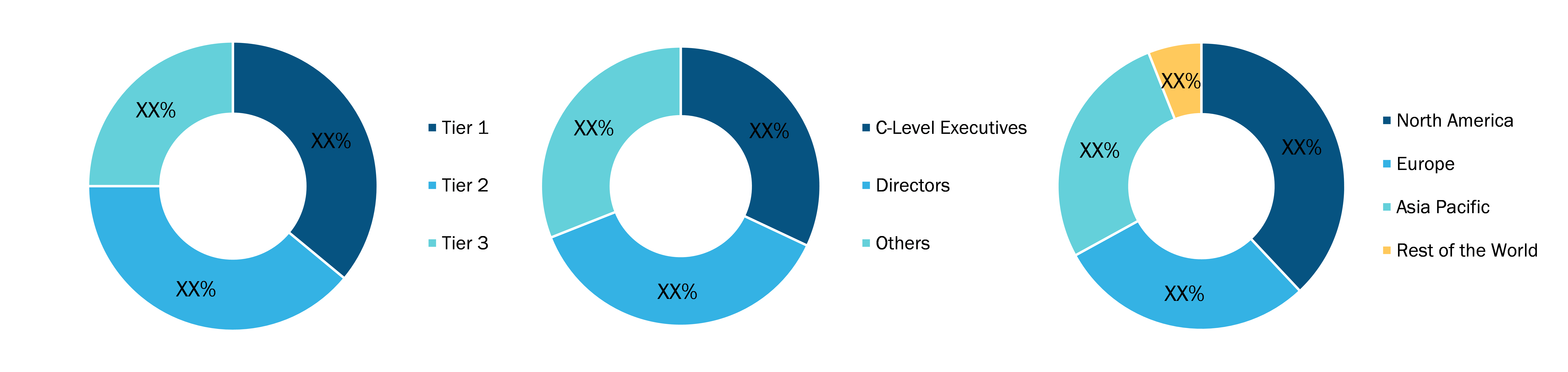
Once we receive the confirmation from primary research sources or primary respondents, we finalize the base year market estimation and forecast the data as per the macroeconomic and microeconomic factors assessed during data collection.
- Data Analysis:
Once data is validated through both secondary as well as primary respondents, we finalize the market estimations by hypothesis formulation and factor analysis at regional and country level.
- 3.1 Macro-Economic Factor Analysis:
We analyse macroeconomic indicators such the gross domestic product (GDP), increase in the demand for goods and services across industries, technological advancement, regional economic growth, governmental policies, the influence of COVID-19, PEST analysis, and other aspects. This analysis aids in setting benchmarks for various nations/regions and approximating market splits. Additionally, the general trend of the aforementioned components aid in determining the market's development possibilities.
- 3.2 Country Level Data:
Various factors that are especially aligned to the country are taken into account to determine the market size for a certain area and country, including the presence of vendors, such as headquarters and offices, the country's GDP, demand patterns, and industry growth. To comprehend the market dynamics for the nation, a number of growth variables, inhibitors, application areas, and current market trends are researched. The aforementioned elements aid in determining the country's overall market's growth potential.
- 3.3 Company Profile:
The “Table of Contents” is formulated by listing and analyzing more than 25 - 30 companies operating in the market ecosystem across geographies. However, we profile only 10 companies as a standard practice in our syndicate reports. These 10 companies comprise leading, emerging, and regional players. Nonetheless, our analysis is not restricted to the 10 listed companies, we also analyze other companies present in the market to develop a holistic view and understand the prevailing trends. The “Company Profiles” section in the report covers key facts, business description, products & services, financial information, SWOT analysis, and key developments. The financial information presented is extracted from the annual reports and official documents of the publicly listed companies. Upon collecting the information for the sections of respective companies, we verify them via various primary sources and then compile the data in respective company profiles. The company level information helps us in deriving the base number as well as in forecasting the market size.
- 3.4 Developing Base Number:
Aggregation of sales statistics (2020-2022) and macro-economic factor, and other secondary and primary research insights are utilized to arrive at base number and related market shares for 2022. The data gaps are identified in this step and relevant market data is analyzed, collected from paid primary interviews or databases. On finalizing the base year market size, forecasts are developed on the basis of macro-economic, industry and market growth factors and company level analysis.
- Data Triangulation and Final Review:
The market findings and base year market size calculations are validated from supply as well as demand side. Demand side validations are based on macro-economic factor analysis and benchmarks for respective regions and countries. In case of supply side validations, revenues of major companies are estimated (in case not available) based on industry benchmark, approximate number of employees, product portfolio, and primary interviews revenues are gathered. Further revenue from target product/service segment is assessed to avoid overshooting of market statistics. In case of heavy deviations between supply and demand side values, all thes steps are repeated to achieve synchronization.
We follow an iterative model, wherein we share our research findings with Subject Matter Experts (SME’s) and Key Opinion Leaders (KOLs) until consensus view of the market is not formulated – this model negates any drastic deviation in the opinions of experts. Only validated and universally acceptable research findings are quoted in our reports.
We have important check points that we use to validate our research findings – which we call – data triangulation, where we validate the information, we generate from secondary sources with primary interviews and then we re-validate with our internal data bases and Subject matter experts. This comprehensive model enables us to deliver high quality, reliable data in shortest possible time.

Nov 2025
Soy Protein Market
Size and Forecast (2021 - 2034), Global and Regional Share, Trend, and Growth Opportunity Analysis Report Coverage: By Type (Soy Protein Concentrate, Soy Protein Isolate, Textured Soy Protein, and Soy Flour & Grits), Category (Conventional and Organic), Form (Dry and Liquid), Application (Bakery and Confectionery, Meat Alternatives, Dairy Alternatives, Infant Nutrition, Protein Supplements, Animal Nutrition, and Others), and Geography (North America, Europe, Asia Pacific, Middle East and Africa, and South and Central America)
Nov 2025
Retail Seasoning Blends Market
Size and Forecast (2021 - 2034), Global and Regional Share, Trend, and Growth Opportunity Analysis Report Coverage: By Type (BBQ Seasoning, Ranch Seasoning, Cajun Seasoning, Italian Seasoning, Five Spice Powder, Berbere Powder, Chili and Lime Seasoning, Fajita Seasoning, Chipotle Seasoning, Tacos Seasoning, All-Purpose, and Others) and Distribution Channel (Supermarkets and Hypermarkets, Convenience Stores, Online Retail, and Others)
Nov 2025
Wheat Tortilla and Wraps Market
Size and Forecast (2021 - 2031), Global and Regional Share, Trend, and Growth Opportunity Analysis Report Coverage: By Type (Wheat Tortilla, Wheat Pita, Wheat Roti or Chapati, and Others), Flavor (Plain or Regular, Herb, Tomato, Peri Peri or Chili, Masala Spiced, Garlic, and Others), Category (Low-Carb and Conventional), End Use [Food Retail (Supermarkets and Hypermarkets, Convenience Stores, Online Retail, and Others) and Foodservice (Quick Service Restaurants, Casual Dining Restaurants, Fine Dining Restaurants, Cafes and Bars, and Others)], and Geography (North America, Europe, Asia Pacific, Middle East and Africa, and South and Central America
Nov 2025
Fillings, Toppings, and Glazes Market
Size and Forecast (2021 - 2031), Global and Regional Share, Trend, and Growth Opportunity Analysis Report Coverage: By Product Type [Fruit Fillings and Jams (Berries, Apple, Pineapple, Cherry, Peach, Citrus, and Others), Chocolate Syrups and Sauces, Caramel Sauces, Sugar Glazes, Fruit Glazes, and Others], Application (Cakes and Pastries, Pies and Tarts, Ice Cream and Frozen Desserts, Chocolate and Confectionery, Waffles and Pancakes, and Others), and Geography (North America, Europe, Asia Pacific, Middle East & Africa, and South & Central America)
Nov 2025
Marinades Market
Size and Forecast (2021 - 2031), Global and Regional Share, Trend, and Growth Opportunity Analysis Report Coverage: By End Use [Food Manufacturing (Processed Meats; Soups, Stocks, and Noodles; Ready Meals; Sauces and Dressings; Snacks; Bakery; and Others), Foodservice, (Restaurant Chains, Independent Restaurants, Hotels and Accommodation, Institutional Foodservice, Catering, and Others), Food Retail], and Geography (North America, Europe, Asia Pacific, Middle East and Africa, and South and Central America)
Nov 2025
Seasoning Blends Market
Size and Forecast (2021 - 2031), Global and Regional Share, Trend, and Growth Opportunity Analysis Report Coverage: By End Use [Food Manufacturing (Processed Meats; Soups, Stocks, and Noodles; Ready Meals; Sauces and Dressings; Snacks; Bakery; and Others), Foodservice (Restaurant Chains, Independent Restaurants, Hotels and Accommodation, Institutional Foodservice, Catering, and Others), and Food Retail (BBQ Seasoning, Ranch Seasoning, Cajun Seasoning, Italian Seasoning, Five Spice Powder, Berbere Powder, Chili and Lime Seasoning, Fajita Seasoning, Chipotle Seasoning, Tacos Seasoning, All-Purpose Seasoning, and Others)], and Geography (North America, Europe, Asia Pacific, Middle East and Africa, and South and Central America)
Nov 2025
Equine Supplements Market
Size and Forecast (2021 - 2031), Global and Regional Share, Trend, and Growth Opportunity Analysis Report Coverage: By Type (Powder, Liquid, Pellets & Granules, and Others), Health Benefits (Digestive Health, Joint and Bone Health, Hoof and Laminitis, General Health and Immunity, Respiratory, Muscle Support, Skin and Coat, Calming and Nervous System, Vitamins & Minerals, Kidney/Renal, Liver/Hepatic, and Others), and Distribution Channel (Supermarkets and Hypermarkets, Pharmacies and Drugstores, Pet Stores, Online Retail, and Others)
Nov 2025
Maize Market
Size and Forecast (2021 - 2031), Global and Regional Share, Trend, and Growth Opportunity Analysis Report Coverage: By Crop Type (White Corn, Yellow Corn, Blue Corn, and Others), Category (Conventional and Organic), and Application (Food and Beverages [Breads and Rolls; Biscuits, Cookies, and Crackers; Snacks; Breakfast Cereals; and Others], Animal Feed, Pharmaceuticals and Nutraceuticals, Agriculture, and Biofuel)
 Get Free Sample For