
Ultra-Mobile Devices Market Demand, Trends & Forecast by 2034
Coverage: by Type (Premium Ultra-Mobile Devices, Basic Ultra-Mobile Devices, Utility Ultra-Mobile Devices); Device (Tablet Laptop, Convertible, Detachable); Industry Vertical (Healthcare, IT and Telecoms, Retail, Consumer, Others) , and Geography (North America, Europe, Asia Pacific, and South and Central America)
- Status : Data Released
- Report Code : TIPRE00009374
- Category : Electronics and Semiconductor
- No. of Pages : 150
- Available Report Formats :


- Last update date : October 30, 2026


2025 Market Size
US$ 257.03 Bn
Base year value
2034 Forecast
US$ 384.29 Bn
Projected by 2034
CAGR 2026-2034
4.57 %
Growth rate
Addressable Market
US$ 2,911.71 Bn
(2026-2034)
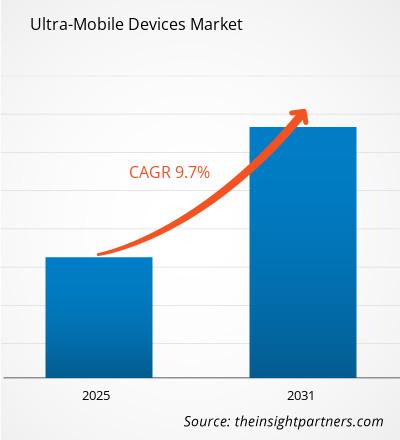
The Ultra-Mobile Devices Market is expanding as consumers and enterprises prioritize portable computing, connected productivity, and increasingly capable personal devices. The market is valued at US$ 257.03 Billion in 2025 and is projected to reach US$ 384.29 Billion by 2034, reflecting a 4.57% CAGR from 2026 to 2034. The market encompasses premium, basic, and utility-oriented ultra-mobile devices across healthcare, IT and telecoms, retail, consumer, and other application environments.
North America is positioned as a major demand center, supported by replacement of aging personal devices, enterprise mobility programs, cloud-connected workflows, and adoption of AI-enabled computing. The Ultra-Mobile Devices Market size is also influenced by premiumization, stronger demand for thin and lightweight systems, and the migration of productivity workloads toward portable form factors. The regional market is modeled to expand at approximately ~4% CAGR through 2034.
Ultra-Mobile Devices Market Assessment and Insights
Regional Outlook
- North America: ~28% of the global market in 2025 | ~4% CAGR through 2034. Market position: North America represents a highly developed demand base, supported by premium device adoption, enterprise refresh cycles, strong digital infrastructure, and widespread use of mobile computing across professional, education, healthcare, and consumer environments.
- US: ~72% of North American market revenue in 2025 | ~4% CAGR through 2034. Market position: The US represents the largest national demand center within North America, with strong adoption of premium notebooks, tablets, smartphones, and hybrid computing devices across enterprise, education, healthcare, and household applications.
- Europe: ~22% of the global market in 2025 | ~3% CAGR through 2034. Market position: Europe is a mature market characterized by replacement-driven demand, enterprise digitization, and sustainability considerations. Germany, the UK, France, Italy, and Spain form the principal demand centers, with Germany representing the leading country in Europe.
- Asia Pacific: ~43% of the global market in 2025 | ~6% CAGR through 2034. Market position: Asia Pacific is the fastest-growing region, supported by manufacturing concentration, expanding digital access, mobile-first consumption, enterprise connectivity, and rising demand across China, Japan, South Korea, India, and Australia.
Segment Outlook
- Consumer: ~48% Share in 2025 | ~4% CAGR through 2034. Market position: Consumer applications lead because smartphones, tablets, notebooks, and other portable systems are embedded in communication, entertainment, education, shopping, and personal productivity. Replacement demand and premium device upgrades sustain the segment.
- IT and Telecoms: ~20% Share in 2025 | ~6% CAGR through 2034. Market position: IT and telecoms represents a high-growth application base as distributed workforces, device management, cloud applications, edge computing, and AI-enabled workflows increase requirements for portable enterprise computing.
Competitive Coverage
Apple Inc., ASUSTeK Computer Inc., Dell Inc., Google LLC, HP Development Company, L.P., HTC Corporation, Lenovo Group Limited, Microsoft Corporation, Samsung Electronics Co., Ltd., Sony Group Corporation, Microchip Technology Incorporated
Methodology
The Insight Partners follows Data Collection & Secondary Research, Primary Research, Data Analysis, and Data Triangulation & Final Review to validate market estimates and insights.
Source: The Insight Partners' analysis based on proprietary research, government publications, company annual reports, investor presentations, industry databases, and expert interviews.
Ultra-Mobile Devices Market has undergone a transformation from regular portable computers and cell phones to computing platforms that are equipped with powerful processors, connected operating systems, advanced displays, increased battery life, and smart software. The design of new products becomes more focused on slim devices, efficient heat management, low power consumption chips, flexible screens, and on-device AI functions. Thus, the supply chain becomes more dependent on closer cooperation between the semiconductor manufacturers, display producers, memory suppliers, operating system developers, original equipment manufacturers, and channel partners.
During the forecast period, the demand is projected to expand not only in North America and Europe but also in emerging Asian economies and consumer markets with growing digitalization. In this respect, the local manufacturing ecosystem, the implementation of the program for digitalization of education, mobility programs within enterprises, and telecommunication infrastructure are expected to assist in the adoption of such products. Simultaneously, the requirements related to energy efficiency, product durability, reparability, and data security may influence purchasing decisions.
Ultra-Mobile Devices Market Report Scope
| Report Attribute | Details |
|---|---|
| Market size in 2025 | US$ 257.03 Billion |
| Market Size by 2034 | US$ 384.29 Billion |
| Global CAGR (2026 - 2034) | 4.57% |
| Historical Data | 2021-2024 |
| Forecast period | 2026-2034 |
Ultra-Mobile Devices Market Analysis
The driving forces behind the Ultra-Mobile Devices Market include the confluence of communication, entertainment, productivity, and computing capabilities in a portable format. Modern consumers are demanding more from their devices in terms of high resolution, multitasking capability, cloud computing capability, games, digital payments, collaboration, and even assistance from AI without compromising portability. For enterprise use, it includes remote work, field activities, mobile point of sales, digital healthcare, and connected retail. This encompasses an ecosystem that includes semiconductor and memory suppliers, display and battery makers, device manufacturers, software companies, carriers, distributors, and after-sales service.
Supply factors in the ultra-mobile devices market involve the architecture of the processor, memory, type of display screen, battery size, and component assembly. The established firms have an edge in securing and allocating components; whereas the specialized firms depend on unique industrial design, software, security features, and customization to create their competitive advantage. It means that the market is vulnerable to semiconductor availability, cost of components, foreign exchange rate, logistics situation, and product update cycle.
The competitive dynamics of the Ultra-Mobile Devices Market Report arises from the intersection of smartphones, tablets, notebooks, hybrid computers, and upcoming mobile computing segments. Apple Inc. leverages proprietary silicon, operating system, application, and device platforms. Samsung Electronics Co., Ltd. competes across smartphones, tablets, and Internet of Things (IoT) products. Lenovo Group Limited, HP Development Company, L.P., Dell Inc., and ASUSTeK Computer Inc. have strong presence in portable personal computing segment; whereas Microsoft Corporation drives the eco-system through Windows and Surface products.
Investment is being made in AI-driven processors, neural processing, power consumption, flexibility in form factor, device compatibility, and software-driven experiences. Companies are also building up their direct consumer sales channels, business management systems, financing services, and lifecycle management for devices. Strategic positioning thus shifts towards an ecosystem approach that raises the cost of switching, promotes multi-device usage, and offers ongoing software improvement post-hardware purchase.
● REPORT CUSTOMIZATION
Tailor This Report To Align With Your Specific Business Requirements
This report can be customized to align precisely with your business objectives, scope, and target markets. Customization options include tailored segmentation, geography, competitive analysis, and strategic insights to support informed decision-making.
Customize This Report →WHAT YOU CAN ADJUST
- ● Segmentations
- ● Geography
- ● Competitive Analysis
- ● Language Preferences
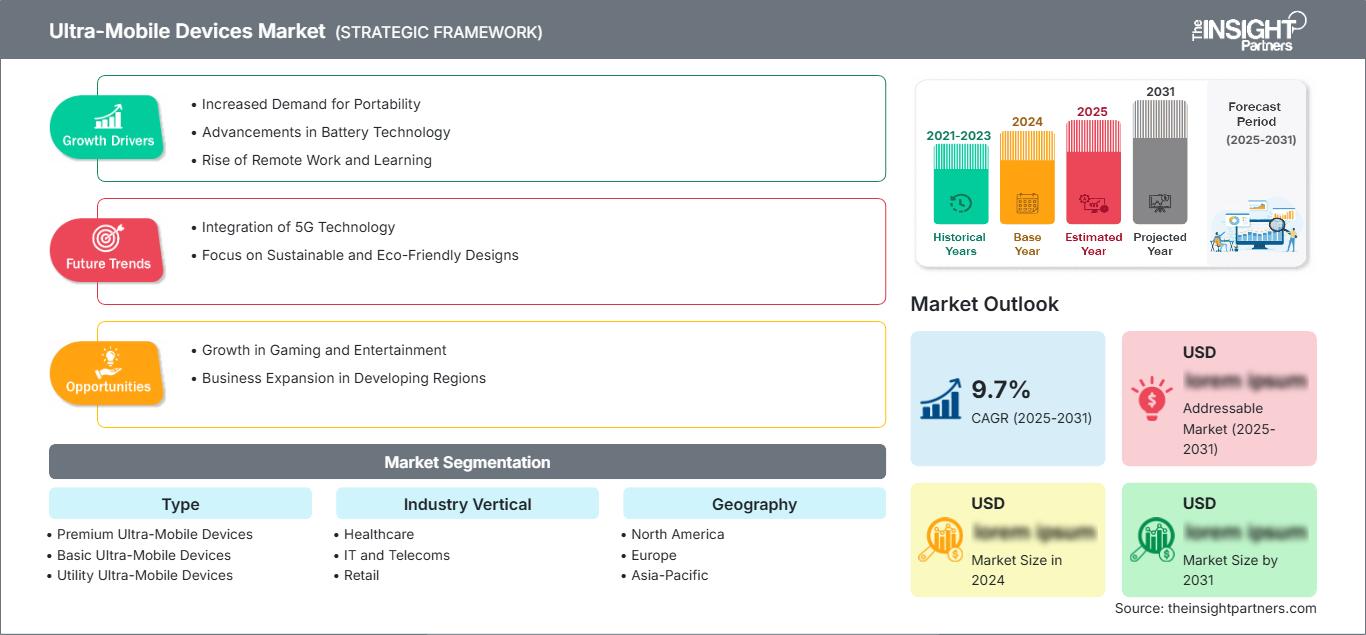
Ultra-Mobile Devices Market: Strategic Insights
Regional Insights
North America Ultra-Mobile Devices Market
North America maintains a substantial position in the Ultra-Mobile Devices Market because of high device ownership, mature broadband infrastructure, enterprise digitization, and strong replacement demand. The region is modeled to expand at approximately ~4% CAGR through 2034. The US accounts for the majority of regional demand, while Canada contributes through enterprise computing, education, healthcare, and consumer electronics adoption. Premium notebooks, smartphones, tablets, and hybrid devices benefit from established financing and carrier ecosystems.
Enterprise procurement still matters since enterprises continue to promote work that is distributed, collaborative, cyber-safe, and runs through cloud applications. Providers of healthcare services utilize mobile devices for their clinical information as well as for other administrative operations, while retailers are increasingly using mobile terminals along with their employees' connected devices. The demand of consumers is still focused on the existing ecosystems and premium products. Growth should therefore continue to be steady without being volume-driven, with value arising out of AI functionality, performance, connectivity, security, efficiency, and device integration.
U.S. Ultra-Mobile Devices Market
The US contributes about 72% of North American market revenues in 2025, with demand expected to grow at ~4% CAGR until 2034. A significant installed base, corporate expenditure on information technology infrastructure, high-quality digital services, and purchasing power of customers offer a solid base for notebooks, tablets, smartphones, and portable hybrid computers. Key industry players in this regard include Apple Inc., Microsoft Corporation, Dell Inc., HP Development Company, L.P., and Google LLC.
Requirements for applications are increasingly differentiated. Corporate clients seek devices that will offer secure operations, be manageable, have AI capabilities, and support cloud computing platforms, whereas individual users are more interested in cameras, battery performance, display performance, mobility, and ecosystems compatibility. Procurement is also ongoing in education and health care sectors. Therefore, US market is characterized by replacement cycle and adoption of premium products by manufacturers, which become increasingly competitive in terms of software, services, financing, and compatibility.
Europe Ultra-Mobile Devices Market
Europe accounts for ~22% of the global Ultra-Mobile Devices Market Share in 2025 and is growing at a modelled ~3% CAGR till 2034. Germany is the largest country in Europe owing to its industrial ecosystem, demand for enterprise technology and high-end consumer electronics. The UK has strong demand for premium computing and connected devices. France gets a boost from its enterprise digitalization process, public sector technology procurements and consumer replacement demand. Italy and Spain get their impetus from household devices usage, retail digitization, tourist mobility, and small enterprise computing needs.
The European region is more impacted by life cycle considerations such as energy efficiency, privacy, security, sustainability and repairability than simply adding new units. Vendors thus have to focus on product longevity and device management. There is also a trend among enterprise buyers for standardizing device fleets and device management.
German companies and corporations’ technology environment contributes to the demand for business notebooks, mobile workstations, tablets, and specialized portable computers. The UK still plays an important role in the financial services, professional services, education, and creative industries. France represents a combination of consumer and institutional demands, and Italy and Spain represent possibilities for small and medium enterprises, retail, education, and hospitality. These country-specific differences result in a well-developed regional market based on replacement, premiumization, and specialization.
APAC Ultra-Mobile Devices Market
In 2025, APAC constitutes nearly ~43% of the worldwide Ultra-Mobile Devices Market Size and is estimated to grow with a ~6% CAGR, making it the fastest growing region. Leading country in APAC is China, owing to its extensive manufacturing capabilities, huge consumer demand and wide electronic environment. Contribution from Japan and South Korea comes due to adoption of advanced technologies whereas India gains from expansion of digital connectivity and enterprise mobility. Australia is a developed market offering mature environment with good educational, business and consumer adoption.
This region offers high consumer demand coupled with fast paced industrial and digitization. Local manufacturing capability, growth in mobile connectivity, government driven digitization, use of education technology solutions and adoption of AI enabled devices drives the demand. Competitive pricing continues to be relevant outside the premium segment whereas advanced markets focus on foldable devices, performance notebooks, tablets and ecosystems.
Middle East & Africa Ultra-Mobile Devices Market
The Middle East and Africa market is modeled to expand at approximately ~6% CAGR through 2034. Saudi Arabia represents the leading country in the Middle East & Africa based on its digital transformation investment, expanding smart infrastructure, enterprise technology deployment, and consumer electronics demand. The UAE is a major premium-device and enterprise technology hub, while South Africa provides a significant base for corporate, retail, education, and household applications.
Energy sector digitalization, smart city initiatives, telecommunication development, mobile internet access, and public sector reform drive demand within the region. On the African continent, the degree of adoption is more price-sensitive in terms of connectivity, financing, and distribution network. Hence, companies providing reliable equipment, power efficiency, good after-sales service, and flexibility in configuration would be able to cover a greater range of use cases. Market growth is anticipated to include both high-end demand in Gulf economies and mass adoption in emerging countries.
Segmentation Analysis
Type
Type is divided into Premium Ultra-Mobile Devices, Basic Ultra-Mobile Devices, and Utility Ultra-Mobile Devices. The Ultra-Mobile Devices Market scope within this segment covers portable computing products differentiated by performance level, intended use, feature depth, and operating environment. Type selection depends on processing requirements, mobility needs, purchasing power, application complexity, device management requirements, and the balance between advanced capabilities and affordability.
- Premium Ultra-Mobile Devices: Premium Ultra-Mobile Devices account for ~48% of the market in 2025 and are projected to grow at ~5% CAGR through 2034. These devices emphasize high-performance processors, advanced displays, integrated AI capabilities, battery efficiency, connectivity, security, and premium industrial design. Demand is concentrated among professional users, creators, executives, affluent consumers, and enterprise teams requiring higher computing performance and advanced productivity capabilities.
- Basic Ultra-Mobile Devices: Basic Ultra-Mobile Devices are expected to expand at ~4% CAGR through 2034, supported by demand from education, entry-level enterprise computing, household connectivity, and price-sensitive consumer applications. These devices prioritize affordability, essential productivity, communication, browsing, and media functions. Standardized configurations, efficient processors, reliable battery performance, and simplified software experiences support adoption where buyers place greater emphasis on upfront cost and practical functionality.
- Utility Ultra-Mobile Devices: Utility Ultra-Mobile Devices are expected to grow at ~6% CAGR through 2034, making them the fastest-growing type segment. These devices address task-specific requirements across healthcare, retail, logistics, field service, education, and other operational environments. Portability, connectivity, durability, manageability, authentication, and workflow compatibility are important purchasing criteria, often taking precedence over premium design and entertainment-oriented features.
Industry Vertical
Industry vertical segment in the Ultra-Mobile Devices Market is divided into Healthcare, IT and Telecoms, Retail, Consumer, and Others. Demand varies according to workforce mobility, application requirements, device-management needs, connectivity infrastructure, and security considerations. Organizations increasingly evaluate ultra-mobile devices based on their ability to support distributed workflows, digital applications, collaboration, data access, and specialized operational tasks rather than simply replacing conventional personal computers.
- Healthcare: Healthcare organizations use ultra-mobile devices for clinical documentation, access to digital records, communication, diagnostics support, administrative workflows, and mobile workforce coordination. Demand is supported by requirements for secure authentication, device management, reliable connectivity, long operating periods, and compatibility with healthcare applications.
- IT and Telecoms: IT and telecom organizations deploy ultra-mobile devices across software development, network operations, technical support, field service, project management, and distributed workforce applications. Strong processing performance, connectivity, cybersecurity, remote management, and compatibility with enterprise software are important purchasing considerations.
- Retail: Retailers use ultra-mobile devices for inventory management, point-of-service activities, assisted selling, workforce coordination, customer engagement, and store operations. Compact form factors, wireless connectivity, application integration, barcode or peripheral compatibility, and centralized device management support adoption across retail environments.
- Consumer: Consumer demand spans personal productivity, entertainment, communication, education, content creation, and general computing. Buyers evaluate devices based on performance, display quality, battery life, portability, connectivity, ecosystem compatibility, and price. The growing integration of AI capabilities is also influencing consumer purchasing criteria across notebooks, tablets, convertibles, and other portable computing formats.
- Others: Other applications include education, government, professional services, industrial operations, logistics, hospitality, and specialized field applications. These users often require combinations of portability, durability, connectivity, security, and application compatibility, creating opportunities for differentiated configurations designed around specific workflows.
Opportunity Snapshot
| Industry Vertical | Revenue Contribution | Trend Tag | Adoption Stage |
|---|---|---|---|
| Healthcare | Medium | Clinical Mobility | Scaling |
| IT and Telecoms | High | AI Workflows | Scaling |
| Retail | Medium | Mobile POS | Scaling |
| Consumer | High | Premium Mobility | Mature |
| Others | Low | Specialized Use | Emerging |
Ultra-Mobile Devices Market Growth Drivers and Impact Analysis
AI-enabled computing increases the value of portable devices
AI is shifting portable computing from a primarily connectivity-oriented proposition toward a more capable local computing platform. Neural processing units and optimized processors allow selected workloads to run closer to the user, reducing dependence on continuous cloud processing and enabling more responsive experiences. For businesses, this can support local inference, productivity assistance, security functions, content generation, and specialized applications. For consumers, AI can improve photography, translation, search, personalization, and accessibility. The resulting performance improvements create a stronger reason to replace older devices, particularly when software features require newer processor architectures. Vendors that integrate AI into operating systems, applications, and hardware can therefore create differentiated products while encouraging higher-value upgrades.
Enterprise mobility expands device deployment beyond conventional computing
Enterprise mobility is broadening the addressable application base for portable devices. Healthcare workers require secure access to patient information, retailers need mobile checkout and inventory capabilities, logistics teams depend on connected field systems, and distributed employees require dependable collaboration tools. These use cases place greater emphasis on centralized management, security, battery endurance, connectivity, and device durability. As organizations standardize technology fleets, purchasing decisions increasingly consider total lifecycle cost rather than initial hardware price alone. This creates opportunities for manufacturers and service providers to bundle hardware, software management, security, support, and replacement programs. The impact is particularly relevant in sectors where portable devices directly affect employee productivity or customer interaction.
Premiumization raises value per device across mature markets
Mature markets are experiencing a shift from simple unit expansion toward higher value per device. Consumers and businesses increasingly seek improved displays, stronger processors, better cameras, longer battery life, advanced connectivity, and integrated AI features. Foldable designs and hybrid systems can also expand the functionality of a single device across multiple usage modes. Premiumization supports manufacturers by increasing revenue potential without requiring equivalent unit growth, while consumers may accept higher prices when productivity, durability, and ecosystem benefits are clear. The effect is especially relevant in North America, Western Europe, Japan, South Korea, and other mature markets where replacement decisions are increasingly based on meaningful functional improvements rather than basic access to computing.
Ultra-Mobile Devices Market Future Trends
Cross-device AI ecosystems will become a core product architecture
The next stage of the Ultra-Mobile Devices Market trends is likely to involve greater coordination between smartphones, tablets, notebooks, wearables, accessories, and cloud services. Instead of treating each device as an isolated endpoint, manufacturers are developing software environments that transfer tasks, context, files, communications, and AI assistance across products. This approach can improve continuity while increasing the value of owning multiple devices within one ecosystem. AI agents may further coordinate activities across screens and applications, allowing users to begin a task on a phone and continue it on a notebook or tablet. Vendors with strong operating systems, application ecosystems, silicon capabilities, and device portfolios will have structural advantages in implementing these experiences.
New form factors will blur boundaries between phones, tablets, and PCs
Flexible displays, foldable designs, detachable keyboards, rollable screens, lightweight computing modules, and connected accessories are likely to create new categories between established device classes. Instead of choosing exclusively between a smartphone, tablet, and notebook, users may increasingly select products based on mobility, screen availability, workload, and interaction method. Foldable smartphones already demonstrate how a compact device can provide a larger workspace, while emerging rollable and modular concepts point toward further experimentation. The commercial opportunity will depend on whether manufacturers can control weight, durability, battery performance, software optimization, and price simultaneously. Successful form factors could increase replacement activity by offering capabilities that conventional designs cannot easily provide.
Ultra-Mobile Devices Market Opportunities
Enterprise device-as-a-service and lifecycle management
Enterprise customers offer an opportunity to shift sales from one-time hardware transactions toward recurring lifecycle relationships. Device-as-a-service models can combine hardware procurement, financing, security, endpoint management, repairs, analytics, upgrades, and end-of-life handling. Such models are particularly relevant to organizations operating distributed workforces or large device fleets. Providers can differentiate through automated provisioning, remote diagnostics, security monitoring, and predictive replacement planning. The Ultra-Mobile Devices Market Forecasts therefore creates opportunities not only for hardware manufacturers but also for distributors, managed service providers, financing companies, and enterprise software vendors. Successful offerings will need transparent lifecycle economics and interoperability across multiple device categories.
Localized ecosystems for emerging Asian markets
Emerging Asian economies provide opportunities for vendors that adapt device portfolios to local affordability, connectivity, education, business, and service requirements. Rather than replicating premium-market configurations, suppliers can develop modular product families with flexible memory and storage options, localized software, financing support, durable construction, and strong service networks. India and Southeast Asian markets can particularly benefit from expanding digital services and enterprise mobility. Manufacturers with regional production or assembly capabilities can also improve supply resilience and shorten distribution cycles. Commercial strategies should therefore combine product localization with channel development, after-sales infrastructure, operator partnerships, and ecosystem integration to capture demand beyond established premium urban markets.
Recent Developments
- August 2026: Apple debuted M6 in the new Mac mini and M5 Ultra in the new Mac Studio, providing an extraordinary leap in performance and AI capabilities. M6, Apple’s first state-of-the-art 2-nanometer chip, advances every compute block, delivering gains across every dimension of performance. The chip features a larger 12-core CPU complex with the world’s fastest CPU core, a larger 12-core GPU with Neural Accelerators, a Dual 16-core Neural Engine, and up to 170GB/s of unified memory bandwidth.1 M5 Ultra, the ultimate powerhouse for pro and AI workloads, uses next-generation UltraFusion technology to form a quad-die architecture for the first time in an M-series system on a chip (SoC). The chip includes an up-to-36-core CPU and up-to-80-core GPU with a massive 1.2TB/s of unified memory bandwidth, 50 percent more than M3 Ultra. With their advanced technologies, these SoCs deliver extraordinary compute with industry-leading power efficiency, empowering users to do even more on a desktop.
- July 2026: Samsung Electronics unveiled the new Galaxy Z series, its most complete lineup yet, designed to expand foldables to a wider audience. The lineup introduces Galaxy Z Fold8, a fresh and exciting form factor that provides a new kind of foldable experience built around the way people explore, discover and immerse themselves in their favorite content.
- March 2026: OPPO confirmed that its next-generation flagship, the OPPO Find X9 Ultra, will make its global debut later this year. With Find X9 Ultra, OPPO's Ultra platform will expand beyond China for the first time, underscoring the company's long-term commitment to the Global market.
Frequently Asked Questions

- Comprehensive Market Sizing and Forecast Analysis
- Detailed Segmentation Analysis
- In-Depth Market Dynamics Assessment
- Regional and Country-Level Insights
- Competitive Landscape and Company Benchmarking
- Strategic Business Intelligence
Recent Reports
Testimonials

The Insight Partners provided valuable market intelligence that supported our global go-to-market strategy. Their team was professional, responsive, and attentive to our feedback, providing thoughtful analysis and helpful methodological clarifications throughout the project.
Junmo Kim Chief Financial Officer (CFO), Enertech Co., Ltd.
The Insight Partners' SCADA System Market report is comprehensive, with valuable insights on current trends and future forecasts. The team was highly professional, responsive, and supportive throughout. We are very satisfied and highly recommend their services.
RAN KEDEM Partner, Reali Technologies LTDs
I requested a report on a very specific software market and the team produced the report in a few days. The information was very relevant and well presented. I then requested some changes and additions to the report. The team was again very responsive and I got the final report in less than a week.
JEAN-HERVE JENN Chairman, Future Analytica
We worked with The Insight Partners for an important market study and forecast. They gave us clear insights into opportunities and risks, which helped shape our plans. Their research was easy to use and based on solid data. It helped us make smart, confident decisions. We highly recommend them.
PIYUSH NAGPAL Sr. Vice President, High Beam Global
The Insight Partners delivered insightful, well-structured market research with strong domain expertise. Their team was professional and responsive throughout. The user-friendly website made accessing industry reports seamless. We highly recommend them for reliable, high-quality research services
YUKIHIKO ADACHI CEO, Deep Blue, LLC.
This is the first time I have purchased a market report from The Insight Partners.While I was unsure at first, I visited their web site and felt more comfortable to take the risk and purchase a market report.I am completely satisfied with the quality of the report and customer service. I had several questions and comments with the initial report, but after a couple of dialogs over email with their analyst I believe I have a report that I can use as input to our strategic planning process.Thank you so much for taking the extra time and making this a positive experience.I will definitely recommend your service to others and you will be my first call when we need further market data.
JOHN SUZUKI President and Chief Executive Officer, Board Director, BK Technologies
I wish to appreciate your support and the professionalism you displayed in the course of attending to my request for information regarding to infectious disease IVD market in Nigeria. I appreciate your patience, your guidance, and the fact that you were willing to offer a discount, which eventually made it possible for us to close a deal. I look forward to engaging The Insight Partners in the future, all thanks to the impression you have created in me as a result of this first encounter.
DR CHIJIOKE ONYIA MANAGING DIRECTOR, PineCrest Healthcare Ltd.Reason to Buy
- Informed Decision-Making
- Understanding Market Dynamics
- Competitive Analysis
- Identifying Emerging Markets
- Customer Insights
- Market Forecasts
- Risk Mitigation
- Boosting Operational Efficiency
- Strategic Planning
- Investment Justification
- Tracking Industry Innovations
- Aligning with Regulatory Trends





 Get Free Sample for