
US and Europe Military GNSS Chip Market Size and Growth 2031
Coverage: By Type (GPS, GLONASS, and Galileo), Platform [Ground (Handheld and Portable, Mounted System and Infrastructure Based), Air (UAVs and Aircrafts), Maritime (Surface Vessels, Submarine, and Unmanned Maritime Systems), and Precision Guided Munitions (PGM) (Missiles and Artillery)], Application (Navigation, Target Tracking, Missile and Projectile Guidance, Search and Rescue, Reconnaissance, Nuclear Detonation Detectors, and Asset Tracking (GNSS + GPRS)), and Geography
- Status : Published
- Report Code : TIPRE00040968
- Category : Electronics and Semiconductor
- No. of Pages : 233
- Available Report Formats :


- Last update date : July 08, 2025


2024 Market Size
US$ 539.91 Mn
Base year value
2031 Forecast
US$ 825.29 Mn
Projected by 2031
CAGR 2025-2031
6.4 %
Growth rate
Addressable Market
US$ 4,881.16 Mn
(2025-2031)
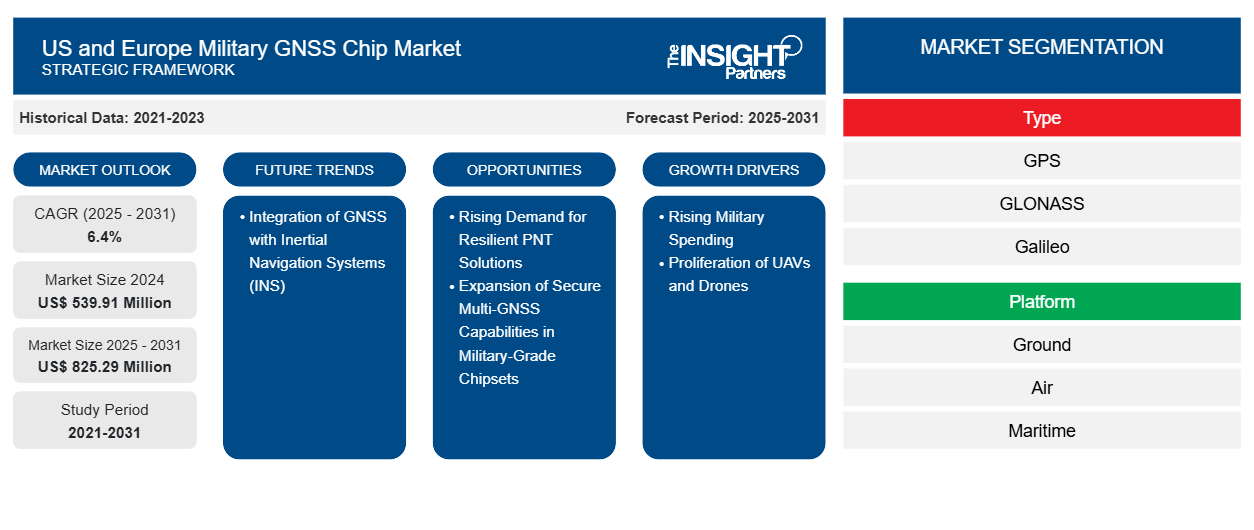
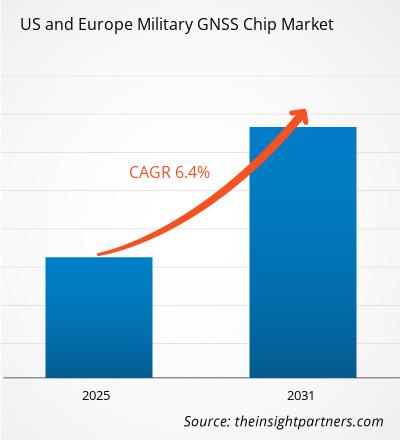
The US and Europe Military GNSS Chip Market size is expected to reach US$ 825.29 million by 2031 from US$ 539.91 million in 2024. The market is anticipated to register a CAGR of 6.4% from 2025–2031. The integration of GNSS with Inertial Navigation Systems (INS) is likely to bring new trends to the market in the coming years.
US and Europe Military GNSS Chip Market Analysis
The increasing demand for secure and resilient navigation solutions in contested or GPS-denied environments is pushing the adoption of GNSS technologies with anti-jamming, anti-spoofing, and encrypted signal capabilities. The US military’s M-Code and Galileo’s Public Regulated Service are among the examples of such capabilities. Growing investments in autonomous and unmanned systems, including drones, ground vehicles, and maritime platforms, are fueling demand for GNSS chips capable of supporting complex defense operations. Geopolitical tensions and the rising need for real-time situational awareness and force coordination are compelling defense agencies to modernize and diversify their PNT capabilities, further fueling the demand.
US and Europe Military GNSS Chip Market Overview
A GNSS (Global Navigation Satellite System) chip is a semiconductor component integrated into electronic devices to enable the reception and processing of signals from satellite navigation systems such as GPS (the US), Galileo (EU), and GLONASS (Russia). They provide positioning, navigation, and timing (PNT) information crucial for applications, including military, automotive, aviation, and consumer electronics. GNSS receivers are electronic devices that process signals from multiple GNSS to determine precise position, velocity, and timing information. GNSS modules are integrated components containing the receiver and related hardware designed for easy integration into larger systems. In military and defense applications, these receivers and modules enable accurate navigation, targeting, reconnaissance, and secure communication in diverse and challenging environments. It supports mission-critical operations with enhanced precision, reliability, and resistance to jamming and spoofing.
● REPORT CUSTOMIZATION
Tailor This Report To Align With Your Specific Business Requirements
This report can be customized to align precisely with your business objectives, scope, and target markets. Customization options include tailored segmentation, geography, competitive analysis, and strategic insights to support informed decision-making.
Customize This Report →WHAT YOU CAN ADJUST
- ● Segmentations
- ● Geography
- ● Competitive Analysis
- ● Language Preferences
US and Europe Military GNSS Chip Market: Strategic Insights
-
Get Top Key Market Trends of this report.This FREE sample will include data analysis, ranging from market trends to estimates and forecasts.
US and Europe Military GNSS Chip Market Drivers and Opportunities
Rising Military Spending
With nearly 1.3 million active-duty personnel, the US is investing in advanced defense technologies, surpassing the total combined defense spending of the 30 other NATO member nations between 2014 and 2022. This escalating investment in the military & defense sectors globally has direct implications for the GNSS chip market, particularly in military and aerospace applications. GNSS chips are critical for defense operations. They support precision-guided munitions, unmanned aerial vehicles (UAVs), missile navigation, surveillance, and secure communication systems. The demand for high-accuracy, multi-frequency, and anti-spoofing GNSS solutions is accelerating as armed forces modernize and prioritize situational awareness, real-time geolocation, and interoperability in complex combat environments. Defense-specific GNSS applications require robust, hardened chipsets that can function reliably under extreme conditions, driving innovation in chip architecture and satellite signal integration.
Expansion of Secure Multi-GNSS Capabilities in Military-Grade Chipsets
Published on October 31, 2024, Vaisala’s announcement of multi-GNSS support and industry-first message authentication within its weather monitoring equipment underscores a strategic shift toward more resilient and secure satellite navigation infrastructures. These technologies, originally tailored for meteorological agencies, offer defense applications—especially in enhancing the reliability of atmospheric data crucial to military operations and national security planning. The introduction of multi-GNSS capabilities allows systems to access multiple satellite constellations simultaneously. It reduces the risk posed by signal interference, whether caused by adverse environmental conditions or hostile jamming. This introduction is a direct value proposition for defense sectors in the US and Europe, where the ability to maintain situational awareness and coordinate logistics in GPS-denied environments is critical. Vaisala’s testing demonstrates a 60% improvement in data availability through multi-GNSS. It offers a benchmark for military-grade chip manufacturers to meet defense specifications in navigation and timing applications.
The implementation of message authentication technologies by Vaisala represents a leap forward in cybersecurity for GNSS-based systems. The military sector, highly sensitive to cyber threats and signal spoofing, stands to benefit from chips that embed similar data integrity features. As adversarial tactics become digitally sophisticated, GNSS chips designed with embedded authentication can safeguard command-and-control systems, weather forecasting tools, drone operations, and other assets dependent on precise geolocation and telemetry.
US and Europe Military GNSS Chip Market Report Segmentation Analysis
Key segments that contributed to the derivation of the US and Europe Military GNSS Chip Market analysis are product type, torque, speed, and end-user.
- Based on type, the market is divided into GPS, GLONASS, Galileo, and others. The GPS segment dominated the market in 2024.
- By platform, the market is categorized into ground, air, maritime, and precision-guided munitions (PGM). The ground segment is divided into handheld and portable, mounted system, and infrastructure-based. Similarly, the air segment is categorized into UAVs and aircraft. The maritime segment is classified into surface vessels, submarines, and unmanned maritime systems. The precision-guided munitions (PGM) segment is categorized into missiles and artillery. The ground segment dominated the market in 2024.
- Per application, the market is divided into navigation, target tracking, missile and projectile guidance, search and rescue, reconnaissance, nuclear detonation detectors, and asset tracking ( GNSS+GPRS). The navigation segment dominated the market in 2024.
US and Europe Military GNSS Chip Market Share Analysis by Geography
The US and Europe Military GNSS Chip Market is segmented into the US and European countries. Of all the countries US dominated the market in 2024.
The US Department of Defense (DoD) is currently upgrading its military systems by incorporating advanced GNSS technology to bring improvements in its positioning, navigation, and timing (PNT) capabilities. This modernization effort aims to enhance operational efficiency, security, and strategic decision-making across defense platforms. The DoD's alternative PNT science and technology strategy focuses on two key areas. These areas include enhancing sensor technology to deliver accurate relative positioning and navigation, and leveraging external sources to provide reliable absolute location data. In February 2024, BAE Systems completed the Critical Design Review for the MGUE Increment 2 program as a part of a US$247 million contract with the US Space Force. This initiative is focused on developing a Next-Generation Application-Specific Integrated Circuit (NG ASIC) to strengthen M-Code capabilities, ensuring reliable PNT in environments where GPS signals are unavailable or compromised. The program targets the development of a compact GNSS receiver designed for integration across a range of military platforms, including handheld systems and precision-guided weapons. The project is scheduled for completion in 2025.
In March 2025, the US Army authorized a full-rate production of the MAPS Generation II system, developed by Collins Aerospace. This vehicle-mounted solution leverages sensor fusion algorithms and non-radio frequency sensors to deliver reliable PNT data in GPS-denied environments. Designed to support multiple users on a single platform, it reduces the requirement for duplicate GPS receivers and antennas. The program has a budget allocation of approximately US$500 million, with plans to acquire 619 units during fiscal year 2025. Thus, such investments in R-GPS drive the growth of the US military GNSS chip market.
US and Europe Military GNSS Chip Market Report Scope
| Report Attribute | Details |
|---|---|
| Market size in 2024 | US$ 539.91 Million |
| Market Size by 2031 | US$ 825.29 Million |
| CAGR (2025 - 2031) | 6.4% |
| Historical Data | 2021-2023 |
| Forecast period | 2025-2031 |
| Segments Covered |
By Type
|
| Regions and Countries Covered |
US
|
| Market leaders and key company profiles |
|
US and Europe Military GNSS Chip Market Players Density: Understanding Its Impact on Business Dynamics
The US and Europe Military GNSS Chip Market is growing rapidly, driven by increasing end-user demand due to factors such as evolving consumer preferences, technological advancements, and greater awareness of the product's benefits. As demand rises, businesses are expanding their offerings, innovating to meet consumer needs, and capitalizing on emerging trends, which further fuels market growth.
US and Europe Military GNSS Chip Market News and Recent Developments
The US and Europe Military GNSS Chip Market is evaluated by gathering qualitative and quantitative data post primary and secondary research. This data includes important corporate publications, association data, and databases. A few of the developments in the US and Europe Military GNSS Chip Market are listed below:
- Thales, the European leader in resilient navigation, announced a €55 million investment to strengthen its industrial sites in Châtellerault and Valence, France. This investment, which will be made between 2025 and 2028, will meet the growing demand for high-performance navigation solutions, both civilian and military. It will strengthen its sovereign and cutting-edge industrial base.
(Source: Thales, Press Release, March 2025)
- L3Harris Technologies received a contract from the US Space Force’s Space Systems Command to design concepts for Phase 0 of the Resilient Global Positioning System (R-GPS) program. The R-GPS program is a procurement of cost-effective small satellites that will augment the existing 31-satellite GPS constellation. It provides resilience to military and civil GPS users. Space Force plans to produce and launch up to eight satellites to address jamming, spoofing, and more permanent disruptions.
(Source: L3Harris Technologies, Press Release, January 2025)
US and Europe Military GNSS Chip Market Report Coverage and Deliverables
The "US and Europe Military GNSS Chip Market Size and Forecast (2021–2031)" provides a detailed analysis of the market covering the areas mentioned below:
- US and Europe Military GNSS Chip Market size and forecast at regional and country levels for all the key market segments covered under the scope
- US and Europe Military GNSS Chip Market trends, as well as market dynamics such as drivers, restraints, and key opportunities
- Detailed PEST and SWOT analysis
- US and Europe Military GNSS Chip Market analysis covering key market trends, regional framework, major players, regulations, and recent market developments
- Industry landscape and competition analysis covering market concentration, heat map analysis, prominent players, and recent developments for the US and Europe Military GNSS Chip Market
- Detailed company profiles
Frequently Asked Questions

- Comprehensive Market Sizing and Forecast Analysis
- Detailed Segmentation Analysis
- In-Depth Market Dynamics Assessment
- Regional and Country-Level Insights
- Competitive Landscape and Company Benchmarking
- Strategic Business Intelligence
Recent Reports
Testimonials

The Insight Partners' SCADA System Market report is comprehensive, with valuable insights on current trends and future forecasts. The team was highly professional, responsive, and supportive throughout. We are very satisfied and highly recommend their services.
RAN KEDEM Partner, Reali Technologies LTDs
I requested a report on a very specific software market and the team produced the report in a few days. The information was very relevant and well presented. I then requested some changes and additions to the report. The team was again very responsive and I got the final report in less than a week.
JEAN-HERVE JENN Chairman, Future Analytica
We worked with The Insight Partners for an important market study and forecast. They gave us clear insights into opportunities and risks, which helped shape our plans. Their research was easy to use and based on solid data. It helped us make smart, confident decisions. We highly recommend them.
PIYUSH NAGPAL Sr. Vice President, High Beam Global
The Insight Partners delivered insightful, well-structured market research with strong domain expertise. Their team was professional and responsive throughout. The user-friendly website made accessing industry reports seamless. We highly recommend them for reliable, high-quality research services
YUKIHIKO ADACHI CEO, Deep Blue, LLC.
This is the first time I have purchased a market report from The Insight Partners.While I was unsure at first, I visited their web site and felt more comfortable to take the risk and purchase a market report.I am completely satisfied with the quality of the report and customer service. I had several questions and comments with the initial report, but after a couple of dialogs over email with their analyst I believe I have a report that I can use as input to our strategic planning process.Thank you so much for taking the extra time and making this a positive experience.I will definitely recommend your service to others and you will be my first call when we need further market data.
JOHN SUZUKI President and Chief Executive Officer, Board Director, BK Technologies
I wish to appreciate your support and the professionalism you displayed in the course of attending to my request for information regarding to infectious disease IVD market in Nigeria. I appreciate your patience, your guidance, and the fact that you were willing to offer a discount, which eventually made it possible for us to close a deal. I look forward to engaging The Insight Partners in the future, all thanks to the impression you have created in me as a result of this first encounter.
DR CHIJIOKE ONYIA MANAGING DIRECTOR, PineCrest Healthcare Ltd.Reason to Buy
- Informed Decision-Making
- Understanding Market Dynamics
- Competitive Analysis
- Identifying Emerging Markets
- Customer Insights
- Market Forecasts
- Risk Mitigation
- Boosting Operational Efficiency
- Strategic Planning
- Investment Justification
- Tracking Industry Innovations
- Aligning with Regulatory Trends





 Get Free Sample for