
Vertical Milling Machine Market Growth, Share & Trends by 2034
Coverage: By Type (Turret Milling Machine, Bed Milling Machine); Milling Material (Wood, Plastic, Metals, Others); End User (Automotive, Aerospace, Electronics and Electricals, Healthcare, Others) , and Geography (North America, Europe, Asia Pacific, and South and Central America)
- Status : Data Released
- Report Code : TIPRE00022740
- Category : Manufacturing and Construction
- No. of Pages : 150
- Available Report Formats :


- Last update date : September 08, 2026


2025 Market Size
US$ 13.57 Bn
Base year value
2034 Forecast
US$ 18.61 Bn
Projected by 2034
CAGR 2026-2034
3.57 %
Growth rate
Addressable Market
US$ 146.14 Bn
(2026-2034)
The vertical milling machine market is projected to grow from US$ 13.57 billion in 2025 to US$ 18.61 billion by 2034, registering a CAGR of 3.57% during 2026–2034. Demand is supported by precision machining needs across automotive, aerospace, electronics, electricals, and healthcare manufacturing. Vertical mills remain central to production environments that require accurate cutting, drilling, contouring, slotting, and finishing of metals, plastics, and wood.
North America is expected to record steady growth as manufacturers invest in CNC-enabled equipment, reshoring-linked machining capacity, and higher-precision component production. The vertical milling machine market size in the region is influenced by aerospace programs, defense machining, medical device production, and automation upgrades in job shops. Manufacturers are prioritizing compact machines, better spindle performance, tool monitoring, and reduced setup time to improve throughput.
Vertical Milling Machine Market Assessment and Insights
- North America: North America accounted for an estimated 24–27% share in 2025 and is expected to grow at a CAGR of 3.6–4.0% during 2026–2034, supported by aerospace, defense, and reshoring-led metalworking demand.
- US: The US represented around 72–76% of North America demand in 2025 and is projected to expand at a CAGR of 3.7–4.1% through 2034.
- Europe: Europe held an estimated 20–23% share in 2025, with Germany, Italy, France, Spain, and the UK leading procurement for precision engineering and machinery production.
- Asia Pacific: Asia Pacific represented the largest regional base at about 46–50% share in 2025 and is expected to grow at a CAGR of 3.8–4.4%, led by China, Japan, South Korea, and India.
- Largest Segment: Bed milling machines held an estimated 39–43% market share in 2025 and are expected to grow at a CAGR of 3.2–3.7% due to stability in heavy-duty machining.
- High Growth Segment: Healthcare end users are projected to grow at a CAGR of 4.1–4.7%, supported by precision components for medical devices, implants, and surgical tooling.
- Key companies analyzed in detail: Hardinge Inc., Haas Automation, Inc., Yamazaki Mazak Corporation, LAGUN Machine Tools S.L., Okuma Corporation, Datron Dynamics Inc., KNUTH Werkzeugmaschinen GmbH, Kent CNC, Hurco Companies, Inc., and Warco.
Source: The Insight Partners' analysis based on proprietary research, government publications, company annual reports, investor presentations, industry databases, and expert interviews.
Machine shops have shifted from manual milling toward CNC-assisted platforms that improve repeatability, surface quality, and production flexibility. The vertical milling machine market growth is closely tied to single-setup machining, multi-axis capability, and connected controls that help manufacturers reduce downtime. Automotive lightweighting, aircraft component complexity, and electronics miniaturization are pushing suppliers to invest in accurate, compact, and automation-ready milling systems.
Forward-looking demand will be strongest where manufacturing localization, industrial modernization, and skilled-labor constraints converge. Emerging economies are expanding machining capacity, while mature markets are replacing aging assets with digital-ready mills. Investment in predictive maintenance, pallet systems, and tool-life monitoring will support higher machine utilization, particularly across aerospace, medical, and precision engineering applications.
Vertical Milling Machine Market Report Scope
| Report Attribute | Details |
|---|---|
| Market size in 2025 | US$ 13.57 Billion |
| Market Size by 2034 | US$ 18.61 Billion |
| Global CAGR (2026 - 2034) | 3.57% |
| Historical Data | 2021-2024 |
| Forecast period | 2026-2034 |
Vertical Milling Machine Market Analysis
Vertical milling machine market growth is reinforced by demand for precision-engineered components, shorter production cycles, and the need to machine complex materials. Automotive manufacturers use vertical milling machines to produce dies, molds, brackets, housings, and lightweight structures. In the aerospace industry, more precise tolerances are required for aluminum, titanium, and high-strength metals, while in the electronics industry, smaller milling machines are needed for tiny components.
The factors that influence supply are spindle performance, the ability of CNC control, services, and system integration into automation processes. Machine manufacturers are enhancing such features as rigidity, chip removal, thermal stability, and diagnostic systems in the machines. Customers now assess the total cost of ownership, availability, training, and robot compatibility over machine cost alone.
The vertical milling machine market analysis shows medium concentration, with global brands competing against regional specialists. The competition amongst Haas Automation, Inc., Yamazaki Mazak Corporation, Okuma Corporation, Hurco Companies, Inc., and Hardinge Inc. is done by means of CNC capability and reliability, along with their after-sales service. Specialized manufacturers, such as LAGUN Machine Tools S.L., KNUTH Werkzeugmaschinen GmbH, Kent CNC, Datron Dynamics Inc., and Warco, are helping to drive the demand from the job shops and application-specific market segments.
In terms of investments, there is a preference for equipment that is capable of flexible batch processing and remote monitoring, while minimizing operator reliance. The current strategy is being developed based on product lines featuring accurate machining capability, program convenience, easy setup, and service availability.
● REPORT CUSTOMIZATION
Tailor This Report To Align With Your Specific Business Requirements
This report can be customized to align precisely with your business objectives, scope, and target markets. Customization options include tailored segmentation, geography, competitive analysis, and strategic insights to support informed decision-making.
Customize This Report →WHAT YOU CAN ADJUST
- ● Segmentations
- ● Geography
- ● Competitive Analysis
- ● Language Preferences
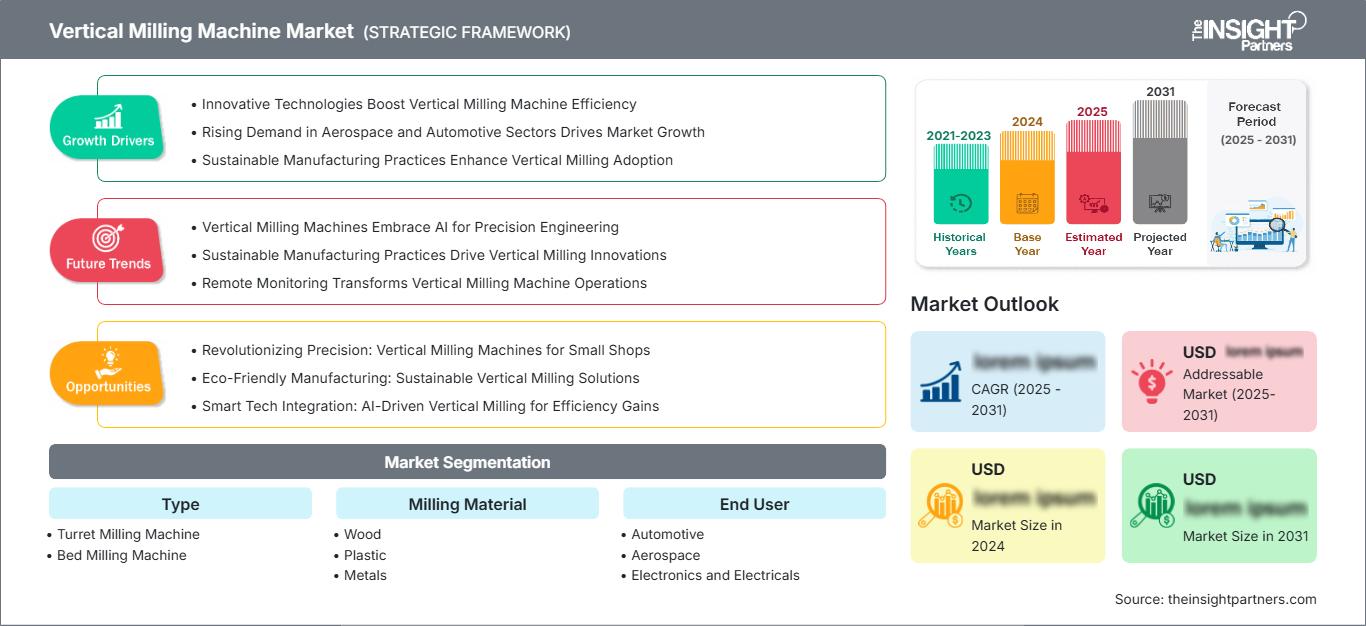
Vertical Milling Machine Market: Strategic Insights
Regional Insights
North America Vertical Milling Machine Market
North America is expected to maintain a 24–27% vertical milling machine market share in 2025, supported by aerospace, medical device, defense, and automotive machining. The region is projected to grow at a CAGR of 3.6–4.0% during 2026–2034 as manufacturers invest in CNC controls, automation-ready workholding, and digital maintenance systems.
US manufacturing modernization remains the main regional driver, while Canada and Mexico contribute through automotive supply chains and general machinery production. Reshoring strategies, shorter supply chains, and high-value component production support procurement of vertical mills that improve uptime, accuracy, and operator efficiency.
U.S. Vertical Milling Machine Market
The US accounted for an estimated 72–76% of North America demand in 2025 and is expected to grow at a CAGR of 3.7–4.1%. The vertical mill is used mostly by aerospace companies, medical device makers, defense contractors, and precision job shops.
Machining investments are being made mostly in CNC machines, five-axis machining centers, and tool management systems. The presence of Haas Automation, Inc., Hardinge Inc., Hurco Companies, Inc., and Yamazaki Mazak Corporation helps promote the use of the technology.
Europe Vertical Milling Machine Market
Europe held an estimated 20–23% share in 2025 and is projected to grow at a CAGR of 3.0–3.5% through 2034. Germany has dominated regional demand because of machinery, automobile, and precision engineering expertise, whereas Italy assists in equipment acquisition by supplying machine tools and industrial suppliers.
The UK, France, and Spain have assisted by means of aerospace equipment manufacturing, energy equipment, and transport manufacturing. European customers pay attention to machine rigidity, energy efficiency, dimensional accuracy, and quality specifications. Demand is steady since small and medium enterprises are replacing their milling machinery.
APAC Vertical Milling Machine Market
APAC represented about 46–50% share in 2025 and is expected to expand at a CAGR of 3.8–4.4%. China retains its status as the dominant nation due to its extensive manufacturing base, with Japan and South Korea creating additional demand from the automotive, electronics, and precision machinery industries.
Other countries like India and Australia are contributing through their investment in industry, manufacture of weapons, and manufacturing related to infrastructure development. The encouragement of local production and factory automation is resulting in increased use of CNC vertical mills.
Middle East & Africa Vertical Milling Machine Market
The Middle East & Africa market is projected to grow at a CAGR of 2.7–3.2% during 2026–2034. Saudi Arabia and the UAE are at the forefront of driving demand by using energy equipment, maintenance workshops, and industry diversification, whereas South Africa has a metalwork industry for the region.
Procurement takes place in terms of oil and gas maintenance, infrastructural fabrication, and industrial service centers. Buyers require durable machinery, training of operators, and availability after-sales. Growth is steady despite being slow.
Segmentation Analysis
Type
Type is projected to grow at a CAGR of 3.3–3.8% during 2026–2034. The vertical milling machine market scope by type is shaped by machine rigidity, table travel, spindle power, and production flexibility. Turret machines remain suitable for maintenance and toolroom work, while bed mills support heavier and more repeatable machining requirements.
- Turret Milling Machine: Turret milling machines are preferred by toolrooms, training centers, and low-volume workshops due to flexibility, operator visibility, and suitability for maintenance, prototyping, and varied machining tasks.
- Bed Milling Machine: Bed milling machines serve higher-load applications where rigidity, stability, and accuracy are essential. Their fixed-bed structure supports heavier components and repeatable metal cutting operations.
Milling Material
Milling Material is expected to grow at a CAGR of 3.2–3.6%. Metals represent the dominant material category because automotive, aerospace, machinery, and healthcare components require strength and tolerance control. Plastic and wood milling remain relevant for prototypes, fixtures, molds, design models, and specialized production environments.
- Wood: Wood milling demand is concentrated in model making, furniture components, education, and pattern production, where accurate shaping, repeatability, and flexible cutting paths are important.
- Plastic: Plastic milling supports prototypes, electronics housings, medical components, and fixture production. Demand is linked to clean finishing, dimensional control, and low-volume customization.
- Metals: Metal milling is the core material application, driven by steel, aluminum, titanium, and alloy components used in automotive, aerospace, machinery, and healthcare manufacturing.
End User
End User demand is projected to grow at a CAGR of 3.5–4.0%. Automotive remains the largest user base, while aerospace and healthcare require higher precision and quality validation. Electronics and electricals support demand for compact parts, tooling, heat sinks, connectors, and production fixtures.
- Automotive: Automotive users deploy vertical mills for dies, tooling, engine parts, brackets, housings, and lightweight components where throughput and cost-efficient machining remain critical.
- Aerospace: Aerospace users require tight tolerances, repeatability, and stable machining of aluminum, titanium, and high-strength alloys for structural, engine, and landing system components.
- Electronics and Electricals: Electronics and electrical manufacturers use vertical mills for enclosures, connectors, heat sinks, tooling, and small precision components requiring accuracy and surface consistency.
- Healthcare: Healthcare users adopt vertical mills for implants, surgical tools, diagnostic equipment parts, and medical device components where material control and precision are essential.
Opportunity Snapshot
| End User | Revenue Contribution | Trend Tag | Adoption Stage |
| Automotive | High | Lightweight Tooling | Mature |
| Aerospace | Medium | Five-Axis | Scaling |
| Electronics and Electricals | Medium | Precision Fixtures | Scaling |
| Healthcare | Low | Medical Parts | Emerging |
Vertical Milling Machine Market Growth Drivers and Impact Analysis
Rising Demand for Precision Components
The reason behind an increased purchase of vertical milling machines from various industries such as the automotive industry, aerospace industry, electronic industry, and healthcare industry is that the design of the parts is becoming more complicated and the tolerances are becoming stricter. The vertical milling machine facilitates the process of drilling, slotting, contouring, and finishing on one machine itself, thus decreasing the movement of the work piece. The effect of this factor can be seen in the market due to the need for stable output in the presence of labor shortage and reduced lead time.
Automation and Digital Monitoring in Machine Shops
Automation is changing buyer expectations in the vertical milling machine market. Users increasingly look for machines that can integrate with tool setters, probes, pallet systems, robotics, and remote monitoring platforms. These upgrades help reduce idle time, prevent tool failures, and improve utilization. Digital dashboards and predictive maintenance tools are especially valuable for high-mix production environments where downtime affects delivery schedules. As a result, machine builders are differentiating through controls, diagnostics, software compatibility, and service support rather than only mechanical specifications.
Manufacturing Localization and Capacity Expansion
Local production in manufacturing is stimulating investment in machining capabilities close to the destination market. Manufacturers of aircraft parts, defense equipment, medical devices, and cars are developing their capabilities locally to avoid being exposed to the risks of the supply chain and to ensure quality standards are met. Vertical milling machines are commonly used since they offer flexibility, save space, and can handle different types of materials and production quantities. This trend creates demand for replacing legacy machines in established markets and purchasing CNC machines for the first time in developing countries.
Vertical Milling Machine Market Future Trends
Connected CNC Milling Cells
Vertical milling machine market trends indicate a shift toward connected CNC milling cells that combine machine tools, sensors, tooling data, and production software. Future systems will allow the operator and management to get real-time insights on spindle load, tooling wear, coolant performance, and cycle efficiency. This will help manufacturers optimize their scheduling, cut down on scrap, and prolong the life of the machinery used. Connected cells will especially be valuable in sectors like aerospace, healthcare, and electronics, where documentation and repeatability are critical to customer acceptance.
Greater Use of Multi-Axis Vertical Platforms
Multi-axis vertical platforms are set to become more popular as companies look to cut down on setups and increase precision in order to manufacture complex components. Multi-axis functionality will enable the machining of complex geometries, angles, and curved surfaces without the need for constant repositioning. While basic machines will continue to have their place in maintenance applications and workshops, multi-axis vertical platforms will attract high-end customers such as the aerospace and medical sectors.
Vertical Milling Machine Market Opportunities
Aftermarket Services and Retrofit Programs
The Vertical Milling Machine Market Forecast indicates that large installed bases of conventional and older CNC mills create opportunities for service providers, distributors, and machine builders. Retrofitting controls, adding probes, upgrading spindles, and improving workholding can extend machine life while delivering productivity gains. Buyers with constrained capital budgets may prefer upgrades before full replacement. This opportunity is attractive because it generates recurring revenue through maintenance, training, software updates, and spare parts. Vendors with strong local service networks can use retrofit programs to build long-term customer relationships.
Application-Specific Machines for High-Value Industries
Application-specific machines offer an opportunity in aerospace, healthcare, electronics, and advanced automotive manufacturing. These users require validated machining processes, material-specific tooling, and accurate surface finishing. Machine builders can differentiate by offering tailored packages for titanium, aluminum, plastics, medical alloys, and small precision parts. Bundled solutions that include fixtures, programming support, and operator training can reduce adoption risk for customers. This approach supports premium pricing and positions vendors as process partners rather than equipment suppliers.
Frequently Asked Questions

- Comprehensive Market Sizing and Forecast Analysis
- Detailed Segmentation Analysis
- In-Depth Market Dynamics Assessment
- Regional and Country-Level Insights
- Competitive Landscape and Company Benchmarking
- Strategic Business Intelligence
Recent Reports
Testimonials

The Insight Partners' SCADA System Market report is comprehensive, with valuable insights on current trends and future forecasts. The team was highly professional, responsive, and supportive throughout. We are very satisfied and highly recommend their services.
RAN KEDEM Partner, Reali Technologies LTDs
I requested a report on a very specific software market and the team produced the report in a few days. The information was very relevant and well presented. I then requested some changes and additions to the report. The team was again very responsive and I got the final report in less than a week.
JEAN-HERVE JENN Chairman, Future Analytica
We worked with The Insight Partners for an important market study and forecast. They gave us clear insights into opportunities and risks, which helped shape our plans. Their research was easy to use and based on solid data. It helped us make smart, confident decisions. We highly recommend them.
PIYUSH NAGPAL Sr. Vice President, High Beam Global
The Insight Partners delivered insightful, well-structured market research with strong domain expertise. Their team was professional and responsive throughout. The user-friendly website made accessing industry reports seamless. We highly recommend them for reliable, high-quality research services
YUKIHIKO ADACHI CEO, Deep Blue, LLC.
This is the first time I have purchased a market report from The Insight Partners.While I was unsure at first, I visited their web site and felt more comfortable to take the risk and purchase a market report.I am completely satisfied with the quality of the report and customer service. I had several questions and comments with the initial report, but after a couple of dialogs over email with their analyst I believe I have a report that I can use as input to our strategic planning process.Thank you so much for taking the extra time and making this a positive experience.I will definitely recommend your service to others and you will be my first call when we need further market data.
JOHN SUZUKI President and Chief Executive Officer, Board Director, BK Technologies
I wish to appreciate your support and the professionalism you displayed in the course of attending to my request for information regarding to infectious disease IVD market in Nigeria. I appreciate your patience, your guidance, and the fact that you were willing to offer a discount, which eventually made it possible for us to close a deal. I look forward to engaging The Insight Partners in the future, all thanks to the impression you have created in me as a result of this first encounter.
DR CHIJIOKE ONYIA MANAGING DIRECTOR, PineCrest Healthcare Ltd.Reason to Buy
- Informed Decision-Making
- Understanding Market Dynamics
- Competitive Analysis
- Identifying Emerging Markets
- Customer Insights
- Market Forecasts
- Risk Mitigation
- Boosting Operational Efficiency
- Strategic Planning
- Investment Justification
- Tracking Industry Innovations
- Aligning with Regulatory Trends





 Get Free Sample for