
VVVF Inverters Market Demand, Size & Forecast by 2034
Coverage: By Type (Natural Cooling VVVF Inverter, Forced-air Cooling VVVF Inverter); Application (Subway, Train, Engineering Vehicle, Others) , and Geography (North America, Europe, Asia Pacific, and South and Central America)
- Status : Data Released
- Report Code : TIPRE00017211
- Category : Manufacturing and Construction
- No. of Pages : 150
- Available Report Formats :


- Last update date : September 22, 2026


2025 Market Size
US$ 4.36 Bn
Base year value
2034 Forecast
US$ 8.16 Bn
Projected by 2034
CAGR 2026-2034
7.21 %
Growth rate
Addressable Market
US$ 56.48 Bn
(2026-2034)
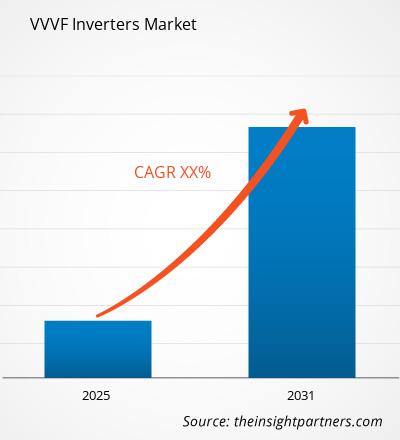
The vvvf inverters market is projected to grow from US$ 4.36 Billion in 2025 to US$ 8.16 Billion by 2034, registering a CAGR of 7.21% during 2026–2034. Demand is supported by rail electrification, metro expansion, rolling stock modernization, and increasing use of efficient traction control systems across subway, train, and engineering vehicle applications.
North America is expected to maintain a measured growth trajectory as transit agencies upgrade propulsion equipment, reduce operating energy consumption, and improve fleet reliability. The regional vvvf inverters market size is supported by subway rehabilitation programs, commuter rail investment, and procurement strategies that prioritize lifecycle efficiency over initial equipment cost.
VVVF Inverters Market Assessment and Insights
- North America: The region accounted for an estimated 18–21% share in 2025 and is projected to grow at a CAGR of 6.4–6.9% during 2026–2034, supported by metro modernization and commuter rail upgrades.
- U.S.: The U.S. represented 71–75% of North America demand in 2025 and is expected to grow at a CAGR of 6.5–7.0% through 2034.
- Europe: Europe held an estimated 23–26% share in 2025 and is projected to expand at a CAGR of 6.6–7.1%, led by Germany, France, the UK, Italy, and Spain.
- Asia Pacific: Asia Pacific accounted for 43–47% share in 2025 and is forecast to grow at a CAGR of 7.8–8.4%, led by China, Japan, South Korea, and India.
- Largest Segment: Forced-air Cooling VVVF Inverter held an estimated 56–60% market share in 2025 and is projected to grow at a CAGR of 7.0–7.5%.
- High Growth Segment: Subway applications held 37–41% share in 2025 and are expected to grow at a CAGR of 7.7–8.3% during 2026–2034.
- Key companies analyzed in detail: DAWONSYS Co., Ltd.; Fuji Electric Co., Ltd.; Lenze SE; Mitsubishi Electric Corporation; Shenzhen INVT Electric Co., Ltd.; Siemens AG; ABB Ltd.; Toshiba Infrastructure Systems & Solutions Corporation; CRRC Corporation Limited; Alstom SA.
Source: The Insight Partners' analysis based on proprietary research, government publications, company annual reports, investor presentations, industry databases, and expert interviews.
Market growth will stem from the changing dynamics from old school traction systems to the adoption of more compact, digital, and energy-efficient inverters. New technologies such as silicon carbide semiconductors, regenerative braking technology, better thermal management, and real-time diagnostics are influencing purchasing considerations. Companies are producing systems that are modular, adaptable, and can be applied to metro, mainline rail, and heavy engineering systems.
Going forward, market demand will focus on those regions that have overlapping plans for rail capacity development and decarbonization. Authorities within public transport systems will favor low life-cycle costs and better acceleration profiles. This creates opportunities for suppliers that combine propulsion expertise, localized service support, and compliance with railway safety standards, according to the VVVF Inverters Market report.
VVVF Inverters Market Report Scope
| Report Attribute | Details |
|---|---|
| Market size in 2025 | US$ 4.36 Billion |
| Market Size by 2034 | US$ 8.16 Billion |
| Global CAGR (2026 - 2034) | 7.21% |
| Historical Data | 2021-2024 |
| Forecast period | 2026-2034 |
VVVF Inverters Market Analysis
The demand for market products is highly associated with the development of electrified railway corridors and urban transport services. The VVVF inverters adjust the voltage and frequency, thus managing the speed of traction motors. They provide enhanced acceleration, efficient braking energy recovery, and improved efficiency of operations. With the efforts to cut down energy intensity, the efficiency of the inverter has become a key factor in bidding processes for trains. Increasing investments in the development of metropolitan transport services, high-speed trains, and eco-friendly public transport contribute to an increase in demand. Railway administration focuses on the development of energy-efficient traction systems.
The supply chain is affected by the availability of semiconductors, the certification process of railways, and the requirement for rugged power electronics. Natural cooling is an approach that has a lot of advantages, where low noise and simpler maintenance are essential, whereas forced air cooling will be beneficial for heavier-duty cycle applications. That is what determines the market for subways, trains, and engineering vehicles. At the same time, there is a growing emphasis on the improvement of power density, thermal management, and reliability. These parameters play a major role in purchasing decisions.
Competitive environment comprises diversified industrial conglomerates and railroad-oriented specialists. Mitsubishi Electric Corporation and Fuji Electric Co., Ltd. concentrate on traction power know-how, while DAWONSYS Co., Ltd. and Shenzhen INVT Electric Co., Ltd. increase the choice of suppliers in the region. Siemens AG, ABB Ltd., Toshiba Infrastructure Systems & Solutions Corporation, CRRC Corporation Limited, and Alstom SA assist with integration of more extensive systems. Modern competition is based on operational efficiency, lifecycle performance, diagnostic capabilities, and compatibility with growing requirements to railroads' electrification. Cooperation with rolling stock manufacturers and public transport authorities helps suppliers enter new markets.
The investments will tend towards high energy density, predictive maintenance user interface, and software-controlled systems. The suppliers will position themselves on the basis of reliability, performance certification, and serviceability at the fleet level instead of single part cost. This means that the analysis of the market will be increasingly driven by the capability to fit the design of the equipment to the operator’s operation profile. In terms of future investment, the areas that will be targeted will be intelligent traction systems, maintenance platforms, and advanced semiconductors.
● REPORT CUSTOMIZATION
Tailor This Report To Align With Your Specific Business Requirements
This report can be customized to align precisely with your business objectives, scope, and target markets. Customization options include tailored segmentation, geography, competitive analysis, and strategic insights to support informed decision-making.
Customize This Report →WHAT YOU CAN ADJUST
- ● Segmentations
- ● Geography
- ● Competitive Analysis
- ● Language Preferences
VVVF Inverters Market: Strategic Insights

Regional Insights
North America vvvf inverters market
North America is projected to grow at a CAGR of 6.4–6.9% during 2026–2034. Demand is supported by metro fleet refurbishment, aging commuter rail systems, and state-level investment in lower-emission mobility. The region accounted for 18–21% of global demand in 2025, with the vvvf inverters market share concentrated around urban rail modernization projects.
Procurement activity is increasingly tied to reliability, maintainability, and energy savings. Transit agencies are prioritizing systems that reduce traction losses and support diagnostic monitoring. Supplier qualification remains rigorous because operators require proven equipment performance under high passenger load and variable climate conditions.
U.S. vvvf inverters Market
The U.S. represented 71–75% of North America's demand in 2025 and is projected to grow at a CAGR of 6.5–7.0%. Renovation programs for subway systems, feasibility analysis for commuter rail electrification, and upgrade of existing propulsion systems aid in generating demand. In the public procurement process, there is a preference for parts with high durability that minimize downtime.
Local presence is influenced by local partnerships, existing rail industry supply chains, and certification criteria for specific projects. The target market is focused on subways, regional passenger trains, and maintenance trains with tight traction controls.
Europe vvvf inverters Market
Europe accounted for 23–26% share in 2025 and is projected to grow at a CAGR of 6.6–7.1%. Germany remains one of the major countries in terms of rolling stock renewal and technological manufacturing. France, Italy, Spain, and the UK participate via investments in urban transit, modernization of their intercity fleets, and decarbonizing rail transport.
The European market is shaped by interoperability requirements, energy efficiency regulations, and the choice of low-noise and compact traction systems on the part of operators. The advanced rail infrastructure in Europe generates replacement needs, whereas HSR and metro projects create a stable order flow.
APAC vvvf inverters Market
Asia Pacific held 43–47% share in 2025 and is projected to grow at a CAGR of 7.8–8.4%. China leads regional demand, followed by Japan, South Korea, India, and Australia. Metro expansion, high-speed rail investment, and domestic rolling stock manufacturing support high-volume procurement.
Policy support for electrified mobility strengthens supplier opportunities. The vvvf inverters market trends in APAC include compact inverter design, local manufacturing, digital control integration, and energy-saving propulsion systems for dense urban transit networks.
Middle East & Africa vvvf inverters Market
The Middle East & Africa region is projected to grow at a CAGR of 6.1–6.8% through 2034. Saudi Arabia and the UAE drive the demand due to the metro, airport rail, and other infrastructure projects, while South Africa drives the demand due to rail rehabilitation and maintenance.
The demand is project-driven and frequently associated with the deployment of new transportation systems as opposed to the replacement of large numbers. Operating environments that are difficult require better cooling, sealed electronics, and support from the supplier.
Segmentation Analysis
Type
Type is projected to grow at a CAGR of 7.0–7.6% during 2026–2034. The segment reflects procurement decisions around heat dissipation, operating environment, reliability, and lifecycle maintenance. The market scope under type is defined by the balance between compact natural cooling and higher-capacity forced-air systems.
- Natural Cooling VVVF Inverter: This sub-segment is preferred where lower acoustic output, simplified upkeep, and compact installation matter, especially in moderate-duty rail systems and applications with controlled operating loads.
- Forced-air Cooling VVVF Inverter: This sub-segment supports higher thermal loads, frequent acceleration cycles, and heavy-duty operations, making it suitable for dense subway networks and demanding train propulsion applications.
Application
Application is projected to grow at a CAGR of 7.2–7.9% during 2026–2034. Demand is concentrated in rail systems requiring precise traction control, lower energy consumption, and improved service reliability. Subway systems represent the strongest opportunity because frequent start-stop cycles increase the value of efficient inverter performance.
- Subway: Subway demand is driven by urbanization, fleet renewal, frequent acceleration cycles, and the need for energy-efficient propulsion in high-frequency transit corridors.
- Train: Train applications include commuter, regional, and intercity fleets where reliable motor control supports passenger comfort, energy savings, and smoother operating performance.
- Engineering Vehicle: Engineering vehicles use VVVF inverters for controlled movement, traction stability, and dependable performance in maintenance, inspection, and infrastructure support operations.
Opportunity Snapshot
| Application | Revenue Contribution | Trend Tag | Adoption Stage |
| Subway | High | Metro Renewal | Scaling |
| Train | Medium | Fleet Upgrade | Scaling |
| Engineering Vehicle | Low | Maintenance Automation | Emerging |
VVVF Inverters Market Growth Drivers and Impact Analysis
Rail Electrification and Urban Metro Expansion
The rail electrification will continue to be the primary structural force behind the market growth. Urban transit agencies are expanding their metro rail networks in order to alleviate congestion and environmental impact, whereas state railways are investing in the upgrading of their propulsion technology in order to increase efficiency. The use of VVVF inverters provides for motor control, regenerative braking, and a smoother acceleration, which makes a direct contribution to the increase of energy efficiency and the passenger experience.
Energy Efficiency and Lifecycle Cost Reduction
Propulsion system evaluation now depends more and more on the total cost of ownership as opposed to simply the cost of acquisition. The benefits of efficient VVVF inverters are reduced traction losses, enabling regenerative braking, and minimizing wear on the motors and other mechanical parts. All of these contribute to reduced maintenance needs and increased availability, an important factor in frequent operations such as those in subways and commuter trains.
Advances in Power Electronics and Digital Control
Innovation in power semiconductors is driving improved efficiency in inverters used in the rail industry. Inverters incorporating silicon carbide semiconductors, advanced IGBT modules, and advanced control algorithms enable increased efficiencies, reduced size of components, and enhanced thermal capabilities. Moreover, digital monitoring enables predictive maintenance, which helps detect abnormal operational behavior even before breakdowns happen. Such innovations make the inverter supplier more strategically important.
VVVF Inverters Market Future Trends
Shift Toward Compact Silicon Carbide Traction Platforms
Market trends indicate that there is an increasing focus on developing traction units that are smaller, lighter, and more efficient in terms of their energy usage. Silicon Carbide (SiC) based power modules have the potential to decrease switching losses and facilitate higher temperatures of operation, resulting in decreased size of the cooling system and increased efficiency. This is particularly applicable to the case of metro and commuter trains, where space limitations and thermal issues remain key operational problems.
Predictive Maintenance Integration in Rail Propulsion
Inverter solutions of the future will have increased diagnostic and condition monitoring capabilities. The rail companies need propulsion solutions that can provide information on operating temperatures, switching patterns, vibration levels, and fault signatures to the maintenance management system. In the context of developing digital rail solutions, the race for inverter manufacturers is not only about electrical capabilities but also data quality and analytics capabilities.
VVVF Inverters Market Opportunities
Aftermarket Modernization of Aging Metro Fleets
There is an obvious chance to provide retrofit solutions for existing metro and commuter trains because of their large installed base. Installing new VVVF inverters will help enhance acceleration capabilities, decrease power consumption, and increase the lifecycle of trains. Retrofitting is a good way to address this challenge, as train owners often have limited budgets and cannot afford to replace the whole train at once.
Localized Manufacturing for High-Growth Rail Markets
There is an increasing trend within rapidly growing rail market segments to produce locally, transfer technology, and have local sourcing. This presents an opportunity for worldwide inverter companies to enter into strategic partnerships with rolling stock manufacturers, component companies, and rail organizations within the public sector. VVVF Inverters Market forecasts indicate stronger traction for suppliers that align technical capability with regional manufacturing strategies.
Frequently Asked Questions

- Comprehensive Market Sizing and Forecast Analysis
- Detailed Segmentation Analysis
- In-Depth Market Dynamics Assessment
- Regional and Country-Level Insights
- Competitive Landscape and Company Benchmarking
- Strategic Business Intelligence
Recent Reports
Testimonials

The Insight Partners provided valuable market intelligence that supported our global go-to-market strategy. Their team was professional, responsive, and attentive to our feedback, providing thoughtful analysis and helpful methodological clarifications throughout the project.
Junmo Kim Chief Financial Officer (CFO), Enertech Co., Ltd.
The Insight Partners' SCADA System Market report is comprehensive, with valuable insights on current trends and future forecasts. The team was highly professional, responsive, and supportive throughout. We are very satisfied and highly recommend their services.
RAN KEDEM Partner, Reali Technologies LTDs
I requested a report on a very specific software market and the team produced the report in a few days. The information was very relevant and well presented. I then requested some changes and additions to the report. The team was again very responsive and I got the final report in less than a week.
JEAN-HERVE JENN Chairman, Future Analytica
We worked with The Insight Partners for an important market study and forecast. They gave us clear insights into opportunities and risks, which helped shape our plans. Their research was easy to use and based on solid data. It helped us make smart, confident decisions. We highly recommend them.
PIYUSH NAGPAL Sr. Vice President, High Beam Global
The Insight Partners delivered insightful, well-structured market research with strong domain expertise. Their team was professional and responsive throughout. The user-friendly website made accessing industry reports seamless. We highly recommend them for reliable, high-quality research services
YUKIHIKO ADACHI CEO, Deep Blue, LLC.
This is the first time I have purchased a market report from The Insight Partners.While I was unsure at first, I visited their web site and felt more comfortable to take the risk and purchase a market report.I am completely satisfied with the quality of the report and customer service. I had several questions and comments with the initial report, but after a couple of dialogs over email with their analyst I believe I have a report that I can use as input to our strategic planning process.Thank you so much for taking the extra time and making this a positive experience.I will definitely recommend your service to others and you will be my first call when we need further market data.
JOHN SUZUKI President and Chief Executive Officer, Board Director, BK Technologies
I wish to appreciate your support and the professionalism you displayed in the course of attending to my request for information regarding to infectious disease IVD market in Nigeria. I appreciate your patience, your guidance, and the fact that you were willing to offer a discount, which eventually made it possible for us to close a deal. I look forward to engaging The Insight Partners in the future, all thanks to the impression you have created in me as a result of this first encounter.
DR CHIJIOKE ONYIA MANAGING DIRECTOR, PineCrest Healthcare Ltd.Reason to Buy
- Informed Decision-Making
- Understanding Market Dynamics
- Competitive Analysis
- Identifying Emerging Markets
- Customer Insights
- Market Forecasts
- Risk Mitigation
- Boosting Operational Efficiency
- Strategic Planning
- Investment Justification
- Tracking Industry Innovations
- Aligning with Regulatory Trends





 Get Free Sample for