
Waste Heat Recovery System Market Demand, Trends & Forecast by 2034
Coverage: by Application (Preheating, Steam and Electricity Generation, Others); End-user (Petroleum Refining, Metal Production, Cement, Chemical, Paper and Pulp, Food and Beverage, Others) , and Geography (North America, Europe, Asia Pacific, and South and Central America)
- Status : Data Released
- Report Code : TIPRE00009362
- Category : Manufacturing and Construction
- No. of Pages : 150
- Available Report Formats :


- Last update date : September 28, 2026


2025 Market Size
US$ 78.33 Bn
Base year value
2034 Forecast
US$ 127.21 Bn
Projected by 2034
CAGR 2026-2034
5.54 %
Growth rate
Addressable Market
US$ 932.09 Bn
(2026-2034)
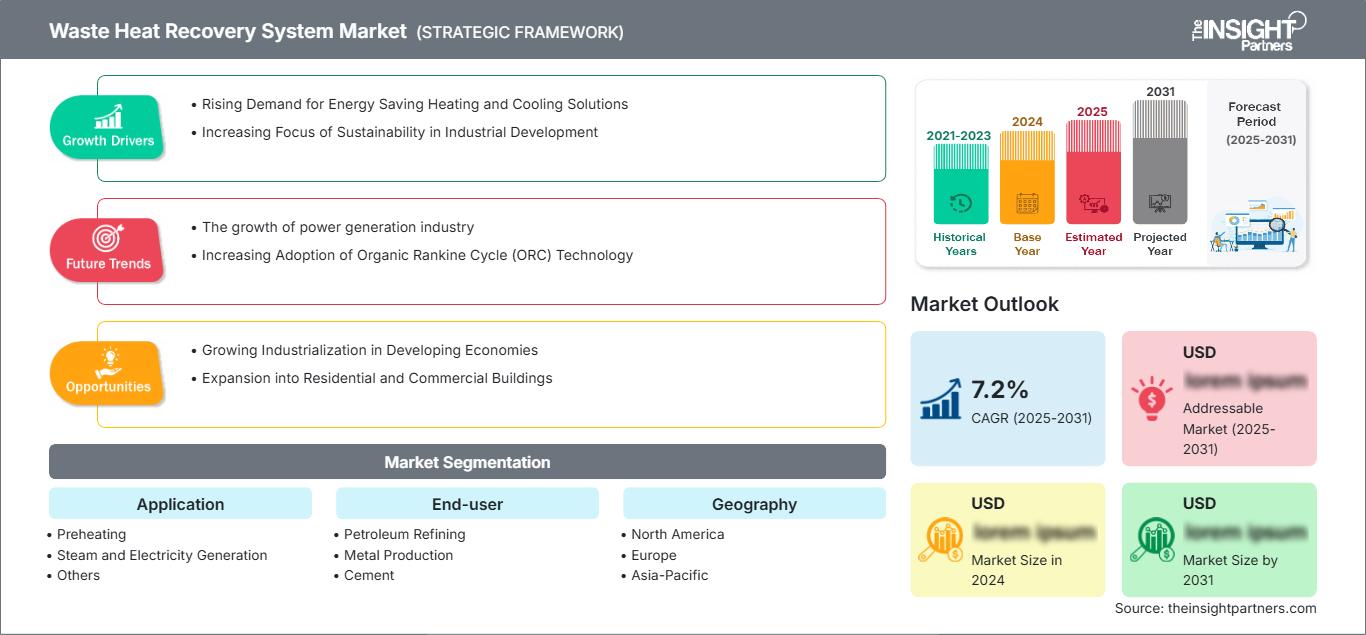
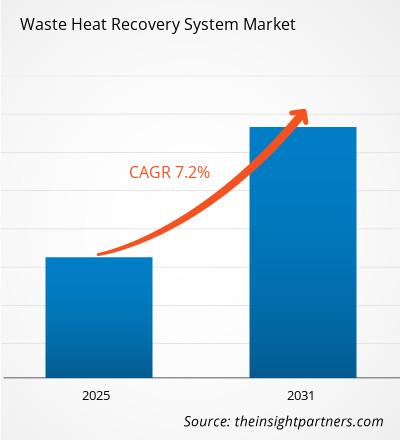
The waste heat recovery system market was valued at US$ 78.33 Billion in 2025 and is projected to reach US$ 127.21 Billion by 2034, registering a CAGR of 5.54% during 2026–2034. Adoption is supported by industrial energy efficiency programs, rising fuel costs, and decarbonization mandates across process industries. Demand is strongest where exhaust gases, kiln heat, turbine discharge, and process steam can be converted into reusable thermal or electrical energy.
North America remains a technically mature demand center, supported by refinery modernization, chemical processing efficiency upgrades, and industrial decarbonization funding. The waste heat recovery system market size in the region is expected to expand steadily as manufacturers prioritize lower operating costs, grid resilience, and compliance-driven energy management. Growth is also reinforced by utilities, cement manufacturers, and food processors investing in steam generation, preheating, and power recovery systems.
Waste Heat Recovery System Market Assessment and Insights
- North America: The region accounted for an estimated 27–30% share in 2025 and is expected to grow at a CAGR of 4.8–5.4% during 2026–2034, driven by refinery efficiency projects, metals processing, and industrial heat reuse.
- US: The US represented nearly 76–80% of North America demand in 2025 and is expected to grow at a CAGR of 4.9–5.5% through 2034.
- Europe: Europe held an estimated 24–27% share in 2025 and is forecast to grow at a CAGR of 5.1–5.7%, led by Germany, the UK, France, Italy, and Spain.
- Asia Pacific: Asia Pacific captured an estimated 34–38% share in 2025 and is projected to grow at a CAGR of 6.0–6.7%, supported by China, India, Japan, and South Korea.
- Largest Segment: Preheating held an estimated 39–43% market share in 2025 and is expected to grow at a CAGR of 5.0–5.6% during 2026–2034.
- High Growth Segment: Steam and electricity generation held a 31–35% share in 2025 and is expected to grow at a CAGR of 5.8–6.5%.
- Key companies analyzed in detail: ABB Ltd, Bosch Limited, Echogen Power Systems LLC, Econotherm (UK) Ltd, General Electric Company, Mitsubishi Heavy Industries Marine Machinery and Equipment Co., Ltd., Ormat Technologies Inc., Siemens AG, Sigma Thermal, Inc., and Thermax Limited.
Source: The Insight Partners' analysis based on proprietary research, government publications, company annual reports, investor presentations, industry databases, and expert interviews.
Heat recovery in industry has shifted from equipment-level conservation to plant-level optimization. Past technologies were concentrated on economizers and recuperators, whereas present-day technologies involve heat exchangers, ORC-based systems, boilers, turbines, controls, and instrumentation. The growth of the industry has been tied to energy intensive equipment in cement, metals, refining, chemical and pulp production industries where high temperature exhaust gases are still economically recoverable.
The waste heat recovery system market report indicates that forward-looking investment is moving toward modular systems, heat-to-power conversion technologies, industrial heat pumps, and hybrid integration with renewable electricity sources. Emerging geographies are prioritizing energy security and cost reduction, while mature markets are increasingly linking system deployment to carbon reduction roadmaps and decarbonization targets. Policy pressure on industrial efficiency is expected to improve project payback confidence and support wider procurement of waste heat recovery solutions through 2034.
Waste Heat Recovery System Market Report Scope
| Report Attribute | Details |
|---|---|
| Market size in 2025 | US$ 78.33 Billion |
| Market Size by 2034 | US$ 127.21 Billion |
| Global CAGR (2026 - 2034) | 5.54% |
| Historical Data | 2021-2024 |
| Forecast period | 2026-2034 |
Waste Heat Recovery System Market Analysis
Demand is governed by three operational imperatives: reduced costs of fuel, increased thermal efficiency, and emissions intensity reduction. Market growth is evident in cement kilns, refinery heaters, steel reheating furnaces, gas turbines, and chemicals manufacturing facilities in which excess heat is recovered for feed water preheating, steam production, or power generation. Energy demand in industrial applications is characterized by an emphasis on thermal intensive industries; hence, heat recovery systems make sense both from a cost-effectiveness and sustainability perspective.
Market supply conditions provide a competitive edge to suppliers with expertise in engineering, process integration skills, and service offerings. Heat recovery installations are usually custom engineered due to variations in temperatures, dust loads, corrosion environment, availability requirements, and physical plant conditions. Therefore, there is demand for technology providers who can provide complete solutions instead of individual equipment.
Market analysis suggests that the competitive environment is dominated by diversified firms in automation, power, boilers, and thermal engineering. Competitors include ABB Ltd, Siemens AG, General Electric Company, Thermax Limited, and Mitsubishi Heavy Industries Marine Machinery and Equipment Co., Ltd. who use integrated energy systems; specialists like Echogen Power Systems LLC, Econotherm (UK) Ltd, Sigma Thermal, Inc., and Ormat Technologies Inc. concentrate on thermal conversion.
Trends in investments imply growing interest in systems that increase plant resilience and measurable energy cost savings. Performance guarantees, assured returns, emissions impact, and diagnostics are the criteria used for evaluation. The firms that have installations at cement plants, refineries, metal facilities, and other heavy industries can benefit from replacement purchases and new installations.
● REPORT CUSTOMIZATION
Tailor This Report To Align With Your Specific Business Requirements
This report can be customized to align precisely with your business objectives, scope, and target markets. Customization options include tailored segmentation, geography, competitive analysis, and strategic insights to support informed decision-making.
Customize This Report →WHAT YOU CAN ADJUST
- ● Segmentations
- ● Geography
- ● Competitive Analysis
- ● Language Preferences
Waste Heat Recovery System Market: Strategic Insights
Regional Insights
North America waste heat recovery system market
North America is expected to maintain a 27–30% waste heat recovery system market share in 2025 and grow at a CAGR of 4.8–5.4% during 2026–2034. Refineries, chemicals plants, pulp mills, food plants, and metal manufactures employ energy recovery systems for reducing fuel contact and better heat integration.
The area is characterized by good automation capabilities, engineering expertise, and the users' interest in making investments in energy saving programs. The replacement market is also growing as a result of modernization of boilers, heaters, and turbines.
U.S. waste heat recovery system Market
The US accounted for an estimated 76–80% of North America demand in 2025 and is expected to grow at a CAGR of 4.9–5.5% through 2034. Improvements, chemicals, cement production, food processing, and distributed industrial power are core areas for domestic usage.
Corporate representation is evident in automation, turbines, boilers, and thermal engineering. American clients value reliability, energy efficiency, and emissions quality, especially in cases where heat recovery enables steam production, electricalization of facilities, and industrial energy management schemes without process interruption.
Europe waste heat recovery system Market
Europe represented an estimated 24–27% share in 2025 and is expected to grow at a CAGR of 5.1–5.7% during 2026–2034. Germany is leading adoption owing to its high density of the process industries, engineering capacity, and efficiency requirements in chemicals, metals, cement, and manufacturing.
In the UK market, there are industrial decarbonization schemes, refinery upgrades, food processing improvements, and district heating opportunities. Companies consider waste heat recovery for steam, power generation, and process heating with low carbon, as well as the cost benefits of carbon.
Demand centers in France, Italy, and Spain include cement, glass, paper, chemicals, and food processing sectors. The electrification, refinery upgrade, and heat recovery from industrial applications are anticipated to drive project activity, albeit delays owing to the capital intensive nature of the projects and their engineering needs.
APAC waste heat recovery system Market
Asia Pacific held an estimated 34–38% share in 2025 and is projected to grow at a CAGR of 6.0–6.7% through 2034. China will continue to be at the forefront of this market owing to the presence of cement, steel, chemicals, and heavy industries that have high recovery potential for heat sources.
India, Japan, South Korea, and Australia contribute to the demand by upgrading their facilities and implementing measures to improve efficiency. The growth of this region is facilitated by increasing capacity additions in energy-intensive industries and growing sensitivity to fuel costs.
Middle East & Africa waste heat recovery system Market
The Middle East and Africa is expected to grow at a CAGR of 5.2–5.9% during 2026–2034, with Saudi Arabia and the UAE leading industrial energy efficiency investments. Heat recovery is feasible due to refining, petrochemicals, cement, and desalination-related infrastructure.
Mining, metals, cement, and heavy industry in South Africa and other MEA countries offer further demand. Selective applications of boilers, pre-heaters, and heat-to-power installations will be facilitated by energy security considerations, grid limitations, and fuel optimization activities.
Segmentation Analysis
Application
Application is expected to grow at a CAGR of 5.3–5.9% during 2026–2034. The market scope across applications includes preheating, steam generation, and electricity production, with adoption determined by exhaust temperature, process continuity, and site energy requirements. Preheating remains widely used because it reduces fuel consumption directly and fits established kiln, furnace, and boiler operations.
- Preheating: Preheating is the largest application because recovered heat can warm combustion air, feedwater, or raw materials, reducing fuel use without changing the core production process.
- Steam and Electricity Generation: Steam and electricity generation is gaining strategic relevance where stable exhaust heat supports boilers, turbines, or organic Rankine cycle systems for internal power and process steam.
End-user
End-user demand is expected to grow at a CAGR of 5.4–6.0% during 2026–2034. Petroleum refining, metal production, cement, chemicals, paper and pulp, and food and beverage facilities remain priority users because they operate continuous heat-intensive processes. Procurement decisions are influenced by payback periods, process compatibility, emission reduction targets, and equipment reliability under harsh operating conditions.
- Petroleum Refining: Refineries use recovery systems around fired heaters, boilers, and exhaust streams to improve thermal efficiency, reduce fuel gas consumption, and support steam balance optimization.
- Metal Production: Steel and non-ferrous metal plants recover heat from furnaces, flue gases, and cooling systems to reduce energy intensity and support lower-emission production pathways.
- Cement: Cement plants apply recovery equipment around preheater towers and clinker coolers, where high-temperature exhaust can support power generation and plant energy cost reduction.
- Chemical: Chemical producers use heat recovery to stabilize process utilities, reduce steam demand, and improve efficiency across reactors, distillation systems, and thermal oxidation units.
- Paper and Pulp: Paper and pulp facilities recover heat from dryers, boilers, and process water streams to improve steam economy and reduce energy costs in continuous operations.
- Food and Beverage: Food and beverage plants apply lower-temperature recovery for hot water, drying, pasteurization support, and boiler feed applications where hygiene and reliability are essential.
Opportunity Snapshot
| End-User | Revenue Contribution | Trend Tag | Adoption Stage |
| Petroleum Refining | High | Fuel Savings | Mature |
| Metal Production | High | Furnace Heat | Scaling |
| Cement | High | Kiln Recovery | Mature |
| Chemical | Medium | Steam Balance | Scaling |
| Paper and Pulp | Medium | Dryer Reuse | Scaling |
| Food and Beverage | Medium | Low Heat | Emerging |
Waste Heat Recovery System Market Growth Drivers and Impact Analysis
Industrial decarbonization and energy efficiency mandates
There is immense pressure on energy-intensive industries to minimize their emissions without affecting production reliability. The waste heat recovery system makes sense since it capitalizes on the use of the thermal energy loss that exists instead of redesigning the whole process. This applies to the cement, steel, refinery, and chemical industry since they have high temperature facilities that generate heat that could be converted to steam, pre-heating of raw materials, and electricity.
Rising fuel costs and operating margin protection
Industrial users have resorted to heat recovery to avoid exposure to volatility in natural gas, coal and cost of electricity bought. This effect is more noticeable at plants that have continuous operation, high load factors, and consistent exhaust streams. With the procurement of energy becoming a strategic concern, heat recovery is now viewed from the perspective of a productivity asset rather than a piece of equipment for compliance.
Growth in high-temperature process industries
The expansion of the use of cement, metal production, refining operations, chemical industries, and food processing industries leads to the creation of more heat that can be recovered. As for new plants, this is an opportunity for them to install the system of recovery from the beginning of their creation; however, existing plants will be able to install retrofits. This leads to the creation of a larger range of preheater, waste heat boiler, Organic Rankine Cycle, heat exchanger, and control systems.
Waste Heat Recovery System Market Future Trends
Integration of heat pumps and low-temperature recovery
Future waste heat recovery system market trends will include greater use of industrial heat pumps to recover lower-temperature heat streams previously considered uneconomic. Food processing, textiles, paper, and chemical applications will be ideal wherever recovery of heat could help in hot water and drying requirements, as well as low-pressure steam requirements. This approach broadens the scope of addressable demand from high-temperature furnaces and kiln applications to modular technologies and electrified process heat.
Digital monitoring for performance-based contracts
Digital control systems, sensors, and analysis tools are anticipated to play an increasingly vital role in the procurement of heat recovery technology. Procuring entities demand assurance that their cost savings remain intact throughout the life cycle of their operations, particularly when fouling, dust, fluctuating loads, and maintenance periods compromise efficiency. Vendors who provide a hardware system coupled with an online monitoring system will be in a better position to offer service-based agreements.
Waste Heat Recovery System Market Opportunities
Retrofit programs in cement and metals plants
Retrofitting cement and metals facilities offers strong waste heat recovery system market forecasts because many plants operate legacy kilns, furnaces, preheaters, and cooling systems with significant thermal losses. The highest potential exists where energy prices, emissions constraints, and power plant utilization rates are sufficiently favorable to warrant engineering spend. The opportunity for value creation lies in delivering on-site evaluations, tailored thermal design, modular machinery, and service throughout the life cycle of the brownfield installation.
Industrial clusters and shared heat networks
Industrial clusters present possibilities for using heat recovered at refineries, chemical plants, data centers, and industrial plants near end-users. Heat recovery systems may be economically viable in cases where there is an excess of heat in one factory and the need for steam or hot water supply in another facility. There are certain prerequisites in terms of infrastructure development and agreements, but such a possibility exists.
Frequently Asked Questions

- Comprehensive Market Sizing and Forecast Analysis
- Detailed Segmentation Analysis
- In-Depth Market Dynamics Assessment
- Regional and Country-Level Insights
- Competitive Landscape and Company Benchmarking
- Strategic Business Intelligence
Recent Reports
Testimonials

The Insight Partners' SCADA System Market report is comprehensive, with valuable insights on current trends and future forecasts. The team was highly professional, responsive, and supportive throughout. We are very satisfied and highly recommend their services.
RAN KEDEM Partner, Reali Technologies LTDs
I requested a report on a very specific software market and the team produced the report in a few days. The information was very relevant and well presented. I then requested some changes and additions to the report. The team was again very responsive and I got the final report in less than a week.
JEAN-HERVE JENN Chairman, Future Analytica
We worked with The Insight Partners for an important market study and forecast. They gave us clear insights into opportunities and risks, which helped shape our plans. Their research was easy to use and based on solid data. It helped us make smart, confident decisions. We highly recommend them.
PIYUSH NAGPAL Sr. Vice President, High Beam Global
The Insight Partners delivered insightful, well-structured market research with strong domain expertise. Their team was professional and responsive throughout. The user-friendly website made accessing industry reports seamless. We highly recommend them for reliable, high-quality research services
YUKIHIKO ADACHI CEO, Deep Blue, LLC.
This is the first time I have purchased a market report from The Insight Partners.While I was unsure at first, I visited their web site and felt more comfortable to take the risk and purchase a market report.I am completely satisfied with the quality of the report and customer service. I had several questions and comments with the initial report, but after a couple of dialogs over email with their analyst I believe I have a report that I can use as input to our strategic planning process.Thank you so much for taking the extra time and making this a positive experience.I will definitely recommend your service to others and you will be my first call when we need further market data.
JOHN SUZUKI President and Chief Executive Officer, Board Director, BK Technologies
I wish to appreciate your support and the professionalism you displayed in the course of attending to my request for information regarding to infectious disease IVD market in Nigeria. I appreciate your patience, your guidance, and the fact that you were willing to offer a discount, which eventually made it possible for us to close a deal. I look forward to engaging The Insight Partners in the future, all thanks to the impression you have created in me as a result of this first encounter.
DR CHIJIOKE ONYIA MANAGING DIRECTOR, PineCrest Healthcare Ltd.Reason to Buy
- Informed Decision-Making
- Understanding Market Dynamics
- Competitive Analysis
- Identifying Emerging Markets
- Customer Insights
- Market Forecasts
- Risk Mitigation
- Boosting Operational Efficiency
- Strategic Planning
- Investment Justification
- Tracking Industry Innovations
- Aligning with Regulatory Trends





 Get Free Sample for