
Water Treatment Aerators Market Size, Share & Growth by 2034
Coverage: by Type (Submersible Aerators, Surface Aerators); End-user (Municipal, Industrial, Aquaculture) , and Geography (North America, Europe, Asia Pacific, and South and Central America)
- Status : Data Released
- Report Code : TIPRE00010642
- Category : Manufacturing and Construction
- No. of Pages : 150
- Available Report Formats :


- Last update date : September 28, 2026


2025 Market Size
US$ 1.35 Bn
Base year value
2034 Forecast
US$ 2.14 Bn
Projected by 2034
CAGR 2026-2034
5.21 %
Growth rate
Addressable Market
US$ 15.80 Bn
(2026-2034)
The water treatment aerators market is valued at US$ 1.35 Billion in 2025 and is projected to reach US$ 2.14 Billion by 2034, expanding at a CAGR of 5.21% during 2026–2034. The market encompasses mechanical equipment used to introduce oxygen, enhance biological treatment, and maintain mixing conditions across wastewater and aquaculture systems. Demand is increasingly linked to treatment capacity expansion, stricter discharge requirements, energy optimization, and modernization of aging municipal and industrial infrastructure.
North America is expected to register an estimated CAGR of 4.7–5.3% during 2026–2034, supported by wastewater infrastructure replacement, nutrient-removal requirements, and increasing emphasis on energy-efficient biological treatment. The regional water treatment aerators market size is also supported by municipal upgrades, industrial water reuse projects, and greater adoption of automated dissolved-oxygen control across treatment facilities.
Water Treatment Aerators Market Assessment and Insights
- North America: North America is estimated to account for 31–35% share in 2025 and is projected to grow at a CAGR of 4.7–5.3% between 2026–2034, supported by municipal rehabilitation and industrial treatment modernization.
- US: The US represents approximately 82–86% of North America's 2025 market and is expected to grow at a CAGR of 4.8–5.4% during 2026–2034, driven by infrastructure renewal and nutrient-control investments.
- Europe: Europe is estimated to hold 27–31% share in 2025 and expand at a CAGR of 4.9–5.5% through 2034, with Germany, the UK, France, Italy, and Spain supported by tighter wastewater standards and energy-efficiency objectives.
- Asia Pacific: Asia Pacific is estimated at 25–29% share in 2025 and is projected to grow at a CAGR of 6.0–6.7% during 2026–2034, led by China, India, Japan, South Korea, and Australia as treatment capacity expands.
- Largest Segment: Surface Aerators are estimated to represent 58–62% market share in 2025, with a CAGR of 4.8–5.4% through 2034, reflecting established municipal and lagoon applications.
- High Growth Segment: Aquaculture is estimated to represent 18–22% share in 2025 and expand at a CAGR of 6.5–7.2%, supported by intensification and oxygen-management requirements.
- Key companies analyzed in detail: Aeration Industries International, LLC; Aqua-Aerobic Systems, Inc.; Fluence Corporation Limited; Otterbine Barebo, Inc.; Philadelphia Mixing Solutions, Ltd.; Rain Bird Corporation; SUEZ; Sulzer Ltd; VaraCorp, LLC; Xylem Inc.
Source: The Insight Partners' analysis based on proprietary research, government publications, company annual reports, investor presentations, industry databases, and expert interviews.
The water treatment aerators market has evolved from mechanically simple oxygen-transfer equipment toward integrated systems combining aeration, hydraulic mixing, controls, and process monitoring. However, surface aerators are still valued for their durability and capacity to both mix and transfer oxygen; submersible models, on the other hand, are progressively favored due to footprint limitations, retrofitting needs, and varying operational parameters. Equipment is selected today based on oxygen-transfer efficiency, tank design, solids suspension, accessibility for maintenance, motor efficiency, and compatibility with process control rather than just oxygen transfer.
Future trends include capital spending on retrofittable equipment, digitally controlled aeration and systems that can maintain biological performance despite changing hydraulic loading and pollutants. Upcoming market areas in South and Southeast Asia, the Middle East, and Latin America are attractive due to growth in municipal wastewater collection and treatment infrastructure. Regulatory pressure around nutrient discharge and water reuse is strengthening the business case for efficient aeration, while electricity costs encourage utilities to prioritize equipment that can operate across broader load ranges, according to the Water Treatment Aerators Market report.
Water Treatment Aerators Market Report Scope
| Report Attribute | Details |
|---|---|
| Market size in 2025 | US$ 1.35 Billion |
| Market Size by 2034 | US$ 2.14 Billion |
| Global CAGR (2026 - 2034) | 5.21% |
| Historical Data | 2021-2024 |
| Forecast period | 2026-2034 |
Water Treatment Aerators Market Analysis
Demand is highly associated with biological wastewater treatment since adequate oxygen and mixing are important for microbial breakdown of organics and nutrients. The municipal utilities represent an important buying power since the aerators are used in activated sludge, lagoon, oxidation ponds, and similar processes. Additional demand comes from the industrial users due to their special requirements for the wastewater characteristics that necessitate a customized oxygen transfer and mixing solution.
The value chain consists of equipment manufacturers, motor suppliers, controls, system integration, engineering contractors, utilities, industrial users, and aquaculture producers. Supply side depends on the price of stainless steel and other engineering materials, motor supply, electric parts, and fabrication specifics. Equipment suppliers increasingly compete through lifecycle performance rather than initial price, with installation support, controls integration, service contracts, and retrofit capability becoming important procurement criteria, as outlined in the Water Treatment Aerators Market forecast.
The competition within the industry is divided between global players of water technologies and companies producing aeration systems. Xylem Inc. offers solutions that incorporate the technologies of aeration with pumps, biological processes, control, and servicing; at the same time, SUEZ offers solutions for optimization of aeration processes together with general optimization of plant performance. Aqua-Aerobic Systems, Inc. is strong in surface aeration and biological processes, whereas Aeration Industries International, LLC and Otterbine Barebo, Inc. specialize in mechanical aeration.
The positioning of the companies is becoming more and more based on the energy performance, the engineering of the specific applications, and the integration of aerators into the automated treatment process. Philadelphia Mixing Solutions, Ltd., Sulzer Ltd, VaraCorp, LLC, and Rain Bird Corporation offer specific mixing, pumping, aeration, or water management services for various customers. The investments tend to go to efficient motors, variable speed, better hydraulic design, remote control, and modularity.
● REPORT CUSTOMIZATION
Tailor This Report To Align With Your Specific Business Requirements
This report can be customized to align precisely with your business objectives, scope, and target markets. Customization options include tailored segmentation, geography, competitive analysis, and strategic insights to support informed decision-making.
Customize This Report →WHAT YOU CAN ADJUST
- ● Segmentations
- ● Geography
- ● Competitive Analysis
- ● Language Preferences
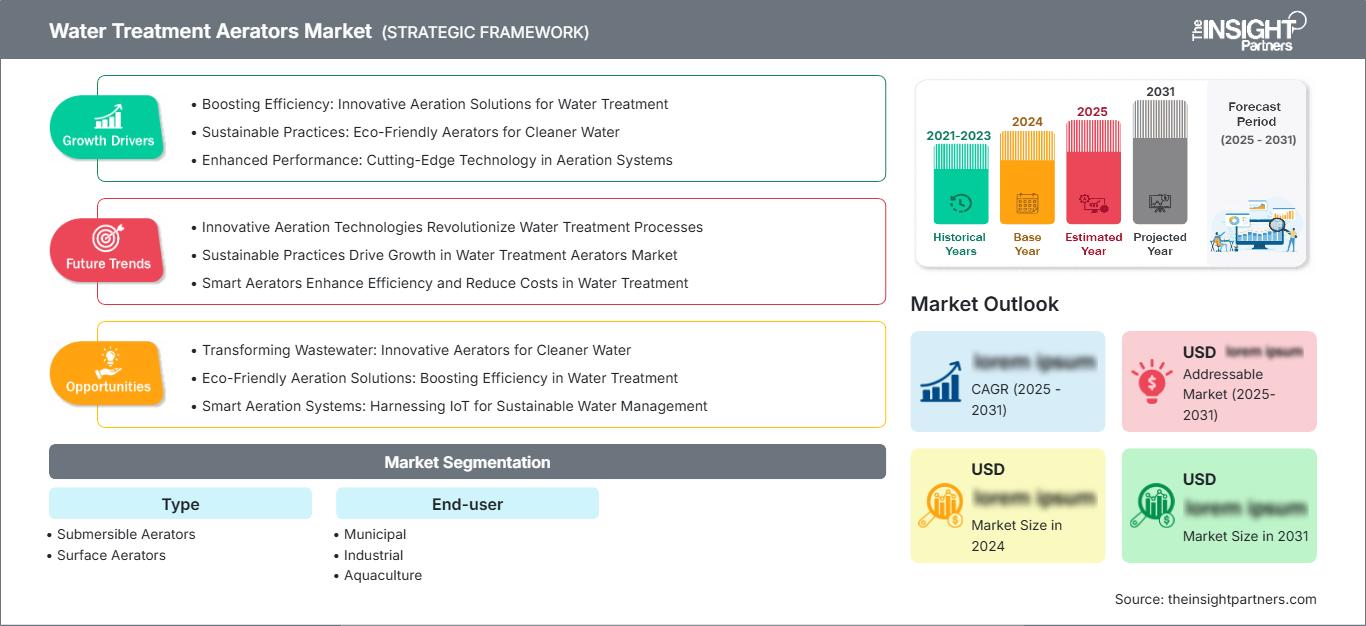
Water Treatment Aerators Market: Strategic Insights
Regional Insights
North America water treatment aerators market
North America is estimated to hold 31–35% of global water treatment aerators market share in 2025, with a projected CAGR of 4.7–5.3% through 2034. This market is served by older aeration assets, more stringent nutrient standards, water recycling by industries, and municipal initiatives aimed at decreasing the intensity of energy usage. New installation projects typically involve aeration technologies which are able to be incorporated into the existing basin system as well as power infrastructure.
The major part of the regional demand belongs to the US, although Canada also plays a role due to municipal investments and industrial water management facilities. Now utilities often consider the options of using aeration together with dissolved oxygen probes, variable speed drives, and process control systems. It is especially valuable in cases when an increase in efficiency or capacity is required without the construction of new basins.
U.S. water treatment aerators Market
The US represents approximately 82–86% of North America's 2025 water treatment aerators market and is expected to expand at a CAGR of 4.8–5.4% during 2026–2034. Federal and state wastewater requirements, aging municipal assets, industrial expansion, and water reuse initiatives support equipment replacement and capacity upgrades. Large utilities increasingly prioritize lifecycle energy costs when evaluating aeration projects.
Xylem Inc., Aqua-Aerobic Systems, Inc., SUEZ, Aeration Industries International, LLC, and other suppliers maintain application and service capabilities across the country. Demand spans activated-sludge facilities, lagoons, industrial treatment systems, and decentralized installations. Automated oxygen control and equipment designed for easier maintenance are gaining attention because operators must manage labor constraints while maintaining discharge compliance and process stability.
Europe water treatment aerators Market
Europe is estimated to represent 27–31% share of the water treatment aerators market in 2025 and is projected to grow at a CAGR of 4.9–5.5% through 2034. Germany leads regional demand, followed by the UK, France, Italy, and Spain, where wastewater modernization and energy management are increasingly connected with environmental policy.
The UK is emphasizing efficiency and resilience across aging wastewater assets, creating opportunities for aeration retrofits and control upgrades. Germany benefits from established wastewater infrastructure and advanced nutrient-removal practices. France is supported by municipal modernization and reuse initiatives, while Italy and Spain are investing in treatment capacity and water-efficiency measures in response to regional water stress.
APAC water treatment aerators Market
APAC is estimated to account for 25–29% of the water treatment aerators market share in 2025 and is expected to grow at a CAGR of 6.0–6.7% through 2034. China leads regional demand, followed by Japan, South Korea, India, and Australia. Industrialization, urban expansion, wastewater reuse, and environmental policy strengthen investment requirements.
China and India provide the largest expansion opportunities because municipal and industrial treatment capacity continues to increase. Japan and South Korea emphasize advanced and energy-efficient treatment, while Australia combines wastewater management with water-scarcity planning. Industrial clusters and aquaculture production also support demand for compact, reliable aeration systems.
Middle East & Africa water treatment aerators Market
The Middle East & Africa water treatment aerators market is expected to expand at a CAGR of 5.2–5.9% during 2026–2034, with Saudi Arabia leading regional opportunities, followed by the UAE and South Africa. Water scarcity, wastewater reuse, urban infrastructure development, and industrial diversification are supporting treatment investment.
Saudi Arabia and the UAE are emphasizing water reuse and advanced treatment as part of broader resource-efficiency strategies. South Africa requires reliable municipal and industrial treatment infrastructure, while the rest of MEA presents opportunities through new urban developments, mining, food production, and decentralized systems. Energy efficiency remains important because aeration can represent a major operating cost.
Segmentation Analysis
Type
Type segmentation reflects different oxygen-transfer and mixing requirements across treatment basins. Submersible Aerators are suited to installations requiring submerged oxygen transfer, compact configurations, and retrofit flexibility, while Surface Aerators remain widely deployed where hydraulic mixing, accessibility, and proven mechanical operation are priorities. The segment is expected to expand at a CAGR of 5.0–5.6% during 2026–2034 as operators balance efficiency, maintenance, and capital constraints, reflecting key Water Treatment Aerators Market trends.
- Submersible Aerators: These systems support applications requiring localized oxygen transfer and mixing, particularly where basin configuration, depth, or retrofit limitations make conventional surface equipment less practical for operators.
- Surface Aerators: Surface equipment remains strategically important for municipal lagoons, oxidation basins, and industrial wastewater systems because it combines oxygen transfer and mixing with accessible installation and maintenance.
End-user
End-user demand varies according to treatment objectives, flow characteristics, regulatory requirements, and operating economics. Municipal installations provide a large recurring base because wastewater collection systems require continuous biological treatment. Industrial customers demand application-specific solutions for variable wastewater composition, while Aquaculture users prioritize dissolved-oxygen management and reliable mixing. The segment is projected to grow at a CAGR of 5.3–5.9% from 2026–2034.
- Municipal: Municipal operators prioritize reliable treatment, regulatory compliance, energy management, and retrofit compatibility, creating steady demand for aerators integrated with biological treatment and plant-control systems.
- Industrial: Industrial users require equipment matched to wastewater chemistry, solids loading, temperature, and production cycles, making application engineering and operating flexibility important purchasing considerations.
- Aquaculture: Aquaculture operators require dependable oxygen availability and circulation to maintain stock health and production density, encouraging adoption of efficient aeration across ponds and intensive recirculating systems.
Opportunity Snapshot
| End-user | Revenue Contribution (High/Medium/Low) | Trend Tag (MAX 2 words) | Adoption Stage (Emerging/Scaling/Mature) |
| Municipal | High | Nutrient Control | Mature |
| Industrial | High | Water Reuse | Scaling |
| Aquaculture | Medium | Oxygen Management | Scaling |
Water Treatment Aerators Market Growth Drivers and Impact Analysis
Rising Energy Optimization Requirements
Electricity is a significant cost associated with biological wastewater treatment, so oxygen transfer efficiency becomes a financial issue. Purchasing decisions for aeration systems take into account oxygen transfer efficiency, motor efficiency, variable speed control and adaptability to fluctuations in biological oxygen demand. SUEZ notes that aeration can account for a significant part of the electricity consumption in wastewater facilities, and their digital solutions show how process control can help to decrease aeration without decreasing the treatment. Thus, purchasing becomes more than buying equipment alone – it becomes a performance solution purchase. Vendors who integrate mechanical aeration with sensors and process control can benefit from such high-value projects, especially in mature municipal facilities.
Stricter Nutrient and Effluent Quality Requirements
More stringent criteria on nitrogen, phosphorus, organic contaminants, and water re-use are placing greater demands on the technology behind biological treatment. The machinery used for aeration needs to be able to provide stable dissolved oxygen levels while facilitating microbial activity amid variable loading conditions. This is likely to favor technology that can deliver oxygen efficiently, suspend solids effectively, and run across aerobic and anoxic phases of treatment. The European trend in terms of regulation will have particular relevance due to the need to enhance treatment effectiveness and improve the energy balance of the facility. There are similar needs developing in North America and the Asia Pacific. For manufacturers, the complexity of regulation represents an opportunity to compete using process and application knowledge rather than just price.
Expansion of Wastewater Reuse and Decentralized Treatment
Water shortages and industrial water security considerations are driving treatment nearer to the point of consumption. Treatment for reuse purposes demands a consistent biological process since the variation in the effluent quality may affect further steps of the process, such as filtration, disinfection, or membranes. Modular aeration-based technologies may help in decentralized treatment, as space constraints, schedule issues, or gradual capacity increases limit conventional plant expansion. Wastewater treatment plants are becoming more common among industrial companies as a means to allow water recycling back into the industrial process. This trend of circular industrial water treatment was noted by Fluence and includes modular systems based on MABR (membrane aerated biofilm reactor) technology. The market effect is in a wider customer base, including industrial facilities, remote locations, resorts and aquaculture companies.
Water Treatment Aerators Market Future Trends
AI-Enabled Aeration Process Optimization
As we continue into the next stages of aeration advancement, the relationship between mechanical equipment and continuous process intelligence is going to become more integrated. There could be sensors monitoring dissolved oxygen levels, ammonia, oxidation-reduction potential, flow rate, and other indicators, whose information could be sent to a control platform where the aeration could be adjusted based on the biological requirements in real-time. Instead of running equipment on conservative fixed rates, we would be able to match the oxygen supply to the demand in the process. This technology would enable us not only to save on energy but also to keep the quality of effluent water intact in case of changing hydraulic and organic load.
Hybrid Aeration for Variable Treatment Conditions
Future treatment facilities are likely to combine surface, submerged, diffused, and process-specific oxygenation technologies according to basin geometry and treatment requirements. Hybrid configurations can provide high oxygen-transfer efficiency during peak biological demand while preserving mixing performance during low-load periods. Such flexibility is particularly relevant for municipal facilities facing seasonal flows and industrial plants exposed to variable production schedules. Aquaculture may also benefit from combining surface circulation with deeper oxygenation where stratification limits oxygen distribution. Equipment design will increasingly emphasize turndown capability, modular motor configurations, corrosion resistance, and simplified maintenance. Suppliers that can engineer complete aeration packages rather than individual units will be better positioned to address complex projects. This trend supports higher-value systems engineering and lifecycle service opportunities.
Water Treatment Aerators Market Opportunities
Retrofit Programs for Aging Treatment Assets
A substantial opportunity exists in upgrading existing treatment basins without major civil reconstruction. Many utilities operate equipment installed decades ago, creating opportunities to replace inefficient motors, improve hydraulic performance, introduce variable-speed controls, and integrate modern monitoring. Retrofit projects can be attractive because they preserve existing tanks while improving operating economics and treatment reliability. Suppliers can develop standardized upgrade packages that include aerators, drives, control panels, sensors, installation support, and commissioning. Engineering firms and utilities can also use phased replacement strategies to minimize plant downtime. The commercial opportunity extends beyond equipment sales because service contracts, condition assessments, spare parts, and performance optimization create recurring revenue. Vendors with broad installed bases have an advantage because existing relationships can accelerate modernization decisions.
Industrial and Aquaculture Water-Circularity Projects
Industrial water reuse and intensive aquaculture create opportunities for specialized aeration solutions designed around closed-loop water management. Food processing, manufacturing, chemicals, and other industries increasingly seek to reduce freshwater withdrawals and wastewater discharge by treating water near production sites. Aeration can become an enabling component where biological treatment precedes filtration, disinfection, or membrane processes. Aquaculture producers similarly require reliable oxygenation as stocking densities increase and water circulation becomes more controlled. Suppliers can target these applications with modular systems, remote monitoring, redundancy, and service agreements tailored to operating continuity. Partnerships with engineering contractors, aquaculture-system integrators, and industrial water specialists could expand distribution without requiring large direct sales organizations. The strongest opportunities will combine process performance with measurable water and energy outcomes.
Frequently Asked Questions

- Comprehensive Market Sizing and Forecast Analysis
- Detailed Segmentation Analysis
- In-Depth Market Dynamics Assessment
- Regional and Country-Level Insights
- Competitive Landscape and Company Benchmarking
- Strategic Business Intelligence
Recent Reports
Testimonials

The Insight Partners provided valuable market intelligence that supported our global go-to-market strategy. Their team was professional, responsive, and attentive to our feedback, providing thoughtful analysis and helpful methodological clarifications throughout the project.
Junmo Kim Chief Financial Officer (CFO), Enertech Co., Ltd.
The Insight Partners' SCADA System Market report is comprehensive, with valuable insights on current trends and future forecasts. The team was highly professional, responsive, and supportive throughout. We are very satisfied and highly recommend their services.
RAN KEDEM Partner, Reali Technologies LTDs
I requested a report on a very specific software market and the team produced the report in a few days. The information was very relevant and well presented. I then requested some changes and additions to the report. The team was again very responsive and I got the final report in less than a week.
JEAN-HERVE JENN Chairman, Future Analytica
We worked with The Insight Partners for an important market study and forecast. They gave us clear insights into opportunities and risks, which helped shape our plans. Their research was easy to use and based on solid data. It helped us make smart, confident decisions. We highly recommend them.
PIYUSH NAGPAL Sr. Vice President, High Beam Global
The Insight Partners delivered insightful, well-structured market research with strong domain expertise. Their team was professional and responsive throughout. The user-friendly website made accessing industry reports seamless. We highly recommend them for reliable, high-quality research services
YUKIHIKO ADACHI CEO, Deep Blue, LLC.
This is the first time I have purchased a market report from The Insight Partners.While I was unsure at first, I visited their web site and felt more comfortable to take the risk and purchase a market report.I am completely satisfied with the quality of the report and customer service. I had several questions and comments with the initial report, but after a couple of dialogs over email with their analyst I believe I have a report that I can use as input to our strategic planning process.Thank you so much for taking the extra time and making this a positive experience.I will definitely recommend your service to others and you will be my first call when we need further market data.
JOHN SUZUKI President and Chief Executive Officer, Board Director, BK Technologies
I wish to appreciate your support and the professionalism you displayed in the course of attending to my request for information regarding to infectious disease IVD market in Nigeria. I appreciate your patience, your guidance, and the fact that you were willing to offer a discount, which eventually made it possible for us to close a deal. I look forward to engaging The Insight Partners in the future, all thanks to the impression you have created in me as a result of this first encounter.
DR CHIJIOKE ONYIA MANAGING DIRECTOR, PineCrest Healthcare Ltd.Reason to Buy
- Informed Decision-Making
- Understanding Market Dynamics
- Competitive Analysis
- Identifying Emerging Markets
- Customer Insights
- Market Forecasts
- Risk Mitigation
- Boosting Operational Efficiency
- Strategic Planning
- Investment Justification
- Tracking Industry Innovations
- Aligning with Regulatory Trends





 Get Free Sample for