
Welding Machines Market Size, Growth & Demand by 2034
Coverage: By Type (Arc Welding, Resistance Welding, Laser Welding, Others); Process (Automatic, Semi-Automatic, Manual); End-user (Aerospace, Automotive, Construction, Marine, Others) , and Geography (North America, Europe, Asia Pacific, and South and Central America)
- Status : Data Released
- Report Code : TIPRE00007276
- Category : Manufacturing and Construction
- No. of Pages : 150
- Available Report Formats :


- Last update date : September 28, 2026


2025 Market Size
US$ 20.51 Bn
Base year value
2034 Forecast
US$ 28.82 Bn
Projected by 2034
CAGR 2026-2034
3.85 %
Growth rate
Addressable Market
US$ 224.03 Bn
(2026-2034)
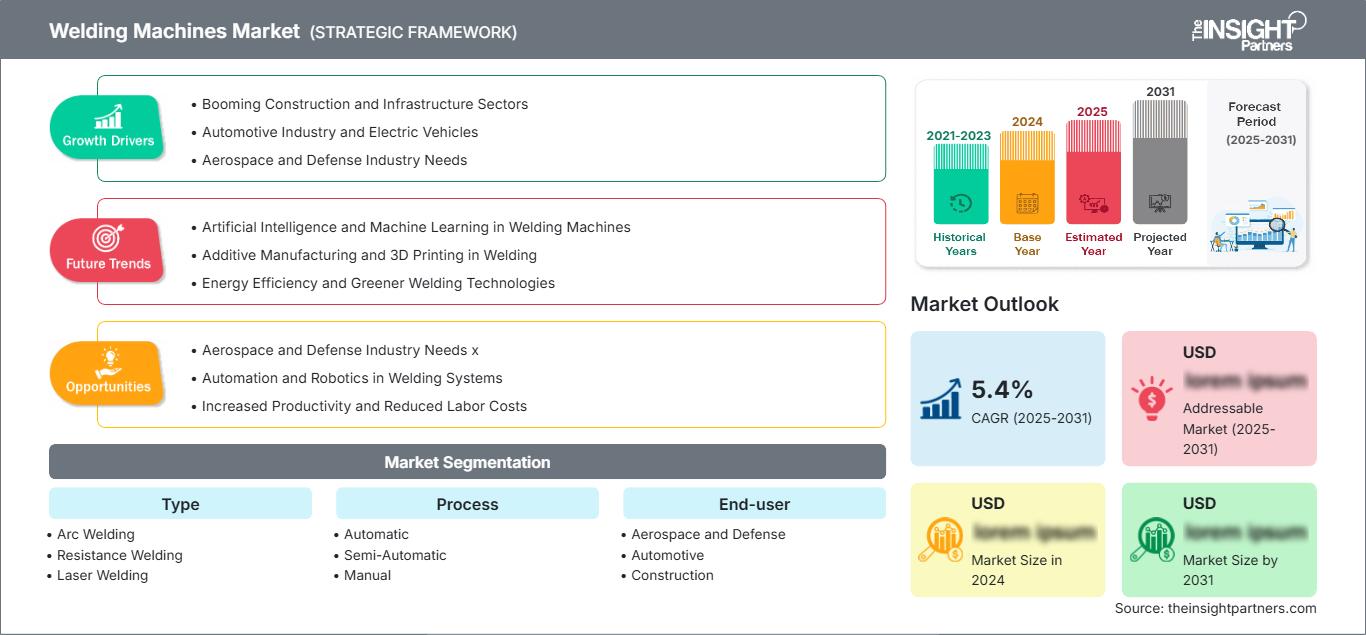
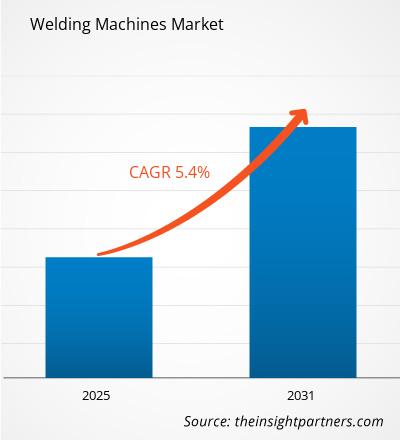
The global Welding Machines market was valued at US$ 20.51 billion in 2025 and is expected to reach US$ 28.82 billion by 2034; it is estimated to record a CAGR of 3.85% during 2026-2034.
Welding Machines Market Assessment and Insights
- North America: North America is expected to hold a 25–29% share in 2025 and expand at a 3.8–4.6% CAGR during 2026–2034, supported by industrial modernization, infrastructure spending, automotive investment, aerospace manufacturing, and replacement demand.
- US: The US is expected to represent 78–83% of North American revenue in 2025 and grow at a 3.9–4.7% CAGR during 2026–2034, led by automotive, aerospace, defense, construction, and energy applications.
- Europe: Europe is projected to account for 22–26% share in 2025 and register a 3.5–4.3% CAGR during 2026–2034. Germany, Italy, France, the UK, and Spain remain important manufacturing and fabrication centers.
- Asia Pacific: Asia Pacific is estimated to capture 35–39% share in 2025 and expand at a 5.0–5.8% CAGR during 2026–2034, with China, Japan, South Korea, and India driving industrial and infrastructure demand.
- Largest Segment: Arc welding is estimated to hold a 48–54% market share in 2025 and expand at a 3.8–4.5% CAGR during 2026–2034 because of broad industrial applicability and mature consumable ecosystems.
- High Growth Segment: Laser welding is estimated at a 7–11% market share in 2025 and is expected to grow at a 7.0–8.2% CAGR during 2026–2034 as precision joining expands.
- Key companies analyzed in detail: ACRO Automation Systems, Inc.; AMADA WELD TECH; Banner Welder, Inc.; Carl Cloos Schweisstechnik GmbH; Cruxweld Industrial Equipment Pvt. Ltd.; Fronius International GmbH; ESAB; OTC DAIHEN Inc.; The Lincoln Electric Company; Kemppi Oy; Miller Electric Mfg. LLC; Panasonic Industry Co., Ltd.; Illinois Tool Works Inc.
Source: The Insight Partners' analysis based on proprietary research, government publications, company annual reports, investor presentations, industry databases, and expert interviews.
The welding machines market has evolved from conventional transformer-based systems toward inverterized, electronically controlled, digitally monitored, and increasingly automated platforms. Equipment manufacturers are integrating process libraries, programmable parameters, remote diagnostics, arc sensing, data capture, and robotic interfaces. Production economics are also changing as fabricators seek higher duty cycles, lower rework, better energy utilization, and repeatable quality. These shifts are particularly important where throughput and traceability influence purchasing decisions.
Over the forecast period, investment is likely to concentrate on flexible automation, compact robotic cells, laser systems, and digitally connected equipment. The Welding Machines Market report indicates that emerging manufacturing clusters in Asia Pacific and selected Middle Eastern economies should create incremental demand, while mature markets prioritize modernization and replacement. Occupational safety requirements, energy efficiency objectives, and tighter production-quality controls are reinforcing the business case for equipment that combines welding performance with monitoring, documentation, and ergonomic improvements.
Welding Machines Market Report Scope
| Report Attribute | Details |
|---|---|
| Market size in 2025 | US$ 20.51 Billion |
| Market Size by 2034 | US$ 28.82 Billion |
| Global CAGR (2026 - 2034) | 3.85% |
| Historical Data | 2021-2024 |
| Forecast period | 2026-2034 |
Welding Machines Market Analysis
The demand for welding machines is highly related to the fabrication of metals, the production of vehicles, construction, shipbuilding, heavy machinery, and maintenance in industry. The growth in the market is driven by both replacements and additions of new capacities. The value chain involves power source providers, torch and feeder suppliers, automation providers, consumable providers, distributors, services and end users. Selection of equipment will depend on the material thickness, joint configuration, volume of production, precision, portability, and certification issues.
The supply conditions are shifting towards suppliers that have the capability of combining their hardware with application engineering and software. Arc machines are more available in the traditional distribution channels, while laser and automated machines require more integration and qualifications. This means that fabricators will take into account the total cost of ownership, service availability, spare parts, training, process qualification, and compatibility with existing production systems.
The competitive positioning in the welding machines industry is changing towards integrated systems as opposed to stand-alone power sources. For instance, Lincoln Electric is comprised of welding equipment, automation systems, consumables and application engineering. Fronius International GmbH places importance on digitally supported welding and automation processes. ESAB has continued with the strategy of connected equipment and robotics, while Carl Cloos Schweisstechnik GmbH has maintained an automation focus. AMADA WELD TECH and OTC DAIHEN Inc. serve the precise and automated joining needs of specialized applications.
Strategies for investment involve increasing emphasis on modular automation systems and software-supported productivity. Competition between firms like Miller Electric Mfg. LLC, Kemppi Oy, Panasonic Industry Co., Ltd. and Illinois Tool Works Inc. involve a broad equipment offering, application engineering and distribution capability. Small firms like ACRO Automation Systems, Inc., Banner Welder, Inc. and Cruxweld Industrial Equipment Pvt. Ltd. will compete in the area of customized systems and regional applications.
● REPORT CUSTOMIZATION
Tailor This Report To Align With Your Specific Business Requirements
This report can be customized to align precisely with your business objectives, scope, and target markets. Customization options include tailored segmentation, geography, competitive analysis, and strategic insights to support informed decision-making.
Customize This Report →WHAT YOU CAN ADJUST
- ● Segmentations
- ● Geography
- ● Competitive Analysis
- ● Language Preferences
Welding Machines Market: Strategic Insights
Regional Insights
North America Welding Machines Market
North America is expected to maintain a 25–29% share of the welding machines market in 2025 and grow at a 3.8–4.6% CAGR through 2034. Demand is driven by industrial replacement, transportation manufacturing, aerospace projects, construction, energy infrastructure, and defense fabrication. There is a trend among manufacturers to substitute their existing power sources for new inverter-driven machinery and automation, which enhances process consistency and reduces the need for operator input. Reshoring and expanding domestic capacity also drive investments in new fabrication lines.
There are advantages in the regional network in terms of existing distributors, maintenance providers, automation firms, and welding training schools. Issues relating to safety regulations and personnel drive the use of ergonomics, fume control, automated welding, and programmable controls. Canadian contributions are energy-related, transportation projects, and heavy fabrication. Mexican markets include automotive industry projects and industrial manufacturing expansion. Together, these markets form a well-rounded demand mix where replacements go hand-in-hand with new capacity and automation improvements.
U.S. Welding Machines Market
The U.S. is expected to account for 78–83% of North American welding machines market revenue in 2025 and expand at a 3.9–4.7% CAGR through 2034. Automotive assembly facilities, aerospace component manufacturing facilities, defense contractors, infrastructure development initiatives, energy sector projects, and general-purpose fabricators make up the diverse demand base. Equipment acquisitions are increasingly biased toward digitally-controlled devices, robotics work cells, automated pipe handling systems, and solutions that provide repeatability and documentability.
A significant advantage of the market is the extensive installed base that needs replacement and maintenance services. Some of the manufacturers that have application exposure include Lincoln Electric Company, Miller Electric Mfg. LLC, ESAB, AMADA WELD TECH, and others. Automatic joining operations are increasing where volumes of production necessitate capital equipment investment, but manual and semi-automatic systems still have a vital place in maintenance, field fabrication, construction, and job shops.
Europe Welding Machines Market
Europe is estimated to represent 22–26% of the welding machines market in 2025 and grow at a 3.5–4.3% CAGR through 2034. Germany still leads due to its machinery, automotive, industrial equipment, and engineering sectors. UK, France, Italy, and Spain offer additional demand due to aerospace, transportation, construction, marine, and general fabrication. Europe is putting more importance on energy efficiency, process traceability, workplace safety, and automatic quality control systems.
Germany is even more critical when it comes to advanced automation and precision fabrication. France is taking advantage of aerospace, defense, rail, and energy applications, while Italy and Spain have strong machinery, construction, automotive, and marine fabrication sectors. The UK is providing demand for aerospace, infrastructure, energy, and specialty engineering. In the region, there is an increasing demand for robot welding, laser joining, process digitization, and production cells.
APAC Welding Machines Market
Asia Pacific is estimated to hold a 35–39% of the Welding Machines Market share in 2025 and expand at a 5.0–5.8% CAGR. China continues to be the dominant player, backed up by manufacturing and construction activities. Japan and South Korea provide sophisticated automotive, electronic, shipbuilding, and robotics technologies, while India provides opportunities in fabricating, construction, transport, and capital goods manufacturing. Australia creates demand through mining, infrastructure, energy, and maintenance activities.
Purchasing in the region varies from low-cost manual equipment to robotic and laser systems. Industrial policies that encourage local manufacturing, infrastructure, and plant upgrading are creating a strong opportunity base. The need for automation systems is important wherever high throughput and quality is required. Incremental opportunities exist in India and Southeast Asia for expansion with development in fabrication capacity. Mature Japanese and Korean markets are more interested in accuracy, connectivity, and efficiency.
Middle East & Africa Welding Machines Market
The Middle East and Africa market is expected to expand at a 3.2–4.1% CAGR through 2034. The two countries that have high importance as demand drivers due to the development of industrial diversification, construction, infrastructure projects, energy, and fabrication include Saudi Arabia and the UAE. South Africa has demand drivers in mining, industrial maintenance, transport, and construction projects. Equipment demand is normally project-driven, offering an opportunity to have strong equipment for tough operating conditions.
Saudi Arabia will continue to dominate in the region due to the development of investment in industry and infrastructure beyond the energy-related activities. The UAE enjoys the benefits of construction, logistics, marine and fabrication projects, whereas South Africa has demand drivers in the form of mining and industrial projects. The rest of the MEA has its demand drivers from oil and gas maintenance, power projects, water infrastructure, and construction projects.
Segmentation Analysis
Type
Type remains a fundamental purchasing dimension because joining technology determines process capability, productivity, material compatibility, and capital intensity. Arc welding retains broad adoption because equipment is versatile and economical, while resistance welding serves high-volume joining. Laser and plasma systems address precision or specialized applications. According to the Welding Machines Market forecast, the segment is expected to grow at a 3.9–4.6% CAGR during 2026–2034 as users balance proven processes with advanced joining requirements.
- Arc Welding: Arc welding remains central to fabrication because it supports diverse metals, thicknesses, field operations, repair work, construction, and industrial production with comparatively accessible equipment and established operator expertise.
- Resistance Welding: Resistance welding is strategically important in high-volume manufacturing, particularly vehicle production, where repeatability, cycle speed, automation compatibility, and controlled heat input support efficient joining of sheet-metal assemblies.
- Laser Welding: Laser welding addresses applications requiring narrow heat-affected zones, precision, speed, and controlled distortion. Its relevance is increasing in automotive, battery-related manufacturing, electronics, and high-value engineered components.
- Plasma Welding: Plasma welding serves specialized precision applications where controlled arcs and concentrated heat support demanding fabrication requirements. Adoption remains concentrated in sectors requiring consistent process control and high-quality joints.
- Others: Other technologies provide application-specific capabilities across specialized fabrication and maintenance requirements, supporting the broader equipment ecosystem where conventional processes cannot economically satisfy particular material or joint specifications.
Process
Process influences labor requirements, throughput, consistency, and capital deployment. Manual systems remain essential for low-volume and field work, while semi-automatic equipment improves productivity without requiring a complete production-line redesign. Automatic systems support repeatability and high utilization. Current Welding Machines Market trends indicate that the process segment is expected to expand at a 4.1–4.9% CAGR during 2026–2034 as manufacturers progressively automate repeatable operations.
- Automatic: Automatic welding supports high-throughput manufacturing by integrating machines, controls, fixtures, sensors, and robotics. Its strategic importance rises where consistent cycle times, repeatability, traceability, and labor productivity justify higher initial investment.
- Semi-Automatic: Semi-automatic equipment provides a practical transition between manual operations and full automation. Fabricators value its flexibility, operator control, and ability to improve productivity without extensive changes to established workflows.
- Manual: Manual equipment remains important for maintenance, construction, repair, job shops, and variable workpieces. Portability, ease of operation, affordability, and broad process compatibility sustain its relevance across fragmented applications.
End-user
End-user demand reflects production intensity, material requirements, quality standards, and capital expenditure cycles. Automotive and industrial users support recurring equipment demand, while aerospace and defense require precision and process qualification. Construction and marine applications favor rugged, flexible systems. The segment is expected to grow at a 4.0–4.8% CAGR during 2026–2034 as industrial investment and replacement demand progress.
- Aerospace and Defense: Aerospace and defense users prioritize precision, repeatability, traceability, and qualified processes. Equipment supporting advanced materials, complex assemblies, and controlled production environments has strong strategic relevance.
- Automotive: Automotive manufacturing remains a major equipment application because high production volumes require resistance, arc, laser, and robotic welding across body, chassis, structural, and component assemblies.
- Construction: Construction applications favor durable and portable equipment capable of supporting structural steel, infrastructure, field fabrication, repair, and installation activities across variable work environments.
- Marine: Marine fabrication requires equipment suited to large structures, long seams, demanding materials, and field conditions. Mechanized and high-deposition processes can improve productivity while supporting consistent weld quality.
- Industrial: Industrial users span machinery, energy equipment, heavy engineering, metal fabrication, and general manufacturing. Their purchasing priorities commonly combine flexibility, duty cycle, serviceability, process control, and automation readiness.
- Others: Other end users encompass specialized fabrication and maintenance activities where equipment requirements vary by material, operating environment, production volume, and process qualification requirements.
Opportunity Snapshot
| End-user | Revenue Contribution | Trend Tag | Adoption Stage |
|---|---|---|---|
| Aerospace and Defense | Medium | Precision Joining | Scaling |
| Automotive | High | Robotic Cells | Mature |
| Construction | High | Field Fabrication | Mature |
| Marine | Medium | Mechanized Welding | Scaling |
| Industrial | High | Smart Fabrication | Scaling |
| Others | Low | Specialty Joining | Emerging |
Welding Machines Market Growth Drivers and Impact Analysis
Expansion of Automated and Robotic Fabrication
Automation is creating a larger market opportunity for welding machines because manufacturing companies require increased repeatability and control over labor exposure and process variations. Automated welding cells, mechanization, sensors, and programmable welding machines allow the standardization of process parameters for repeatable joint welds. This makes purchase decisions more complicated, from replacing equipment to productivity improvements. The impact is seen most strongly in the automotive, heavy equipment, transportation, and industrial fabrication industries, where repeatability allows high utilization of machines. Welding machine suppliers who offer welding machines integrated with control and programming solutions, fixtures, and software solutions can realize better value per unit installed. Small manufacturing businesses have become important customers as cobot welding solutions have made entry less difficult for small companies. Thus, automation is creating a broader market for welding machines that are connectable and have process libraries and monitoring.
Industrial Infrastructure and Manufacturing Capacity Expansion
The industrial infrastructure drive influences equipment demand through infrastructure development involving the use of structural steel, machine production, energy projects, transportation infrastructure, and fabrication activities. New factories will be using machines in the process of commissioning and scaling up production, while the existing factories are going to procure new machines as the existing machines reach the end of their useful lives. In addition, the infrastructure projects generate demand among contractors requiring sturdy machines for welding activities in the field. The effect is regional, depending on the timing of the projects as well as the cycle of capital spending. The Asia Pacific region has manufacturing volume and infrastructure development, while North America and Europe have modernization and manufacturing investments.
Demand for Higher Productivity, Quality, and Traceability
Manufacturers are placing greater emphasis on weld consistency because defects create rework, inspection costs, production delays, and potential equipment reliability issues. Digitally controlled machines can store parameters, monitor production, support procedure compliance, and provide records for quality management. These capabilities are increasingly valuable in aerospace, automotive, energy, and engineered products where documentation and repeatability influence supplier qualification. Productivity objectives also encourage equipment with higher duty cycles, faster wire-feed capabilities, improved arc stability, and process-specific controls. The commercial impact extends beyond premium equipment because buyers increasingly evaluate lifetime operating costs rather than acquisition price alone. Suppliers that demonstrate lower rework, reduced consumable waste, easier operator training, and better process visibility can strengthen customer retention while supporting upgrades from older equipment.
Welding Machines Market Future Trends
AI-Assisted Welding and Process Intelligence
AI-assisted welding is likely to move from experimental applications toward practical process-support functions during the forecast period. Equipment can increasingly combine sensors, machine parameters, vision systems, and historical weld data to identify deviations and support corrective action. Rather than replacing skilled operators entirely, these capabilities are expected to assist parameter selection, joint recognition, quality verification, and production documentation. The strongest adoption potential lies in repetitive manufacturing, where large datasets can be generated from standardized operations. Cloud-connected platforms may also allow manufacturers to compare equipment performance across facilities and identify recurring process problems. As digital infrastructure improves, welding machines could become active sources of production intelligence rather than isolated fabrication assets. Vendors capable of integrating usable analytics without excessive complexity will be better positioned to serve both sophisticated plants and smaller manufacturers.
Compact Automation and Connected Equipment for SMEs
Compact robotic cells, cobots, portable mechanized systems, and connected power sources are likely to make automation more accessible to small and medium-sized fabricators. Historically, complex automation required substantial floor space, integration expertise, and engineering resources, limiting adoption to high-volume facilities. Newer systems can be configured for shorter production runs and redeployed between jobs, improving capital flexibility. Connectivity can further simplify monitoring, maintenance, parameter management, and operator guidance. This trend should be particularly relevant in markets facing shortages of experienced welders, where manufacturers need practical methods to stabilize output without redesigning entire facilities. Adoption will depend on straightforward programming, safety integration, service availability, and demonstrable payback. Equipment suppliers that reduce commissioning complexity can expand the addressable customer base beyond traditional automated manufacturing environments.
Welding Machines Market Opportunities
Regional Manufacturing Localization
Manufacturing localization creates opportunities for welding equipment suppliers to establish regional distribution, service, training, and application-engineering capabilities. Countries expanding automotive, machinery, infrastructure, shipbuilding, energy, or defense production require dependable equipment ecosystems rather than isolated product shipments. India, Southeast Asia, Mexico, and selected Middle Eastern economies can offer attractive opportunities where new production capacity is being established. Suppliers can differentiate through localized configurations, spare-parts availability, technical support, operator training, and financing partnerships. Regional production can also reduce delivery times and improve responsiveness to project requirements. The opportunity extends to consumables, automation integration, maintenance contracts, and digital services linked to equipment installations. A localized go-to-market model can therefore generate recurring revenue while helping manufacturers overcome technical and operational barriers associated with adopting more sophisticated welding technologies.
Laser and Hybrid Joining Applications
Laser welding presents an opportunity to address applications where conventional joining methods face limitations involving distortion, speed, material combinations, or dimensional precision. Automotive components, battery-related manufacturing, electronics, medical equipment, and lightweight structures provide potential demand pools. Hybrid systems that combine laser energy with established arc processes may broaden applicability by balancing penetration, deposition, and process flexibility. Investment opportunities are strongest where production volumes and component values justify higher equipment costs. Suppliers can also create value through turnkey cells, optics, process development, inspection, and operator training rather than selling the laser source alone. As manufacturers adopt lighter materials and more compact designs, precise thermal control becomes increasingly important. This creates a pathway for advanced joining equipment to gain share within applications traditionally served by conventional arc or resistance technologies.
Frequently Asked Questions

- Comprehensive Market Sizing and Forecast Analysis
- Detailed Segmentation Analysis
- In-Depth Market Dynamics Assessment
- Regional and Country-Level Insights
- Competitive Landscape and Company Benchmarking
- Strategic Business Intelligence
Recent Reports
Testimonials

The Insight Partners provided valuable market intelligence that supported our global go-to-market strategy. Their team was professional, responsive, and attentive to our feedback, providing thoughtful analysis and helpful methodological clarifications throughout the project.
Junmo Kim Chief Financial Officer (CFO), Enertech Co., Ltd.
The Insight Partners' SCADA System Market report is comprehensive, with valuable insights on current trends and future forecasts. The team was highly professional, responsive, and supportive throughout. We are very satisfied and highly recommend their services.
RAN KEDEM Partner, Reali Technologies LTDs
I requested a report on a very specific software market and the team produced the report in a few days. The information was very relevant and well presented. I then requested some changes and additions to the report. The team was again very responsive and I got the final report in less than a week.
JEAN-HERVE JENN Chairman, Future Analytica
We worked with The Insight Partners for an important market study and forecast. They gave us clear insights into opportunities and risks, which helped shape our plans. Their research was easy to use and based on solid data. It helped us make smart, confident decisions. We highly recommend them.
PIYUSH NAGPAL Sr. Vice President, High Beam Global
The Insight Partners delivered insightful, well-structured market research with strong domain expertise. Their team was professional and responsive throughout. The user-friendly website made accessing industry reports seamless. We highly recommend them for reliable, high-quality research services
YUKIHIKO ADACHI CEO, Deep Blue, LLC.
This is the first time I have purchased a market report from The Insight Partners.While I was unsure at first, I visited their web site and felt more comfortable to take the risk and purchase a market report.I am completely satisfied with the quality of the report and customer service. I had several questions and comments with the initial report, but after a couple of dialogs over email with their analyst I believe I have a report that I can use as input to our strategic planning process.Thank you so much for taking the extra time and making this a positive experience.I will definitely recommend your service to others and you will be my first call when we need further market data.
JOHN SUZUKI President and Chief Executive Officer, Board Director, BK Technologies
I wish to appreciate your support and the professionalism you displayed in the course of attending to my request for information regarding to infectious disease IVD market in Nigeria. I appreciate your patience, your guidance, and the fact that you were willing to offer a discount, which eventually made it possible for us to close a deal. I look forward to engaging The Insight Partners in the future, all thanks to the impression you have created in me as a result of this first encounter.
DR CHIJIOKE ONYIA MANAGING DIRECTOR, PineCrest Healthcare Ltd.Reason to Buy
- Informed Decision-Making
- Understanding Market Dynamics
- Competitive Analysis
- Identifying Emerging Markets
- Customer Insights
- Market Forecasts
- Risk Mitigation
- Boosting Operational Efficiency
- Strategic Planning
- Investment Justification
- Tracking Industry Innovations
- Aligning with Regulatory Trends





 Get Free Sample for