
Wheel Balancing Machines Market Trends, Size & Forecast by 2034
Coverage: By Product Type (Static Wheel Balancing Machines, Dynamic Wheel Balancing Machines, Bubble Wheel Balancing Machines, Others); Operation (Automatic, Semi-Automatic, Manual); Application (Motorcycles, Passenger Cars, Commercial Vehicles, Others) , and Geography (North America, Europe, Asia Pacific, and South and Central America)
- Status : Data Released
- Report Code : TIPRE00022008
- Category : Manufacturing and Construction
- No. of Pages : 150
- Available Report Formats :


- Last update date : September 28, 2026


2025 Market Size
US$ 2.56 Bn
Base year value
2034 Forecast
US$ 3.48 Bn
Projected by 2034
CAGR 2026-2034
3.47 %
Growth rate
Addressable Market
US$ 27.43 Bn
(2026-2034)
The wheel balancing machines market was valued at US$ 2.56 Billion in 2025 and is projected to reach US$ 3.48 Billion by 2034, registering a CAGR of 3.47% during 2026–2034. The market covers equipment used to identify and correct wheel imbalance across automotive service environments. Demand is shaped by vehicle parc expansion, tire replacement cycles, workshop modernization, and increasing requirements for accurate, repeatable wheel-service procedures.
Across North America, the wheel balancing machines market size is expected to expand at an estimated 3.0–3.8% CAGR between 2026–2034. High vehicle utilization and continued investment in professional tire-service facilities support equipment replacement, while technician productivity requirements encourage adoption of automatic measurement, laser positioning, diagnostic balancing, and integrated workflow technologies.
Wheel Balancing Machines Market Assessment and Insights
- North America: North America represented approximately 30–34% share in 2025, supported by high vehicle usage, established aftermarket infrastructure, and replacement demand. The region is projected to grow at a 3.0–3.8% CAGR between 2026–2034, with automation supporting premium equipment adoption.
- US: The US accounted for approximately 24–27% share in 2025 and is expected to grow at a 2.9–3.7% CAGR between 2026–2034, supported by large service networks, high road usage, and replacement-oriented maintenance activity.
- Europe: Europe held approximately 25–29% share in 2025 and is projected to grow at a 2.8–3.6% CAGR between 2026–2034. Germany, France, the UK, Italy, and Spain remain important markets because of substantial vehicle fleets and sophisticated aftermarket service capabilities.
- Asia Pacific: Asia Pacific represented approximately 27–31% share in 2025 and is forecast to record a 4.0–4.8% CAGR between 2026–2034. China, Japan, South Korea, India, and Australia are key markets, with vehicle production, workshop expansion, and fleet growth supporting demand.
- Largest Segment: Dynamic Wheel Balancing Machines represented approximately 58–63% market share in 2025 and is expected to expand at a 3.4–4.1% CAGR between 2026–2034, reflecting broad professional workshop use.
- High Growth Segment: Automatic Operation represented approximately 31–36% market share in 2025 and is projected to grow at a 4.2–5.0% CAGR between 2026–2034, driven by productivity and labor-efficiency requirements.
- Key companies analyzed in detail: Hunter Engineering Company, CEMB S.p.A., Hofmann Maschinen- und Anlagenbau GmbH, Tecalemit Garage Equipment Company Limited, Dannmar Equipment, Signet Automation Engineers Pvt. Ltd., Robert Bosch GmbH, BendPak Inc., Atlas Automotive Equipment, and Snap-on Incorporated.
Source: The Insight Partners' analysis based on proprietary research, government publications, company annual reports, investor presentations, industry databases, and expert interviews.
The wheel balancing machines market is evolving from manually entered balancing parameters toward automated measurement, electronic sensing, laser-guided weight positioning, diagnostic runout assessment, and digitally controlled operating interfaces. Equipment manufacturers increasingly combine balancing with tire-changing, alignment, inspection, and workshop-management workflows. These developments reduce technician intervention and improve repeatability, particularly where service centers process high volumes of passenger-car, SUV, and commercial-vehicle assemblies.
Looking ahead, adoption is likely to be strongest in replacement-driven automotive aftermarket economies and rapidly expanding service networks. Investment priorities increasingly favor equipment that improves technician utilization without requiring extensive retraining. The Wheel Balancing Machines Market report highlights that regulatory attention to vehicle safety, tire condition, and roadworthiness also supports professional maintenance practices. Emerging markets in Asia Pacific and selected Middle Eastern economies offer additional opportunities as organized workshops replace basic balancing equipment with digitally assisted systems.
Wheel Balancing Machines Market Report Scope
| Report Attribute | Details |
|---|---|
| Market size in 2025 | US$ 2.56 Billion |
| Market Size by 2034 | US$ 3.48 Billion |
| Global CAGR (2026 - 2034) | 3.47% |
| Historical Data | 2021-2024 |
| Forecast period | 2026-2034 |
Wheel Balancing Machines Market Analysis
Vehicle parc expansion, tire replacement, and rising workshop throughput requirements remain core demand factors. The wheel balancing machines market growth is reinforced by increasing wheel diameters, low-profile tires, alloy wheels, and more complex wheel assemblies that make accurate positioning increasingly important. Equipment makers, suppliers of electronics, distributors of wheel services, automobile dealers, independent repair shops, tire shops, and fleet maintenance companies are all part of the value chain.
The supply chain is becoming increasingly affected by availability of sensors, high-quality machining, software development, and integration ability. High-end machines have automatic data entry, laser alignment, diagnostic capabilities, and wheel lifters, whereas low-end machines continue to use manual or semi-automatic settings. Hence, there is competition at multiple levels. Distribution channels matter since installation and training affect equipment choices.
The competitive analysis shows that there is a highly fragmented competitive landscape with the presence of global equipment makers alongside regional players. Hunter Engineering Company focuses on automation and diagnostic efficiency, whereas CEMB S.p.A. and Hofmann Maschinen- und Anlagenbau GmbH have comprehensive workshop equipment product lines. Snap-on Incorporated has an integrated service-equipment approach, whereas Robert Bosch GmbH takes advantage of the overall automotive aftermarket environment.
Capital investments in the industry have started moving towards automation, sensing technology, ergonomics, and service workflow integration beyond basic mechanics. BendPak Inc. has added to its wheel-service portfolio through the value-based APEX line of products and innovative Ranger balancing solutions. Tecalemit Garage Equipment Company Limited, Atlas Automotive Equipment, Dannmar Equipment, and Signet Automation Engineers Pvt. Ltd. have catered to various workshop needs. According to the Wheel Balancing Machines Market forecast, the competitive priority is shifting toward productivity per service bay, ease of operation, equipment reliability, and lifecycle support.
● REPORT CUSTOMIZATION
Tailor This Report To Align With Your Specific Business Requirements
This report can be customized to align precisely with your business objectives, scope, and target markets. Customization options include tailored segmentation, geography, competitive analysis, and strategic insights to support informed decision-making.
Customize This Report →WHAT YOU CAN ADJUST
- ● Segmentations
- ● Geography
- ● Competitive Analysis
- ● Language Preferences
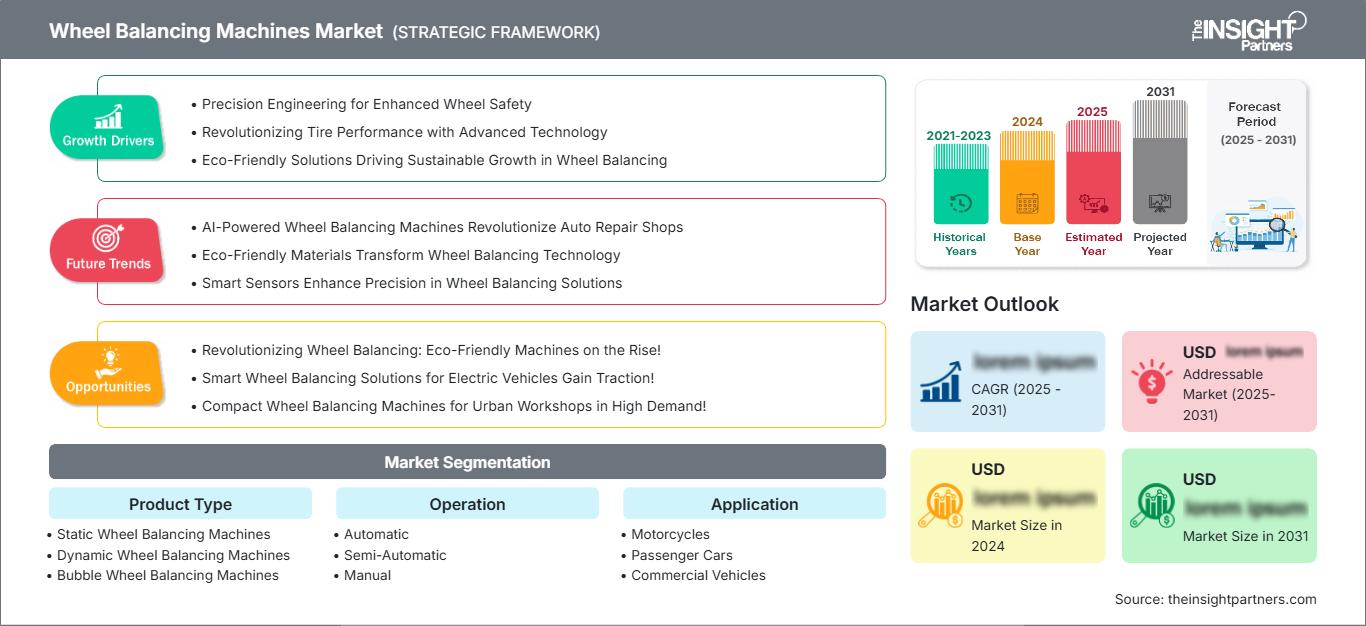
Wheel Balancing Machines Market: Strategic Insights
Regional Insights
North America Wheel Balancing Machines Market
North America accounted for approximately 30–34% share of the Wheel Balancing Machines Market in 2025 and is projected to grow at a 3.0–3.8% CAGR through 2034. The US represents the largest regional market because of its extensive vehicle fleet, high annual road usage, mature tire-service infrastructure, and widespread independent repair facilities. Canada's organized automotive aftermarket also supports replacement demand.
The US Federal Highway Administration reported approximately 3.3 trillion vehicle-miles traveled on public roads in 2024, demonstrating the scale of vehicle utilization. Such utilization creates recurring tire-service requirements and reinforces demand for accurate balancing. Automation, wheel lifts, laser measurement, and diagnostic functions are particularly relevant where workshops seek greater throughput and reduced technician intervention.
U.S. Wheel Balancing Machines Market
The US represented approximately 79–82% of North America's 2025 Wheel Balancing Machines Market share and is expected to grow at a 2.9–3.7% CAGR through 2034. High vehicle utilization, extensive dealer networks, independent repair facilities, and tire retailers create a diversified customer base. Commercial fleets additionally require reliable equipment capable of handling heavier assemblies and frequent service cycles.
Application demand is concentrated in passenger cars and light trucks, while specialty and performance vehicles create demand for higher-capability diagnostic systems. Hunter Engineering Company, BendPak Inc., Snap-on Incorporated, and other suppliers compete through automation, faster measurement, ergonomic accessories, and integrated service packages. Replacement purchases increasingly consider cycle time, technician safety, calibration requirements, and total ownership cost.
Europe Wheel Balancing Machines Market
Europe held approximately 25–29% share of the Wheel Balancing Machines Market in 2025 and is projected to expand at a 2.8–3.6% CAGR through 2034. Germany remains a leading market because of its automotive manufacturing base and technically advanced aftermarket. The UK maintains substantial demand through independent garages and national service networks. France, Italy, and Spain contribute through large vehicle populations and established tire-service infrastructure. ACEA data indicate that EU car registrations increased 1.8% in 2025, while battery-electric vehicles reached 17.4% of registrations.
Germany's mature workshop ecosystem supports premium balancing systems with automatic rim profiling, diagnostic functions, and wheel-lift capabilities. The country's strong automotive engineering base also encourages adoption of technologically sophisticated equipment. The UK market is characterized by a broad independent repair sector, where compact semi-automatic and automatic machines can address space and labor constraints. France, Italy, and Spain provide additional replacement demand through sizable fleets, tire retailers, and independent service businesses.
APAC Wheel Balancing Machines Market
APAC represented approximately 27–31% of the Wheel Balancing Machines Market share in 2025 and is forecast to grow at a 4.0–4.8% CAGR through 2034. China is the leading market, followed by Japan, South Korea, India, and Australia. Expanding vehicle populations, workshop formalization, automotive manufacturing, and increasing use of organized tire-service facilities support equipment demand.
India is particularly significant as vehicle production and sales broaden service requirements. SIAM reported 3.10 crore vehicles produced in FY2024–25, including strong two-wheeler and passenger-vehicle volumes. China benefits from its enormous automotive production ecosystem, while Japan and South Korea favor technologically advanced service equipment. Australia adds demand from a high vehicle-use environment and geographically dispersed service networks.
Middle East & Africa Wheel Balancing Machines Market
Middle East and Africa Wheel Balancing Machines Market accounted for approximately 6–9% share in 2025 and is projected to grow at a 2.5–3.4% CAGR through 2034. Saudi Arabia and the UAE lead regional demand, while South Africa remains an important southern African market. Vehicle maintenance activity is supported by long-distance travel, commercial fleets, and infrastructure investment.
Saudi Arabia benefits from transport and logistics expansion, while the UAE has a highly organized automotive service environment and substantial premium-vehicle presence. South Africa provides demand from passenger vehicles, commercial fleets, and independent workshops. Across the Rest of MEA, equipment adoption is increasingly tied to workshop modernization, replacement cycles, and the need to improve service accuracy in challenging operating conditions.
Segmentation Analysis
Product Type
Product Type segmentation includes Static Wheel Balancing Machines, Dynamic Wheel Balancing Machines, and Bubble Wheel Balancing Machines. Dynamic equipment remains the dominant technology because it addresses imbalance across multiple planes and aligns with contemporary wheel-service requirements. The segment is projected to grow at a 3.4–4.1% CAGR during 2026–2034, supported by professional workshops and higher wheel complexity. Current Wheel Balancing Machines Market trends indicate increasing adoption of digitally assisted dynamic balancing systems that improve accuracy, reduce service time, and support the growing complexity of modern wheel and tire assemblies.
- Static Wheel Balancing Machines: These machines remain relevant for straightforward balancing requirements and cost-sensitive workshops. Their relatively simple operating architecture supports use where service volumes and wheel configurations do not justify advanced diagnostic functionality.
- Dynamic Wheel Balancing Machines: Dynamic systems serve professional workshops requiring correction across multiple planes. Their compatibility with alloy wheels, larger assemblies, automated measurement, and diagnostic balancing makes them strategically important for higher-throughput service environments.
- Bubble Wheel Balancing Machines: Bubble systems retain a niche position because of simple construction and low operating complexity. They can suit basic applications and locations where capital expenditure, maintenance simplicity, or limited technical infrastructure remains a priority.
Operation
Operation includes Automatic, Semi-Automatic, Manual. Automatic equipment is expected to grow at a 4.2–5.0% CAGR during 2026–2034, supported by labor-efficiency requirements and demand for repeatable measurements. Semi-automatic systems provide an intermediate proposition, while manual machines remain important in cost-sensitive and low-volume workshops.
- Automatic: Automatic machines increasingly integrate data entry, wheel profiling, positioning, and diagnostic functions. Their strategic value comes from shorter technician interaction times and improved consistency across repetitive service operations.
- Semi-Automatic: Semi-automatic equipment balances affordability with selected automated functions. It is attractive to workshops upgrading from manual systems while maintaining technician involvement in wheel measurement and correction procedures.
- Manual: Manual machines serve smaller workshops and price-sensitive markets where equipment simplicity is prioritized. Their continued presence reflects lower acquisition costs, straightforward maintenance, and applications with moderate balancing volumes.
Application
Application includes Motorcycles, Passenger Cars, Commercial Vehicles. Passenger Cars represent the broadest application base and are expected to grow at a 3.2–3.9% CAGR during 2026–2034, supported by large vehicle fleets and recurring tire replacement. Commercial vehicles require heavier-duty equipment, while motorcycles sustain demand for compact balancing solutions.
- Motorcycles: Motorcycle applications require equipment capable of accommodating smaller wheel dimensions and specialized mounting arrangements. Demand is supported by large two-wheeler populations across Asia and continued service activity in urban mobility markets.
- Passenger Cars: Passenger cars constitute the principal application environment because of their large installed fleet and frequent tire-service requirements. Increasing wheel sizes and alloy-wheel penetration strengthen demand for accurate and digitally assisted balancing.
- Commercial Vehicles: Commercial vehicles require robust machines capable of handling heavier wheel and tire assemblies. Fleet operators place greater emphasis on uptime, repeatability, technician safety, and equipment durability, supporting specialized balancing solutions.
Opportunity Snapshot
| Application | Revenue Contribution | Trend Tag | Adoption Stage |
| Motorcycles | Medium | Compact Balancing | Scaling |
| Passenger Cars | High | Diagnostic Balancing | Mature |
| Commercial Vehicles | Medium | Heavy-Duty Service | Scaling |
Wheel Balancing Machines Market Growth Drivers and Impact Analysis
Increasing Technician Productivity Requirements
Auto repair companies have increasingly focused on assessing equipment based on throughput per mechanic instead of machine capability alone. Availability of labor, need for training, and use of bay space will factor in when making buying decisions. Automated data entry, wheel profiling, laser wheel positioning, and wheel lift mechanisms limit repeated tasks by technicians while ensuring consistency of procedure. The effect is especially pronounced for tire shops and multi-bay operations where even a small improvement in service time can be compounded by hundreds of services performed. Equipment makers that offer both balancing and ergonomics, coupled with digital inputs, can meet productivity and labor needs simultaneously. This driver also makes obsolete old manual machines whose efficiency relies on experience. When operators in services standardize processes in several locations, machines with repeatable procedures gain importance.
Growing Complexity of Modern Wheel and Tire Assemblies
Present-day cars are increasingly fitted with bigger wheels, alloys, low-profile tires, performance-based components, and specific wheel types. Such a setup results in increased sensitivity towards mounting precision, weight distribution, runout, and vibration remaining after the process is completed. Hence, the need for better balancing machines increases as these may spot problems that cannot be easily fixed through static balancing. Devices capable of spotting runout on a wheel, defects in a tire, or improper wheel alignment may help decrease repeat customers and raise the success rate of the first service. There are economic implications of the matter besides equipment sales, since expensive wheel sets may raise the price of any mistakes related to balancing. Hence, manufacturers are encouraged to install sensors, laser systems, automation, and advanced clamping systems.
Expansion of Organized Automotive Aftermarket Infrastructure
The growth of organized dealerships, tire dealers, franchises, and multi-site service networks will raise the need for standard wheel service equipment. Such operators tend to demand consistency in performance, maintenance, training of technicians, and results from equipment. Standardization will allow suppliers to offer equipment bundles consisting of balancers, tire changers, wheel lifts, and aligning systems. In emerging markets, standardization of workshops will speed up the transition from basic equipment to electronically controlled equipment. The operators of fleet maintenance will need the reliability of equipment since their operations are directly related to the downtime of vehicles. With the growth of service networks, lifecycle services, spare parts availability, software upgrades, calibration, and responsiveness of suppliers will become more important than just the price of the equipment.
Wheel Balancing Machines Market Future Trends
Connected Diagnostics and Data-Assisted Balancing
The trend in connected balancing equipment is going to shift away from simply measuring and toward the use of data-driven workshop workflow processes. Upcoming connected balancing machines will increasingly link balancing outcomes to inspection data, vehicle records, tire-pressure readings, and alignment measurements, among others. Connected and cloud-enabled reporting capabilities can assist multi-site businesses in comparing equipment performance, pinpointing recurrent wheel issues, and planning maintenance based on operational conditions. Artificial intelligence can even be used for understanding repeated vibration and runout issues, although this will depend on how good the data is. What will create commercial success in this market is the ability to leverage data as a service intelligence and not just as a display of correction weights.
Automation Designed Around Heavy and Complex Assemblies
Automation will also increasingly be applied to physical handling, not just measurement. Bigger wheels and heavier tires lead to ergonomic problems, especially in commercial vehicles and in performance cars. Future balancing systems will thus be able to rely on automation of wheel lifting, assistance in mounting, intelligent clamping, and automated positioning. Verification with sensors could ensure that a wheel is correctly centered prior to the measurement process and avoid inaccuracies resulting from inconsistent mounting. Automation of the process might include coordination of such activities as inflation, balancing, and tire changing in order to keep a technician idle as little as possible. However, the direction of evolution of the technology does not necessarily mean total automation everywhere, only selected processes.
Wheel Balancing Machines Market Opportunities
Localized Automation for Emerging Workshop Networks
Emerging markets can be tapped by the suppliers of such equipment through the development of modular, automatic and semi-automatic machines that are appropriate for the economics of local workshops. There are many growing service shops that need better productivity but cannot afford special equipment for high-production Western plants. Equipment that would allow for automatic measurements, lasers, small sizes, and wheel lifts is the solution. India, Southeast Asia, the Middle East, and some parts of Latin America have growing automobile fleets along with growing aftermarkets. The development of local distribution channels, as well as the standardization of spare parts supply, can solve the problem of customer trust.
Integrated Wheel-Service Platforms for Multi-Bay Facilities
The multi-bay facility opens up possibilities to sell a wheel-service process bundle as opposed to selling individual balancing machines. There may be an opportunity to integrate tire change, balance, lift, alignment, inspection, and digital documentation into a single package, which will optimize the use of the equipment and, at the same time, simplify its purchase. Centralized software could be used to monitor the performance of the service, the status of the machine, calibration needs, and repeated repairs. The idea seems appealing to dealer networks and national tire service chains interested in having the same procedures everywhere. Upgrade opportunities for clients can be created through allowing automation or diagnostics upon increases in service volume.
Frequently Asked Questions

- Comprehensive Market Sizing and Forecast Analysis
- Detailed Segmentation Analysis
- In-Depth Market Dynamics Assessment
- Regional and Country-Level Insights
- Competitive Landscape and Company Benchmarking
- Strategic Business Intelligence
Recent Reports
Testimonials

The Insight Partners provided valuable market intelligence that supported our global go-to-market strategy. Their team was professional, responsive, and attentive to our feedback, providing thoughtful analysis and helpful methodological clarifications throughout the project.
Junmo Kim Chief Financial Officer (CFO), Enertech Co., Ltd.
The Insight Partners' SCADA System Market report is comprehensive, with valuable insights on current trends and future forecasts. The team was highly professional, responsive, and supportive throughout. We are very satisfied and highly recommend their services.
RAN KEDEM Partner, Reali Technologies LTDs
I requested a report on a very specific software market and the team produced the report in a few days. The information was very relevant and well presented. I then requested some changes and additions to the report. The team was again very responsive and I got the final report in less than a week.
JEAN-HERVE JENN Chairman, Future Analytica
We worked with The Insight Partners for an important market study and forecast. They gave us clear insights into opportunities and risks, which helped shape our plans. Their research was easy to use and based on solid data. It helped us make smart, confident decisions. We highly recommend them.
PIYUSH NAGPAL Sr. Vice President, High Beam Global
The Insight Partners delivered insightful, well-structured market research with strong domain expertise. Their team was professional and responsive throughout. The user-friendly website made accessing industry reports seamless. We highly recommend them for reliable, high-quality research services
YUKIHIKO ADACHI CEO, Deep Blue, LLC.
This is the first time I have purchased a market report from The Insight Partners.While I was unsure at first, I visited their web site and felt more comfortable to take the risk and purchase a market report.I am completely satisfied with the quality of the report and customer service. I had several questions and comments with the initial report, but after a couple of dialogs over email with their analyst I believe I have a report that I can use as input to our strategic planning process.Thank you so much for taking the extra time and making this a positive experience.I will definitely recommend your service to others and you will be my first call when we need further market data.
JOHN SUZUKI President and Chief Executive Officer, Board Director, BK Technologies
I wish to appreciate your support and the professionalism you displayed in the course of attending to my request for information regarding to infectious disease IVD market in Nigeria. I appreciate your patience, your guidance, and the fact that you were willing to offer a discount, which eventually made it possible for us to close a deal. I look forward to engaging The Insight Partners in the future, all thanks to the impression you have created in me as a result of this first encounter.
DR CHIJIOKE ONYIA MANAGING DIRECTOR, PineCrest Healthcare Ltd.Reason to Buy
- Informed Decision-Making
- Understanding Market Dynamics
- Competitive Analysis
- Identifying Emerging Markets
- Customer Insights
- Market Forecasts
- Risk Mitigation
- Boosting Operational Efficiency
- Strategic Planning
- Investment Justification
- Tracking Industry Innovations
- Aligning with Regulatory Trends





 Get Free Sample for