
Wind Turbine Rotor Blades Market Growth, Trends & Demand by 2034
Coverage: By Type (Below 40m, 41-60m, 61-70m, & Above 70m); Deployment Type (Onshore and Offshore), and Geography
- Status : Data Released
- Report Code : TIPRE00021136
- Category : Energy and Power
- No. of Pages : 150
- Available Report Formats :


- Last update date : June 15, 2026


2025 Market Size
US$ 23.83 Bn
Base year value
2034 Forecast
US$ 52.04 Bn
Projected by 2034
CAGR 2026-2034
9.07 %
Growth rate
Addressable Market
US$ 339.43 Bn
(2026-2034)
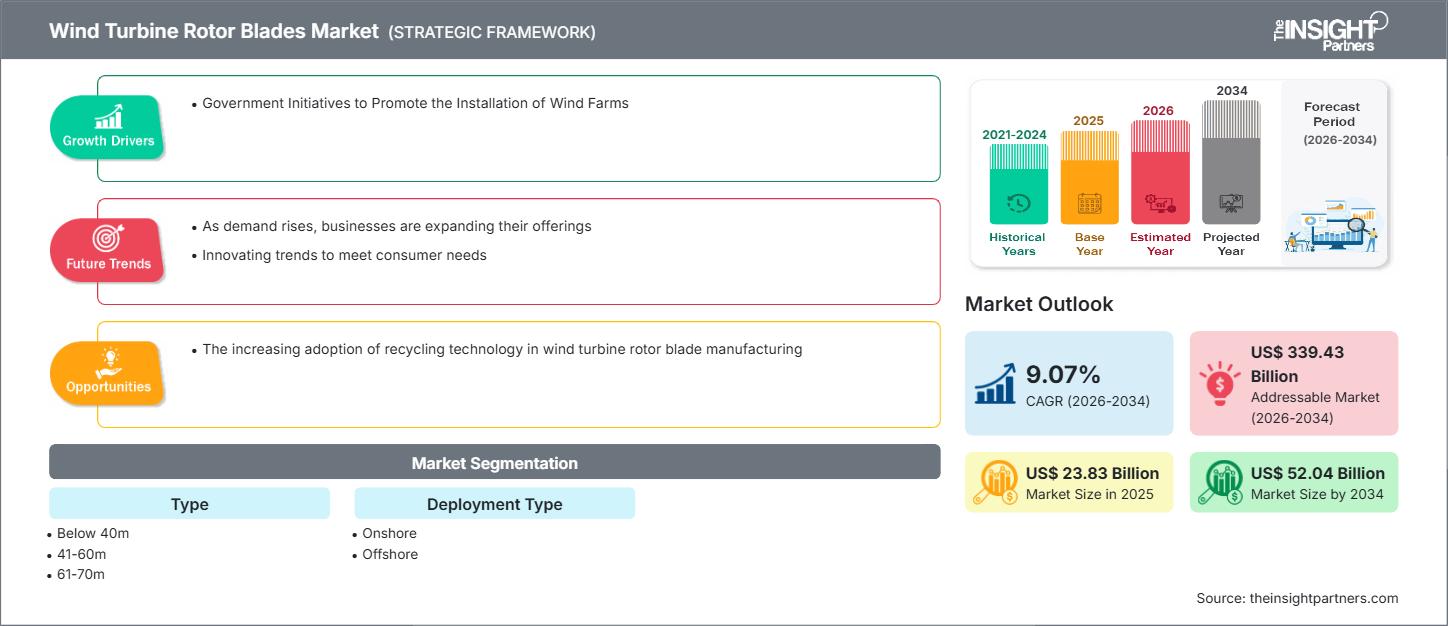
The global wind turbine rotor blades market size is projected to reach US$ 52.04 billion by 2034 from US$ 23.83 billion in 2025. The market is anticipated to register a CAGR of 9.07% during the forecast period 2026–2034.
Key market dynamics include a heightening global focus on renewable energy transition, rising demand for high-capacity turbines to optimize power generation, and a significant shift toward offshore wind expansion. Additionally, the market is expected to benefit from the growing popularity of carbon-fiber reinforced blades, expansion in wind farm installations across emerging economies, and the increasing inclusion of recyclable blade materials in high-value sustainability segments like the European and North American utility markets.
Wind Turbine Rotor Blades Market Analysis
The wind turbine rotor blades market analysis shows a shift toward larger and more aerodynamic components as developers prioritize energy capture and lower maintenance costs. The market drives into traditional onshore segments dominated by glass-fiber technology and high-growth offshore requiring blades above 70m. Strategic opportunities are emerging in repowering projects, where replacing aging blades with modern, longer alternatives offers a clear competitive advantage in energy yield. The analysis also notes that market expansion depends on logistics for transporting massive components and manufacturing efficiency for complex aerodynamic shapes. Competitive differentiation now stands out depending on material innovation that highlights weight reduction, durability, and being able to recycle blades at the end of their lifecycle. This approach helps top-tier manufacturers justify premium pricing in a market with evolving environmental regulations.
Wind Turbine Rotor Blades Market Overview
Wind turbine rotor blades have evolved from niche industrial parts to critical high-tech energy assets. The market includes specialized low-wind blades, typhoon-resistant structures, and ultra-long offshore formats. Both global energy giants and regional specialists compete in this market, using composite materials such as glass fiber, carbon fiber, and hybrid resins. Growing demand for clean electricity among carbon-conscious nations in Europe and Asia-Pacific has increased the popularity of wind power as a primary grid solution. Asia-Pacific leads in revenue due to its massive domestic wind programs, while Europe is advancing in offshore innovation and circular economy adoption. The North American market is highly developed, driven by federal tax incentives and the broad availability of land for onshore projects. Competition among brands is fueling greater variety in airfoil designs and the inclusion of advanced features like serrated trailing edges for noise reduction.
Market Assessment and Insights
- Global market for Wind Turbine Rotor Blades was valued at US$ 23.83 Billion in 2025
- Annual market size is expected to reach US$ 52.04 Billion by 2034
- Total addressable market (TAM) during 2026-2034 is projected to reach approximately US$ 339.43 Billion
- Market is anticipated to register a CAGR of 9.07% during the forecast period
- The United States represents a key market, supported by Government Initiatives to Promote the Installation of Wind Farms, as well as evolving industry dynamics
- Market analysis covers North America, Europe, Asia-Pacific, South and Central America, Middle East and Africa, with growth evaluated across the forecast period
- Market opportunities such as The increasing adoption of recycling technology in wind turbine rotor blade manufacturing are expected to influence market dynamics and addressable market
- Report profiles industry participants, including TPI Composites Inc, Vestas Wind Systems AS, ENERCON GmbH, LM Wind Power AS, Siemens Gamesa Renewable Energy, Acciona SA, Suzlon Energy Ltd, Nordex SE, Envision Energy USA Ltd, Lianyungang Zhongfu Lianzhong Composites Group Co Ltd, while analyzing competitive strategies and innovation developments
-
Source: The Insight Partners' analysis based on proprietary research, government publications, company annual reports, investor presentations, industry databases, and expert interviews.
● REPORT CUSTOMIZATION
Tailor This Report To Align With Your Specific Business Requirements
This report can be customized to align precisely with your business objectives, scope, and target markets. Customization options include tailored segmentation, geography, competitive analysis, and strategic insights to support informed decision-making.
Customize This Report →WHAT YOU CAN ADJUST
- ● Segmentations
- ● Geography
- ● Competitive Analysis
- ● Language Preferences
Wind Turbine Rotor Blades Market: Strategic Insights
-
Get Top Key Market Trends of this report.This FREE sample will include data analysis, ranging from market trends to estimates and forecasts.
Wind Turbine Rotor Blades Market Drivers and Opportunities
Market Drivers:
- Expansion of Global Wind Energy Capacity: Nations worldwide are setting aggressive net-zero targets, leading to a surge in utility-scale wind farm projects that require a steady supply of high-performance rotor blades.
- Technological Shift Toward Larger Turbines: The move toward 10 MW+ turbines necessitates much longer blades to maximize swept area. This drive for efficiency is a primary catalyst for market value growth.
- Government Incentives and Green Subsidies: Favorable policies such as the Inflation Reduction Act in the United States and the REPowerEU plan in Europe provide the financial foundation for long-term project viability.
Market Opportunities:
- Repowering of Aging Wind Farms: Older turbines reaching the end of their design life present a massive opportunity for blade replacements that utilize modern materials to boost efficiency without replacing the entire infrastructure.
- Advancements in Recyclable Blade Materials: As environmental regulations tighten, the development of blades that can be fully recycled at the end of their 20-25 year lifespan offers a significant opening for sustainable brands.
- Floating Offshore Wind Infrastructure: Deep-water projects represent a new frontier, requiring specialized blade designs capable of handling unique structural loads and harsh maritime environments.
Wind Turbine Rotor Blades Market Report Segmentation Analysis
The Wind Turbine Rotor Blades Market share is analyzed across various segments to provide a clearer understanding of its structure, growth potential, and emerging trends. Below is the standard segmentation approach used in most industry reports:
By Type (Blade Length):
- Below 40m: Commonly used for smaller-scale or older onshore turbines. This segment is stable but is gradually being replaced by longer formats in utility-scale projects.
- 41-60m: A versatile and widely used segment for mid-range onshore turbines, offering a balance between energy capture and transportability.
- 61-70m: The leading segment for current onshore utility-scale installations, favored for its optimized performance in moderate wind speeds.
- Above 70m: The fastest-growing segment, primarily serving the massive turbines used in offshore installations and advanced onshore platforms.
By Deployment Type:
- Onshore: Holds the largest market share due to its established infrastructure, lower installation costs, and widespread adoption across diverse geographies.
- Offshore: Represents a high-value growth segment, benefiting from higher wind speeds at sea and the ability to accommodate the largest blade sizes.
By Geography:
- North America
- Europe
- Asia Pacific
- South & Central America
- Middle East & Africa
Wind Turbine Rotor Blades Market Report Scope
| Report Attribute | Details |
|---|---|
| Market size in 2025 | US$ 23.83 Billion |
| Market Size by 2034 | US$ 52.04 Billion |
| Global CAGR (2026 - 2034) | 9.07% |
| Historical Data | 2021-2024 |
| Forecast period | 2026-2034 |
| Segments Covered |
By Type
|
| Regions and Countries Covered |
North America
|
| Market leaders and key company profiles |
|
Wind Turbine Rotor Blades Market Players Density: Understanding Its Impact on Business Dynamics
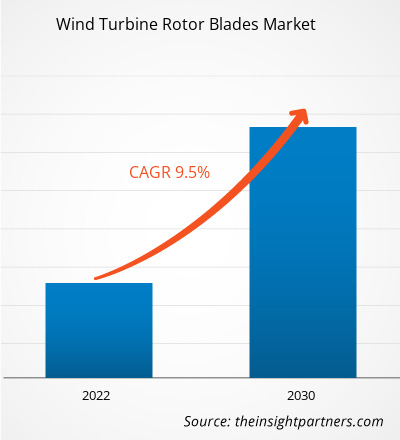
The Wind Turbine Rotor Blades Market is growing rapidly, driven by increasing end-user demand due to factors such as evolving consumer preferences, technological advancements, and greater awareness of the product's benefits. As demand rises, businesses are expanding their offerings, innovating to meet consumer needs, and capitalizing on emerging trends, which further fuels market growth.
Wind Turbine Rotor Blades Market Share Analysis by Geography
Asia-Pacific is expected to grow fastest in the coming years. Emerging markets in South & Central America, the Middle East, and Africa also have many untapped opportunities for utility-scale developers and blade manufacturers to expand.
The wind turbine rotor blades market is undergoing a significant transformation, moving from a standard onshore energy component to a global high-value industrial asset. Growth is driven by the rising need for grid decarbonization, a surge in offshore wind capacity, and the expansion of the high-performance carbon-fiber blade sector. Below is a summary of market share and trends by region:
1. North America
- Market Share: A robust and steady segment, driven by federal tax incentives and the maturation of the domestic supply chain.
- Key Drivers:
- Implementation of the Inflation Reduction Act (IRA), providing long-term visibility for wind projects
- Expansion of offshore wind leasing along the East Coast and the Gulf of Mexico
- Significant repowering activities where aging blades are replaced with high-efficiency modern versions
- Trends: Strategic reshoring of blade manufacturing facilities to the United States to qualify for domestic content bonuses and reduce heavy logistics costs.
2. Europe
- Market Share: Holds a leading position in offshore technology and innovation, anchored by a high concentration of established OEMs in Denmark, Germany, and Spain.
- Key Drivers:
- Ambitious REPowerEU targets aimed at accelerating the deployment of renewable energy
- Advanced offshore infrastructure in the North Sea and Baltic Sea
- Stringent environmental regulations pushing for 100% recyclable blade solutions
- Trends: A strategic shift toward circular economy models, where manufacturers focus on the end-of-life recyclability of composite materials to meet zero-waste industrial mandates.
3. Asia-Pacific
- Market Share: The largest and fastest-growing region globally, with China serving as the primary driver of growth.
- Key Drivers:
- Massive state-backed renewable energy bases and the 14th Five-Year Plan in China
- Rapid urbanization and soaring electricity demand in India and Southeast Asia
- Increasing technical capabilities of domestic OEMs to produce massive 100m+ blades
- Trends: Heavy investment in automated manufacturing and AI-driven quality control to lower production costs and maintain a dominant position in the global export market.
4. South and Central America
- Market Share: Emerging market with a growing onshore in countries like Brazil and Chile.
- Key Drivers:
- Vast untapped wind resources in the Northeast of Brazil and Southern Chile
- Increasing corporate power purchase agreements (PPAs) for clean energy
- Modernization of local manufacturing hubs to supply regional projects
- Trends: Growth of hybrid wind-solar projects and the adoption of blades designed specifically for high-altitude or low-wind speed South American terrains.
5. Middle East and Africa
- Market Share: Developing market with significant potential, transitioning from fossil fuel dependency toward formalized green energy programs.
- Key Drivers:
- Large-scale wind initiatives in Morocco, Egypt, and Saudi Arabia (e.g., NEOM project)
- Strategic focus on energy diversification to support long-term economic stability
- Improving grid infrastructure to accommodate decentralized wind power
- Trends: Implementation of specialized protective coatings for blades to withstand harsh desert environments and sand erosion.
High Market Density and Competition
Competition is intensifying due to the presence of established leaders such as LM Wind Power, TPI Composites, and Siemens Gamesa. Regional specialists and niche players alongside global OEMs contribute to a diverse and rapidly expanding market landscape.
This competitive environment pushes vendors to differentiate through:
- Material Performance: Positioning carbon-fiber and hybrid blades as superior alternatives for weight reduction and stiffness in ultra-long formats.
- Aerodynamic Innovation: Offering blades with specialized tips and trailing edges to maximize energy output and reduce noise in noise-sensitive onshore areas.
- Localized Manufacturing: Establishing factories near major wind projects to reduce the massive costs and logistical complexities associated with transporting large blades.
Opportunities and Strategic Moves
- Partner with offshore logistics and maritime specialists to streamline the transport and installation of massive rotor blades in deep-water and floating wind locations.
- Incorporate advanced material sciences such as thermoplastic resins and bio-based composites to meet the rising demand for sustainable and easily repairable wind turbine components.
Major Companies operating in the Wind Turbine Rotor Blades Market are:
- TPI Composites Inc
- Vestas Wind Systems AS
- ENERCON GmbH
- LM Wind Power AS
- Siemens Gamesa Renewable Energy
- Acciona SA
- Suzlon Energy Ltd
- Nordex SE
- Envision Energy USA Ltd
- Lianyungang Zhongfu Lianzhong Composites Group Co Ltd
Disclaimer: The companies listed above are not ranked in any particular order.
Wind Turbine Rotor Blades Market News and Recent Developments
- In May 2025, Vestas and LM Wind Power announced a deal that will see LM Wind Power’s blade factory in Goleniów near Szczecin, Poland, become part of Vestas’ growing European manufacturing setup for an undisclosed amount paid by Vestas to LM Wind Power. The factory produces blades for Vestas’ onshore wind solutions and will continue to play a key role in meeting Poland’s and the rest of Europe’s growing energy needs.
- In February 2025, ACCIONA, a global leader in renewable energy and sustainable infrastructure, announced the launch of Turbine Madeopens in a new tab, Australia’s first initiative dedicated to exploring innovative ways to transform decommissioned wind turbine blades into new materials and products.
Wind Turbine Rotor Blades Market Report Coverage and Deliverables
The Wind Turbine Rotor Blades Market Size and Forecast (2021–2034) report provides a detailed analysis of the market covering below areas:
- Wind Turbine Rotor Blades Market size and forecast at global, regional, and country levels for all the key market segments covered under the scope
- Wind Turbine Rotor Blades Market trends, as well as market dynamics such as drivers, restraints, and key opportunities
- Detailed PEST and SWOT analysis
- Wind Turbine Rotor Blades Market analysis covering key market trends, global and regional framework, major players, regulations, and recent market developments
- Industry landscape and competition analysis covering market concentration, heat map analysis, prominent players, and recent developments in the Wind Turbine Rotor Blades Market.
- Detailed company profiles
Frequently Asked Questions

- Comprehensive Market Sizing and Forecast Analysis
- Detailed Segmentation Analysis
- In-Depth Market Dynamics Assessment
- Regional and Country-Level Insights
- Competitive Landscape and Company Benchmarking
- Strategic Business Intelligence
Recent Reports
Testimonials

The Insight Partners provided valuable market intelligence that supported our global go-to-market strategy. Their team was professional, responsive, and attentive to our feedback, providing thoughtful analysis and helpful methodological clarifications throughout the project.
Junmo Kim Chief Financial Officer (CFO), Enertech Co., Ltd.
The Insight Partners' SCADA System Market report is comprehensive, with valuable insights on current trends and future forecasts. The team was highly professional, responsive, and supportive throughout. We are very satisfied and highly recommend their services.
RAN KEDEM Partner, Reali Technologies LTDs
I requested a report on a very specific software market and the team produced the report in a few days. The information was very relevant and well presented. I then requested some changes and additions to the report. The team was again very responsive and I got the final report in less than a week.
JEAN-HERVE JENN Chairman, Future Analytica
We worked with The Insight Partners for an important market study and forecast. They gave us clear insights into opportunities and risks, which helped shape our plans. Their research was easy to use and based on solid data. It helped us make smart, confident decisions. We highly recommend them.
PIYUSH NAGPAL Sr. Vice President, High Beam Global
The Insight Partners delivered insightful, well-structured market research with strong domain expertise. Their team was professional and responsive throughout. The user-friendly website made accessing industry reports seamless. We highly recommend them for reliable, high-quality research services
YUKIHIKO ADACHI CEO, Deep Blue, LLC.
This is the first time I have purchased a market report from The Insight Partners.While I was unsure at first, I visited their web site and felt more comfortable to take the risk and purchase a market report.I am completely satisfied with the quality of the report and customer service. I had several questions and comments with the initial report, but after a couple of dialogs over email with their analyst I believe I have a report that I can use as input to our strategic planning process.Thank you so much for taking the extra time and making this a positive experience.I will definitely recommend your service to others and you will be my first call when we need further market data.
JOHN SUZUKI President and Chief Executive Officer, Board Director, BK Technologies
I wish to appreciate your support and the professionalism you displayed in the course of attending to my request for information regarding to infectious disease IVD market in Nigeria. I appreciate your patience, your guidance, and the fact that you were willing to offer a discount, which eventually made it possible for us to close a deal. I look forward to engaging The Insight Partners in the future, all thanks to the impression you have created in me as a result of this first encounter.
DR CHIJIOKE ONYIA MANAGING DIRECTOR, PineCrest Healthcare Ltd.Reason to Buy
- Informed Decision-Making
- Understanding Market Dynamics
- Competitive Analysis
- Identifying Emerging Markets
- Customer Insights
- Market Forecasts
- Risk Mitigation
- Boosting Operational Efficiency
- Strategic Planning
- Investment Justification
- Tracking Industry Innovations
- Aligning with Regulatory Trends






 Get Free Sample for