
Benazepril Market Size, Trends & Growth by 2034
Coverage: By Type (Purity:less than 98%, Purity:less than 99%) ; Applications (Table Product, Capsule Product, Others), and Geography (North America, Europe, Asia Pacific, and South and Central America)
- Status : Data Released
- Report Code : TIPRE00008642
- Category : Life Sciences
- No. of Pages : 150
- Available Report Formats :


- Last update date : October 26, 2026


2025 Market Size
US$ 1.53 Bn
Base year value
2034 Forecast
US$ 3.14 Bn
Projected by 2034
CAGR 2026-2034
8.35 %
Growth rate
Addressable Market
US$ 21.01 Bn
(2026-2034)
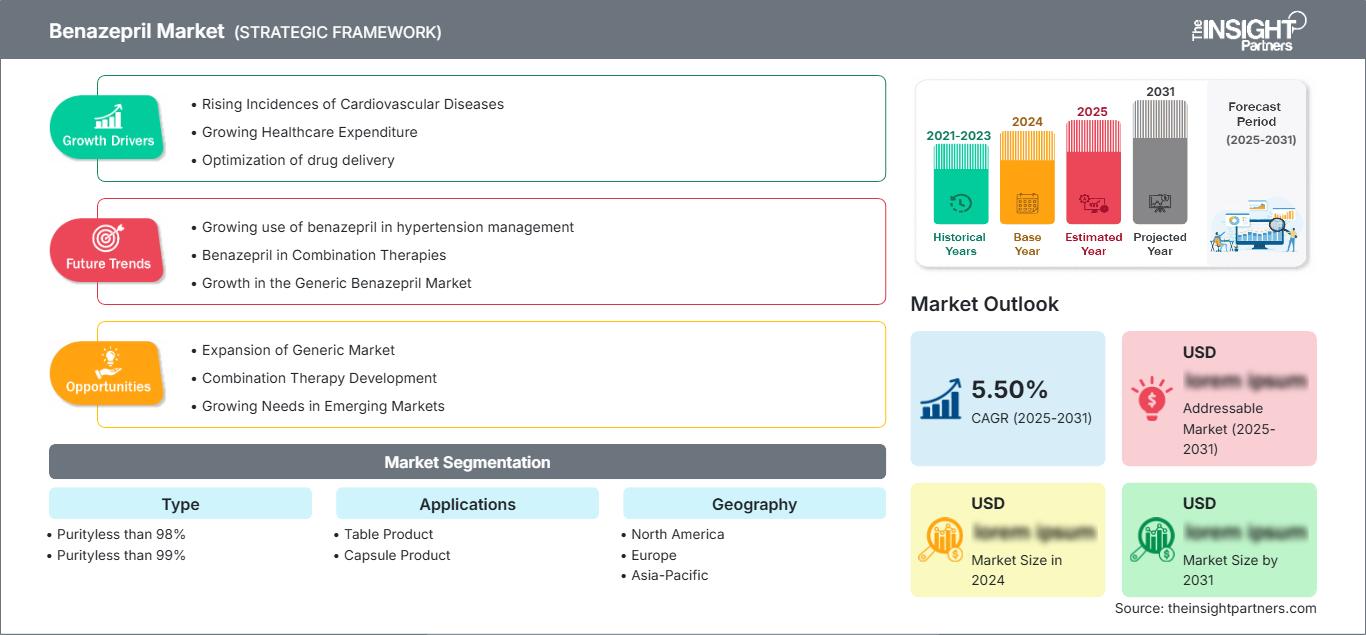
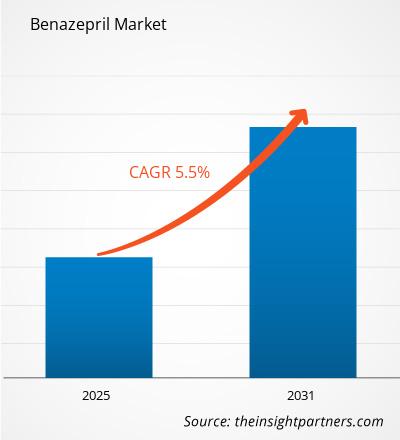
The benazepril market was valued at US$ 1.53 Billion in 2025 and is projected to reach US$ 3.14 Billion by 2034, registering a CAGR of 8.35% during 2026–2034. Expansion is supported by the growing hypertension burden, wider access to generic medicines, aging populations, and sustained demand for oral antihypertensive therapy. Manufacturing scale, active pharmaceutical ingredient quality, regulatory compliance, and dependable distribution remain central to competitive performance.
Within North America, the benazepril market size is projected to expand at a CAGR of ~8% through 2034. The region benefits from high hypertension diagnosis, broad generic-drug availability, developed retail pharmacy channels, and healthcare coverage for long-term cardiovascular therapy. Demand is also supported by fixed-dose combination prescribing, established clinical familiarity with angiotensin-converting enzyme inhibitors, and continuing efforts to improve blood-pressure control among diagnosed patients.
Benazepril Market Assessment and Insights
Regional Outlook
- North America: ~38% of the global benazepril market share in 2025 | ~8% CAGR through 2034. Market position: North America leads through high cardiovascular treatment expenditure, extensive generic availability, broad pharmacy distribution, established hypertension screening, and developed reimbursement pathways for chronic prescription medicines.
- US: ~88% of North American market revenue in 2025 | ~8% CAGR through 2034. Market position: The US dominates regional revenue through substantial treated-patient volume, generic substitution, fixed-dose combination use, large retail pharmacy networks, and the presence of established pharmaceutical suppliers.
- Europe: ~27% of the global market in 2025 | ~8% CAGR through 2034. Market position: Europe is a mature market supported by universal healthcare, generic prescribing policies, centralized procurement, and sustained antihypertensive demand across Germany, the UK, France, Italy, and Spain.
- Asia Pacific: ~26% of the global market in 2025 | ~10% CAGR through 2034. Market position: Asia Pacific is the fastest-growing region as hypertension diagnosis, pharmaceutical manufacturing, insurance coverage, generic medicine access, and primary-care capacity improve across China, India, Japan, South Korea, and Australia.
Segment Outlook
- Purity less than 99%: ~68% Share in 2025 | ~9% CAGR through 2034. Market position: The segment leads through greater relevance to regulated pharmaceutical production, stringent finished-dose specifications, supplier qualification requirements, and demand for consistent active pharmaceutical ingredient performance.
- Table Product: ~82% Share in 2025 | ~8% CAGR through 2034. Market position: Table Product leads because benazepril is primarily commercialized in tablet form, supported by multiple strengths, established manufacturing processes, prescribing familiarity, generic availability, and efficient retail distribution.
Competitive Coverage
Amneal Pharmaceuticals, Inc., ANI Pharmaceuticals, Inc., Apotex Inc., Aurobindo Pharma Limited, Canagen Pharmaceuticals Inc., Viatris Inc., ScinoPharm Taiwan, Ltd., Sun Pharmaceutical Industries Limited, Teva Pharmaceutical Industries Ltd., Zydus Pharmaceuticals (USA) Inc.
Methodology
The Insight Partners follows Data Collection & Secondary Research, Primary Research, Data Analysis, and Data Triangulation & Final Review to validate market estimates and insights.
Source: The Insight Partners' analysis based on proprietary research, government publications, company annual reports, investor presentations, industry databases, and expert interviews.
The distribution of benazepril has shifted from its original branded cardiovascular medication status into that of a largely generic drug, driven by large-scale production of the active pharmaceutical ingredient and oral solid dose manufacturing. The process has relied on automation, through granulation, mixing, compaction, coating, analysis, and serialization of the drug. Performance relies on impurities, dissolution, stability, bioequivalency, regulatory inspection history, cost of production, and continuity of supply of various tablet strengths and combinations.
Through the year 2034, investments will be made in resilient manufacturing, backward integration, continuous quality monitoring, and reduced cost of supply to nascent healthcare systems. Asia Pacific will be strategically relevant due to the combination of high hypertension prevalence and large scale of pharmaceutical manufacturing. The regulations on elemental impurities, nitrosamine risk, Good Manufacturing Practice, stability, labeling, and pharmacovigilance will give an advantage to the producers with good quality systems and varied manufacturing facilities.
Benazepril Market Report Scope
| Report Attribute | Details |
|---|---|
| Market size in 2025 | US$ 1.53 Billion |
| Market Size by 2034 | US$ 3.14 Billion |
| Global CAGR (2026 - 2034) | 8.35% |
| Historical Data | 2021-2024 |
| Forecast period | 2026-2034 |
Benazepril Market Analysis
Factors influencing the growth of the benazepril market include rising rates of hypertension, long-term cardiovascular risk management, aging demographics, and accessibility of generics. The demand comes from primary-care doctors, cardiologists, hospitals, retail drugstores, governmental purchasers, and chronic disease programs. The volume of treatment is influenced by diagnosis, selection by a doctor, adherence, tolerance, inclusion in a formulary, and ongoing monitoring of blood pressure.
The value chain includes raw-material providers, intermediate pharmaceutical ingredient makers, drug-formulation companies, packagers, distributors, pharmacy benefit management organizations, hospitals, and community drug stores. Supply costs include yield, impurity control, validated equipment, regulation compliance, distribution expenses, inventory management, and alternative sources availability. Generics approved in many cases compete with each other, thus putting pressure on price.
Market analysis of benazepril shows that competition is formed due to regulatory approvals, reliable production, strength coverage, reachability, contracting, and net acquisition cost. Amneal Pharmaceuticals, Inc., ANI Pharmaceuticals, Inc., Apotex Inc., Viatris Inc., Teva Pharmaceutical Industries Ltd., and Zydus Pharmaceuticals (USA) Inc. have relevant resources for generics in regulated markets and oral solid dose formulations.
Aurobindo Pharma Limited, Sun Pharmaceutical Industries Limited, ScinoPharm Taiwan, Ltd., and Canagen Pharmaceuticals Inc. improve the manufacturing and supply picture by having formulation or active ingredient capability. Investments are being directed towards quality control automation, supply chain redundancy, high purity production, and combination products. The firms capable of being compliant, avoiding shortages, and serving mature and price-sensitive markets can be more successful than low-unit-price competitors.
● REPORT CUSTOMIZATION
Tailor This Report To Align With Your Specific Business Requirements
This report can be customized to align precisely with your business objectives, scope, and target markets. Customization options include tailored segmentation, geography, competitive analysis, and strategic insights to support informed decision-making.
Customize This Report →WHAT YOU CAN ADJUST
- ● Segmentations
- ● Geography
- ● Competitive Analysis
- ● Language Preferences
Benazepril Market: Strategic Insights
Regional Insights
North America Benazepril Market
North America accounted for approximately ~38% of global revenue in 2025 and is projected to register a CAGR of ~8% through 2034. The regional benazepril market share reflects high hypertension diagnosis, substantial cardiovascular medicine expenditure, developed pharmacy infrastructure, and widespread availability of generic oral therapies. Clinical familiarity supports use among suitable patients requiring angiotensin-converting enzyme inhibition.
The involvement of Canada takes place through public drug schemes, private health insurance, generics switching, and managed primary care. The market potential in Mexico comes from improved hypertensive testing, pharmacy coverage increase, and distribution of generics locally. Demand for the market relies on certain aspects like formulary makeup, competitive prices, availability of the product, and switching therapies due to an oversaturated market segment of antihypertensives. Supplier reliability becomes very important since the treatment is long term and requires no switching of pharmacies and prescriptions.
U.S. Benazepril Market
The US represented approximately ~88% of North American revenue in 2025 and is expected to grow at a CAGR of ~8% through 2034. This positioning is supported by a broad population base of hypertensives who have been treated, strong retail pharmacy distribution networks, electronic prescribing systems, generic substitution, and insurance coverages of commercial and government organizations. Tablets containing benazepril have several strengths, making it possible to initiate and adjust dosing under medical supervision.
Companies capable of developing this generic drug include Amneal Pharmaceuticals, Inc., ANI Pharmaceuticals, Inc., Apotex Inc., Viatris Inc., Teva Pharmaceutical Industries Ltd., and Zydus Pharmaceuticals (USA) Inc. The factors that will ensure competition include availability of the product, wholesale contracting, pharmacy procurement, quality performance, and consistency in supply. The fixed-dose combination of the products will also help satisfy the demand for capsules when the doctors prescribe them in a simple regimen for their patients.
Europe Benazepril Market
Europe held approximately ~27% of global revenue in 2025 and is projected to expand at a CAGR of ~8% through 2034. Universal healthcare systems, chronic-disease management, population aging, and generic prescribing policies support antihypertensive medicine use. Germany is assessed as the leading country in Europe because of its healthcare scale, pharmaceutical expenditure, diagnosed hypertension population, and developed community pharmacy network.
Generic prescription in the UK is done through primary care prescribing pathways and national reimbursement. France guarantees universal access to health care services and systematic screening for cardiovascular risks. Italy and Spain guarantee constant demand owing to their aging population and consistent prescription of hypertensive drugs with their attendant cardiovascular risks. National reimbursement laws, tendering and reference pricing policies exert pressure on unit costs.
EU manufacturers have to comply with high standards for active pharmaceutical ingredients, drug products, serialization, pharmacovigilance and production. Market access depends on the quality of the dossier, bioequivalence, logistics and commercial feasibility under regulated pricing. Demand growth is relatively low in established Western Europe, whereas selected CEE countries provide additional demand through diagnostic tests and generic access.
APAC Benazepril Market
Asia Pacific represented approximately ~26% of global revenue in 2025 and is the fastest-growing region, with a CAGR of ~10% through 2034. China is assessed as the leading country in Asia Pacific because of its population scale, hypertension burden, pharmaceutical manufacturing capacity, and expanding chronic-disease management. India combines large unmet treatment needs with extensive generic production.
Universal health care and cardiovascular treatment in Japan contribute to regional growth. On the other hand, South Korea contributes to the regional growth through well-developed clinical and pharmacy facilities that support demand. Australia contributes through structured reimbursement and primary care management. Insurance expansion, screening, domestic production, urbanization, and medicine distribution are some other factors supporting regional growth.
Middle East & Africa Benazepril Market
The Middle East & Africa market is projected to register a CAGR of ~9% through 2034. Saudi Arabia is assessed as the leading country in the Middle East & Africa through healthcare expenditure, chronic-disease programs, hospital capacity, and pharmacy access. The UAE contributes through private healthcare, insurance coverage, and an established pharmaceutical distribution system.
South Africa has comparatively developed generic-drug manufacturing, retail pharmacy, and private medical coverage. Across the Rest of MEA, undiagnosed hypertension, affordability constraints, medicine shortages, and limited primary-care reach restrict consistent treatment. Investment in screening, procurement, logistics, local packaging, and community pharmacy infrastructure can expand access to affordable antihypertensive medicines.
Segmentation Analysis
Type
The benazepril market scope covers the supplied purity classifications used to differentiate material quality, production requirements, and potential suitability for pharmaceutical processing. Buyer decisions depend on impurity profiles, analytical documentation, regulatory standards, batch consistency, stability, supplier qualification, and intended formulation. Purity less than 99% is projected to register a CAGR of ~9% during 2026–2034 as regulated manufacturers increase requirements for consistent active pharmaceutical ingredients and comprehensive quality documentation.
- Purity less than 98%: This classification addresses material supplied for applications with defined but comparatively less stringent purity requirements. Commercial relevance depends on customer specifications, analytical results, process capability, permissible impurity levels, and regulatory suitability for the intended use.
- Purity less than 99%: This classification supports demand for more tightly controlled material used in pharmaceutical development and commercial production. Supplier qualification emphasizes impurity characterization, batch reproducibility, stability data, documentation, and compliance with applicable pharmacopeial or regulatory expectations.
Applications
Application demand is influenced by dosage-form preference, manufacturing capability, prescribed strength, patient convenience, combination-product strategy, and pharmacy availability. Oral solid products remain commercially important because they are stable, familiar, scalable, and suitable for chronic treatment. Table Product is projected to expand at a CAGR of ~8% during 2026–2034, supported by broad prescribing, efficient manufacturing, several dose strengths, and established generic distribution.
- Table Product: Table Product remains the standard standalone presentation for benazepril. Production involves controlled blending, compression, coating, dissolution testing, stability assessment, and packaging designed to preserve product quality throughout distribution and shelf life.
- Capsule Product: Capsule Product is relevant primarily to combination formulations and differentiated oral-dose strategies. Demand depends on regulatory approvals, co-formulated active ingredients, patient convenience, manufacturing complexity, payer coverage, and physician preference for simplified multidrug regimens.
Opportunity Snapshot
| Applications | Revenue Contribution | Trend Tag | Adoption Stage |
| Table Product | High | Generic Substitution | Mature |
| Capsule Product | Medium | Combination Therapy | Scaling |
Benazepril Market Growth Drivers and Impact Analysis
Rising Hypertension Diagnosis and Long-Term Treatment Demand
Hypertension necessitates continuous management since poor control of blood pressure leads to risk factors in both cardiovascular and renal functions. Aging of population, urbanization, obesity, eating habits, and better screening are resulting in increased diagnosis of hypertensive cases in both advanced and developing healthcare environments. This results in the need for long-term consumption of medication in oral form, which includes generic angiotensin-converting enzyme inhibitors for proper patients. Market opportunity lies in the recurring prescription volume instead of the demand for short-term treatment. The manufacturers gain an advantage when there are provisions for continuous treatment through accessibility of primary care, pharmacy services, coverage, and follow-up of the patients.
Expansion of Affordable Generic Medicine Access
Patent expiration and generic competition have transformed benazepril into an affordability-oriented pharmaceutical category. Multiple suppliers allow wholesalers, government agencies, hospitals, insurers, and pharmacies to negotiate lower acquisition costs and maintain alternative sources. This supports treatment access, particularly in countries where patients pay a significant share of prescription expenditure. Increased competition also compresses margins, requiring manufacturers to improve capacity utilization, production yield, packaging efficiency, and distribution planning. The market impact extends to contract manufacturing, active pharmaceutical ingredient supply, dossier licensing, and local packaging partnerships. Commercial success depends on balancing price competitiveness with reliable availability and regulatory compliance.
Greater Use of Combination Therapy for Blood-Pressure Control
Many patients require more than one mechanism to achieve appropriate blood-pressure control. Fixed-dose products containing benazepril and another antihypertensive ingredient can simplify regimens by reducing the number of separate prescriptions. This creates opportunities for capsule manufacturers, formulation developers, analytical laboratories, and suppliers capable of managing interactions between active ingredients. Combination therapy can support adherence, although prescribing depends on patient response, dose flexibility, renal function, electrolyte status, contraindications, and clinical judgment. Manufacturers must demonstrate stability, content uniformity, dissolution, bioequivalence, and dependable supply for each approved strength. Combination products provide a differentiation pathway in a highly competitive commodity-generic environment.
Benazepril Market Future Trends
Automated Quality Control and Data-Driven Manufacturing
Benazepril market trends are moving toward digital production records, process analytical technologies, automated sampling, predictive maintenance, and real-time review of critical quality attributes. These capabilities can reduce deviation investigation time, strengthen batch consistency, and improve traceability from active ingredient through packaged tablets. Manufacturers may use statistical process control to identify subtle changes in granulation, compression, coating, moisture, or dissolution before a batch fails specification. Adoption will depend on system validation, cybersecurity, data integrity, workforce training, and compatibility with existing facilities. Companies able to combine automation with strong quality governance can improve regulatory readiness and reduce the operational cost of serving price-sensitive generic markets.
Supply Diversification and Localized Pharmaceutical Production
Governments and healthcare organizations are expected to place greater emphasis on resilient supplies of essential chronic medicines. Benazepril producers may respond by qualifying alternative active-ingredient sources, holding strategic inventory, regionalizing packaging, and reducing dependence on single manufacturing sites. Localized production can shorten lead times and improve tender participation, but it requires sufficient scale, technical expertise, quality systems, and predictable procurement. Future contracting may evaluate continuity plans, geographic redundancy, and shortage history alongside price. Suppliers that demonstrate reliable recovery from raw-material interruptions, shipping disruption, or facility shutdowns may gain preference in institutional and public-health purchasing.
Benazepril Market Opportunities
Expansion in High-Burden Emerging Healthcare Markets
Manufacturers can expand through local distributors, public tenders, licensing arrangements, and regional packaging partnerships in countries where hypertension diagnosis and treatment access are improving. Benazepril market Forecasts support opportunity across Asia Pacific, the Middle East, Africa, and Latin America as primary-care coverage and generic medicine adoption increase. Commercial strategies should prioritize affordable pack sizes, dependable inventory, physician education, pharmacovigilance, and compliance with local registration requirements. Companies must also account for price controls, tender concentration, currency risk, and fragmented pharmacy distribution when assessing market attractiveness.
Differentiated Combination Products and Flexible Manufacturing
Generic manufacturers can create value through fixed-dose combinations, additional strength configurations, optimized packaging, and supply agreements serving private labels or regional brands. Flexible facilities capable of producing tablets and capsules can respond to market-specific preferences without relying on one presentation. Investment should focus on formulation compatibility, impurity assessment, bioequivalence, stability, and efficient technology transfer between sites. Partnerships with active-ingredient suppliers can strengthen cost control and reduce shortage exposure. Differentiation will depend on practical prescribing value and supply reliability rather than branding alone, given the mature and highly competitive nature of antihypertensive therapy.
Recent Developments
- April 2026: Aurobindo Pharma Limited approved the transfer of its domestic branded generic formulations business to its wholly owned subsidiary, Auropharm Limited, for ₹143.21 crore. The restructuring was intended to consolidate domestic pharmaceutical operations and improve operational efficiency, strengthening the group’s capacity to commercialize oral formulations within India’s expanding chronic-disease market.
- November 2025: Zydus Pharmaceuticals (USA) Inc. and its parent group received US FDA approval for another oral generic product manufactured at the group’s special economic zone facility. Although unrelated directly to benazepril, the approval expanded Zydus’ regulated-market portfolio and demonstrated continuing investment in abbreviated new drug applications, oral-dose manufacturing, and US commercialization capabilities.
- February 2025: Amneal Pharmaceuticals, Inc. launched mesalamine delayed-release tablets and announced US FDA approval for lenalidomide capsules. The developments expanded its complex generic portfolio and demonstrated capabilities across tablet and capsule manufacturing. These capabilities are relevant to competitive oral generic markets requiring scalable production, regulatory execution, and reliable commercial distribution.
Frequently Asked Questions

- Comprehensive Market Sizing and Forecast Analysis
- Detailed Segmentation Analysis
- In-Depth Market Dynamics Assessment
- Regional and Country-Level Insights
- Competitive Landscape and Company Benchmarking
- Strategic Business Intelligence
Recent Reports
Testimonials

The Insight Partners provided valuable market intelligence that supported our global go-to-market strategy. Their team was professional, responsive, and attentive to our feedback, providing thoughtful analysis and helpful methodological clarifications throughout the project.
Junmo Kim Chief Financial Officer (CFO), Enertech Co., Ltd.
The Insight Partners' SCADA System Market report is comprehensive, with valuable insights on current trends and future forecasts. The team was highly professional, responsive, and supportive throughout. We are very satisfied and highly recommend their services.
RAN KEDEM Partner, Reali Technologies LTDs
I requested a report on a very specific software market and the team produced the report in a few days. The information was very relevant and well presented. I then requested some changes and additions to the report. The team was again very responsive and I got the final report in less than a week.
JEAN-HERVE JENN Chairman, Future Analytica
We worked with The Insight Partners for an important market study and forecast. They gave us clear insights into opportunities and risks, which helped shape our plans. Their research was easy to use and based on solid data. It helped us make smart, confident decisions. We highly recommend them.
PIYUSH NAGPAL Sr. Vice President, High Beam Global
The Insight Partners delivered insightful, well-structured market research with strong domain expertise. Their team was professional and responsive throughout. The user-friendly website made accessing industry reports seamless. We highly recommend them for reliable, high-quality research services
YUKIHIKO ADACHI CEO, Deep Blue, LLC.
This is the first time I have purchased a market report from The Insight Partners.While I was unsure at first, I visited their web site and felt more comfortable to take the risk and purchase a market report.I am completely satisfied with the quality of the report and customer service. I had several questions and comments with the initial report, but after a couple of dialogs over email with their analyst I believe I have a report that I can use as input to our strategic planning process.Thank you so much for taking the extra time and making this a positive experience.I will definitely recommend your service to others and you will be my first call when we need further market data.
JOHN SUZUKI President and Chief Executive Officer, Board Director, BK Technologies
I wish to appreciate your support and the professionalism you displayed in the course of attending to my request for information regarding to infectious disease IVD market in Nigeria. I appreciate your patience, your guidance, and the fact that you were willing to offer a discount, which eventually made it possible for us to close a deal. I look forward to engaging The Insight Partners in the future, all thanks to the impression you have created in me as a result of this first encounter.
DR CHIJIOKE ONYIA MANAGING DIRECTOR, PineCrest Healthcare Ltd.Reason to Buy
- Informed Decision-Making
- Understanding Market Dynamics
- Competitive Analysis
- Identifying Emerging Markets
- Customer Insights
- Market Forecasts
- Risk Mitigation
- Boosting Operational Efficiency
- Strategic Planning
- Investment Justification
- Tracking Industry Innovations
- Aligning with Regulatory Trends





 Get Free Sample for