
Blotting Tank Market Demand, Size & Forecast by 2034
Coverage: By Product Type (Wet Transfer Tanks, Semi-Dry Transfer Tanks, and Automated Blotting Systems); Application (Western Blot, Northern Blot, Eastern Blot, Southern Blot); End User (Academic and Research Institutes, Biopharmaceutical Companies, Diagnostic Laboratories, and Contract Research Organizations), and Geography (North America, Europe, Asia Pacific, and South and Central America)
- Status : Data Released
- Report Code : TIPRE00017783
- Category : Life Sciences
- No. of Pages : 150
- Available Report Formats :


- Last update date : July 29, 2026


2025 Market Size
US$ 559.39 Mn
Base year value
2034 Forecast
US$ 1,182. Mn
Projected by 2034
CAGR 2026-2034
8.67 %
Growth rate
Addressable Market
US$ 7,806.68 Mn
(2026-2034)
The Blotting Tank Market size is expected to increase from US$ 559.39 Million in 2025 to US$ 1,182. Million in 2034, with a CAGR of 8.67% between 2026-2034. This is driven by consistent application of western, northern, and southern blotting for protein expression, research on infectious diseases, cancer biomarker validation, and academia labs performing protein expression experiments requiring consistent gel membrane transfer process.
In North America, the Blotting Tank Market will be driven by high rate of replacement of laboratory equipment, generous federal biomedical grants and early adoption of multiplex protein analyses processes. The region will grow at a CAGR range of 8.1-8.5% in 2026-2034 as universities, biopharma companies, and translational research centers modernize manual blotting tanks to automated wet and semi dry transfer process.
Blotting Tank Market Assessment and Insights
- North America accounted for 36–39% share in 2025 and is expected to grow at a CAGR between 2026 – 2034 of 8.1–8.5%, driven by NIH-funded protein research, oncology biomarker programs, and faster adoption of standardized western blot workflows.
- US represented 78–82% of North America in 2025 and is projected to grow at a CAGR between 2026 – 2034 of 8.2–8.6%, led by biopharma R&D density and academic core laboratories.
- Europe held 27–30% share in 2025 and is forecast to grow at a CAGR between 2026 – 2034 of 7.6–8.1%, with Germany, the UK, and France leading installed base modernization.
- Asia Pacific captured 22–25% share in 2025 and is set to grow at a CAGR between 2026 – 2034 of 9.4–10.1%, led by China, Japan, South Korea, and India.
- Largest Segment wet transfer tanks held 48–52% market share in 2025, with CAGR between 2026 – 2034 of 7.8–8.3%, supported by reliability in high-molecular-weight protein transfer.
- High Growth Segment automated blotting systems held 14–17% market share in 2025, with CAGR between 2026 – 2034 of 10.6–11.4%, reflecting demand for reproducibility and reduced hands-on time.
- Key companies analyzed in detail: GenScript Biotech Corporation, Bio-Rad Laboratories, Inc., Cell Signaling Technology, Inc., Analytik Jena GmbH+Co. KG, Cytiva, Cleaver Scientific Ltd., Expedeon Ltd., Thermo Fisher Scientific Inc., Hoefer, Inc., F. Hoffmann-La Roche Ltd, Siemens Healthineers AG, Bioo Scientific Corporation, XpressBio, Eagle Biosciences, Inc., Beacon Diagnostics Pvt. Ltd., Invitrogen, Accurex Biomedical Pvt. Ltd., and Pointe Scientific, Inc.
Source: The Insight Partners' analysis based on proprietary research, government publications, company annual reports, investor presentations, industry databases, and expert interviews.
Technological progression in the Blotting Tank Market can be described by the transition from simple buffer-based transfer units to modular systems with cassettes, cooling, and power supply features. The manufacturers are now developing tanks with advanced polymers, robust electrodes, and transfer quality to minimize band distortion. Changes in production dynamics are expected due to the development of bundled consumables, membranes, and prevalidated protocols where suppliers can earn additional revenue from each transaction besides the sales of instruments.
As far as future developments are concerned, purchasing behavior will tend to choose instruments minimizing the variability between different locations in multi-site research facilities. Developing regions are witnessing benefits in the form of public biotechnology parks, growth of the clinical diagnostics industry, and distribution channels. The importance of reproducibility in analytical methods in biologics production is driving the need for documenting transfer conditions in laboratories.
Blotting Tank Market Report Scope
| Report Attribute | Details |
|---|---|
| Market size in 2025 | US$ 559.39 Million |
| Market Size by 2034 | US$ 1,182. Million |
| Global CAGR (2026 - 2034) | 8.67% |
| Historical Data | 2021-2024 |
| Forecast period | 2026-2034 |
Blotting Tank Market Analysis
Growth in the Blotting Tank Market will be driven by the increasing adoption of protein characterization techniques for drug discovery, cell signaling, vaccines, and infectious disease monitoring. Wet transfer will continue to be favored when protein size, membrane binding, and protocol flexibility are factors. There is increasing demand for semi-dry and automated methods of transfer within laboratories that process several gels each day.
The value chain consists of manufacturers, reagents providers, antibody providers, distributors, laboratories in academia, CROs, and biopharmaceutical research labs. Supply is moderately stable due to the use of standard components, but more expensive electrodes, cassettes, and cooling equipment have an impact on replacement frequency. Demand is highest when laboratories need reliable membrane transfer prior to imaging and antibody analysis.
Analysis of Blotting Tank market reveals an increasing level of competition due to global players competing against electrophoresis manufacturers based on performance, capabilities, and after-sales service. Thermo Fisher Scientific Inc., Bio-Rad Laboratories, Inc., Cytiva, and GenScript Biotech Corporation have the advantage of offering protein biology product lines. In contrast, Cleaver Scientific Ltd. and Hoefer, Inc. compete with their dedicated equipment.
Strategic positioning tends towards workflow integration. Cell Signaling Technology, Inc. helps in meeting demand by offering western blot-validated antibodies. On the other hand, Analytik Jena GmbH+Co. KG and local diagnostic firms ensure access to laboratory infrastructure. Investments are being made into small footprint design, starter kit bundles, online protocol selection, and fluorescence-based workflow compatibility.
● REPORT CUSTOMIZATION
Tailor This Report To Align With Your Specific Business Requirements
This report can be customized to align precisely with your business objectives, scope, and target markets. Customization options include tailored segmentation, geography, competitive analysis, and strategic insights to support informed decision-making.
Customize This Report →WHAT YOU CAN ADJUST
- ● Segmentations
- ● Geography
- ● Competitive Analysis
- ● Language Preferences
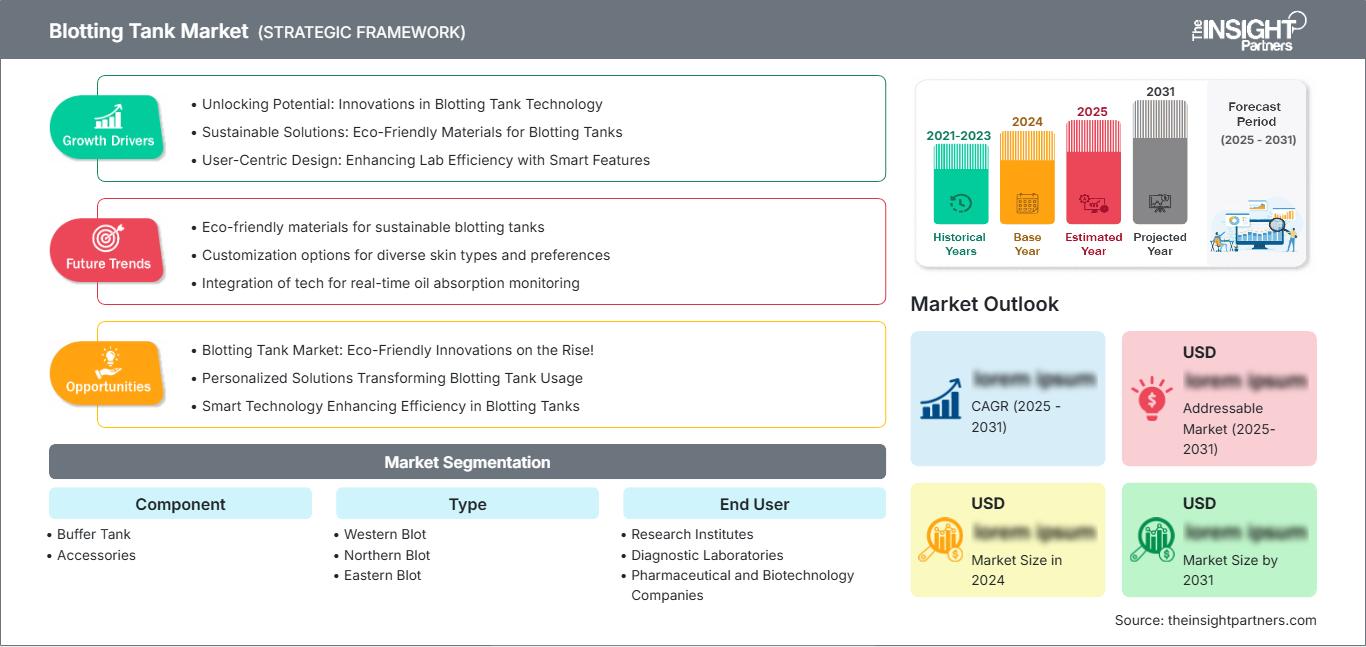
Blotting Tank Market: Strategic Insights
Regional Insights
North America Blotting Tank Market
North America held 36–39% Blotting Tank Market share in 2025 and is expected to advance at a CAGR of 8.1–8.5% during 2026–2034. The region benefits from dense biopharmaceutical research clusters, university proteomics cores, and well-funded translational research programs. Demand is also supported by recurring western blot validation needs in oncology, immunology, neurobiology, and cell therapy development.
The US drives regional procurement through replacement of aging electrophoresis systems and adoption of semi-dry transfer options in high-throughput laboratories. Canada contributes through academic research institutes and public health laboratories. Supplier access is mature, with direct sales, national distributors, and technical support teams improving instrument standardization across multi-site research groups.
U.S. Blotting Tank Market
The US constituted 78-82% of North America in 2025 and is predicted to expand at a CAGR of 8.2-8.6% from 2026-2034. Market demand will be high among university-based medical facilities, biotechnology firms, federally funded research institutes, and contract research organizations. Usage patterns include phosphoprotein study, antibody verification, biologics identification, and protein expression analysis confirmation.
Competition in the market is high with companies such as Thermo Fisher Scientific Inc., Bio-Rad Laboratories, Inc., Cell Signaling Technology, Inc., GenScript Biotech Corporation, and Hoefer, Inc. being active participants providing instruments, reagents, and antibodies to research laboratories. The requirement for replacement will be driven by harmonization of workflow, electronic laboratory documentation, and lowering failed transfers in federally funded research projects.
Europe Blotting Tank Market
The European region constituted a share of 27-30% in 2025, with an estimated CAGR of 7.6-8.1% for the period of 2026-2034. Germany has been dominating owing to presence of life science manufacturing companies, research facilities in universities and biotechnology applications. The UK continues its demand owing to biomedical research centers, cell therapy programs and academia-based proteomics with standard western blot protocols.
France, Italy and Spain provide their contribution owing to cancer research centers, public university laboratories and diagnostic instruments. Purchase is driven by framework contracts and distributor relationships with preference for instruments with proven performance and durability. Blotting Tank Market in Europe is also affected by sustainability considerations where products with reusable parts and long product lifecycles are favored.
APAC Blotting Tank Market
In 2025, APAC had 22-25% market share and is expected to witness growth at a CAGR of 9.4-10.1% between 2026 and 2034. The largest market in the region will be China, followed by Japan, South Korea, India, and Australia. The growth in the market can be attributed to increasing investments in biotech parks, laboratories, and local R&D on biologics.
Supportive policies related to manufacturing, clinical research, and molecular diagnostics encourage investments in the instruments. Local distributors play a significant role in providing services, while multinationals get advantage due to demand for validated protocols in international research studies.
Middle East & Africa Blotting Tank Market
Middle East & Africa is expected to register a CAGR of 6.8–7.4% during 2026–2034, with Saudi Arabia, the UAE, South Africa, and the Rest of MEA forming the core demand base. Growth is linked to healthcare infrastructure modernization, university research funding, and national biotechnology initiatives.
Saudi Arabia leads regional adoption through investments in medical research institutes and laboratory infrastructure. The UAE supports procurement through academic hospitals and life science free zones, while South Africa remains important for infectious disease and public health research. Energy-funded diversification programs indirectly support laboratory equipment demand.
Segmentation Analysis
Product Type
The product type segment is projected to grow at a CAGR of 8.4–8.9% during 2026–2034. Blotting Tank Market scope is expanding as laboratories evaluate wet, semi-dry, and automated systems based on throughput, transfer efficiency, protein size, and reproducibility. Wet tanks dominate legacy use, while automated platforms gain ground where protocol standardization and lower user intervention are priorities.
- Wet Transfer Tanks remain the largest sub-segment because they support broad protein molecular weights, flexible buffer systems, and well-established protocols in academic and biopharmaceutical laboratories.
- Semi-Dry Transfer Tanks attract laboratories seeking faster transfer times, lower buffer usage, and compact benchtop workflows for routine confirmation studies and medium-throughput western blotting.
- Automated Blotting Systems are strategically important for regulated research environments where repeatability, time savings, and reduced operator variability influence procurement decisions.
Application
The application segment is expected to grow at a CAGR of 8.2–8.8% during 2026–2034. Western blotting accounts for the strongest demand because it remains a widely accepted confirmatory technique in protein expression and antibody validation. Southern and northern blotting retain relevance in specialized nucleic acid workflows, particularly where established protocols or confirmatory assays are required.
- Western Blotting generates the highest revenue contribution due to routine use in protein validation, target pathway studies, antibody testing, and translational research programs.
- Southern Blotting remains relevant in genetic confirmation workflows, especially in laboratories that require established DNA transfer methods for specific research protocols.
- Northern Blotting serves RNA expression analysis needs in selected academic and molecular biology laboratories where transcript size and integrity confirmation remain important.
End User
The end user segment is projected to grow at a CAGR of 8.5–9.1% during 2026–2034. Academic and research institutes represent the core installed base, while biopharmaceutical companies are increasing purchases for biologics, cell therapy, and target validation work. Diagnostic and contract research laboratories adopt systems when workflow consistency directly affects project turnaround.
- Academic and Research Institutes account for recurring demand because teaching labs, core facilities, and grant-funded research groups require dependable transfer systems.
- Biopharmaceutical Companies purchase higher-performance platforms to support protein characterization, biomarker validation, cell therapy research, and biologics development workflows.
- Diagnostic Laboratories adopt blotting equipment for specialized confirmatory testing and assay development, particularly where protein detection supports disease research.
- Contract Research Organizations value standardized systems that enable reproducible client projects, faster turnaround, and transferable assay conditions across study teams.
Opportunity Snapshot
| End User | Revenue Contribution | Trend Tag | Adoption Stage |
| Academic and Research Institutes | High | Core Labs | Mature |
| Biopharmaceutical Companies | High | Biologics R&D | Scaling |
| Diagnostic Laboratories | Medium | Confirmatory Testing | Scaling |
| Contract Research Organizations | Medium | Outsourced Assays | Scaling |
Blotting Tank Market Growth Drivers and Impact Analysis
Rising Protein Research Across Translational Science
The study of proteins is still crucial in discovering new therapies, validating biomarkers and exploring disease pathways, as genomic signatures frequently require protein level verification. The Blotting Tank Market will be supported by this trend since western blots continue to serve as a connection between omics-based research and protein-based experiments. In labs investigating diseases such as cancer, neurodegenerative diseases, immunological diseases, and infectious diseases, reliable membrane transfer for comparative protein expression analysis is required. This leads to a constant need for tanks, electrodes, cassettes, membranes, and buffer solutions. These factors affect the Blotting Tank Market through repurchase decisions, workflow standardization, and increasing accessory needs for failed transfers prevention.
Shift Toward Reproducible and Documented Workflows
There is a demand for research institutions to increase reproducibility whenever there is protein information used in the publication of papers, investigational tests, and preclinical testing decisions. Inconsistencies in transfer may have an effect on the intensity of bands, normalization, and subsequent analysis of results, thus making the quality of instruments a productivity issue. There is a change in the demand from simple machines to equipment that offers good distribution of current, alignment of cassettes, thermal stability, and suitability to the standardized protocols. It drives premiumization of the Blotting Tanks Market because laboratories will be able to justify increased costs in systems that reduce the need for repeated tests.
Biopharmaceutical Expansion in Emerging Research Hubs
Biopharmaceutical capacity is expanding in China, India, South Korea, the Middle East, and parts of Eastern Europe, creating new demand for protein biology equipment. Early-stage biologics, biosimilars, antibody discovery, and cell therapy work all require routine protein expression confirmation. Blotting tanks are relatively low-cost compared with advanced analytical platforms, making them accessible entry equipment for laboratories building broader molecular biology capabilities. This supports distributor-led growth and localized inventory strategies. The market impact is strongest where public investment in biotechnology parks is paired with private CRO expansion, creating recurring purchases of tanks, consumables, and replacement parts across newly established laboratories.
Blotting Tank Market Future Trends
Automation Moving into Routine Protein Transfer
Blotting Tank Market trends point toward broader adoption of automated and semi-automated transfer systems that reduce operator variability and shorten protocol time. Future systems are expected to integrate preprogrammed transfer conditions, cassette recognition, and compatibility with digital lab records. This evolution will not eliminate wet tanks, but it will shift premium growth toward platforms that support repeatable workflows across multi-user laboratories. Automated systems will be especially attractive in CROs, biopharma research teams, and core facilities where failed transfers create measurable productivity losses. Suppliers that combine automation with validated consumable kits can capture stronger lifetime value.
Workflow Bundling Around Antibodies and Imaging
The market is expected to move further toward complete protein analysis workflows rather than standalone equipment sales. Vendors with antibodies, membranes, buffers, imaging systems, and analysis software can position blotting tanks as part of a validated chain from gel separation to quantification. This trend supports cross-selling and improves customer retention because laboratories prefer fewer compatibility risks. Future differentiation will depend on how effectively suppliers demonstrate transfer quality across protein sizes, detection chemistries, and membrane types. Bundled workflows may also help smaller laboratories adopt best-practice methods without extensive internal optimization.
Blotting Tank Market Opportunities
Localized Distribution and Service Models in APAC
Blotting Tank Market Forecasts indicate attractive opportunities for suppliers that build stronger local distribution, service, and training capabilities in APAC. Many laboratories in China, India, South Korea, and Southeast Asia are expanding protein research capacity but still rely on distributor guidance for system selection and protocol setup. Companies can improve conversion by offering application notes, bundled starter kits, and regional technical support. Localized inventory of electrodes, cassettes, gaskets, and compatible membranes can reduce downtime and strengthen customer loyalty. The opportunity is practical rather than speculative, as equipment adoption follows ongoing investment in biotech parks, academic research, and biosimilar development.
Premium Replacement in Mature Academic Laboratories
A sizable opportunity exists in replacing older wet transfer tanks installed across universities and public research institutes. Many legacy systems still function, but inconsistent electrodes, aging cassettes, and poor thermal control can affect experimental repeatability. Suppliers can target these laboratories with durable, modular systems that fit existing gel formats while improving transfer efficiency. Replacement campaigns should focus on productivity, lower repeat-run costs, and compatibility with modern fluorescent detection. This opportunity is strongest in North America and Europe, where laboratory budgets often prioritize reliability upgrades over entirely new workflow changes. It also supports recurring accessory and consumable revenue.
Recent Developments
- May 2026: Bio-Rad Laboratories, Inc. expanded its TrailBlazer antibody conjugation kit range for StarBright dyes, supporting flow cytometry and fluorescent western blot applications. The development strengthens the company’s protein detection ecosystem and complements demand for reproducible blot transfer systems used before fluorescent imaging and multiplexed antibody detection.
- May 2026: Thermo Fisher Scientific Inc. unveiled next-generation Orbitrap platforms and AI-enabled analytical tools at ASMS 2026, reinforcing its broader proteomics strategy. Although focused on mass spectrometry, the launch reflects rising demand for deeper protein analysis workflows, supporting upstream laboratory infrastructure such as electrophoresis and blot transfer systems.
- March 2026: GenScript Biotech Corporation reported strong FY2025 results and highlighted continued demand for gene-to-protein businesses, research products, and life science instruments. The update reinforces the company’s positioning across protein expression, antibody development, and laboratory workflow tools, including electrophoresis and blotting-related systems.
Frequently Asked Questions

- Comprehensive Market Sizing and Forecast Analysis
- Detailed Segmentation Analysis
- In-Depth Market Dynamics Assessment
- Regional and Country-Level Insights
- Competitive Landscape and Company Benchmarking
- Strategic Business Intelligence
Recent Reports
Testimonials

The Insight Partners' SCADA System Market report is comprehensive, with valuable insights on current trends and future forecasts. The team was highly professional, responsive, and supportive throughout. We are very satisfied and highly recommend their services.
RAN KEDEM Partner, Reali Technologies LTDs
I requested a report on a very specific software market and the team produced the report in a few days. The information was very relevant and well presented. I then requested some changes and additions to the report. The team was again very responsive and I got the final report in less than a week.
JEAN-HERVE JENN Chairman, Future Analytica
We worked with The Insight Partners for an important market study and forecast. They gave us clear insights into opportunities and risks, which helped shape our plans. Their research was easy to use and based on solid data. It helped us make smart, confident decisions. We highly recommend them.
PIYUSH NAGPAL Sr. Vice President, High Beam Global
The Insight Partners delivered insightful, well-structured market research with strong domain expertise. Their team was professional and responsive throughout. The user-friendly website made accessing industry reports seamless. We highly recommend them for reliable, high-quality research services
YUKIHIKO ADACHI CEO, Deep Blue, LLC.
This is the first time I have purchased a market report from The Insight Partners.While I was unsure at first, I visited their web site and felt more comfortable to take the risk and purchase a market report.I am completely satisfied with the quality of the report and customer service. I had several questions and comments with the initial report, but after a couple of dialogs over email with their analyst I believe I have a report that I can use as input to our strategic planning process.Thank you so much for taking the extra time and making this a positive experience.I will definitely recommend your service to others and you will be my first call when we need further market data.
JOHN SUZUKI President and Chief Executive Officer, Board Director, BK Technologies
I wish to appreciate your support and the professionalism you displayed in the course of attending to my request for information regarding to infectious disease IVD market in Nigeria. I appreciate your patience, your guidance, and the fact that you were willing to offer a discount, which eventually made it possible for us to close a deal. I look forward to engaging The Insight Partners in the future, all thanks to the impression you have created in me as a result of this first encounter.
DR CHIJIOKE ONYIA MANAGING DIRECTOR, PineCrest Healthcare Ltd.Reason to Buy
- Informed Decision-Making
- Understanding Market Dynamics
- Competitive Analysis
- Identifying Emerging Markets
- Customer Insights
- Market Forecasts
- Risk Mitigation
- Boosting Operational Efficiency
- Strategic Planning
- Investment Justification
- Tracking Industry Innovations
- Aligning with Regulatory Trends





 Get Free Sample for