Hydrocarbon Resins Market Share, Size & Demand by 2034
Hydrocarbon Resins Market Size and Forecast (2021 - 2034), Global and Regional Share, Trend, and Growth Opportunity Analysis Report Coverage: By Type (C5 Petroleum Resins, C9 Petroleum Resins, C5/C9 Petroleum Resins, and Others) and Application (Adhesives and Sealants, Printing Inks, Rubber Compounding, Paints and Coatings, Tapes and Labels, and Others)
Historic Data: 2021-2024 | Base Year: 2025 | Forecast Period: 2026-2034- Report Date : Apr 2026
- Report Code : TIPRE00016535
- Category : Chemicals and Materials
- Status : Upcoming
- Available Report Formats :


- No. of Pages : 150

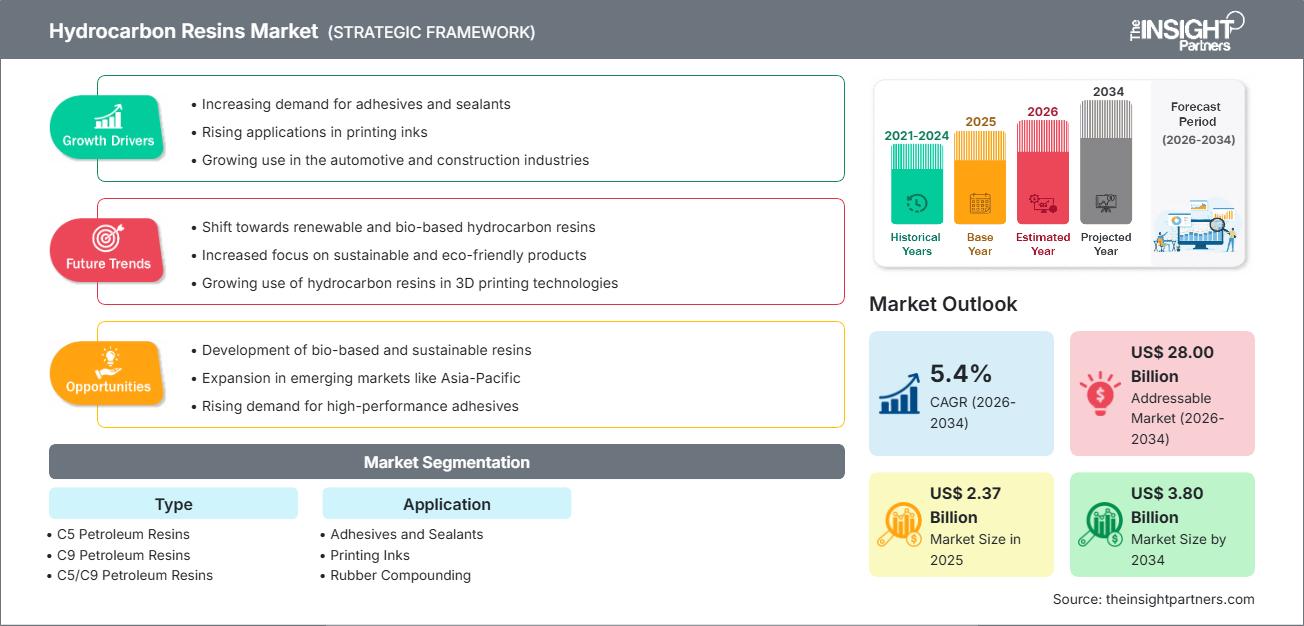
The global Hydrocarbon Resins market size is projected to reach US$ 3.80 billion by 2034 from US$ 2.37 billion in 2025. The market is anticipated to register a CAGR of 5.4% during the forecast period 2026–2034. Key market dynamics include the rising demand for high-performance tackifiers in the packaging industry, significant infrastructure investments in emerging economies, and the rapid expansion of the electric vehicle (EV) sector, which requires advanced lightweight bonding solutions. Additionally, the market is expected to benefit from technological breakthroughs in hydrogenated resins, a growing shift toward low-VOC formulations in paints and coatings, and the increasing utilization of C5 and C9 resins in medical-grade adhesives.
Hydrocarbon Resins Market Analysis
The hydrocarbon resins market analysis indicates a critical strategic pivot toward specialized, high-purity resins to meet stringent environmental and performance standards. As industries transition away from traditional mechanical fastening, the demand for resin-based adhesives in the automotive and aerospace sectors is creating a high-margin opportunity for manufacturers. Strategic success in this landscape requires investment in R&D to develop bio-based feedstocks and hydrogenated variants that offer superior thermal stability and colorlessness. Furthermore, market participants should focus on localizing production in the Asia-Pacific region to capitalize on the manufacturing boom, while simultaneously adopting circular economy practices to mitigate the regulatory risks associated with petroleum-derived products.
Hydrocarbon Resins Market Overview
Hydrocarbon resins serve as a backbone for the global specialty chemicals industry, providing essential thermoplastic polymers used across diverse industrial sectors. Derived primarily from the polymerization of unsaturated hydrocarbons found in petroleum streams, these resins are valued for their exceptional tackifying properties, water resistance, and compatibility with various elastomers. The market is currently experiencing a transition from commodity-grade C5 and C9 resins to value-added, modified, and hydrogenated grades that cater to premium segments such as hygiene products and high-end electronics. While global supply chains remain influenced by crude oil price volatility, the consistent demand from the construction and e-commerce-driven packaging sectors provides a stable foundation for long-term growth. For instance, the market in the US is characterized by a high degree of technological maturity and a robust demand for high-specification resins in the automotive and aerospace industries. Driven by advanced manufacturing processes and stringent environmental regulations, the region emphasizes low-emission and high-performance bonding solutions across domestic construction and industrial infrastructure projects.
Customize This Report To Suit Your Requirement
Get FREE CUSTOMIZATIONHydrocarbon Resins Market: Strategic Insights
-
Get Top Key Market Trends of this report.This FREE sample will include data analysis, ranging from market trends to estimates and forecasts.
Hydrocarbon Resins Market Drivers and Opportunities
Market Drivers:
- Expansion of E-commerce and Packaging: The global surge in online retail has necessitated high-speed, reliable packaging solutions, driving the consumption of hot-melt adhesives formulated with hydrocarbon resin tackifiers.
- Automotive Lightweighting Trends: The shift toward fuel-efficient and electric vehicles is increasing the use of structural adhesives and rubber compounding, where hydrocarbon resins improve performance and durability.
- Infrastructure and Construction Growth: Rising urbanization and government-led infrastructure projects globally are fueling the demand for road-marking paints, sealants, and waterproofing membranes.
Market Opportunities:
- Development of Bio-based Alternatives: Increasing pressure to reduce carbon footprints offers significant potential for producers to innovate with renewable feedstocks that mimic the performance of petroleum resins.
- Niche Applications in Medical and Hygiene: High-purity hydrogenated resins present lucrative opportunities in the production of surgical tapes, wound dressings, and feminine hygiene products.
- Strategic Partnerships in Emerging Corridors: Collaboration between global petrochemical leaders and regional distributors in Southeast Asia and India can unlock high-growth manufacturing hubs.
Hydrocarbon Resins Market Report Segmentation Analysis
The Hydrocarbon Resins Market share is analyzed across various segments to provide a clearer understanding of its structure, growth potential, and emerging trends. Below is the standard segmentation approach used in most industry reports:
By Category:
- Organic: A fast-growing niche that aligns with global sustainability trends. It is increasingly preferred by high-income consumers who prioritize animal welfare and chemical-free production.
- Conventional: The dominant volume driver, particularly within the traditional European cheese and yogurt manufacturing sectors, due to established supply chains and cost efficiencies.
By Distribution Channel:
- Supermarkets & Hypermarkets: Remain the primary channel for fresh dairy, yogurts, and premium cheeses, benefiting from the expansion of specialty and imported food sections.
- Online Retail: The fastest-rising channel, especially for dry goods like milk powders and D2C artisanal farm brands, enabling cross-border premium imports.
- Convenience Stores: Offers a select but growing range of grab-and-go sheep-milk snacks and individual yogurt servings in urban markets.
By Geography:
- North America
- Europe
- Asia Pacific
- South & Central America
- Middle East & Africa
Hydrocarbon Resins Market Report Scope
| Report Attribute | Details |
|---|---|
| Market size in 2025 | US$ 2.37 Billion |
| Market Size by 2034 | US$ 3.80 Billion |
| Global CAGR (2026 - 2034) | 5.4% |
| Historical Data | 2021-2024 |
| Forecast period | 2026-2034 |
| Segments Covered |
By Type
|
| Regions and Countries Covered |
North America
|
| Market leaders and key company profiles |
|
Hydrocarbon Resins Market Players Density: Understanding Its Impact on Business Dynamics
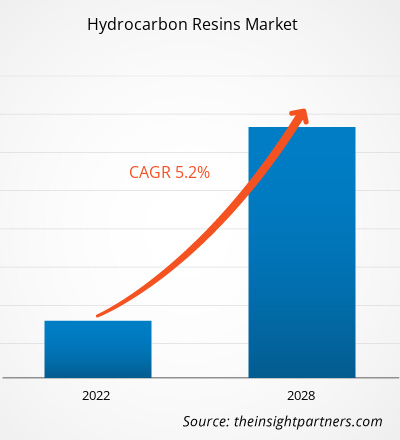
The Hydrocarbon Resins Market is growing rapidly, driven by increasing end-user demand due to factors such as evolving consumer preferences, technological advancements, and greater awareness of the product's benefits. As demand rises, businesses are expanding their offerings, innovating to meet consumer needs, and capitalizing on emerging trends, which further fuels market growth.
Hydrocarbon Resins Market Share Analysis by Geography
Asia-Pacific is expected to grow the fastest and maintain its lead as the largest market. North America and Europe remain pivotal due to their focus on high-performance grades and sustainable resin technologies.
The hydrocarbon resins market is undergoing a significant transformation, moving from a standard petroleum byproduct to a global high-value specialty chemical. Growth is driven by the rising demand for high-performance tackifiers in the packaging sector, a surge in "lightweighting" trends within the automotive industry, and the expansion of the sustainable infrastructure and construction sectors. Below is a summary of market share and trends by region:
North America
- Market Share: A mature and dominant segment (approx. 22-25% share) driven by robust petrochemical infrastructure and high consumption of industrial adhesives.
- Key Drivers:
- Strong recovery in the domestic construction sector and rising infrastructure maintenance
- High demand for specialized hydrogenated resins in the hygiene and medical industries
- Expansion of the e-commerce logistics network requires advanced hot-melt adhesives.
- Trends: Increasing focus on low-VOC (Volatile Organic Compound) formulations and the development of mass-balance certified sustainable resin systems to meet corporate ESG goals.
Europe
- Market Share: A significant market characterized by a strong regulatory push for high-purity and eco-friendly chemical inputs.
- Key Drivers:
- Strict REACH and food-contact safety regulations are driving the adoption of premium hydrogenated grades.
- Growth in the automotive sector, specifically for specialty rubber compounding in high-performance tires
- Robust demand for road-marking resins tied to regional transportation safety initiatives
- Trends: A strategic shift toward "circular" chemistry and bio-based resin alternatives, with a high priority on technical documentation and product safety compliance.
Asia-Pacific
- Market Share: The largest and fastest-growing region globally, serving as the central hub for mass manufacturing and resin production.
- Key Drivers:
- Rapid urbanization in China and India is fueling massive demand for construction sealants and coatings.
- Presence of global manufacturing powerhouses for electronics and automotive components
- Growing middle-class disposable income is leading to a surge in flexible packaging demand.
- Trends: Massive capacity expansions in integrated petrochemical complexes and an increasing shift from commodity C5/C9 grades to high-end hydrogenated resins for the export market.
South and Central America
- Market Share: An emerging market with steady growth tied to the automotive and industrial manufacturing sectors in Brazil and Chile.
- Key Drivers:
- Rising investments in regional tire manufacturing and rubber processing facilities
- Increasing adoption of modern packaging technologies in the food and beverage industry
- Expansion of domestic infrastructure projects requiring cost-effective adhesive solutions
- Trends: Growth of localized supply chains to mitigate import costs and a rising interest in C9 resins for architectural and protective coatings.
Middle East and Africa
- Market Share: A developing market leveraging its vast feedstock reserves to move downstream into resin production.
- Key Drivers:
- Large-scale "Smart City" and infrastructure projects across the GCC region are driving asphalt and adhesive demand.
- Strategic investments in integrated crackers to localize the value chain for specialty chemicals
- Growing demand for shelf-stable packaging and hygiene products in arid climates
- Trends: Implementation of modern polymerization technologies to produce high-quality precursors and a focus on expanding export corridors to European and Asian markets.
High Market Density and Competition
Competition is intensifying due to the presence of established leaders such as Eastman Chemical Company, EXXON MOBIL CORPORATION, Kolon Industries Inc., Shandong Landun Petroleum Resin Co., Ltd., Puyang Tiancheng Chemical Co., Ltd., Shanghai Jinsen Hydrocarbon Resins Co., Ltd, Lesco Chemical Limited, Henan Anglxxon Chemical Co., Ltd., and Arakawa Chemical Industries, Ltd, also contributing to a diverse and rapidly expanding market landscape.
The competitive landscape is characterized by the presence of global chemical giants and specialized regional players. Differentiation is achieved through:
- Hydrogenation Capabilities: Offering clear, odorless resins for the most sensitive hygiene and medical applications.
- Feedstock Integration: Major players leverage vertical integration with refineries to ensure a stable supply of C5 and C9 streams.
- Sustainable Innovation: Developing resins with lower environmental impact to appeal to ESG-conscious industrial clients.
Opportunities and Strategic Moves
- Expansion into Electric Vehicle (EV) Infrastructure: The rapid electrification of global automotive fleets presents a significant opportunity for specialized resin formulations. EV assembly requires advanced structural adhesives and battery encapsulants with enhanced thermal conductivity and flame retardancy, creating a high-margin niche for tailored hydrocarbon resin solutions.
- Vertical Integration and Supply Chain Optimization: To mitigate the impact of crude oil price volatility, major players are increasingly pursuing vertical integration by securing long-term feedstock contracts or operating their own upstream polymerization units. Additionally, the digitalization of supply chains using AI-driven tools is being used to enhance production consistency and reduce energy consumption.
Major Companies operating in the Hydrocarbon Resins Market are:
- Eastman Chemical Company
- EXXON MOBIL CORPORATION
- Kolon Industries Inc.
- Shandong Landun Petroleum Resin Co., Ltd.
- Puyang Tiancheng Chemical Co., Ltd.
- Shanghai Jinsen Hydrocarbon Resins Co., Ltd
- Lesco Chemical Limited
- Henan Anglxxon Chemical Co., Ltd.
- Arakawa Chemical Industries, Ltd.
Disclaimer: The companies listed above are not ranked in any particular order.
Hydrocarbon Resins Market News and Recent Developments
- In January 2024, Evonik manufactured the first product from its industrial-scale facility for sustainable biosurfactants, which was completed ahead of schedule at its site in Slovakia. This landmark development ensured that the company remained well-positioned to meet the surging demand for bio-based alternatives, much like the evolving demand seen in the Hydrocarbon Resins market for high-performance, sustainable tackifiers. The new plant became the first worldwide to produce sustainable rhamnolipid biosurfactants. Evonik's rhamnolipids reached an exceptionally high quality and provided the company with a unique market position due to the IP-protected, fermentation-based manufacturing process.
- In March 2024, SABIC introduced its LNP™ ELCRES™ SLX1271SR resin as a significant addition to the weatherable LNP SLX copolymer portfolio. Much like the performance-driven additives required in the Hydrocarbon Resins market, this specialty material featured enhanced scratch and mar resistance alongside a high-gloss surface finish. Developed to provide the automotive industry with a new molded-in color solution for exterior components, the LNP ELCRES SLX1271SR resin also delivered exceptional weatherability, continuous UV stability, and robust mechanical performance. By adopting this innovative solution, customers leveraged the environmental and potential system cost advantages of paint elimination while maintaining the attractive appearance of exterior parts over time.
Hydrocarbon Resins Market Report Coverage and Deliverables
The "Hydrocarbon Resins Market Size and Forecast (2021–2034)" report provides a detailed analysis of the market covering below areas:
- Hydrocarbon Resins Market size and forecast at global, regional, and country levels for all the key market segments covered under the scope
- Hydrocarbon Resins Market trends, as well as market dynamics such as drivers, restraints, and key opportunities
- Detailed PEST and SWOT analysis
- Hydrocarbon Resins Market analysis covering key market trends, global and regional framework, major players, regulations, and recent market developments
- Industry landscape and competition analysis covering market concentration, heat map analysis, prominent players, and recent developments in the Hydrocarbon Resins Market.
- Detailed company profiles
Frequently Asked Questions

- Historical Analysis (2 Years), Base Year, Forecast (7 Years) with CAGR
- PEST and SWOT Analysis
- Market Size Value / Volume - Global, Regional, Country
- Industry and Competitive Landscape
- Excel Dataset
Recent Reports
Testimonials

The Insight Partners' SCADA System Market report is comprehensive, with valuable insights on current trends and future forecasts. The team was highly professional, responsive, and supportive throughout. We are very satisfied and highly recommend their services.
RAN KEDEM Partner, Reali Technologies LTDs
I requested a report on a very specific software market and the team produced the report in a few days. The information was very relevant and well presented. I then requested some changes and additions to the report. The team was again very responsive and I got the final report in less than a week.
JEAN-HERVE JENN Chairman, Future Analytica
We worked with The Insight Partners for an important market study and forecast. They gave us clear insights into opportunities and risks, which helped shape our plans. Their research was easy to use and based on solid data. It helped us make smart, confident decisions. We highly recommend them.
PIYUSH NAGPAL Sr. Vice President, High Beam Global
The Insight Partners delivered insightful, well-structured market research with strong domain expertise. Their team was professional and responsive throughout. The user-friendly website made accessing industry reports seamless. We highly recommend them for reliable, high-quality research services
YUKIHIKO ADACHI CEO, Deep Blue, LLC.
This is the first time I have purchased a market report from The Insight Partners.While I was unsure at first, I visited their web site and felt more comfortable to take the risk and purchase a market report.I am completely satisfied with the quality of the report and customer service. I had several questions and comments with the initial report, but after a couple of dialogs over email with their analyst I believe I have a report that I can use as input to our strategic planning process.Thank you so much for taking the extra time and making this a positive experience.I will definitely recommend your service to others and you will be my first call when we need further market data.
JOHN SUZUKI President and Chief Executive Officer, Board Director, BK Technologies
I wish to appreciate your support and the professionalism you displayed in the course of attending to my request for information regarding to infectious disease IVD market in Nigeria. I appreciate your patience, your guidance, and the fact that you were willing to offer a discount, which eventually made it possible for us to close a deal. I look forward to engaging The Insight Partners in the future, all thanks to the impression you have created in me as a result of this first encounter.
DR CHIJIOKE ONYIA MANAGING DIRECTOR, PineCrest Healthcare Ltd.Reason to Buy
- Informed Decision-Making
- Understanding Market Dynamics
- Competitive Analysis
- Identifying Emerging Markets
- Customer Insights
- Market Forecasts
- Risk Mitigation
- Boosting Operational Efficiency
- Strategic Planning
- Investment Justification
- Tracking Industry Innovations
- Aligning with Regulatory Trends




 Get Free Sample For