
Sorting Machines Market Size, Share & Demand by 2034
Coverage: by Type (Belt Sorter, Freefall Sorter, Channel Sorter, Others); End-user (Food, Chemical, Plastic, Pharmaceutical, Packaging, Agriculture, Others), and Geography (North America, Europe, Asia Pacific, and South and Central America)
- Status : Data Released
- Report Code : TIPRE00013175
- Category : Manufacturing and Construction
- No. of Pages : 150
- Available Report Formats :


- Last update date : October 30, 2026


2025 Market Size
US$ 4.96 Bn
Base year value
2034 Forecast
US$ 10.82 Bn
Projected by 2034
CAGR 2026-2034
9.05 %
Growth rate
Addressable Market
US$ 70.58 Bn
(2026-2034)
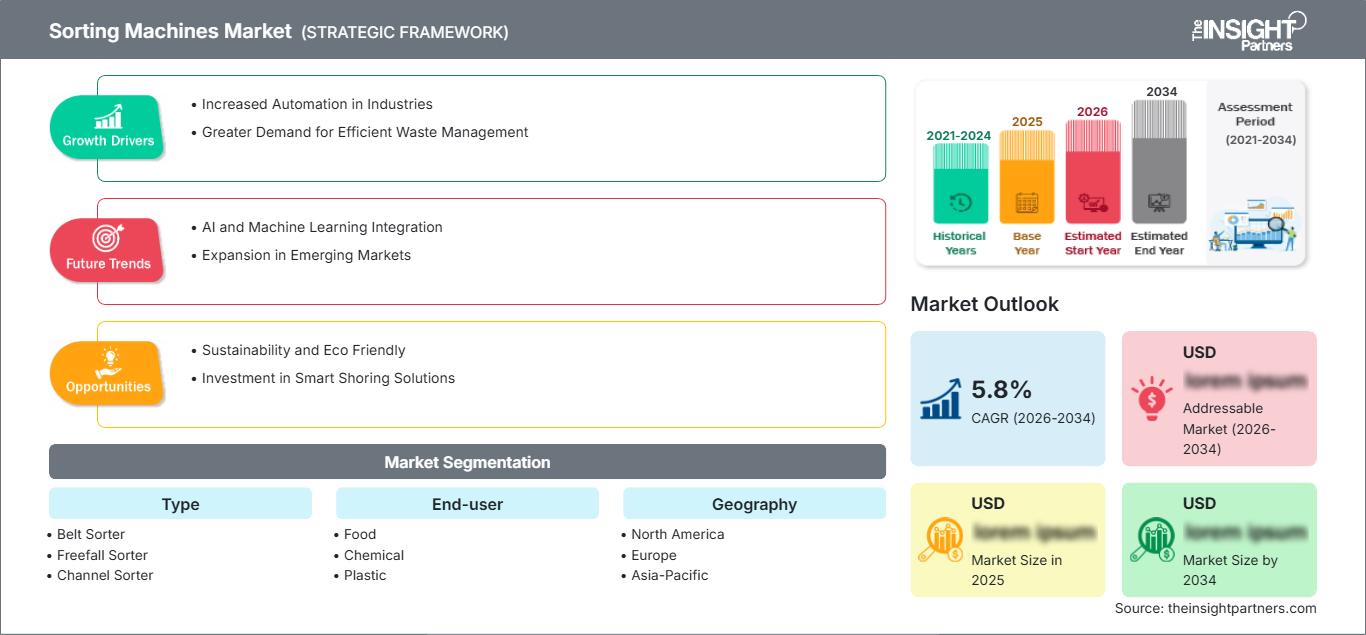
The Sorting Machines market was valued at US$ 4.96 Billion in 2025 and is projected to reach US$ 10.82 Billion by 2034, registering a CAGR of 9.05% during 2026–2034. The Demand is increasing in sectors like food, chemicals, plastic, pharmaceutical, packaging, and agriculture as consumers aim to achieve greater efficiency, better quality grades, reduce losses, and minimize their reliance on manual sorting. The Market is now in for an extended period of growth with the automation of processes like inspection, sorting, and quality control among others.
North America is projected to grow at a CAGR of about 8% through 2034, driven by the need for replacements of old inspection systems and stringent demands in food safety, recycled content purity, and labor-efficient processing. The Market Size of the Sorting Machines Market in North America is further driven by well-established infrastructures in food, packaging, and materials recovery industries, where buyers increasingly utilize machine vision, near infrared sensing, x-ray detections, and service tools.
Sorting Machines Market Assessment and Insights
Regional Outlook
- North America: ~35% of the global market in 2025 | ~8% CAGR through 2034. Market position: The region leads through a large installed base, stringent quality controls, mature recycling infrastructure, and rapid adoption of AI-enabled optical systems.
- US: ~78% of North American market revenue in 2025 | ~8% CAGR through 2034. Market position: The US anchors regional demand through automated food plants, material recovery facilities, parcel hubs, and strong technology-provider coverage.
- Europe: ~29% of the global market in 2025 | ~8% CAGR through 2034. Market position: A mature installed base and circular-economy rules sustain upgrades, with Germany leading and the UK, France, Italy, and Spain contributing application diversity.
- Asia Pacific: ~27% of the global market in 2025 | ~11% CAGR through 2034. Market position: It is the fastest-growing region as China, Japan, South Korea, India, and Australia expand processing capacity and automate quality assurance.
Segment Outlook
- Food: ~36% Share in 2025 | ~9% CAGR through 2034. Market position: Food leads because high-volume processors require repeatable removal of defects, allergens, foreign material, and off-grade product without sacrificing usable yield.
- Pharmaceutical: ~12% Share in 2025 | ~11% CAGR through 2034. Market position: Growth reflects stricter contamination control, serialization-compatible inspection workflows, and investment in automated, validated production lines.
Competitive Coverage
TOMRA Systems ASA, BarcoVision, Daewon GSI Co., Ltd., Binder+Co AG, Dematic Corp., Bühler AG, Sesotec GmbH, Raytec Vision S.p.A., Concept Engineers B.V., Satake Corporation, CP Global, National Recovery Technologies, GREEFA, Allgaier Process Technology GmbH, Cumbria Waste Group Ltd.
Methodology
The Insight Partners follows Data Collection & Secondary Research, Primary Research, Data Analysis, and Data Triangulation & Final Review to validate market estimates and insights.
Source: The Insight Partners' analysis based on proprietary research, government publications, company annual reports, investor presentations, industry databases, and expert interviews.
Sorting technologies have evolved from mechanized sorting and basic color sorting techniques to multisensory devices employing high-definition cameras, near infrared spectroscopy, laser, X-rays, shape recognition and artificial intelligence. The design trends have moved to modular chute designs, sanitary frames, faster ejector valves, and recipe control systems, helping recover more of the good materials and enabling processing of more diverse feedstock. Equipment manufacturers are now offering their equipment coupled with remote diagnostics tools, monitoring dashboards and application libraries, converting the sorter to a quality control monitoring station.
For the forecasted period until 2034, the growing centers of manufacturing and food processing in Asia Pacific, Middle East, and chosen Africa locations are likely to play an important role in adding new units. Capital investment would go towards the equipment that can process different products and proves itself via yield retention, as well as flexibility in dealing with diverse input materials. Regulations on package waste, food safety regulation enforcement, recycled content requirements and traceability would provide a favorable regulatory environment, while local integration possibilities would determine the uptake rate beyond the developed world.
Sorting Machines Market Report Scope
| Report Attribute | Details |
|---|---|
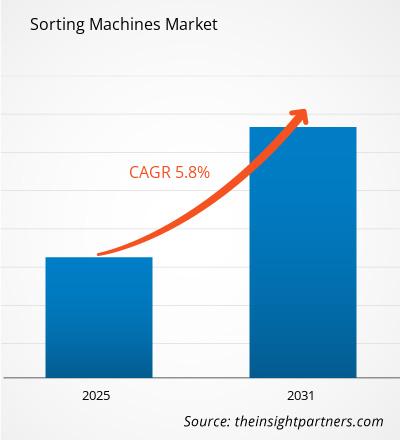
| Market size in 2025 | US$ 4.96 Billion |
| Market Size by 2034 | US$ 10.82 Billion |
| Global CAGR (2026 - 2034) | 9.05% |
| Historical Data | 2021-2024 |
| Forecast period | 2026-2034 |
Sorting Machines Market Analysis
Sorting Machines Market Growth is due to the cost of non-uniform quality: contamination results in rejection of batches, product recall, downgrading of the product, and unnecessary waste. In food and pharmaceutical facilities, detection capability and cleanability are critical features; in plastics and packaging businesses, polymers recognition and quality of recovered material are most important. Agriculture has additional requirements for high seasonality and variety of products, which requires flexible recipe development and fast calibration.
Market ecosystem comprises sensor vendors, camera and lighting providers, conveyor and feeder makers, software companies, system integrators, and service firms. There is a growing supply chain trend where vendors having optics, algorithms, ejection technologies, and applications knowledge would benefit more due to the short development time related to integration. Customers evaluate the total cost in terms of uptime, false rejects, compressed air usage, maintainability, and yield.
Competitive Dynamics in Sorting Machines Market report highlights an industry that is segmented into diverse automation players and application experts. The first category comprises of TOMRA Systems ASA, Bühler AG, Satake Corporation, Sesotec GmbH and Binder+Co AG. In this case, the competition is focused on sensor penetration and after sale services of the installed base. The other group of competitors includes Raytec Vision S.p.A., GREEFA, CP Global, National Recovery Technologies and Concept Engineers B.V.
The focus of investments in the industry is towards building data sets for AI training, modular systems and remote monitoring systems. The Dematic Corp. is adding automation capabilities to logistics systems; BarcoVision and Daewon GSI Co., Ltd. bring expertise in textiles and grains respectively while Allgaier Process Technology GmbH is bringing process systems integration skills. Differentiation would be through yield increase, application engineering and lifecycle management.
● REPORT CUSTOMIZATION
Tailor This Report To Align With Your Specific Business Requirements
This report can be customized to align precisely with your business objectives, scope, and target markets. Customization options include tailored segmentation, geography, competitive analysis, and strategic insights to support informed decision-making.
Customize This Report →WHAT YOU CAN ADJUST
- ● Segmentations
- ● Geography
- ● Competitive Analysis
- ● Language Preferences
Sorting Machines Market: Strategic Insights
Regional Insights
North America Sorting Machines Market
North America commands a modeled ~35% share of the market globally in 2025 and is forecast to record ~8% CAGR from 2026 to 2034. This is based on an abundance of food processing capabilities, existing material recovery facilities, warehouse automation, and stringent requirements by buyers for removal of contamination. The Sorting Machines Market is also driven by a replacement cycle where users upgrade simple color sorters to connected multisensor systems capable of measuring purity, yield, and down time.
Adoption is increasingly supported by the avoidance of labor costs and quality loss as well as throughput. The Canadian market is supported by demand from grains, pulses, mining, and recycling applications, while the Mexican market is driven by exports of food, packaging, and manufacturing lines. Serviceability is key across the region since calibration, valve upkeep, software upgrades, and applications dictate post-installation performance.
U.S. Sorting Machines Market
U.S. contributes a modeled ~78% Sorting Machines Market share of North American market revenue in 2025 and will grow at ~8% CAGR up to 2034. Big food/beverage manufacturing facilities, plastics recyclers, parcel sortation, and municipal recyclers offer a diversified demand base. The applications feature the combination of optical sorting with air blowing, robot picking, or further analytics to minimize manual quality controls and ensure stable output specifications.
Such companies as TOMRA Systems ASA, Bühler AG, Satake Corporation, Sesotec GmbH, Dematic Corp., CP Global, and National Recovery Technologies have relevant products/services exposure in this market. The purchase decision includes local service, retrofit capability, sanitation, connected machinery cybersecurity, and secure supply of spare parts. The investments are concentrated on the areas where the feedstock quality varies to make manual control impossible or where the contamination impacts food safety and price of recycled material.
Europe Sorting Machines Market
Europe will contribute an estimated ~29% to the total global revenue in 2025 and is estimated to have a ~8% CAGR till 2034 owing to circular economy policies, packaging recyclability, food safety policies, and high cost of labor. Germany is the key market in Europe, driven by engineering of machinery, plastic processing, recycling investments, and supply chain availability.
UK focuses on advanced MRFs, food processing, and automation for parcels. France has the combination of agri-food demand and policy-driven recycling enhancement, whereas Italy has clusters of machinery and fruit, vegetable, pasta, and packaging industries driving specialized installations. In addition to this, Spain also includes produce, nuts, grains, and plastics installations where throughput needs to be consistent even in variable feed conditions.
The competition in Europe is technologically oriented. The companies that participate in competition include Binder+Co AG, Bühler AG, Sesotec GmbH, GREEFA, Raytec Vision S.p.A., Concept Engineers B.V., Allgaier Process Technology GmbH, and TOMRA Systems ASA. The need for retrofitting is important since many factories have the required conveyor systems in place. Therefore, the size of the machine, modular sensors, and energy efficiency may play as significant a role as detection accuracy.
APAC Sorting Machines Market
Asia Pacific has a projected Sorting Machines Market share of ~27% of the world in 2025 and is the highest growing region at a rate of ~11% CAGR until 2034. China is the largest country in the Asia Pacific region, with its abundant food, plastics, packaging, and manufacturing capacities. Japan and South Korea focus on precision, accuracy, and small automation systems, whereas the grains, spices, pulses, and recycling segments of India provide ample greenfield opportunity.
The demand generated from Australia will include agricultural, mining materials handling, and recovery centers. In the region, the combination of policy pressures regarding food quality and waste diversion, along with the increase in wages and export regulations, make the economics for automation more favorable.
Middle East & Africa Sorting Machines Market
The Middle East & Africa market is projected to advance at a modeled ~7% CAGR through 2034. The UAE is positioned as the leading country in the Middle East & Africa where large logistics, food-import, packaging, and waste-management investments support automated inspection. Saudi Arabia’s industrial diversification and food-security initiatives create additional demand for processing equipment.
South Africa provides the region’s broadest established base across fruit exports, grains, mining-linked processing, plastics, and recycling. Elsewhere, adoption remains project-led and concentrated in larger facilities. Energy costs, water constraints, imported-equipment lead times, and technician availability shape purchasing decisions, favoring robust machines with remote diagnostics and configurable sensor packages.
Segmentation Analysis
Type
The Type segment is modeled to grow at a ~9% CAGR during 2026–2034. The Sorting Machines Market scope spans continuous belt inspection, gravity-fed freefall separation, channel-based routing, and specialized configurations. Selection depends on particle geometry, fragility, feed presentation, throughput, hygiene, and the sensor-to-ejector distance needed for reliable removal.
- Belt Sorter: Belt platforms hold a strong position in heterogeneous, fragile, or larger-item streams because controlled presentation improves imaging stability. They are strategically important in recycling, fresh and processed foods, and applications requiring multisensor inspection from more than one angle.
- Freefall Sorter: Freefall systems serve grains, seeds, nuts, pellets, and other flowable products where gravity enables high throughput and compact layouts. Their demand is tied to precise chute design, fast valves, consistent illumination, and low good-product loss.
- Channel Sorter: Channel sorters organize product into defined lanes before inspection and ejection, supporting repeatable trajectories and fine defect removal. They remain important where uniform particle flow, recipe control, and stable high-speed separation outweigh flexibility for irregular objects.
End-user
The End-user main segment is modeled to expand at a ~9% CAGR during 2026–2034. Adoption varies by contamination risk, product value, compliance burden, and feedstock variability. Food accounts for ~36% of 2025 revenue and grows at ~9%, while pharmaceuticals represent ~12% and rise at ~11%, making validation, traceability, and clean design increasingly important.
- Food: Food is the largest end-user segment because processors must remove foreign matter and defects while preserving edible yield. Demand spans grains, nuts, pulses, fruits, vegetables, seafood, and packaged products, with sanitation and allergen control shaping specifications.
- Chemical: Chemical producers use sorting to protect downstream equipment, improve raw-material consistency, and separate off-spec particles. Strategic value rises in high-purity or specialty formulations where contamination creates disproportionate rework, disposal, or customer-acceptance costs.
- Plastic: Plastics applications focus on separating polymers, colors, labels, metals, and contaminants from pellets, flakes, and mixed waste. Recycled-content commitments increase the importance of high-purity output, flexible sensor combinations, and reliable quality documentation.
- Pharmaceutical: Pharmaceutical adoption is smaller but faster-growing, supported by stringent contamination control and automated quality assurance. Systems must fit validated workflows, handle sensitive products, facilitate cleaning, and deliver repeatable inspection suitable for regulated production environments.
- Packaging: Packaging users deploy sorting for recovered paper, polymers, containers, and production scrap. The segment’s strategic role increases as design-for-recycling rules and recycled-content targets shift value toward cleaner, traceable secondary material streams.
- Agriculture: Agricultural demand centers on seeds, grains, pulses, coffee, and export crops. Sorters improve grade consistency, germination quality, and foreign-material removal, while modular capacity and simple operation matter for seasonal facilities and diverse crop mixes.
Opportunity Snapshot
| End Users | Revenue Contribution | Trend Tag | Adoption Stage |
| Food | High | Yield Protection | Mature |
| Chemical | Medium | Purity Control | Scaling |
| Plastic | High | Polymer Purity | Scaling |
| Pharmaceutical | Medium | Validated Inspection | Scaling |
| Packaging | Medium | Recycled Content | Scaling |
| Agriculture | High | Seed Quality | Mature |
| Others | Low | Niche Automation | Emerging |
Sorting Machines Market Growth Drivers and Impact Analysis
Automation Economics and Skilled-Labor Constraints
Persistent hiring difficulty in repetitive inspection roles is changing the investment case for automated sorting. A machine can operate at line speed, apply the same rejection logic across shifts, and generate data that supervisors use to diagnose upstream process losses. The impact is strongest in high-throughput food, plastics, packaging, and agricultural plants, where a small improvement in retained good product can materially affect margins. Buyers therefore compare equipment through labor redeployment, uptime, recovery, false rejects, and changeover time. This broadens demand beyond new factories because existing lines can justify retrofits when manual inspection becomes a throughput bottleneck or when inconsistent grading limits access to premium customers.
Tighter Quality, Safety, and Traceability Requirements
Processors face rising consequences when foreign material, allergens, off-color particles, or incompatible polymers enter finished output. Sorting equipment provides a scalable control point between incoming-material variability and downstream specifications. In food and pharmaceuticals, hygienic construction, validated recipes, and auditable settings support quality systems. In recycling, purity determines whether recovered material can enter higher-value applications. The commercial impact is a shift from visual color sorting toward combined camera, infrared, laser, and X-ray configurations. Suppliers that can demonstrate detection performance on a customer’s actual material are better positioned, because qualification trials translate technical capability into an operational risk-reduction case.
Circular-Material Quality and Resource Recovery
Recycled-content targets and landfill diversion policies increase the economic value of separating useful material from mixed streams. However, buyers require consistent polymer, color, metal, paper, or glass purity before secondary feedstock can replace virgin inputs. Sensor-based sorting is therefore central to upgrading material-recovery facilities and plastics reclamation lines. Real-world impact includes additional saleable fractions, lower manual picking exposure, and improved ability to meet customer specifications. The mechanism also extends upstream: packaging design and collection quality influence feed composition, while sorting data helps operators identify losses. Investment consequently favors flexible platforms that can add sensors, update classification models, and adapt to new packaging formats.
Sorting Machines Market Future Trends
Deep Learning Moves from Detection to Process Optimization
Sorting Machines Market trends will increasingly center on models trained to distinguish subtle defects and complex objects that conventional threshold-based vision misses. Over time, the value will extend beyond acceptance or rejection decisions. Connected systems can quantify feed composition, track defect patterns, recommend recipe changes, and flag upstream process drift. This creates a feedback loop between inspection and production planning. Adoption will depend on transparent model validation, secure data handling, and sufficient training examples for each application. Vendors with large installed bases and disciplined application-data pipelines should gain an advantage, while customers will expect software updates to improve performance without replacing core mechanical equipment.
Modular, Serviceable Platforms Become the Default Architecture
Future systems are likely to separate core conveying and ejection hardware from upgradeable sensing, computing, and software modules. This architecture lowers migration risk for processors facing uncertain feedstocks or evolving regulation. A facility could begin with color cameras, then add near-infrared or AI classification when purity requirements tighten. Remote condition monitoring and predictive maintenance will support performance-based service contracts, especially where on-site expertise is scarce. Standardized interfaces will also make sorters easier to integrate with robotics, warehouse-control systems, and plant analytics. The result should be longer asset lives, more frequent software-led upgrades, and a larger aftermarket opportunity for vendors and integrators.
Sorting Machines Market Opportunities
Retrofit Packages for Installed Processing Lines
A substantial commercial opening lies in upgrading existing conveyors, chutes, lighting, cameras, controls, and ejectors without rebuilding complete plants. Sorting Machines Market Forecasts indicate that replacement demand will remain important in mature regions, while retrofit-friendly designs can accelerate adoption among mid-sized processors. Suppliers should package site audits, sample testing, integration engineering, operator training, and performance monitoring into defined offers. Financing tied to yield savings or service outcomes can reduce capital barriers. Priority targets include facilities with rising labor costs, recurring contamination losses, or limited floor space. A disciplined retrofit strategy also creates recurring revenue from software, spare parts, calibration, and sensor additions.
Localized Solutions for High-Growth Processing Hubs
Asia Pacific, the Middle East, and Africa offer opportunities where food processing, plastics recovery, packaging, and agricultural exports are expanding faster than the installed sorting base. Winning requires more than exporting a standard machine. Vendors should localize interfaces, establish application laboratories, train distributors, maintain critical spares, and engineer systems for local power, dust, heat, humidity, and product variability. Partnerships with line builders and financing providers can improve project conversion. Compact modular systems are especially relevant for processors moving from manual grading to automation. Suppliers that document payback through recovered yield and reduced rework can address buyers whose capital budgets remain cautious.
Recent Developments
- March 2026: Pellenc ST - launched the Mistral+ CONNECT optical sorter, featuring an integrated conveyor, detection system, and ejection hood for modern recycling facilities. The system uses FLOW Detection technology combining NIR/VIS spectroscopy and focused illumination to improve material recovery and purity. Its SMART&SHARE application enables operational data monitoring, while the CNS platform supports future upgrades such as IIoT, watermarking, and AI.
- September 2025: TOMRA Food - introduced the TOMRA 4C optical sorting machine for the nut and individual quick freezing (IQF) industries. The system combines LUCAi Deep Learning with traditional machine learning and Pulsed LED sensors to improve detection of foreign materials, defects, and color variations. TOMRA stated that the machine can achieve false reject rates below 1% for nuts and below 0.5% for IQF products.
- June 2025: Satake Corporation - launched the Pellet Sorter II, an optical sorting system specifically designed to remove defective and discolored plastic pellets. The machine uses 4K cameras, high-intensity LED lighting, Satake Intelligent Software, and high-speed Piezo ejector valves to detect defects as small as 0.1 mm. It can process up to 3.0 t/h and sort both transparent and opaque plastic pellets using a single unit.
Frequently Asked Questions

- Comprehensive Market Sizing and Forecast Analysis
- Detailed Segmentation Analysis
- In-Depth Market Dynamics Assessment
- Regional and Country-Level Insights
- Competitive Landscape and Company Benchmarking
- Strategic Business Intelligence
Recent Reports
Testimonials

The Insight Partners provided valuable market intelligence that supported our global go-to-market strategy. Their team was professional, responsive, and attentive to our feedback, providing thoughtful analysis and helpful methodological clarifications throughout the project.
Junmo Kim Chief Financial Officer (CFO), Enertech Co., Ltd.
The Insight Partners' SCADA System Market report is comprehensive, with valuable insights on current trends and future forecasts. The team was highly professional, responsive, and supportive throughout. We are very satisfied and highly recommend their services.
RAN KEDEM Partner, Reali Technologies LTDs
I requested a report on a very specific software market and the team produced the report in a few days. The information was very relevant and well presented. I then requested some changes and additions to the report. The team was again very responsive and I got the final report in less than a week.
JEAN-HERVE JENN Chairman, Future Analytica
We worked with The Insight Partners for an important market study and forecast. They gave us clear insights into opportunities and risks, which helped shape our plans. Their research was easy to use and based on solid data. It helped us make smart, confident decisions. We highly recommend them.
PIYUSH NAGPAL Sr. Vice President, High Beam Global
The Insight Partners delivered insightful, well-structured market research with strong domain expertise. Their team was professional and responsive throughout. The user-friendly website made accessing industry reports seamless. We highly recommend them for reliable, high-quality research services
YUKIHIKO ADACHI CEO, Deep Blue, LLC.
This is the first time I have purchased a market report from The Insight Partners.While I was unsure at first, I visited their web site and felt more comfortable to take the risk and purchase a market report.I am completely satisfied with the quality of the report and customer service. I had several questions and comments with the initial report, but after a couple of dialogs over email with their analyst I believe I have a report that I can use as input to our strategic planning process.Thank you so much for taking the extra time and making this a positive experience.I will definitely recommend your service to others and you will be my first call when we need further market data.
JOHN SUZUKI President and Chief Executive Officer, Board Director, BK Technologies
I wish to appreciate your support and the professionalism you displayed in the course of attending to my request for information regarding to infectious disease IVD market in Nigeria. I appreciate your patience, your guidance, and the fact that you were willing to offer a discount, which eventually made it possible for us to close a deal. I look forward to engaging The Insight Partners in the future, all thanks to the impression you have created in me as a result of this first encounter.
DR CHIJIOKE ONYIA MANAGING DIRECTOR, PineCrest Healthcare Ltd.Reason to Buy
- Informed Decision-Making
- Understanding Market Dynamics
- Competitive Analysis
- Identifying Emerging Markets
- Customer Insights
- Market Forecasts
- Risk Mitigation
- Boosting Operational Efficiency
- Strategic Planning
- Investment Justification
- Tracking Industry Innovations
- Aligning with Regulatory Trends





 Get Free Sample for