
Turbo Trainer Market Share, Size & Demand by 2034
Coverage: By Product Type (Regular Trainers and Smart Trainers) and Distribution Channel (Specialty Stores, Online Retail, and Others), and Geography (North America, Europe, Asia Pacific, and South and Central America)
- Status : Data Released
- Report Code : TIPRE00029734
- Category : Consumer Goods
- No. of Pages : 150
- Available Report Formats :


- Last update date : June 15, 2026


2025 Market Size
US$ 3375.21 Mn
Base year value
2034 Forecast
US$ 5205.99 Mn
Projected by 2034
CAGR 2026-2034
4.93 %
Growth rate
Addressable Market
US$ 38,939.37 Mn
(2026-2034)
The global turbo trainer market size is projected to reach US$ 5205.99 million by 2034 from US$ 3375.21 million in 2025. The market is anticipated to register a CAGR of 4.93% during the forecast period 2026–2034.
Key market dynamics include a heightening global focus on year-round fitness consistency, rising consumer integration of gamified indoor cycling apps like Zwift and TrainerRoad, and a significant shift toward high-end interactive trainers. Additionally, the market is expected to benefit from the growing popularity of e-sports cycling, expansion in home-gym setups across emerging economies, and the increasing inclusion of smart resistance technology in entry-level models to capture a broader enthusiast segment.
Turbo Trainer Market Analysis
The turbo trainer market analysis shows a shift toward immersive, high-precision training ecosystems as consumers prioritize realism and data accuracy. The market is diversifying into a premium smart segment, dominated by noise-reduction technology and gradient simulation, and a regular segment favored by budget-conscious beginners or those needing simple warm-up tools. Strategic opportunities are emerging in the integration of smart accessories such as steering plates and climbing simulators, where hardware synergy offers a clear competitive advantage. The analysis also notes that market expansion depends on firmware stability and seamless Bluetooth/ANT+ connectivity. Competitive differentiation now stands out depending on branding that highlights road-feel simulation, silent operation, and power meter accuracy. This approach helps top-tier manufacturers maintain premium pricing in an increasingly crowded tech-heavy landscape.
Turbo Trainer Market Overview
Indoor cycling has evolved from a niche winter substitute for professional athletes to a mainstream lifestyle fitness solution. The market includes smart direct-drive trainers, interactive wheel-on units, and regular magnetic or fluid trainers. Both legacy cycling hardware companies and tech-focused startups compete in this market, using innovations such as electromagnetic resistance and dual-protocol wireless communication. Growing demand for time-efficient, weather-independent workouts among health-conscious consumers in North America and Europe has increased the popularity of turbo trainers as a core home-fitness pillar. Europe leads in revenue due to its deep-seated cycling culture, while North America is advancing rapidly in software-hardware integration. The US market is highly developed, driven by the broad availability of subscription-based virtual training platforms. Competition among brands is fueling greater realism, such as side-to-side motion plates and simulated road surfaces like cobbles or gravel.
Market Assessment and Insights
- Global market for Turbo Trainer was valued at US$ 3,375.21 Million in 3375
- Annual market size is expected to reach US$ 5,205.99 Million by 5205
- Total addressable market (TAM) during 2026-2034 is projected to reach approximately US$ XX
- Market is anticipated to register a CAGR of 4.93% during the forecast period
- The United States represents a key market, supported by Increase in demand for home fitness equipment, Growing popularity of cycling, Rising consumer awareness of fitness, as well as evolving industry dynamics
- Market analysis covers North America, Europe, Asia-Pacific, South and Central America, Middle East and Africa, with growth evaluated across the forecast period
- Market opportunities such as Development of smart turbo trainers, Growth in online fitness platforms, Expansion in the virtual cycling space are expected to influence market dynamics and addressable market
- Report profiles industry participants, including Elite, Garmin Ltd., Kurt Manufacturing, Minoura Co. Ltd., Nautilus, Inc., Saris, Technogym SpA, Wahoo Fitness, Jetblack Cycling, Wattbike Ltd., while analyzing competitive strategies and innovation developments
-
Source: The Insight Partners' analysis based on proprietary research, government publications, company annual reports, investor presentations, industry databases, and expert interviews.
● REPORT CUSTOMIZATION
Tailor This Report To Align With Your Specific Business Requirements
This report can be customized to align precisely with your business objectives, scope, and target markets. Customization options include tailored segmentation, geography, competitive analysis, and strategic insights to support informed decision-making.
Customize This Report →WHAT YOU CAN ADJUST
- ● Segmentations
- ● Geography
- ● Competitive Analysis
- ● Language Preferences
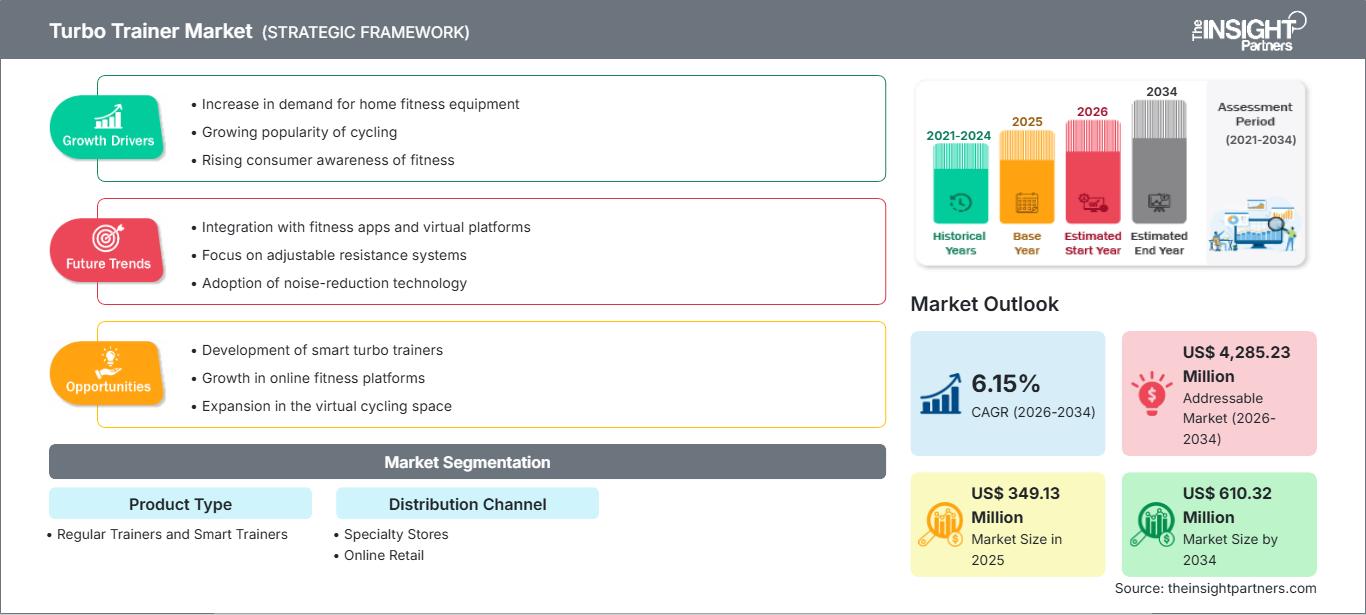
Turbo Trainer Market: Strategic Insights
-
Get Top Key Market Trends of this report.This FREE sample will include data analysis, ranging from market trends to estimates and forecasts.
Turbo Trainer Market Drivers and Opportunities
Market Drivers:
- Integration of Gamified Training Platforms: The rise of virtual cycling worlds allows users to compete globally from home. This indoor-tainment trend is a primary driver for consumers upgrading from regular trainers to interactive smart units.
- Year-Round Training Consistency: Increasing urbanization and unpredictable weather patterns make indoor trainers an essential tool for cyclists looking to maintain fitness levels without the risks of traffic or seasonal changes.
- Technological Precision and Silent Operation: Advancements in belt drives and magnets have made trainers nearly silent, allowing for use in apartment living, which has significantly broadened the addressable urban market.
Market Opportunities:
- Expansion into Corporate Wellness: Partnering with corporate health programs to provide indoor cycling stations offers a significant path for bulk B2B sales and fleet management.
- Growth in Emerging APAC Urban Hubs: Forming strategic partnerships with local cycling cafes and premium gyms in cities like Tokyo, Seoul, and Singapore can facilitate access to high-margin segments where cycling is a growing status sport.
- Diversification into E-Sports Hardware: There is a growing opportunity for manufacturers to create certified racing hardware specifically for professional e-cycling leagues, ensuring the highest levels of calibration and data verification.
Turbo Trainer Market Report Segmentation Analysis
The Turbo Trainer Market share is analyzed across various segments to provide a clearer understanding of its structure, growth potential, and emerging trends. Below is the standard segmentation approach used in most industry reports:
By Product Type:
- Smart Trainers: The fastest-growing segment. These units automatically adjust resistance based on virtual terrain and provide precise power data, making them the preferred choice for the modern connected cyclist.
- Regular Trainers: This segment includes basic magnetic and fluid trainers. While slower growing, it remains a stable volume driver for entry-level users and warm-up use cases due to affordability and simplicity.
By Distribution Channel:
- Specialty Stores: Remains a primary channel where consumers seek expert advice and hands-on demonstrations of high-end smart trainers and bike compatibility.
- Online Retail: The fastest-rising channel, benefiting from the convenience of home delivery for heavy equipment and the ability for consumers to compare technical specifications and reviews.
By Geography:
- North America
- Europe
- Asia Pacific
- South & Central America
- Middle East & Africa
Turbo Trainer Market Report Scope
| Report Attribute | Details |
|---|---|
| Market size in 2025 | US$ 3375.21 Million |
| Market Size by 2034 | US$ 5205.99 Million |
| Global CAGR (2026 - 2034) | 4.93% |
| Historical Data | 2021-2024 |
| Forecast period | 2026-2034 |
| Segments Covered |
By Product Type
|
| Regions and Countries Covered |
North America
|
| Market leaders and key company profiles |
|
Turbo Trainer Market Players Density: Understanding Its Impact on Business Dynamics
The Turbo Trainer Market is growing rapidly, driven by increasing end-user demand due to factors such as evolving consumer preferences, technological advancements, and greater awareness of the product's benefits. As demand rises, businesses are expanding their offerings, innovating to meet consumer needs, and capitalizing on emerging trends, which further fuels market growth.
Turbo Trainer Market Share Analysis by Geography
Asia-Pacific is expected to grow fastest in the coming years. Emerging markets in South & Central America, the Middle East, and Africa also have many untapped opportunities for premium fitness hardware manufacturers and smart-trainer developers to expand.
The turbo trainer market is undergoing a significant transformation, moving from a seasonal training tool to a year-round global fitness ecosystem. Growth is driven by the rising popularity of virtual cycling, a surge in home-gym investment, and the expansion of the high-end direct-drive sector. Below is a summary of market share and trends by region:
North America
- Market Share: A major and technologically advanced segment, driven by the high penetration of subscription training apps and indoor cycling culture.
- Key Drivers:
- Strong consumer preference for high-tech, interactive smart trainers that integrate with platforms like Zwift
- Mainstreaming of connected fitness in urban households and the popularity of premium home-gym setups
- Increased availability of advanced cycling ecosystems, including climbing simulators and smart fans
- Trends: Scaling of direct-to-consumer sales and the successful adoption of smart-bike units as high-end alternatives to traditional trainer-and-bicycle setups.
Europe
- Market Share: Holds the largest share globally, anchored by deep-seated cycling traditions in Italy, France, Germany, and the UK.
- Key Drivers:
- High domestic participation in road cycling and professional racing culture
- Established manufacturing presence and specialized distribution networks for cycling hardware
- Robust government and local support for cycling infrastructure and indoor sports development
- Trends: A strategic shift toward silent-drive technology for high-density apartment living. There is also an increasing focus on sustainable manufacturing and energy-efficient resistance units to meet European consumer standards.
Asia-Pacific
- Market Share: The fastest-growing region, with major tech hubs acting as the primary for software-hardware integration.
- Key Drivers:
- Massive consumer base in China, Japan, and Australia seeking premium, data-driven fitness technology
- Rising middle-class disposable income and a trend toward westernized high-performance sports
- Rapid urbanization is making indoor training a safer and more convenient alternative to outdoor riding
- Trends: Heavy reliance on e-commerce platforms and the rapid growth of professional indoor e-sports leagues, which drive demand for highly accurate, certified racing hardware.
South and Central America
- Market Share: Emerging market with a growing competitive cycling in countries like Colombia and Brazil.
- Key Drivers:
- Increasing awareness of the safety benefits of indoor training compared to busy urban road environments
- Modernization of local bike shops into high-end cycling boutiques that offer trainer demos
- Rising interest in structured, power-based training among amateur cycling clubs
- Trends: Growth of boutique indoor cycling studios and the introduction of entry-level smart trainers to provide a path for users to transition from regular magnetic trainers.
Middle East and Africa
- Market Share: Developing market with significant growth in high-income urban centers, transitioning toward formalized indoor sports.
- Key Drivers:
- Extreme environmental temperatures make indoor training a necessity for year-round fitness
- High demand for premium, aesthetically pleasing fitness equipment for luxury home gyms
- Strategic investments in sports technology and smart-city fitness initiatives
- Trends: Implementation of specialized cooling and ventilation accessories to complement trainers in arid climates, coupled with a focus on high-durability hardware for commercial gym environments.
High Market Density and Competition
Competition is intensifying due to the presence of established leaders such as Garmin (Tacx), Wahoo Fitness, and Elite. Regional technology experts and niche players like Saris (USA) and Oreka Training (Spain), alongside fitness innovators such as Technogym, contribute to a diverse and rapidly expanding market landscape. This competitive environment pushes vendors to differentiate through:
- Premiumization and Functional Branding: Positioning smart trainers as a superior fitness alternative to traditional gym equipment by emphasizing data precision, virtual realism, and time-efficient workouts for busy professionals.
- Ecosystem Expansion: Turbo trainer products now include more than just the resistance unit. Companies offer motion plates for side-to-side realism, interactive climbing blocks, and dedicated indoor smart bikes.
- Vertical Integration: Producers manage the entire user experience, from high-precision hardware engineering to proprietary training software and cloud-based performance tracking.
- Advanced Connectivity: New processing technologies, like Wi-Fi integration and direct Ethernet connections, help create high-stability training environments for competitive virtual racing and e-sports.
Opportunities and Strategic Moves
- Partner with high-end fitness apps and e-sports platforms to tap into the surging demand for gamified and socially connected workouts in Asia-Pacific and North American markets.
- Incorporate sustainable manufacturing and recyclable materials to appeal to environmentally conscious millennials and Gen Z consumers seeking ethical fitness hardware.
Major Companies operating in the Turbo Trainer Market are:
- Elite
- Garmin Ltd.
- Kurt Manufacturing
- Minoura Co. Ltd.
- Nautilus, Inc.
- Saris
- Technogym SpA
- Wahoo Fitness
- Jetblack Cycling
- Wattbike Ltd.
Disclaimer: The companies listed above are not ranked in any particular order.
Turbo Trainer Market News and Recent Developments
- In February 2026, Saris, manufacturer of world-class bike racks, trainers, storage, and bicycle parking products, announced the launch of its new Indoor Bike Trainer Thru Axle Adapter Kits, becoming the first trainer company to introduce a UDH-compatible adapter. Available for road bikes and mountain bikes, the new kits are designed to help riders keep their training on track when riding moves indoors.
- In June 2025, Garmin announced Tacx® Alpine, a gradient simulator that raises and lowers the front of a bike during an indoor ride to replicate climbs and provide more natural movement. Featuring an exclusive design that accommodates the motion of Tacx NEO 2T and 3M smart trainers, Tacx Alpine builds upon that powerful, immersive ride experience by mimicking grades from up to 25% and down to -10% and enabling steering to create a more realistic ride for cyclists as they virtually explore and train indoors.
Turbo Trainer Market Report Coverage and Deliverables
The Turbo Trainer Market Size and Forecast (2021–2034) report provides a detailed analysis of the market covering below areas:
- Turbo Trainer Market size and forecast at global, regional, and country levels for all the key market segments covered under the scope
- Turbo Trainer Market trends, as well as market dynamics such as drivers, restraints, and key opportunities
- Detailed PEST and SWOT analysis
- Turbo Trainer Market analysis covering key market trends, global and regional framework, major players, regulations, and recent market developments
- Industry landscape and competition analysis covering market concentration, heat map analysis, prominent players, and recent developments in the Turbo Trainer Market.
- Detailed company profiles
Frequently Asked Questions

- Comprehensive Market Sizing and Forecast Analysis
- Detailed Segmentation Analysis
- In-Depth Market Dynamics Assessment
- Regional and Country-Level Insights
- Competitive Landscape and Company Benchmarking
- Strategic Business Intelligence
Recent Reports
Testimonials

The Insight Partners' SCADA System Market report is comprehensive, with valuable insights on current trends and future forecasts. The team was highly professional, responsive, and supportive throughout. We are very satisfied and highly recommend their services.
RAN KEDEM Partner, Reali Technologies LTDs
I requested a report on a very specific software market and the team produced the report in a few days. The information was very relevant and well presented. I then requested some changes and additions to the report. The team was again very responsive and I got the final report in less than a week.
JEAN-HERVE JENN Chairman, Future Analytica
We worked with The Insight Partners for an important market study and forecast. They gave us clear insights into opportunities and risks, which helped shape our plans. Their research was easy to use and based on solid data. It helped us make smart, confident decisions. We highly recommend them.
PIYUSH NAGPAL Sr. Vice President, High Beam Global
The Insight Partners delivered insightful, well-structured market research with strong domain expertise. Their team was professional and responsive throughout. The user-friendly website made accessing industry reports seamless. We highly recommend them for reliable, high-quality research services
YUKIHIKO ADACHI CEO, Deep Blue, LLC.
This is the first time I have purchased a market report from The Insight Partners.While I was unsure at first, I visited their web site and felt more comfortable to take the risk and purchase a market report.I am completely satisfied with the quality of the report and customer service. I had several questions and comments with the initial report, but after a couple of dialogs over email with their analyst I believe I have a report that I can use as input to our strategic planning process.Thank you so much for taking the extra time and making this a positive experience.I will definitely recommend your service to others and you will be my first call when we need further market data.
JOHN SUZUKI President and Chief Executive Officer, Board Director, BK Technologies
I wish to appreciate your support and the professionalism you displayed in the course of attending to my request for information regarding to infectious disease IVD market in Nigeria. I appreciate your patience, your guidance, and the fact that you were willing to offer a discount, which eventually made it possible for us to close a deal. I look forward to engaging The Insight Partners in the future, all thanks to the impression you have created in me as a result of this first encounter.
DR CHIJIOKE ONYIA MANAGING DIRECTOR, PineCrest Healthcare Ltd.Reason to Buy
- Informed Decision-Making
- Understanding Market Dynamics
- Competitive Analysis
- Identifying Emerging Markets
- Customer Insights
- Market Forecasts
- Risk Mitigation
- Boosting Operational Efficiency
- Strategic Planning
- Investment Justification
- Tracking Industry Innovations
- Aligning with Regulatory Trends





 Get Free Sample for