Webbing Market Share, Size & Demand by 2034
Webbing Market Size and Forecast (2021 - 2034), Global and Regional Share, Trend, and Growth Opportunity Analysis Report Coverage: By Material (Natural and Man-Made), Product (Flat Webbing, Tubular Webbing and Others), and End Use (Aerospace, Automotive, Military, Industrial and Safety, Fashion Accessories, E-Textile, Sport Goods, Marine, Medical and Others)
Historic Data: 2021-2024 | Base Year: 2025 | Forecast Period: 2026-2034- Report Date : Apr 2026
- Report Code : TIPRE00020354
- Category : Chemicals and Materials
- Status : Upcoming
- Available Report Formats :


- No. of Pages : 150

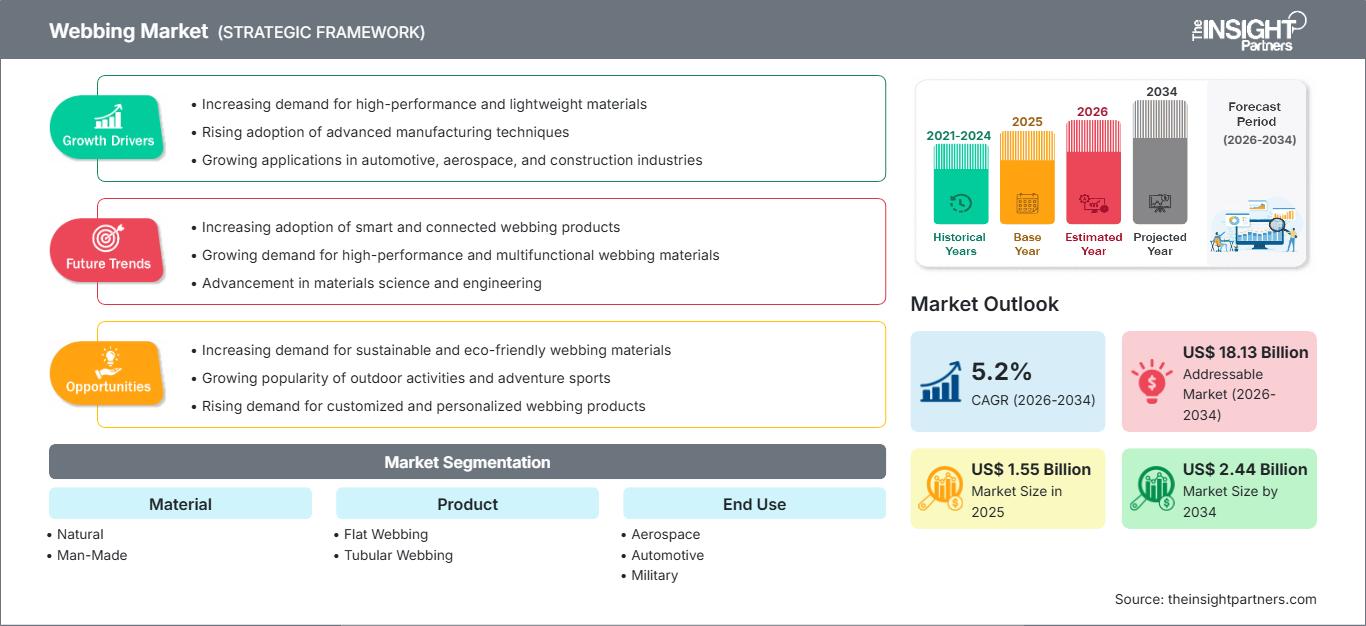
The global webbing market size is projected to reach US$ 2.44 billion by 2034 from US$ 1.55 billion in 2025. The market is anticipated to register a CAGR of 5.2% during the forecast period 2026–2034. Key market dynamics include a heightening global focus on occupant safety in the automotive sector, rising defense expenditures for tactical load-bearing equipment, and a significant shift toward high-performance synthetic fibers. Additionally, the market is expected to benefit from the growing popularity of outdoor adventure sports, expansion in e-commerce logistics requiring secure cargo lashing, and the increasing inclusion of specialized webbings in technical segments like aerospace and medical rehabilitation.
Webbing Market Analysis
The webbing market analysis shows a shift toward high-tenacity synthetic materials as industries prioritize strength-to-weight ratios and environmental durability. Procurement trends indicate the market is splitting into high-volume conventional polyester sectors for automotive safety and high-growth specialty segments using para-aramid and carbon fibers for extreme conditions. Strategic opportunities are emerging in the electric vehicle (EV) market, where lightweight webbing components contribute to overall vehicle efficiency. The analysis also notes that market expansion depends on innovations in flame-retardant and UV-resistant treatments. Competitive differentiation now stands out depending on branding that highlights sustainable manufacturing, recycled material integration, and compliance with stringent international safety standards like FMVSS 209 and OSHA. This approach helps established manufacturers maintain margins in a landscape populated by regional specialized suppliers.
Webbing Market Overview
Webbing is shifting from a basic industrial commodity to a highly engineered technical textile. While historically focused on seatbelts and simple furniture straps, webbing is expanding into value-added products like specialized climbing harnesses, military-grade MOLLE systems, and medical orthotics. Both large-scale industrial textile mills and niche performance manufacturers are part of this market, making use of advanced polymers like UHMWPE and liquid crystal polymer yarns. More safety-conscious consumers and regulatory bodies in North America and Asia-Pacific are looking for reliable fall protection and secure cargo restraint, which has helped high-performance webbing gain popularity as a "reliability-critical" component. Asia-Pacific is currently the leading producer and consumer, but North America maintains a strong position in the aerospace and defense sectors.
For instance, the market in the US is characterized by a mature industrial landscape with a heavy emphasis on military and aerospace innovation. Driven by stringent federal safety mandates for automotive occupant protection and significant defense investments, the region prioritizes high-performance, technical fabrics that ensure maximum durability and reliability in safety-critical applications.
Customize This Report To Suit Your Requirement
Get FREE CUSTOMIZATIONWebbing Market: Strategic Insights
-
Get Top Key Market Trends of this report.This FREE sample will include data analysis, ranging from market trends to estimates and forecasts.
Webbing Market Drivers and Opportunities
Market Drivers:
- Stringent Automotive Safety Regulations: Global mandates for seatbelts and airbag systems continue to drive massive volumes for polyester webbing. The rise in vehicle production in emerging economies further accelerates this demand.
- Surge in Outdoor and Adventure Sports: Growing participation in activities like rock climbing, hiking, and paragliding has sustained high demand for high-strength nylon and tubular webbings used in harnesses and safety slings.
- Modernization of Military Equipment: Increased global defense spending is fueling the procurement of advanced load-bearing vests, tactical gear, and parachute webbings that require high thermal and abrasion resistance.
Market Opportunities:
- Expansion into Smart Textiles (E-Textile): Incorporating conductive fibers into webbing offers significant opportunities for integrated sensors in military and sports applications for real-time health and load monitoring.
- Growth in Medical Rehabilitation: The demand for high-quality, hypoallergenic, and high-strength webbing for orthopedic braces and patient lifting slings is increasing as the global geriatric population grows.
- Development of Sustainable/Recycled Webbing: There is a growing opportunity for producers to target eco-conscious brands by offering webbing made from rPET (recycled polyester) or bio-based polymers to meet "green" procurement standards.
Webbing Market Report Segmentation Analysis
The Webbing Market share is analyzed across various segments to provide a clearer understanding of its structure, growth potential, and emerging trends. Below is the standard segmentation approach used in most industry reports:
By Material:
- Man-Made: The dominant volume driver, comprising polyester, nylon, and polypropylene. These materials are preferred for their high strength-to-weight ratio, durability, and cost-efficiency in industrial applications.
- Natural: A niche segment including cotton and jute, primarily utilized in fashion accessories, furniture manufacturing, and eco-friendly consumer goods.
By Product:
- Flat Webbing: Remains the primary channel for automotive seatbelts and cargo lashing, benefiting from its high breaking strength and suitability for heavy-load applications.
- Tubular Webbing: Favored for climbing, rescue operations, and marine applications due to its superior flexibility and higher resistance to abrasion compared to flat variants.
By End Use:
- Aerospace
- Automotive
- Military
- Industrial and Safety
- Fashion Accessories
- E-Textile
- Sport Goods
- Marine
- Medical
By Geography:
- North America
- Europe
- Asia Pacific
- South & Central America
- Middle East & Africa
Webbing Market Report Scope
| Report Attribute | Details |
|---|---|
| Market size in 2025 | US$ 1.55 Billion |
| Market Size by 2034 | US$ 2.44 Billion |
| Global CAGR (2026 - 2034) | 5.2% |
| Historical Data | 2021-2024 |
| Forecast period | 2026-2034 |
| Segments Covered |
By Material
|
| Regions and Countries Covered |
North America
|
| Market leaders and key company profiles |
|
Webbing Market Players Density: Understanding Its Impact on Business Dynamics
The Webbing Market is growing rapidly, driven by increasing end-user demand due to factors such as evolving consumer preferences, technological advancements, and greater awareness of the product's benefits. As demand rises, businesses are expanding their offerings, innovating to meet consumer needs, and capitalizing on emerging trends, which further fuels market growth.
Webbing Market Share Analysis by Geography
Asia-Pacific is expected to grow fastest in the coming years. Emerging markets in South & Central America, the Middle East, and Africa also have many untapped opportunities for premium technical textile producers and industrial safety equipment manufacturers to expand.
The webbing market is undergoing a significant transformation, moving from a traditional industrial staple to a high-value technical component. Growth is driven by the rising prioritization of workplace safety, a surge in vehicle production, and the expansion of the luxury outdoor and fashion sectors. Below is a summary of market share and trends by region:
1. North America
- Market Share: A robust segment driven by aerospace, defense, and high-end industrial safety.
- Key Drivers:
- Strict OSHA workplace safety regulations mandating certified fall protection.
- Presence of leading aerospace giants requiring high-spec aramid webbings.
- Growing demand for "Made in USA" military-grade tactical equipment.
- Trends: Successful adoption of recycled materials in the fashion and sports sectors and the integration of e-textile sensors for military use.
2. Europe
- Market Share: Holds a significant share globally, anchored by luxury automotive brands and advanced technical textile ecosystems in Germany, France, and Italy.
- Key Drivers:
- Strong presence of premium car manufacturers requiring high-quality seatbelt webbing.
- Strict regulatory frameworks for industrial lifting and safety equipment.
- Robust government support for sustainable manufacturing and circular economies.
- Trends: A strategic shift toward organic and recycled certifications to meet the demands of eco-conscious European consumers and industrial mandates.
3. Asia-Pacific
- Market Share: The fastest-growing region, with China, India, and Vietnam acting as the primary manufacturing engines for automotive and sports goods.
- Key Drivers:
- Massive consumer base and vehicle production leading to high demand for automotive safety webbing.
- Rapid urbanization and infrastructure development are increasing the use of industrial lifting slings.
- Rising disposable incomes leading to a preference for high-end outdoor adventure gear.
- Trends: Heavy reliance on e-commerce platforms and B2B digital procurement for industrial safety supplies and sporting goods.
4. South and Central America
- Market Share: Emerging market with a growing manufacturing sector in countries like Brazil and Argentina.
- Key Drivers:
- Increasing awareness of industrial safety standards in mining and construction.
- Modernization of regional automotive assembly plants.
- Rising interest in outdoor adventure tourism.
- Trends: Growth of localized production units to serve regional automotive and industrial hubs, reducing reliance on expensive imports.
5. Middle East and Africa
- Market Share: Developing market with high demand in the energy and construction sectors.
- Key Drivers:
- High demand for heavy-duty cargo lashing and lifting webbings in oil & gas operations.
- Strategic investments in infrastructure and "Smart Cities."
- Modernization of military and security forces across the region.
- Trends: Implementation of high-tenacity and flame-retardant webbings for extreme environments, coupled with a focus on high-performance materials for construction safety.
High Market Density and Competition
Competition is intensifying due to the presence of established leaders such as Autoliv Inc., Murdock Webbing Company, and Bally Ribbon Mills. Regional experts and niche players contribute to a diverse and rapidly expanding market landscape.
This competitive environment pushes vendors to differentiate through:
- Premiumization and Functional Branding: Positioning webbing as a superior safety component by emphasizing tensile strength, UV resistance, and flame retardancy.
- Product Diversification: Offering specialized products like conductive e-webbings, anti-microbial medical straps, and high-performance carbon-fiber webbings.
- Vertical Integration: Managing the supply chain from polymer extrusion to final weaving to ensure quality, transparency, and ethical standards.
- New Processing Technologies: Using advanced weaving and coating techniques to create high-durability products for aerospace and military use.
Opportunities and Strategic Moves
- Partner with automotive OEMs and e-commerce logistics firms to tap into the surging demand for safety-critical and cargo-securing products.
- Incorporate sustainable farming (for natural fibers) and regenerative manufacturing (for synthetics) to appeal to environmentally conscious B2B and B2C clients.
Major Companies operating in the Webbing Market are:
- AMERICAN CORD & WEBBING CO., INC
- BALLY RIBBON MILLS
- BELT-TECH
- E. OPPERMANN GMBH
- MURDOCK WEBBING COMPANY, INC.
- NARROWTEX AUSTRALIA
- NATIONAL WEBBING PRODUCTS CO.
- OHIO PLASTICS BELTING CO.
- RIBBON WEBBING CORP
- TENNESSEE WEBBING PRODUCTS
Disclaimer: The companies listed above are not ranked in any particular order.
Webbing Market News and Recent Developments
- In February 2025, Bally Ribbon Mills (BRM) announced that it will showcase its high-quality, high-performance webbing designs at the PIA Symposium in Daytona Beach, FL. At the booth, BRM experts will be available to discuss the company’s award-winning materials, tapes, webbings, and specialty textiles, including high-performance webbings, E-WEBBINGS®, and other narrow fabrics for the parachute industry.
- In January 2025, Ocean State Innovations and 1947LLC announced a partnership with Murdock Webbing. OSI and 1947 will be the exclusive international distributors of Jacquard-woven MultiCam® webbing.
Webbing Market Report Coverage and Deliverables
The "Webbing Market Size and Forecast (2021–2034)" report provides a detailed analysis of the market covering below areas:
- Webbing Market size and forecast at global, regional, and country levels for all the key market segments covered under the scope
- Webbing Market trends, as well as market dynamics such as drivers, restraints, and key opportunities
- Detailed PEST and SWOT analysis
- Webbing Market analysis covering key market trends, global and regional framework, major players, regulations, and recent market developments
- Industry landscape and competition analysis covering market concentration, heat map analysis, prominent players, and recent developments in the Webbing Market.
- Detailed company profiles
Frequently Asked Questions

- Historical Analysis (2 Years), Base Year, Forecast (7 Years) with CAGR
- PEST and SWOT Analysis
- Market Size Value / Volume - Global, Regional, Country
- Industry and Competitive Landscape
- Excel Dataset
Recent Reports
Testimonials

The Insight Partners' SCADA System Market report is comprehensive, with valuable insights on current trends and future forecasts. The team was highly professional, responsive, and supportive throughout. We are very satisfied and highly recommend their services.
RAN KEDEM Partner, Reali Technologies LTDs
I requested a report on a very specific software market and the team produced the report in a few days. The information was very relevant and well presented. I then requested some changes and additions to the report. The team was again very responsive and I got the final report in less than a week.
JEAN-HERVE JENN Chairman, Future Analytica
We worked with The Insight Partners for an important market study and forecast. They gave us clear insights into opportunities and risks, which helped shape our plans. Their research was easy to use and based on solid data. It helped us make smart, confident decisions. We highly recommend them.
PIYUSH NAGPAL Sr. Vice President, High Beam Global
The Insight Partners delivered insightful, well-structured market research with strong domain expertise. Their team was professional and responsive throughout. The user-friendly website made accessing industry reports seamless. We highly recommend them for reliable, high-quality research services
YUKIHIKO ADACHI CEO, Deep Blue, LLC.
This is the first time I have purchased a market report from The Insight Partners.While I was unsure at first, I visited their web site and felt more comfortable to take the risk and purchase a market report.I am completely satisfied with the quality of the report and customer service. I had several questions and comments with the initial report, but after a couple of dialogs over email with their analyst I believe I have a report that I can use as input to our strategic planning process.Thank you so much for taking the extra time and making this a positive experience.I will definitely recommend your service to others and you will be my first call when we need further market data.
JOHN SUZUKI President and Chief Executive Officer, Board Director, BK Technologies
I wish to appreciate your support and the professionalism you displayed in the course of attending to my request for information regarding to infectious disease IVD market in Nigeria. I appreciate your patience, your guidance, and the fact that you were willing to offer a discount, which eventually made it possible for us to close a deal. I look forward to engaging The Insight Partners in the future, all thanks to the impression you have created in me as a result of this first encounter.
DR CHIJIOKE ONYIA MANAGING DIRECTOR, PineCrest Healthcare Ltd.Reason to Buy
- Informed Decision-Making
- Understanding Market Dynamics
- Competitive Analysis
- Identifying Emerging Markets
- Customer Insights
- Market Forecasts
- Risk Mitigation
- Boosting Operational Efficiency
- Strategic Planning
- Investment Justification
- Tracking Industry Innovations
- Aligning with Regulatory Trends




 Get Free Sample For