
生物乳液聚合物市场驱动因素和范围展望(2034 年)
覆盖范围:按类型(丙烯腈-丁二烯-苯乙烯共聚物、乙烯-醋酸乙烯酯共聚物、聚丙烯酸共聚物和聚酰胺共聚物);应用领域(油漆和涂料、粘合剂、纺织品和纸张);以及地理区域(北美、欧洲、亚太地区以及南美和中美洲)。
- 状态 : 数据发布
- 报告代码 : TIPRE00015606
- 类别 : 化学品和材料
- 页数 : 150
- 可用报告格式 :


- 最后更新日期 : August 28, 2026


2025年市场规模
8.1947 亿美元
基准年值
2034 年预测
17.1931 亿美元
预计到2034年
2026-2034年复合年增长率
8.58 %
增长率
目标市场
113.8385 亿美元
(2026-2034)
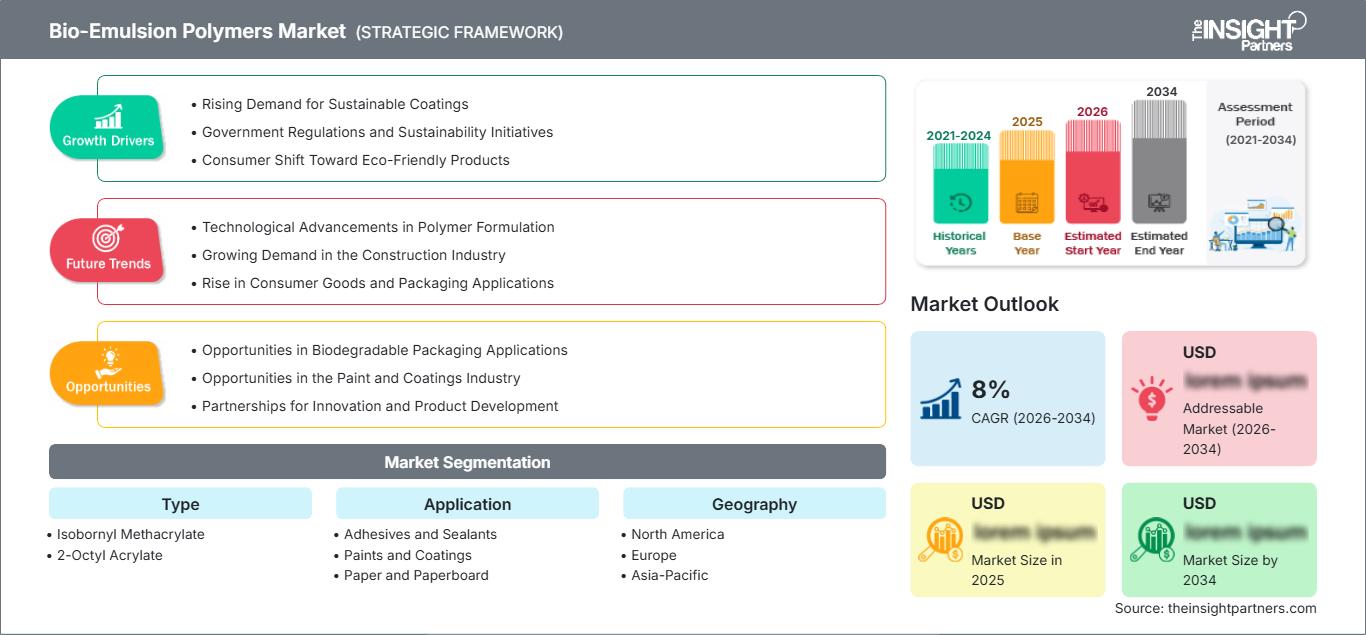
2025年全球生物乳液聚合物市场价值为8.1947亿美元,预计到2034年将达到17.1931亿美元;预计2026-2034年期间的复合年增长率为8.58%。
生物乳液聚合物市场评估与洞察
- 北美:预计到 2025 年,北美将占 28% 至 32% 的份额,并在 2026 年至 2034 年间以 6.6% 至 7.4% 的复合年增长率增长,这得益于可持续涂料、包装粘合剂、建筑应用和可再生材料采购要求。
- 美国:2025 年,美国在全球市场中约占24% 至 27% 的份额,预计在 2026 年至 2034 年期间,将以 6.7% 至 7.5% 的复合年增长率增长,主要增长动力来自建筑涂料和粘合剂。
- 欧洲:预计到 2025 年,欧洲将占据 30-34% 的份额,并在 2026-2034 年期间以 6.8-7.6% 的复合年增长率增长,其中德国、法国、意大利、英国和西班牙将受益于碳减排政策和可持续配方要求。
- 亚太地区:预计到 2025 年,亚太地区的市场份额将达到 25% 至 29%,并在 2026 年至 2034 年期间以7.2% 至 8.1% 的复合年增长率增长。中国、日本、韩国和印度将受益于涂料、纸张、包装和建筑生产的扩张。
- 最大的细分市场:油漆和涂料预计在 2025 年将占 39% 至 43% 的市场份额,在 2026 年至 2034 年期间将以 7.0% 至 7.8% 的复合年增长率增长,这得益于可再生含量粘合剂和水性配方的采用。
- 高增长细分市场:粘合剂和密封剂预计在 2025 年将占 28-32% 的市场份额,并在 2026-2034 年期间保持7.4-8.2% 的复合年增长率,因为包装和建筑应用越来越多地采用低碳配方。
- 重点分析的公司有: Allnex Netherlands BV、Arkema SA、BASF SE、CH-Polymers Oy、Covestro AG、Evonik Industries AG、Synthomer plc、OMNOVA Solutions Inc.、旭化成株式会社和塞拉尼斯株式会社。
资料来源: Insight Partners 根据专有研究、政府出版物、公司年报、投资者报告、行业数据库和专家访谈进行的分析。
Bio-Emulsion Polymers are progressing via renewable monomers, biomass-balanced feedstocks, and aqueous dispersion systems. The growing focus on commercial development is on providing similar performance with reduced dependency on non-renewable resources. For instance, BASF supplies acrylic dispersions and binders with a high level of bio-renewable content, while Arkema manufactures bio-based aqueous acrylic dispersions. This shows a transition from sustainable formulations to technically equivalent products suitable for existing coating and adhesive formulations.
Future growth will probably rely on feedstock availability, certification frameworks, and customer acceptance of renewable content. Mass balance solutions will help in this process, since they allow the unchanged use of current production capacities and formulation requirements. Celanese currently offers certified bio-based products for some emulsion systems, whereas Synthomer has implemented ISCC PLUS certified value chains for bio-based nitrile latexes.
Bio-Emulsion Polymers Market Report Scope
| Report Attribute | Details |
|---|---|
| Market size in 2025 | US$ 819.47 Million |
| Market Size by 2034 | US$ 1719.31 Million |
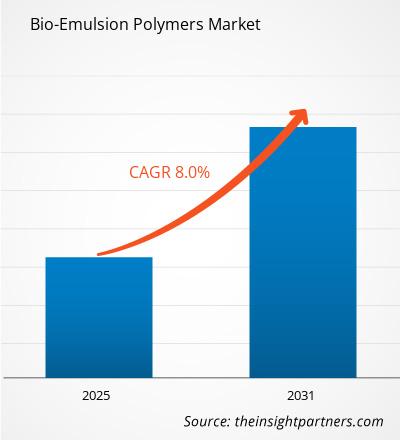
| Global CAGR (2026 - 2034) | 8.58% |
| Historical Data | 2021-2024 |
| Forecast period | 2026-2034 |
Bio-Emulsion Polymers Market Analysis
可持续性因素影响着涂料、粘合剂和造纸应用领域的需求。生物乳液聚合物市场的增长取决于对可再生原料的探索,这些原料不会损害材料在粘合性、柔韧性、成膜性、耐久性和高效生产等方面的性能。水基聚合尤其引人关注,因为该方法可以减少溶剂的使用,并允许使用生物基单体和原材料。
价值链始于可再生农业和生物质原料,途经单体生产、聚合、分散配方、添加剂以及后续转化。供应仍然取决于原料的可用性、认证、原材料成本和技术兼容性。如果客户采取渐进式而非突变式的转变,那么能够获得可靠可再生原料并保持批次一致性的制造商将从中受益。
如今,聚合物的市场定位越来越依赖于其性能、配方兼容性以及在涂料、粘合剂和造纸应用中使用可再生原料的能力。根据《生物乳液聚合物市场报告》,各公司目前正围绕生物基原料的使用、减少排放的配方开发以及针对特定应用的聚合物配方展开竞争。巴斯夫公司 (BASF SE)、阿科玛公司 (Arkema SA)、科思创公司 (Covestro AG)、Allnex Netherlands BV 和 Synthomer plc 等公司拥有广泛的配方能力,而其他公司则专注于那些能够受益于可持续化学的特定应用领域。
因此,对即用型产品、可再生材料化学以及采用认证原料的生产系统的投资正在增加。拥有成熟分散平台的分散剂公司能够更快地将可持续产品推向市场,因为他们的客户无需经历重新认证流程。巴斯夫和塞拉尼斯提供的可持续聚合物平台就充分体现了这一点。
您可以调整的内容
- ● 细分
- ● 地理
- ● 竞争分析
- ● 语言偏好
生物乳液聚合物市场:战略洞察
区域洞察
北美生物乳液聚合物市场
预计到 2025 年,北美将占生物乳液聚合物市场份额的 28% 至 32%,到 2034 年预计复合年增长率为 6.6% 至 7.4%。美国仍然是主要的需求中心,因为建筑涂料、包装粘合剂、建筑材料和特种纸生产商越来越重视可再生成分的粘合剂。
低VOC配方标准和企业碳排放核算目标是推动市场需求的主要因素。加拿大通过可持续建筑材料的使用和包装来增加碳排放,而美国公司则看重经认证的生物质平衡材料的价值。现有聚合物生产商的优势在于他们已经拥有客户群,并且能够在不改变工艺流程的情况下将可再生材料融入现有配方中。
美国生物乳液聚合物市场
预计到 2025 年,美国将占全球需求的 24-27%,占北美需求的 76-84%,到 2034 年,年复合增长率将达到 6.7-7.5%。建筑涂料、包装粘合剂和纸张是其主要应用领域。
该国已制定了特种化学品的生产和可持续性认证体系。巴斯夫、塞拉尼斯等公司可以依托其现有的分散技术,推出由可再生材料制成的产品。客户对低碳产品的需求不断增长,同时这些产品还需具备良好的粘合性、耐久性、成膜性和设备兼容性。
欧洲生物乳液聚合物市场
Europe is expected to account for a 30–34% share in 2025 and register a 6.8–7.6% CAGR through 2034, making it the leading regional market. Germany represents the largest country-level market, supported by advanced coatings, automotive materials, construction chemicals, and specialty manufacturing.
Sustainable packaging, construction materials, and environmental procurement practices are some of the key drivers in the UK. In Germany, the advantages lie in the dense network of chemical production and high levels of development of renewable formulations. France, Italy, and Spain provide support through their contributions in coatings, adhesives, packaging, furniture, and construction uses.
APAC Bio-Emulsion Polymers Market
In 2025, APAC accounts for 25-29%, having a 7.2-8.1% CAGR until 2034. China is leading in consumption in the region, with Japan, South Korea, India, and Australia coming next. Growing construction, packaging, paper, and textile production drive the demand.
China is characterized by the broadness of its scope since of the volume of manufacturing. However, Japan and South Korea focus on sustainable materials. India is important due to coating and packaging usage. Infrastructure is also essential for India. Australia is known for low-carbon materials.
Middle East & Africa Bio-Emulsion Polymers Market
The Middle East and Africa region is forecast to achieve 6.1-6.9% CAGR until 2034. Leading regional prospects include Saudi Arabia, the UAE, and South Africa. Opportunities for application are available in construction, infrastructure investment, packaging, and industrial coatings.
For Saudi Arabia and the UAE, the prospects depend on major investment in infrastructure projects and expertise in the chemical industry, while the prospects for South Africa rely on expertise in coatings and packaging. For the rest of the MEA, there is a diversified outlook; adoption will be hindered by high cost of formulations and lack of domestic renewable polymer infrastructure.
Segmentation Analysis
Type
The Type segment is strategically important because monomer selection directly determines polymer performance, compatibility, flexibility, and sustainability characteristics. The Type segment is expected to expand at a 6.7–7.5% CAGR during 2026–2034. The market increasingly favors specialty monomers capable of delivering renewable-content benefits while preserving established performance specifications.
- Isobornyl Methacrylate: This monomer supports formulations requiring hardness, weathering resistance, and optical properties. Its specialty positioning makes it relevant for higher-performance coatings and adhesive systems where durability and formulation stability influence purchasing decisions.
- 2-Octyl Acrylate: This material provides flexibility and low-temperature performance characteristics, making it strategically relevant for adhesive and coating formulations. Demand is supported by applications requiring balanced flexibility, adhesion, and film-forming behavior.
Application
Application diversification determines how rapidly sustainable emulsion polymers move beyond specialty formulations. The Application segment is projected to grow at a 7.0–7.8% CAGR during 2026–2034. Increasing renewable-content targets across industrial coatings, packaging, and construction adhesives are broadening opportunities for compatible polymer dispersions. This supports the Bio-Emulsion Polymers Market scope across established downstream industries.
- Adhesives and Sealants: Packaging, construction, labeling, and consumer-product applications create demand for emulsions delivering adhesion, flexibility, moisture resistance, and controlled setting. Renewable-content alternatives gain relevance where customers require lower-carbon formulations without changing processing systems.
- Paints and Coatings: Architectural and industrial coatings remain major applications because waterborne formulations can incorporate renewable-content binders. Demand centers on durability, cleanability, low emissions, and carbon-footprint reduction while maintaining established application performance.
- Paper and Paperboard: Packaging conversion and recyclable-paper formats support polymer emulsion demand for coating, binding, and functional surface treatment. Sustainable packaging requirements increase interest in renewable-content materials compatible with paper recycling and established converting operations.
Opportunity Snapshot
|
Application |
Revenue Contribution |
Trend Tag |
Adoption Stage |
|---|---|---|---|
|
Adhesives and Sealants |
High |
Bio Feedstocks |
Scaling |
|
Paints and Coatings |
High |
Low Carbon |
Scaling |
|
Paper and Paperboard |
Medium |
Fiber Packaging |
Scaling |
Bio-Emulsion Polymers Market Growth Drivers and Impact Analysis
Increasing demand for lower-carbon coating formulations
Pressure is growing on coating makers to minimize reliance on fossil resources while maintaining current specifications. Renewable-content acrylic dispersions offer a way forward, given that they can be formulated into waterborne architectural and industrial coatings. This is shown by the portfolio of Acronal BIO from BASF, which comprises bio-based all-acrylic dispersions for interior architectural coatings. These materials can facilitate low-carbon purchasing without requiring downstream manufacturers to completely reformulate their product lines. This goes beyond the impact on premium products, as biomasse-balanced and certified feedstock-based strategies can enable more use of renewables in conventional grades. Customers who will begin comparing products based on their carbon footprint will find such polymers attractive.
Expansion of sustainable packaging and paper applications
Material recyclability, carbon footprint, and resource renewability are becoming increasingly important criteria used by packaging converters when assessing materials. Emulsion polymers play an important role in paper coating, adhesives, lamination, and surface finishing due to their unique film-forming properties and excellent bonding capacity. The Joncryl BRC line from BASF is an example of commercializing the bio-renewable and water-based binders for use in ink, overprint varnish, and paper coatings. The significance of this trend is that packaging converters can use renewable material polymers without having to change their existing water-based manufacturing technology. With more and more environmental material requirements from brand owners, converters will increasingly demand such information from material suppliers.
Growth of certified mass-balance chemical production
质量平衡生产正在克服聚合物可持续应用的最大障碍之一,它能够将可再生资源融入传统的化学制造工艺中。塞拉尼斯公司提供ECO-B替代方案,其质量平衡组分已获得ISCC PLUS认证,并能保持特定乳液材料的化学性质不变。Synthomer公司也为生物基丁腈乳胶创建了一条获得ISCC PLUS认证的价值链,展示了如何将可再生资源融入现有的聚合物制造工艺中。这种策略有助于加快客户审批流程,保持现有设施的完整性,并带来可持续发展的益处。
生物乳液聚合物市场未来趋势
更多地使用可追溯的可再生原料配方
生物乳液聚合物 市场的发展趋势正从简单的可再生来源声明转向可追溯性。客户越来越需要原料来源、认证含量、碳足迹表现以及监管链控制等方面的证据。这将促使供应商将质量平衡认证与产品层面的环境信息相结合。巴斯夫对可追溯生物源含量和碳足迹测量的应用就体现了这一趋势。未来的配方可能会提供差异化的可再生含量水平,使客户能够根据监管、采购和产品要求选择可持续性表现。这一趋势应会增强对标准化认证和生命周期评估方法的需求,同时鼓励供应商发布更清晰的环境数据。竞争差异化将越来越依赖于可持续性声明的可信度和可衡量性,而不仅仅是可再生含量。
开发性能相当的生物基聚合物平台
聚合物开发商正日益致力于研发性能媲美现有化石基聚合物的生物基材料。这一策略降低了技术壁垒,因为客户可以利用现有的应用规范来评估可持续产品。巴斯夫将其Rheovis系列产品转型为生物基丙烯酸乙酯,展现了在保持技术规范的同时提高生物基含量的商业潜力。预计丙烯酸分散体、粘合剂、涂料和纸张粘合剂等领域也将采用类似的方法。未来的研发重点将放在分子设计、可再生单体的可用性、聚合效率以及与现有添加剂的兼容性上。能够以商业可接受的成本实现性能相当的供应商可以加速从试验配方到批量应用的转化。这一趋势将逐步推动可持续乳液从专业细分市场走向标准化的工业采购体系。
生物乳液聚合物市场机遇
拓展可再生材料建筑涂料业务
建筑涂料市场蕴藏着巨大的商机,因为水性丙烯酸体系既能融入可再生粘合剂,又能保持其原有的应用特性。供应商可以瞄准那些寻求低碳产品的涂料制造商,这些产品适用于住宅、商业和公共建筑项目。巴斯夫的Acronal BIO产品组合展示了植物基丙烯酸分散体在室内建筑涂料领域的应用前景。生物乳液聚合物市场预测表明,随着建筑商、建筑师和采购团队在评估产品时兼顾环境性能、耐久性和成本,市场机遇将日益涌现。生产商可以通过可追溯的原料、经验证的碳足迹减少、低VOC特性以及与现有配方平台的兼容性来脱颖而出。在可持续建筑规范和绿色采购政策对材料选择影响日益增强的地区,区域性机遇尤为重要。
通过现有制造平台扩大生物基粘合剂的生产规模
第二个机遇在于无需重建生产基础设施即可将现有聚合物等级转化为可再生原料。质量平衡系统使生产商能够在保持产品一致性的同时,将经认证的可再生投入物整合到现有的化学价值链中。塞拉尼斯公司的ECO-B方案便是这种即插即用策略的典范,而Synthomer公司经认证的生物基乳胶价值链则展示了其在工业规模上的应用。因此,生产商可以优先发展客户重视简化认证流程的大批量粘合剂、涂料和造纸等级产品。对于拥有广泛分销网络和现有技术服务能力的供应商而言,这一机遇尤为重要。随着时间的推移,扩大生产基地的认证覆盖范围可以提高产品供应,并支持跨国客户更广泛地采用这些产品。
最新进展
- 2025年2月:斯德哥尔摩大学——研究人员利用木质素凝胶乳液开发了一种完全生物基的护发素。这种木质素凝胶无需化学改性或有机溶剂即可稳定油包水乳液。测试表明,该乳液的稳定性、粘度和护发效果与市售护发素相当,而含有6%椰子油的配方可降低13%的湿梳阻力。这项研究成果展现了生物基乳液体系在化妆品及相关配方领域的巨大潜力。
- 2026年8月:陶氏化学公司推出RHOPLEX™ RN-128,这是一款100%丙烯酸生物基乳液,专为室内装饰建筑涂料而设计,包括哑光和半光涂料。该产品含有27%的生物基碳,经ASTM D6866 C-14测试验证,并获得美国农业部生物基认证。该产品配方中未添加APEO或PFAS,旨在提供与石油基丙烯酸粘合剂相当的性能,同时减少对化石原料的依赖。
常见问题解答

Vrushali 是一位资深咨询顾问,拥有超过八年的行业经验,在化工与材料领域具备深厚的专业知识,尤其精通特种化学品行业。她已成功完成50多个咨询项目,涵盖化工与材料、食品与饮料以及消费品等多个行业,涉及功能性原料、可再生化学品、动物饲料和农用化学品等多个细分领域。
她拥有化学学士学位和管理学硕士学位,兼具扎实的技术专业知识和敏锐的商业战略洞察力。她曾协助客户评估市场拓展机会、制定业务增长战略,并推动运营转型项目的实施,为企业的长期发展提供战略支持。
Vrushali 在客户开发、利益相关方管理及团队领导方面具备出色的专业能力。通过系统化、结构化的项目管理与执行方法,她有效帮助客户提升运营效率和生产力。凭借将技术专业知识与商业战略目标相结合的能力,她能够深入理解客户的业务需求,并提供切实可行、具有针对性的战略建议与解决方案。
- 全面的市场规模与预测分析
- 详细的细分市场分析
- 深入的市场动态评估
- 区域及国家级洞察
- 竞争格局与企业对标分析
- 战略性商业情报
客户评价

The Insight Partners 提供了有价值的市场情报,帮助我们制定并推进全球市场进入战略。他们的团队专业、响应及时,并认真听取我们的反馈,在整个项目过程中提供了深入的分析和有帮助的方法论说明。
Junmo Kim 首席财务官(CFO), Enertech Co., Ltd.
Insight Partners 的 SCADA 系统市场报告内容全面,对当前趋势和未来预测提供了宝贵的见解。该团队始终高度专业、响应迅速且乐于助人。我们非常满意,强烈推荐他们的服务。
兰·凯德姆 伙伴, Reali Technologies LTD
我请求一份关于特定软件市场的报告,团队在几天内就完成了。报告信息非常相关,而且呈现得非常出色。之后,我请求对报告进行一些修改和补充。团队再次迅速响应,不到一周我就收到了最终报告。
让-埃尔韦·詹恩 主席, 未来分析公司
我们与 Insight Partners 合作进行了一项重要的市场研究和预测。他们清晰地洞察了机遇和风险,帮助我们制定了计划。他们的研究简单易用,数据可靠,帮助我们做出了明智而自信的决策。我们强烈推荐他们。
皮尤什·纳格帕尔 高级副总裁, 远光全球
Insight Partners 凭借其深厚的行业专业知识,提供了富有洞察力、结构合理的市场研究。他们的团队始终专业且响应迅速。用户友好的网站让访问行业报告变得顺畅无阻。我们强烈推荐他们可靠、高质量的研究服务。
安达幸彦 首席执行官, 深蓝有限责任公司
这是我第一次从The Insight Partners购买市场报告。起初我有些犹豫,但访问了他们的网站后,我更放心地冒险购买市场报告。我对报告的质量和客户服务非常满意。我对最初的报告有一些疑问和意见,但在与他们的分析师通过电子邮件沟通了几次后,我相信这份报告可以作为我们战略规划流程的参考。非常感谢您抽出宝贵的时间,让这次体验如此愉快。我一定会向其他人推荐你们的服务,当我们需要更多市场数据时,你们将是我的首选。
约翰·铃木 总裁兼首席执行官、董事会董事, BK科技
感谢您在处理我关于尼日利亚传染病体外诊断市场信息请求的过程中所展现的支持和专业精神。感谢您的耐心、指导,以及您愿意提供的折扣,最终促成了这笔交易。我期待未来与 Insight Partners 继续合作,这一切都要归功于您与我初次接触后留下的良好印象。
奇吉奥克博士 ONYIA 董事总经理, PineCrest 医疗保健有限公司购买理由
- 明智的决策
- 了解市场动态
- 竞争分析
- 客户洞察
- 市场预测
- 风险规避
- 战略规划
- 投资论证
- 识别新兴市场
- 优化营销策略
- 提升运营效率
- 顺应监管趋势



















 获取免费样品 -