
Industrial Wireless Sensor Network Market Size, Growth & Trends by 2034
Coverage: by Sensor Type (Pressure Sensor, Biosensor, Level Sensor, Temperature Sensor, Flow Sensor, and Others); Technology (Zigbee, Bluetooth, Near Field Communication (NFC), Wi-Fi, Cellular Network, and Others), Application (Process Monitoring, Machine Monitoring, Safety & Surveillance, Asset Tracking, and Others); End User (Oil & Gas, Automotive, Manufacturing, Healthcare, Food & Beverages, and Others), and Geography (North America, Europe, Asia Pacific, and South and Central America)
- Status : Data Released
- Report Code : TIPTE100000145
- Category : Electronics and Semiconductor
- No. of Pages : 150
- Available Report Formats :


- Last update date : September 21, 2026


2025 Market Size
US$ 6,625.51 Mn
Base year value
2034 Forecast
US$ 17,096.59 Mn
Projected by 2034
CAGR 2026-2034
11.11 %
Growth rate
Addressable Market
US$ 104,754.93 Mn
(2026-2034)
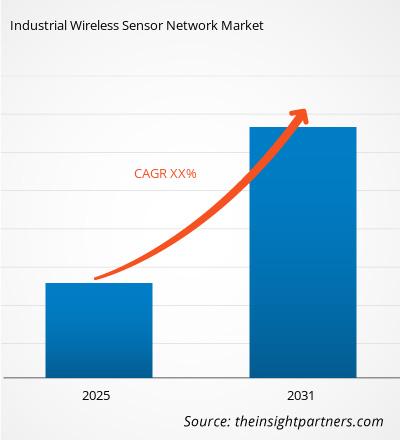
The Industrial Wireless Sensor Network Market was valued at US$ 6,625.51 Million in 2025 and is projected to reach US$ 17,096.59 Million by 2034, expanding at a CAGR of 11.11% during 2026–2034. The market encompasses connected sensing architectures used to capture industrial operating data across processes, machines, assets, and facilities. Wireless connectivity enables organizations to expand measurement coverage while reducing dependence on extensive cabling, particularly across brownfield plants and geographically distributed industrial assets.
North America is positioned for sustained adoption as manufacturers modernize legacy instrumentation and energy companies expand connected monitoring across distributed assets. The Industrial Wireless Sensor Network Market size in the region is expected to increase at a modeled CAGR of 10.0–10.8% during 2026–2034. Oil and gas digitization, predictive maintenance, industrial cybersecurity, and automation investments provide structural support for regional deployment.
Industrial Wireless Sensor Network Market Assessment and Insights
- North America: The region accounted for an estimated 28–32% share in 2025 and is projected to expand at a CAGR of 10.0–10.8% between 2026–2034, supported by manufacturing modernization and energy-sector digitization.
- US: The US represented approximately 74–78% of North American demand in 2025 and is expected to grow at a CAGR of 10.2–11.0%, led by automation and predictive maintenance.
- Europe: Europe held approximately 23–27% share in 2025 and is forecast to grow at a CAGR of 9.5–10.3%, with Germany, the UK, France, Italy, and Spain supporting industrial modernization.
- Asia Pacific: Asia Pacific represented approximately 32–36% share in 2025 and is projected to grow at a CAGR of 12.0–12.8%, led by China, Japan, South Korea, India, and Australia.
- Largest Segment: Temperature Sensor represented approximately 24–28% market share in 2025 and is expected to grow at a CAGR of 10.4–11.2%, supported by broad industrial process applications.
- High Growth Segment: Machine Monitoring accounted for approximately 24–28% market share in 2025 and is forecast to grow at a CAGR of 12.8–13.6%, driven by predictive maintenance.
- Key companies analyzed in detail: ABB Ltd., Yokogawa Electric Corporation, Texas Instruments Incorporated, Siemens AG, Analog Devices, Inc., Honeywell International Inc., Emerson Electric Co., NXP Semiconductors N.V., STMicroelectronics N.V., Schneider Electric SE, and OMRON Corporation.
Source: The Insight Partners' analysis based on proprietary research, government publications, company annual reports, investor presentations, industry databases, and expert interviews.
The industrial sensing landscape has evolved from individual measurement points to integrated and networked architectures that include sensors, gateways, edge devices, and analytics. WirelessHART, ISA100 Wireless, Zigbee, Bluetooth, Wi-Fi, and cellular technologies cater to different needs related to coverage, power consumption, bandwidth, reliability, and network topology. Small battery-operated wireless devices have significantly contributed to the opportunities of installing sensors on rotating machinery, tanks, pipelines, and other hard-to-wire systems.
Deployment of such solutions is expected to become more widespread in new manufacturing locations and energy-related infrastructure facilities during the forecast period. The reduction in power consumption and energy harvesting, along with edge computing capabilities and enhanced device security, are expected to make the installation of dense sensor networks more cost-effective. At the same time, regulatory focus on operational safety, energy efficiency, emissions control, and the resiliency of critical infrastructure can spur data gathering activities.
Industrial Wireless Sensor Network Market Report Scope
| Report Attribute | Details |
|---|---|
| Market size in 2025 | US$ 6,625.51 Million |
| Market Size by 2034 | US$ 17,096.59 Million |
| Global CAGR (2026 - 2034) | 11.11% |
| Historical Data | 2021-2024 |
| Forecast period | 2026-2034 |
Industrial Wireless Sensor Network Market Analysis
Industrial Wireless Sensor Network Market growth drivers include increasing needs for continuous measurement of parameters such as temperature, pressure, flow, level, vibration, and machinery condition. The wireless technology makes it possible for the industrial end users to install more measurement points without laying cables across the plant infrastructure. The network ecosystem consists of sensor vendors, semiconductor companies, wireless modules, gateways, automation providers, software solutions, system integrators, and industrial end users.
Key supply-side factors include availability of low power semiconductors, sensor accuracy, radio capabilities, rugged packaging, battery life, and security features. Other considerations for suppliers include dealing with hazardous areas, EMI, wide temperature range, and maintenance cycle. Increasing integration capabilities with distributed control systems, PLCs, historians, cloud solutions, and asset management software impact the purchasing decision making process as customers want operational data rather than measurements.
The Industrial Wireless Sensor Network Market Report shows competition between automation vendors, instrumentation providers, and semiconductor experts. These players include ABB Ltd., Yokogawa Electric Corporation, Siemens AG, Honeywell International Inc., Emerson Electric Co., and Schneider Electric SE, competing based on their strengths in automation, sensing, connectivity, and software solutions. Among semiconductor players are Texas Instruments Incorporated, Analog Devices, Inc., NXP Semiconductors N.V., and STMicroelectronics N.V., contributing to the supply chain through sensing, processing, power management, and wireless technologies.
Investments are being made in condition monitoring, industrial edge computing, multiprotocol gateways, and connected asset management. ABB's 2025 application of AssetInsight using WirelessHART-enabled Smart Sensors to monitor pumps, motors, stirrers, fans, and scrubbers at the semiconductor manufacturing site showed the capability to use wireless sensors and analyze data for maintenance decisions.
● REPORT CUSTOMIZATION
Tailor This Report To Align With Your Specific Business Requirements
This report can be customized to align precisely with your business objectives, scope, and target markets. Customization options include tailored segmentation, geography, competitive analysis, and strategic insights to support informed decision-making.
Customize This Report →WHAT YOU CAN ADJUST
- ● Segmentations
- ● Geography
- ● Competitive Analysis
- ● Language Preferences
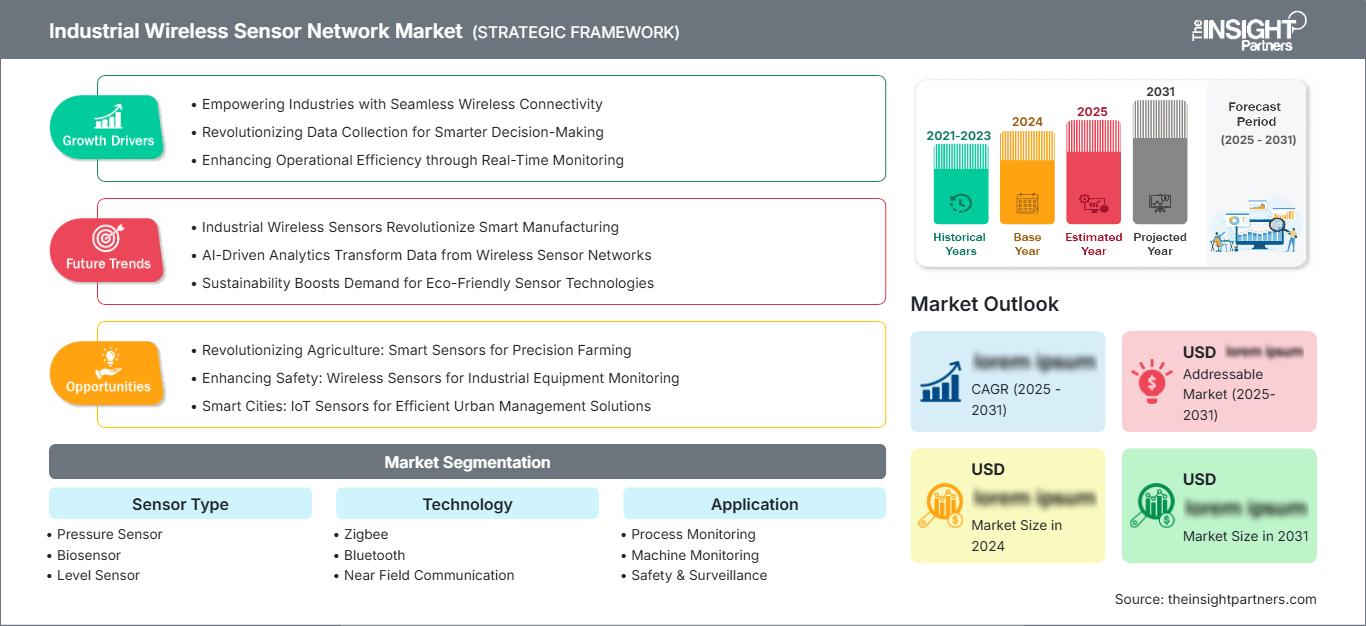
Industrial Wireless Sensor Network Market: Strategic Insights
Regional Insights
North America Industrial Wireless Sensor Network Market
North America constituted 28–32% of global demand in 2025 and will continue to grow at a CAGR of 10.0–10.8% until 2034. The US is the major consumer region, whereas Canada participates through energy, mining, manufacturing, and utilities sectors. Brownfield modernization, predictive maintenance, and process automation have been the key structural drivers of demand in North America.
The Industrial Wireless Sensor Network Market share in North America is driven by oil & gas, chemicals, manufacturing, utilities, and food processing industries. Wireless technologies are especially beneficial in monitoring remote tanks, rotating machines, pipelines, and transient measuring points. End users are looking more for security gateways, long battery life, protocol interoperability, and control system compatibility, thus eliminating technological obstacles to installation of additional sensors.
U.S. Industrial Wireless Sensor Network Market
The US market constitutes around 74–78% of the North American demand in 2025 and is projected to grow at a CAGR of 10.2–11.0% until 2034. The demand in the US market is focused in oil & gas, manufacturing, chemicals, utility, food processing, and industries working towards becoming connected.
Some of the leading players like ABB Ltd., Honeywell International Inc., Emerson Electric Co., Siemens AG, and Schneider Electric SE have a well-established position in industrial automation in the country. In addition, applications for industrial automation are expanding into machine monitoring, process measurements, environment measurements, security, and asset tracking applications.
Europe Industrial Wireless Sensor Network Market
The European region accounted for 23–27% of global demand in 2025 and is forecasted to experience CAGR growth at 9.5–10.3% through 2034. In the region, Germany stands out as the leading market, due to the country's development of the automotive manufacturing industry, machinery, chemical industry, industrial automation, and production. Additional markets are the UK, France, Italy, and Spain in energy, manufacturing, utilities, food processing, and infrastructure industries.
The UK offers opportunities for modernizing the process industry along with smart manufacturing solutions, while Germany can benefit from its large machinery industry, automotive industry, chemical industry, and industrial automation. France holds potential in aerospace, energy, food, and industrial production industries, whereas Italy and Spain hold potential in machinery, automotive, food processing, utilities, and industrial modernization.
APAC Industrial Wireless Sensor Network Market
The APAC region accounted for 32–36% of total demand in 2025 and is estimated to witness a CAGR of 12.0–12.8% to become the fastest-growing region among all regions. China dominates the regional deployment followed by Japan, South Korea, India, and Australia. Manufacturing growth, electronic manufacturing, auto plants, energy, and industrial automation drive demand.
China's industrial size creates deployment opportunity for manufacturers, whereas Japan and South Korea focus on high automation of production. India grows in its deployment of connected manufacturing and industrial infrastructure whereas Australia makes contribution through mining and energy. Initiatives in government for smart factory, industrial digitization, electronics manufacturing, and infrastructure development will foster adoption.
Middle East & Africa Industrial Wireless Sensor Network Market
MEA is expected to expand at a CAGR of 9.0–9.8% through 2034, with Saudi Arabia representing the leading market, followed by the UAE and South Africa. Oil and gas modernization, industrial diversification, mining, utilities, and infrastructure investment create opportunities for wireless sensing across distributed assets.
The industrial transformation of Saudi Arabia involves energy and manufacturing plants linked to each other, while UAE is working on the development of smart infrastructure and industrial technologies. South Africa gives demand via mining, manufacturing, and utilities sectors. RO-MEA gives prospects for remote energy infrastructure, water infrastructures, and industrial areas, where wireless connectivity can simplify deployment.
Segmentation Analysis
Sensor Type
The Sensor Type segment in the Industrial Wireless Sensor Network Market includes Pressure Sensor, Biosensor, Level Sensor, Temperature Sensor, and Flow Sensor. Industrial Wireless Sensor Network scope extends across process variables and equipment conditions. Temperature Sensor maintains the largest position because temperature measurement is required across manufacturing, energy, food processing, healthcare, and machinery applications. The segment is projected to grow at a CAGR of 10.8–11.6% during 2026–2034.
- Pressure Sensor: Supports process control, leak detection, equipment diagnostics, and pipeline monitoring, making it important for oil and gas, chemicals, utilities, and machinery requiring distributed pressure measurements.
- Biosensor: Addresses specialized healthcare, biotechnology, food safety, and environmental applications where wireless transmission can facilitate remote measurement and distributed monitoring.
- Level Sensor: Supports tanks, silos, vessels, and storage systems, particularly where wired installation is difficult or remote visibility improves process management.
- Temperature Sensor: Serves machinery, production lines, storage, energy, food processing, and process control, making it a central component of distributed industrial monitoring.
- Flow Sensor: Supports fluid and gas measurement across energy, water, chemicals, manufacturing, and food applications, particularly where dispersed process points require flexible instrumentation.
Technology
The Technology segment in the Industrial Wireless Sensor Network Market covers Zigbee, Bluetooth, Near Field Communication, Wi-Fi, and Cellular Network. It is forecast to grow at a CAGR of 10.9–11.7% during 2026–2034. Technology selection depends on range, energy consumption, bandwidth, network topology, security, device density, and integration requirements, producing differentiated opportunities across industrial deployments.
- Zigbee: Provides low-power mesh connectivity suitable for distributed sensor networks where device density and battery efficiency are more important than high bandwidth.
- Bluetooth: Supports commissioning, portable equipment, local diagnostics, and low-power sensing, with Bluetooth Low Energy relevant to battery-operated industrial devices.
- Near Field Communication: Enables short-range configuration, identification, authentication, and service interactions, complementing longer-range wireless technologies inside industrial equipment.
- Wi-Fi: Supports higher-bandwidth industrial connectivity for sensors, mobile equipment, cameras, and edge devices where existing network infrastructure provides suitable coverage.
- Cellular Network: Extends connectivity across geographically dispersed assets, supporting remote monitoring of pipelines, energy equipment, transportation infrastructure, and isolated industrial facilities.
Application
The Application segment in the Industrial Wireless Sensor Network Market comprises Process Monitoring, Machine Monitoring, Safety & Surveillance, and Asset Tracking. It is projected to grow at a CAGR of 11.8–12.6% through 2034. Machine Monitoring is expected to demonstrate the strongest momentum because wireless sensing can expand condition-monitoring coverage without extensive installation work.
- Process Monitoring: Provides continuous measurement of operating variables, improving process visibility and enabling additional instrumentation at difficult-to-wire locations.
- Machine Monitoring: Enables vibration, temperature, acoustic, and condition measurements that support predictive maintenance and earlier identification of equipment degradation.
- Safety & Surveillance: Connects environmental and operational sensors to monitoring systems, supporting worker protection, hazardous-area awareness, and facility visibility.
- Asset Tracking: Improves visibility of equipment, containers, tools, vehicles, and other mobile or distributed assets through connected identification and location technologies.
End User
The End User segment in the Industrial Wireless Sensor Network Market consists of Oil & Gas, Automotive, Manufacturing, Healthcare, and Food & Beverages. It is projected to grow at a CAGR of 10.7–11.5% through 2034. Oil and gas and manufacturing remain important users because distributed assets and difficult wiring conditions create strong economic justification for wireless monitoring.
- Oil & Gas: Uses wireless sensing for process variables, rotating equipment, tanks, pipelines, and remote installations where hazardous environments and cabling constraints increase the value of wireless architectures.
- Automotive: Applies connected sensors across production lines, assembly equipment, quality systems, and logistics operations as manufacturers adopt data-driven manufacturing.
- Manufacturing: Represents a broad demand base spanning machinery, production processes, utilities, quality control, and predictive maintenance.
- Healthcare: Uses wireless sensing for equipment monitoring, environmental conditions, asset visibility, and selected connected-care applications requiring controlled connectivity.
- Food & Beverages: Applies wireless monitoring to temperature, process conditions, storage, utilities, and equipment, with flexible deployment particularly useful in production environments.
Opportunity Snapshot
| End User | Revenue Contribution (High/Medium/Low) | Trend Tag (MAX 2 words) | Adoption Stage (Emerging/Scaling/Mature) |
|---|---|---|---|
| Oil & Gas | High | Remote Monitoring | Scaling |
| Automotive | Medium | Smart Factory | Scaling |
| Manufacturing | High | Predictive Maintenance | Mature |
| Healthcare | Medium | Asset Visibility | Scaling |
| Food & Beverages | Medium | Cold Monitoring | Scaling |
Industrial Wireless Sensor Network Market Growth Drivers and Impact Analysis
Expansion of Predictive Maintenance and Condition Monitoring
Predictive maintenance is increasing the number of industrial assets requiring continuous condition information. Wireless vibration, temperature, acoustic, pressure, and other sensors can be installed on rotating equipment without extensive cable routing. The commercial impact is significant because operators can extend monitoring to assets previously considered too costly or difficult to instrument. This supports earlier identification of degradation, more targeted maintenance scheduling, and improved equipment availability. Industrial facilities can deploy monitoring incrementally rather than undertaking large instrumentation projects. As battery performance and analytics capabilities improve, wireless condition monitoring should become increasingly practical across manufacturing, energy, chemicals, utilities, and process industries. ABB's 2025 semiconductor customer deployment demonstrates this model by combining wireless sensing with FFT-based analysis for pumps, motors, fans, and other rotating equipment.
Replacement of Hard-Wired Instrumentation in Difficult Locations
Wireless networks provide an alternative where conduit, cable trays, power infrastructure, or long signal runs are expensive or disruptive. Remote tanks, rotating equipment, pipelines, temporary production areas, and dispersed facilities can be monitored with fewer physical installation constraints. This changes the economics of plant instrumentation by allowing operators to add measurement points without redesigning existing infrastructure. The impact is particularly relevant to brownfield facilities, where physical modifications can require shutdowns or substantial engineering work. Wireless sensing also supports temporary measurement campaigns, enabling operators to investigate process issues before deciding whether permanent instrumentation is justified. Suppliers that combine rugged sensors, gateways, cybersecurity, and installation support can capture value across the deployment lifecycle.
Industrial Digitalization and Connected Asset Management
Industrial digitalization is expanding the role of sensors from isolated measurement devices into connected data sources for operational and enterprise systems. Wireless gateways can aggregate sensor information and transfer it to automation platforms, historians, analytics systems, and cloud environments. This creates demand beyond individual sensor hardware, including gateways, network management, cybersecurity, analytics, and integration services. Industrial operators increasingly seek common architectures capable of accommodating multiple measurement types and protocols. The resulting market favors suppliers capable of delivering complete sensing and connectivity solutions rather than standalone components. Honeywell's portfolio strategy emphasizes industrial automation, process automation, smart edge devices, connectivity, and software, reflecting the broader movement toward integrated operational technology architectures.
Industrial Wireless Sensor Network Market Future Trends
Growth of Energy-Harvesting Wireless Sensor Platforms
Industrial Wireless Sensor Network Market trends increasingly favor sensing platforms that minimize routine battery replacement. Energy harvesting can capture heat, vibration, solar energy, or other environmental sources to extend operational life in remote installations. Future products are likely to combine energy harvesting with ultra-low-power processors, duty-cycle optimization, local analytics, and intermittent communication. Such architectures can improve the economics of monitoring assets that are difficult to access. Greater deployment of self-powered sensors could support denser instrumentation because maintenance requirements become less dependent on physical access to individual devices. The trend should also encourage sensor manufacturers to integrate power management, sensing, processing, and wireless connectivity within compact modules. This could make autonomous monitoring increasingly practical across industrial facilities.
Convergence of Wireless Protocols and Edge Intelligence
Future industrial networks are likely to combine multiple wireless technologies rather than rely on one universal standard. Facilities may use low-power mesh technologies for dense sensing, Bluetooth for local commissioning, Wi-Fi for higher-bandwidth devices, and cellular connectivity for remote assets. Edge gateways can normalize these data streams and perform filtering, anomaly detection, and protocol translation close to equipment. The next stage should emphasize policy-based security, automated device provisioning, edge analytics, and integration with industrial control systems. Texas Instruments' February 2026 agreement to acquire Silicon Labs illustrates the strategic importance of embedded wireless connectivity, with the transaction expected to add approximately 1,200 products supporting multiple wireless standards and protocols.
Industrial Wireless Sensor Network Market Opportunities
Wireless Retrofit Programs for Brownfield Industrial Assets
Industrial Wireless Sensor Network Market Forecasts indicate a substantial opportunity in brownfield facilities where existing machinery lacks comprehensive instrumentation. Retrofit programs can add wireless sensors to pumps, motors, compressors, tanks, valves, conveyors, and other assets without extensive cabling. Vendors can package sensors, gateways, analytics, installation, and maintenance into standardized solutions that simplify procurement. The approach is particularly relevant to mature manufacturing and energy facilities where replacement of existing control infrastructure is uneconomic. Suppliers can develop application-specific kits for rotating machinery, process vessels, utilities, and storage systems. Partnerships with system integrators and maintenance providers can accelerate deployment by combining sensor technology with established plant engineering relationships and operational expertise. This model also creates recurring opportunities for device management and analytics services.
Industrial Wireless Monitoring for Remote Energy Infrastructure
Remote energy assets offer another investment opportunity because physical connectivity can be difficult across pipelines, substations, storage facilities, renewable-energy installations, and geographically dispersed production sites. Cellular and low-power wireless technologies can transmit sensor information to centralized monitoring systems while reducing dependence on fixed communication infrastructure. Suppliers can target pressure, temperature, flow, level, vibration, and environmental applications, combining sensing with rugged enclosures and remote device management. Solar power and energy harvesting can reduce maintenance requirements further. The opportunity extends beyond oil and gas to utilities and renewable infrastructure, where operators increasingly require distributed visibility across assets separated by substantial distances. Regional service networks and remote commissioning capabilities can strengthen supplier differentiation in these applications.
Recent Developments
- August 2026: Semtech Corporation (Nasdaq: SMTC), a leading provider of high-performance semiconductors powering AI data center networking and intelligent, connected Internet of Things (“IoT”) devices worldwide, will host the LoRa Global Ecosystem Forum at the 2026 International Internet of Things Exhibition (IOTE), taking place at the Shenzhen World Exhibition & Convention Center (Bao’an District) from Aug. 26-28. The company is exhibiting in Hall 10, Booth #10C51.
- August 2026: TDK Corporation (TSE:6762) announced the launch of the TDK SensEI edgeRX PRO, a new high-performance sensor node that expands its predictive maintenance platform, edgeRX. edgeRX PRO integrates vibration, acoustic, magnetic, temperature, and rotational motion sensing, leveraging an integrated 6-axis IMU and edge AI processing in a compact, IP67-rated enclosure. In addition to battery operation, it also supports USB wired power, with USB power prioritized when connected, enabling flexible operation for evaluation and permanent installation use cases. Designed for harsh industrial environments, edgeRX PRO enables long-term monitoring with up to 10 years of battery life.
- March 2026: Siemens announced a verified cybersecurity solution for industrial private 5G Networks in collaboration with Palo Alto Networks. The solution combines Siemens' Private 5G infrastructure with Palo Alto Networks' Next-Generation Firewall (NGFW), specifically optimized for AI, extensively tested to verify high availability, network resilience, and uninterrupted operations. It enables manufacturers to meet diverse industrial security requirements while maintaining the critical performance their increasingly AI-driven productions demand.
Frequently Asked Questions

- Comprehensive Market Sizing and Forecast Analysis
- Detailed Segmentation Analysis
- In-Depth Market Dynamics Assessment
- Regional and Country-Level Insights
- Competitive Landscape and Company Benchmarking
- Strategic Business Intelligence
Recent Reports
Testimonials

The Insight Partners' SCADA System Market report is comprehensive, with valuable insights on current trends and future forecasts. The team was highly professional, responsive, and supportive throughout. We are very satisfied and highly recommend their services.
RAN KEDEM Partner, Reali Technologies LTDs
I requested a report on a very specific software market and the team produced the report in a few days. The information was very relevant and well presented. I then requested some changes and additions to the report. The team was again very responsive and I got the final report in less than a week.
JEAN-HERVE JENN Chairman, Future Analytica
We worked with The Insight Partners for an important market study and forecast. They gave us clear insights into opportunities and risks, which helped shape our plans. Their research was easy to use and based on solid data. It helped us make smart, confident decisions. We highly recommend them.
PIYUSH NAGPAL Sr. Vice President, High Beam Global
The Insight Partners delivered insightful, well-structured market research with strong domain expertise. Their team was professional and responsive throughout. The user-friendly website made accessing industry reports seamless. We highly recommend them for reliable, high-quality research services
YUKIHIKO ADACHI CEO, Deep Blue, LLC.
This is the first time I have purchased a market report from The Insight Partners.While I was unsure at first, I visited their web site and felt more comfortable to take the risk and purchase a market report.I am completely satisfied with the quality of the report and customer service. I had several questions and comments with the initial report, but after a couple of dialogs over email with their analyst I believe I have a report that I can use as input to our strategic planning process.Thank you so much for taking the extra time and making this a positive experience.I will definitely recommend your service to others and you will be my first call when we need further market data.
JOHN SUZUKI President and Chief Executive Officer, Board Director, BK Technologies
I wish to appreciate your support and the professionalism you displayed in the course of attending to my request for information regarding to infectious disease IVD market in Nigeria. I appreciate your patience, your guidance, and the fact that you were willing to offer a discount, which eventually made it possible for us to close a deal. I look forward to engaging The Insight Partners in the future, all thanks to the impression you have created in me as a result of this first encounter.
DR CHIJIOKE ONYIA MANAGING DIRECTOR, PineCrest Healthcare Ltd.Reason to Buy
- Informed Decision-Making
- Understanding Market Dynamics
- Competitive Analysis
- Identifying Emerging Markets
- Customer Insights
- Market Forecasts
- Risk Mitigation
- Boosting Operational Efficiency
- Strategic Planning
- Investment Justification
- Tracking Industry Innovations
- Aligning with Regulatory Trends





 Get Free Sample for