
Activated Carbon Market Drivers and Forecasts by 2028
Historic Data: 2020-2021 | Base Year: 2022 | Forecast Period: 2023-2028
- Status : Published
- Report Code : TIPAR100000777
- Category : Chemicals and Materials
- No. of Pages : 243
- Available Report Formats :




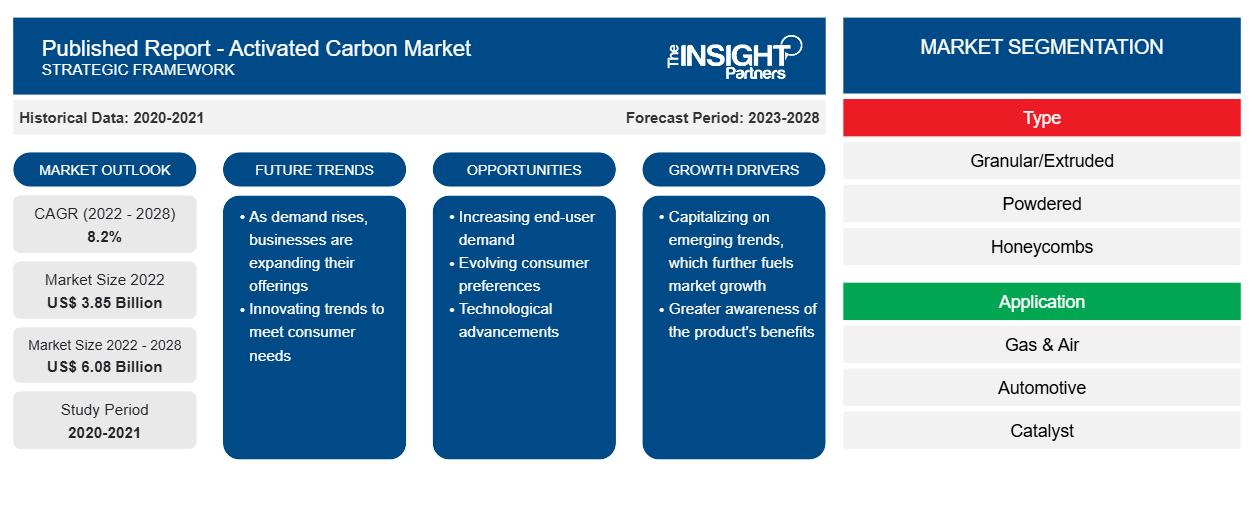
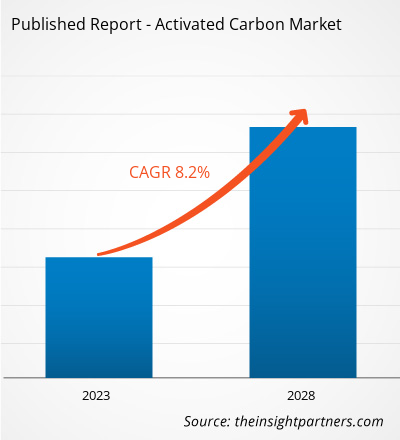
[Research Report] The activated carbon market size is expected to grow from US$ 3,845.46 million in 2022 to US$ 6,081.05 million by 2028; it is estimated to record a CAGR of 8.2% from 2023 to 2028.
Market Insights and Analyst View:
Activated carbon is defined as microporous carbonaceous material derived from coal, peat, bituminous, lignite, peat, wood, or coconut shell, among others, through two stage chemical activation process. It is manufactured in distinct forms to serve specific applications of various end use industries such as air & gas purification, wastewater treatment, chemicals, and food & beverages, among others. The available forms of activated carbon include powder, pellets, extrudates, granules, honeycomb-structure, impregnated, and reactivated. Granular form of activated carbons are widely used in water treatment plants, whereas powdered activated carbon is utilized in food & beverage industry for various applications such as purification and refining. The high adsorptive capacities of activated carbon makes it suitable option for extraction gold from gold-cyanide mixture.
Growth Drivers and Challenges:
Many countries in the world are adopting a circular economy for sustainability. Urban wastewater treatment plants that integrate resource recovery and energy production processes with clean water production contribute significantly to the sustainable development of any country. Over the past two decades, the demand for wastewater treatment has increased due to the trend of recovering water from energy generation processes. A report published by the United Nations Department of Economic and Social Affairs in 2022 sheds light on the rising interdependency of water and energy generation, with the increasing demand for each of these resources in many regions due to factors such as growing population and climate change. According to the current policies scenario of the International Energy Agency, energy consumption is projected to increase by 50% by 2035, in turn, boosting water consumption of the energy sector by 85%. According to the United Nations World Water Development Report (2018), global water demand is projected to rise by ~33% by 2050. Therefore, governments worldwide are taking initiatives for encouraging the adoption of sustainable solutions to ensure water security worldwide. Governments of the US, Germany Thailand, the Philippines, China, and India have commenced programs and initiatives to support wastewater treatment and circular economy through statutory or legislative authorities. Different government policies and initiatives to promote wastewater management are projected to drive the activated carbon market growth, as this material is widely used in the tertiary stage of wastewater treatment. However, the frequent price fluctuations in primary raw material of activated carbon is expected to restrain the market. Coal based activated carbon is one of the most commonly used type of activated carbon utilized in all end user industries. Coal is obtained through mining and then transported to consumers. The transportation costs add to the delivered price of coal. Most coal is transported in truck, barge, train, or combination of all these modes. All the transportation modes use diesel fuel which is subject to prices changes. Increase in diesel and oil fuel prices significantly affects the transportation cost, subsequently leading to a change in cost of coal.
Customize This Report To Suit Your Requirement
Get FREE CUSTOMIZATIONPublished Report - Activated Carbon Market: Strategic Insights
-
Get Top Key Market Trends of this report.This FREE sample will include data analysis, ranging from market trends to estimates and forecasts.
Report Segmentation and Scope:
The “Global Activated Carbon Market” is segmented based on type, application, and geography. Based on type, the activated carbon market is segmented into granular/extruded, powdered, honeycombs, impregnated, and reactivated. The activated carbon market is segmented based on application, into gas & air, automotive, catalyst, chemicals, food & beverage, mining, pharmaceuticals, water treatment, and others. The activated carbon market based on geography is segmented into North America (US, Canada, and Mexico), Western Europe (Germany, France, Italy, UK, Spain, Belgium, Netherlands, and Rest of Western Europe), Eastern Europe (Russia, Poland, and the Rest of Eastern Europe), Asia Pacific (Australia, China, Japan, India, South Korea, Vietnam, Pakistan, Indonesia, Taiwan, and Rest of Asia Pacific), Middle East & Africa (Turkey, Saudi Arabia, and Rest of Middle East & Africa), and South & Central America (Brazil and Rest of South & Central America).
Segmental Analysis:
Based on type, the activated carbon market is segmented into granular/extruded, powdered, honeycombs, impregnated, and reactivated. The powdered segment held the significant share in the activated carbon market and is expected to register the significant growth during 2023 to 2028. Powdered activated carbon is carbonaceous microporous material consisting of a high specific surface area compared to other forms of activated carbon, thereby increasing its adsorption capacity. The mass transfer and filterability of powdered activated carbon is associated with its particle size and size distribution. The benefits of powdered activated carbon utilization are that it offers timely, optimized, and efficient dosage.
Regional Analysis:
Based on geography, the activated carbon market is divided into key regions: North America, Western Europe, Eastern Europe, Asia Pacific, South & Central America, and Middle East & Africa. The global activated carbon market was dominated by Asia Pacific which accounted for near about US$ 1,481 Million in 2021. Western Europe is a one of the major contributor in the global activated carbon market. North America is expected to register the considerable growth at a CAGR of over 9% during 2023 to 2028. According to the US Environmental Protection Agency, the majority of households and industries direct wastewater toward a treatment plant. Wastewater contains nitrogen and phosphorus from human waste, food, and certain soaps and detergents. Hence, the growing concern for environmental protection and rising need for safe water are driving the demand for various wastewater treatment plants and products in the country, which is boosting the market for activated carbon. According to the report published in 2022, Orange Water and Sewer Authority increased the use of powdered activated carbon at the treatment plant to help eliminate undesirable odor. Activated carbon is extensively used in filtration systems of wastewater treatment plants as well as purification & clarification of food & beverage products. The growing concern about water pollution and untreated wastewater in the country is driving the market for activated carbon.
Industry Developments and Future Opportunities:
Various initiatives taken by the key players operating in the activated carbon market are listed below:
- In February 2021, Ingevity Corporation expanded its activated carbon production capacity following significant debottlenecking and equipment upgrades completed and verified at its facility in Zhuhai, China.
- In June 2020, Calgon Carbon Corporation announced that it intends to expand capacity at its Pearlington, Mississippi plant by adding a second virgin activated carbon production line.
- In January 2021, Tantech Holdings Ltd launched Variety Combination Honeycomb Activated Carbon, an innovative new activated carbon product. Tantech's Variety Combination Honeycomb Activated Carbon product is a new type of environmentally friendly activated carbon (exhaust gas purification product), which can effectively reduce odors and pollutants, including the adsorption of formaldehyde and benzene, and industrial gas purification to reach the national first-level exhaust gas emission standard.
Covid-19 Impact:
The COVID-19 pandemic affected almost all industries in various countries. Lockdowns, travel restrictions, and business shutdowns in North America, Europe, Asia Pacific (APAC), South & Central America (SAM), and the Middle East & Africa (MEA) hampered the growth of several industries, including the chemicals and materials industry. The shutdown of manufacturing units disturbed global supply chains, manufacturing activities, delivery schedules, and essential and nonessential product sales. Various companies witnessed delays in product deliveries and a slump in sales of their products in 2020. The ongoing pandemic has drastically altered the chemicals & materials sector's status and negatively impacted the activated carbon market growth in Europe. The implementation of measures to combat the spread of the virus has aggravated the situation and has impacted the growth of several industrial sectors. Industries such as automotive, chemical, food and beverages have been impacted by operational efficiencies and disruptions in the value chains due to the sudden closure of national and international boundaries. The significant decline in the growth of several industrial sectors has impacted the demand for activated carbon in the global market. Various industries have faced supply chain disruption due to the COVID-19 pandemic. The demand for activated carbon has been negatively affected due to the total shutdown of manufacturing activities. However, the demand for pharmaceuticals products such as medicines increased during the lockdown to prevent the affect of virus. This factor helped the activated carbon market size to grow.
However, as the economies have revived their operations, the demand for activated carbon is expected to rise globally. The demand for activated carbon has started rising with the resumption of operations in the automotive, food and beverages, along with restarting manufacturing activities and lifting lockdown measures globally. The increase in demand for activated carbon in various applications, such as water treatment, food and beverages, pharmaceuticals, and automotive, and significant investments by prominent manufacturers are expected to drive the activated carbon market growth in the coming years.
Activated Carbon
Published Report - Activated Carbon Market Report Scope
| Report Attribute | Details |
|---|---|
| Market size in 2022 | US$ 3.85 Billion |
| Market Size by 2028 | US$ 6.08 Billion |
| Global CAGR (2022 - 2028) | 8.2% |
| Historical Data | 2020-2021 |
| Forecast period | 2023-2028 |
| Segments Covered |
By Type
|
| Regions and Countries Covered |
North America
|
| Market leaders and key company profiles |
|
Published Report - Activated Carbon Market Players Density: Understanding Its Impact on Business Dynamics
The Published Report - Activated Carbon Market is growing rapidly, driven by increasing end-user demand due to factors such as evolving consumer preferences, technological advancements, and greater awareness of the product's benefits. As demand rises, businesses are expanding their offerings, innovating to meet consumer needs, and capitalizing on emerging trends, which further fuels market growth.
Competitive Landscape and Key Companies:
A few of the players operating in the global activated carbon market include Osaka Gas Co Ltd, Haycarb PLC, Kureha Corp, Donau Chemie AG, Activated Carbon Technologies Pty Ltd, Albemarle Corp, CPL Activated Carbons, James Cumming and Sons Pty Ltd, Ingevity Corp, and Norit Nederland BV. Global activated carbon manufacturers focus on providing high-quality products to fulfill the customer demand.
Frequently Asked Questions

- Historical Analysis (2 Years), Base Year, Forecast (7 Years) with CAGR
- PEST and SWOT Analysis
- Market Size Value / Volume - Global, Regional, Country
- Industry and Competitive Landscape
- Excel Dataset
Recent Reports
Testimonials

The Insight Partners' SCADA System Market report is comprehensive, with valuable insights on current trends and future forecasts. The team was highly professional, responsive, and supportive throughout. We are very satisfied and highly recommend their services.
RAN KEDEM Partner, Reali Technologies LTDs
I requested a report on a very specific software market and the team produced the report in a few days. The information was very relevant and well presented. I then requested some changes and additions to the report. The team was again very responsive and I got the final report in less than a week.
JEAN-HERVE JENN Chairman, Future Analytica
We worked with The Insight Partners for an important market study and forecast. They gave us clear insights into opportunities and risks, which helped shape our plans. Their research was easy to use and based on solid data. It helped us make smart, confident decisions. We highly recommend them.
PIYUSH NAGPAL Sr. Vice President, High Beam Global
The Insight Partners delivered insightful, well-structured market research with strong domain expertise. Their team was professional and responsive throughout. The user-friendly website made accessing industry reports seamless. We highly recommend them for reliable, high-quality research services
YUKIHIKO ADACHI CEO, Deep Blue, LLC.
This is the first time I have purchased a market report from The Insight Partners.While I was unsure at first, I visited their web site and felt more comfortable to take the risk and purchase a market report.I am completely satisfied with the quality of the report and customer service. I had several questions and comments with the initial report, but after a couple of dialogs over email with their analyst I believe I have a report that I can use as input to our strategic planning process.Thank you so much for taking the extra time and making this a positive experience.I will definitely recommend your service to others and you will be my first call when we need further market data.
JOHN SUZUKI President and Chief Executive Officer, Board Director, BK Technologies
I wish to appreciate your support and the professionalism you displayed in the course of attending to my request for information regarding to infectious disease IVD market in Nigeria. I appreciate your patience, your guidance, and the fact that you were willing to offer a discount, which eventually made it possible for us to close a deal. I look forward to engaging The Insight Partners in the future, all thanks to the impression you have created in me as a result of this first encounter.
DR CHIJIOKE ONYIA MANAGING DIRECTOR, PineCrest Healthcare Ltd.Reason to Buy
- Informed Decision-Making
- Understanding Market Dynamics
- Competitive Analysis
- Identifying Emerging Markets
- Customer Insights
- Market Forecasts
- Risk Mitigation
- Boosting Operational Efficiency
- Strategic Planning
- Investment Justification
- Tracking Industry Innovations
- Aligning with Regulatory Trends
Unlock Exclusive Report Discounts
Enquire Now




 Get Free Sample For