
Electronic Data Interchange (EDI) Market Developments and Forecast by 2030
Coverage: By Component (Solution, Services), Type (Direct EDI, EDI via AS2, EDI via VAN, Mobile EDI, Web EDI, EDI Outsourcing, Others), Industry (BFSI, Retail & Consumer Goods, Healthcare, IT & Telecommunication, Transportation & Logistics, Others)
- Status : Published
- Report Code : TIPAR00006160
- Category : Technology, Media and Telecommunications
- No. of Pages : 200
- Available Report Formats :


- Last update date : September 14, 2023


2022 Market Size
US$ 27.93 Bn
Base year value
2030 Forecast
US$ 58.98 Bn
Projected by 2030
CAGR 2023-2030
9.8 %
Growth rate
Addressable Market
US$ 348.17 Bn
(2023-2030)
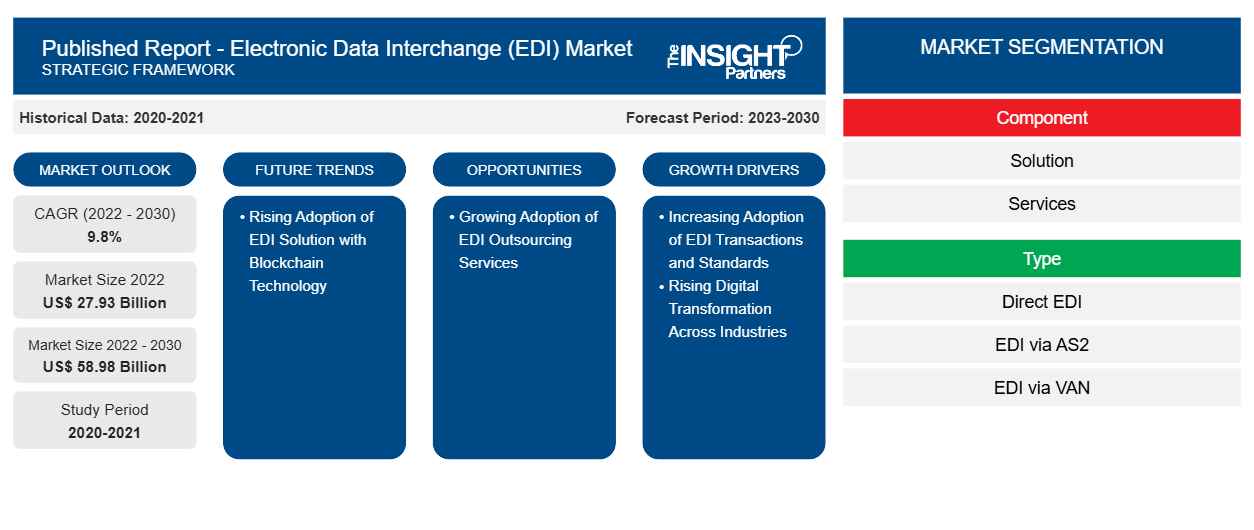
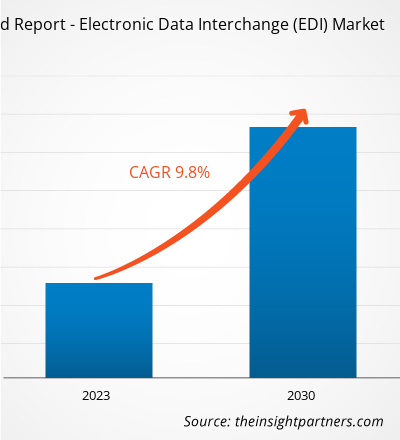
[Research Report] The electronic data interchange (EDI) market is expected to grow from US$ 27.93 billion in 2022 to US$ 58.98 billion by 2030; it is estimated to register a CAGR of 9.8% from 2022 to 2030.
Electronic Data Interchange (EDI) Market Analyst Perspective:
The rising digital transformation and acceptance of EDI solutions for data transaction trends across industries, rising EDI-related compliance requirements, and favorable government initiatives to boost EDI solution adoption are some of the critical factors driving the growth of the EDI market. However, there are a few issues/concerns related to EDI solutions, which may restrain frequent adoption of these solutions in the coming years. Despite some limitations, the growing demand for cloud-based solutions and the adoption of advanced technologies such as blockchain are anticipated to fuel the electronic data interchange (EDI) market growth during the forecast period.
The EDI system helps to reduce data entry needs and maximize strategic, scalable, sustainable communication with trading partners. In August 2016, PLEXIS Healthcare Systems launched an Ignite EDI system. The Ignite EDI system simplifies electronic data management to reduce data entry needs and maximize strategic, scalable, sustainable communication with trading partners. The Ignite EDI hub is powered by four smart, foundational building blocks: the EDI gateway, portal technologies, the Atlas engine, and EDI exploration services.
For instance, some common materials that are interchanged with the help of EDI are Electronic Data Interchange (EDI) Market Overview:
Electronic data interchange (EDI) is a process of transaction of business documents, basically standard electronic format between the organization and trade partners invoices, purchase orders, and advance ship notices. But there are several other documents, such as customs, payment, inventory, bills of lading, and shipping status documents. EDI empowers organizations to regulate the exchange of data between supply chain applications. EDI helps the organization and guarantees the business-critical data to be sent on time. The EDI replaced traditional business communication with mail preparation and handling automatically. However, it helps the organizations to standardize the information interchanged via business documents, which makes it a paperless exchange. The EDI solutions permit organizations to enhance the overall workflow performance, a significant factor driving the global EDI market during the forecast period. The fast and accurate processing of EDI documents leads to less repeated work, fewer canceled orders, and fewer stock-outs.
● REPORT CUSTOMIZATION
Tailor This Report To Align With Your Specific Business Requirements
This report can be customized to align precisely with your business objectives, scope, and target markets. Customization options include tailored segmentation, geography, competitive analysis, and strategic insights to support informed decision-making.
Customize This Report →WHAT YOU CAN ADJUST
- ● Segmentations
- ● Geography
- ● Competitive Analysis
- ● Language Preferences
Published Report - Electronic Data Interchange (EDI) Market: Strategic Insights
-
Get Top Key Market Trends of this report.This FREE sample will include data analysis, ranging from market trends to estimates and forecasts.
Electronic Data Interchange (EDI) Market Driver:
Rising Digital Transformation Across Industries Fuel Growth of Electronic Data Interchange (EDI) Market
Large and small enterprises are continuously investing in cloud computing, EDI solutions, web apps, artificial intelligence, predictive analytics, the Internet of Things, and big data, as digital technologies are constantly transforming industries across the globe and revolutionizing business processes by improving operational efficiency at reduced costs. The rising adoption of cloud computing is one of the substantial factors for deploying EDI technology and service consumption models. Organizations are diverting their focus on applications, data, connections, and cloud integration, including EDI. Although cloud computing has grown exponentially, there is a shortage of well-trained IT professionals. Process automation and digital transformation can create unparalleled opportunities for businesses to create more value and increase revenue. Invoicing is a considerable function in all business segments, including B2B and B2C, which require a substantial cost, time, and workforce. Along with paper-based invoices, a large number of e-invoices are generated daily, thereby reducing the overall productivity cost of the business. The rising adoption of e-invoicing helps businesses save substantial costs associated with invoicing generation and transmission to end customers.
Automating the invoicing process through e-invoicing offers several strategic and operational benefits to buyers, suppliers, and managers. A few advantages of EDI solutions include reduced costs, increased accuracy, faster payments, improved cash management, enhanced productivity, environmental benefits, and improved compliance. Thus, the rising adoption of innovative and digitalized solutions, such as EDI, drives global electronic data interchange (EDI) market growth.
Shippers communicate with ship carriers and other transportation-related stakeholders through EDI technology. Instead of physically inputting information onto paper forms, shipping businesses may transfer information electronically through EDI. EDI also benefits organizations in terms of time and money savings. By utilizing EDI, shippers may automate billing, tracking shipments, and payment collection. EDI can also maintain inventories and handle client orders in the shipping sector. By removing mistakes and decreasing human data entry, EDI helps processes run more smoothly. Since there is less need for human interaction, processing paperwork takes less time. Various countries are deploying the EDI in their shipping port. For instance, in December 2021, Japan provided US$ 12.2 million to construct a Port EDI system in Cambodia to speed up administrative and business work at all ports. According to Heang Sotheayuth, IT specialist at the Ministry of Public Works, the EDI on the shipping port will help to ease legal procedures for cargo ships at all ports in Japan. Such development propels the electronic data interchange (EDI) market growth in the shipping industry.
Report Segmentation and Scope:
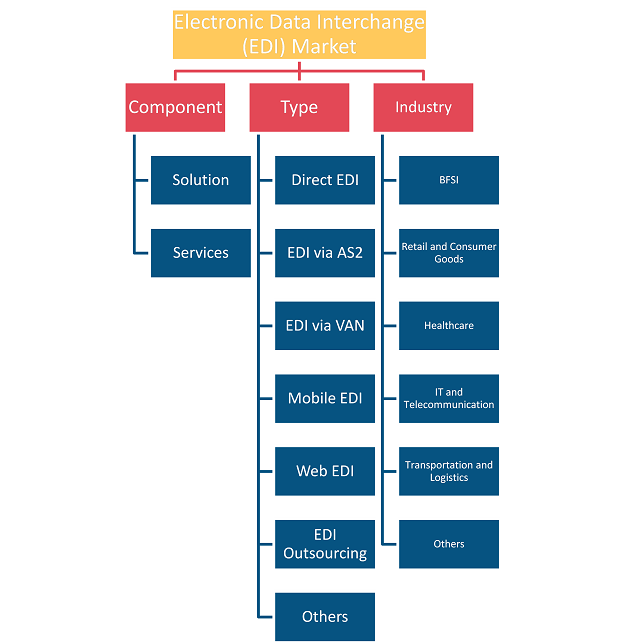
The electronic data interchange (EDI) market is segmented based on component, type, industry, and geography. Based on component, the electronic data interchange (EDI) market is bifurcated into solutions and services. Based on type, the electronic data interchange (EDI) market is segmented into direct EDI, EDI via AS2, EDI via VAN, mobile EDI, web EDI, EDI outsourcing, and others. Based on industry, the electronic data interchange (EDI) market is divided into BFSI, Retail & Consumer Goods, Healthcare, IT & Telecommunication, Transportation & Logistics, and Others. Geographically, the electronic data interchange (EDI) market is segmented into North America, Europe, Asia Pacific (APAC), the Middle East & Africa (MEA), and South America (SAM).
- This FREE sample will include data analysis, ranging from market trends to estimates and forecasts.
Electronic Data Interchange (EDI) Market Segmental Analysis:
Based on component, the electronic data interchange (EDI) market is bifurcated into:
- Solution
- Services
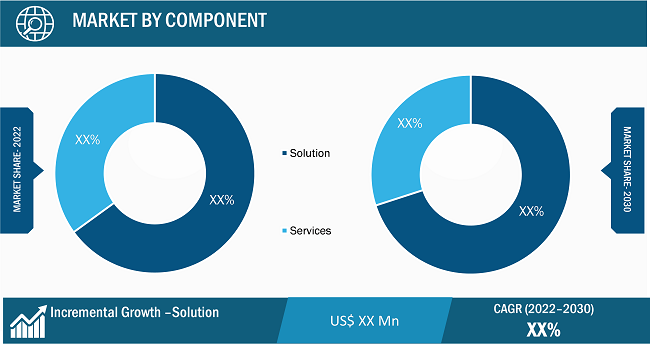
The solution segment held a larger electronic data interchange (EDI) market share in 2022 and is anticipated to register a higher CAGR in the market during 2022–2030. These solutions can meet the growing needs of its clients, exceptional borders, and technical specifications, restructuring the receiving and sending of commercial transactions for all kinds of businesses. These solutions are deployed in a broad range of large and small to mid-sized enterprises for interchanging commercial documents between businesses in a multitude of sectors across the globe.
- This FREE sample will include data analysis, ranging from market trends to estimates and forecasts.
Electronic Data Interchange (EDI) Market Regional Analysis:
The electronic data interchange (EDI) market is broadly segmented into five major regions—North America, Europe, Asia Pacific (APAC), the Middle East & Africa (MEA), and South & Central America (SAM). North America holds the largest electronic data interchange (EDI) market share owing to the widespread penetration of electronic data interchange (EDI) transaction mandates across organizations in countries such as the US, Canada, and Mexico. North America is one of the most advanced regions in terms of implementation and adoption of EDI solutions.
In North America, various EDI system providers are expanding their businesses. In October 2019, Epicor Software Corporation acquired 1 EDI Source Inc., a leading EDI solutions and business visibility software provider. Adding 1 EDI Source to the Epicor Software Corporation product portfolio provides a single comprehensive EDI platform, allowing customers to choose the best option to fit their business needs. Business expansion strategies propel the adoption of EDI systems in the region.
Key Player Analysis:
Mulesoft, LLC; SPS Commerce, Inc.; TrueCommerce Inc.; IBM Corporation; Cleo; The Descartes Systems Group Inc.; Data Masons Software LLC; crossinx GmbH; EDICOM; Comarch SA; and InterTrade Systems, Inc. are the key electronic data interchange (EDI) market players profiled in the report.
Recent Developments:
The electronic data interchange (EDI) market players highly adopt inorganic and organic strategies. A few recent key market developments are listed below:
- In 2022, Cleo announced deeper integrations between the Cleo Integration Cloud (CIC) platform and Microsoft Dynamics 365 ERP. The Cleo solution enables organizations to connect their Dynamics 365 Supply chain solutions through the X12 EDI integration. It will allow an organization to reduce the complexity of supporting their EDI network and seamlessly integrate it into their Dynamics application.
- In 2020, Data Communications Solutions (DCS) and Cleo partnered to help enterprises remodel their B2B steps by focusing on EDI and API integration, majorly for ERP systems.
- In 2020, Data Mason announced the expansion of its EDI cloud Strategy. This expansion benefits organizations with compliant and quick EDI implementation, accelerated digital transformation, and lower deployment costs.
Published Report - Electronic Data Interchange (EDI) Market Report Scope
| Report Attribute | Details |
|---|---|
| Market size in 2022 | US$ 27.93 Billion |
| Market Size by 2030 | US$ 58.98 Billion |
| Global CAGR (2022 - 2030) | 9.8% |
| Historical Data | 2020-2021 |
| Forecast period | 2023-2030 |
| Segments Covered |
By Component
|
| Regions and Countries Covered |
North America
|
| Market leaders and key company profiles |
|
Published Report - Electronic Data Interchange (EDI) Market Players Density: Understanding Its Impact on Business Dynamics
The Published Report - Electronic Data Interchange (EDI) Market is growing rapidly, driven by increasing end-user demand due to factors such as evolving consumer preferences, technological advancements, and greater awareness of the product's benefits. As demand rises, businesses are expanding their offerings, innovating to meet consumer needs, and capitalizing on emerging trends, which further fuels market growth.
Frequently Asked Questions
2. Rising digital transformation across industries

- Comprehensive Market Sizing and Forecast Analysis
- Detailed Segmentation Analysis
- In-Depth Market Dynamics Assessment
- Regional and Country-Level Insights
- Competitive Landscape and Company Benchmarking
- Strategic Business Intelligence
Recent Reports
Testimonials

The Insight Partners' SCADA System Market report is comprehensive, with valuable insights on current trends and future forecasts. The team was highly professional, responsive, and supportive throughout. We are very satisfied and highly recommend their services.
RAN KEDEM Partner, Reali Technologies LTDs
I requested a report on a very specific software market and the team produced the report in a few days. The information was very relevant and well presented. I then requested some changes and additions to the report. The team was again very responsive and I got the final report in less than a week.
JEAN-HERVE JENN Chairman, Future Analytica
We worked with The Insight Partners for an important market study and forecast. They gave us clear insights into opportunities and risks, which helped shape our plans. Their research was easy to use and based on solid data. It helped us make smart, confident decisions. We highly recommend them.
PIYUSH NAGPAL Sr. Vice President, High Beam Global
The Insight Partners delivered insightful, well-structured market research with strong domain expertise. Their team was professional and responsive throughout. The user-friendly website made accessing industry reports seamless. We highly recommend them for reliable, high-quality research services
YUKIHIKO ADACHI CEO, Deep Blue, LLC.
This is the first time I have purchased a market report from The Insight Partners.While I was unsure at first, I visited their web site and felt more comfortable to take the risk and purchase a market report.I am completely satisfied with the quality of the report and customer service. I had several questions and comments with the initial report, but after a couple of dialogs over email with their analyst I believe I have a report that I can use as input to our strategic planning process.Thank you so much for taking the extra time and making this a positive experience.I will definitely recommend your service to others and you will be my first call when we need further market data.
JOHN SUZUKI President and Chief Executive Officer, Board Director, BK Technologies
I wish to appreciate your support and the professionalism you displayed in the course of attending to my request for information regarding to infectious disease IVD market in Nigeria. I appreciate your patience, your guidance, and the fact that you were willing to offer a discount, which eventually made it possible for us to close a deal. I look forward to engaging The Insight Partners in the future, all thanks to the impression you have created in me as a result of this first encounter.
DR CHIJIOKE ONYIA MANAGING DIRECTOR, PineCrest Healthcare Ltd.Reason to Buy
- Informed Decision-Making
- Understanding Market Dynamics
- Competitive Analysis
- Identifying Emerging Markets
- Customer Insights
- Market Forecasts
- Risk Mitigation
- Boosting Operational Efficiency
- Strategic Planning
- Investment Justification
- Tracking Industry Innovations
- Aligning with Regulatory Trends





 Get Free Sample for