
Medical Imaging Market Segments and Growth by 2028
Published Report - Medical Imaging Market Forecast to 2028 - COVID-19 Impact and Global Analysis By Product (CT Systems, X-ray Systems, PET Systems, MRI systems, Ultrasound Systems, Others); End User (Urgent Care Centers, OP Centers, Clinicians Offices, Emergency Care Centers), and Geography
- Status : Published
- Report Code : TIPAR100000883
- Category : Life Sciences
- No. of Pages : 166
- Available Report Formats :


- Last update date : June 12, 2024


2020 Market Size
US$ 23.9 Bn
Base year value
2028 Forecast
US$ 33 Bn
Projected by 2028
CAGR 2021-2028
4.3 %
Growth rate
Addressable Market
US$ 232.16 Bn
(2021-2028)
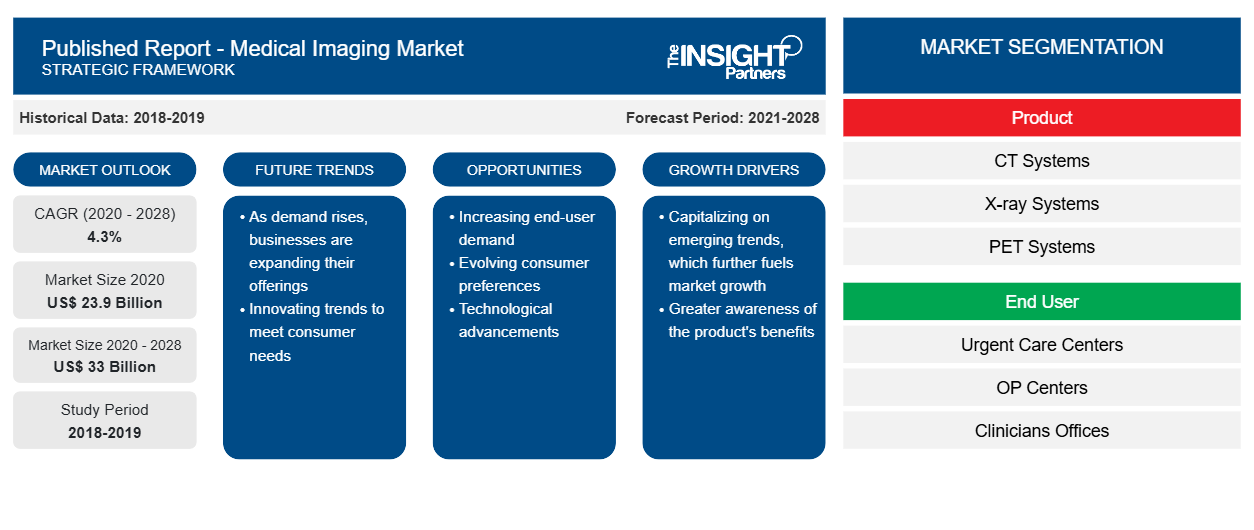
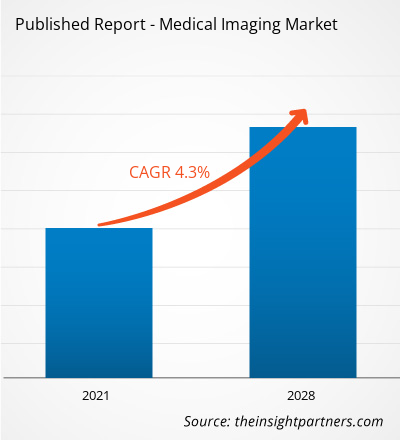
The medical imaging market was valued at US$ 23,901.88 million in 2020 and it is projected to reach US$ 33,002.52 million by 2028; it is expected to grow at a CAGR of 4.3% during 2021–2028.
Medical imaging refers to techniques and processes used to create images of various parts of the human body for diagnosis and treatment purposes within digital health. The term, medical imaging, includes various radiological imaging techniques such as X-ray radiography, fluoroscopy, magnetic resonance imaging (MRI), medical ultrasonography or ultrasound, endoscopy, elastography, tactile imaging, thermography, medical photography and nuclear medicine functional imaging techniques—e.g. positron emission tomography (PET). Medical imaging is crucial in every medical setting and at all levels of healthcare. The use of medical imaging helps physicians arrive at more accurate diagnoses and appropriate treatment decisions. Without medical imaging, both diagnosis and treatment in digital health can be very difficult to achieve with any level of accuracy. The factors such as the increasing demand for early disease diagnosis and widening scope of clinical applications, rapidly growing geriatric population and the subsequent increase in the prevalence of associated diseases, technological advancements in diagnostic imaging industry drive the growth of the medical imaging market.
Market Insights
Introduction Of Technologically Advanced Systems
Medical imaging is an integral part of the diagnostic process. From ultrasounds to MRIs and CT scans, radiologists utilize medical imaging to properly diagnose and treat diseases. Also, doctors use medical imaging technologies to determine if a particular therapy has been effective in patient’s treatment method.
● REPORT CUSTOMIZATION
Tailor This Report To Align With Your Specific Business Requirements
This report can be customized to align precisely with your business objectives, scope, and target markets. Customization options include tailored segmentation, geography, competitive analysis, and strategic insights to support informed decision-making.
Customize This Report →WHAT YOU CAN ADJUST
- ● Segmentations
- ● Geography
- ● Competitive Analysis
- ● Language Preferences
Published Report - Medical Imaging Market: Strategic Insights
-
Get Top Key Market Trends of this report.This FREE sample will include data analysis, ranging from market trends to estimates and forecasts.
Over the past couple of decades, the capabilities of medical imaging have radially increased. There have been numerous advancements in medical imaging technology owing to essential research and technological evolution. This progress is crucial in providing accurate diagnoses and improving patient care. These advancements, along with the power of IT and digital technology, promotes greater procedural efficiency in the provision and execution of patient care. Artificial intelligence (AI) helps improve numerous aspects of the healthcare industry, and medical imaging technology is one of the fields that has benefited greatly. AI is being used to make advanced imaging devices, which can detect diseases earlier and guide diagnosis and early treatment.
In September 2018, Nvidia, a technology company, unveiled the Nvidia Clara platform, which is a combination of software and hardware working together to bring AI to future medical instruments. The Clara software development kit will enable developers to apply a wide range of AI-powered applications to existing medical imaging equipment. On February 20, 2018, Aidoc, a deep learning start-up, revealed what it referred to as the world’s first comprehensive full body technology that can use AI to analyze computed tomography (CT) scans. Aidoc’s AI-powered medical imaging technology can highlight any abnormal findings on a patient’s medical scan, which can be further reviewed by radiologists. The AI solution aims to offer support to radiologists focusing on body parts such as the chest, abdomen, spine, and head. The company received the CE mark for this technology last year, which made it accessible to medical institutions across Europe. Google’s DeepMind developed an AI system that can quickly detect over 50 eye disorders using routine medical scans. GE Healthcare introduced a new medical imaging tech in March in the form of the LOGIQ E10 radiology ultrasound system, which is integrated by AI to quickly capture data and reconstruct images. The digital system employs closed connectivity and advanced algorithms to ensure 48 times more data throughput and 10 times the processing power of previous systems. Further, in Jan 2021 Carestream Health earned 70 new patents in medical imaging for advances in digital radiography, mobile imaging X-ray systems, and other healthcare technology areas. A total of 27 patents were awarded by the US Patent and Trademark Office; an additional 43 patents were received in European and Asian countries.
Product-Based Insights
Based on product, the medical imaging market is categorized into CT systems, X-ray systems, PET systems, MRI systems, ultrasound systems, and others. The X-ray segment held the largest share of the market in 2020 and is also anticipated to register the highest CAGR in the market during the forecast period.
End User-Based Insights
Based on end user, the medical imaging market is segmented into hospitals, OP centers, clinicians’ offices, and emergency care centers. The hospitals segment held the largest share of the market in 2020 and is also estimated to register the highest CAGR in the market during the forecast period.
Various companies operating in the medical imaging market adopt strategies such as product launches, mergers and acquisitions, collaborations, product innovations, and product portfolio expansions to expand their footprint worldwide, maintain brand name, and meet the growing demand from end users.
Medical Imaging
Published Report - Medical Imaging Market Report Scope
| Report Attribute | Details |
|---|---|
| Market size in 2020 | US$ 23.9 Billion |
| Market Size by 2028 | US$ 33 Billion |
| Global CAGR (2020 - 2028) | 4.3% |
| Historical Data | 2018-2019 |
| Forecast period | 2021-2028 |
| Segments Covered |
By Product
|
| Regions and Countries Covered |
North America
|
| Market leaders and key company profiles |
|
Published Report - Medical Imaging Market Players Density: Understanding Its Impact on Business Dynamics
The Published Report - Medical Imaging Market is growing rapidly, driven by increasing end-user demand due to factors such as evolving consumer preferences, technological advancements, and greater awareness of the product's benefits. As demand rises, businesses are expanding their offerings, innovating to meet consumer needs, and capitalizing on emerging trends, which further fuels market growth.
Medical Imaging Market – by Product
- CT Systems
- X-ray Systems
- PET Systems
- MRI Systems
- Ultrasound Systems
- Others
Medical Imaging Market – by End User
- Urgent Care Centres
- OP Centres
- Clinicians’ Offices
- Emergency Care Centres
Medical Imaging Market – by Geography
-
North America
- US
- Canada
- Mexico
-
Europe
- France
- Germany
- Italy
- UK
- Spain
- Rest of Europe
-
Asia Pacific (APAC)
- China
- India
- South Korea
- Japan
- Australia
- Rest of Asia Pacific
-
Middle East & Africa (MEA)
- South Africa
- Saudi Arabia
- UAE
- Rest of Middle East & Africa
-
South America (SAM)
- Brazil
- Argentina
- Rest of South and Central America
Company Profiles
- General Electric Company
- Siemens AG
- Koninklijke Philips N.V.
- SHIMADZU CORPORATION
- Hitachi, Ltd.
- Canon Inc.
- Hologic, Inc.
- Carestream Health Inc.
- ESAOTE SPA
- Samsung Group
Frequently Asked Questions
The Asia Pacific region is expected to account for the fastest growth in the medical imaging market. An increasing awareness among the population for early diagnosis is anticipated to drive Asia Pacific medical imaging market during the forecast period.

- Comprehensive Market Sizing and Forecast Analysis
- Detailed Segmentation Analysis
- In-Depth Market Dynamics Assessment
- Regional and Country-Level Insights
- Competitive Landscape and Company Benchmarking
- Strategic Business Intelligence
Recent Reports
Testimonials

The Insight Partners' SCADA System Market report is comprehensive, with valuable insights on current trends and future forecasts. The team was highly professional, responsive, and supportive throughout. We are very satisfied and highly recommend their services.
RAN KEDEM Partner, Reali Technologies LTDs
I requested a report on a very specific software market and the team produced the report in a few days. The information was very relevant and well presented. I then requested some changes and additions to the report. The team was again very responsive and I got the final report in less than a week.
JEAN-HERVE JENN Chairman, Future Analytica
We worked with The Insight Partners for an important market study and forecast. They gave us clear insights into opportunities and risks, which helped shape our plans. Their research was easy to use and based on solid data. It helped us make smart, confident decisions. We highly recommend them.
PIYUSH NAGPAL Sr. Vice President, High Beam Global
The Insight Partners delivered insightful, well-structured market research with strong domain expertise. Their team was professional and responsive throughout. The user-friendly website made accessing industry reports seamless. We highly recommend them for reliable, high-quality research services
YUKIHIKO ADACHI CEO, Deep Blue, LLC.
This is the first time I have purchased a market report from The Insight Partners.While I was unsure at first, I visited their web site and felt more comfortable to take the risk and purchase a market report.I am completely satisfied with the quality of the report and customer service. I had several questions and comments with the initial report, but after a couple of dialogs over email with their analyst I believe I have a report that I can use as input to our strategic planning process.Thank you so much for taking the extra time and making this a positive experience.I will definitely recommend your service to others and you will be my first call when we need further market data.
JOHN SUZUKI President and Chief Executive Officer, Board Director, BK Technologies
I wish to appreciate your support and the professionalism you displayed in the course of attending to my request for information regarding to infectious disease IVD market in Nigeria. I appreciate your patience, your guidance, and the fact that you were willing to offer a discount, which eventually made it possible for us to close a deal. I look forward to engaging The Insight Partners in the future, all thanks to the impression you have created in me as a result of this first encounter.
DR CHIJIOKE ONYIA MANAGING DIRECTOR, PineCrest Healthcare Ltd.Reason to Buy
- Informed Decision-Making
- Understanding Market Dynamics
- Competitive Analysis
- Identifying Emerging Markets
- Customer Insights
- Market Forecasts
- Risk Mitigation
- Boosting Operational Efficiency
- Strategic Planning
- Investment Justification
- Tracking Industry Innovations
- Aligning with Regulatory Trends





 Get Free Sample for